Chapter 19 · Organic Chemistry · 4 questions in the paper · 27 min read
Aldehydes, Ketones, Carboxylic Acids and their Derivatives
What the syllabus asks for 3
- Aliphatic aldehydes and ketones: nomenclature, preparation and reactions; benzaldehyde
- Monocarboxylic acids: preparation and properties
- Acid halides, anhydrides, amides and esters: preparation, properties and relative reactivity
The carbonyl group is organic chemistry's busiest crossroads, and this chapter is worth about 4 questions. One polarized C=O explains why aldehydes and ketones accept nucleophiles, why only some carbonyl compounds reduce Tollens' reagent, why α-hydrogens open the aldol pathway, and why replacing –OH of a carboxylic acid by Cl, OCOR, OR or NH₂ creates a ladder of derivative reactivity. Keep asking: is the carbonyl carbon being attacked, is the α-carbon forming an enolate, or is a group leaving from an acyl carbon?
- Aldehydes (R–CHO, suffix -al, carbonyl carbon is C-1) and ketones (R–CO–R′, suffix -one) share CₙH₂ₙO for saturated acyclic members and are functional isomers. The carbonyl carbon is sp², planar and electrophilic (Cδ+).
- Prepare aldehydes by controlled oxidation of 1° alcohols, Rosenmund reduction of RCOCl (H₂/Pd–BaSO₄, poisoned), Stephen reduction of nitriles (SnCl₂/HCl then hydrolysis) and ozonolysis. Prepare ketones by oxidation of 2° alcohols, alkyne hydration, Friedel–Crafts acylation (aryl ketones), RCOCl + organocadmium/Gilman reagent, nitrile + Grignard then hydrolysis, and dry distillation of calcium carboxylates.
- Nucleophilic additions: H₂ or hydride → alcohol; HCN → cyanohydrin; NaHSO₃ → crystalline bisulfite adducts (aldehydes and most methyl ketones); Grignard → alcohol after workup; ammonia derivatives (hydroxylamine, hydrazine, phenylhydrazine, 2,4-DNP) → crystalline C=N derivatives with loss of water.
- Aldehydes are more reactive than ketones (less steric crowding, one rather than two electron-donating alkyl groups). Tollens gives a silver mirror; Fehling gives red Cu₂O with most aliphatic aldehydes but not benzaldehyde; ketones resist these mild oxidants. 2,4-DNP detects aldehydes and ketones. Schiff's reagent is restored to magenta by aldehydes.
- Carbonyl compounds with α-H undergo base-catalysed aldol addition (then dehydration on heating). Aldehydes with no α-H undergo Cannizzaro disproportionation in concentrated alkali. Methyl ketones (and CH₃CH(OH)– alcohols/ethanal) give yellow iodoform with I₂/NaOH.
- Clemmensen (Zn–Hg/conc. HCl, acidic) and Wolff–Kishner (NH₂NH₂/KOH, heat, basic) both reduce C=O all the way to CH₂; choose by acid/base sensitivity. PCl₅ converts C=O to a gem-dichloride.
- Benzaldehyde: Etard oxidation of toluene or Gattermann–Koch formylation; Tollens positive, Fehling negative, no α-H; Cannizzaro, benzoin condensation (KCN/EtOH), Perkin condensation to cinnamic acid and easy air oxidation to benzoic acid.
- Carboxylic acids are prepared by vigorous oxidation of 1° alcohols/aldehydes, hydrolysis of nitriles/esters/amides, Grignard + CO₂, haloform oxidation of methyl ketones, and side-chain oxidation of alkylbenzenes to benzoic acid.
- Carboxylate resonance makes RCO₂H acidic (typical pKₐ 4–5) and gives CO₂ with NaHCO₃. –I groups strengthen the acid; alkyl donation weakens it slightly (HCOOH > CH₃COOH). Formic acid is also a reducing agent and is dehydrated by conc. H₂SO₄ to CO.
- Acid reactions: salts with bases/carbonates, Fischer esterification, SOCl₂ to acid chloride, LiAlH₄ to 1° alcohol, soda-lime decarboxylation, Kolbe electrolysis, and HVZ α-bromination with Br₂/red P (α-H required).
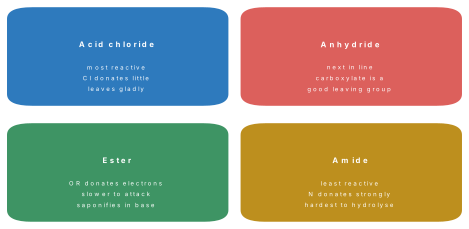
- Nucleophilic acyl substitution reactivity: acid chloride > anhydride > ester > amide. Poorer resonance donation into C=O and a weaker-base leaving group mean faster reaction. All ultimately hydrolyse to the carboxylic acid, amides most reluctantly.
- Derivative signatures: acid chloride as the universal acylating gateway; anhydride acylation (aspirin); ester alkaline hydrolysis = saponification; ester α-H + strong base = Claisen condensation; amide dehydration → nitrile, LiAlH₄ → amine with the same carbon count, Hofmann bromamide (Br₂/NaOH) → primary amine with one carbon fewer.
19.1 Aliphatic aldehydes and ketones: nomenclature, preparation and reactions; benzaldehyde
The carbonyl group and names
In C=O, carbon and oxygen are sp² hybridized. The σ framework is planar with angles near 120°, while the π bond sits above and below that plane. Oxygen's electronegativity makes the carbon electron-poor. A nucleophile therefore attacks carbon, the π electrons move to oxygen, and the resulting tetrahedral alkoxide is protonated — the standard two-step script of carbonyl addition.
An aldehyde has at least one H on the carbonyl carbon and is terminal in a chain: CH₃CH₂CHO is propanal; HCHO is methanal (formaldehyde). A ketone has two carbon groups on C=O: CH₃COCH₂CH₃ is butan-2-one. Number a ketone to give C=O the lowest locant; in an aldehyde the –CHO carbon is automatically C-1 and needs no locant. Lower aldehydes/ketones are water-soluble carbonyl acceptors, but they cannot donate O–H hydrogen bonds, so their boiling points lie between ethers and alcohols of comparable mass.
Preparation map
| Target | Reliable preparations | Control point |
|---|---|---|
| Aldehyde from 1° alcohol | PCC or another controlled oxidant; Cu-catalysed dehydrogenation | Stop before RCO₂H; vigorous aqueous dichromate overshoots |
| Aldehyde from acyl chloride | Rosenmund: H₂, Pd/BaSO₄ poisoned with sulfur/quinoline | Poisoned catalyst must not reduce RCHO to RCH₂OH |
| Aldehyde from nitrile | Stephen: SnCl₂/HCl, then hydrolysis of the iminium salt | Formal one-carbon retention from RCN |
| Aldehyde/ketone from alkene | Reductive ozonolysis | Each alkene carbon becomes a carbonyl carbon |
| Ketone from 2° alcohol | K₂Cr₂O₇/H⁺, PCC, Cu dehydrogenation | No aldehydic H, so no easy further oxidation |
| Ketone from alkyne | HgSO₄/H₂SO₄ hydration | Terminal alkyne gives a methyl ketone; ethyne gives ethanal |
| Aryl ketone | Friedel–Crafts acylation: arene + RCOCl/AlCl₃ | Installed acyl group deactivates the ring to a second acylation |
| Ketone from acyl chloride | R₂Cd or R₂CuLi | These softer organometallics stop where RMgX would add twice |
| Ketone from nitrile | RMgX, then acidic hydrolysis | The imine salt resists a second addition until workup |
| Simple symmetrical ketone | Dry-distil a calcium carboxylate: Ca(CH₃CO₂)₂ → CH₃COCH₃ + CaCO₃ | Mixed salts give mixed ketone products |
Addition reactions and carbonyl derivatives
Reduction with H₂/Ni, NaBH₄ or LiAlH₄ converts aldehydes to primary alcohols and ketones to secondary alcohols. Hydrogen cyanide (generated/used with great care because of toxicity) adds under base catalysis to a cyanohydrin, lengthening the carbon skeleton and opening routes to α-hydroxy acids. Concentrated aqueous NaHSO₃ gives crystalline α-hydroxy sulfonates with aldehydes and many methyl ketones; acid or alkali regenerates the carbonyl compound, so the adduct is both a test and a purification handle. Bulky diaryl or hindered ketones may fail for steric/equilibrium reasons.
Ammonia derivatives of the form H₂N–Z condense with C=O and lose water:
| Reagent H₂N–Z | Product name |
|---|---|
| Hydroxylamine (Z = OH) | Oxime |
| Hydrazine (Z = NH₂) | Hydrazone |
| Phenylhydrazine (Z = NHC₆H₅) | Phenylhydrazone |
| 2,4-Dinitrophenylhydrazine | 2,4-Dinitrophenylhydrazone — yellow/orange/red crystals |
| Semicarbazide | Semicarbazone |
The sharp melting points of these solids historically identified liquid carbonyl compounds. 2,4-DNP (Brady's reagent) therefore proves “a carbonyl”, not “an aldehyde”. Formaldehyde is anomalous with ammonia itself, condensing to cage-like hexamethylenetetramine (urotropine); with phenol under acid/base catalysis it polymerizes to Bakelite-type phenol–formaldehyde resin. Formalin is an approximately 37–40% aqueous formaldehyde solution, used as a disinfectant and biological preservative.
Oxidation tests that separate aldehydes from ketones
Tollens' reagent — ammoniacal silver nitrate, [Ag(NH₃)₂]⁺ — oxidizes an aldehyde to a carboxylate while Ag(I) is reduced to a silver mirror. Fehling's solution keeps Cu²⁺ in alkaline tartrate solution; many aliphatic aldehydes reduce it on warming to brick-red Cu₂O. Ketones lack an aldehydic C–H and would require C–C cleavage to oxidize, so they resist these mild reagents. α-Hydroxy ketones and reducing sugars can be exceptions in biochemical settings because base-catalysed isomerization creates oxidizable forms — do not transfer the school rule blindly to carbohydrates.
Formic acid also reduces Tollens/Fehling reagents because its structure, H–CO₂H, contains an aldehyde-like H on the carbonyl carbon. Schiff's reagent (decolourized magenta) regains a pink-violet colour with aldehydes. With PCl₅, carbonyl oxygen is replaced by two Cl atoms; with strong oxidants, ketones cleave to carboxylic acids of fewer carbons.
Reactions at the α-carbon: aldol, Cannizzaro and haloform
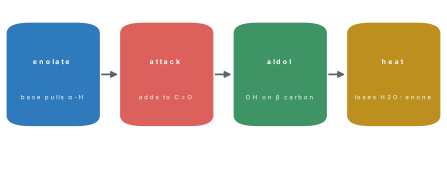
Hydrogens on the carbon adjacent to C=O are weakly acidic because removal gives a resonance- stabilized enolate. In dilute NaOH/KOH, the enolate of one molecule attacks the carbonyl carbon of another: aldol addition. Ethanal gives 3-hydroxybutanal (CH₃–CH(OH)–CH₂–CHO); heating dehydrates it to but-2-enal (crotonaldehyde), an α,β-unsaturated aldehyde stabilized by conjugation. Ketones react more sluggishly, and crossed aldols are cleanest when one partner has no α-H and acts only as the electrophile.
If an aldehyde has no α-hydrogen, concentrated KOH cannot divert it into enolate chemistry, so one molecule transfers hydride to another: Cannizzaro reaction. Formaldehyde gives methanol + potassium formate; benzaldehyde gives benzyl alcohol + potassium benzoate. It is a disproportionation — one molecule oxidized, one reduced.
A methyl group directly attached to C=O is exhaustively halogenated by I₂/NaOH, then cleaved: CH₃COCH₃ + 3I₂ + 4NaOH → CHI₃↓ + CH₃CO₂Na + 3NaI + 3H₂O. Yellow iodoform (m.p. about 119 °C, antiseptic smell) signals a CH₃CO– group or a CH₃CH(OH)– group that the reagent oxidizes to one; ethanal is the only aldehyde that responds.
Finally, deoxygenation C=O → CH₂ is achieved under either acidic Clemmensen conditions (Zn–Hg/conc. HCl) or basic Wolff–Kishner conditions (first form the hydrazone, then KOH in a high-boiling solvent with heat). The products match; compatibility with the rest of the molecule makes the choice.
Problem. A compound C₃H₆O gives an orange precipitate with 2,4-DNP and a silver mirror with Tollens' reagent, but no yellow precipitate with I₂/NaOH. Identify it.
Solution. DU = 1 and 2,4-DNP confirms an aldehyde or ketone. Tollens selects aldehyde. For C₃ the aldehyde is propanal, CH₃CH₂CHO. The rival propanone would fail Tollens and pass iodoform. Each test is allowed to veto one candidate — that is qualitative analysis done efficiently.
Benzaldehyde, C₆H₅CHO
Benzaldehyde is the bitter-almond oil aldehyde. It is prepared by Etard oxidation of toluene with chromyl chloride (CrO₂Cl₂) followed by hydrolysis; by side-chain chlorination of toluene to benzal chloride and hydrolysis; by Rosenmund reduction of benzoyl chloride; and by Gattermann–Koch formylation of benzene with CO/HCl over AlCl₃/CuCl.
Conjugation with the ring makes benzaldehyde less reactive toward nucleophiles than ethanal. It restores Schiff's colour and reduces Tollens' reagent but does not reduce Fehling's solution. Exposed to air it autoxidizes to benzoic acid. It has no α-H on the side chain, so concentrated KOH gives Cannizzaro products. With ethanolic KCN, two molecules undergo benzoin condensation: cyanide temporarily converts one aldehyde carbon into a nucleophilic equivalent, yielding benzoin, C₆H₅–CH(OH)–CO–C₆H₅. With acetic anhydride/sodium acetate it gives cinnamic acid (Perkin reaction); with acetone/dilute alkali it gives crossed-aldol (Claisen–Schmidt) enones. Ring substitution is slowed and meta-directed by –CHO.
Problem. The haloform cleavage of propanone runs CH₃COCH₃ + 3 I₂ + 4 NaOH → CHI₃ + CH₃COONa + 3 NaI + 3 H₂O. From 0.2 mol of propanone with excess reagents, how many moles of iodine are consumed and what mass of iodoform falls? (M of CHI₃ = 394 g/mol.) Solution. The equation taxes 3 mol I₂ per ketone: 0.2 mol ketone consumes 0.6 mol I₂ and yields 0.2 mol CHI₃, whose mass is 0.2 × 394 = 78.8 g of yellow precipitate — the balance confirms itself: 6 iodine atoms in, 3 in CHI₃ and 3 in NaI; sodium 4 in, 1 in the acetate and 3 in the iodide.
19.2 Monocarboxylic acids: preparation and properties
A carboxylic acid contains –CO₂H: a carbonyl and a hydroxyl on the same carbon. That carbon is C-1 in the suffix name (ethanoic acid), while common names persist for formic (methanoic), acetic (ethanoic), propionic and benzoic acids. Carboxylic acids dimerize through two hydrogen bonds in the vapour and in nonpolar solvents, raising boiling points; solubility in water is high for the first few members and then falls as the hydrocarbon part grows.
Preparation
- Oxidation: a primary alcohol or aldehyde with hot acidified K₂Cr₂O₇/KMnO₄ gives the acid.
- Nitrile hydrolysis: RX →(KCN) RCN →(H₃O⁺ or OH⁻, heat) RCO₂H; the product has one carbon more than RX, a favourite chain-extension sequence.
- Grignard carboxylation: RMgX + CO₂, then acid workup (also one carbon more).
- Derivative hydrolysis: esters, amides, anhydrides and acid chlorides all return the acid.
- Haloform reaction: a methyl ketone gives the carboxylate with one carbon fewer.
- Alkylbenzene oxidation: hot alkaline KMnO₄ oxidizes any side chain bearing a benzylic H all the way to benzoic acid; ethylbenzene and propylbenzene converge on the same product. tert-Butylbenzene, with no benzylic H, resists.
Acidity and reactions
Loss of H⁺ gives a carboxylate ion in which the negative charge is shared equally by two oxygens; both C–O bonds become equivalent. Electron-withdrawing substituents stabilize that anion and lower pKₐ (Ch. 16's chloroacetic acids), whereas electron-donating alkyl groups raise pKₐ modestly. Formic acid (pKₐ 3.75) is therefore stronger than acetic acid (4.76). Benzoic acid (pKₐ 4.20) is strengthened by the sp² ring carbon; ring substituents then tune it by the usual –I/+R logic, with ortho effects able to override simple predictions.
Sodium bicarbonate gives brisk CO₂ effervescence — the practical acid test that phenol fails. Metals and bases give salts. With an alcohol and acid catalyst, Fischer esterification reaches equilibrium; removing water or using excess alcohol drags it forward. SOCl₂ or PCl₅ converts –OH into the far more reactive acid chloride (§19.3). LiAlH₄ (or borane) reduces the acid to a primary alcohol; NaBH₄ is generally too mild. Soda lime decarboxylates the sodium salt to an alkane with one fewer carbon, and Kolbe electrolysis of a concentrated carboxylate couples two alkyl fragments with loss of CO₂.
The Hell–Volhard–Zelinsky (HVZ) reaction brominates the α-carbon with Br₂/red phosphorus. A trace of acyl bromide forms first and enolizes far more readily than the acid, so substitution lands specifically at α-C; an α-H is mandatory. α-Bromo acids are gateways to α-hydroxy and α-amino acids.
Methanoic (formic) acid is the family rebel. Because H–CO₂H still carries a formyl hydrogen, it reduces Tollens' and Fehling's reagents, turns HgCl₂ first white (Hg₂Cl₂) then grey (Hg), and decolourizes acidified KMnO₄, itself becoming CO₂. Concentrated H₂SO₄ dehydrates it neatly to CO + H₂O — the standard laboratory preparation of carbon monoxide in Ch. 13. Benzoic acid's ring, deactivated and meta-directed by –CO₂H, undergoes nitration and related substitutions mainly at the meta position.
19.3 Acid halides, anhydrides, amides and esters: preparation, properties and relative reactivity
Replace the –OH of RCO₂H and a family appears: RCOCl (acid/acyl chloride), (RCO)₂O (anhydride), RCO₂R′ (ester) and RCONH₂ (amide; N-substituted amides replace one or both N-hydrogens). A nucleophile still attacks the acyl carbon, but now the tetrahedral intermediate can expel a leaving group and restore C=O: nucleophilic acyl substitution. The observed order,
acid chloride > anhydride > ester > amide,
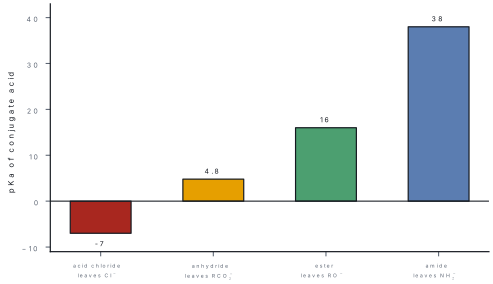
follows two reinforcing effects. The substituent donates its lone pair into C=O most strongly for nitrogen and least effectively for chlorine (poor 3p–2p overlap), so an amide carbonyl is least electrophilic. The leaving groups also become more basic across the series (Cl⁻, RCO₂⁻, RO⁻, NH₂⁻), and stronger bases leave more reluctantly. The pKₐ of each leaving group's conjugate acid compresses the point into one scale.
Preparation from the acid (and from one another)
- Acid chloride: RCO₂H + SOCl₂ (cleanest; SO₂/HCl gases escape), PCl₅ or PCl₃.
- Anhydride: heat the acid with P₂O₅, or react an acid chloride with a sodium carboxylate; suitable dicarboxylic acids cyclize on heating (Ch. 21's phthalic anhydride).
- Ester: Fischer esterification, or alcohol + acid chloride/anhydride when speed and yield matter. Diazomethane methylates acids to methyl esters almost quantitatively.
- Amide: acid chloride/anhydride/ester + NH₃ or an amine; heating an ammonium carboxylate; or carefully stopping nitrile hydrolysis at the amide stage.
Movement down the reactivity ladder is easy (an acid chloride will make the other three); movement up requires hydrolysis to the acid and reconversion, because an amide will not directly become an acid chloride under examination conditions.
Properties and signature reactions
Hydrolysis. Acid chlorides fume and react violently with water to the acid + HCl. Anhydrides hydrolyse on warming to two acid molecules. Acid-catalysed ester hydrolysis is the reverse of Fischer esterification, whereas NaOH hydrolysis (saponification) is driven to completion because the acid product is immediately trapped as carboxylate — the chemistry by which fats become soap plus glycerol. Amides need prolonged strong acid/alkali and heat; enzymes called proteases perform the same cleavage gently on peptide bonds.
Acid chlorides are acylation couriers: alcohols/phenols give esters, ammonia/amines give amides (Schotten–Baumann conditions in aqueous NaOH for benzoylation), arenes give ketones by Friedel–Crafts, Rosenmund reduction gives aldehydes, organocadmium/Gilman reagents stop at ketones, and LiAlH₄ reduces to the primary alcohol.
Anhydrides acylate similarly but waste one equivalent as carboxylic acid. Acetic anhydride converts salicylic acid to aspirin — perhaps the most medically important reaction in this section for a CEE candidate. Cyclic anhydrides open with alcohols/amines to half-esters and amic acids.
Esters are volatile, often fruity-smelling liquids. Besides hydrolysis, they undergo transesterification (exchange of the –OR group with another alcohol), reduction by LiAlH₄ to two alcohols (the acyl side becomes a primary alcohol), reaction with two equivalents of a Grignard reagent to a tertiary alcohol after workup, and Claisen condensation: an ester with α-H plus a strong base such as sodium ethoxide gives a β-ketoester (ethyl acetate → ethyl acetoacetate). The base must match the ester's alkoxy group to avoid transesterification scrambling — a detail examiners love.
Amides are high-melting, strongly hydrogen-bonded solids (except liquid formamide/DMF-type solvents); nitrogen's lone pair is busy conjugating with C=O, so amides are only feebly basic and the C–N bond has partial double-bond character (the planar peptide bond). They hydrolyse under forcing conditions, dehydrate with P₂O₅ to nitriles, and reduce with LiAlH₄ to amines with the carbonyl carbon retained as CH₂. A primary amide with Br₂/NaOH undergoes the Hofmann bromamide reaction: N-bromination, rearrangement to an isocyanate with loss of the carbonyl carbon's bond to nitrogen, then hydrolysis to a primary amine with one carbon fewer plus carbonate. Retention at the migrating group is a mechanistic jewel; the carbon count is the examination takeaway.
Problem. Outline conversions of ethanoic acid into (i) ethanamide and (ii) methylamine, checking the carbon count at each stage.
Solution. (i) CH₃CO₂H + SOCl₂ → CH₃COCl; then excess NH₃ → CH₃CONH₂ (two carbons throughout; each step moves down or across the reactivity ladder). (ii) Treat ethanamide with Br₂/NaOH: Hofmann rearrangement expels the carbonyl carbon as carbonate and yields CH₃NH₂ (one carbon). Trying to aminate ethanoic acid directly in one step, or expecting LiAlH₄ to give methylamine (it would give ethylamine), are the standard carbon-count errors.
Five traps the paper sets in this chapter: Tollen's answers for every aldehyde but Fehling's only for aliphatic ones — benzaldehyde mirrors silver yet leaves Fehling's blue; aldol needs an α-hydrogen and dilute base, Cannizzaro needs none and concentrated base; Clemmensen runs in strong acid, Wolff–Kishner in strong base, so each rescues the other's casualties; NaHCO₃ fizzes with carboxylic acids but not phenols, the cleanest family separation; and Rosenmund's poisoned catalyst stops at the aldehyde where LiAlH₄ would run on to the alcohol.
Formula and fact sheet
| Topic | Must-know |
|---|---|
| Carbonyl tests | 2,4-DNP: aldehyde + ketone. Tollens: aldehydes (mirror). Fehling: aliphatic aldehydes (red Cu₂O); benzaldehyde negative |
| Name reductions | Rosenmund RCOCl → RCHO; Stephen RCN → RCHO; Clemmensen (acid) and Wolff–Kishner (base) C=O → CH₂ |
| α-Carbon fork | α-H present → aldol/haloform (if CH₃CO–). No α-H in RCHO + conc. OH⁻ → Cannizzaro |
| Benzaldehyde | Etard/Gattermann–Koch; benzoin with KCN; Perkin cinnamic acid; oxidizes in air |
| Acid making | Oxidize 1° ROH/RCHO; hydrolyse RCN; RMgX + CO₂; alkylbenzene side-chain oxidation → benzoic acid |
| Acid doing | NaHCO₃ fizz; Fischer esterification; SOCl₂ gateway; LiAlH₄ → 1° ROH; soda-lime decarboxylation; HVZ α-Br |
| Formic acid | Reducing acid: Tollens/Fehling/KMnO₄ positive; conc. H₂SO₄ → CO + H₂O |
| Derivative ladder | RCOCl > (RCO)₂O > RCO₂R′ > RCONH₂; leaving-group basicity and C=O donation both increase rightward |
| Name reactions | Saponification; Claisen β-ketoester; Hofmann bromamide amine with −1 C; aspirin from acetic anhydride |
Rapid-revision tables and high-yield facts
| Item | Rule or value |
|---|---|
| Aldehyde / ketone suffix | –al / –one |
| Rosenmund | RCOCl + H₂, Pd/BaSO₄ → RCHO |
| Étard | toluene + CrO₂Cl₂ → PhCHO |
| Gattermann–Koch | C₆H₆ + CO + HCl/AlCl₃ → PhCHO |
| Clemmensen / Wolff–Kishner | Zn–Hg/HCl / NH₂NH₂ then KOH |
| Acid strength | ClCH₂COOH > HCOOH > CH₃COOH |
| NaHCO₃ test | CO₂ fizz: acid, not phenol |
| Derivative reactivity | RCOCl > (RCO)₂O > RCOOR' > RCONH₂ |
| CHI₃ molar mass | 394 g/mol |
| Copper dehydrogenation | 573 K |
Chapter summary
- Aldehydes and ketones are distinguished by oxidation behaviour, not by 2,4-DNP: aldehydes reduce Tollens' reagent; ordinary ketones do not.
- Controlled stopping power is the theme of preparation — PCC stops at aldehyde, poisoned Pd stops Rosenmund at aldehyde, and soft organometallics stop at ketone.
- Enolate chemistry at the α-carbon gives aldol products and the haloform reaction; blocking α-H switches an aldehyde to Cannizzaro disproportionation.
- Benzaldehyde combines an aldehyde's Tollens response with aromatic specialities: no Fehling reaction, Cannizzaro, benzoin and Perkin condensations.
- Carboxylic acids owe their acidity and high boiling points to carboxylate resonance and hydrogen-bonded dimers; substituent effects and HVZ chemistry operate through that same functional group.
- Formic acid breaks the family pattern by reducing mild oxidants and dehydrating to CO.
- Acyl derivatives react by addition–elimination in the order chloride > anhydride > ester > amide; easy conversions run down that ladder.
- Saponification, Claisen condensation and Hofmann bromamide degradation are the derivative reactions most likely to be recognized by product and carbon count.
Practice questions
Set A — Recall (25 questions)
- The carbonyl carbon in aldehydes and ketones isasp³ and tetrahedralbpositively charged fullycsp and lineardsp² and planar
- The IUPAC suffix for an aldehyde isa-alb-onec-old-oic acid
- In naming a ketone, the chain is numbered to give the carbonyl carbon theahighest locantbmiddle positionclowest possible locantdlocant 1 always
- Rosenmund reduction converts an acyl chloride into anaalkanebaldehydecketonedester
- Stephen reduction prepares an aldehyde from aanitrilebketonecalkene onlydphenol
- Oxidation of a secondary alcohol ordinarily gives aaaldehydebalkene onlyccarboxylic aciddketone
- A yellow/orange precipitate with 2,4-dinitrophenylhydrazine indicates an aldehyde or aaalcoholbketonecetherdalkane
- Tollens' reagent is reduced by aldehydes to metallicacopperbmercury onlycsilverdiron
- The red precipitate in a positive Fehling test isaCuObCu₂OcCu(OH)₂dCu metal only
- Benzaldehyde gives a negative test withaFehling solutionbTollens reagentc2,4-DNPdSchiff reagent
- Addition of HCN to a carbonyl compound gives aahydrazonebacetal onlycoximedcyanohydrin
- Crystalline sodium-bisulfite addition compounds are formed readily by aldehydes and most methylaalcoholsbetherscketonesdamides
- Aldol condensation requires a carbonyl compound having at least oneaα-hydrogenbringchalogend–OH group
- Cannizzaro reaction is shown by aldehydes havingatwo α-hydrogensba triple bondcno α-hydrogenda carboxyl group
- Clemmensen reduction uses zinc amalgam with concentratedaNaOHbHClcHNO₃ solution onlydammonia
- Wolff–Kishner reduction is carried out with hydrazine and strongaacidbbrominecozonedbase (heat)
- The yellow solid in the iodoform test isaCHBr₃bCHCl₃cCHI₃dCI₄
- Benzoin condensation of benzaldehyde is catalysed by ethanolicaHClbKCNcNaHCO₃dFeCl₃
- Formalin is an aqueous solution of about 37–40%aformaldehydebmethanolcformic aciddphenol
- A carboxylic acid liberates CO₂ briskly fromaNaClbNaNO₂ onlycNa₂SO₄dNaHCO₃
- The Hell–Volhard–Zelinsky reaction uses Br₂ with redaleadbphosphorusccopperdsulfur only
- Concentrated H₂SO₄ dehydrates formic acid mainly toaCO₂ and H₂bformaldehydecCH₄ and O₂dCO and H₂O
- The most reactive carboxylic-acid derivative toward nucleophiles is generally theaamidebestercacid chloridedcarboxylate salt
- The least reactive among acid chloride, anhydride, ester and amide is theaamidebacid chloridecanhydridedester
- Hofmann bromamide reaction converts a primary amide into a primary amine withaone carbon morebthe same carbonscone carbon fewerdno nitrogen
Answers and explanations — Set A
1. (d) — planar sp² geometry leaves the π bond open to nucleophilic attack from either face.
2. (a) — methanal, ethanal, propanal; the aldehyde carbon is C-1.
3. (c) — principal-group low locant outranks substituent preferences.
4. (b) — the poisoned catalyst stops hydrogenation at RCHO.
5. (a) — SnCl₂/HCl reduces RCN to an iminium salt hydrolysed to RCHO.
6. (d) — oxidation removes the carbinol H and the O–H proton equivalent.
7. (b) — both families condense with the hydrazine reagent.
8. (c) — a silver mirror (or grey Ag precipitate if the glass is not clean).
9. (b) — Cu(I) oxide; do not confuse the Cu₂O of cuprite/Ch. 14 contexts.
10. (a) — aromatic aldehydes are the textbook Fehling exception while still reducing Tollens'.
11. (d) — the product bears –OH and –CN on the former carbonyl carbon.
12. (c) — sterically accessible methyl ketones; many hindered ketones fail.
13. (a) — enolate formation is impossible without an α-H.
14. (c) — HCHO and C₆H₅CHO are the standard examples in concentrated alkali.
15. (b) — strongly acidic deoxygenation; protect acid-sensitive groups by choosing Wolff–Kishner instead.
16. (d) — the hydrazone is decomposed by KOH at high temperature with N₂ loss.
17. (c) — triiodomethane, yellow crystals of m.p. about 119 °C.
18. (b) — cyanide is both nucleophile and leaving group in the umpolung cycle.
19. (a) — stabilized with some methanol; it is a preservative/disinfectant, not “formic acid solution”.
20. (d) — RCO₂H is stronger than carbonic acid; phenol cannot do this.
21. (b) — PBr₃ generated in situ creates the enolizable acyl bromide form.
22. (d) — the laboratory source of CO from Ch. 13.
23. (c) — Cl⁻ is the weakest base/best leaving group in the series and donates least into C=O.
24. (a) — amide resonance is strongest and –NH₂ would be a very poor leaving group.
25. (c) — the carbonyl carbon is expelled as carbonate through an isocyanate.
Set B — Understanding (15 questions)
- Aldehydes generally undergo nucleophilic addition faster than ketones because ketones are more sterically hindered and have electron-donating alkyl groups onaoxygen onlybnitrogencboth sides of carbonyl carbonda ring always
- Ordinary ketones do not reduce Tollens' reagent because their oxidation would require breaking aaC–H bond on oxygenbπ bond only reversiblychydrogen bonddC–C bond
- Many bulky ketones fail to give a bisulfite adduct mainly because addition is reversible and the tetrahedral adduct isasterically crowdedbaromaticcionic in carbonddehydrated
- Heating an aldol addition product often dehydrates it because the resulting C=C is conjugated withaan alkyl halidebthe carbonyl groupcwaterda benzene solvent
- Formaldehyde undergoes Cannizzaro rather than aldol in concentrated KOH because it cannot form anaalkoxidebhydrogen bondchydratedenolate (no α-carbon/H)
- Benzaldehyde is less reactive than ethanal toward many nucleophiles mainly because the ring conjugates with and stabilizes thealeaving groupbcarbonyl π systemcsolventdproton only
- In benzoin condensation, cyanide's key role is to convert an aldehyde carbon temporarily into aacarbocationbfree radical onlycnucleophilic (umpolung) centredcarboxylate
- Carboxylate ion has two equal C–O bond lengths because the negative charge and π bond areadelocalized over both oxygensblocalized on carboncremoved by resonance forms reactingdshared with hydrogen
- Chloroethanoic acid is stronger than ethanoic acid because chlorine stabilizes the carboxylate by aa+I effectb−I effectcsteric effect onlydcolour effect
- Formic acid is stronger than acetic acid mainly because acetic acid's methyl group is electronadonating (+I), destabilizing acetate slightlybwithdrawing by resonancecneutral in charge alwaysdbonded to oxygen
- Alkaline ester hydrolysis goes essentially to completion because the carboxylic acid first formed is converted into resonance-stabilizedaacylium ionbcarbon dioxidecenolate onlydcarboxylate
- Amides are much less reactive than esters toward hydrolysis mainly because nitrogen donates strongly into C=O and an amino group is a pooranucleophilebsolventcleaving groupdacid
- Acetyl chloride reacts violently with water because its carbonyl is highly electrophilic and chloride is aagood leaving groupbstrong basecreducing agentdbulky group
- An anhydride is more reactive than an ester mainly because a carboxylate leaving group is a weaker base than anaalkyl groupbprotonchydridedalkoxide
- In Hofmann bromamide degradation, the product amine has one carbon fewer because the carbonyl carbon is lost (as carbonate) through an intermediateacarbene onlybisocyanatecnitrile oxideddiazonium salt
Answers and explanations — Set B
1. (c) — two +I groups make ketone carbon less δ+ and block the approach trajectory.
2. (d) — there is no aldehydic C–H to convert into C–OH; the carbon skeleton itself must be cleaved.
3. (a) — the equilibrium stops favouring a congested sp³ adduct.
4. (b) — an α,β-unsaturated carbonyl gains conjugation energy on losing water.
5. (d) — methanal has no α-carbon at all, so hydride-transfer disproportionation takes over.
6. (b) — ground-state conjugation lowers carbonyl electrophilicity relative to a small aliphatic aldehyde.
7. (c) — after CN addition and proton transfer, the former electrophilic carbon attacks a second benzaldehyde.
8. (a) — two equivalent resonance contributors produce bond order 1.5 for each C–O.
9. (b) — the same substituent argument quantified by pKₐ in Ch. 16.
10. (a) — HCO₂⁻ receives no comparable alkyl donation.
11. (d) — acid–base trapping removes a product and defeats the Fischer equilibrium.
12. (c) — amide resonance also flattens nitrogen and lowers carbonyl electrophilicity.
13. (a) — HCl's low pKₐ is the quick numerical proxy (see the pKₐ figure).
14. (d) — compare conjugate-acid pKₐ values near 5 (carboxylic acid) and 16 (alcohol).
15. (b) — R–N=C=O hydrolyses to RNH₂ + CO₂/carbonate under the alkaline conditions.
Set C — Application (10 questions)
- A C₃H₆O compound gives a silver mirror but no iodoform precipitate. It isapropanonebpropanalcpropan-1-oldmethoxyethane
- A C₄H₈O compound gives a 2,4-DNP precipitate, no silver mirror, and a positive iodoform test. It isabutanalbbutan-1-olcbutan-2-onedethoxyethane
- Ethanal with dilute NaOH, followed by heating the aldol product, gives mainlyabut-2-enalbbutan-1-olcethanoic aciddbutane
- Benzaldehyde heated with concentrated KOH gives benzyl alcohol together with potassiumaformatebcarbonate onlycphenoxidedbenzoate
- Propanone treated with Zn–Hg and concentrated HCl givesapropan-2-olbpropenecpropanedpropanal
- Toluene subjected to Etard oxidation (CrO₂Cl₂, then hydrolysis) givesabenzaldehydebbenzoic acidcbenzyl alcoholdphenol
- Benzaldehyde with ethanolic KCN givesabenzoic acidbhydrobenzamide onlyccinnamic aciddbenzoin
- Ethylbenzene boiled with alkaline KMnO₄ and then acidified givesaphenylacetic acidbbenzoic acidcacetophenonedphenol
- Ethyl ethanoate boiled with aqueous NaOH gives ethanol and sodiumaethanoatebformatecpropanoatedcarbonate
- Ethanamide treated with Br₂/NaOH givesaethylaminebmethylaminecethanenitrileddimethylamine
Answers and explanations — Set C
1. (b) — the same evidence pattern as Worked example 19.1: Tollens demands an aldehyde; iodoform excludes the methyl-ketone rival.
2. (c) — a ketone by Tollens, and specifically a CH₃CO– ketone by iodoform; the C₄ skeleton leaves butan-2-one.
3. (a) — aldol addition gives 3-hydroxybutanal and dehydration conjugates the new double bond with –CHO.
4. (d) — Cannizzaro: one C₆H₅CHO is reduced to the alcohol, the other oxidized to benzoate.
5. (c) — Clemmensen replaces C=O by CH₂ without changing the three-carbon skeleton.
6. (a) — Etard stops side-chain oxidation at the aldehyde stage, unlike hot KMnO₄.
7. (d) — C₆H₅CH(OH)COC₆H₅, the α-hydroxy ketone from two benzaldehyde molecules.
8. (b) — a benzylic side chain with benzylic H is degraded to –CO₂H regardless of its length.
9. (a) — saponification: CH₃CO₂C₂H₅ + NaOH → CH₃CO₂Na + C₂H₅OH.
10. (b) — Hofmann degradation removes the amide carbonyl carbon: CH₃CONH₂ → CH₃NH₂.