Chapter 6 · Physical Chemistry · 2 questions in the paper · 32 min read
States of Matter
What the syllabus asks for 4
- Gases: kinetic theory, the gas laws, the ideal and combined gas equations, deviation of real gases
- Liquids: vapour pressure, boiling point, surface tension, viscosity, liquid crystals, solubility and solubility curves
- Solids: crystalline and amorphous solids; efflorescent, deliquescent and hygroscopic substances; water of crystallization
- The unit cell, the seven crystal systems and the fourteen Bravais lattices; types of crystalline solid by bonding
States of matter carries about two questions in the paper (our estimate from the MEC topic list). It is a wide chapter, so the questions spread: a gas-law or kinetic-theory calculation (combined gas equation, Graham's law, partial pressure, rms speed), a real-gas idea (van der Waals constants, when gases behave ideally), a liquid property (vapour pressure, boiling point, surface tension, viscosity, liquid crystals, solubility curves) or a solid-state fact (crystalline versus amorphous, deliquescent versus hygroscopic, crystal systems, atoms per unit cell). Most are one-line answers if the relations are learnt as proportionalities.
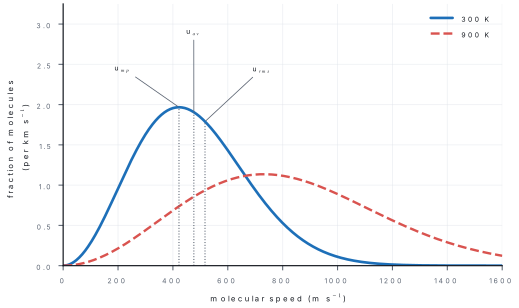
- Kinetic theory: average KE = (3/2)RT per mole, depends only on T; u_{rms} = \sqrt{3RT/M}; u_{mp} : u_{av} : u_{rms} = 1 : 1.128 : 1.224.
- Gas laws: Boyle, Charles, pressure law, Avogadro → PV = nRT; combined P_1V_1/T_1 = P_2V_2/T_2 (T in kelvin); Dalton p_i = x_iP; Graham r \propto 1/\sqrt{M}.
- Real gases: Z = PV/nRT; van der Waals a (attraction) and b (volume); ideal at low P and high T.
- Liquids: vapour pressure depends only on the liquid and T; boiling point when VP = external pressure; surface tension and viscosity fall with temperature; liquid crystals are the mesophase.
- Solids: crystalline (sharp mp, anisotropic) versus amorphous (softening range, isotropic); efflorescent, deliquescent, hygroscopic; water of crystallisation.
- 7 crystal systems, 14 Bravais lattices; Z = 1, 2, 4 and coordination 6, 8, 12 for simple, body-centred and face-centred cubic; ρ = ZM/(a³N_A).
6.1 Gases: kinetic theory, gas laws, ideal and combined gas equations, deviation of real gases
Kinetic theory of gases
The postulates (for an ideal gas):
- A gas consists of a very large number of tiny particles whose own volume is negligible compared with the volume of the container.
- The particles move randomly in straight lines in all directions, colliding with one another and with the walls; the pressure is due to collisions with the walls.
- The collisions are perfectly elastic (no loss of total kinetic energy).
- There are no forces of attraction or repulsion between the particles.
- The average kinetic energy is proportional to the absolute temperature.
From these follows the kinetic gas equation, PV = \frac{1}{3}mNu_{rms}^2, and with PV = RT for one mole:
(k = R/N_A = 1.38 × 10⁻²³ J K⁻¹; M in kg mol⁻¹ when R = 8.314 J mol⁻¹ K⁻¹.) At a given temperature all gases have the same average kinetic energy; lighter molecules simply move faster. At absolute zero the kinetic energy would be zero.
| Speed | Formula | Relative value |
|---|---|---|
| Most probable, u_{mp} | \sqrt{2RT/M} | 1 |
| Average (mean), u_{av} | \sqrt{8RT/\pi M} | 1.128 |
| Root mean square, u_{rms} | \sqrt{3RT/M} | 1.224 |
The gas laws
| Law | Statement (fixed amount of gas) | Form |
|---|---|---|
| Boyle (1662) | at constant T, volume is inversely proportional to pressure | PV = constant; P₁V₁ = P₂V₂ |
| Charles (1787) | at constant P, volume is directly proportional to absolute temperature | V/T = constant; V_t = V₀(1 + t/273) |
| Pressure law (Gay-Lussac) | at constant V, pressure is directly proportional to absolute temperature | P/T = constant |
| Avogadro | at constant T and P, volume is proportional to the number of moles | V/n = constant |
| Combined | all of the above together | P₁V₁/T₁ = P₂V₂/T₂ |
Charles's law, extrapolated, gives zero volume at −273.15 °C — absolute zero, the origin of the kelvin scale (T/K = t/°C + 273). Graph shapes are a favourite: P against V is a rectangular hyperbola; P against 1/V, and V against T, are straight lines through the origin; PV against P (at constant T) is a horizontal line.
The ideal gas equation
| R in | Value |
|---|---|
| J mol⁻¹ K⁻¹ (SI) | 8.314 |
| L atm mol⁻¹ K⁻¹ | 0.0821 |
| cal mol⁻¹ K⁻¹ | 1.987 (≈ 2) |
R is the work done by one mole of an ideal gas when it is heated through 1 K at constant pressure; it has the same value for all gases. An ideal gas obeys PV = nRT exactly at all temperatures and pressures; no real gas does.
Problem. A gas occupies 500 mL at 27 °C and 1.0 atm. Find its volume at 177 °C and 1.5 atm.
Solution. Convert to kelvin: 300 K and 450 K. V₂ = V₁ × (P₁/P₂) × (T₂/T₁) = 500 × (1.0/1.5) × (450/300) = 500 mL — the two changes cancel exactly. Never put °C into a gas law.
Dalton's law of partial pressures
The total pressure of a mixture of non-reacting gases equals the sum of their partial pressures (the pressure each would exert alone in the whole volume): P = p_1 + p_2 + \ldots, and p_i = x_iP where x_i is the mole fraction. A gas collected over water is saturated with water vapour, so p(dry gas) = P(total) − aqueous tension (the vapour pressure of water at that temperature).
Graham's law of diffusion
At constant temperature and pressure, the rate of diffusion (or effusion) of a gas is inversely proportional to the square root of its density, and hence of its molar mass:
Uses: separating ²³⁵UF₆ from ²³⁸UF₆; finding molar masses. When NH₃ and HCl are released at the two ends of a tube, NH₃ (M = 17) travels √(36.5/17) = 1.47 times faster than HCl, so the white ring of NH₄Cl forms nearer the HCl end (about 59 % of the way from the NH₃ end).
Problem. A gas takes 3 times as long as oxygen to effuse through the same hole under the same conditions. Find its molar mass.
Solution. t ∝ √M, so M = 32 × 3² = 288 g mol⁻¹. (Squaring the time ratio is the step most often forgotten.)
Deviation of real gases from ideality
Real gases deviate because two postulates are false: the molecules do have volume and they do attract one another. The deviation is measured by the compressibility factor
Z = 1 for an ideal gas. Z < 1 (more compressible than ideal) when attractions dominate — moderate pressures, for easily liquefied gases such as CO₂ and NH₃. Z > 1 when the molecular volume dominates — at high pressure for all gases, and at all pressures for H₂ and He at room temperature. Real gases behave most ideally at low pressure and high temperature.
The van der Waals equation corrects both postulates:
- a measures the attractive forces (pressure correction, unit atm L² mol⁻²). Easily liquefied gases (NH₃, SO₂, CO₂) have large a; H₂ and He have very small a.
- b is the excluded volume (volume correction, unit L mol⁻¹), about four times the actual volume of the molecules in one mole.
- Boyle temperature T_B = a/Rb: the temperature at which a real gas obeys Boyle's law over a range of pressure. Critical temperature T_c = 8a/27Rb: above it a gas cannot be liquefied by pressure alone (CO₂ 31 °C, NH₃ 132 °C, O₂ −119 °C, He −268 °C).
Celsius instead of kelvin; M in g mol⁻¹ with R = 8.314 J (it must be kg mol⁻¹ — the answer comes out √1000 ≈ 31.6 times too small); forgetting to square the time ratio in Graham's law; and using total moles instead of the mole fraction for a partial pressure.
6.2 Liquids: vapour pressure, boiling point, surface tension, viscosity, liquid crystals, solubility and solubility curves
Vapour pressure and boiling point
Evaporation is the escape of the fastest surface molecules at any temperature; it cools the liquid left behind. In a closed vessel evaporation and condensation reach a dynamic equilibrium, and the pressure of the vapour then is the vapour pressure. It depends only on the nature of the liquid and the temperature — not on the amount of liquid, the surface area or the volume of the vessel. It rises steeply with temperature, and it is high for liquids with weak intermolecular forces (diethyl ether > ethanol > water at the same temperature).
A liquid boils when its vapour pressure equals the external pressure. The normal boiling point is the boiling temperature at 1 atm (760 mmHg): water 100 °C.
Lower the external pressure and the boiling point falls: water boils at about 95 °C in Kathmandu (about 1400 m, near 640 mmHg) and at about 70 °C on the summit of Mount Everest, so food cooks slowly there. A pressure cooker raises the pressure, and so the boiling point, to about 120 °C. Water at 25 °C has a vapour pressure of 23.8 mmHg.
Surface tension
Surface tension is the force acting per unit length at right angles to an imaginary line drawn on the surface of a liquid. SI unit N m⁻¹ (also J m⁻², energy per unit area; CGS dyne cm⁻¹).
A molecule inside the liquid is pulled equally in all directions; one at the surface is pulled inwards only, so the surface behaves like a stretched skin and tends to minimise its area. Results: drops and bubbles are spherical; water rises in a narrow glass capillary (mercury falls); insects walk on water; a needle floats. Surface tension decreases as temperature rises (it vanishes at the critical temperature) and is lowered sharply by soaps and detergents. Water's value (about 72 mN m⁻¹ at 25 °C) is high because of hydrogen bonding. With a stalagmometer (drop-number method), \gamma_1/\gamma_2 = \rho_1 n_2/(\rho_2 n_1) — fewer, bigger drops mean a higher surface tension.
Viscosity
Viscosity is the internal resistance of a fluid to flow. The coefficient of viscosity η is the tangential force per unit area needed to maintain unit velocity gradient between two layers: F = \eta A\,(dv/dx). SI unit N s m⁻² = Pa s (= kg m⁻¹ s⁻¹); CGS unit the poise (1 P = 0.1 Pa s). Its reciprocal is fluidity.
The viscosity of a liquid decreases with rising temperature (molecules gain energy to overcome attractions) — but the viscosity of a gas increases with temperature. Strong intermolecular forces and large molecules raise viscosity: glycerol (three OH groups, extensive hydrogen bonding) ≫ ethylene glycol > water > diethyl ether. With an Ostwald viscometer, \eta_1/\eta_2 = \rho_1 t_1/(\rho_2 t_2).
Liquid crystals
Some organic substances with long, rod-like molecules melt first to a cloudy fluid that flows like a liquid but keeps some of the orientational order of a crystal — the liquid crystal (mesomorphic) state. Reinitzer (1888) saw it in cholesteryl benzoate, which turns cloudy at 145 °C and clear at 179 °C.
| Type | Order | Note |
|---|---|---|
| Nematic (thermotropic) | molecules parallel, not in layers | used in LCD screens |
| Smectic (thermotropic) | parallel and arranged in layers | most ordered |
| Cholesteric (thermotropic) | layers twisted one over another | colour changes with temperature |
| Lyotropic | formed on dissolving in a solvent | soap solutions, cell membranes |
Uses: liquid crystal displays (watches, calculators, phones, televisions), temperature strips and thermometers, and medical thermography (locating tumours and blocked blood vessels by skin temperature).
Solubility and solubility curves
Solubility is the mass of solute (in grams) that dissolves in 100 g of solvent to give a saturated solution at a stated temperature. A solubility curve plots it against temperature.
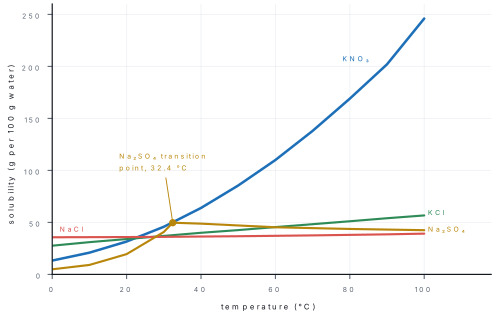
- Most solids dissolve better when hot; KNO₃, NH₄Cl and KCl strongly, NaCl only slightly. A few become less soluble on heating — Ca(OH)₂, Li₂SO₄ and Ce₂(SO₄)₃.
- A kink marks a change of the solid phase (Na₂SO₄·10H₂O → Na₂SO₄ at 32.4 °C).
- Gases become less soluble as temperature rises and more soluble as pressure rises (Henry's law) — that is why fish need cool, oxygen-rich water and why a soft drink fizzes when opened.
- Uses of curves: finding the mass that crystallises on cooling (difference of two solubilities), choosing a method of crystallisation (cooling for KNO₃, evaporation for NaCl), and separating salts by fractional crystallisation.
Problem. A solution of KNO₃ saturated at 60 °C contains 100 g of water. How much KNO₃ crystallises when it is cooled to 20 °C? (Solubility 110 g and 31.6 g per 100 g water.)
Solution. Mass that crystallises = 110 − 31.6 = 78.4 g. (For w grams of water, scale by w/100.) The same cooling would deposit only about 1.2 g of NaCl from its saturated solution, which is why salt is crystallised by evaporation instead.
6.3 Solids: crystalline and amorphous solids; efflorescent, deliquescent and hygroscopic substances; water of crystallisation
Crystalline and amorphous solids
| Property | Crystalline | Amorphous |
|---|---|---|
| Arrangement of particles | regular, repeating, long-range order | irregular, only short-range order |
| Shape | definite geometric shape | no definite shape |
| Melting | sharp melting point | soften over a range of temperature |
| Heat of fusion | definite | not definite |
| Physical properties with direction | anisotropic (differ with direction) | isotropic (same in all directions) |
| Cutting | clean cleavage along planes | irregular fracture |
| Nature | true solids | pseudo-solids or supercooled liquids |
| Examples | NaCl, quartz, diamond, sugar, ice, metals | glass, rubber, plastics, fused silica, pitch |
Quartz (crystalline SiO₂) and fused silica glass (amorphous SiO₂) are the same compound in the two forms. Amorphous solids are often called pseudo-solids or supercooled liquids: their particles are frozen in the disorder of a liquid.
Efflorescent, deliquescent and hygroscopic substances
| Term | Behaviour in moist air | Examples |
|---|---|---|
| Efflorescent | loses water of crystallisation to the air and crumbles to a powder | washing soda Na₂CO₃·10H₂O, Glauber's salt Na₂SO₄·10H₂O, FeSO₄·7H₂O |
| Deliquescent | absorbs so much moisture that it dissolves in it | CaCl₂, NaOH, KOH, MgCl₂, FeCl₃, ZnCl₂ |
| Hygroscopic | absorbs moisture but does not dissolve (or is a liquid that takes up water) | quicklime CaO, silica gel, anhydrous CuSO₄, P₄O₁₀, conc. H₂SO₄ |
A hydrate effloresces when its own water-vapour pressure is greater than the partial pressure of water in the air; a solid deliquesces when its saturated solution has a vapour pressure lower than that of the air. Deliquescent and hygroscopic substances are drying agents: fused CaCl₂, quicklime (for ammonia), conc. H₂SO₄, P₄O₁₀ and silica gel. Common salt becomes damp in the rainy season only because of traces of deliquescent MgCl₂ and CaCl₂ in it.
Both absorb water. A deliquescent solid ends up as a solution; a hygroscopic solid only becomes damp. Every deliquescent substance is hygroscopic, but not every hygroscopic substance is deliquescent.
Crystallisation and water of crystallisation
Crystallisation purifies a solid: dissolve it in the minimum of hot solvent, filter hot, and cool slowly; crystals separate and soluble impurities stay in the mother liquor. A crystal grows by nucleation (a tiny ordered cluster forms) followed by growth (more particles add to its faces); slow, undisturbed cooling gives fewer, larger crystals.
The water of crystallisation is the fixed number of water molecules combined with one formula unit of a salt in its crystals. It is responsible for the shape (and often the colour) of the crystals and is driven off on heating: CuSO₄·5H₂O (blue) → CuSO₄ (white) + 5H₂O.
| Name | Formula | Name | Formula |
|---|---|---|---|
| Blue vitriol | CuSO₄·5H₂O | Washing soda | Na₂CO₃·10H₂O |
| Green vitriol | FeSO₄·7H₂O | Glauber's salt | Na₂SO₄·10H₂O |
| White vitriol | ZnSO₄·7H₂O | Gypsum | CaSO₄·2H₂O |
| Epsom salt | MgSO₄·7H₂O | Plaster of Paris | CaSO₄·½H₂O |
| Borax | Na₂B₄O₇·10H₂O | Potash alum | K₂SO₄·Al₂(SO₄)₃·24H₂O |
| Mohr's salt | FeSO₄·(NH₄)₂SO₄·6H₂O | Hypo | Na₂S₂O₃·5H₂O |
Problem. Crystals of Na₂CO₃·xH₂O lose 62.9 % of their mass when heated to constant mass. Find x. (Na₂CO₃ = 106)
Solution. 18x/(106 + 18x) = 0.629 → 18x(1 − 0.629) = 66.7 → x = 66.7/6.68 = 10 (washing soda).
6.4 The unit cell, the seven crystal systems and the fourteen Bravais lattices; types of crystalline solid by bonding
Lattice, unit cell and crystal systems
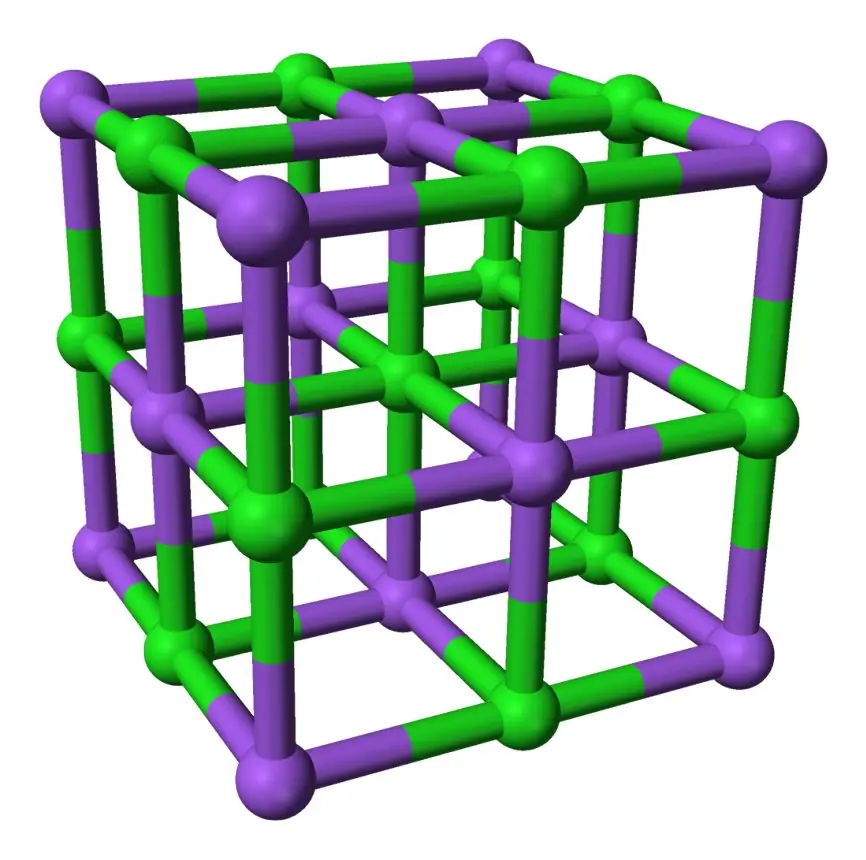
A crystal lattice (space lattice) is the regular three-dimensional array of points that shows the positions of the particles in a crystal. The unit cell is the smallest portion of the lattice which, repeated in three dimensions, generates the whole crystal. It is described by the edge lengths a, b, c and the angles α, β, γ between them.
Only seven crystal systems are possible, and placing particles at corners, body centres, face centres or end-face centres gives fourteen Bravais lattices in all (Bravais, 1848).
| Crystal system | Edges | Angles | Bravais lattices | Examples |
|---|---|---|---|---|
| Cubic | a = b = c | α = β = γ = 90° | 3 (simple, body-centred, face-centred) | NaCl, Cu, diamond, ZnS |
| Tetragonal | a = b ≠ c | α = β = γ = 90° | 2 (simple, body-centred) | white tin, SnO₂, TiO₂ |
| Orthorhombic | a ≠ b ≠ c | α = β = γ = 90° | 4 (simple, body, face, end-centred) | rhombic sulphur, KNO₃, BaSO₄ |
| Monoclinic | a ≠ b ≠ c | α = γ = 90°, β ≠ 90° | 2 (simple, end-centred) | monoclinic sulphur, Na₂SO₄·10H₂O |
| Triclinic | a ≠ b ≠ c | α ≠ β ≠ γ ≠ 90° | 1 | CuSO₄·5H₂O, K₂Cr₂O₇, H₃BO₃ |
| Hexagonal | a = b ≠ c | α = β = 90°, γ = 120° | 1 | graphite, ZnO, Mg, ice |
| Rhombohedral (trigonal) | a = b = c | α = β = γ ≠ 90° | 1 | calcite (CaCO₃), cinnabar (HgS), NaNO₃ |
3 + 2 + 4 + 2 + 1 + 1 + 1 = 14. The cubic system is the most symmetrical and the triclinic the least.
Counting particles in cubic unit cells
A corner particle is shared by 8 unit cells (contributes 1/8), an edge particle by 4 (1/4), a face-centre particle by 2 (1/2), and a body-centre particle belongs wholly to its cell.
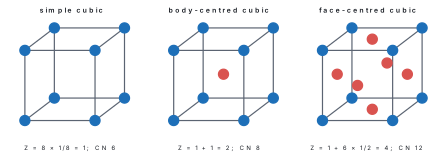
| Cubic cell | Atoms per cell, Z | Coordination number | Edge and radius | Packing efficiency |
|---|---|---|---|---|
| Simple (primitive) | 1 | 6 | a = 2r | 52.4 % |
| Body-centred (bcc) | 2 | 8 | √3 a = 4r | 68 % |
| Face-centred (fcc, ccp) | 4 | 12 | √2 a = 4r | 74 % |
The density of a cubic crystal follows from the unit cell:
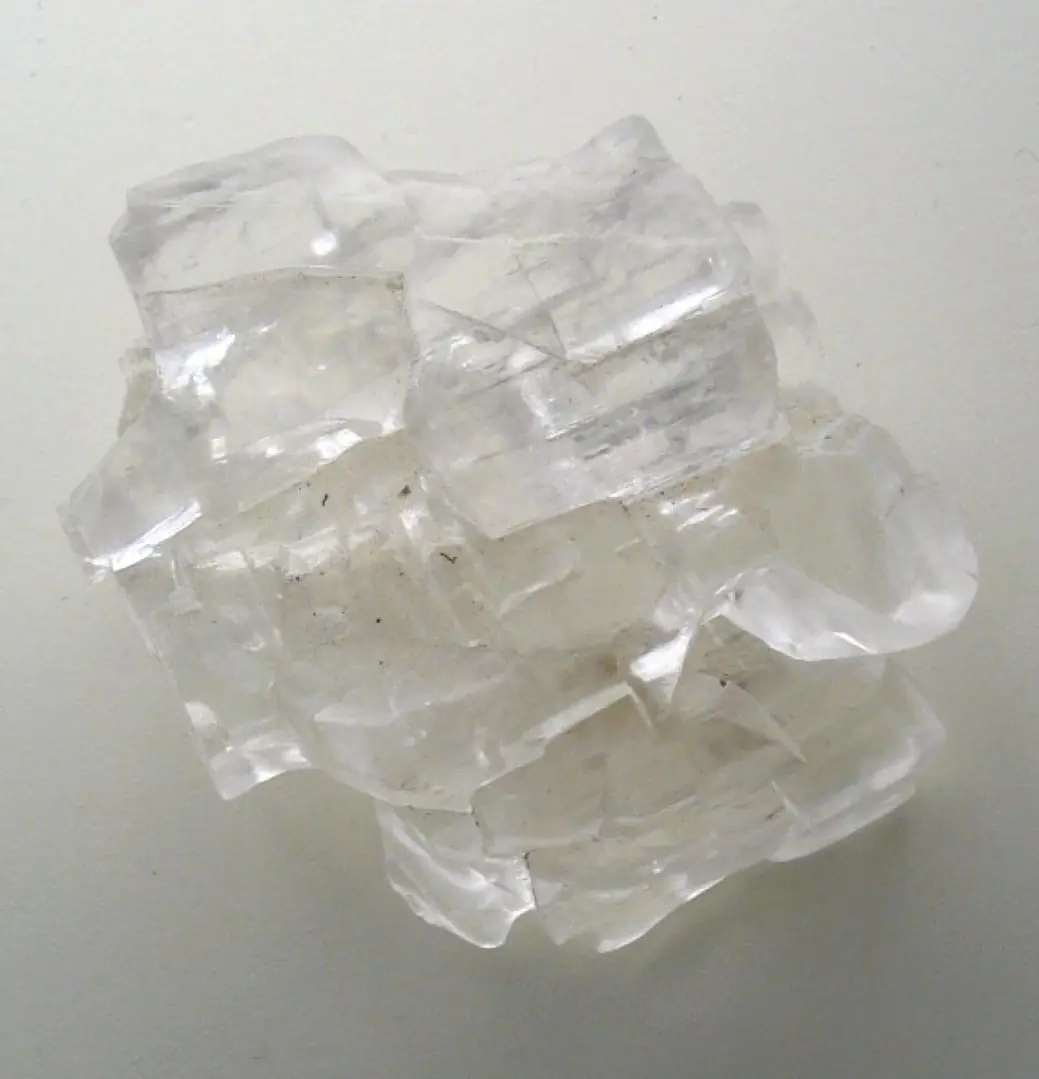
(a in cm gives ρ in g cm⁻³.) Examples: Na, K and Fe (at room temperature) are bcc; Cu, Ag, Au and Al are fcc; NaCl has 4 formula units per cubic cell.
Problem. NaCl has a face-centred cubic cell with edge 564 pm and 4 formula units per cell. Find its density (NaCl = 58.5 g mol⁻¹, N_A = 6.02 × 10²³ mol⁻¹).
Solution. a = 5.64 × 10⁻⁸ cm, a³ = 1.794 × 10⁻²² cm³. ρ = (4 × 58.5)/(1.794 × 10⁻²² × 6.02 × 10²³) = 234/108 = 2.17 g cm⁻³ — the measured value, which confirms the structure.
Types of crystalline solid by bonding
| Type | Particles | Forces | Properties | Examples |
|---|---|---|---|---|
| Ionic | cations and anions | electrostatic (ionic) bonds | hard, brittle, high mp; conduct only when molten or dissolved | NaCl, KNO₃, MgO, CaF₂ |
| Covalent (network) | atoms | covalent bonds throughout | very hard, very high mp, non-conductors (graphite excepted) | diamond, quartz SiO₂, SiC, graphite |
| Molecular | molecules | van der Waals forces or hydrogen bonds | soft, low mp, often volatile, insulators | I₂, dry ice (CO₂), naphthalene, ice, S₈, P₄ |
| Metallic | positive kernels in an electron sea | metallic bonds | lustrous, malleable, ductile, good conductors; mp varies | Na, Cu, Fe, Ag |
Graphite is the classic exception: a covalent solid that conducts, because each carbon (sp²) leaves one electron delocalised over its layer; the layers are held by weak van der Waals forces, so it is soft and slippery.
Formula and fact sheet
| Quantity | Formula |
|---|---|
| Kinetic gas equation | PV = \frac{1}{3}mNu_{rms}^2 |
| Kinetic energy | (3/2)RT per mole; (3/2)kT per molecule; depends only on T |
| Molecular speeds | u_{mp} = \sqrt{2RT/M}, u_{av} = \sqrt{8RT/\pi M}, u_{rms} = \sqrt{3RT/M}; u_{mp} : u_{av} : u_{rms} = 1 : 1.128 : 1.224 |
| Gas laws | PV = const (T); V/T = const (P); P/T = const (V); V/n = const |
| Ideal and combined | PV = nRT; ρ = PM/RT; P₁V₁/T₁ = P₂V₂/T₂ |
| R | 8.314 J mol⁻¹ K⁻¹ = 0.0821 L atm mol⁻¹ K⁻¹ = 1.987 cal mol⁻¹ K⁻¹ |
| Dalton | P = Σpᵢ; pᵢ = xᵢP; p(dry) = P − aqueous tension |
| Graham | r₁/r₂ = √(M₂/M₁) = √(ρ₂/ρ₁); t₁/t₂ = √(M₁/M₂) |
| Real gases | Z = PV/nRT; (P + an²/V²)(V − nb) = nRT; T_B = a/Rb; T_c = 8a/27Rb |
| Surface tension (drops) | γ₁/γ₂ = ρ₁n₂/(ρ₂n₁); unit N m⁻¹ |
| Viscosity (Ostwald) | η₁/η₂ = ρ₁t₁/(ρ₂t₂); unit Pa s; 1 P = 0.1 Pa s |
| Unit cell | Z = 1, 2, 4 (sc, bcc, fcc); CN 6, 8, 12; ρ = ZM/(a³N_A) |
Facts: 7 crystal systems and 14 Bravais lattices; liquid viscosity and surface tension fall with temperature (gas viscosity rises); boiling point is where VP = external pressure (water: about 95 °C in Kathmandu, about 70 °C on Everest); efflorescent loses water, deliquescent dissolves in absorbed water, hygroscopic merely absorbs it.
Chapter summary
- Kinetic theory: random elastic motion, no attractions, negligible molecular volume; KE = (3/2)RT per mole for every gas; u_{rms} = \sqrt{3RT/M} and u_{mp} : u_{av} : u_{rms} = 1 : 1.128 : 1.224.
- Boyle, Charles, pressure and Avogadro laws combine into PV = nRT (R = 8.314 J or 0.0821 L atm mol⁻¹ K⁻¹); always use kelvin.
- Dalton: p_i = x_iP; Graham: rate ∝ 1/√M (lighter gases diffuse faster; time ∝ √M).
- Real gases: Z = PV/nRT; van der Waals a (attraction) and b (excluded volume); ideal behaviour at low P and high T; large a means easy liquefaction.
- Vapour pressure depends only on the liquid and T; boiling occurs when VP = external pressure. Surface tension (N m⁻¹) and liquid viscosity (Pa s) fall as T rises.
- Liquid crystals (nematic, smectic, cholesteric) flow but keep orientational order; used in LCDs and thermometers. Solubility curves show crystallisation yields; KNO₃ rises steeply, NaCl barely.
- Crystalline solids: long-range order, sharp mp, anisotropic; amorphous: short-range order, soften over a range, isotropic. Efflorescent loses water; deliquescent dissolves; hygroscopic absorbs.
- 7 crystal systems, 14 Bravais lattices; sc, bcc, fcc have Z = 1, 2, 4 and CN 6, 8, 12; ρ = ZM/(a³N_A). Solids are ionic, covalent network, molecular or metallic.
Practice questions
Set A — Recall (20 questions)
- According to the kinetic theory, the average kinetic energy of gas molecules is directly proportional toathe pressurebthe volumecthe absolute temperaturedthe molar mass
- Boyle's law states that, for a fixed mass of gas at constant temperature,aPV = constantbV/T = constantcP/T = constantdPT = constant
- The value of the gas constant R in L atm mol⁻¹ K⁻¹ isa8.314b0.0821c1.987d22.4
- Graham's law states that the rate of diffusion of a gas isaproportional to its molar massbinversely proportional to its molar masscproportional to the square root of its densitydinversely proportional to the square root of its density
- Real gases behave most nearly like an ideal gas atalow pressure and high temperaturebhigh pressure and low temperaturechigh pressure and high temperaturedlow pressure and low temperature
- In the van der Waals equation the constant a corrects forathe volume of the moleculesbthe mass of the moleculescthe attraction between the moleculesdthe speed of the molecules
- A liquid boils at the temperature at whichait starts to evaporatebits vapour pressure becomes zerocits vapour pressure is 1 mmHgdits vapour pressure equals the external pressure
- The SI unit of surface tension isaN mbN m⁻¹cN m⁻²dN s m⁻²
- When the temperature rises, the viscosity of a liquidadecreasesbincreasescdoes not changedfirst increases, then decreases
- A substance that absorbs moisture from the air and dissolves in it is calledaefflorescentbhygroscopiccdeliquescentdamorphous
- Which of the following is an amorphous solid?asodium chloridebglasscquartzddiamond
- The numbers of crystal systems and of Bravais lattices are respectivelya14 and 7b7 and 7c6 and 14d7 and 14
- The state of matter that flows like a liquid but keeps some orientational order of a crystal isaan amorphous solidba plasmaca liquid crystalda supercritical fluid
- The number of atoms in a face-centred cubic unit cell isa4b2c1d6
- Crystals of washing soda lose water and crumble when exposed to air. This property is calledadeliquescencebhygroscopycsublimationdefflorescence
- Dalton's law of partial pressures applies toareacting gases onlybmixtures of non-reacting gasescliquidsdsolutions of gases in water
- Unlike amorphous solids, crystalline solids areaisotropicbwithout a sharp melting pointcanisotropic, with a sharp melting pointdsupercooled liquids
- The number of molecules of water of crystallisation in blue vitriol isa5b7c10d2
- Diamond is an example of aamolecular solidbionic solidcmetallic soliddcovalent network solid
- The solubility of a gas in water generallyaincreases with temperaturebdecreases with temperaturecis independent of pressureddecreases with pressure
Answers and explanations — Set A
1. (c) — KE = (3/2)RT per mole: it depends on the absolute temperature only, not on P, V or the kind of gas.
2. (a) — P ∝ 1/V at constant T, so PV is constant. V/T = constant is Charles's law; P/T = constant the pressure law.
3. (b) — 0.0821 L atm mol⁻¹ K⁻¹. 8.314 is in J mol⁻¹ K⁻¹ and 1.987 in cal mol⁻¹ K⁻¹; 22.4 L is the molar volume.
4. (d) — r ∝ 1/√ρ ∝ 1/√M. Option (b) misses the square root.
5. (a) — At low pressure the molecular volume is negligible, and at high temperature the attractions hardly matter.
6. (c) — a corrects the pressure for intermolecular attraction; b corrects the volume for the size of the molecules.
7. (d) — Boiling begins when bubbles of vapour can form inside the liquid, i.e. when its vapour pressure equals the pressure above it.
8. (b) — Force per unit length: N m⁻¹ (equivalently J m⁻²). N s m⁻² is the unit of viscosity.
9. (a) — Warmer molecules overcome intermolecular attraction more easily, so the liquid flows more freely. (Gas viscosity does the opposite.)
10. (c) — Deliquescent solids, such as CaCl₂ and NaOH, dissolve in the water they absorb; hygroscopic ones only become damp.
11. (b) — Glass has only short-range order and softens over a range of temperature. NaCl, quartz and diamond are crystalline.
12. (d) — Seven crystal systems give fourteen Bravais lattices.
13. (c) — The liquid crystal (mesophase) lies between the crystalline solid and the isotropic liquid.
14. (a) — 8 corners × 1/8 + 6 face centres × 1/2 = 1 + 3 = 4.
15. (d) — Efflorescence: Na₂CO₃·10H₂O gives up water of crystallisation to the air and turns powdery.
16. (b) — The partial pressures add only when the gases do not react with one another.
17. (c) — Long-range order makes crystals anisotropic and gives them a sharp melting point.
18. (a) — CuSO₄·5H₂O. Green and white vitriol have 7 H₂O; washing soda 10; gypsum 2.
19. (d) — Every carbon is covalently bonded to four others in a giant 3-D network, hence extreme hardness and a very high melting point.
20. (b) — Dissolving a gas releases heat, so warming drives gas out; higher pressure increases solubility (Henry's law).
Set B — Understanding (14 questions)
- At the same temperature, which gas has the greatest average kinetic energy per molecule?aall have the samebH₂cO₂dCO₂
- The ratio of the most probable, average and root-mean-square speeds of gas molecules isa1 : 1.224 : 1.128b1.224 : 1.128 : 1c1 : 1 : 1d1 : 1.128 : 1.224
- The vapour pressure of a pure liquid depends onathe amount of liquidbthe surface area of the liquidcthe nature of the liquid and the temperaturedthe volume of the container
- Water boils at a lower temperature on Mount Everest than in Kathmandu becauseathe air is colder therebthe atmospheric pressure is lower therecthe vapour pressure of water is higher theredthe water there is purer
- Small liquid drops are spherical because ofasurface tensionbviscositycvapour pressuredgravity
- Glycerol is far more viscous than water mainly becauseait has a lower molar massbit is an ionic compoundcits three OH groups form extensive hydrogen bondsdit has a lower density
- A real gas shows Z < 1 at moderate pressure. The main cause isathe finite volume of its moleculesbattraction between its moleculescthe high speed of its moleculesda chemical reaction between its molecules
- Fused CaCl₂ is used in desiccators to dry substances because it isaefflorescentbamorphouscvolatileddeliquescent
- KNO₃ is far more soluble in hot water than in cold, while NaCl is about equally soluble in both. To recover pure KNO₃ by crystallisation one shouldacool a hot saturated solutionbevaporate at room temperature onlycheat a cold saturated solutiondadd more water
- Which property shows that glass is an amorphous solid?ait is transparentbit is hardcit is brittledit softens over a range of temperature
- The coordination number of an atom in a body-centred cubic lattice isa6b12c8d4
- Ice is a molecular solid in which the molecules are held together byaionic bondsbhydrogen bondscmetallic bondsdcovalent bonds between the molecules
- Which set of parameters describes a cubic unit cell?aa = b = c; α = β = γ = 90°ba = b ≠ c; α = β = γ = 90°ca ≠ b ≠ c; α = β = γ = 90°da = b ≠ c; α = β = 90°, γ = 120°
- NH₃ and HCl gases released at the same moment at opposite ends of a long tube meet and form a white ring of NH₄Cl. The ring formsaexactly in the middlebnearer the NH₃ endcnearer the HCl enddat the NH₃ end itself
Answers and explanations — Set B
1. (a) — Average KE = (3/2)kT depends only on temperature; H₂ moves fastest, but its KE per molecule is the same as that of O₂ or CO₂.
2. (d) — √2 : √(8/π) : √3 = 1 : 1.128 : 1.224, so u_mp < u_av < u_rms.
3. (c) — It is an equilibrium property, set by the intermolecular forces and the temperature; the amount and the area change only how fast equilibrium is reached.
4. (b) — Lower outside pressure is matched by the vapour pressure at a lower temperature (about 70 °C on the summit against about 95 °C in Kathmandu).
5. (a) — Surface tension pulls a free liquid into the shape of least surface area for its volume — a sphere.
6. (c) — Each glycerol molecule has three OH groups and is held to its neighbours by many hydrogen bonds, which resist flow.
7. (b) — Attractions pull the molecules together, so the gas is more compressible than ideal (PV < nRT). Molecular volume makes Z > 1.
8. (d) — CaCl₂ takes up water vapour so strongly that it dissolves in it; that is what makes it a good drying agent.
9. (a) — A large drop in solubility on cooling throws out most of the KNO₃ as crystals, while the small amount of NaCl impurity stays dissolved.
10. (d) — Amorphous solids have no sharp melting point; transparency, hardness and brittleness are shown by crystals too.
11. (c) — The body-centre atom touches the 8 corner atoms; simple cubic has CN 6 and fcc 12.
12. (b) — Each water molecule is hydrogen-bonded to four neighbours in a tetrahedral, open arrangement.
13. (a) — Cubic: all edges and all angles equal, angles 90°. (b) is tetragonal, (c) orthorhombic, (d) hexagonal.
14. (c) — Lighter NH₃ diffuses √(36.5/17) ≈ 1.47 times faster, so it covers more of the tube before the two meet.
Set C — Application (10 questions)
- A gas occupies 600 mL at 27 °C and 760 mmHg. Its volume at 127 °C and 380 mmHg isa800 mLb1600 mLc1200 mLd225 mL
- The root-mean-square speed of O₂ molecules at 27 °C is about (R = 8.314 J mol⁻¹ K⁻¹)a15.3 m s⁻¹b395 m s⁻¹c446 m s⁻¹d484 m s⁻¹
- The rates of diffusion of H₂ and O₂ under the same conditions are in the ratioa4 : 1b1 : 4c16 : 1d1 : 16
- A flask contains 0.20 mol of N₂ and 0.30 mol of O₂ at a total pressure of 5.0 atm. The partial pressure of O₂ isa2.0 atmb2.5 atmc3.0 atmd5.0 atm
- 50 mL of a gas X effuses through a pinhole in 20 s, while 50 mL of O₂ takes 10 s under the same conditions. The molar mass of X isa64 g mol⁻¹b128 g mol⁻¹c16 g mol⁻¹d8 g mol⁻¹
- A gas has a density of 1.30 g L⁻¹ at 27 °C and 1.0 atm. Its molar mass is about (R = 0.0821 L atm mol⁻¹ K⁻¹)a28 g mol⁻¹b2.9 g mol⁻¹c44 g mol⁻¹d32 g mol⁻¹
- A solution of KNO₃ saturated at 60 °C contains 100 g of water. The solubility of KNO₃ is 110 g at 60 °C and 31.6 g at 20 °C per 100 g of water. On cooling to 20 °C, the mass of KNO₃ that crystallises isa78.4 gb110 gc31.6 gd141.6 g
- A metal of molar mass 50 g mol⁻¹ has a face-centred cubic lattice with edge length 400 pm. Its density is about (N_A = 6.02 × 10²³ mol⁻¹)a1.30 g cm⁻³b2.60 g cm⁻³c5.19 g cm⁻³d10.4 g cm⁻³
- Crystals of Na₂CO₃·xH₂O lose 62.9 % of their mass on heating to constant mass. The value of x is (Na₂CO₃ = 106)a1b5c7d10
- A stalagmometer delivers 20 drops of water (density 1.0 g mL⁻¹, surface tension 72 mN m⁻¹) and 50 drops of a liquid of density 0.80 g mL⁻¹ for the same volume. The surface tension of the liquid isa23 mN m⁻¹b36 mN m⁻¹c144 mN m⁻¹d225 mN m⁻¹
Answers and explanations — Set C
1. (b) — V₂ = 600 × (760/380) × (400/300) = 600 × 2 × 4/3 = 1600 mL. (a) ignores the pressure change, (c) ignores the temperature change, (d) inverts both.
2. (d) — u_rms = √(3 × 8.314 × 300/0.032) = 484 m s⁻¹. (a) uses M = 32 instead of 0.032 kg mol⁻¹; (b) and (c) are u_mp and u_av.
3. (a) — r(H₂)/r(O₂) = √(32/2) = √16 = 4. Option (c) forgets the square root.
4. (c) — x(O₂) = 0.30/0.50 = 0.60; p(O₂) = 0.60 × 5.0 = 3.0 atm.
5. (b) — t ∝ √M: (20/10)² = 4, so M = 4 × 32 = 128 g mol⁻¹. Option (a) forgets to square the time ratio.
6. (d) — M = ρRT/P = 1.30 × 0.0821 × 300/1.0 = 32.0 g mol⁻¹ (the gas could be O₂). Option (b) uses 27 instead of 300 K.
7. (a) — 110 − 31.6 = 78.4 g crystallises; 31.6 g stays in the 100 g of water.
8. (c) — ρ = ZM/(a³N_A) = 4 × 50/((4.00 × 10⁻⁸)³ × 6.02 × 10²³) = 200/38.5 = 5.19 g cm⁻³. (a) and (b) use Z = 1 and 2.
9. (d) — 18x/(106 + 18x) = 0.629 gives x = 9.98 ≈ 10: washing soda, Na₂CO₃·10H₂O.
10. (a) — γ = 72 × (0.80 × 20)/(1.0 × 50) = 72 × 0.32 = 23 mN m⁻¹: more, smaller drops mean lower surface tension. (c) inverts the drop ratio.