Chapter 13 · Inorganic Chemistry · 4 questions in the paper · 31 min read
Chemistry of Non-metals
What the syllabus asks for 5
- Atomic, molecular and nascent hydrogen; isotopes of hydrogen; heavy water; types of oxides
- Ozone: preparation, structure and tests; depletion of the ozone layer
- Ammonia, phosphine and nitric acid
- Chlorine, bromine and iodine; HCl, HBr and HI
- Allotropes of carbon and carbon monoxide; hydrogen sulphide, sulphur dioxide and sulphuric acid
This is one of the two heavyweight inorganic chapters — about 4 questions — and it is unashamedly factual: preparations, properties, tests and which reagent does what to whom. The winning strategy is to file each species under three hooks — how it is made, what kind of agent it is (oxidant, reductant, acid, dehydrator…), and its one diagnostic test — and to know the trends that bind families (halogen reactivity falls down the group, HX acidity rises). Every equation below is balanced; in the examination hall, write the same way: charge and atoms both counted.
- Hydrogen: nascent [H] (freshly generated, e.g. Zn + HCl) reduces more strongly than molecular H₂; atomic H from an electric arc is fiercer still (atomic hydrogen torch). Isotopes: ¹H (protium), ²H/D (deuterium), ³H/T (tritium, β⁻, t½ 12.3 y). D₂O (heavy water): denser (1.106 g cm⁻³), b.p. 101.4 °C — a neutron moderator and tracer.
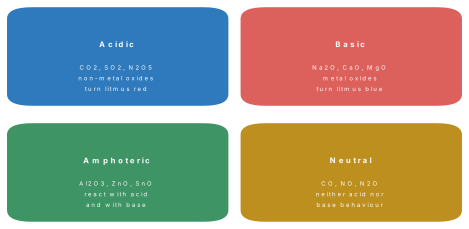
- Oxides: acidic (CO₂, SO₂, NO₂), basic (Na₂O, CaO), amphoteric (Al₂O₃, ZnO), neutral (CO, NO, N₂O, H₂O), peroxides (Na₂O₂: O at −1), superoxides (KO₂: −½), mixed (Fe₃O₄, Pb₃O₄).
- Ozone: 3O₂ ⇌ 2O₃ by silent electric discharge; bent (116.8°), resonance-equal bonds, strong oxidant (starch–iodide turns blue; Hg loses its meniscus — "tailing of mercury"). CFC chlorine radicals catalytically destroy stratospheric O₃ → UV shield thinning (Montreal Protocol 1987).
- NH₃: Haber (450 °C, 200 atm, Fe/Mo); pyramidal lone-pair base & ligand ([Cu(NH₃)₄]²⁺ deep blue); Nessler's test (brown). PH₃: Ca₃P₂ + water; rotten-fish, poisonous, far less basic/soluble than NH₃.
- HNO₃: Ostwald (NH₃/Pt gauze → NO → NO₂ → absorb); oxidizing acid — Cu + dil. → NO, Cu + conc. → NO₂; Fe/Al go passive in conc. HNO₃; aqua regia (1 HNO₃ : 3 HCl) dissolves Au/Pt; brown-ring test for NO₃⁻.
- Halogens: reactivity F > Cl > Br > I; colours pale-green/red-brown/violet; each higher halogen displaces lower halides. HX acidity HF ≪ HCl < HBr < HI; reducing power runs the other way; HF etches glass (→ SiF₄).
- Carbon: diamond (sp³, hardest, insulator), graphite (sp² layers, conductor, lubricant), fullerene C₆₀, graphene. CO: from formic acid + conc. H₂SO₄; neutral oxide, strong reductant, binds haemoglobin ~250× O₂ (poison); water gas = CO + H₂, producer gas = CO + N₂.
- H₂S: FeS + dil. H₂SO₄ (Kipp); rotten eggs, weak dibasic acid, reductant; blackens lead-acetate paper; the group-analysis precipitant (Ch. 22). SO₂: acidic oxide, reducing bleach (temporary!), turns acidified dichromate green. H₂SO₄: Contact process (V₂O₅, oleum), dehydrating + oxidizing (hot conc.) — "king of chemicals".
13.1 Atomic, molecular and nascent hydrogen; isotopes; heavy water; types of oxides
Ordinary hydrogen is the molecular diatomic gas. Two more reactive forms are exam staples: nascent hydrogen [H], the just-born atoms liberated in situ by a reaction such as Zn + 2HCl → ZnCl₂ + 2[H], which reduce things (e.g. acidified KMnO₄, Fe³⁺ salts, KClO₃) that bubbling molecular H₂ through the same solution leaves untouched; and atomic hydrogen, made by passing H₂ through an electric arc — its atoms recombine on a surface releasing so much heat (≈ 4000 °C, the atomic hydrogen torch for welding refractory metals) and it is the strongest reducing form of all: reducing power: atomic H > nascent [H] > molecular H₂. (Modern chemistry treats "nascent" effects as adsorbed hydrogen atoms/electron transfer at the metal surface — the exam keeps the classical name and ranking.)
| Isotope | Nucleus | Abundance/behaviour | Uses |
|---|---|---|---|
| Protium ¹H | 1 p | 99.985 % | — |
| Deuterium ²H (D) | 1 p + 1 n | 0.015 %; stable | D₂O, tracers, NMR solvents, fusion fuel |
| Tritium ³H (T) | 1 p + 2 n | radioactive β⁻, t½ 12.3 y | luminous signs, biological labelling (Ch. 12) |
Heavy water, D₂O, is obtained in practice by prolonged electrolysis of ordinary water (containing alkali) — H₂ is evolved preferentially, concentrating D₂O behind — or by the Girdler-sulfide exchange industrially. Its molecules are heavier, so its constants crawl up (m.p. 3.8 °C, b.p. 101.4 °C, density 1.106 g cm⁻³, maximum density at 11.6 °C) and its reactions run slower; organisms tolerate only dilution (high fractions are toxic because enzyme kinetics and mitotic spindles depend on those very rates). Its headline job is the neutron moderator in CANDU-type reactors, where its low neutron absorption lets natural (unenriched) uranium burn.
Types of oxides (memory scheme: the partner's character decides):
| Type | Examples | Behaviour/test |
|---|---|---|
| Acidic (mostly non-metals, high oxidation states) | CO₂, SO₂, SO₃, NO₂, P₂O₅, CrO₃ | turn moist litmus red; +base → salt + water; many are acid anhydrides |
| Basic (metals) | Na₂O, CaO, MgO, CuO | +acid → salt + water |
| Amphoteric | Al₂O₃, ZnO, PbO, SnO | react with both acid and alkali |
| Neutral | CO, NO, N₂O, H₂O | neither acidic nor basic to litmus |
| Peroxides (O = −1) | Na₂O₂, BaO₂, H₂O₂ | give H₂O₂ with dilute acid |
| Superoxides (O = −½) | KO₂, RbO₂ | large alkali metals in excess O₂; used to regenerate O₂ in spacecraft/submarines |
| Mixed | Fe₃O₄ (FeO·Fe₂O₃), Pb₃O₄ (2PbO·PbO₂) | two formal oxides in one lattice |
Problem. 90 mL of oxygen is converted to ozone in a silent discharge, and the conversion reaches 60 % by volume of oxygen consumed. Later the ozone fully decomposes. What volumes of ozone form and of oxygen return? Solution. Ozonisation runs 3O₂ → 2O₃: 60 % of 90 mL = 54 mL of O₂ reacts, giving 2/3 × 54 = 36 mL of O₃ (with 36 mL O₂ left over, 72 mL total gas). Decomposition runs 2O₃ → 3O₂: 36 mL of O₃ returns 3/2 × 36 = 54 mL of O₂, restoring the original 90 mL. Volume arithmetic of gases is stoichiometry at constant T and P — Gay-Lussac doing the counting.
13.2 Ozone: preparation, structure and tests; depletion of the ozone layer
Preparation. A slow, silent (sparkless) electric discharge through dry oxygen in an ozonizer (Siemens/Brodie) gives up to ~10 % of the pale-blue, pungent gas:
3O₂ ⇌ 2O₃ (ΔH = +285 kJ — endothermic; heat destroys the product, hence the silent, cold discharge)
Pure ozone is condensed out as a deep-blue, dangerously explosive liquid. Structure: the molecule is bent (bond angle 116.8°, O–O 127 pm — between single (148) and double (121)), a resonance hybrid of two forms with an sp² central oxygen carrying a lone pair; the delocalized π system makes both bonds equal (bond order 1.5). Properties: a powerful oxidant — stronger than O₂, because it sheds an atom of "nascent oxygen", O₃ → O₂ + [O]: it oxidizes I⁻ to I₂ (starch–iodide paper turns blue — the standard test), black PbS to white PbSO₄, and mercury suffers tailing (oxidized to Hg₂O, it loses its meniscus and sticks to glass — the classic distinguishing test); it bleaches dyes and disinfects drinking water without chlorine's taste. Its quantity is estimated iodometrically (O₃ + 2KI + H₂O → I₂ + O₂ + 2KOH).
The ozone layer (stratosphere, 20–35 km) absorbs 97–99 % of the Sun's medium UV (200–315 nm), shielding DNA from its mutagen. Depletion: chlorofluorocarbons (CFCs — old refrigerants/aerosols) survive to that altitude, where UV frees chlorine atoms that catalytically destroy ozone:
Cl• + O₃ → ClO• + O₂, and ClO• + O → Cl• + O₂ (the Cl• is regenerated: one atom kills ≈ 10⁵ O₃ molecules)
with the Antarctic spring "ozone hole" worsened by polar stratospheric clouds. The Montreal Protocol (1987) phased CFCs out worldwide — atmospheric chlorine is falling and the layer is on a slow (mid-century) mend, the most successful environmental treaty to date; NO from jets and N₂O are also catalytic offenders. Consequences of thinning: more UV-B → skin cancer, cataracts, phytoplankton and crop damage. (Do not confuse good stratospheric ozone with bad ground-level ozone, a photochemical-smog pollutant — Ch. 21.)
13.3 Ammonia, phosphine and nitric acid
Ammonia NH₃. Laboratory: heat NH₄Cl with slaked lime, 2NH₄Cl + Ca(OH)₂ → CaCl₂ + 2NH₃↑ + 2H₂O, and dry over quicklime (never conc. H₂SO₄ or CaCl₂ — both absorb it). Industrial: Haber, N₂ + 3H₂ ⇌ 2NH₃ at 450 °C, 200 atm, Fe/Mo (Ch. 7's compromise). A colourless, pungent gas, fantastically soluble in water (the fountain experiment: ~700 volumes in 1), giving the weak base NH₄OH. Its trigonal- pyramidal molecule (sp³ N, lone pair at the apex) explains both faces: it is a base (turns litmus blue; dense white fumes of NH₄Cl with HCl vapour — a field test), and a ligand, donating the pair to metal ions: pale-blue Cu(OH)₂ dissolves in excess NH₃ to the deep-blue tetraammine [Cu(NH₃)₄]²⁺ (Schweizer's reagent chemistry, Ch. 14). Tests: Nessler's reagent (alkaline K₂[HgI₄]) gives a brown colour/precipitate with even traces of NH₃/NH₄⁺. Uses: fertilizers (urea, ammonium salts), HNO₃ manufacture, refrigeration, and (aqueous) as a laboratory base and complexing agent.
Phosphine PH₃. From calcium phosphide and water, Ca₃P₂ + 6H₂O → 3Ca(OH)₂ + 2PH₃↑ (companion: white phosphorus boiled with NaOH gives PH₃ + sodium hypophosphite). A colourless, rotten-fish/garlic-smelling, very poisonous gas, sparingly soluble, only feebly basic (PH₄⁺ salts form only with strong acids like HI; basicity NH₃ ≫ PH₃ because the lone pair sits in a diffuse 3s-ish orbital on the bigger atom) and a stronger reductant than NH₃. Impure PH₃ (with P₂H₄ vapour) ignites spontaneously in air — the basis of Holmes' signals (sea flares: Ca₃P₂ + CaC₂ cannisters) and of marsh "will-o'-the-wisp" tales.
Nitric acid HNO₃. Laboratory: distil KNO₃/NaNO₃ with conc. H₂SO₄ in an all-glass retort (KNO₃ + H₂SO₄ → KHSO₄ + HNO₃↑). Industrial: Ostwald's process — 4NH₃ + 5O₂ →(Pt–Rh gauze, ~800 °C) 4NO + 6H₂O; 2NO + O₂ → 2NO₂; 2NO₂ + H₂O → HNO₃ + HNO₂ (practically 3NO₂ + H₂O → 2HNO₃ + NO, the NO recycled). Pure HNO₃ is colourless but commercial acid is yellow-brown from dissolved NO₂ (made by its photodecomposition — store shaded). It is both a strong acid and a fierce oxidizing agent whose reduction product tracks concentration:
| Reaction | Product gas | Notes |
|---|---|---|
| Cu + dilute HNO₃: 3Cu + 8HNO₃ → 3Cu(NO₃)₂ + 2NO↑ + 4H₂O | NO (browns in air) | the standard equation |
| Cu + conc. HNO₃: Cu + 4HNO₃ → Cu(NO₃)₂ + 2NO₂↑ + 2H₂O | NO₂ (brown) | |
| Zn + very dilute/cold HNO₃ | even NH₄NO₃ (N reduced to −3) | deeper reduction with active metals |
| Fe, Al, Cr + conc. HNO₃ | no attack — passivity | dense oxide film; hence conc. HNO₃ ships in aluminium |
| Non-metals + hot conc.: C → CO₂, S → H₂SO₄, P → H₃PO₄, I₂ → HIO₃ | — | HNO₃ plays pure oxidant |
| Aqua regia: HNO₃ + 3HCl (1 : 3) | dissolves Au, Pt | nascent Cl₂ and NOCl do the work |
Test: the brown ring — FeSO₄ solution + conc. H₂SO₄ down the side gives a brown ring of [Fe(NO)]SO₄ at the junction (NO₃⁻/NO₂⁻ confirm; Ch. 22).
13.4 Chlorine, bromine and iodine; HCl, HBr and HI
The group-17 elements are diatomic, coloured, and hangrier for electrons at the top: oxidizing power F₂ > Cl₂ > Br₂ > I₂, so the higher halogen displaces the lower from its salts (Cl₂ + 2KBr → 2KCl + Br₂; Br₂ will not displace Cl⁻ in return). Laboratory Cl₂: warm MnO₂ with conc. HCl (MnO₂ + 4HCl → MnCl₂ + Cl₂↑ + 2H₂O, similarly KMnO₄ acts in the cold); industry gets it from brine electrolysis (Ch. 10) and historically by Deacon's 4HCl + O₂ → 2Cl₂ + 2H₂O (over CuCl₂ catalyst). Chlorine water bleaches by oxidation (via HOCl) and its bleaching is permanent (contrast SO₂ below); with cold dilute NaOH it gives NaCl + NaClO (bleach liquor), with hot concentrated, NaCl + NaClO₃; over slaked lime it makes bleaching powder, Ca(OCl)Cl. Bromine (red-brown fuming liquid) is won from sea-water/brines by chlorine displacement; iodine (violet vapour, sublimes, starch turns deep blue) from seaweed ash and Chilean nitrate deposits; both dissolve in KI solution (as I₃⁻) and in organic solvents with characteristic colours (Br₂ orange in CCl₄; I₂ violet in CCl₄, brown in water/ethanol — a living qualitative test).
Hydrogen halides are made by displacing from salts with a non-volatile acid — with a crucial exception:
| HX | Preparation | Acid strength in water | Signature |
|---|---|---|---|
| HF | CaF₂ + conc. H₂SO₄ (in lead/Pt, not glass!) | weak (strong H–F bond, H-bonding) | etches glass: SiO₂ + 4HF → SiF₄↑ + 2H₂O — used for marking glassware, fluoridation |
| HCl | NaCl + conc. H₂SO₄; direct synthesis H₂ + Cl₂ (industry) | strong | white fumes with NH₃; AgCl white ppt, soluble in NH₄OH |
| HBr | not conc. H₂SO₄ (it oxidizes HBr → Br₂); use H₃PO₄, or PBr₃ + water | stronger | reducing agent |
| HI | H₃PO₄ route or PI₃ hydrolysis; conc. H₂SO₄ would give I₂ | strongest | strongest reductant of the four; even reduces conc. H₂SO₄ to H₂S/S |
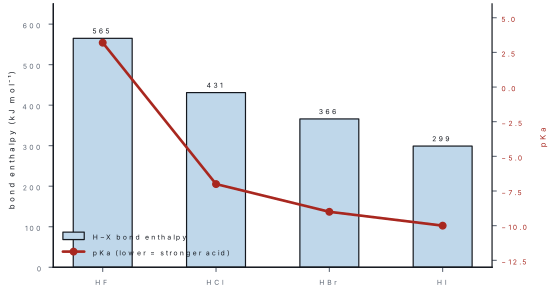
Trends in one breath: bond strength HF > HCl > HBr > HI, so thermal stability falls and acidity and reducing power rise down the group; silver halide tests run AgCl (white, NH₄OH-soluble) → AgBr (pale yellow, sparingly soluble) → AgI (yellow, insoluble) as Ksp falls (Ch. 7 patterns again).
13.5 Allotropes of carbon and carbon monoxide; H₂S, SO₂ and sulphuric acid
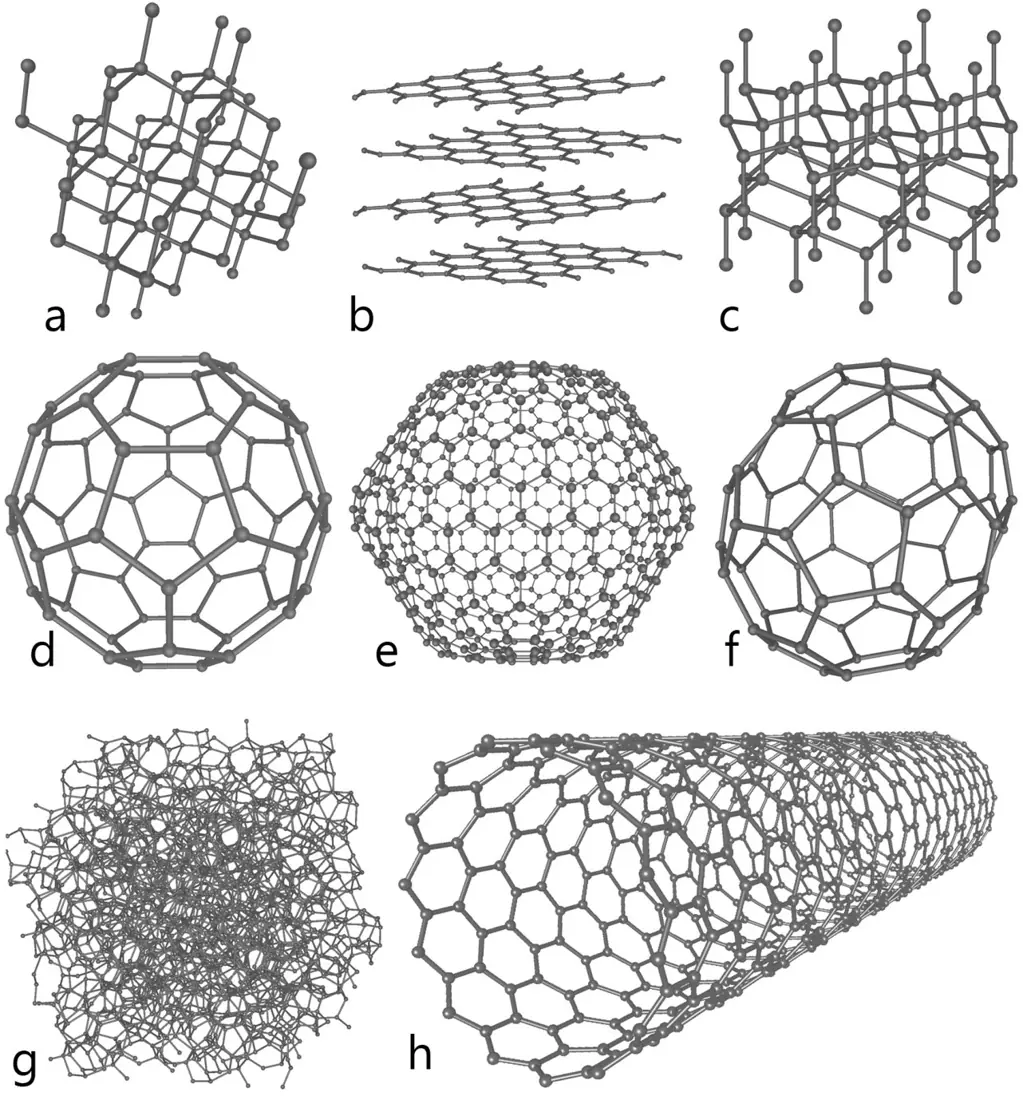
Allotropes. Diamond: every C sp³-bonded in a 3-D tetrahedral lattice — the hardest natural substance, electrical insulator, superb heat conductor, transparent, very high melting. Graphite: sp² sheets (each C bonded to three, the fourth electron delocalized) held by weak forces — soft, slippery (pencil "lead", lubricant), conducts electricity along the planes (electrodes, brushes). Fullerenes (C₆₀ buckminsterfullerene, soccer-ball cages), graphene (a single graphite sheet — Physics Ch. 22), nanotubes, and the amorphous family (coke, charcoal — adsorptive, gas masks; lampblack/carbon black — inks, tyres). Whichever the costume, the chemistry (combustion to CO₂ 393.5 kJ per mole for graphite) is carbon's.
Carbon monoxide CO. Laboratory: dehydrate formic (or oxalic) acid with hot conc. H₂SO₄: HCOOH → CO↑ + H₂O. Industrial: producer gas (air over red-hot coke: CO + N₂) and water gas (steam over coke: CO + H₂, endothermic — alternated with air blasts). Colourless, odourless, almost insidiously poisonous: it binds haemoglobin (carboxyhaemoglobin) some 200–250 times more avidly than O₂ — faulty room heaters kill silently, and cherry-red blood is the post-mortem clue. Chemically a neutral oxide (yet it reduces Fe₂O₃ in the blast furnace, Ch. 14), burns with a blue flame (2CO + O₂ → 2CO₂), and is a strong ligand (Ni + 4CO ⇌ Ni(CO)₄, the Mond refining step).
Hydrogen sulphide H₂S. Kipp's apparatus, FeS + dil. H₂SO₄ → FeSO₄ + H₂S↑ (never conc. acid or HNO₃ — they oxidize it). Rotten-egg gas, denser than air, very poisonous (and treacherously paralyses the sense of smell). A weak dibasic acid (→ HS⁻ → S²⁻) and a reductant (decolorizes Br₂ water and acidified KMnO₄, depositing sulfur). Its kingdom is analysis: with controlled [S²⁻] (acidic vs alkaline medium, the common-ion machinery of Ch. 7) it precipitates metal sulphides group by group (Ch. 22). Test: lead acetate paper turns black (PbS).
Sulphur dioxide SO₂. Made by burning sulfur, roasting sulphides (4FeS₂ + 11O₂ → 2Fe₂O₃ + 8SO₂), or Cu + hot conc. H₂SO₄. Pungent, denser than air, very soluble; an acidic oxide (H₂SO₃ in water; salts sulphites/bisulphites) — a major acid-rain precursor. It is a reducing agent (turns acidified K₂Cr₂O₇ paper green, Cr³⁺ — its distinguishing test; decolorizes KMnO₄) and its bleaching, by reduction of coloured matter to colourless, is temporary (air slowly re-oxidizes the fabric — the eternal pair with chlorine's permanent oxidative bleach).
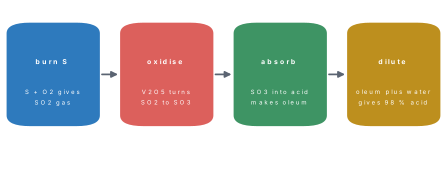
Sulphuric acid H₂SO₄ — the "king of chemicals". Contact process: purify SO₂; 2SO₂ + O₂ ⇌ 2SO₃ over V₂O₅ at ~450 °C and modest pressure (exothermic: low T favoured but rate demands compromise, Ch. 7); absorb SO₃ not in water (violent mist) but in conc. H₂SO₄ to give oleum H₂S₂O₇, then dilute to order. Properties to file in threes: (1) strong dibasic acid (first proton complete); (2) dehydrating agent when concentrated — chars sugar to black carbon (C₁₂H₂₂O₁₁ → 12C + 11H₂O), dries gases (not NH₃, HBr, H₂S), and demands respect on dilution — always acid into water, the mixing is fiercely exothermic; (3) oxidizing agent when hot and concentrated (Cu + 2H₂SO₄ → CuSO₄ + SO₂↑ + 2H₂O; C → CO₂ + SO₂). Tests: BaCl₂ gives a white precipitate of BaSO₄ insoluble in acids. Industrial fingerprints: fertilizers ((NH₄)₂SO₄, superphosphate), detergents, petroleum refining, lead-acid batteries (density of the acid even gauges their charge, Ch. 10).
Problem. A colourless gas G (i) turns limewater milky slowly, (ii) turns acidified potassium dichromate solution green, (iii) decolorizes bromine water, and (iv) bleaches a coloured flower, whose colour returns in a few days. Identify G and the chemistry of (ii).
Solution. G is SO₂: a reducing, acidic gas with temporary reductive bleaching (CO₂ would fail (ii)–(iv); Cl₂'s bleaching is permanent and it is greenish). (ii) SO₂ reduces orange Cr₂O₇²⁻ to green Cr³⁺: K₂Cr₂O₇ + H₂SO₄ + 3SO₂ → K₂SO₄ + Cr₂(SO₄)₃ + H₂O (Cr +6 → +3; S +4 → +6).
Concentrated sulphuric acid fails as a maker/drier whenever the other partner reduces it or is a base: HBr and HI (oxidized to Br₂, I₂), H₂S (oxidized to S), NH₃ (acid–base). Examiners ask for the workarounds (H₃PO₄ for HBr/HI; CaO to dry NH₃; dil. acid for H₂S).
Six swaps the paper sets: nascent hydrogen is atomic hydrogen in statu nascendi, not a different element; D₂O moderates neutrons but poisons eukaryotic life in bulk — the same property list; chlorine bleaches by oxidation (permanent), SO₂ by reduction (temporary); aqua regia is 3 HCl : 1 HNO₃, not the reverse; HF is weak despite fluorine's electronegativity, because the H–F bond and hydrogen bonding hold the proton; and SO₃ is absorbed into acid as oleum, never into water, which would fog it into an unusable mist.
Problem. Write the balanced ionic equations and oxidation-state changes when \text{Cl}_2 reacts with (a) cold, dilute \text{NaOH} and (b) hot, concentrated \text{NaOH}.
Solution. (a) Cold dilute alkali gives chloride (-1) and hypochlorite (+1): \text{Cl}_2 + 2\text{OH}^- \rightarrow \text{Cl}^- + \text{ClO}^- + \text{H}_2\text{O}. (b) Hot concentrated alkali disproportionates \text{Cl}_2 (0) into chloride (-1) and chlorate (+5) in a 5 : 1 molar ratio: 3\text{Cl}_2 + 6\text{OH}^- \rightarrow 5\text{Cl}^- + \text{ClO}_3^- + 3\text{H}_2\text{O}.
Formula and fact sheet
| Topic | Must-know |
|---|---|
| Hydrogen forms | atomic > nascent > molecular (reducing); D₂O: electrolysis, moderator |
| Oxides | CO, NO, N₂O neutral; Al₂O₃, ZnO amphoteric; Na₂O₂ peroxide; KO₂ superoxide |
| Ozone | silent discharge; bent 116.8°, resonance; tests: starch–iodide blue, Hg tailing; CFC Cl• eats it |
| NH₃/PH₃ | Haber Fe/Mo; Nessler brown; [Cu(NH₃)₄]²⁺; PH₃ feebly basic, Ca₃P₂ route, poisonous |
| HNO₃ | Ostwald Pt gauze; Cu dil→NO, conc→NO₂; passivity Fe/Al; brown ring; aqua regia 1:3 |
| Halogens/HX | F>Cl>Br>I oxidizing; acidity and reducing power rise HF ≪ HCl, then HBr, then HI; HF etches glass; AgX colours/solubility |
| Carbon/CO | diamond sp³ insulator; graphite sp² conductor; CO: formic acid route, Hb poison, blue flame |
| Sulphur family | H₂S: Kipp, Pb acetate black, group reagent; SO₂: dichromate green, temporary bleach; H₂SO₄: Contact V₂O₅/oleum, dehydrating + oxidizing (hot conc.) |
Rapid-revision tables and high-yield facts
| Item | Value |
|---|---|
| Nascent hydrogen | newly born atoms, extra reactive |
| Oxide families | acidic / basic / amphoteric / neutral |
| Ozone making | silent electric discharge |
| Ozone geometry | bent, ≈ 117°, bond order 1.5 |
| Ozone depletion | Cl· catalytic, ~10⁵ O₃ per Cl |
| Montreal Protocol | 1987 |
| Aqua regia | 3 HCl : 1 HNO₃ |
| Brown ring | [Fe(H₂O)₅NO]²⁺ |
| HX acid order | HI > HBr > HCl ≫ HF |
| Contact catalyst | V₂O₅; oleum H₂S₂O₇ |
Chapter summary
- Hydrogen's personas scale in reducing violence (H₂ < [H] < atomic H); its isotopes give heavy water (a moderator) and tritium (a tracer).
- Oxides sort by character — acidic, basic, amphoteric, neutral, peroxide, superoxide, mixed — and ozone is oxygen's bent, resonating, oxidizing allotrope, whose stratospheric veil CFC chemistry taught us to defend.
- Ammonia is base and ligand in one lone pair; phosphine its feebler, fouler sibling; nitric acid an oxidizing acid whose product gas advertises its concentration.
- Halogens weaken downwards as oxidants while their hydrides strengthen as acids and reductants; HF alone is weak — and alone eats glass.
- Carbon reinvents itself from diamond to graphene; CO poisons quietly and refines metals; the sulphur trio H₂S/SO₂/H₂SO₄ escalates from analytical precipitant to the dehydrating, oxidizing king of chemicals.
Practice questions
Set A — Recall (25 questions)
- Nascent hydrogen is more reactive than ordinary (molecular) hydrogen because it isaionic H⁺ in solutionbmixed with oxygencat higher pressuredavailable as atoms/at the surface at the moment of formation
- Heavy water isaD₂O (deuterium oxide)bH₂O with dissolved saltsctritium waterdwater at 4 °C only
- The isotopic composition of tritium nucleus isa1 proton, 0 neutronb1 proton, 1 neutronc1 proton, 2 neutronsd2 protons, 1 neutron
- Which of the following oxides is neutral?aCO₂bCOcSO₂dCaO
- ZnO and Al₂O₃ are examples ofaamphoteric oxidesbacidic oxidescneutral oxidesdperoxides
- Ozone is prepared in the laboratory by passing through oxygen aaspark discharge loudlybbeam of α-rays onlyccurrent of steamdsilent electric discharge
- The "tailing of mercury" test is used forachlorinebozonecsulphur dioxidedammonia
- The depletion of the ozone layer is mainly caused by free radicals ofamethane directly fragmenting O₃bcarbon dioxidecchlorine from CFCsdwater vapour
- In Haber's process the catalyst used isaplatinum gauzebiron with molybdenum promotercvanadium pentoxidednickel
- Nessler's reagent gives a brown colour/precipitate withaammonia/ammonium saltsbCO₂cH₂Sdchlorine
- The deep blue colour when excess ammonia is added to copper sulphate solution is due toaCuObNH₄⁺ itself colouredcCu metald[Cu(NH₃)₄]²⁺ complex ion
- Phosphine is prepared in the laboratory by treating calcium phosphide withaconc. HNO₃bNaOH strong only heating P redcwaterdoxygen
- In Ostwald's process, ammonia is oxidized to NO over a catalyst ofaplatinum–rhodium gauzebV₂O₅cFe/ModCuCl₂
- Copper with dilute nitric acid gives mainly the gasaNO₂bN₂OcNOdH₂
- Iron becomes passive in concentrated HNO₃ because of the formation ofaferrous nitrateba protective oxide film on the surfacechydrogen layerdmagnetic iron only by cooling
- Aqua regia is a mixture (by volume) of concentratedaHCl : HNO₃ = 1 : 3bHCl : H₂SO₄ = 3 : 1cH₂SO₄ : HNO₃ = 1 : 1dHNO₃ : HCl = 1 : 3
- The strongest acid among the hydrogen halides isaHFbHClcHIdHBr
- Hydrofluoric acid is stored in wax/plastic bottles (not glass) because itais very volatilebattacks glass forming SiF₄cis a strong oxidantdfreezes glass joints always
- The allotrope of carbon that conducts electricity isagraphitebdiamondccharcoal ideally puredcoke metal-like entirely
- Carbon monoxide is poisonous because itaburns the lungsbstops diffusion by weightcis acidicdbinds haemoglobin much more strongly than oxygen (carboxyhaemoglobin)
- Water gas is a mixture ofaCO + N₂bCO + H₂cCO₂ + H₂dH₂ + O₂
- Lead acetate paper turning black is a test foraSO₂bNH₃cCl₂dH₂S
- Sulphur dioxide turns acidified potassium dichromate solutionabluebcolourless eternalcgreendpink
- In the Contact process for H₂SO₄, SO₃ is absorbed in concentrated sulphuric acid to formaoleum (H₂S₂O₇)bpersulphuric acidcsulphurous aciddthiosulphuric acid
- The bleaching action of SO₂ differs from that of Cl₂ in beingastrongerbonly for wool bannedctemporary (reductive) whereas chlorine's is permanent (oxidative)dheat-free always
Answers and explanations — Set A
1. (d) — atoms not yet paired into H₂ (and surface-adsorbed H) reduce directly; molecular H₂ must first break its bond.
2. (a) — deuterium oxide; tritium water would be T₂O (a biohazard, option (c) is a real but different thing).
3. (c) — mass 3 with the lone charge of hydrogen.
4. (b) — CO is neutral (also NO, N₂O, H₂O). (a), (c) acidic; (d) basic.
5. (a) — dual behaviour with acids and alkalis.
6. (d) — sparkless discharge: the product is endothermic and easily destroyed by heat/sparks.
7. (b) — O₃ oxidizes the mercury surface (Hg₂O), which then wets and sticks to glass.
8. (c) — Cl• (and Br•) radicals from photolysed CFCs/halons, recycled ~10⁵ times each.
9. (b) — finely divided Fe promoted with Mo (modern plants use K₂O/Al₂O₃ promoters — the Fe/Mo formulation is the syllabus classic).
10. (a) — K₂[HgI₄]/KOH gives brown iodide of Millon's base with NH₃ traces (water analysis standard).
11. (d) — tetraamminecopper(II): the hydroxide precipitate first formed dissolves into the complex.
12. (c) — Ca₃P₂ + 6H₂O → 3Ca(OH)₂ + 2PH₃.
13. (a) — Pt–Rh gauze at ~800 °C, millisecond contact.
14. (c) — 3Cu + 8HNO₃(dil) → 3Cu(NO₃)₂ + 2NO + 4H₂O (the NO browns at the mouth, NO₂).
15. (b) — an impervious Fe₃O₄-type film; scratch it under the acid and attack restarts.
16. (d) — 1 volume conc. HNO₃ to 3 volumes conc. HCl (freshly mixed).
17. (c) — weakest H–X bond, easiest proton release; HF is (famously) the weak one.
18. (b) — it converts silica to gaseous SiF₄/soluble H₂SiF₆, etching the bottle through.
19. (a) — graphite's delocalized π electrons travel the sheets; diamond's are all σ-locked.
20. (d) — carboxyhaemoglobin locks up the O₂ seats (affinity ~250 : 1).
21. (b) — from steam over coke; producer gas (air) is CO + N₂, option (a).
22. (d) — black PbS; the matching sulphide-analytical chemistry is Chapter 22.
23. (c) — Cr(VI) orange → Cr(III) green: the signature of a reducer.
24. (a) — absorbing into water directly makes a stubborn acid mist; oleum is then diluted to strength.
25. (c) — reduction to a colourless form that air re-oxidizes (straw hats re-yellow), while chlorine destroys chromophores permanently.
Set B — Understanding (15 questions)
- Ozone acts as a stronger oxidizing agent than oxygen mainly because itais heavierbis ioniccreadily yields a reactive oxygen atom, O₃ → O₂ + [O]ddissolves less
- The two O–O bonds in ozone are of equal length because the molecule isalinearban ion pair fixedchydrogen bondedda resonance hybrid with delocalized π electrons
- Ammonia gas is dried by passing over quicklime (CaO) and not over conc. H₂SO₄ or CaCl₂ because ammoniaareacts with H₂SO₄ and forms a complex with CaCl₂ (CaCl₂·8NH₃)bis acidiccis too lightddissolves in lime fully
- Basicity falls drastically from NH₃ to PH₃ chiefly because the lone pair on phosphorusais absentboccupies a larger, more diffuse orbital, less available for donationcis shared with metals onlydis used in π bonding with H strongly
- A bottle of concentrated nitric acid turns yellow-brown on standing in light because it slowly decomposes to giveaN₂bO₃cNH₃dNO₂ which dissolves in the acid
- Chlorine displaces bromine from KBr solution, but bromine cannot displace chlorine from KCl. This follows the order ofaatomic massesboxidizing power/electron affinity: Cl₂ > Br₂csolubility fixed ratiosdboiling points descending helps only
- HBr cannot be prepared by warming NaBr with conc. H₂SO₄, the way HCl is made from NaCl, because conc. H₂SO₄adoes not react with NaBrbis too dilutecoxidizes the HBr formed to Br₂dabsorbs HBr as base
- Diamond is hard and an insulator, graphite soft and a conductor, because in diamond each carbon isasp³-bonded in a 3-D network with all electrons localizedbsp² in sheetscionizeddlarger in size atoms differing
- Charcoal decolourizes sugar solutions (and is used in gas masks) mainly throughareduction of the colourbadsorption on its huge porous surfacecoxidation to CO₂ fastdacid neutralization
- Sulphur dioxide bleaches moist litmus first red then colourless while CO₂ only turns it red; the additional action of SO₂ is itsareducing (bleaching) propertybbasicitycgreater acidity so strong it destroys paper alwaysdprecipitation of dye
- Why is sulphuric acid added to water, and never the reverse, when diluting?aconvention onlybthe acid would float otherwise inertlycwater evaporates the acid's power chemicallyddilution is highly exothermic; much water absorbs the heat safely
- When conc. H₂SO₄ is dropped on sugar, it turns black. This demonstrates the acid's role as aareducing agentbcatalyst of burning by aircdehydrating agent (removes H and O as water, leaving carbon)dpigment itself
- Hydrogen peroxide and ozone both liberate iodine from KI solution, yet H₂O₂ can also remove the iodine colour in presence of... — in the syllabus frame, an agent acting both as oxidant and reductant is exemplified also byaSO₂ (reduces dichromate, oxidized by halogens; oxidized state +4 mid-way)bconc. HNO₃ only ever oxidant strictcCl₂ in water cold alkali only reductantdCO₂
- Mercury kept in ozonized air loses its shining mobility; the same mercury recovers on shaking with water. The skin formed is ofaHgO red oxide thickbHgScamalgamdHg₂O (mercurous oxide film)
- Kerosene stoves in sealed winter rooms kill through CO rather than CO₂ mainly because, mole for mole, CO is dangerous at concentrations where CO₂ is merely stuffy, owing to itsacolourbchemical hijacking of haemoglobin at tiny partial pressurescgreater density at ceiling level alwaysdflammability indoors specifically
Answers and explanations — Set B
1. (c) — the third atom is weakly held (ΔH of O₃ formation is positive: it "wants" to let go).
2. (d) — bond order 1.5 in both links; the bent shape comes from the central lone pair.
3. (a) — NH₃ is a base (makes (NH₄)₂SO₄ with the acid) and a ligand (absorbed by CaCl₂ as ammine): both classic driers eat the product.
4. (b) — poorer overlap/donation from the bigger, more s-like lone pair (bond angle also shrinks: PH₃ 93.6° vs NH₃ 107°).
5. (d) — 4HNO₃ → 4NO₂ + O₂ + 2H₂O in sunlight: brown NO₂ stays dissolved (blow air through warm acid to bleach it back).
6. (b) — the halogen pecking order F > Cl > Br > I is an electron-affinity/E° ladder (Ch. 10 series logic).
7. (c) — hot conc. acid takes HBr up to red Br₂ vapour (you collect brown mist, not the hydracid): switch to syrupy H₃PO₄.
8. (a) — the network locks every electron into σ bonds, hard and insulating; graphite's leftover π system gives slip and conduction.
9. (b) — surface adsorption (Physics Ch. 22's area arithmetic at household scale); filtration/regeneration by steam confirms it is physical capture.
10. (a) — SO₂ + water gives a reducing medium ("nascent hydrogen" in old books, in truth direct electron transfer hydrating the dye).
11. (d) — with water-on-top the first drops boil in a concentrated layer and spatter acid; acid-into-water keeps every drop met by a cool excess.
12. (c) — the elements of water are torn out of the carbohydrate skeleton, leaving black carbon (dehydration, not burning).
13. (a) — sulfur at +4 can climb to +6 (acting reductant, e.g. to dichromate) or fall to 0/−2 as oxidant (e.g. with H₂S: SO₂ + 2H₂S → 3S + 2H₂O — the volcanic sulfur maker).
14. (d) — a film of Hg₂O makes the metal drag and stick ("tail"); acids/shaking strip it off again.
15. (b) — even 0.1 % CO (1000 ppm) ties up a lethal fraction of haemoglobin over hours, far below CO₂ discomfort levels: chemistry, not suffocation by displacement.
Set C — Application (10 questions)
- Which gas is obtained when formic acid is warmed with concentrated H₂SO₄?aCO₂bCOcH₂dCH₄
- A gas turns starch–iodide paper blue and also causes tailing of mercury. The gas isaCl₂ alone onlybSO₂cO₃dNO₂
- When Cl₂ is passed through cold dilute NaOH, the products areaNaCl + NaOClbNaCl + NaClO₃cNaClO₃ + H₂dNaCl + H₂O only
- White fumes with a glass rod dipped in conc. HCl held near a gas identify the gas asaCl₂bCO₂cSO₂dNH₃
- In the brown ring test for nitrate, the brown colour is due to the complexa[Fe(CN)₅NO]²⁻ always nitroprusside confusionbFe₂O₃c[Fe(NO)]SO₄dFe(NO₃)₃ brown salt solid
- Which element will displace iodine from a KI solution but not displace chlorine from KCl?aBr₂bF₂cI₂dAt never used practical scale
- Passing H₂S through acidified KMnO₄ solutionaturns it greenbprecipitates PbScevolves Cl₂ddecolorizes it with a yellow-white sulfur deposit
- A mixture required to dissolve gold is freshly prepared aqua regia; the active species attacking gold includeahot waterbnascent chlorine/NOCl and complexation to [AuCl₄]⁻cfluorine gas releaseddozone
- Sulphur is burnt in air and the gas passed into water; the solution turns blue litmus red and slowly becomes a stronger acid on keeping in air because it containsaH₂SO₃ which air-oxidizes to H₂SO₄bH₂ScHCl impuritydcarbolic acid formation
- The catalyst and temperature in the oxidation of SO₂ to SO₃ (Contact process) areaFe/Mo at 450 °CbV₂O₅ at about 450 °CcPt gauze at 800 °CdNi at 200 °C
Answers and explanations — Set C
1. (b) — HCOOH —(conc. H₂SO₄)→ CO + H₂O: the standard laboratory CO generator. (Oxalic acid gives CO + CO₂, separated by KOH.)
2. (c) — the pair of tests together pin ozone (Cl₂ also blues starch–iodide but does not tail mercury and is greenish-yellow — the question's combination is the fingerprint).
3. (a) — cold/dilute: chloride + hypochlorite (bleach); hot/concentrated would give the chlorate of (b).
4. (d) — NH₄Cl smoke-particles: the pocket test for ammonia leaks.
5. (c) — nitrosoferrous sulphate at the acid–water junction; shake and it vanishes (NO escapes). (a) is the nitroprusside used for a different (sulphide) test.
6. (a) — the displacement ladder: Br₂ oxidizes I⁻ but not Cl⁻.
7. (d) — H₂S reduces MnO₄⁻ all the way to Mn²⁺, itself stopping at S. (In neutral solution the Mn stops at brown MnO₂ — medium matters, as Ch. 8's n-factors priced.)
8. (b) — HNO₃ oxidizes the HCl's chloride (NOCl + Cl₂), and [AuCl₄]⁻ complexation drags the equilibrium across (Ch. 14 metallurgy meets this again).
9. (a) — sulphurous acid slowly air-oxidizes (2H₂SO₃ + O₂ → 2H₂SO₄): acid rain chemistry in a beaker.
10. (b) — V₂O₅ (or Pt in older plants), ~450 °C, near-atmospheric to 2 atm: the exothermic-equilibrium compromise of §7.2. (a) is Haber's recipe, (c) Ostwald's.)
Haber NH₃ = Fe/Mo; Ostwald HNO₃ = Pt–Rh gauze; Contact H₂SO₄ = V₂O₅. The options in at least one question a year are exactly these three, shuffled.