Chapter 8 · Physical Chemistry · 1 question in the paper · 29 min read
Volumetric Analysis
What the syllabus asks for 2
- Equivalent weight; concentration as percentage, g/L, normality, molarity, molality, formality, ppm, ppb and mole fraction
- Primary and secondary standards; the law of equivalence and the normality equation
Volumetric analysis is the branch of the paper where chemistry becomes a measurement: a solution of known strength is run from a burette into a measured volume of the unknown until the reaction is just complete. It carries about one question (our estimate from the MEC topic list), and that question is nearly always arithmetic — an equivalent weight, a conversion between two concentration units, or a titration volume from N_1V_1 = N_2V_2. The definitions are few; the marks are lost on units, on the n-factor of the reagent, and on the difference between molality and molarity.
- Equivalent weight E = M/n, where the n-factor is the basicity of an acid, the acidity of a base, the total charge of the cation of a salt, or the number of electrons gained or lost by an oxidant or reductant.
- KMnO₄ has three n-factors: 5 in acidic medium (to Mn²⁺), 3 in neutral (to MnO₂), 1 in strongly alkaline (to MnO₄²⁻). K₂Cr₂O₇ is always 6.
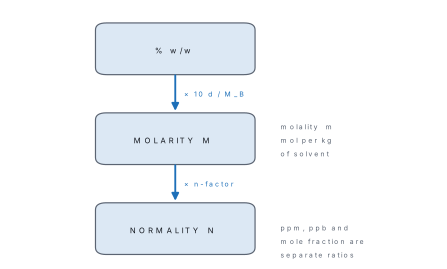
- Molarity = mol solute per litre of solution; molality = mol solute per kg of solvent; normality = molarity × n-factor.
- The one conversion that needs the density: M = \dfrac{10 \times \%\text{w/w} \times d}{M_B}.
- ppm = mg per kg (≈ mg L⁻¹ in dilute water), ppb = μg per kg; mole fraction = n_i/\sum n.
- Dilution: M_1V_1 = M_2V_2 — the number of moles does not change.
- A primary standard is pure, stable, non-hygroscopic and of high molar mass (oxalic acid, Na₂CO₃, KHP, borax, K₂Cr₂O₇); NaOH, HCl, KMnO₄ and Na₂S₂O₃ are secondary and must be standardised.
- Law of equivalence: N_1V_1 = N_2V_2; equivalents = NV(\text{L}) = \text{mass}/E. In a back titration the excess is subtracted.
8.1 Equivalent weight and every concentration unit
What a titration is
Volumetric analysis is the quantitative determination of the concentration of a solution by measuring the volume of another solution of known concentration that reacts with it completely.
| Term | Meaning |
|---|---|
| titrant | the solution of known concentration, run from the burette |
| analyte (titrand) | the solution being measured, pipetted into the conical flask |
| standard solution | a solution whose concentration is accurately known |
| equivalence point | the point at which the reactants have combined in the exact stoichiometric ratio |
| end point | the point at which the indicator changes colour — the observed approximation to the equivalence point |
| titration error | the difference between the end point and the equivalence point |
The whole method rests on one measurement: the volume delivered. Everything else is a conversion from that volume to an amount of substance.
Equivalent weight and the n-factor
The equivalent weight E of a substance is the mass of it that supplies, consumes or is associated with one mole of H⁺, one mole of OH⁻ or one mole of electrons in the reaction concerned.
where M is the molar mass and n is the n-factor (the number of equivalents per mole).
The n-factor is not a property of the substance alone — it is a property of the substance in a particular reaction. That is why KMnO₄ has three different equivalent weights.
| Substance | Reaction role | n-factor | E (g eq⁻¹) |
|---|---|---|---|
| HCl | acid (basicity 1) | 1 | 36.5 |
| CH₃COOH | acid (basicity 1) | 1 | 60 |
| H₂SO₄ | acid (basicity 2) | 2 | 49 |
| H₃PO₄ | acid (basicity 3) | 3 | 32.7 |
| NaOH | base (acidity 1) | 1 | 40 |
| Ca(OH)₂ | base (acidity 2) | 2 | 37 |
| Na₂CO₃ | salt, 2 H⁺ accepted | 2 | 53 |
| NaHCO₃ | salt, 1 H⁺ accepted | 1 | 84 |
| KMnO₄ (acidic) | Mn⁷⁺ → Mn²⁺, 5 e⁻ | 5 | 31.6 |
| KMnO₄ (neutral) | Mn⁷⁺ → Mn⁴⁺, 3 e⁻ | 3 | 52.7 |
| KMnO₄ (alkaline) | Mn⁷⁺ → Mn⁶⁺, 1 e⁻ | 1 | 158 |
| K₂Cr₂O₇ (acidic) | 2 Cr⁶⁺ → 2 Cr³⁺, 6 e⁻ | 6 | 49 |
| FeSO₄ | Fe²⁺ → Fe³⁺, 1 e⁻ | 1 | 152 |
| H₂C₂O₄·2H₂O | C₂O₄²⁻ → 2CO₂, 2 e⁻ | 2 | 63 |
| Na₂S₂O₃ | 2S₂O₃²⁻ → S₄O₆²⁻, 2 e⁻ for two | 1 | 158 |
| I₂ | I₂ → 2I⁻, 2 e⁻ | 2 | 127 |
- H₃PO₄ is tribasic, so E = 98/3 = 32.7 when all three hydrogens are replaced. In a reaction that replaces only one, E = 98; only two, E = 49. Read what the equation does.
- Na₂CO₃ with HCl to the methyl orange end point (all the way to CO₂) has n = 2 and E = 53. To the phenolphthalein end point it stops at NaHCO₃ and n = 1, E = 106.
- Na₂S₂O₃ has n = 1, not 2, because the two sulphur atoms in one formula unit lose one electron each between them.
- Oxalic acid as the dihydrate has M = 126, so E = 63; the anhydrous acid gives 45.
Problem. Find the equivalent weight of KMnO₄ when it oxidises oxalate in acid: 2KMnO₄ + 5H₂C₂O₄ + 3H₂SO₄ → K₂SO₄ + 2MnSO₄ + 10CO₂ + 8H₂O. (K = 39, Mn = 55, O = 16)
Solution. Manganese goes from +7 in MnO₄⁻ to +2 in Mn²⁺, a gain of 5 electrons per formula unit, so n = 5. M = 39 + 55 + 64 = 158, hence E = 158/5 = 31.6 g eq⁻¹. The same reaction shows oxalate losing 2 electrons per H₂C₂O₄, so its E = 90/2 = 45.
The concentration units
| Unit | Definition | Formula |
|---|---|---|
| % w/w | mass of solute per 100 g of solution | \dfrac{m_{\text{solute}}}{m_{\text{solution}}}\times 100 |
| % w/v | mass of solute per 100 mL of solution | \dfrac{m_{\text{solute}}\text{ (g)}}{V\text{ (mL)}}\times 100 |
| g L⁻¹ | mass of solute per litre of solution | m/V |
| Molarity M | moles of solute per litre of solution | \dfrac{n}{V(\text{L})} |
| Molality m | moles of solute per kilogram of solvent | \dfrac{n}{m_{\text{solvent}}(\text{kg})} |
| Normality N | equivalents of solute per litre of solution | \dfrac{\text{eq}}{V(\text{L})} = M \times n\text{-factor} |
| Formality F | formula masses per litre of solution | \dfrac{\text{formula mass}}{\text{L}} |
| ppm | parts per million by mass | \dfrac{m_{\text{solute}}}{m_{\text{solution}}}\times 10^{6} ≈ mg kg⁻¹ |
| ppb | parts per billion by mass | \dfrac{m_{\text{solute}}}{m_{\text{solution}}}\times 10^{9} = μg kg⁻¹ |
| mole fraction x | moles of one component ÷ total moles | \dfrac{n_i}{n_1+n_2+\dots} |
Molarity from percentage and density. This is the conversion the paper actually asks, and it needs the density because a percentage is by mass while molarity is by volume:
Setting up. Take exactly 100 g of solution. It contains p grams of solute (p = the percentage) and has density d g mL⁻¹.
Step 1 — the volume of 100 g. V = \dfrac{100}{d} mL = \dfrac{0.1}{d} L.
Step 2 — the moles of solute. n = \dfrac{p}{M_B}.
Step 3 — divide.
Result. M = \dfrac{10 \times \%\text{w/w} \times d}{M_B} with d in g mL⁻¹.
What it means. A percentage tells you nothing about molarity until you know how heavy the solution is. The factor 10 comes from 1000 mL ÷ 100 g.
Problem. Concentrated sulphuric acid is 98 % w/w H₂SO₄ and has density 1.84 g mL⁻¹. Find its molarity and normality. (M_{\text{H}_2\text{SO}_4} = 98)
Solution. M = \dfrac{10 \times 98 \times 1.84}{98} = 18.4 mol L⁻¹. Sulphuric acid has two replaceable hydrogens, so N = 2 \times 18.4 = 36.8 N. This is why concentrated H₂SO₄ is described as "18 M" in the laboratory.
Molality of a glucose solution
Problem. A 10 % w/w aqueous glucose solution contains 10 g of glucose (M = 180) in 90 g of water. Find its molality.
Solution. n = 10/180 = 0.0556 mol; solvent = 90 g = 0.090 kg. m = 0.0556/0.090 = 0.617 mol kg⁻¹. Note that the denominator is the mass of water, not the mass of the solution (100 g). Using 0.100 kg gives 0.556, the classic wrong option.
Problem. (a) 0.020 g of Ca²⁺ is dissolved in 1.00 kg of water. Express this in ppm. (b) A sample contains 5 μg of arsenic per kg. Express this in ppb. (c) 36 g of water is mixed with 46 g of ethanol. Find the mole fraction of ethanol.
Solution. (a) 0.020\ \text{g} = 20 mg in 1.00 kg, so 20 ppm. (b) 5 μg kg⁻¹ = 5 ppb (1 ppb = 1 μg kg⁻¹). (c) Water: 36/18 = 2 mol; ethanol: 46/46 = 1 mol; total 3 mol. x_{\text{ethanol}} = 1/3 = 0.333. The mole fractions of all components add to 1.
- Molarity is per litre of solution; molality is per kilogram of solvent. Molarity changes when the solution is warmed (the volume expands); molality does not, which is why colligative-property work uses molality.
- Normality is molarity times the n-factor, so the same solution can be 0.1 M and 0.5 N (KMnO₄ in acid). Never write "0.1 N KMnO₄" and then use 0.1 as the molarity.
- ppm is a mass ratio, so it equals mg L⁻¹ only for dilute aqueous solutions, where 1 L weighs about 1 kg. For a concentrated or non-aqueous solution the two differ.
Dilution
Diluting a solution adds solvent but not solute, so the number of moles is unchanged:
Problem. What volume of 2.0 M HCl is needed to prepare 500 mL of 0.10 M HCl?
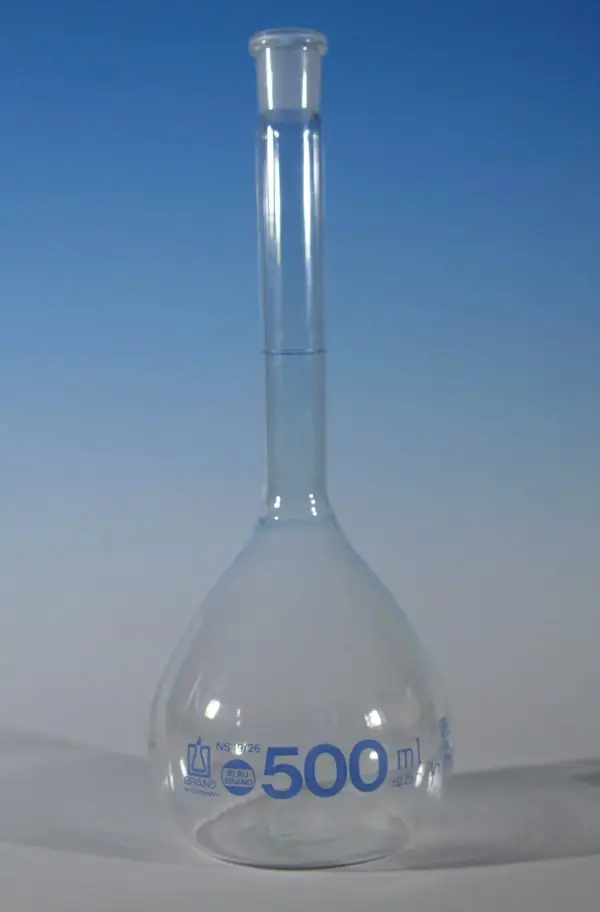
Solution. V_1 = \dfrac{M_2V_2}{M_1} = \dfrac{0.10 \times 500}{2.0} = 25 mL. Measure 25 mL of the concentrated acid into a 500 mL volumetric flask and make up to the mark with water. (Acid into water, never water into acid.)
8.2 Primary and secondary standards; the law of equivalence
Primary and secondary standards
A primary standard is a substance pure enough and stable enough to be weighed directly and dissolved to give a solution of accurately known concentration, without standardising it against anything else.
| Quality of a primary standard | Why it matters |
|---|---|
| very high purity (99.9 % or better) | the mass weighed is the mass of the substance |
| stable in air — not hygroscopic, not efflorescent, not oxidised | the mass does not drift while you weigh it |
| high molar mass | a weighing error of 1 mg is a smaller fraction of a larger mass |
| readily soluble in water | it must dissolve completely and quickly |
| reacts rapidly and stoichiometrically | a sharp end point, a known equation |
| non-toxic and reasonably cheap | it is used in every laboratory |
| Primary standards | Used to standardise |
|---|---|
| oxalic acid H₂C₂O₄·2H₂O | NaOH, KMnO₄ |
| anhydrous sodium carbonate Na₂CO₃ | HCl, H₂SO₄ |
| potassium hydrogen phthalate (KHP) | NaOH |
| borax Na₂B₄O₇·10H₂O | HCl |
| potassium dichromate K₂Cr₂O₇ | Na₂S₂O₃, Fe²⁺ solutions |
| sodium chloride NaCl | AgNO₃ |
| pure zinc or copper | EDTA, iodine |
| Mohr's salt FeSO₄·(NH₄)₂SO₄·6H₂O | KMnO₄, K₂Cr₂O₇ |
A secondary standard is a solution whose concentration is found by titrating it against a primary standard. Its own solute is not pure or stable enough to be weighed directly.
| Secondary standard | Why it cannot be a primary standard |
|---|---|
| NaOH, KOH | hygroscopic; absorb CO₂ from the air, so the effective concentration drifts |
| HCl, H₂SO₄ | HCl is volatile; both absorb water and their strength varies |
| KMnO₄ | decomposes slowly, oxidises water and traces of organic matter; light-sensitive |
| Na₂S₂O₃ | decomposes in acid and is attacked by CO₂ and bacteria; concentration falls with time |
| I₂ | volatile and slightly soluble in water; solutions change strength on standing |
Analytical-grade NaOH is sold as pure pellets, yet it still cannot be a primary standard, because it takes water and CO₂ out of the air the moment the bottle is opened. Purity at the factory and stability on the balance are different requirements, and the paper tests the second one.
The law of equivalence and the normality equation
At the equivalence point, the number of equivalents of the titrant equals the number of equivalents of the analyte:
where N is normality in eq L⁻¹ and V is volume in the same unit on both sides.
Equivalents can be counted in three ways, and all three must agree:
That identity is what makes normality so convenient: it removes the coefficients from the calculation. Twenty millilitres of 0.1 N acid neutralises exactly twenty millilitres of 0.1 N base, whatever the acid and whatever the base, because "equivalent" already means "capable of reacting with one mole of the other partner".
Problem. 25.0 mL of 0.100 M Na₂CO₃ is titrated with 0.200 M HCl to the methyl orange end point. Find the volume of acid used.
Solution — normality route. Na₂CO₃ has n = 2, so N = 0.200 N. HCl has n = 1, so N = 0.200 N. Then N_1V_1 = N_2V_2 gives 0.200 \times 25.0 = 0.200 \times V_2, so V_2 = 25.0 mL.
Solution — mole route. Na₂CO₃ + 2HCl → 2NaCl + H₂O + CO₂. Moles of Na₂CO₃ = 0.100 \times 0.0250 = 2.50 \times 10^{-3} mol; HCl needed = 5.00 \times 10^{-3} mol; V = 5.00 \times 10^{-3}/0.200 = 0.0250 L = 25.0 mL. Both routes agree.
Problem. 25.0 mL of a solution of oxalic acid is exactly decolourised by 20.0 mL of 0.0200 M KMnO₄ in acidic medium. Find the normality and the strength of the oxalic acid in g L⁻¹. (E_{\text{oxalic}} = 63)
Solution. KMnO₄ in acid has n = 5, so N = 0.0200 \times 5 = 0.100 N. N_1V_1 = N_2V_2: N_{\text{oxalic}} \times 25.0 = 0.100 \times 20.0, so N_{\text{oxalic}} = 0.0800 N. Strength = N \times E = 0.0800 \times 63 = 5.04 g L⁻¹.
Back titration
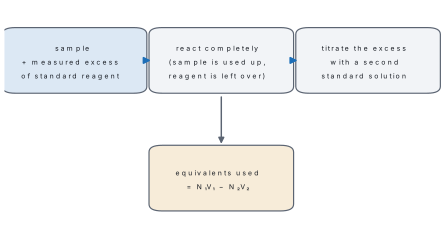
A back titration is used when the reaction is slow, when the analyte is insoluble, or when the end point is hard to see. A measured excess of a standard reagent is added, the mixture is left to react completely, and the unreacted excess is then titrated:
where N_1V_1 refers to the excess reagent added and N_2V_2 to the unreacted part.
Problem. 1.20 g of impure CaCO₃ is dissolved in 50.0 mL of 0.500 N HCl. The excess acid needs 20.0 mL of 0.250 N NaOH for neutralisation. Find the percentage of CaCO₃ in the sample. (Ca = 40, C = 12, O = 16; E_{\text{CaCO}_3} = 50)
Solution. Equivalents of HCl taken = 0.500 \times 0.0500 = 0.0250. Equivalents of HCl left = 0.250 \times 0.0200 = 0.00500. Equivalents used by the carbonate = 0.0250 - 0.00500 = 0.0200. Mass of CaCO₃ = 0.0200 \times 50 = 1.00 g. Percentage = \dfrac{1.00}{1.20} \times 100 = 83.3 %. Check the arithmetic the other way: 0.0200 eq of CaCO₃ is 0.0100 mol, and 0.0100 × 100 = 1.00 g. Both routes agree because E = M/2 = 50.
Choosing the indicator
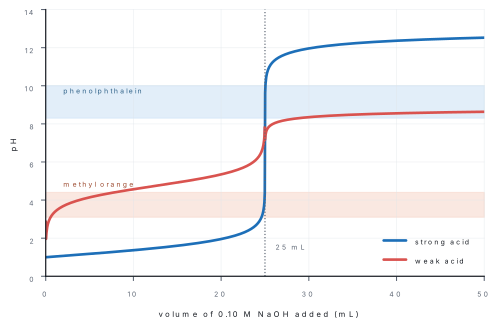
The indicator must change colour within the steep part of the titration curve, so that the end point falls as close as possible to the equivalence point.
| Titration | pH at equivalence | Indicator |
|---|---|---|
| strong acid + strong base | 7 | phenolphthalein (8.3–10.0) or methyl orange (3.1–4.4) |
| weak acid + strong base | above 7 (about 8.7) | phenolphthalein only |
| strong acid + weak base | below 7 (about 5.1) | methyl orange only |
| weak acid + weak base | near 7, no sharp jump | none is satisfactory |
| KMnO₄ against a reductant | — | self-indicating (purple to colourless) |
| iodine against thiosulphate | — | starch (blue-black to colourless) |
- The burette is rinsed with the titrant, the pipette with the solution it will deliver; rinsing with water would dilute the solution.
- The conical flask is rinsed with water only — a few drops of water in the flask do not change the number of moles present.
- Air bubbles in the burette tip must be removed before the initial reading; a bubble that escapes during the titration makes the volume read too high.
- Read the burette at the bottom of the meniscus, with the eye level with the reading.
- The last drop is added dropwise, and the flask is swirled after each addition.
Formula and fact sheet
| Quantity | Relation |
|---|---|
| Equivalent weight | E = M/n; equivalents = \text{mass}/E |
| n-factor: acid | basicity (replaceable H⁺): HCl 1, H₂SO₄ 2, H₃PO₄ 3 |
| n-factor: base | acidity (OH⁻): NaOH 1, Ca(OH)₂ 2, Al(OH)₃ 3 |
| n-factor: salt | total charge on the cation: NaCl 1, Na₂CO₃ 2, Al₂(SO₄)₃ 6 |
| n-factor: redox | electrons gained or lost per formula unit |
| KMnO₄ | 5 (acid, Mn²⁺), 3 (neutral, MnO₂), 1 (alkaline, MnO₄²⁻) |
| K₂Cr₂O₇ | 6 in acid (2Cr³⁺); E = 49 |
| Molarity | M = n/V(\text{L}); M = \dfrac{10 \times \%\text{w/w} \times d}{M_B} |
| Molality | m = n/\text{kg solvent} |
| Normality | N = M \times n\text{-factor} |
| Formality | formula masses per litre; used for ionic solids such as NaCl |
| ppm / ppb | mg kg⁻¹ / μg kg⁻¹ (≈ mg L⁻¹ for dilute aqueous) |
| Mole fraction | x_i = n_i/\sum n; \sum x_i = 1 |
| Dilution | M_1V_1 = M_2V_2; N_1V_1 = N_2V_2 |
| Law of equivalence | N_1V_1 = N_2V_2 at the equivalence point |
| Back titration | equivalents of sample = N_1V_1 - N_2V_2 |
| Strength | g L⁻¹ = N \times E |
| Indicator | pH range | Colour change | Use |
|---|---|---|---|
| methyl orange | 3.1–4.4 | red to yellow | strong acid + weak base |
| methyl red | 4.4–6.2 | red to yellow | strong acid + weak base |
| bromothymol blue | 6.0–7.6 | yellow to blue | strong acid + strong base |
| phenolphthalein | 8.3–10.0 | colourless to pink | weak acid + strong base |
| starch | — | blue-black to colourless | iodometric titrations |
| KMnO₄ itself | — | purple to colourless | permanganate titrations |
Primary standards: oxalic acid, Na₂CO₃, KHP, borax, K₂Cr₂O₇, NaCl, pure Zn/Cu, Mohr's salt. Secondary standards: NaOH, KOH, HCl, H₂SO₄, KMnO₄, Na₂S₂O₃, I₂.
Chapter summary
- Volumetric analysis measures the volume of a standard solution needed to react completely with a measured volume of analyte; the end point is the indicator's approximation to the equivalence point.
- Equivalent weight E = M/n; the n-factor is the basicity of an acid, the acidity of a base, the cation charge of a salt, or the electron change of an oxidant or reductant.
- KMnO₄ has three equivalent weights because it is reduced to Mn²⁺ (n = 5), MnO₂ (n = 3) or MnO₄²⁻ (n = 1); K₂Cr₂O₇ is always n = 6.
- Molarity is per litre of solution and changes with temperature; molality is per kilogram of solvent and does not. Normality = molarity × n-factor.
- M = 10 \times \%\text{w/w} \times d / M_B is the only conversion that needs the density; ppm and ppb are mass ratios, and mole fractions sum to 1.
- Dilution conserves moles: M_1V_1 = M_2V_2.
- A primary standard is pure, stable, non-hygroscopic, soluble, fast-reacting and of high molar mass; NaOH, HCl, KMnO₄, Na₂S₂O₃ and I₂ are secondary standards and must be standardised.
- At the equivalence point N_1V_1 = N_2V_2, and equivalents can be counted as NV, mass/E, or n-factor × moles.
- In a back titration the equivalents used by the sample are the excess added minus the excess titrated back.
- Choose the indicator whose transition range lies on the steep part of the curve: phenolphthalein for weak acid + strong base, methyl orange for strong acid + weak base.
Practice questions
Set A — Recall (23 questions)
- The equivalent weight of an acid is its molar mass divided byaits basicitybits aciditycthe number of oxygen atomsdthe number of moles
- The equivalent weight of H₂SO₄ (M = 98) isa98b24.5c49d32.7
- The n-factor of K₂Cr₂O₇ in acidic medium isa3b6c2d7
- The equivalent weight of KMnO₄ in acidic medium (M = 158) isa158b52.7c79d31.6
- The equivalent weight of anhydrous Na₂CO₃ (M = 106) isa106b53c35.3d26.5
- Molarity is the number of moles of solute peralitre of solutionbkilogram of solventclitre of solventdkilogram of solution
- Molality is expressed inamol L⁻¹bmol kg⁻¹ceq L⁻¹dg L⁻¹
- Normality is equal to molarity multiplied byamolar massbdensitycthe n-factordvolume in litres
- One part per million is the same asa1 g per kgb1 mg per gc1 μg per kgd1 mg per kg
- The sum of the mole fractions of all the components of a solution isa1b100c0dequal to the molarity
- Formality is normally used foraweak acidsbgasescionic solids that do not exist as moleculesdnon-electrolytes
- Which substance is a primary standard?aNaOHboxalic acidcHCldKMnO₄
- Which substance is NOT a primary standard?aNaOHbNa₂CO₃cpotassium hydrogen phthalatedborax
- The law of equivalence is written asaM_1V_1 = M_2V_2bN_1V_2 = N_2V_1cN_1 = N_2dN_1V_1 = N_2V_2
- The indicator used for a strong acid–weak base titration isaphenolphthaleinbmethyl orangecstarchdlitmus
- The indicator used for a weak acid–strong base titration isamethyl orangebstarchcphenolphthaleindmethyl red
- The number of equivalents of a solute is equal toaN \times V in litresbM \times V in litrescmass × EdN/V
- The equivalent weight of oxalic acid dihydrate (M = 126) isa126b45c90d63
- The point at which the indicator changes colour in a titration is called theaequivalence pointbend pointcneutral pointdstoichiometric point
- Potassium permanganate needs no external indicator because it isacolourlessbyellowcpurple and turns colourlessdwhite
- A primary standard should haveaa high molar massblow solubilityca low molar massdhigh volatility
- The burette should be rinsed withadistilled waterbthe analyte solutioncthe indicatordthe titrant
- 1 M H₂SO₄ is the same asa0.5 Nb2 Nc1 Nd4 N
Answers and explanations — Set A
1. (a) — An acid's n-factor is its basicity, the number of replaceable H⁺ per molecule. For a base it would be the acidity, the number of OH⁻.
2. (c) — Sulphuric acid is dibasic, so E = 98/2 = 49. Option (a) forgets the n-factor and (d) is the value for H₃PO₄.
3. (b) — Two chromium atoms go from +6 to +3, so 2 × 3 = 6 electrons are gained per formula unit. Option (a) counts only one chromium atom.
4. (d) — Mn goes from +7 to +2, so n = 5 and E = 158/5 = 31.6. Option (b) is the value in neutral medium (n = 3).
5. (b) — The carbonate ion takes two protons, so n = 2 and E = 106/2 = 53. Option (a) uses n = 1, which is right only for NaHCO₃.
6. (a) — Molarity is moles per litre of solution, not of solvent. The volume includes the solute.
7. (b) — Molality is moles of solute per kilogram of solvent, so its unit is mol kg⁻¹ and it does not change with temperature.
8. (c) — N = M \times n-factor. The n-factor is 1 for HCl, 2 for H₂SO₄ and 5 for KMnO₄ in acid.
9. (d) — ppm is 1 mg per kg (or per litre of dilute aqueous solution). Option (c) is one part per billion.
10. (a) — Mole fractions are fractions of the total number of moles, so they must add up to exactly 1.
11. (c) — Formality counts formula masses per litre and is used for ionic solids such as NaCl, which contain no discrete molecules.
12. (b) — Oxalic acid is pure, stable and non-hygroscopic. NaOH absorbs CO₂ and water, HCl is volatile and KMnO₄ decomposes.
13. (a) — NaOH is hygroscopic and absorbs CO₂ from the air, so its concentration drifts. The other three are standard primary standards.
14. (d) — At the equivalence point the equivalents of the two reactants are equal: N_1V_1 = N_2V_2. Option (a) is true only for a 1 : 1 reaction in molar terms.
15. (b) — The salt of a weak base is acidic at equivalence (pH about 5), so the indicator must change in the acid region: methyl orange.
16. (c) — The salt of a weak acid is basic at equivalence (pH about 8.7), so phenolphthalein, which changes at 8.3–10.0, is the right choice.
17. (a) — Equivalents = N \times V in litres. Option (b) gives moles, not equivalents.
18. (d) — Oxalate loses two electrons, so n = 2 and E = 126/2 = 63. Option (b) is the anhydrous value, 90/2.
19. (b) — The end point is what you observe; the equivalence point is the true stoichiometric point. The small difference between them is the titration error.
20. (c) — The purple permanganate ion is reduced to almost colourless Mn²⁺, so the first permanent pink tint marks the end point.
21. (a) — A high molar mass makes the weighing error a smaller fraction of the mass taken. Low solubility and volatility would both be disqualifying.
22. (d) — Rinsing with the titrant removes water that would otherwise dilute it. Rinsing with water would make the delivered concentration lower than stated.
23. (b) — Sulphuric acid has two replaceable protons, so N = 2M = 2 N. Option (c) is the value for a monobasic acid.
Set B — Understanding (14 questions)
- KMnO₄ has different equivalent weights in acidic, neutral and alkaline media becauseaits n-factor depends on the electrons gainedbits molar mass changescthe temperature changesdit decomposes
- NaOH cannot be used as a primary standard because itais insoluble in waterbhas a low molar masscis a strong basedabsorbs water and CO₂ from the air
- Molality is preferred to molarity in colligative-property work because molalityais easier to measurebdoes not change with temperaturecuses a smaller mass of solutedis always numerically smaller
- 0.1 M H₂SO₄ is 0.2 N becauseaits molar mass is 98bit is a strong acidcit has two replaceable H⁺ per moleculedit contains two oxygen atoms
- When a solution is diluted with water, the number of moles of soluteastays the samebincreasescdecreasesddoubles
- Phenolphthalein is unsuitable for a strong acid–weak base titration because the pH at equivalence isaabove 10bexactly 7cbelow 3dbelow its colour-change range
- A primary standard should have a high molar mass so thatait dissolves fasterbit reacts fasterca weighing error is a small fraction of the massdit is cheaper
- A back titration is used whenathe reaction is very fastbthe analyte is insoluble or the reaction is slowcno indicator is availabledthe titrant is a primary standard
- The difference between the end point and the equivalence point is called theatitration errorbindicator constantcpercentage puritydbuffer error
- No external indicator is needed in a permanganate titration becauseathe analyte is already colouredbthe end point is a precipitatecKMnO₄ is its own indicatordthe pH changes sharply
- Which solution has the greater normality: 0.1 M H₂SO₄ or 0.1 M HCl?aHClbboth are equalcit depends on the volumedH₂SO₄, which has two replaceable protons
- A concentration of 1 ppm in water meansa1 g per litreb1 mg per kgc1 μg per kgd1 mol per litre
- The pipette should be rinsed withadistilled waterbthe titrantcthe solution it will deliverdthe indicator
- A few drops of distilled water left in the conical flask before the titrationado not change the number of moles of analytebincrease its concentrationcchange the end pointdinvalidate the titration
Answers and explanations — Set B
1. (a) — The manganese is reduced to Mn²⁺ (5 e⁻), MnO₂ (3 e⁻) or MnO₄²⁻ (1 e⁻), so E = 158/5, 158/3 or 158/1. The molar mass never changes.
2. (d) — Pellets of NaOH take up water and CO₂, forming carbonate, so the mass weighed no longer corresponds to the stated amount of NaOH.
3. (b) — Molality uses a mass of solvent, which does not expand or contract with temperature; a molarity would change as the solution's volume changed.
4. (c) — Normality counts replaceable H⁺, and H₂SO₄ has two. The strength of the acid is irrelevant to the n-factor.
5. (a) — Dilution adds solvent only, so the moles of solute are conserved. That is exactly why M_1V_1 = M_2V_2.
6. (d) — The equivalence pH of about 5 lies below phenolphthalein's range of 8.3–10.0, so the indicator would change far too late.
7. (c) — A 1 mg error on a 2 g mass is 0.05 %; the same error on a 0.05 g mass is 2 %. A high molar mass makes the relative error small.
8. (b) — When the analyte dissolves slowly, reacts slowly, or gives no sharp end point, an excess of reagent is added and the remainder is titrated back.
9. (a) — This difference is the titration error. A good indicator keeps it small by changing on the steep part of the curve.
10. (c) — The purple colour of MnO₄⁻ disappears as it is reduced, so the first permanent pink colour is the end point.
11. (d) — N = M \times n-factor: 0.1 M H₂SO₄ is 0.2 N while 0.1 M HCl is 0.1 N. Normality does not depend on the volume taken.
12. (b) — One part per million is 1 mg kg⁻¹ (≈ 1 mg L⁻¹ for dilute aqueous solutions). Option (c) is 1 ppb.
13. (c) — The pipette must deliver exactly the solution it holds; rinsing with water would dilute it and rinsing with titrant would add extra reagent.
14. (a) — The water adds volume but no analyte, and the titration measures moles, not concentration in the flask. The end point is unchanged.
Set C — Application (9 questions)
- The molarity of 98 % w/w H₂SO₄ of density 1.84 g mL⁻¹ isa9.2 Mb1.84 Mc18.4 Md36.8 M
- The normality of 0.05 M K₂Cr₂O₇ in acidic medium isa0.30 Nb0.05 Nc0.10 Nd0.60 N
- 25 mL of 2.0 M HCl is diluted to 500 mL. The new molarity isa0.50 Mb0.05 Mc1.0 Md0.10 M
- The volume of 0.200 M HCl needed to neutralise 25.0 mL of 0.100 M Na₂CO₃ completely isa12.5 mLb25.0 mLc50.0 mLd5.0 mL
- The mass of Na₂CO₃ needed to prepare 250 mL of 0.100 N solution is (Na = 23)a1.325 gb2.650 gc0.662 gd5.300 g
- 1.20 g of impure CaCO₃ is dissolved in 50.0 mL of 0.500 N HCl; the excess acid needs 20.0 mL of 0.250 N NaOH. The percentage of CaCO₃ (E = 50) isa20.0 %b96.0 %c66.7 %d83.3 %
- The molality of a 10 % w/w glucose solution (M = 180) isa0.556 mb1.00 mc0.617 md0.100 m
- 0.020 g of Ca²⁺ dissolved in 1.00 kg of water gives a concentration ofa2 ppmb20 ppmc200 ppmd0.02 ppm
- 0.200 g of impure NaOH needs 48.0 mL of 0.100 M HCl for neutralisation. The percentage purity of the NaOH is (Na = 23, O = 16, H = 1)a48 %b80 %c96 %d100 %
Answers and explanations — Set C
1. (c) — M = \dfrac{10 \times 98 \times 1.84}{98} = 18.4 M. Option (d) is the normality, since H₂SO₄ has two replaceable protons.
2. (a) — N = M \times 6 = 0.05 \times 6 = 0.30 N. Option (c) wrongly uses n = 2, the n-factor of oxalic acid.
3. (d) — M_2 = M_1V_1/V_2 = 2.0 \times 25/500 = 0.10 M. Option (a) divides by 100 instead of 500.
4. (b) — N(\text{Na}_2\text{CO}_3) = 0.200 N and N(\text{HCl}) = 0.200 N, so N_1V_1 = N_2V_2 gives 25.0 mL. By moles: 0.00250 mol carbonate needs 0.00500 mol acid.
5. (a) — Equivalents = 0.250 \times 0.100 = 0.0250; mass = 0.0250 \times 53 = 1.325 g. Option (b) uses E = 106, i.e. n = 1.
6. (d) — Acid taken 0.0250 eq, acid left 0.00500 eq, so 0.0200 eq reacted with the carbonate; mass = 0.0200 \times 50 = 1.00 g, and 1.00/1.20 = 83.3 %.
7. (c) — 10 g glucose is 0.0556 mol and the solvent is 90 g = 0.090 kg, so m = 0.0556/0.090 = 0.617. Option (a) divides by the 100 g of solution.
8. (b) — 0.020 g = 20 mg in 1.00 kg, so 20 ppm. Option (a) forgets to convert grams to milligrams.
9. (c) — Moles of HCl = 0.0480 \times 0.100 = 0.00480; mass of NaOH = 0.00480 \times 40 = 0.192 g; purity = 0.192/0.200 = 96 %.