Chapter 7 · Physical Chemistry · 2 questions in the paper · 46 min read
Chemical and Ionic Equilibrium
What the syllabus asks for 5
- Physical and chemical equilibrium; the law of mass action; Kc, Kp, the reaction quotient and the Kp–Kc relation
- Le Chatelier's principle and its applications
- Arrhenius, Brønsted–Lowry and Lewis acids and bases; Ostwald's dilution law
- Ionic product of water, pH, pOH, pKa and pKb; common-ion effect; solubility product
- Acidic and basic buffers; types of salts and their hydrolysis
Equilibrium is the chapter that joins the arithmetic of Unit 1 to the acid–base and solubility work of the rest of the paper. It carries about two questions (our estimate from the MEC topic list), and they come in four shapes: a Kc or Kp calculation from equilibrium concentrations, a "which way does it shift" question on Le Chatelier, a pH or pKa one-liner, and a buffer, hydrolysis or Ksp judgement. Almost every question is decided by one of two sentences — the equilibrium constant changes only with temperature and compare the ionic product with Ksp — so learn those two properly and the rest is arithmetic.
- Equilibrium is dynamic: at equilibrium the forward and reverse rates are equal and the concentrations stay constant, but both reactions continue.
- K_c and K_p from the balanced equation, products over reactants, each raised to its coefficient; pure solids and pure liquids never appear in the expression.
- K_p = K_c(RT)^{\Delta n}, with \Delta n = (moles of gaseous products) − (moles of gaseous reactants). \Delta n = 0 makes K_p = K_c, and both are then dimensionless.
- Q vs K: Q < K shifts forward, Q > K shifts backward, Q = K is equilibrium.
- Le Chatelier: concentration, pressure (only if \Delta n \neq 0) and temperature; a catalyst never shifts an equilibrium and never changes K.
- Definitions: Arrhenius (H⁺/OH⁻), Brønsted–Lowry (proton donor/acceptor, conjugate pairs), Lewis (electron-pair acceptor/donor); Ostwald's dilution law \alpha = \sqrt{K_a/C}.
- K_w = 10^{-14} at 25 °C, \text{pH} + \text{pOH} = 14, \text{p}K_a + \text{p}K_b = 14; the log arithmetic for pH without a calculator.
- Buffer: \text{pH} = \text{p}K_a + \log\frac{[\text{salt}]}{[\text{acid}]}; the four salt types and which gives pH < 7, = 7, > 7.
- K_{sp}: precipitation starts when the ionic product exceeds K_{sp}; for AB, s = \sqrt{K_{sp}}, for AB₂, K_{sp} = 4s^3.
7.1 Physical and chemical equilibrium; law of mass action; Kc, Kp and Q
Reversible reactions and dynamic equilibrium
A reversible reaction can go in both directions under the same conditions; it is written with a double arrow, ⇌. Nothing is ever "finished": as soon as products appear they begin to react back. A irreversible reaction, written with a single arrow, runs to completion — Ag⁺ + Cl⁻ → AgCl(s) in a test tube, or the burning of methane.
A system is at dynamic equilibrium when the rate of the forward reaction equals the rate of the reverse reaction, so that the concentrations of all species remain constant with time, although both reactions are still taking place.
Three ideas in that sentence carry marks. Equal rates, not equal concentrations. Constant concentrations, not zero rates. Closed system — if a product escapes, as CO₂ does from an open flask of limestone, the reverse reaction cannot keep up and the "equilibrium" is never reached.
| Feature | What it means |
|---|---|
| Rates | r_{\text{forward}} = r_{\text{reverse}} (not zero) |
| Concentrations | constant in time, but generally not equal to each other |
| Starting point | the same equilibrium position is reached whether you start from reactants or from products |
| Catalyst | equilibrium is reached faster, at the same position |
| Nature | dynamic, not static — measurable by isotopic labelling (H₂ + D₂ ⇌ 2HD) |
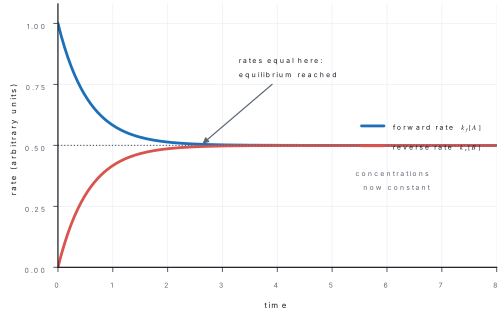
The law of chemical equilibrium follows: at a fixed temperature, for
the ratio \frac{[C]^c[D]^d}{[A]^a[B]^b} is constant at equilibrium. That constant is K_c, the equilibrium constant in terms of concentration.
The law of mass action
The rate of a chemical reaction is proportional to the product of the active masses (molar concentrations) of the reactants, each raised to the power of its stoichiometric coefficient.
Applied to the forward and reverse reactions separately and then equated at equilibrium, the law gives the equilibrium constant:
where square brackets mean mol L⁻¹ and p means partial pressure (usually in atm). K_p is used for gas reactions because partial pressures are what a pressure change actually alters.
| Rule for writing any K | Example |
|---|---|
| products on top, reactants below | N₂ + 3H₂ ⇌ 2NH₃ gives K_c = \frac{[\text{NH}_3]^2}{[\text{N}_2][\text{H}_2]^3} |
| each concentration raised to its coefficient | the 3 on H₂ becomes a cube, not a factor of 3 |
| omit pure solids and pure liquids | CaCO₃(s) ⇌ CaO(s) + CO₂(g) gives K_p = p_{\text{CO}_2} only |
| omit the solvent in a dilute solution | water is left out of the esterification constant |
| the reverse reaction has 1/K | if K = 49 for H₂ + I₂ ⇌ 2HI, then K = 1/49 for 2HI ⇌ H₂ + I₂ |
| doubling the equation squares K | 2H₂ + 2I₂ ⇌ 4HI has K = 49^2 = 2401 |
The "concentration" of a pure solid or a pure liquid is its density divided by its molar mass — a fixed number at a given temperature. It is constant, so it is folded into K. That is why a heap of CaCO₃ and a heap of CaO of any size give the same K_p: only p_{\text{CO}_2} appears. Writing [\text{CaCO}_3] in the expression is one of the most common wrong options in the paper.
The relation between Kp and Kc
We start from the ideal-gas law and substitute p = (n/V)RT = cRT for every gas.
Setting up. For aA + bB \rightleftharpoons cC + dD, all species gaseous, let \Delta n = (c + d) - (a + b), counting gases only.
Step 1 — replace each partial pressure. p_C = [C]RT, and likewise for the others.
Step 2 — substitute into K_p.
Step 3 — collect the powers of RT.
Step 4 — recognise K_c.
Result. K_p = K_c(RT)^{\Delta n}, with R = 0.0821\ \text{L atm mol}^{-1}\text{K}^{-1} when pressures are in atm, and T in kelvin.
What it means. The two constants differ only by the pressure–concentration conversion for the change in the number of gas molecules. If the reaction produces as many gas molecules as it consumes, \Delta n = 0, (RT)^0 = 1, and K_p = K_c exactly.
| Reaction | \Delta n | K_p in terms of K_c | Units of K_c | Units of K_p |
|---|---|---|---|---|
| N₂ + 3H₂ ⇌ 2NH₃ | 2 − 4 = −2 | K_c(RT)^{-2} | L² mol⁻² | atm⁻² |
| PCl₅ ⇌ PCl₃ + Cl₂ | 2 − 1 = +1 | K_c(RT) | mol L⁻¹ | atm |
| H₂ + I₂ ⇌ 2HI | 2 − 2 = 0 | K_c | none | none |
| N₂O₄ ⇌ 2NO₂ | +1 | K_c(RT) | mol L⁻¹ | atm |
| CaCO₃(s) ⇌ CaO(s) + CO₂(g) | 1 − 0 = +1 | K_c(RT) | mol L⁻¹ | atm |
The unit of K_c is (\text{mol L}^{-1})^{\Delta n} and of K_p is (\text{atm})^{\Delta n}. So for N₂ + 3H₂ ⇌ 2NH₃, \Delta n = -2 and the unit is (\text{mol L}^{-1})^{-2} = \text{L}^2\text{mol}^{-2}. When \Delta n = 0 the constant is dimensionless — a favourite one-mark question. A "unitless" answer is wrong for PCl₅ ⇌ PCl₃ + Cl₂ and right for H₂ + I₂ ⇌ 2HI.
Problem. At 500 K, 1.0 mol of N₂ and 3.0 mol of H₂ are sealed in a 1.0 L vessel. At equilibrium the vessel contains 1.0 mol N₂, 2.0 mol H₂ and 4.0 mol NH₃. Find K_c and K_p (R = 0.0821 L atm mol⁻¹ K⁻¹).
Solution. All volumes are 1.0 L, so moles = concentrations. K_c = \dfrac{[\text{NH}_3]^2}{[\text{N}_2][\text{H}_2]^3} = \dfrac{4.0^2}{1.0 \times 2.0^3} = \dfrac{16}{8} = 2.0, unit L² mol⁻². \Delta n = 2 - 4 = -2, so K_p = K_c(RT)^{-2} = 2.0 \times (0.0821 \times 500)^{-2} = 2.0 \times (41.05)^{-2} = 1.19 \times 10^{-3} atm⁻².
The reaction quotient Q and the direction of shift
Q is the same fraction as K but built from concentrations at any moment, not necessarily at equilibrium. Comparing the two tells you which way the reaction must go.
| Comparison | Meaning | What happens |
|---|---|---|
| Q < K | too little product, too much reactant | reaction goes forward (to the right) |
| Q > K | too much product | reaction goes backward (to the left) |
| Q = K | the ratio already has the equilibrium value | the system is at equilibrium |
Problem. For H₂ + I₂ ⇌ 2HI, K_c = 49 at 700 K. A mixture contains [H₂] = 1.0, [I₂] = 1.0 and [HI] = 2.0 mol L⁻¹. Which way does the reaction go?
Solution. Q = \dfrac{[\text{HI}]^2}{[\text{H}_2][\text{I}_2]} = \dfrac{2.0^2}{1.0 \times 1.0} = 4.0. Q < K (4 < 49), so the reaction proceeds forward, making more HI until Q rises to 49.
What does and does not change K
K is a constant at a given temperature and nothing else. This one sentence answers a large share of the objective questions on the chapter.
| Change | Effect on K | Effect on the position |
|---|---|---|
| temperature | changes (increases for endothermic, decreases for exothermic) | shifts |
| adding or removing a reactant or product | none | shifts to restore Q = K |
| changing pressure or volume | none | shifts only if \Delta n \neq 0 |
| adding a catalyst | none | none — equilibrium arrives sooner |
| adding an inert gas at constant volume | none | none |
| changing the surface area of a solid | none | none |
Underline the word constant. If the only change is concentration, pressure, volume, catalyst or surface area, K does not move — only the position does. Temperature is the sole entry in the left-hand column that changes K.
7.2 Le Chatelier's principle and its applications
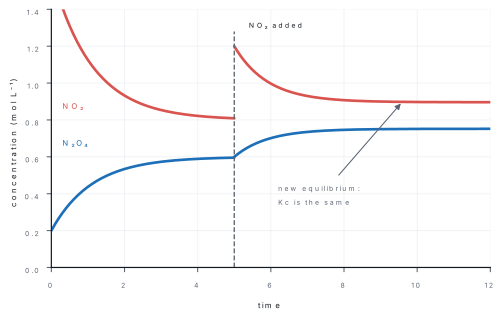
If a system at equilibrium is disturbed by a change in concentration, pressure or temperature, the system shifts in the direction that tends to oppose the change and so establishes a new equilibrium.
| Disturbance | Shift | Reason |
|---|---|---|
| add a reactant | forward | uses up the added substance |
| remove a product | forward | replaces what was taken away |
| add a product | backward | removes the added product |
| increase pressure (reduce volume) | towards the side with fewer gas molecules | fewer molecules occupy less space |
| decrease pressure | towards more gas molecules | |
| increase temperature | in the endothermic direction | absorbs the extra heat |
| decrease temperature | in the exothermic direction | releases heat |
| add catalyst | no shift | forward and reverse rates rise equally |
Two cases where students lose the mark:
- \Delta n = 0. In H₂ + I₂ ⇌ 2HI there are two gas molecules on each side, so squeezing the mixture changes both partial pressures equally and the position does not move at all. Pressure has no effect.
- Inert gas. Added at constant volume, it does not change any partial pressure and there is no shift. Added at constant pressure the vessel must expand, every partial pressure falls, and the equilibrium shifts towards the side with more gas molecules — exactly as if the pressure had been lowered.
The Haber process
| Factor | Effect on yield of NH₃ | What the industry does |
|---|---|---|
| pressure | 4 mol gas → 2 mol gas, so high pressure favours NH₃ | about 200 atm |
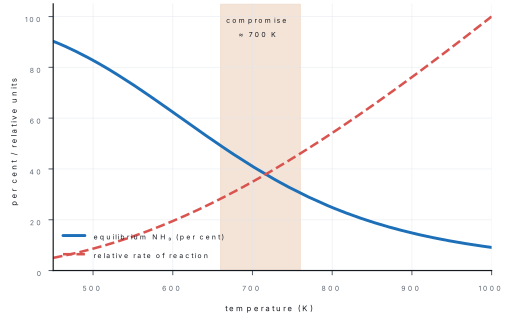
| temperature | exothermic, so low temperature favours NH₃ | about 700 K (430 °C) |
| catalyst | no effect on yield, large effect on rate | iron with K₂O and Al₂O₃ promoters |
| removal of NH₃ | shifts forward | cool and condense the ammonia, recycle the rest |
Why a compromise temperature? At 300 K the equilibrium yield at 200 atm is very high but the reaction is so slow that the plant would produce almost nothing. At 900 K the rate is excellent but the equilibrium has moved back towards nitrogen and hydrogen. The catalyst only works efficiently above about 650 K. The operating temperature of about 700 K is therefore the point where a usable rate and a worthwhile yield meet — a compromise, not an optimum of either quantity alone. Increasing the pressure shifts the equilibrium the right way and also raises the collision rate, which is why pressure is pushed as high as the plant's steel allows.
The contact process
Three gas molecules become two, and the reaction is exothermic, so high pressure and low temperature both favour SO₃. Again the rate sets the limit: the plant runs at about 720 K (450 °C) and 1–2 atm over a V₂O₅ catalyst, with the SO₃ absorbed in concentrated H₂SO₄ as it forms so that it cannot react back. The yield is about 98 %.
The Ostwald process
Here 9 gas molecules become 10, so a rise in pressure shifts the equilibrium backwards — pressure is not a lever for yield in this step. It is still run at about 9 atm because the higher pressure raises the collision rate and the throughput, and because the equilibrium lies so far to the right at 800–900 K that the yield is nearly complete. The real difficulty is selectivity: too high a temperature decomposes NH₃ and carries the oxidation on to N₂. Hence a platinum–rhodium gauze at about 800 K, a contact time of about a millisecond, and rapid cooling of the gases.
A catalyst lowers the activation energy of both directions by the same amount. It therefore does not change \Delta H, does not change K, and does not change the equilibrium yield — it only shortens the time needed to reach it. Every option that says "the catalyst increases the yield of ammonia" is wrong for that reason.
Problem. For 2SO₂ + O₂ ⇌ 2SO₃, ΔH = −197 kJ, state the effect on the amount of SO₃ of (a) raising the temperature, (b) compressing the mixture, (c) adding V₂O₅, (d) removing SO₃.
Solution. (a) The forward reaction is exothermic, so heat is a product; raising the temperature shifts the equilibrium backward and SO₃ falls. (b) 3 mol gas → 2 mol gas, so compression shifts forward and SO₃ rises. (c) No effect on the amount — equilibrium is reached sooner only. (d) Removing a product shifts the equilibrium forward, so more SO₃ forms (and the yield of the step rises).
7.3 Arrhenius, Brønsted–Lowry and Lewis acids and bases; Ostwald's dilution law
The three definitions
| Theory | Acid | Base | Example that only this theory explains |
|---|---|---|---|
| Arrhenius (1884) | gives H⁺ ions in water | gives OH⁻ ions in water | HCl and NaOH in water |
| Brønsted–Lowry (1923) | proton (H⁺) donor | proton acceptor | NH₃ is a base although it contains no OH |
| Lewis (1923) | electron-pair acceptor | electron-pair donor | BF₃ + NH₃, with no proton transferred at all |
Each theory widens the one before. Arrhenius cannot call NH₃ a base (it has no OH group) and cannot handle reactions in solvents other than water. Brønsted–Lowry handles NH₃ and all proton transfers, but cannot explain why BF₃ and AlCl₃ behave as acids. Lewis covers those, at the cost of calling every cation and every electron-pair-deficient molecule an acid.
An acid is a species that donates a proton; a base is a species that accepts a proton. Every acid has a conjugate base, formed by losing one H⁺, and every base has a conjugate acid, formed by gaining one H⁺.
| Acid | Conjugate base | Base | Conjugate acid |
|---|---|---|---|
| HCl | Cl⁻ | NH₃ | NH₄⁺ |
| CH₃COOH | CH₃COO⁻ | OH⁻ | H₂O |
| H₂O | OH⁻ | H₂O | H₃O⁺ |
| HCO₃⁻ | CO₃²⁻ | HCO₃⁻ | H₂CO₃ |
| NH₄⁺ | NH₃ | CH₃COO⁻ | CH₃COOH |
| HSO₄⁻ | SO₄²⁻ | HSO₄⁻ | H₂SO₄ |
A species that can both donate and accept a proton is amphiprotic — water, HCO₃⁻, HSO₄⁻, H₂PO₄⁻ and the amino acids are the standard examples. Notice in the table that water appears twice: it is the base when it accepts a proton from HCl, and the acid when it donates one to NH₃.
The stronger the acid, the weaker its conjugate base. HCl is a strong acid, so Cl⁻ is a negligible base (which is why NaCl solutions are neutral); CH₃COOH is weak, so CH₃COO⁻ is a real base (which is why sodium acetate solutions are alkaline).
Strong and weak electrolytes
The degree of dissociation \alpha is the fraction of the dissolved molecules that have split into ions: \alpha = \dfrac{\text{moles dissociated}}{\text{moles dissolved}}. A strong electrolyte is almost completely dissociated (\alpha \approx 1); a weak electrolyte is only slightly dissociated (\alpha \ll 1).
| Strong electrolyte | Weak electrolyte | |
|---|---|---|
| \alpha | close to 1 (0.9–1) | small (0.01–0.1) |
| Arrow | single → | double ⇌ |
| Examples (acids) | HCl, HBr, HI, HNO₃, H₂SO₄, HClO₄ | CH₃COOH, H₂CO₃, HCN, H₃PO₄, HF |
| Examples (bases) | NaOH, KOH, Ca(OH)₂, Ba(OH)₂ | NH₃, amines, Mg(OH)₂ |
| Examples (salts) | NaCl, KNO₃, NH₄Cl (all soluble salts) | — (salts are strong electrolytes) |
| Conductivity | high | low, but rises on dilution |
Ostwald's dilution law
We start from the equilibrium of a weak monobasic acid and the definition of \alpha.
Setting up. Let C mol L⁻¹ of HA be dissolved; a fraction \alpha dissociates.
Step 1 — concentrations at equilibrium. HA left = C(1-\alpha); [\text{H}^+] = [\text{A}^-] = C\alpha.
Step 2 — write K_a.
Step 3 — use the weakness. For a weak electrolyte \alpha \ll 1, so 1-\alpha \approx 1:
Result. \alpha = \sqrt{K_a/C} for a weak acid, and \alpha = \sqrt{K_b/C} for a weak base. The law holds only for weak binary electrolytes in dilute solution; it fails for strong electrolytes, where \alpha is near 1 and 1-\alpha cannot be dropped.
What it means. \alpha is inversely proportional to the square root of the concentration: diluting a weak acid increases the fraction dissociated.
These two statements look contradictory and examiners exploit the confusion. As C falls, \alpha = \sqrt{K_a/C} rises, but the actual hydrogen-ion concentration [\text{H}^+] = C\alpha = \sqrt{K_aC} falls, because C falls faster than \alpha rises. So a dilute weak acid is more dissociated and less acidic at the same time. For acetic acid, K_a = 1.8 \times 10^{-5}: at 0.1 M, \alpha = 1.3\% and [\text{H}^+] = 1.3 \times 10^{-3} M; at 0.001 M, \alpha = 13.4\% but [\text{H}^+] = 1.3 \times 10^{-4} M — ten times weaker.
Problem. A 0.10 M solution of a weak monobasic acid has pH 2.87. Find \alpha and K_a.
Solution. [\text{H}^+] = 10^{-2.87} = 1.35 \times 10^{-3} M. \alpha = [\text{H}^+]/C = 1.35 \times 10^{-3}/0.10 = 1.35 \times 10^{-2} (1.35 %). K_a = C\alpha^2 = 0.10 \times (1.35 \times 10^{-2})^2 = 1.8 \times 10^{-5}. (Check with the shortcut: \alpha = \sqrt{1.8\times10^{-5}/0.1} = 1.34\%.)
7.4 Ionic product of water, pH, pOH, pKa, pKb; common-ion effect; solubility product
The ionic product of water
Water dissociates very slightly:
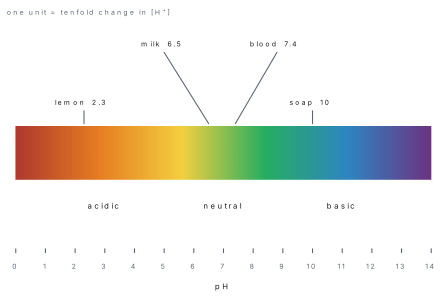
K_w is the ionic product of water. Because dissociation absorbs heat, K_w increases with temperature — about 5.5 \times 10^{-13} at 100 °C. Pure water is always electrically neutral, so [\text{H}^+] = [\text{OH}^-] = 10^{-7} M at 25 °C and pH 7. At 100 °C neutral water has pH ≈ 6.13: pH 7 means neutral only at 25 °C.
pH, pOH, pKa and pKb
| Solution | [\text{H}^+] | pH | Working |
|---|---|---|---|
| 0.01 M HCl | 10^{-2} | 2.00 | strong acid, fully ionised |
| 0.01 M NaOH | 10^{-12} | 12.00 | pOH = 2, so pH = 14 − 2 |
| 2 \times 10^{-3} M HCl | 2 \times 10^{-3} | 2.70 | 3 − log 2 = 3 − 0.30 |
| 5 \times 10^{-5} M HCl | 5 \times 10^{-5} | 4.30 | 5 − log 5 = 5 − 0.70 |
| 0.1 M CH₃COOH | 1.34 \times 10^{-3} | 2.87 | \tfrac{1}{2}(\text{p}K_a - \log C) |
| 0.1 M NH₃ | 1.34 \times 10^{-3} (OH⁻) | 11.13 | pOH = 2.87, pH = 14 − 2.87 |
Learn four logarithms and you can do every pH question in the paper by hand: \log 2 = 0.30, \log 3 = 0.48, \log 5 = 0.70, \log 7 = 0.85. To take a pH, write the concentration as (a number between 1 and 10) × 10⁻ⁿ: the pH is n - \log(\text{that number}). So [\text{H}^+] = 4 \times 10^{-4} gives pH = 4 − 0.60 = 3.40. Going the other way, pH 5.3 means [\text{H}^+] = 10^{-5.3} = 10^{-6} \times 10^{0.7} = 5 \times 10^{-6} M. For a weak acid use \text{pH} = \tfrac{1}{2}(\text{p}K_a - \log C); for its salt, \text{pH} = 7 + \tfrac{1}{2}(\text{p}K_a + \log C).
The common-ion effect
The common-ion effect is the suppression of the ionisation of a weak electrolyte by the addition of a strong electrolyte that supplies one of the same ions.
Add sodium acetate to acetic acid. The acetate ion is already the product of the acid's ionisation, so by Le Chatelier the equilibrium is driven back to the left:
The result: \alpha falls, [\text{H}^+] falls, and the pH rises. The same idea lowers the solubility of a sparingly soluble salt in a solution containing one of its ions, and it is the reason a buffer works.
Problem. Find the pH of a solution that is 0.10 M in CH₃COOH and 0.10 M in CH₃COONa (K_a = 1.8 \times 10^{-5}).
Solution. The salt is fully ionised, so [\text{CH}_3\text{COO}^-] \approx 0.10 M. Let x = [\text{H}^+]. Then K_a = \dfrac{x(0.10 + x)}{0.10 - x} \approx \dfrac{x \times 0.10}{0.10}, so x = K_a = 1.8 \times 10^{-5} M and pH = 4.74. Compare pure 0.10 M acetic acid: pH 2.87. The common ion has raised the pH by nearly two units — the acid is now only 0.018 % ionised.
Solubility product and precipitation
For a sparingly soluble salt in contact with its saturated solution,
The solubility product K_{sp} is the product of the molar concentrations of the ions in a saturated solution, each raised to the power of its coefficient in the dissociation equation, at a given temperature. It is an equilibrium constant, so it depends only on temperature.
| Salt | Dissociation | K_{sp} expression | K_{sp} at 25 °C |
|---|---|---|---|
| AgCl | AgCl(s) ⇌ Ag⁺ + Cl⁻ | [\text{Ag}^+][\text{Cl}^-] | 1.8 \times 10^{-10} |
| AgBr | AgBr(s) ⇌ Ag⁺ + Br⁻ | [\text{Ag}^+][\text{Br}^-] | 5.0 \times 10^{-13} |
| AgI | AgI(s) ⇌ Ag⁺ + I⁻ | [\text{Ag}^+][\text{I}^-] | 8.3 \times 10^{-17} |
| BaSO₄ | BaSO₄(s) ⇌ Ba²⁺ + SO₄²⁻ | [\text{Ba}^{2+}][\text{SO}_4^{2-}] | 1.1 \times 10^{-10} |
| PbCl₂ | PbCl₂(s) ⇌ Pb²⁺ + 2Cl⁻ | [\text{Pb}^{2+}][\text{Cl}^-]^2 | 1.6 \times 10^{-5} |
| CaF₂ | CaF₂(s) ⇌ Ca²⁺ + 2F⁻ | [\text{Ca}^{2+}][\text{F}^-]^2 | 4.0 \times 10^{-11} |
The ionic product test. Calculate the ionic product Q_{sp} exactly as you would K_{sp}, but from the concentrations actually present:
| Meaning | Result | |
|---|---|---|
| Q_{sp} < K_{sp} | unsaturated | no precipitate; more solid would dissolve |
| Q_{sp} = K_{sp} | saturated | at the point of precipitation |
| Q_{sp} > K_{sp} | supersaturated | precipitate forms until Q_{sp} falls to K_{sp} |
Solubility from K_{sp}. Let the solubility be s mol L⁻¹.
| Type | Example | K_{sp} | Solubility |
|---|---|---|---|
| AB | AgCl | s^2 | s = \sqrt{K_{sp}} |
| AB₂ or A₂B | PbCl₂, Ag₂CrO₄ | 4s^3 | s = \sqrt[3]{K_{sp}/4} |
| AB₃ | Fe(OH)₃ | 27s^4 | s = \sqrt[4]{K_{sp}/27} |
Problem. K_{sp}(\text{AgCl}) = 1.8 \times 10^{-10}. Find its solubility in (a) pure water and (b) 0.010 M NaCl. (M_{\text{AgCl}} = 143.5)
Solution. (a) s = \sqrt{1.8 \times 10^{-10}} = 1.34 \times 10^{-5} mol L⁻¹, which is 1.34 \times 10^{-5} \times 143.5 = 1.9 \times 10^{-3} g L⁻¹. (b) Now [\text{Cl}^-] = 0.010 M, so [\text{Ag}^+] = K_{sp}/0.010 = 1.8 \times 10^{-8} M. The solubility has fallen by a factor of about 750. This is the common-ion effect applied to a solubility equilibrium, and it is why AgCl is washed with dilute HCl, not water.
Problem. Equal volumes of 0.020 M AgNO₃ and 0.020 M NaCl are mixed. Will AgCl precipitate? (K_{sp} = 1.8 \times 10^{-10})
Solution. Mixing doubles the total volume, so each concentration is halved: [\text{Ag}^+] = [\text{Cl}^-] = 0.010 M. Q_{sp} = 0.010 \times 0.010 = 1.0 \times 10^{-4}. Q_{sp} \gg K_{sp} (10^{-4} against 10^{-10}), so yes, AgCl precipitates at once.
- K_{sp} has no units in the expression but the concentrations are molar. Do not add the concentrations; multiply them, with each raised to its coefficient.
- K_{sp} is not solubility. For salts of different types, the bigger K_{sp} does not always mean the more soluble salt — compare s, not K_{sp}.
- A precipitate needs Q_{sp} > K_{sp}, not Q_{sp} = K_{sp} and certainly not "K_{sp} is exceeded by the mass added". Calculate the concentrations after mixing, which means after any dilution.
7.5 Acidic and basic buffers; types of salts and their hydrolysis
Buffer solutions
A buffer solution is a solution that resists a change in pH when a small amount of acid or base is added, or when it is diluted. An acidic buffer contains a weak acid and its salt with a strong base; a basic buffer contains a weak base and its salt with a strong acid.
| Acidic buffer | Basic buffer | |
|---|---|---|
| Contains | weak acid + its salt (CH₃COOH + CH₃COONa) | weak base + its salt (NH₃ + NH₄Cl) |
| pH | below 7 (about \text{p}K_a) | above 7 (about 14 - \text{p}K_b) |
| Added H⁺ is consumed by | CH₃COO⁻ | NH₃ |
| Added OH⁻ is consumed by | CH₃COOH | NH₄⁺ |
| Henderson form | \text{pH} = \text{p}K_a + \log\dfrac{[\text{salt}]}{[\text{acid}]} | \text{pOH} = \text{p}K_b + \log\dfrac{[\text{salt}]}{[\text{base}]} |
How it works. In an acetic acid–acetate buffer both components are present in large amount. Added H⁺ is taken up by the acetate ion, added OH⁻ is taken up by the acid, and neither survives to change the pH much. The ratio [salt]/[acid] barely moves, so the pH barely moves.
Setting up. A weak acid HA at concentration c_a with its salt NaA at c_s. The salt is fully ionised, so [\text{A}^-] \approx c_s; the acid is only slightly ionised, so [\text{HA}] \approx c_a.
Step 1 — start from K_a.
Step 2 — solve for [\text{H}^+].
Step 3 — take negative logarithms of both sides.
Step 4 — use the definitions and flip the ratio.
Result. \text{pH} = \text{p}K_a + \log\dfrac{[\text{salt}]}{[\text{acid}]}.
What it means. The pH is fixed by the ratio, not by the absolute concentrations, which is why dilution does not change the pH of a buffer much. When [\text{salt}] = [\text{acid}], pH = pKa — the point of maximum buffer capacity.
Problem. A buffer is 0.10 M in CH₃COOH and 0.20 M in CH₃COONa; pKa = 4.74. Find its pH, and the pH after 0.01 mol of HCl is added to 1.0 L of it.
Solution. pH = 4.74 + \log(0.20/0.10) = 4.74 + 0.30 = 5.04. After adding 0.01 mol HCl, the acid rises to 0.11 M and the salt falls to 0.19 M: pH = 4.74 + \log(0.19/0.11) = 4.74 + 0.24 = 4.98. The pH has moved by only 0.06 unit; the same amount of HCl in 1.0 L of pure water would take pH from 7 to 2.
Blood is buffered at pH 7.35–7.45 by the H₂CO₃/HCO₃⁻ pair (and by haemoglobin and phosphate); a deviation of 0.4 unit is life-threatening. Buffer capacity is greatest when the ratio is 1 : 1 and falls as the ratio moves away from it.
Salt hydrolysis — the four types
A salt of a weak acid or weak base reacts with water; this is hydrolysis. Which ion hydrolyses decides whether the solution is acidic, basic or neutral.
| Salt type | Example | Ion that hydrolyses | Solution | pH formula |
|---|---|---|---|---|
| strong acid + strong base | NaCl, KNO₃, Na₂SO₄ | neither | neutral, pH 7 | pH = 7 |
| weak acid + strong base | CH₃COONa, Na₂CO₃, KCN | the anion (A⁻) | basic, pH > 7 | \text{pH} = 7 + \tfrac{1}{2}(\text{p}K_a + \log C) |
| strong acid + weak base | NH₄Cl, (NH₄)₂SO₄ | the cation (BH⁺) | acidic, pH < 7 | \text{pH} = 7 - \tfrac{1}{2}(\text{p}K_b + \log C) |
| weak acid + weak base | CH₃COONH₄, NH₄CN | both ions | depends on K_a vs K_b | \text{pH} = 7 + \tfrac{1}{2}(\text{p}K_a - \text{p}K_b) |
Why each behaves as it does.
- NaCl. Na⁺ is the conjugate acid of NaOH (a strong base) and Cl⁻ is the conjugate base of HCl (a strong acid). Neither is strong enough to take or give a proton to water, so nothing hydrolyses and the pH stays 7.
- CH₃COONa. The acetate ion is the conjugate base of a weak acid, so it does take a proton from water:
OH⁻ is left over, so the solution is basic. The hydrolysis constant is K_h = K_w/K_a. - NH₄Cl. The ammonium ion is the conjugate acid of a weak base and donates a proton to water:
H₃O⁺ is produced, so the solution is acidic, with K_h = K_w/K_b. - CH₃COONH₄. Both ions hydrolyse. Because K_a(\text{CH}_3\text{COOH}) \approx K_b(\text{NH}_3) \approx 1.8 \times 10^{-5}, the two effects cancel and the pH is 7.00 — and, unusually, independent of concentration.
Problem. Find the pH of 0.10 M CH₃COONa (K_a = 1.8 \times 10^{-5}, so pKa = 4.74).
Solution. pH = 7 + \tfrac{1}{2}(\text{p}K_a + \log C) = 7 + \tfrac{1}{2}(4.74 - 1.00) = 7 + 1.87 = 8.87. Check the logic: the salt of a weak acid is basic, and 8.87 is basic but not strongly so.
Problem. Find the pH of 0.10 M NH₄Cl (K_b for NH₃ = 1.8 \times 10^{-5}).
Solution. pH = 7 - \tfrac{1}{2}(\text{p}K_b + \log C) = 7 - \tfrac{1}{2}(4.74 - 1.00) = 7 - 1.87 = 5.13. Acidic, as expected for the salt of a weak base.
- pH 7 does not mean "no hydrolysis". It means the two hydrolyses happen to cancel (CH₃COONH₄) or that neither ion hydrolyses (NaCl). Read the question.
- A salt of a weak acid is basic, not acidic. Students reverse this because the word "acid" appears. Anchor it: the anion of a weak acid is a base (it takes H⁺ back).
- The pH of a weak acid–weak base salt does not depend on concentration, because the C cancels between the two hydrolysis expressions. Every formula with \log C in it must contain a \log C term that is genuinely there.
- Hydrolysis increases on dilution and on heating (both are endothermic in the forward direction for these salts), so a dilute or warm salt solution is further from pH 7.
Formula and fact sheet
| Quantity | Relation |
|---|---|
| Equilibrium constant | K_c = \dfrac{[C]^c[D]^d}{[A]^a[B]^b}; pure solids and liquids omitted |
| Pressure form | K_p = \dfrac{p_C^c p_D^d}{p_A^a p_B^b} |
| Kp–Kc | K_p = K_c(RT)^{\Delta n}, \Delta n = gas product moles − gas reactant moles |
| Reaction quotient | Q from the same expression at any moment; Q<K forward, Q>K backward |
| Reverse / multiple | reverse reaction 1/K; equation × n gives K^n; added equations multiply K |
| Partial pressure | p_i = x_iP_{\text{total}} |
| Ostwald dilution | K_a = C\alpha^2/(1-\alpha) \approx C\alpha^2; \alpha = \sqrt{K_a/C} |
| Weak acid | [\text{H}^+] = \sqrt{K_aC}; \text{pH} = \tfrac{1}{2}(\text{p}K_a - \log C) |
| Water | K_w = [\text{H}^+][\text{OH}^-] = 10^{-14} at 25 °C; pH + pOH = 14 |
| Definitions | pH = −log[H⁺]; pOH = −log[OH⁻]; pKa = −log Ka; pKa + pKb = 14 |
| Common ion | [\text{H}^+] = K_a\dfrac{[\text{acid}]}{[\text{salt}]} |
| Solubility product | K_{sp} = [\text{Ag}^+][\text{Cl}^-]; precipitate when Q_{sp} > K_{sp} |
| Solubility | AB: s=\sqrt{K_{sp}}; AB₂: K_{sp}=4s^3; AB₃: K_{sp}=27s^4 |
| Buffer | \text{pH} = \text{p}K_a + \log([\text{salt}]/[\text{acid}]) |
| Salt pH | weak acid salt: 7+\tfrac{1}{2}(\text{p}K_a+\log C); weak base salt: 7-\tfrac{1}{2}(\text{p}K_b+\log C); both weak: 7+\tfrac{1}{2}(\text{p}K_a-\text{p}K_b) |
| Hydrolysis constant | K_h = K_w/K_a (anion) or K_w/K_b (cation); h = \sqrt{K_h/C} |
| Equilibrium | \Delta n | Shift with pressure | Shift with temperature |
|---|---|---|---|
| N₂ + 3H₂ ⇌ 2NH₃, ΔH = −92 kJ | −2 | right (high P) | left (high T) |
| 2SO₂ + O₂ ⇌ 2SO₃, ΔH = −197 kJ | −1 | right | left |
| 4NH₃ + 5O₂ ⇌ 4NO + 6H₂O, ΔH = −905 kJ | +1 | left (slightly) | left |
| H₂ + I₂ ⇌ 2HI, ΔH = −9.4 kJ | 0 | no effect | left (slightly) |
| N₂O₄ ⇌ 2NO₂, ΔH = +57 kJ | +1 | left | right (browns on heating) |
| CaCO₃ ⇌ CaO + CO₂, ΔH = +178 kJ | +1 | left | right |
Industrial conditions: Haber 700 K, 200 atm, Fe + K₂O/Al₂O₃; contact 720 K, 1–2 atm, V₂O₅; Ostwald 800 K, 9 atm, Pt–Rh gauze. In each case the temperature is a compromise between yield (low T) and rate (high T), and the catalyst changes only the rate.
Logs worth memorising: log 2 = 0.30, log 3 = 0.48, log 5 = 0.70, log 7 = 0.85.
Chapter summary
- At dynamic equilibrium the forward and reverse rates are equal and concentrations are constant, but both reactions continue; a catalyst only shortens the time taken to get there.
- K_c and K_p take products over reactants with each concentration raised to its coefficient; pure solids and pure liquids are omitted because their concentrations are constant.
- K_p = K_c(RT)^{\Delta n}. When \Delta n = 0 the two are equal and both are dimensionless; when \Delta n = -2, K_c carries L² mol⁻² and K_p atm⁻².
- Q is the same ratio at any moment: Q < K shifts forward, Q > K shifts backward. Only temperature changes K; pressure shifts the position only if \Delta n \neq 0.
- Le Chatelier: added reactant, removed product, higher pressure (towards fewer gas moles) and lower temperature (for an exothermic reaction) all push the equilibrium forward. Haber, contact and Ostwald each use a compromise temperature of roughly 700–800 K for rate, with pressure chosen from \Delta n.
- Arrhenius: H⁺/OH⁻ in water. Brønsted–Lowry: proton donor/acceptor, with conjugate pairs differing by one H⁺. Lewis: electron-pair acceptor/donor. Amphiprotic species (H₂O, HCO₃⁻) can act either way.
- Ostwald's dilution law gives \alpha = \sqrt{K_a/C}: dilution raises the fraction dissociated but lowers [\text{H}^+] = \sqrt{K_aC}.
- K_w = 10^{-14} at 25 °C, pH + pOH = 14, pKa + pKb = 14. Neutral is pH 7 only at 25 °C.
- A buffer is a weak acid (or base) with its salt; \text{pH} = \text{p}K_a + \log([\text{salt}]/[\text{acid}]), and the pH depends on the ratio, not the concentrations.
- Salt hydrolysis: strong/strong neutral; weak acid/strong base basic; strong acid/weak base acidic; weak/weak decided by K_a against K_b and independent of concentration.
- K_{sp} is an equilibrium constant: a precipitate forms when the ionic product after mixing exceeds it, and a common ion lowers the solubility.
Practice questions
Set A — Recall (26 questions)
- At equilibrium, a reversible reaction hasathe forward reaction stoppedbthe reverse reaction stoppedcboth reactions proceeding at equal ratesdall the reactants used up
- For N₂ + 3H₂ ⇌ 2NH₃, the equilibrium constant K_c isa[NH₃]²/([N₂][H₂]³)b[NH₃]/([N₂][H₂])c[N₂][H₂]³/[NH₃]²d[NH₃]²/([N₂][H₂])
- The unit of K_c for H₂ + I₂ ⇌ 2HI isamol L⁻¹bL mol⁻¹cmol² L⁻²dthere is no unit
- For PCl₅ ⇌ PCl₃ + Cl₂, the relation between K_p and K_c isaK_p = K_cbK_p = K_c(RT)cK_p = K_c(RT)^2dK_p = K_c/(RT)
- Which species is left out of the equilibrium constant expression?agasesbaqueous ionscpure solidsddissolved molecules
- If the reaction quotient Q is greater than K, the reactionagoes forwardbgoes backwardcis at equilibriumdcannot proceed at all
- A catalyst added to a system already at equilibriumashifts it forwardbshifts it backwardcincreases Kddoes not change the position
- The equilibrium constant of a reaction changes whenathe pressure is changedbthe temperature is changedca catalyst is addeddthe volume is changed
- An increase in pressure shifts an equilibrium towardsathe side with more gas moleculesbthe endothermic sidecno shift at alldthe side with fewer gas molecules
- The catalyst used in the Haber process isaV₂O₅bplatinum–rhodiumciron with promotersdnickel
- The catalyst used in the contact process isaironbV₂O₅cplatinumdnickel
- The catalyst used in the Ostwald process isaV₂O₅bironcplatinum–rhodium gauzedcopper
- According to Brønsted and Lowry, an acid is aaproton donorbproton acceptorcelectron-pair donordsubstance that gives OH⁻
- The conjugate base of HCO₃⁻ isaH₂CO₃bCO₂cCO₃²⁻dOH⁻
- According to Lewis, an acid is anaelectron-pair donorbelectron-pair acceptorcproton donordproton acceptor
- Which species is amphiprotic?aHSO₄⁻bSO₄²⁻cHCldNH₄⁺
- The ionic product of water at 25 °C isa1 \times 10^{-7}b1 \times 10^{-14}c1 \times 10^{-10}d55.5
- At 25 °C, pH + pOH is equal toa0b7c1d14
- For a conjugate acid–base pair at 25 °C, pKa + pKb isa7b10c14d0
- Ostwald's dilution law for a weak acid gives \alpha equal toa\sqrt{K_a/C}b\sqrt{K_aC}cK_a/CdC/K_a
- The common-ion effectaincreases ionisationbincreases Kchas no effect on ionisationdsuppresses the ionisation of a weak electrolyte
- For PbCl₂, the solubility product isa[Pb²⁺][Cl⁻]b[Pb²⁺][Cl⁻]²c[Pb²⁺]²[Cl⁻]d[Pb²⁺][2Cl⁻]²
- A mixture of CH₃COOH and CH₃COONa in water isaan acidic bufferba basic bufferca neutral solutiondnot a buffer at all
- An aqueous solution of NH₄Cl isabasicbneutralcstrongly basicdacidic
- An aqueous solution of NaCl isaacidicbbasiccneutraldacidic only when concentrated
- The degree of dissociation of an electrolyte isathe fraction of dissolved molecules that ionisebthe number of ions per moleculecthe molar mass divided by the number of ionsdthe concentration of the solution
Answers and explanations — Set A
1. (c) — Equilibrium is dynamic: both reactions continue at the same rate, so concentrations stay constant. Nothing has stopped and nothing is necessarily used up.
2. (a) — Products over reactants, each raised to its coefficient: [NH₃]² on top, [N₂] and [H₂]³ below. Option (c) is the expression for the reverse reaction.
3. (d) — \Delta n = 2 - 2 = 0, so the concentration units cancel and K_c is dimensionless. Options (a) and (b) belong to reactions with \Delta n = +1 and -1.
4. (b) — \Delta n = 2 - 1 = +1, so K_p = K_c(RT)^{+1}. Option (a) would be right only if \Delta n = 0.
5. (c) — The concentration of a pure solid or pure liquid is constant (its density divided by molar mass) and is absorbed into K. Gases and aqueous species do appear.
6. (b) — Q > K means there is too much product, so the reverse reaction runs until Q falls to K. Option (a) is the case Q < K.
7. (d) — A catalyst lowers the activation energy of both directions equally, so equilibrium is reached sooner at exactly the same position. It does not change K.
8. (b) — K depends only on temperature. Pressure, volume, concentration and catalyst change the position or the rate, never the value of K.
9. (d) — Raising the pressure favours the side with fewer gas molecules, because that side occupies less volume. If \Delta n = 0 there is no shift at all.
10. (c) — Iron with K₂O and Al₂O₃ promoters, at about 700 K and 200 atm. V₂O₅ is the contact process and Pt–Rh the Ostwald process.
11. (b) — Vanadium(V) oxide, V₂O₅, at about 720 K. Iron is the Haber catalyst and platinum–rhodium the Ostwald catalyst.
12. (c) — A platinum–rhodium gauze at about 800 K and 9 atm. It is expensive, so it is used as a fine gauze with a very short contact time.
13. (a) — A Brønsted–Lowry acid donates a proton and its conjugate base is what remains after the proton has gone. An electron-pair acceptor is the Lewis definition.
14. (c) — Remove one H⁺ from HCO₃⁻ and CO₃²⁻ remains. H₂CO₃ is the conjugate acid, formed by adding H⁺.
15. (b) — A Lewis acid accepts an electron pair, as BF₃ does from NH₃. This definition covers acids such as BF₃ and AlCl₃ that contain no hydrogen at all.
16. (a) — HSO₄⁻ can donate a proton (to give SO₄²⁻) or accept one (to give H₂SO₄). SO₄²⁻ and NH₄⁺ can only do one of the two.
17. (b) — K_w = [\text{H}^+][\text{OH}^-] = 1 \times 10^{-14} at 25 °C. Option (a) is the concentration of each ion in pure water, not the product.
18. (d) — Since K_w = 10^{-14}, -\log[\text{H}^+] - \log[\text{OH}^-] = 14, so pH + pOH = 14 at 25 °C. At other temperatures the sum is pKw, not 14.
19. (c) — K_aK_b = K_w for a conjugate pair, so taking logs gives pKa + pKb = pKw = 14 at 25 °C.
20. (a) — K_a = C\alpha^2 for a weak electrolyte, so \alpha = \sqrt{K_a/C}. Option (b) is the expression for [\text{H}^+], not for \alpha.
21. (d) — Adding a common ion drives the ionisation equilibrium back towards the un-ionised molecule, so \alpha and [\text{H}^+] fall. K itself is unchanged.
22. (b) — PbCl₂ gives one Pb²⁺ and two Cl⁻, so each concentration is raised to its coefficient: [Pb²⁺][Cl⁻]².
23. (a) — A weak acid with its salt is an acidic buffer, with pH ≈ pKa = 4.74. A basic buffer needs a weak base and its salt, such as NH₃ + NH₄Cl.
24. (d) — NH₄⁺ is the conjugate acid of the weak base NH₃, so it donates a proton to water and leaves H₃O⁺. The salt of a weak base is acidic.
25. (c) — Na⁺ and Cl⁻ are the conjugates of a strong base and a strong acid, so neither hydrolyses and the pH stays 7 at 25 °C.
26. (a) — \alpha is the fraction of the dissolved molecules that have split into ions, so it lies between 0 and 1 (or 0 and 100 %). It is not the number of ions per formula unit.
Set B — Understanding (16 questions)
- For N₂ + 3H₂ ⇌ 2NH₃ at equilibrium, which change increases the amount of NH₃ without changing K?araising the temperaturebadding a catalystccompressing the mixturedadding argon at constant volume
- Argon is added to a gaseous equilibrium mixture at constant volume. The position of equilibriumadoes not changebshifts forwardcshifts backwarddchanges K
- For H₂ + I₂ ⇌ 2HI, doubling the total pressure at constant temperatureashifts the equilibrium forwardbshifts it backwardcdoubles Kdleaves the position unchanged
- N₂O₄ ⇌ 2NO₂ is endothermic. On warming the mixture, itabecomes colourlessbbecomes a deeper browncdoes not change colourddeposits a solid
- On diluting a weak acid solution with water,a\alpha falls and [H⁺] fallsb\alpha rises and [H⁺] risesc\alpha rises and [H⁺] fallsdboth stay the same
- Which 0.1 M aqueous solution has the highest pH at 25 °C?aHClbCH₃COOHcNaCldNaOH
- In HCO₃⁻ + H₂O ⇌ H₂CO₃ + OH⁻, water acts asaan acidba baseca saltda catalyst
- NH₃ is a Brønsted base but not an Arrhenius base becauseait does not accept protonsbits formula contains no OH groupcit is a weak electrolytedit reacts with acids
- A buffer solution resists a change in pH because itaholds reserves of a weak acid and its conjugate basebcontains a strong acid and a strong basecalways has pH exactly 7ddoes not ionise at all
- A solution of sodium acetate is basic becauseaNa⁺ hydrolysesbthe salt is insolublecCH₃COO⁻ accepts a proton from waterdCH₃COO⁻ donates a proton to water
- Which pair of solutions, mixed, gives a buffer?aHCl + NaClbNaOH + NaClcHCl + NaOH in equal amountsdCH₃COOH + CH₃COONa
- AgCl is much less soluble in 0.1 M NaCl than in pure water becauseaK_{sp} increasesbthe common ion shifts the equilibrium leftcNaCl reacts with AgCldthe temperature falls
- A catalyst cannot change the equilibrium constant because italowers only the forward activation energybis used up in the reactioncchanges ΔHdlowers both activation energies equally
- Ostwald's dilution law cannot be applied to strong electrolytes becauseathey are almost completely ionisedbthey do not dissolvecthey have no K_a at alldtheir \alpha is zero
- At 100 °C pure water has pH about 6.1. This shows thatawater is acidic at 100 °Cbwater is basic at 100 °Ccwater is still neutral because [H⁺] = [OH⁻]dK_w is smaller at 100 °C
- Which 0.1 M salt solution is acidic at 25 °C?aNaClbNH₄ClcNa₂CO₃dCH₃COONa
Answers and explanations — Set B
1. (c) — Compression favours the side with fewer gas molecules (4 → 2), so more NH₃ forms while K stays the same. Heating would shift an exothermic reaction backward, and a catalyst changes only the rate.
2. (a) — At constant volume the partial pressures of the reacting gases are unchanged, so Q is unchanged and there is no shift. At constant pressure the added gas would expand the mixture and shift it towards more gas molecules.
3. (d) — \Delta n = 0, so both partial pressures are multiplied by the same factor and Q still equals K. K itself never depends on pressure.
4. (b) — Dissociation of N₂O₄ into NO₂ absorbs heat, so warming shifts the equilibrium to the right. NO₂ is the brown gas, so the colour deepens.
5. (c) — Dilution raises the fraction ionised (\alpha = \sqrt{K_a/C}) but lowers the concentration of ions, since [\text{H}^+] = \sqrt{K_aC}. More dissociated, less acidic.
6. (d) — NaOH is a strong base, so its pH is about 13. NaCl is neutral (7), acetic acid about 2.9 and HCl about 1.
7. (a) — Water donates a proton to HCO₃⁻ and becomes OH⁻, so water is the acid and HCO₃⁻ the base. In the reverse reaction their roles swap.
8. (b) — The Arrhenius definition requires a base to supply OH⁻ in water; NH₃ has no OH group and acts as a base only by accepting H⁺.
9. (a) — Both members of the pair are present in large amount: the acid neutralises added OH⁻ and the anion neutralises added H⁺, so the ratio, and with it the pH, hardly moves.
10. (c) — The acetate ion is the conjugate base of a weak acid, so it takes a proton from water and leaves OH⁻ behind. Na⁺ is the conjugate of a strong base and does not hydrolyse.
11. (d) — A weak acid with its salt is the definition of an acidic buffer. HCl + NaOH in equal amounts gives NaCl and water — a neutral salt, not a buffer.
12. (b) — Extra Cl⁻ pushes the dissolution equilibrium back towards the solid, so less AgCl dissolves. K_{sp} is unchanged; only the position of the equilibrium moves.
13. (d) — It provides an alternative path of lower activation energy for both directions by the same amount, so the difference between the two rates, and hence K, is untouched.
14. (a) — The approximation 1-\alpha \approx 1 fails when \alpha is close to 1, which is exactly the case for a strong electrolyte.
15. (c) — At 100 °C K_w is larger, about 5.5 \times 10^{-13}, so neutral water has [H⁺] = [OH⁻] = 7.4 × 10⁻⁷ M and pH 6.13. Neutral does not mean pH 7 at every temperature.
16. (b) — NH₄⁺ is the conjugate acid of the weak base NH₃ and hydrolyses to give H₃O⁺. NaCl is neutral and the other two are basic.
Set C — Application (10 questions)
- For H₂ + I₂ ⇌ 2HI, the equilibrium concentrations are [H₂] = 0.50, [I₂] = 0.50 and [HI] = 2.0 mol L⁻¹. K_c isa4.0b8.0c16d32
- For N₂ + 3H₂ ⇌ 2NH₃, K_c = 4.0 \times 10^{-2} at 400 K. Taking R = 0.0821 L atm mol⁻¹ K⁻¹, K_p is abouta3.7 \times 10^{-5}b1.3c4.3 \times 10^{1}d3.7 \times 10^{-3}
- For 2SO₂ + O₂ ⇌ 2SO₃, K_c = 278. A mixture has [SO₂] = 0.20, [O₂] = 0.10 and [SO₃] = 0.40 mol L⁻¹. The reaction willago backwardbgo forwardcstay at equilibriumdstop completely
- The pH of 2 \times 10^{-3} M HCl isa2.00b2.30c3.00d2.70
- The pH of 0.005 M NaOH at 25 °C isa11.70b2.30c12.00d11.30
- The pH of 0.01 M CH₃COOH (K_a = 1.8 \times 10^{-5}) is abouta2.00b2.87c3.37d4.74
- The solubility of AgCl in pure water is (K_{sp} = 1.8 \times 10^{-10})a1.3 \times 10^{-5} mol L⁻¹b1.8 \times 10^{-10} mol L⁻¹c9.0 \times 10^{-6} mol L⁻¹d1.3 \times 10^{-3} mol L⁻¹
- Equal volumes of 0.020 M AgNO₃ and 0.020 M NaCl are mixed. Taking K_{sp}(AgCl) = 1.8 \times 10^{-10},ano precipitate forms because Q < K_{sp}ba precipitate forms because Q = K_{sp}cno precipitate forms because Q = K_{sp}da precipitate forms because Q > K_{sp}
- A buffer is 0.10 M in CH₃COOH and 0.010 M in CH₃COONa (pKa = 4.74). Its pH isa4.74b3.74c5.74d4.04
- The pH of 0.10 M CH₃COONa solution is (pKa of CH₃COOH = 4.74)a5.13b7.00c8.87d11.13
Answers and explanations — Set C
1. (c) — K_c = [\text{HI}]^2/([\text{H}_2][\text{I}_2]) = 2.0^2/(0.50 \times 0.50) = 4.0/0.25 = 16. Option (a) forgets to square [HI] or to multiply the two denominators.
2. (a) — \Delta n = 2 - 4 = -2 and RT = 0.0821 \times 400 = 32.84. So K_p = 0.040 \times (32.84)^{-2} = 0.040/1078 = 3.7 \times 10^{-5} atm⁻². Option (b) multiplies instead of dividing.
3. (b) — Q = [\text{SO}_3]^2/([\text{SO}_2]^2[\text{O}_2]) = 0.16/(0.040 \times 0.10) = 40, which is less than K = 278, so the forward reaction runs until Q reaches 278.
4. (d) — pH = -\log(2 \times 10^{-3}) = 3 - \log 2 = 3 - 0.30 = 2.70. Option (a) ignores the factor 2 and option (c) rounds the wrong way.
5. (a) — pOH = -\log(5 \times 10^{-3}) = 3 - 0.70 = 2.30, so pH = 14 - 2.30 = 11.70. Option (b) is the pOH, not the pH.
6. (c) — pH = \tfrac{1}{2}(\text{p}K_a - \log C) = \tfrac{1}{2}(4.74 + 2.00) = 3.37. Option (b) is the value for 0.1 M, ten times stronger.
7. (a) — For a 1 : 1 salt s = \sqrt{K_{sp}} = \sqrt{1.8 \times 10^{-10}} = 1.34 \times 10^{-5} mol L⁻¹. Option (b) is K_{sp} itself, not the solubility.
8. (d) — After mixing, each concentration is halved to 0.010 M, so Q = 1.0 \times 10^{-4}, far above 1.8 \times 10^{-10}. Precipitation continues until Q falls to K_{sp}.
9. (b) — pH = 4.74 + \log(0.010/0.10) = 4.74 - 1.00 = 3.74. The salt is ten times more dilute than the acid, so the buffer is more acidic than pKa.
10. (c) — pH = 7 + \tfrac{1}{2}(\text{p}K_a + \log C) = 7 + \tfrac{1}{2}(4.74 - 1.00) = 8.87. Option (a) is the pH of the corresponding NH₄Cl-type salt, and (d) would need a much stronger base.