Chapter 9 · Physical Chemistry · 1 question in the paper · 34 min read
Chemical Kinetics
What the syllabus asks for 3
- Rate of reaction, rate expressions, the rate constant and its units; order and molecularity
- Integrated rate laws and half-lives of zero- and first-order reactions
- Collision theory, activation and threshold energy, the activated complex; factors affecting rate; homogeneous, heterogeneous and enzyme catalysis
Stoichiometry tells you what a reaction produces; kinetics tells you how fast it gets there. The paper carries about one question from this chapter (our estimate from the MEC topic list), and it is nearly always one of three things: a definition that turns on the difference between order and molecularity, a one-line calculation with t_{1/2} or the integrated rate law, or a statement about catalysts and collision theory that is true except for one wrong word. Almost every mark here is lost to a sign, a unit or a half-life taken as proportional to concentration.
- Rate of reaction is a positive quantity: for a reactant, rate = -\frac{1}{a}\frac{d[A]}{dt}; average rate uses a finite interval, instantaneous rate the tangent.
- Rate law is experimental; order = m+n can be zero, fractional or negative. Molecularity is theoretical and always a whole number.
- Units of k: order 0 → mol L⁻¹ s⁻¹; order 1 → s⁻¹; order 2 → L mol⁻¹ s⁻¹; order n → mol^{1-n} L^{n-1} s⁻¹.
- Zero order: [A] = [A]_0 - kt, t_{1/2} = [A]_0/2k. First order: \ln([A]_0/[A]) = kt, t_{1/2} = 0.693/k — independent of [A]_0.
- A straight line of \ln[A] against t proves first order; its slope is -k.
- Collision theory: only collisions with energy ≥ threshold energy and the right orientation react; the activated complex sits at the top of the barrier.
- Arrhenius: k = Ae^{-E_a/RT}; a 10 °C rise roughly doubles the rate because the fraction of molecules above E_a roughly doubles.
- A catalyst lowers E_a for both directions equally: it changes the rate, never \Delta H, \Delta G or K.
9.1 Rate of reaction, rate expressions, the rate constant and its units; order and molecularity
Rate of reaction: average and instantaneous
The rate of reaction is the change in concentration of a reactant or product per unit time. Because concentrations are measured in mol L⁻¹ and time in seconds, the unit is mol L⁻¹ s⁻¹ (also written mol dm⁻³ s⁻¹ or M s⁻¹).
For a reactant the concentration falls, so \Delta[R] is negative. Rate must be positive, hence the minus sign:
For a product the concentration rises and no sign is needed. For the general equation aA + bB \rightarrow cC + dD all four species must give the same number for the rate, so each is divided by its own coefficient:
| Reaction | Rate expression |
|---|---|
| 2N₂O₅ → 4NO₂ + O₂ | -\frac{1}{2}\frac{d[\text{N}_2\text{O}_5]}{dt} = \frac{1}{4}\frac{d[\text{NO}_2]}{dt} = \frac{d[\text{O}_2]}{dt} |
| H₂ + I₂ → 2HI | -\frac{d[\text{H}_2]}{dt} = \frac{1}{2}\frac{d[\text{HI}]}{dt} |
| 2HI → H₂ + I₂ | -\frac{1}{2}\frac{d[\text{HI}]}{dt} = \frac{d[\text{H}_2]}{dt} |
| N₂ + 3H₂ → 2NH₃ | -\frac{d[\text{N}_2]}{dt} = -\frac{1}{3}\frac{d[\text{H}_2]}{dt} = \frac{1}{2}\frac{d[\text{NH}_3]}{dt} |
Average rate is measured over a finite interval, \Delta[R]/\Delta t, and is read from the slope of the chord joining two points on the concentration–time curve. Instantaneous rate is the limit as \Delta t \rightarrow 0 and is the slope of the tangent at that instant. Because the reactant is consumed fastest at the start, the average rate over the first interval is always larger than the instantaneous rate at the end of it.
- The sign. "Rate of disappearance of N₂O₅" is a positive number; "rate of change of [N₂O₅]" is negative. If an option is negative and the stem says "rate of disappearance", it is wrong.
- The coefficient. For 2N₂O₅ → 4NO₂ + O₂ the rate of formation of NO₂ is four times the rate of reaction, and the rate of disappearance of N₂O₅ is twice it. Do not report d[\text{NO}_2]/dt as "the rate".
Problem. In the decomposition 2N₂O₅ → 4NO₂ + O₂ the concentration of O₂ rises at 2.0 \times 10^{-3} mol L⁻¹ s⁻¹. Find the rate of reaction and the rate of disappearance of N₂O₅.
Solution. O₂ has coefficient 1, so it reports the rate directly: rate = d[\text{O}_2]/dt = \mathbf{2.0 \times 10^{-3}} mol L⁻¹ s⁻¹. N₂O₅ has coefficient 2 and is consumed, so -d[\text{N}_2\text{O}_5]/dt = 2 \times \text{rate} = \mathbf{4.0 \times 10^{-3}} mol L⁻¹ s⁻¹.
Rate law and the rate constant
The rate law (rate expression) is an equation that relates the rate of a reaction to the concentrations of the reactants, with the exponents found by experiment: \text{rate} = k[A]^m[B]^n. The constant k is the rate constant (specific reaction rate): the rate when every concentration in the law is 1 mol L⁻¹.
k does not change as the reaction proceeds, and it does not depend on the concentrations. It does depend on temperature, on the presence of a catalyst, and on the nature of the reactants and the solvent.
The units of k are whatever makes rate = k \times (concentration)^n come out in mol L⁻¹ s⁻¹. For overall order n:
| Overall order | Rate law | Unit of k |
|---|---|---|
| 0 | rate = k | mol L⁻¹ s⁻¹ |
| 1 | rate = k[A] | s⁻¹ |
| 2 | rate = k[A]^2 or k[A][B] | L mol⁻¹ s⁻¹ |
| 3 | rate = k[A]^2[B] | L² mol⁻² s⁻¹ |
| n | rate = k[A]^n | mol^{1-n} L^{n-1} s⁻¹ |
Take the rate law, put the unit mol L⁻¹ s⁻¹ on the left and the concentration units on the right, and solve. For rate = k[A]^2: mol L⁻¹ s⁻¹ = (unit of k) × (mol L⁻¹)², so unit of k = L mol⁻¹ s⁻¹. For a first-order reaction the same trick gives s⁻¹, which is why a first-order k is sometimes called the frequency of reaction.
Order and molecularity — the pair examiners love to confuse
The order of a reaction with respect to a reactant is the power to which its concentration is raised in the experimentally determined rate law; the overall order is the sum of these powers. The molecularity of a reaction is the number of molecules (atoms or ions) that collide in a single elementary step to bring about the reaction.
| Order | Molecularity | |
|---|---|---|
| How obtained | experiment (rate law) | from the mechanism (theory) |
| Value | 0, 1, 2, 3, or a fraction; can be negative | always a positive whole number, 1, 2 or 3 |
| Applies to | the reaction as a whole | one elementary step only |
| Depends on concentration | no | no |
| Can change with conditions | yes — a reaction can change order as concentration changes | no |
| Relation | order = molecularity only for a single-step reaction |
Where they differ — learn these three.
| Reaction | Molecularity | Experimental order | Why |
|---|---|---|---|
| H₂ + Cl₂ → 2HCl | 2 | 1.5, rate = k[\text{H}_2][\text{Cl}_2]^{1/2} | chain mechanism; the Cl₂ step is not the only slow one |
| 2NH₃ → N₂ + 3H₂ on hot tungsten | 2 | 0 | the surface is saturated, so pressure no longer matters |
| C₁₂H₂₂O₁₁ + H₂O → C₆H₁₂O₆ + C₆H₁₂O₆ | 2 | 1 (pseudo-first-order) | water is in such large excess that its concentration hardly changes |
A balanced equation is a book-keeping statement about atoms, not a description of the slow step. The decomposition 2N₂O₅ → 4NO₂ + O₂ is first order, not second; the oxidation 2NO + O₂ → 2NO₂ is third order; and H₂ + Cl₂ → 2HCl is of order 1.5. Any option that says "the order is the sum of the coefficients in the balanced equation" is wrong, and it is the most popular distractor in this chapter.
Finding the order from initial rates
Hold all concentrations but one constant and see how the rate responds.
| Experiment | [A] (M) | [B] (M) | Initial rate (mol L⁻¹ s⁻¹) |
|---|---|---|---|
| 1 | 0.10 | 0.10 | 2.0 \times 10^{-3} |
| 2 | 0.20 | 0.10 | 4.0 \times 10^{-3} |
| 3 | 0.10 | 0.20 | 8.0 \times 10^{-3} |
Experiments 1 → 2: [A] doubles, rate doubles, so the order in A is 1. Experiments 1 → 3: [B] doubles, rate becomes four times larger, so the order in B is 2. Overall order = 1 + 2 = 3, rate = k[A][B]^2.
Problem. Use the table above. Find the rate law, the overall order and k.
Solution. Order in A: \frac{4.0}{2.0} = 2 = 2^m, so m = 1. Order in B: \frac{8.0}{2.0} = 4 = 2^n, so n = 2. Rate = k[A][B]^2, overall order 3. From experiment 1: k = \frac{2.0 \times 10^{-3}}{(0.10)(0.10)^2} = \frac{2.0 \times 10^{-3}}{1.0 \times 10^{-3}} = \mathbf{2.0} L² mol⁻² s⁻¹. The unit follows the overall order 3: mol^{1-3} L^{3-1} s⁻¹ = L² mol⁻² s⁻¹.
Ask: "can this number be a molecularity?" If an option offers a fractional or zero order as a molecularity, eliminate it at once. If it offers "order = molecularity" as a general rule, eliminate it too — that is true only for a one-step reaction.
9.2 Integrated rate laws and half-lives of zero- and first-order reactions
A rate law is a differential equation. Integrating it gives concentration as a function of time, which is what a question actually asks for.
Zero order
Here the rate does not depend on concentration at all, which happens when a surface or a catalyst is saturated, or in some photochemical reactions.
Separating and integrating from [A]_0 at t = 0 to [A] at t:
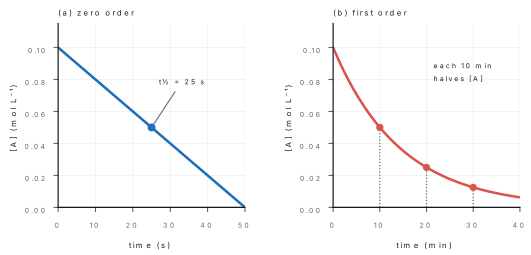
This is the equation of a straight line: a plot of [A] against t has slope -k and intercept [A]_0. The concentration falls by the same amount in every equal interval of time, so the reaction finishes in a finite time, t_{\text{complete}} = [A]_0/k.
Half-life. Put [A] = [A]_0/2:
So for a zero-order reaction the half-life is directly proportional to the starting concentration: start with twice as much and the first half takes twice as long. Each successive half-life is shorter than the one before.
First order
We start from the rate law and want [A] as a function of time.
Step 1 — separate the variables. Divide both sides by [A] and multiply by dt: \frac{d[A]}{[A]} = -k\,dt.
Step 2 — integrate between t = 0 (when [A] = [A]_0) and time t: \int_{[A]_0}^{[A]} \frac{d[A]}{[A]} = -k\int_0^t dt.
Step 3 — evaluate. \ln[A] - \ln[A]_0 = -kt, that is \ln\frac{[A]}{[A]_0} = -kt, or equivalently \ln\frac{[A]_0}{[A]} = kt.
Step 4 — convert to base 10, because CEE data are usually given as logarithms to base 10: \ln x = 2.303\log x, so k = \frac{2.303}{t}\log\frac{[A]_0}{[A]}.
Step 5 — exponentiate for the working form: [A] = [A]_0e^{-kt}.
Result. \ln\frac{[A]_0}{[A]} = kt, [A] = [A]_0e^{-kt}, k = \frac{2.303}{t}\log\frac{[A]_0}{[A]}.
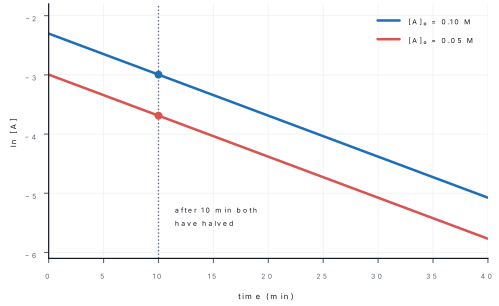
What it means. A plot of \ln[A] against t is a straight line of slope -k; the concentration itself decays exponentially, so it never quite reaches zero. The law assumes the reaction is first order throughout and that temperature is constant.
Half-life. Put [A] = [A]_0/2:
The initial concentration has cancelled out. The half-life of a first-order reaction is independent of the starting concentration — this single sentence is the most examined idea in the chapter. After n half-lives the fraction left is (1/2)^n:
| Half-lives elapsed | 1 | 2 | 3 | 4 | 5 |
|---|---|---|---|---|---|
| Fraction left | 1/2 | 1/4 | 1/8 | 1/16 | 1/32 |
| Percentage left | 50 % | 25 % | 12.5 % | 6.25 % | 3.13 % |
The graphical test — which plot is straight?
This table answers most graph questions in the paper.
| Order | Plot that is a straight line | Slope | Intercept | Half-life |
|---|---|---|---|---|
| 0 | [A] vs t | -k | [A]_0 | [A]_0/2k, ∝ [A]_0 |
| 1 | \ln[A] vs t | -k | \ln[A]_0 | 0.693/k, independent of [A]_0 |
| 2 | 1/[A] vs t | +k | 1/[A]_0 | 1/(k[A]_0) |
Worked calculations
Problem. The concentration in a first-order reaction falls from 0.80 M to 0.10 M in 400 s. Find k and t_{1/2}.
Solution. \frac{[A]_0}{[A]} = \frac{0.80}{0.10} = 8, so k = \frac{2.303}{400}\log 8 = \frac{2.303 \times 0.903}{400} = \mathbf{5.2 \times 10^{-3}} s⁻¹. Then t_{1/2} = \frac{0.693}{5.2 \times 10^{-3}} = \mathbf{133} s. Short cut: 0.80 → 0.10 is three halvings, so t_{1/2} = 400/3 = 133 s.
Problem. A zero-order reaction has [A]_0 = 0.10 M and k = 2.0 \times 10^{-3} mol L⁻¹ s⁻¹. Find t_{1/2} and the time for complete reaction.
Solution. t_{1/2} = \frac{[A]_0}{2k} = \frac{0.10}{2(2.0 \times 10^{-3})} = \mathbf{25} s. Complete reaction means [A] = 0: t = \frac{[A]_0}{k} = \frac{0.10}{2.0 \times 10^{-3}} = \mathbf{50} s. The second half takes 25 s — the same as the first, because the rate never changes.
- First order: t_{1/2} does not depend on [A]_0. An option saying "the half-life doubles when the initial concentration is doubled" is right only for zero order.
- Zero order: t_{1/2} doubles when [A]_0 doubles, and the second half-life is shorter (it is half of the first) — unlike first order, where every half-life is equal.
- "75 % complete" is two half-lives, not one and a half. 100 → 50 → 25 means 75 % has gone in 2t_{1/2}.
- A first-order reaction never reaches 100 %. Any option with "completes at t = \ldots" for first order is wrong.
9.3 Collision theory, activation and threshold energy, the activated complex; factors affecting rate; catalysis
Collision theory
Molecules in a gas collide about 10^{10} times per second, yet most reactions are slow. Collision theory explains the gap with two filters:
where Z is the collision frequency (collisions per unit volume per second) and f is the fraction of collisions that are effective. A collision produces reaction only if (i) the molecules together carry energy at least equal to the threshold energy, and (ii) they are correctly oriented at the moment of impact.
- Raising the concentration raises Z: more molecules in the same volume, more collisions, faster reaction.
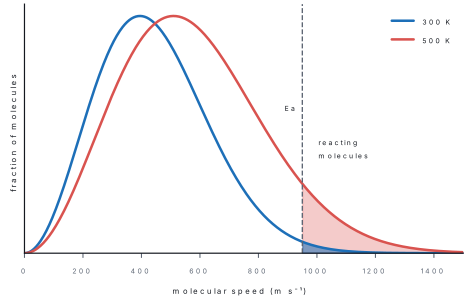
- Raising the temperature raises both the average speed (so Z rises slightly) and, far more importantly, f (which rises steeply). The temperature effect is therefore much larger than the concentration effect.
- A catalyst raises f by providing a route with a lower energy demand.
Threshold energy, activation energy and the activated complex
The threshold energy is the minimum total energy that colliding molecules must possess if they are to react. The activation energy E_a is the extra energy the reactants must gain above their average energy to reach the threshold: E_a = E_{\text{threshold}} - E_{\text{reactants}}. The activated complex (transition state) is the short-lived, unstable, high-energy arrangement of atoms at the top of the energy barrier; it is not an intermediate and cannot be isolated.
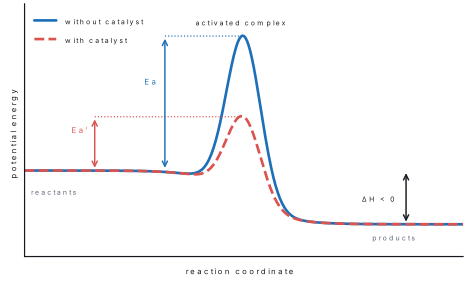
For a single-step reaction the enthalpy change is the difference of the two barriers:
For an exothermic reaction E_{a(\text{backward})} > E_{a(\text{forward})}; for an endothermic one the reverse. A catalyst lowers both barriers by the same amount, so \Delta H is untouched and the equilibrium constant cannot change — only the speed with which equilibrium is reached.
Temperature and the Arrhenius equation
A is the frequency factor (roughly the collision frequency with the right orientation), E_a the activation energy in J mol⁻¹, R = 8.314 J mol⁻¹ K⁻¹ and T the absolute temperature. Taking logarithms:
so a plot of \ln k against 1/T is a straight line of slope -E_a/R. Comparing two temperatures eliminates A:
Because E_a sits in the exponent, a small rise in T produces a large rise in k. The empirical temperature coefficient is k at (T + 10) divided by k at T; for most reactions near room temperature it lies between 2 and 3, which is the familiar rule that a 10 °C rise roughly doubles the rate.
Problem. A reaction has E_a = 50 kJ mol⁻¹. By what factor does k increase when the temperature rises from 300 K to 310 K? (R = 8.314 J mol⁻¹ K⁻¹)
Solution. \log\frac{k_2}{k_1} = \frac{50000}{2.303 \times 8.314}\left(\frac{1}{300} - \frac{1}{310}\right) = 2612 \times (1.075 \times 10^{-4}) = 0.281. \frac{k_2}{k_1} = 10^{0.281} = \mathbf{1.9}, i.e. the rate roughly doubles — the 10 °C rule, now derived rather than memorised.
A rise in temperature does not lower the activation energy. The barrier stays where it is; what changes is how many molecules have enough energy to clear it. An option saying "heating lowers E_a" is a standard wrong key. Only a catalyst lowers E_a.
The other factors that change the rate
| Factor | Effect | Reason |
|---|---|---|
| Concentration of reactants | rate rises | more molecules per unit volume, so more collisions per second |
| Pressure (gases) | rate rises with pressure | same as raising concentration |
| Surface area (solids) | rate rises with finer division | reaction happens at the surface only |
| Temperature | rate rises steeply | larger fraction of molecules above E_a |
| Catalyst | rate rises | alternative path with lower E_a |
| Nature of the reactants | ionic and radical reactions are fast; covalent bond-breaking is slow | bond strength and number of bonds to break |
| Light | starts photochemical reactions | photons supply the activation energy (H₂ + Cl₂, photography, photosynthesis) |
| Solvent | can change the rate greatly | polarity and solvation stabilise or destabilise the activated complex |
Catalysis: homogeneous, heterogeneous and enzyme
A catalyst is a substance that increases the rate of a reaction without itself being consumed, by providing an alternative reaction path of lower activation energy. It is recovered chemically unchanged in mass and composition at the end of the reaction.
| Type | Phase | How it works | Examples |
|---|---|---|---|
| Homogeneous | same phase as the reactants (usually all gas or all liquid) | forms a short-lived intermediate with a reactant, which then decomposes | NO in the lead-chamber process (SO₂ + O₂); H⁺ in the hydrolysis of an ester; Cl• in the destruction of ozone; I⁻ in the decomposition of H₂O₂ |
| Heterogeneous | different phase — usually a solid with gaseous or liquid reactants | reactants are adsorbed on the surface, which weakens their bonds and holds them in the right orientation | Fe in the Haber process; V₂O₅ in the contact process; Pt in the oxidation of SO₂ and in catalytic converters; Ni in the hydrogenation of oils; MnO₂ in the decomposition of KClO₃ |
| Enzyme | biological, in living cells | a protein with an active site of fixed shape; the substrate fits like a key in a lock, so the enzyme is highly specific | zymase (glucose → ethanol); invertase (sucrose → glucose + fructose); urease (urea → NH₃ + CO₂); pepsin and trypsin (proteins); catalase (H₂O₂) |
Characteristics of a catalyst — the list examiners pick from.
- It increases the rate of the forward and the backward reaction equally, so it shortens the time to reach equilibrium but does not shift the position of equilibrium or change K, \Delta H or \Delta G.
- It is needed in only a small amount and is regenerated, so its mass and composition are unchanged at the end.
- It is highly specific: MnO₂ works for KClO₃ but not for every decomposition.
- It works by lowering the activation energy, not by supplying energy.
- A finely divided catalyst is more effective — greater surface area.
- A promoter increases a catalyst's activity (Mo promotes Fe in the Haber process); a poison (catalyst poison) destroys it (arsenic poisons the Pt catalyst in the contact process; lead poisons the Pt in a catalytic converter).
- A negative catalyst or inhibitor slows a reaction (glycerol in hydrogen peroxide; tetraethyl lead in petrol).
- In autocatalysis a product catalyses its own reaction (Mn²⁺ in the permanganate–oxalate titration).
- A catalyst cannot make a thermodynamically forbidden reaction happen; it only speeds a reaction that is already possible.
- Enzymes are destroyed by high temperature and by extremes of pH — they are denatured, which is why the body has an optimum temperature near 37 °C.
A catalyst cannot change \Delta H, cannot change the equilibrium constant, and cannot start a reaction that is thermodynamically impossible. If an option claims any of these, it is the distractor.
Formula and fact sheet
| Quantity | Relation | Unit |
|---|---|---|
| Rate of reaction | -\frac{1}{a}\frac{d[A]}{dt} = \frac{1}{c}\frac{d[C]}{dt} | mol L⁻¹ s⁻¹ |
| Average rate | -\Delta[R]/\Delta t over a finite interval | mol L⁻¹ s⁻¹ |
| Instantaneous rate | slope of the tangent to the concentration–time curve | mol L⁻¹ s⁻¹ |
| Rate law | rate = k[A]^m[B]^n; order = m+n | — |
| Unit of k | mol^{1-n} L^{n-1} s⁻¹ | see table |
| Zero order | [A] = [A]_0 - kt; t_{1/2} = [A]_0/2k; t_{\text{complete}} = [A]_0/k | — |
| First order | \ln\frac{[A]_0}{[A]} = kt; k = \frac{2.303}{t}\log\frac{[A]_0}{[A]} | s⁻¹ |
| First-order half-life | t_{1/2} = 0.693/k | s |
| Fraction left after n half-lives | (1/2)^n | — |
| Second order | \frac{1}{[A]} = \frac{1}{[A]_0} + kt; t_{1/2} = \frac{1}{k[A]_0} | L mol⁻¹ s⁻¹ |
| Arrhenius | k = Ae^{-E_a/RT}; \ln k = \ln A - E_a/RT | — |
| Two temperatures | \log\frac{k_2}{k_1} = \frac{E_a}{2.303R}\left(\frac{1}{T_1} - \frac{1}{T_2}\right) | — |
| Temperature coefficient | k_{T+10}/k_T \approx 2 to 3 | — |
| Enthalpy from barriers | \Delta H = E_{a(\text{f})} - E_{a(\text{b})} | J mol⁻¹ |
| Straight-line test | y-axis | Slope | Intercept |
|---|---|---|---|
| Zero order | [A] | -k | [A]_0 |
| First order | \ln[A] | -k | \ln[A]_0 |
| Second order | 1/[A] | +k | 1/[A]_0 |
| Arrhenius | \ln k | -E_a/R | \ln A |
Orders and units to memorise: 0 → mol L⁻¹ s⁻¹; 1 → s⁻¹; 2 → L mol⁻¹ s⁻¹; 3 → L² mol⁻² s⁻¹. Order–molecularity gaps: H₂ + Cl₂ → 2HCl (order 1.5, molecularity 2); 2NH₃ on tungsten (order 0, molecularity 2); ester hydrolysis in excess water (pseudo-first-order, molecularity 2).
Chapter summary
- Rate is positive: for a reactant rate = -(1/a)d[R]/dt; the coefficient of every species must be included. Average rate is a chord, instantaneous rate a tangent.
- The rate law is experimental; order is the sum of the exponents and may be 0, fractional or negative, while molecularity is a theoretical whole number for one step.
- Units of k: mol L⁻¹ s⁻¹ (0), s⁻¹ (1), L mol⁻¹ s⁻¹ (2), L² mol⁻² s⁻¹ (3).
- Zero order: [A] = [A]_0 - kt, t_{1/2} = [A]_0/2k (doubles when [A]_0 doubles), and the reaction finishes at [A]_0/k.
- First order: \ln([A]_0/[A]) = kt, [A] = [A]_0e^{-kt}, t_{1/2} = 0.693/k — independent of [A]_0; n half-lives leave (1/2)^n.
- A straight \ln[A]–t plot (slope -k) is the test for first order; a straight [A]–t plot is the test for zero order.
- Collision theory: rate depends on collision frequency and on the fraction of collisions with energy ≥ threshold energy and correct orientation; the activated complex is the top of the barrier.
- k = Ae^{-E_a/RT}; a 10 °C rise roughly doubles the rate; the barrier itself does not fall with temperature.
- A catalyst lowers E_a for both directions, speeds the approach to equilibrium, and changes neither \Delta H, \Delta G nor K; enzymes are specific biological catalysts with an optimum pH and temperature.
Practice questions
Set A — Recall (25 questions)
- The rate of disappearance of a reactant is written with a negative sign becauseareactants are always solidsbthe stoichiometric coefficient of a reactant is negativecthe reactant concentration falls, so d[R]/dt is negativedthe rate constant of a reactant is negative
- The SI unit of the rate of a chemical reaction isamol L⁻¹ s⁻¹bmol L⁻¹cs⁻¹dL mol⁻¹ s⁻¹
- For 2N₂O₅ → 4NO₂ + O₂ the rate of reaction is equal toa-d[\text{N}_2\text{O}_5]/dtb-2d[\text{N}_2\text{O}_5]/dtc+\frac{1}{2}d[\text{N}_2\text{O}_5]/dtd-\frac{1}{2}d[\text{N}_2\text{O}_5]/dt
- The unit of the rate constant of a first-order reaction isamol L⁻¹ s⁻¹bs⁻¹cL mol⁻¹ s⁻¹dmol⁻¹ L s⁻¹
- The unit of k for a zero-order reaction isamol L⁻¹ s⁻¹bs⁻¹cL mol⁻¹ s⁻¹dL² mol⁻² s⁻¹
- The order of a reaction isathe number of molecules in the balanced equationbalways equal to the molecularitycthe sum of the concentration powers in the experimental rate lawdthe number of steps in the mechanism
- The molecularity of a reactionamay be zerobmay be fractionalcis found by experimentdis always a whole number
- The half-life of a first-order reaction isadirectly proportional to [A]_0bindependent of [A]_0cinversely proportional to [A]_0dproportional to [A]_0^2
- The integrated rate equation of a zero-order reaction isa[A] = [A]_0e^{-kt}b1/[A] = 1/[A]_0 + ktc\ln[A] = \ln[A]_0 + ktd[A] = [A]_0 - kt
- For a first-order reaction, a graph of \ln[A] against time isaa straight line of slope -kba straight line of slope +kca straight line of slope -k/2.303da curve
- For a zero-order reaction, a graph of [A] against time is a straight line whose slope isa+kb-2.303kc-kdk/2.303
- For a first-order reaction, t_{1/2} is equal toa0.693kb0.693/kck/0.693d1/k
- According to collision theory, colliding molecules react only if theyahave equal massesbcollide exactly head-oncare in the gaseous statedhave at least the threshold energy and a favourable orientation
- The minimum energy that colliding molecules must possess in order to react is called theaactivation energybinternal energycbond energydlattice energy
- The short-lived, high-energy arrangement of atoms at the top of the energy barrier is theaintermediatebactivated complexcfree radicaldcatalyst
- A catalyst increases the rate of a reaction byaraising the activation energybchanging the enthalpy of reactioncproviding an alternative path of lower activation energydincreasing the equilibrium constant
- The catalyst used in the Haber process isaironbV₂O₅cplatinumdnickel
- A catalyst present in a different phase from the reactants is described asahomogeneousban enzymecan autocatalystdheterogeneous
- Enzymes areainorganic catalystsbinhibitors of biological reactionschighly specific biological catalystsdhomogeneous gas-phase catalysts
- The temperature coefficient of a reaction compares the rate constants at two temperatures differing bya1 Kb10 Kc100 Kd273 K
- The Arrhenius equation isak = Ae^{-E_a/RT}bk = Ae^{E_a/RT}ck = Ae^{-RT/E_a}dk = A + e^{-E_a/RT}
- A reaction whose rate does not depend on the concentration of the reactant is ofafirst orderbsecond orderczero orderdfractional order
- The unit of the rate constant of a second-order reaction isas⁻¹bL mol⁻¹ s⁻¹cmol L⁻¹ s⁻¹dL² mol⁻² s⁻¹
- For H₂ + Cl₂ → 2HCl the rate law is rate = k[\text{H}_2][\text{Cl}_2]^{1/2}. The overall order isa1b2c3d1.5
- The hydrolysis of an ester in a large excess of water is an example of aazero-order reactionbpseudo-first-order reactioncsecond-order reactiondthird-order reaction
Answers and explanations — Set A
1. (c) — Concentration falls, so d[R]/dt is negative; the minus sign makes the rate positive. Rate constants are always positive and coefficients are positive numbers.
2. (a) — Concentration per unit time, mol L⁻¹ ÷ s. Option (c) is the unit of a first-order k; (d) of a second-order k.
3. (d) — Every rate must agree, so each is divided by its coefficient; N₂O₅ has 2 and is consumed.
4. (b) — rate = k[A] gives mol L⁻¹ s⁻¹ = k × mol L⁻¹, so k is in s⁻¹.
5. (a) — rate = k for zero order, so k carries the unit of rate itself.
6. (c) — Order is experimental. It equals the molecularity only for a single-step reaction.
7. (d) — Molecularity counts whole species colliding in one step, so it cannot be 0 or a fraction. Zero and fractional orders exist because order is empirical.
8. (b) — t_{1/2} = 0.693/k contains no concentration term. Only for zero order is t_{1/2} proportional to [A]_0.
9. (d) — Integrating -d[A]/dt = k gives [A] = [A]_0 - kt. Option (a) is the first-order law, (b) the second-order law.
10. (a) — \ln[A] = \ln[A]_0 - kt; slope -k, intercept \ln[A]_0.
11. (c) — [A] = [A]_0 - kt; the slope is -k.
12. (b) — Putting [A] = [A]_0/2 in the integrated law gives kt_{1/2} = \ln 2 = 0.693.
13. (d) — Both conditions are needed: enough energy and the right geometry. Head-on collision alone is neither necessary nor sufficient.
14. (a) — The activation energy is the extra energy above the reactants' average energy needed to reach the threshold.
15. (b) — The activated complex is a transient arrangement at the peak; an intermediate sits in a valley between two steps.
16. (c) — A catalyst offers a new path of lower E_a. It cannot alter \Delta H or K.
17. (a) — Iron with molybdenum as promoter. V₂O₅ is the contact process, Pt the oxidation of SO₂ and catalytic converters, Ni the hydrogenation of oils.
18. (d) — Different phase, e.g. solid Fe with gaseous N₂ and H₂. A homogeneous catalyst shares the phase of the reactants.
19. (c) — Enzymes are proteins with an active site of fixed shape, hence highly specific; they work best at an optimum pH and near 37 °C.
20. (b) — The temperature coefficient is k_{T+10}/k_T, usually about 2 to 3.
21. (a) — k rises as T rises, which requires the negative exponent -E_a/RT.
22. (c) — Rate = k[A]^0 = k, independent of concentration. This happens on a saturated catalyst surface.
23. (b) — mol L⁻¹ s⁻¹ = k(mol L⁻¹)², so k is in L mol⁻¹ s⁻¹.
24. (d) — Order = 1 + \frac{1}{2} = 1.5. The balanced equation's coefficients (1 and 1) do not give the order.
25. (b) — Water is in such large excess that its concentration is effectively constant, so the observed order is 1 although two molecules are involved.
Set B — Understanding (15 questions)
- The order of a reaction can be fractional but its molecularity cannot, because molecularityais measured at constant temperaturebcounts the actual species colliding in one elementary stepcdepends on the concentrations useddequals the number of product molecules
- The decomposition of ammonia on a hot tungsten surface has a rate independent of ammonia pressure. The reaction isafirst orderbsecond ordercof order 1.5dzero order
- The half-life of a first-order reaction is 20 min. The time for the concentration to fall to one-eighth of its initial value isa60 minb40 minc80 mind160 min
- For a zero-order reaction, the time needed for complete reaction isaindependent of [A]_0bproportional to 1/[A]_0cproportional to [A]_0dproportional to [A]_0^2
- A catalyst does NOT change thearate of the forward reactionbenthalpy change of the reactioncactivation energydrate of the reverse reaction
- The rate of most reactions increases with temperature mainly becauseaa larger fraction of molecules has energy at least equal to E_abthe activation energy fallscthe molecules become smallerdthe concentration of the reactants rises
- For an exothermic reaction, the activation energy of the reverse reaction isaequal to that of the forward reactionbsmaller than that of the forward reactionczerodlarger than that of the forward reaction
- Two reactions have the same rate constant at 300 K but different activation energies. At 350 K the reaction with the larger E_a hasathe smaller rate constantbthe same rate constantcthe larger rate constantda rate constant that cannot be compared
- Which statement about the rate constant k is correct?aIt equals the rate when every reactant concentration is 1 mol L⁻¹bIt depends on the concentrations of the reactantscIt has the same unit for every reactiondIt increases steadily as the reaction proceeds
- If the activation energy of a reaction is zero, the rateais zero at every temperaturebdoes not depend on temperaturecdoubles for every 10 K risedfalls as the temperature rises
- A homogeneous catalyst is one thatais always a solidbis in a different phase from the reactantscis consumed during the reactiondis in the same phase as the reactants
- Enzyme-catalysed reactions are characterised byavery high activation energiesba complete absence of specificitycmaximum activity at an optimum pH and temperaturedindependence of temperature
- The half-life of a first-order reaction is 10 min. The time needed for 99.9 % completion is abouta100 minb30 minc50 mind1000 min
- In an energy profile, the difference between the threshold energy and the average energy of the reactants is theaenthalpy of reactionbbond energycactivation energydinternal energy
- The rate of a reaction between a gas and a solid is increased most byausing the solid in large lumpsbgrinding the solid to a fine powderccooling the reaction mixturedadding an inert gas at constant volume
Answers and explanations — Set B
1. (b) — Molecularity is a count of particles in one step, so it is a whole number. Order is empirical and may be fractional because it reflects the mechanism, not a count.
2. (d) — A saturated surface cannot use more ammonia, so the rate stops responding to pressure: rate = k[\text{NH}_3]^0.
3. (a) — One-eighth is three halvings: 3 \times 20 = 60 min. Option (b) is two half-lives (one-quarter left).
4. (c) — t_{\text{complete}} = [A]_0/k, so doubling [A]_0 doubles the time. For first order there is no finite completion time.
5. (b) — A catalyst lowers E_a and so speeds both directions, but \Delta H depends only on the reactants and products.
6. (a) — Heating does not lower the barrier; it shifts the Maxwell–Boltzmann curve so that a much larger fraction lies above E_a.
7. (d) — \Delta H = E_{a(\text{f})} - E_{a(\text{b})} is negative for an exothermic reaction, so E_{a(\text{b})} must be the larger.
8. (c) — \ln k changes with temperature at the rate E_a/RT^2; the reaction with the larger E_a is more temperature-sensitive, so it overtakes the other.
9. (a) — That is the definition of the specific rate constant. k does not depend on concentration, and its unit changes with the order.
10. (b) — k = Ae^{0} = A, so k is independent of T. This is the case for some radical recombinations.
11. (d) — Same phase, e.g. NO gas with SO₂ and O₂ gases, or H⁺(aq) in ester hydrolysis.
12. (c) — Enzymes are proteins: specific, and denatured by heat or by the wrong pH, so they show an optimum near body temperature.
13. (a) — 99.9 % gone leaves 0.1 % = 10^{-3}, which is about 10 half-lives (2^{10} = 1024): 10 \times 10 = 100 min.
14. (c) — E_a = E_{\text{threshold}} - E_{\text{reactants}}. The enthalpy change compares products with reactants, not the peak with the reactants.
15. (b) — Reaction occurs only at the surface, so finer division exposes far more surface. Cooling slows it; an inert gas at constant volume changes nothing.
Set C — Application (10 questions)
- In the decomposition 2N₂O₅ → 4NO₂ + O₂, oxygen is formed at 2.0 \times 10^{-3} mol L⁻¹ s⁻¹. The rate of disappearance of N₂O₅ isa1.0 \times 10^{-3}b2.0 \times 10^{-3}c4.0 \times 10^{-3}d8.0 \times 10^{-3} mol L⁻¹ s⁻¹
- A first-order reaction has a half-life of 10 min. Its rate constant isa6.93 \times 10^{-2} min⁻¹b6.93 \times 10^{-3} min⁻¹c1.44 \times 10^{-1} min⁻¹d0.693 min⁻¹
- In a first-order reaction the concentration falls from 0.80 M to 0.10 M in 400 s. The rate constant isa2.6 \times 10^{-3} s⁻¹b1.7 \times 10^{-3} s⁻¹c6.9 \times 10^{-3} s⁻¹d5.2 \times 10^{-3} s⁻¹
- A zero-order reaction has [A]_0 = 0.10 M and k = 2.0 \times 10^{-3} mol L⁻¹ s⁻¹. Its half-life isa50 sb25 sc5.0 sd100 s
- For A + B → products, doubling [A] at fixed [B] doubles the rate, while doubling [B] at fixed [A] makes the rate four times larger. The rate law isarate = k[A][B]^2brate = k[A]^2[B]crate = k[A][B]drate = k[A]^2[B]^2
- For a reaction with rate = k[A][B]^2, the rate is 2.0 \times 10^{-3} mol L⁻¹ s⁻¹ when [A] = [B] = 0.10 M. The value of k isa0.20b2.0 \times 10^{-2}c2.0d20, in L² mol⁻² s⁻¹
- The rate constant of a reaction doubles when the temperature rises from 300 K to 310 K. Taking R = 8.314 J mol⁻¹ K⁻¹, E_a is abouta50 kJ mol⁻¹b25 kJ mol⁻¹c200 kJ mol⁻¹d107 kJ mol⁻¹
- A first-order reaction is 75 % complete in 60 min. Its half-life isa30 minb20 minc45 mind60 min
- A zero-order reaction starts at 0.50 M with k = 1.0 \times 10^{-2} mol L⁻¹ s⁻¹. The concentration after 20 s isa0.10 Mb0.20 Mc0.30 Md0.40 M
- The half-life of a first-order reaction is 1.5 h. Its rate constant in s⁻¹ isa4.6 \times 10^{-4}b1.28 \times 10^{-4}c1.28 \times 10^{-3}d7.7 \times 10^{-3}
Answers and explanations — Set C
1. (c) — -d[\text{N}_2\text{O}_5]/dt = 2 \times d[\text{O}_2]/dt = 4.0 \times 10^{-3}. Option (b) forgets the coefficient 2.
2. (a) — k = 0.693/10 = 6.93 \times 10^{-2} min⁻¹. Option (b) divides by 100; (d) forgets to divide at all.
3. (d) — k = \frac{2.303}{400}\log 8 = \frac{2.303 \times 0.903}{400} = 5.2 \times 10^{-3} s⁻¹. Short cut: three halvings in 400 s, so t_{1/2} = 133 s and k = 0.693/133.
4. (b) — t_{1/2} = [A]_0/2k = 0.10/(4.0 \times 10^{-3}) = 25 s. Option (a) is the completion time, [A]_0/k.
5. (a) — Order in A is 1 (rate doubles), order in B is 2 (rate quadruples). Option (c) is the answer students give when they ignore the four-fold change.
6. (c) — k = \frac{2.0 \times 10^{-3}}{(0.10)(0.10)^2} = 2.0 L² mol⁻² s⁻¹. Option (a) uses [A][B] instead of [A][B]^2.
7. (d) — \log 2 = \frac{E_a}{2.303 \times 8.314}\left(\frac{1}{300} - \frac{1}{310}\right), so E_a = \frac{0.301 \times 19.15}{1.075 \times 10^{-4}} \approx 1.07 \times 10^{5} J mol⁻¹.
8. (a) — 75 % complete means two half-lives (100 → 50 → 25), so t_{1/2} = 30 min. Option (c) wrongly halves 75.
9. (c) — [A] = 0.50 - (1.0 \times 10^{-2})(20) = 0.30 M. Option (a) subtracts 0.40, using twice the time.
10. (b) — 1.5 h = 5400 s, so k = 0.693/5400 = 1.28 \times 10^{-4} s⁻¹. Option (a) is the same number with the wrong power of ten.