Chapter 17 · Organic Chemistry · 3 questions in the paper · 29 min read
Hydrocarbons
What the syllabus asks for 3
- Cracking, pyrolysis and reforming; gasoline quality, octane and cetane numbers, gasoline additives
- Alkanes, alkenes and alkynes: isomerism, nomenclature and preparation; properties of ethane; addition reactions of alkenes and alkynes; acidity of alkynes
- Aromaticity and resonance; preparation and properties of benzene
Hydrocarbons are the carbon skeletons on which the rest of organic chemistry is built, and they contribute about 3 questions. The paper moves quickly from fuels to reaction patterns: first how refineries reshape molecules for engines, then how σ-bonded alkanes, π-bonded alkenes/alkynes and the delocalized benzene ring each react. Keep one mechanistic question in front of you — where are the available electrons? Alkanes hide them in strong σ bonds, alkenes and alkynes offer π electrons to electrophiles, and benzene offers π electrons but fights to keep its aromatic sextet.
- Cracking breaks long hydrocarbons into shorter, more useful alkanes and alkenes. Pyrolysis is thermal decomposition without oxygen; steam cracking is high-temperature pyrolysis used especially for ethene/propene. Reforming rearranges/cyclizes/aromatizes straight chains to improve petrol quality and make BTX aromatics plus H₂.
- Octane number measures resistance to knocking in a spark-ignition engine: 2,2,4-trimethylpentane (“isooctane”) = 100, n-heptane = 0. It is not a measure of energy content. Cetane number measures diesel ignition quality (short ignition delay): n-hexadecane = 100. Straight chains tend to have low octane but high cetane.
- Tetraethyllead was the historic antiknock additive, now abandoned as a neurotoxic pollutant and catalyst poison. Modern blending uses branched alkylate, reformate, aromatics within limits and oxygenates such as ethanol; MTBE has groundwater-contamination concerns.
- Alkanes (CₙH₂ₙ₊₂) are tetrahedral, nonpolar and comparatively inert. Main reactions: combustion, free-radical halogenation, pyrolysis/cracking, isomerization and aromatization. Ethane burns, undergoes UV chlorination and cracks to ethene + H₂.
- Prepare alkanes by catalytic hydrogenation, Wurtz coupling (2 RX + 2 Na in dry ether; symmetrical products), decarboxylation of sodium carboxylates with soda lime (one carbon fewer) and reduction of alkyl halides.
- Alkenes (CₙH₂ₙ) are planar at C=C and show chain/position and E/Z isomerism. Prepare by alcohol dehydration, dehydrohalogenation with alcoholic KOH, Zn dehalogenation of vicinal dihalides and stereoselective partial hydrogenation of alkynes.
- Alkene additions: H₂/catalyst; X₂ (decolorized); HX by Markovnikov orientation through the more stable carbocation; HBr/peroxide by a radical anti-Markovnikov path; cold dilute alkaline KMnO₄ to a cis-diol; ozonolysis cleaves C=C to carbonyls; acid hydration gives Markovnikov alcohol.
- Alkynes (CₙH₂ₙ₋₂) are linear at C≡C. Prepare ethyne from CaC₂ + water or by double dehydrohalogenation. Lindlar H₂ gives a cis-alkene; Na/liquid NH₃ gives a trans-alkene. Hydration (HgSO₄/H₂SO₄) gives an enol that tautomerizes: ethyne → ethanal, a terminal alkyne → methyl ketone.
- A terminal alkyne C–H is weakly acidic (pKₐ ≈ 25) because the conjugate base holds its lone pair in an sp orbital (50% s). It forms metal acetylides with Na/NaNH₂, white Ag acetylide with ammoniacal AgNO₃ and red Cu(I) acetylide with ammoniacal Cu₂Cl₂.
- Benzene is a planar regular hexagon with six equal C–C bonds (≈139 pm) and a cyclic 6π cloud. Hückel aromaticity requires a cyclic, planar, fully conjugated system with 4n+2 π electrons. Benzene prefers electrophilic substitution over addition because substitution restores aromaticity. Key electrophiles: NO₂⁺ (nitration), polarized X₂/FeX₃ (halogenation), SO₃ (sulfonation), R⁺ or RCO⁺ equivalents with AlCl₃ (Friedel–Crafts).
17.1 Cracking, pyrolysis and reforming; petrol quality, octane and cetane numbers and additives
Crude oil fractions seldom match market demand or engine design. Refineries therefore perform molecular tailoring.
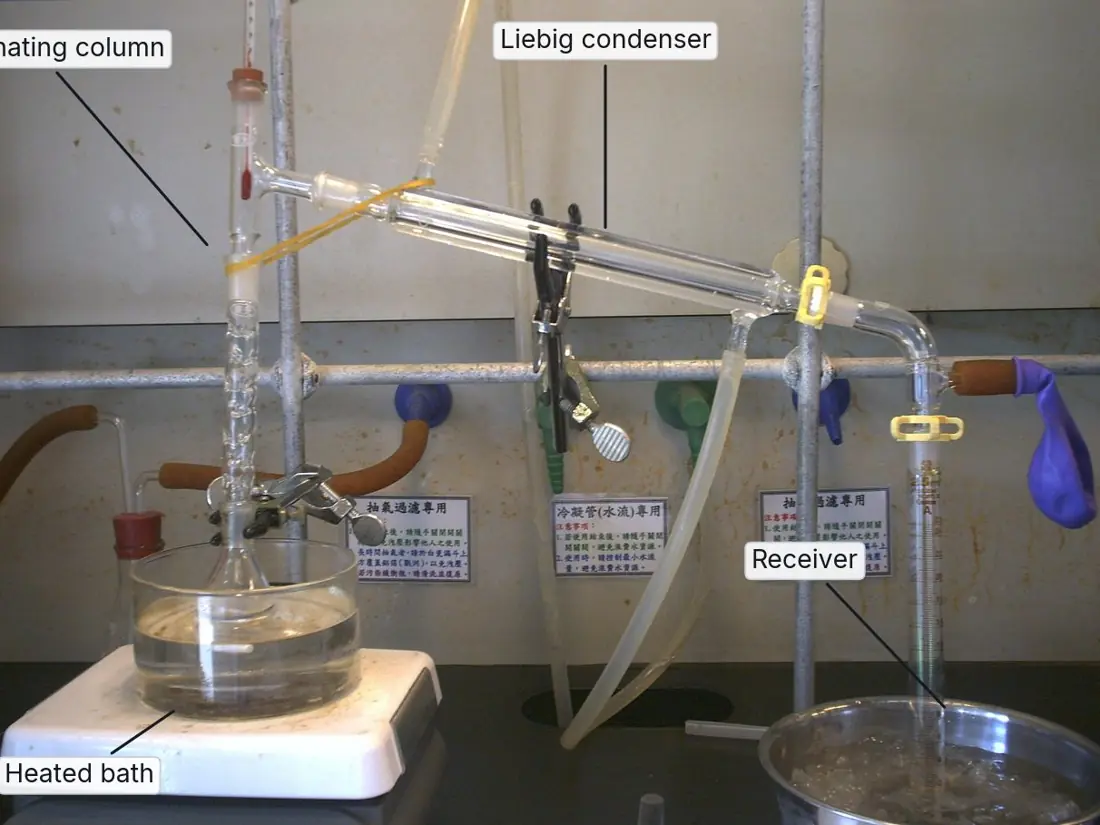
Cracking uses heat and/or a catalyst to split a long-chain hydrocarbon into shorter molecules. A representative split is
C₁₆H₃₄ → C₈H₁₈ + C₈H₁₆.
Catalytic cracking over acidic zeolites gives branched, high-octane petrol components and valuable propene/butenes. Hydrocracking adds H₂ over a catalyst and gives more saturated, cleaner middle distillates.
Pyrolysis is decomposition by heat in the absence (or near-absence) of oxygen. In petrochemistry, steam cracking of ethane, propane or naphtha at roughly 800–900 °C for a fraction of a second maximizes ethene and propene for polymers. Even a simple alkane can be described by several competing pyrolyses; for ethane the headline dehydrogenation is
C₂H₆ → C₂H₄ + H₂.
Reforming does not mainly shorten the chain. Over Pt/Re catalysts at high temperature, straight-chain alkanes isomerize to branched alkanes and cyclize/dehydrogenate to aromatics. For example,
n-C₇H₁₆ → C₆H₅CH₃ + 4H₂,
and n-hexane can be aromatized to benzene (also §17.3). Reformate has high octane; the H₂ co-product feeds refinery hydroprocessing. In older school language, “reforming” may also describe converting straight-chain petrol hydrocarbons into branched ones — the goal is the same shape change.
Octane: resistance to unwanted self-ignition
In a petrol engine the spark should start a smooth flame front. Knocking is the damaging, near-explosive autoignition of the unburned mixture ahead of that front. The octane scale assigns 100 to very knock-resistant 2,2,4-trimethylpentane and 0 to knock-prone n-heptane. A fuel rated 95 behaves, in the test engine, like a 95:5 blend of those reference compounds. Laboratory RON and the harsher MON differ, but the examination point is simple: higher octane permits higher compression without knock; it does not automatically mean more energy per litre.
Branched alkanes, cycloalkanes, many aromatics and ethanol-rich blends resist knock better than long straight chains. Tetraethyllead, Pb(C₂H₅)₄, once quenched radical pre-flame chemistry at tiny concentration, but it spread lead through cities (Ch. 15), poisoned catalytic converters and has been removed from road petrol worldwide. Present-day octane comes from refinery streams and additives/blendstocks: alkylate, reformate, isomerate, ethanol and other ether oxygenates where permitted. MTBE raises octane and oxygen content but its taste/odour and mobility in groundwater led many jurisdictions to restrict it. Detergents, antioxidants and metal deactivators are fuel additives too, but they manage deposits and storage rather than the octane scale itself.
Cetane: willingness to ignite on compression
A diesel engine has no spark: injected fuel must ignite promptly in hot compressed air. Cetane number measures that readiness — higher cetane means shorter ignition delay, smoother start and less diesel knock. n-Hexadecane (old name cetane) is 100. The structural preference is opposite to petrol: a long straight chain autoignites readily, so it has high cetane but poor octane. Cetane improvers such as 2-ethylhexyl nitrate decompose to radicals that shorten ignition delay.
Spark engine: “wait for the spark” — high octane. Diesel: “ignite when squeezed, at once” — high cetane. A straight-chain molecule obeys the diesel wish and disobeys the petrol wish.
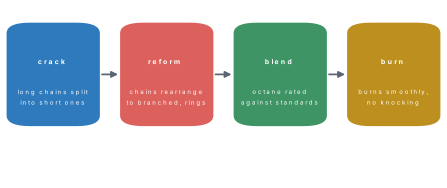
Problem. A petrol sample knocks exactly like a blend of 92 % iso-octane and 8 % n-heptane by volume. State its octane number, and name two modern additives that could raise it without lead. If a diesel matches 65 % cetane with 35 % α-methylnaphthalene, what is its cetane number? Solution. Octane number = the iso-octane percentage of the matching blend = 92; lead-free boosters include ethanol and MTBE (or reformate aromatics). Cetane number = the cetane percentage = 65. The two scales run opposite temperaments: petrol wants reluctance to auto-ignite, diesel wants eagerness — one barrel, two contradictory virtues.
17.2 Alkanes, alkenes and alkynes: isomerism, nomenclature and preparation; properties of ethane; additions and alkyne acidity
Structures and isomerism at a glance
| Family | Bonding/geometry | Isomerism to watch |
|---|---|---|
| Alkane, CₙH₂ₙ₊₂ | sp³, tetrahedral; rotation about σ bonds gives conformers, not new structural isomers | Chain isomerism begins at C₄; a substituted alkane frequent trap is missing a branched parent |
| Alkene, CₙH₂ₙ | sp², trigonal planar at C=C; π bond blocks rotation | Chain and position isomerism; cycloalkanes are ring–chain functional isomers; E/Z when each C=C carbon has two different groups |
| Alkyne, CₙH₂ₙ₋₂ | sp, linear at C≡C; two π bonds | Chain/position isomerism; dienes and cycloalkenes share the formula; terminal vs internal controls acidity tests |
Nomenclature follows Ch. 16: longest chain including the multiple bond, lowest locant to the multiple bond, ene before yne when a genuine tie must be broken, and E/Z descriptors when a stereoisomer is specified. CH₃–C(CH₃)=CH–CH₃ is 2-methylbut-2-ene; CH≡C–CH(CH₃)₂ is 3-methylbut-1-yne.
Preparation of alkanes and the chemistry of ethane
- Catalytic hydrogenation: an alkene or alkyne with H₂/Ni, Pt or Pd gives the alkane.
- Wurtz reaction: 2CH₃CH₂Br + 2Na →(dry ether) CH₃CH₂CH₂CH₃ + 2NaBr. It joins two identical alkyl groups efficiently; two different halides give a mixture, and methane cannot be made this way.
- Decarboxylation: soda lime (NaOH + CaO) removes the carboxyl carbon: CH₃CO₂Na + NaOH → CH₄ + Na₂CO₃. The alkane has one carbon fewer than the acid salt.
- Reduction of alkyl halides: Zn/acid and other reducing systems replace halogen by H.
- Kolbe electrolysis of a concentrated carboxylate can couple two alkyl radicals at the anode, a laboratory route to symmetrical even-carbon alkanes.
Ethane is a colourless, odourless, sparingly soluble gas (b.p. −89 °C). It burns completely,
2C₂H₆ + 7O₂ → 4CO₂ + 6H₂O,
and in oxygen-poor flames gives CO/soot. With Cl₂ in sunlight/UV it undergoes free-radical substitution,
C₂H₆ + Cl₂ → C₂H₅Cl + HCl,
with further chlorination possible. The chain has initiation (Cl₂ → 2Cl•), propagation (Cl• abstracts H, then C₂H₅• reacts with Cl₂) and termination (two radicals combine). Bromination is slower and more selective in higher alkanes; direct iodination is unfavourable because HI reduces the alkyl iodide back. Hot concentrated HNO₃ vapour can nitrate alkanes (radical nitration), and strong heating cracks/pyrolyses them. Rotation about ethane's C–C bond interconverts staggered (lower energy) and eclipsed conformations; they are not separable isomers at room temperature.
Alkanes generally have low density, are insoluble in water and show boiling point rising with chain length. Branching lowers boiling point by making molecules more compact and reducing contact area/dispersion forces. Their old name paraffins (“little affinity”) fits their indifference to acids, alkalis and ordinary oxidants: only strong σ bonds are offered and there is no accessible π bond or lone pair.
Preparation and addition chemistry of alkenes
Alkenes are made by elimination: dehydration of an alcohol with hot concentrated H₂SO₄ or Al₂O₃; dehydrohalogenation of an alkyl halide with hot alcoholic KOH; and Zn dehalogenation of a vicinal dihalide. When two β-hydrogens can be removed unequally, the Saytzeff (Zaitsev) product — the more substituted, more stable alkene — usually dominates. Partial hydrogenation of an alkyne with Lindlar catalyst adds H₂ syn to give the cis-alkene; Na in liquid NH₃ gives the trans-alkene.
The π bond is the reactive handle. Typical electrophilic addition begins when the π electrons attack E⁺, placing the new bond so that the more stable carbocation forms; a nucleophile then completes the product. That mechanism is the reason behind Markovnikov's rule for HX: hydrogen attaches to the alkene carbon already richer in hydrogen because protonation at the other carbon gives the better carbocation. Thus propene + HCl gives 2-chloropropane.
| Reagent | Product pattern / examination hook |
|---|---|
| H₂, Ni/Pt/Pd | Alkane; syn delivery from the catalyst surface |
| Br₂ in CCl₄ | Vicinal dibromide; orange colour discharged — test for unsaturation. Addition is anti through a bromonium ion |
| HBr, no peroxide | Markovnikov bromide (ionic path) |
| HBr, peroxide/ROOR | Anti-Markovnikov bromide (radical path); the peroxide effect is special to HBr |
| Conc. H₂SO₄, then warm H₂O; or H₂O/H⁺ | Markovnikov alcohol by carbocation capture/rearrangement risk |
| 1. B₂H₆; 2. H₂O₂/OH⁻ (hydroboration–oxidation) | Anti-Markovnikov, syn alcohol without a free carbocation (developed again in Ch. 18) |
| Cold dilute alkaline KMnO₄ (Baeyer) | Syn vicinal diol; purple colour fades and brown MnO₂ appears — test for unsaturation |
| Hot concentrated KMnO₄ | Oxidative cleavage: =CH₂ → CO₂, =CHR → carboxylic acid, =CR₂ → ketone |
| O₃, then Zn/H₂O (reductive ozonolysis) | Cleaves C=C to aldehydes/ketones; joining the carbonyl carbons in reverse locates the original double bond |
| Heat/pressure or radical initiator; Ziegler–Natta for ethene | Addition polymer (polyethene etc.) |
Worked example 17.1 — one alkene, two HBr answers
Problem. Give the major product when propene reacts with HBr (i) in the dark with no peroxide and (ii) in the presence of a peroxide.
Solution. (i) Ionic addition: protonation that gives the secondary carbocation is favoured, then Br⁻ attacks it → 2-bromopropane (Markovnikov). (ii) Peroxide initiates Br•. The bromine radical adds first so as to leave the more stable secondary carbon radical; that radical abstracts H from HBr, placing Br on the terminal carbon → 1-bromopropane (anti-Markovnikov). Same reagents, different mechanism, opposite orientation — and the trick does not transfer to HCl or HI.
Preparation, additions and acidity of alkynes
Ethyne (acetylene) is classically prepared by dropping water on calcium carbide:
CaC₂ + 2H₂O → C₂H₂↑ + Ca(OH)₂.
It is also obtained industrially by partial oxidation/high-temperature cracking of methane. Alkynes in general come from double dehydrohalogenation of vicinal or geminal dihalides (alcoholic KOH; the stronger NaNH₂ is often needed to finish a terminal alkyne), and from Zn dehalogenation of vicinal tetrahalides. The old laboratory preparation 2CHCl₃ + 6Ag → C₂H₂ + 6AgCl illustrates reductive coupling of two one-carbon fragments.
Alkynes add many alkene reagents twice unless the conditions are tuned to stop halfway:
| Reagent | Outcome |
|---|---|
| H₂/Lindlar | cis-alkene (syn, poisoned catalyst) |
| Na or Li, liquid NH₃ | trans-alkene (dissolving-metal reduction) |
| H₂/Ni or Pt, excess | Alkane |
| Br₂ (2 equivalents) | Tetrabromoalkane; bromine is decolorized |
| HX (2 equivalents) | Geminal dihalide by two Markovnikov additions |
| H₂O, H₂SO₄/HgSO₄ (Kucherov hydration) | Enol → carbonyl: ethyne gives ethanal; propyne gives propanone; internal unsymmetrical alkynes may give ketone mixtures |
| O₃ then H₂O | Carboxylic acids from internal carbons; terminal ≡CH is driven to CO₂/formic-acid level |
| Red-hot iron tube (ethyne) | Cyclic trimerization to benzene (§17.3) |
| ammoniacal Cu(I) catalysis (ethyne) | Linear coupling/polymerization products such as vinylacetylene |
Terminal alkynes are carbon acids of modest strength: HC≡C–H has pKₐ ≈ 25, far more acidic than ethene (≈44) or ethane (≈50) but still vastly weaker than water (≈15.7) or alcohols. The trend follows s-character: an sp lone pair in ⁻C≡CR is held closer to the nucleus (50% s) and is more stable than an sp² (33% s) or sp³ (25% s) lone pair. Therefore NaNH₂ and other very strong bases form acetylides; aqueous NaOH does not meaningfully deprotonate a terminal alkyne.
Diagnostic precipitations are coordination chemistry dressed as tests. With ammoniacal AgNO₃, a terminal alkyne gives a white silver acetylide; with ammoniacal Cu₂Cl₂ it gives a red copper(I) acetylide. Internal alkynes lack ≡C–H and give neither. Sodium metal liberates H₂ from a terminal alkyne (and from alcohols/water too, so the sample must be dry and alcohol-free before this is called a test). Do not store dry heavy-metal acetylides: they can be shock-sensitive explosives.
Acetylene burns in oxygen at about 3100 °C, hot enough for welding/cutting; in air its flame is smoky because of the high carbon fraction. Its compressed gas is stored dissolved in acetone in a porous cylinder filling because free acetylene can decompose explosively under pressure (Ch. 21 revisits the safety chemistry).
17.3 Aromaticity and resonance; preparation and properties of benzene
Why benzene is not “cyclohexatriene”
Kekulé's alternating double-bond hexagon explains benzene's formula C₆H₆ but not its behaviour. Experiment says all six C–C bonds are equal at about 139 pm (between C–C 154 pm and C=C 134 pm), all angles are 120°, the molecule is planar, and it resists the addition reactions that consume ordinary alkenes. Resonance theory draws two equivalent Kekulé contributors; molecular-orbital language places three π bonding orbitals over the whole ring. Either way, six π electrons occupy a cyclic cloud above and below the plane.
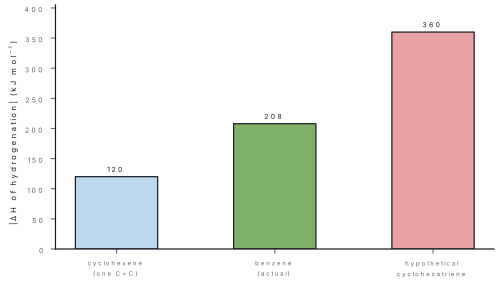
Thermochemistry measures the prize. Hydrogenating cyclohexene releases about 120 kJ mol⁻¹, so a hypothetical 1,3,5-cyclohexatriene might be expected near 360 kJ mol⁻¹. Benzene releases only about 208 kJ mol⁻¹ on complete hydrogenation: it starts about 152 kJ mol⁻¹ lower in energy than the invented triene. That difference is its empirical resonance (aromatic stabilization) energy.
Hückel's rule generalizes the pattern for a monocyclic system: cyclic + planar + fully conjugated + 4n+2 π electrons (n = 0, 1, 2, …) → aromatic. Benzene has 6 (n=1); naphthalene's fused 10π perimeter fits the same count. The cyclopentadienyl anion (two π bonds + a lone pair = 6) is aromatic, explaining cyclopentadiene's unusual acidity for a hydrocarbon. Pyrrole's nitrogen lone pair is part of its sextet, whereas pyridine's lone pair lies outside the π system and remains basic. A planar fully conjugated 4n π system is antiaromatic; failure of planarity/conjugation makes a molecule simply non-aromatic.
Preparation of benzene
- Cyclic trimerization: 3C₂H₂ passed through a red-hot iron/copper tube gives C₆H₆.
- Decarboxylation: sodium benzoate with soda lime gives benzene: C₆H₅CO₂Na + NaOH → C₆H₆ + Na₂CO₃.
- From phenol: distilling phenol with zinc dust removes oxygen: C₆H₅OH + Zn → C₆H₆ + ZnO.
- Aromatization/reforming: n-hexane over Cr₂O₃/Al₂O₃ or Pt at high temperature gives C₆H₁₄ → C₆H₆ + 4H₂; petroleum reformate and coal tar are industrial sources.
Benzene is a colourless, volatile, flammable liquid (b.p. 80.1 °C, m.p. 5.5 °C), lighter than and almost insoluble in water, with a sweet odour. Modern safety practice treats it as a proven human carcinogen associated with leukaemia; smelling it as a “test” belongs to history. In air it burns with a very sooty flame:
2C₆H₆ + 15O₂ → 12CO₂ + 6H₂O.
Chemical properties: substitution protects the sextet
If bromine simply added across one “double bond”, the product would surrender aromatic stabilization. Instead benzene's π cloud attacks a strong electrophile, forming a resonance-stabilized arenium ion (σ complex); a base then removes the proton from the same carbon and the aromatic ring is restored. Overall this is electrophilic aromatic substitution, not addition.
| Reaction | Conditions / electrophile | Product | Notes |
|---|---|---|---|
| Nitration | Conc. HNO₃ + conc. H₂SO₄, about 50–55 °C; NO₂⁺ | Nitrobenzene | Gateway to aniline (Ch. 20); hotter mixed acid forces further substitution |
| Bromination/chlorination | Br₂/FeBr₃ or Cl₂/FeCl₃ (or Fe) in the dark; polarized X₂–Lewis acid | Bromobenzene/chlorobenzene | Benzene alone does not discharge Br₂ water — the catalyst is the point |
| Sulfonation | Fuming H₂SO₄ (SO₃) | Benzenesulfonic acid | Reversible; used as a removable blocking/solubilizing group |
| Friedel–Crafts alkylation | RCl/AlCl₃ | Alkylbenzene | Carbocation rearrangement and polyalkylation can spoil an otherwise easy plan |
| Friedel–Crafts acylation | RCOCl/AlCl₃ | Aryl ketone, e.g. phenylethanone | Product ring is deactivated, so reaction usually stops at one acyl group |
Under forcing conditions addition can be compelled: hydrogenation with Ni at high temperature/pressure gives cyclohexane (C₆H₆ + 3H₂ → C₆H₁₂), and chlorine under UV adds to give hexachlorocyclohexane isomers, C₆H₆Cl₆ (the γ-isomer is lindane, now heavily restricted as a persistent pollutant). Ozonolysis attacks all three formal π bonds and, after workup, glyoxal fragments are obtained — useful historically as evidence for the ring, not a preparative method.
For a ring that already carries a substituent, the first group steers the second. The school map (mechanism generalities from Ch. 16) is:
| Existing group type | Rate vs benzene | Main orientation |
|---|---|---|
| Strong/moderate donors: –NH₂, –OH, –OR, –NHCOR | Activating | ortho/para |
| Alkyl groups | Weakly activating | ortho/para |
| Halogens | Deactivating (−I stronger overall) | ortho/para (+R controls position) |
| Strong withdrawers: –NO₂, –CN, –CHO, –COR, –CO₂H, –SO₃H | Deactivating | meta |
Benzene's formula is highly unsaturated (DU = 4), yet it does not decolorize bromine water or cold alkaline KMnO₄ under alkene-test conditions. DU counts rings and π bonds; it does not say those π electrons are available for ordinary addition. Aromatic stabilization is exactly the energy that would be lost.
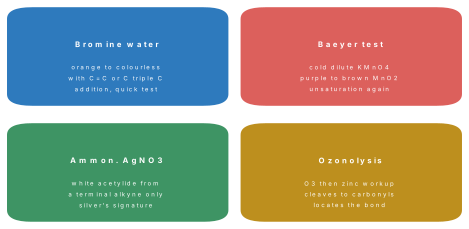
Five swaps the paper sets: alcoholic KOH eliminates (alkene), aqueous KOH substitutes (alcohol) — the solvent chooses the path; Markovnikov is the ionic rule, the peroxide effect its radical exception, and the exception works for HBr only (HCl and HI chains fail energetically); ozonolysis with Zn/H₂O stops at aldehydes and ketones; oxidative workup pushes on to acids; terminal alkynes answer silver and copper ammoniates, internal ones stay silent — and terminal alkynes are the acidic hydrocarbons, not the reactive ones; and benzene substitutes to keep its resonance energy; addition (BHC, cyclohexane) needs light, heat and excess reagent.
Problem. Reductive ozonolysis (\text{O}_3 followed by \text{Zn/H}_2\text{O}) of an alkene \text{C}_5\text{H}_{10} gives an equimolar mixture of acetone (\text{CH}_3\text{COCH}_3) and acetaldehyde (\text{CH}_3\text{CHO}). Deduce the structure and IUPAC name of the alkene.
Solution. Erase the two \text{=O} oxygen atoms and join the carbonyl carbons by a double bond: (\text{CH}_3)_2\text{C=O} + \text{O=CHCH}_3 \Longrightarrow (\text{CH}_3)_2\text{C=CHCH}_3, which is 2-methylbut-2-ene.
Formula and fact sheet
| Topic | Must-know |
|---|---|
| Refinery verbs | Crack = shorten; pyrolyse = heat without O₂; reform = branch/cyclize/aromatize |
| Fuel scales | Octane: isooctane 100, n-heptane 0. Cetane: n-hexadecane 100; high cetane = short diesel ignition delay |
| Alkane preps | Hydrogenation; Wurtz (dry ether/Na); soda-lime decarboxylation (−1 C); RX reduction |
| Ethane | Burns to CO₂/H₂O; UV radicals substitute Cl; cracks to ethene + H₂; staggered conformer lowest |
| Alkene additions | Markovnikov via better carbocation; HBr/peroxide flips by radicals; Br₂ and Baeyer tests; ozonolysis cleaves |
| Alkyne control | Lindlar → cis; Na/NH₃ → trans; Hg²⁺ hydration → carbonyl; 2 eq. HX → gem-dihalide |
| Terminal alkyne | pKₐ ≈ 25 (sp); Ag(I) white ppt, Cu(I) red ppt; internal alkyne negative |
| Benzene | 6 π e⁻, equal 139 pm bonds, resonance energy ≈152 kJ mol⁻¹; substitution with NO₂⁺, X₂/FeX₃, SO₃, RCl/RCOCl + AlCl₃ |
Rapid-revision tables and high-yield facts
| Item | Value or rule |
|---|---|
| Octane standards | iso-octane 100, n-heptane 0 |
| Cetane standards | cetane 100, α-methylnaphthalene 0 |
| Wurtz | 2 RX + 2 Na → R–R |
| Ethene | EtOH, conc. H₂SO₄, 170 °C |
| Markovnikov | H to the H-richer carbon |
| Peroxide effect | HBr only, anti-Markovnikov |
| Carbide | CaC₂ + 2H₂O → C₂H₂ |
| Nitration | HNO₃/H₂SO₄, NO₂⁺, 50–60 °C |
| Friedel–Crafts | AlCl₃ catalyst |
| BHC | C₆H₆ + 3Cl₂, hv |
Chapter summary
- Refineries crack long chains, pyrolyse feedstocks to light alkenes and reform straight chains into branched/aromatic molecules that engines and polymer plants actually want.
- Octane rewards resistance to autoignition; cetane rewards prompt compression ignition. Molecular shape therefore wins opposite prizes in the two fuels.
- Alkanes are strong-σ, nonpolar and slow to react except by combustion and radical pathways; ethane exemplifies combustion, UV substitution and cracking.
- Alkenes spend a π bond in addition reactions. Carbocation stability explains Markovnikov orientation, while peroxide changes HBr addition into a radical anti-Markovnikov process.
- Alkynes can be stopped at a cis- or trans-alkene by choosing the reduction system; their terminal C–H is acidic because an sp conjugate base is comparatively stable.
- Benzene is stabilized by a six-electron cyclic π system (Hückel 4n+2), so electrophiles substitute a ring hydrogen rather than permanently adding and destroying aromaticity.
Practice questions
Set A — Recall (25 questions)
- Cracking in petroleum refining is the process of breakingaonly aromatic ringsbcrude oil into elementscwater into hydrogendlong-chain hydrocarbons into shorter hydrocarbons
- Pyrolysis is thermal decomposition carried outain the absence of oxygenbin excess oxygenconly in waterdby electrolysis
- Catalytic reforming mainly converts straight-chain hydrocarbons intoapolymersbcarbon dioxidecbranched and aromatic hydrocarbonsdalkyl halides
- The hydrocarbon assigned octane number 100 isan-heptaneb2,2,4-trimethylpentanecn-hexadecanedbenzene
- The hydrocarbon assigned octane number 0 isan-heptanebmethaneccyclohexanedisooctane
- Cetane number is a measure of the ignition quality ofapetrol onlybaviation spirits onlyckerosene lampsddiesel fuel
- The historic antiknock petrol additive now phased out for toxicity isaethanolbtetraethylleadcdetergentd2-ethylhexyl nitrate
- The general formula of an alkane isaCₙH₂ₙbCₙH₂ₙ₋₂cCₙH₂ₙ₊₂dCₙHₙ
- In the Wurtz reaction an alkyl halide is treated withaaqueous KOHbsodium in dry ethercconcentrated H₂SO₄dLindlar catalyst
- Soda-lime decarboxylation of a sodium carboxylate gives an alkane withaone carbon fewerbone carbon morecthe same carbon numberdtwice the carbons
- Chlorination of ethane in sunlight proceeds by aanucleophilic substitutionbpericyclic reactioncelectrophilic additiondfree-radical substitution
- Chain isomerism in alkanes first appears inamethanebethanecbutanedpropane
- The geometry around each carbon of ethene is approximatelyatrigonal planarbtetrahedralclineardpyramidal
- Ethanol is dehydrated to ethene using hotadilute NaOHbammoniacal AgNO₃cconcentrated H₂SO₄ (or Al₂O₃)dFeCl₃ only
- Dehydrohalogenation of an alkyl halide is commonly done with hotaaqueous KOHbalcoholic KOHcNaHCO₃dZn/H₂O only
- An alkene is detected by decolorization ofaFehling solutionbBenedict solution onlyclime waterdbromine in CCl₄
- In Markovnikov addition of HX to an unsymmetrical alkene, H attaches to the carbon that gives the more stableacarbanionbfree radical alwaysccarbocationdaromatic ring
- The peroxide effect (anti-Markovnikov addition) is shown byaHCl onlybHBrcHI onlydHF only
- Cold dilute alkaline KMnO₄ converts an alkene into aavicinal diolbdiketoneccarboxylic acid onlydalkane
- Ethyne is prepared in the laboratory from calcium carbide andaethanolbbrominecconcentrated HNO₃dwater
- Hydrogenation of an alkyne over Lindlar catalyst gives mainly theaalkanebcis-alkenectrans-alkenedaromatic compound
- Hydration of ethyne with H₂SO₄/HgSO₄ givesaethanolbmethanecethanoic acid directlydethanal
- A terminal alkyne with ammoniacal silver nitrate gives a precipitate that isaredbbluecwhitedblack only
- The six C–C bonds in benzene areaall equal at about 139 pmbalternating 134 and 154 pmcall 154 pmdall 120 pm
- The electrophile in nitration of benzene isaNO₂•bNO₃⁻cNO₂⁺dNH₄⁺
Answers and explanations — Set A
1. (d) — shorter alkanes/alkenes match petrol and petrochemical demand better than wax-range chains.
2. (a) — without O₂, heat breaks bonds rather than burning the substrate.
3. (c) — isomerization, cyclization and dehydrogenation raise octane and supply aromatics/H₂.
4. (b) — 2,2,4-trimethylpentane is the knock-resistant reference.
5. (a) — straight-chain n-heptane knocks very readily and anchors the bottom of the scale.
6. (d) — a high cetane number means a short compression-ignition delay.
7. (b) — tetraethyllead's benefit was overwhelmed by lead neurotoxicity and catalyst poisoning.
8. (c) — an acyclic saturated hydrocarbon has DU = 0.
9. (b) — Na couples two alkyl groups in dry ether; water/alcohol would quench the organometallic pathway.
10. (a) — the –CO₂Na carbon leaves as carbonate/CO₂ chemistry, shortening the chain by one.
11. (d) — UV homolyses Cl₂ and starts a radical chain.
12. (c) — butane and 2-methylpropane are the first skeletal pair.
13. (a) — sp² carbon has angles near 120°.
14. (c) — a strong dehydrating acid or hot alumina removes H₂O from adjacent carbons.
15. (b) — alcoholic KOH favours elimination over the substitution promoted by aqueous conditions.
16. (d) — dibromination consumes orange Br₂; benzene does not do this under the same conditions.
17. (c) — Markovnikov's rule is a consequence of forming the better carbocation.
18. (b) — the radical chain is energetically practical for HBr, not for HCl/HI.
19. (a) — Baeyer conditions add two –OH groups syn across the double bond.
20. (d) — CaC₂ + 2H₂O → C₂H₂ + Ca(OH)₂.
21. (b) — the poisoned catalyst delivers both H atoms to the same face and stops at the alkene.
22. (d) — the first-formed enol, CH₂=CH–OH, tautomerizes to ethanal.
23. (c) — white silver acetylide; the copper(I) analogue is red.
24. (a) — equal intermediate bond lengths are central evidence against a fixed cyclohexatriene.
25. (c) — concentrated H₂SO₄ converts HNO₃ into the nitronium ion, NO₂⁺.
Set B — Understanding (15 questions)
- A higher octane rating does not necessarily mean the fuel contains more chemical energy; it means the fuel better resistsaevaporationbdissolving in oilcknocking/autoignitiondfreezing
- A long straight-chain alkane generally has low octane but high cetane because it autoignitesaneverbafter hydrogenation onlyconly under UVdreadily, which is bad with a spark but good in a diesel
- Tetraethyllead was removed from petrol chiefly because lead compounds are neurotoxic and alsoapoison catalytic convertersbraise cetane too muchcmake petrol alkalineddissolve rubber instantly
- Alkanes are much less reactive than alkenes toward Br₂ in the dark because alkanes lack an accessibleacarbon atombπ bond (or lone pair) for attackchydrogen atomdσ bond
- Among C₅H₁₂ isomers, the most branched isomer usually has the lowest boiling point mainly because branching reducesamolar massbhydrogen countccovalent bond strengthdsurface contact and dispersion forces
- Dehydration of butan-2-ol gives but-2-ene as the major alkene rather than but-1-ene because but-2-ene isaaromaticbmore substituted and more stable (Saytzeff)ca terminal alkenedunable to rotate
- Propene + HCl gives 2-chloropropane mainly because protonation can produce aaprimary carbanionbmethyl radical onlycsecondary carbocationdbenzene ring
- In HBr/peroxide addition, bromine ends up on the less substituted carbon because Br• adds first to generate the more stableacarbon radicalbcarbocationccarbaniondbromonium ion
- trans-But-2-ene is generally more stable than cis-but-2-ene mainly because in the trans form the methyl groups areaionicbfarther apart (less steric crowding)creplaced by hydrogendconjugated with oxygen
- Ozonolysis products locate an alkene double bond because each former alkene carbon becomes aacarbonyl carbon in an identifiable fragmentbcarboxylate onlycmethyl groupdnitrile carbon
- A terminal alkyne is more acidic than an alkene because its conjugate base has the lone pair in an orbital with greaterap characterbionic radiuscd characterds character
- But-2-yne gives no precipitate with ammoniacal AgNO₃ because it has noatriple bondbcarbon atomcterminal ≡C–H protondπ electrons
- Benzene undergoes substitution rather than addition with many electrophiles because substitution restores theaaromatic 6π-electron systembσ framework onlyctetrahedral geometrydhydrogen bonding
- Benzene does not decolorize bromine water although its DU is 4 because addition would destroyaall C–H bondsbmolecular symmetry onlyccarbon atomsdaromatic stabilization
- The cyclopentadienyl anion is aromatic because it is cyclic, planar, conjugated and containsa4 π electronsb6 π electronsc8 π electronsdonly σ electrons
Answers and explanations — Set B
1. (c) — octane is a knock-resistance rating, not a calorific-value label.
2. (d) — the two engines want opposite autoignition behaviour.
3. (a) — environmental Pb exposure was decisive; catalyst poisoning made leaded fuel incompatible with emission control.
4. (b) — electrophiles need accessible electron density; alkane σ bonds respond instead to radical attack under initiation.
5. (d) — all isomers have the same mass/formula, so shape-controlled intermolecular contact explains the trend.
6. (b) — greater alkene substitution gives more hyperconjugative stabilization; trans-but-2-ene leads within that pair.
7. (c) — proton adds to the terminal carbon, leaving (CH₃)₂CH⁺ rather than a primary cation.
8. (a) — radical stability, not carbocation stability, directs the first addition step under peroxide conditions.
9. (b) — opposite placement relieves methyl–methyl steric repulsion.
10. (a) — redrawing the two carbonyl carbons joined by a double bond reconstructs the alkene.
11. (d) — 50% s character holds the anion pair closer to carbon's nucleus and stabilizes it.
12. (c) — silver acetylide formation requires replacement of the terminal acetylenic proton.
13. (a) — deprotonation of the arenium ion refunds aromatic stabilization energy.
14. (d) — DU counts the ring as well; addition would convert a stabilized π sextet into a non-aromatic diene.
15. (b) — 4 π electrons from two double bonds plus the 2-electron lone pair satisfy 4n+2 with n=1.
Set C — Application (10 questions)
- Which equation correctly represents one possible cracking of dodecane?aC₁₂H₂₆ → C₇H₁₆ + C₅H₁₂bC₁₂H₂₆ → C₇H₁₆ + C₅H₁₀cC₁₂H₂₆ → C₆H₁₄ + C₆H₁₄dC₁₂H₂₆ → C₈H₁₈ + C₄H₁₀
- Catalytic aromatization of n-hexane can be represented asaC₆H₁₄ → C₆H₆ + 2H₂bC₆H₁₄ → C₆H₁₂ + H₂cC₆H₁₄ → C₆H₆ + 4H₂dC₆H₁₄ → 6C + 7H₂
- Bromoethane with Na in dry ether (Wurtz) gives mainlyan-butanebethanecethenedmethane
- Sodium propanoate heated with soda lime givesapropanebbutanecmethanedethane
- Propene + HBr (no peroxide) gives mainlya1-bromopropaneb1,2-dibromopropanec2-bromopropanedpropan-2-ol
- Propene + HBr in the presence of peroxide gives mainlya1-bromopropaneb2-bromopropanecpropanedallyl bromide
- Reductive ozonolysis of but-2-ene gives two molecules ofaformaldehydebethanoic acidcpropanonedethanal
- But-2-yne hydrogenated over Lindlar catalyst givesatrans-but-2-enebcis-but-2-enecbutanedbut-1-ene
- Propyne on hydration with dilute H₂SO₄/HgSO₄ gives mainlyapropanonebpropanalcpropan-1-oldpropanoic acid
- Benzene + CH₃COCl in the presence of anhydrous AlCl₃ givesatoluenebphenylethanone (acetophenone)cchlorobenzenedbenzoic acid
Answers and explanations — Set C
1. (b) — atoms balance: C 7+5=12 and H 16+10=26, with one product an alkene as cracking requires.
2. (c) — losing eight H atoms as 4H₂ converts C₆H₁₄ into benzene C₆H₆.
3. (a) — two ethyl fragments couple: C₂H₅–C₂H₅.
4. (d) — remove the carboxyl carbon from the three-carbon propanoate chain.
5. (c) — ionic Markovnikov addition through the secondary carbocation.
6. (a) — radical addition places Br at C1; compare Worked example 17.1's mechanism with the changed conditions emphasis.
7. (d) — each CH₃CH= half becomes CH₃CHO under reductive workup.
8. (b) — syn delivery on the poisoned catalyst gives the cis (Z) alkene and stops there.
9. (a) — Markovnikov hydration gives the enol CH₃–C(OH)=CH₂, which tautomerizes to the methyl ketone.
10. (b) — Friedel–Crafts acylation installs –COCH₃; the deactivated product resists a second acylation.