Chapter 22 · Analytical Chemistry · 3 questions in the paper · 30 min read
Analytical Chemistry
What the syllabus asks for 3
- Tests for acid and basic radicals; tests for unsaturation and functional groups; distinction tests; Lassaigne's test; tests for fats, proteins and carbohydrates
- Separation techniques: filtration, sublimation, evaporation, precipitation, crystallization, distillation, paper chromatography and atmolysis
- Acid–base, redox (permanganometric, iodometric and iodimetric) and complexometric titrations; choice of indicator
Analytical chemistry is the detective work of the subject: qualitative tests ask what is present, separations ask how can it be isolated, and titrations ask how much. It carries about 3 questions, usually as a colour, precipitate, gas, separation choice or a short titration calculation. The winning habit is to treat every observation as evidence with a chemical reason — a white precipitate is only useful when you also know where it dissolves, what gas came before it and which rival ion could imitate it.
- Dilute-acid anion gases: carbonate/bicarbonate → CO₂ (lime water milky, excess clears); sulfite → SO₂ (acidified dichromate turns green); sulfide → H₂S (lead-ethanoate paper blackens); nitrite → NO browning in air; ethanoate → vinegar smell on warming.
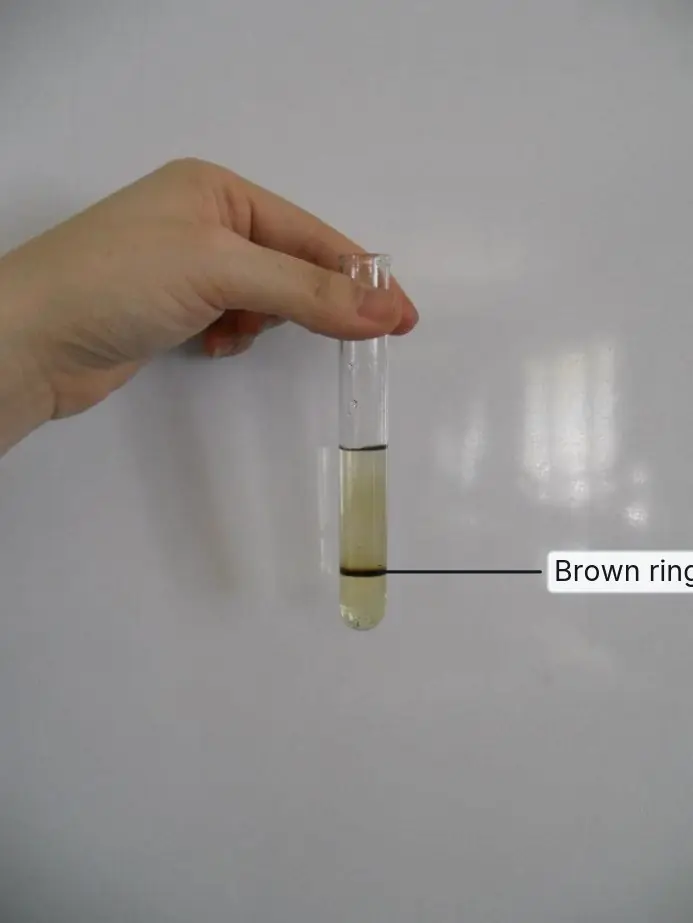
- Confirmatory anions: sulfate = BaCl₂/HCl white ppt insoluble in acid; nitrate = brown-ring test; phosphate = yellow ppt with ammonium molybdate/HNO₃ on warming; halides with AgNO₃: AgCl white (soluble in dilute NH₄OH), AgBr pale yellow (sparingly soluble in conc. NH₄OH), AgI yellow (insoluble).
- Cation groups: I dil. HCl (Ag⁺, Hg₂²⁺, Pb²⁺; PbCl₂ dissolves in hot water, AgCl in NH₄OH, Hg₂Cl₂ blackens with NH₄OH); II H₂S/dil. HCl; III NH₄OH/NH₄Cl (Fe³⁺ brown ppt, Al³⁺ white, Cr³⁺ green); IV H₂S/NH₄OH (ZnS white, MnS flesh, NiS/CoS black); V (NH₄)₂CO₃ (Ba²⁺/Sr²⁺/Ca²⁺ white carbonates); VI Mg²⁺/Na⁺/K⁺ remain. NH₄⁺ is tested in the original sample (Group 0).
- Spot tests: Fe³⁺ + SCN⁻ blood-red; Cu²⁺ + excess NH₄OH deep-blue [Cu(NH₃)₄]²⁺; Ni²⁺ + dimethylglyoxime rosy-red ppt; flames Na golden-yellow, K lilac (cobalt glass), Ca brick-red, Sr crimson, Ba apple-green, Cu blue-green.
- Organic unsaturation: Br₂/CCl₄ decolorized and cold dilute alkaline KMnO₄ (Baeyer) discharged — but benzene is negative, and phenol/aniline decolorize bromine water by substitution with a precipitate.
- Functional-group anchors: –CO₂H fizzes with NaHCO₃; phenol violet with FeCl₃; aldehyde Tollens/Fehling positive, ketone only 2,4-DNP; CH₃CO– iodoform positive; terminal alkyne gives white Ag(I)/red Cu(I) acetylide; 1° amine carbylamine positive.
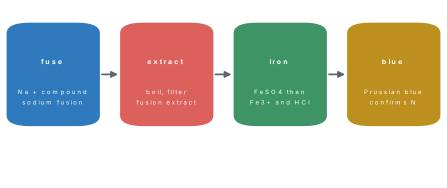
- Lassaigne: sodium fusion converts organically bound N → CN⁻, S → S²⁻, halogen → X⁻ (N+S may give SCN⁻). Nitrogen → Prussian blue; sulfur → violet with sodium nitroprusside or black PbS; N+S → blood-red Fe³⁺ thiocyanate colour; halogens → AgX after boiling the extract with HNO₃.
- Food tests: Molisch = carbohydrate (violet ring); Benedict/Fehling = reducing sugar (brick-red Cu₂O); iodine = starch (blue-black); Biuret = peptide bonds (violet); xanthoproteic = aromatic amino-acid residues (yellow → orange in alkali); grease spot/Sudan dyes = fat.
- Separations follow a property difference: filtration (particle size), sublimation (vapour pressure of a solid), evaporation/crystallization (solubility), precipitation (selective insolubility), distillation (volatility; fractional for close boiling points, steam for heat-sensitive immiscibles, vacuum to lower b.p.), paper chromatography (partition; R_f = spot distance ÷ solvent-front distance), atmolysis (Graham diffusion, rate ∝ 1/√M).
- Indicator choice follows the pH at equivalence: strong acid–weak base → methyl orange/red; weak acid–strong base → phenolphthalein; strong–strong → either. Endpoint (observed) must be matched to equivalence point (stoichiometric).
- KMnO₄ titrations are self-indicating, use H₂SO₄ (not HCl), and in acid MnO₄⁻ takes 5 e⁻ to Mn²⁺. Iodimetry titrates a reductant directly with I₂; iodometry lets an oxidant liberate I₂ from I⁻ and titrates it with thiosulfate, adding starch only near the pale-straw end point.
- EDTA binds metal ions 1:1. At pH 10 with Eriochrome Black T, wine-red → blue marks total Ca²⁺+Mg²⁺ hardness; results are reported as mg L⁻¹ CaCO₃ equivalent.
22.1 Tests for acid and basic radicals; unsaturation and functional groups; distinction tests; Lassaigne's test; fats, proteins and carbohydrates
Acid radicals (anions): let the gas speak first
Qualitative salt analysis begins with the sample's appearance and solubility, but the systematic anion hunt starts with dilute H₂SO₄, warm if needed:
| Observation with dil. H₂SO₄ | Ion indicated | Confirmation |
|---|---|---|
| Brisk effervescence; gas turns lime water milky, excess gas clears it (soluble bicarbonate) | CO₃²⁻ / HCO₃⁻ | CO₂ has no smell and no effect on dichromate paper |
| Choking gas of burning sulfur; turns acidified K₂Cr₂O₇ paper green | SO₃²⁻ | SO₂ also decolorizes dilute KMnO₄ |
| Rotten-egg gas; lead-ethanoate paper turns black (PbS) | S²⁻ | Sodium nitroprusside on alkaline extract → violet |
| Colourless gas browning at the mouth of the tube (NO → NO₂ in air); brown fumes | NO₂⁻ | FeSO₄ gives a dark brown/black ring even with dilute acid |
| Vinegar smell, stronger on warming | CH₃CO₂⁻ | Neutral FeCl₃ gives a deep-red colour; esterification gives fruity ethyl ethanoate |
| No gas | Try conc. H₂SO₄ tests and specific tests below | — |
Concentrated H₂SO₄ (handle as the dehydrating oxidant of Ch. 13) interrogates a second tier: chlorides fume HCl (white smoke with an NH₃ rod; with MnO₂, greenish Cl₂); bromides give HBr partly oxidized to orange Br₂ vapour; iodides give violet I₂ vapour; nitrates with Cu turnings give brown NO₂; oxalates evolve CO + CO₂ without charring; fluorides generate HF, which etches glass. These are old but logically ordered tests — the strong acid first expels a weaker/more volatile acid, then may oxidize it.
Independent confirmations settle the common ions:
- Sulfate: BaCl₂ to an acidified solution gives white BaSO₄ that stays insoluble in dilute HCl — acid solubility separates it from BaCO₃/BaSO₃ impostors.
- Nitrate (brown ring): fresh FeSO₄ solution, then conc. H₂SO₄ poured down the wall; a brown [Fe(H₂O)₅(NO)]²⁺ ring forms at the junction. Do not shake the layers away.
- Halides: AgNO₃ after acidifying with dilute HNO₃ — AgCl white and soluble in dilute NH₄OH, AgBr pale yellow and only sparingly soluble in concentrated NH₄OH, AgI yellow and insoluble. The organic-layer test agrees: chlorine water liberates Br₂ (orange) or I₂ (violet) into CHCl₃/CCl₄.
- Phosphate: ammonium molybdate in conc. HNO₃, warmed, gives a canary-yellow precipitate of ammonium phosphomolybdate.
- Chromate: yellow solution; BaCl₂ gives yellow BaCrO₄ soluble in strong acid; acidifying shifts CrO₄²⁻ (yellow) toward Cr₂O₇²⁻ (orange), Ch. 7 in colour.
Basic radicals (cations): separation by controlled precipitation
The classical scheme precipitates groups in order, each reagent exploiting a solubility cliff. Ammonium is hunted first (Group 0) because later reagents add it: warm the original solid with NaOH — NH₃ turns moist red litmus blue and gives a brown precipitate with Nessler's reagent.
| Group reagent | Ions precipitated | Discriminating observations |
|---|---|---|
| I: dilute HCl | Ag⁺, Hg₂²⁺, Pb²⁺ as white chlorides | PbCl₂ dissolves in hot water; AgCl dissolves in NH₄OH; Hg₂Cl₂ turns black with NH₄OH |
| II: H₂S in dilute HCl | Cu²⁺/Pb²⁺/Hg²⁺ (black sulfides), Cd²⁺ (yellow CdS), As³⁺ (yellow), Sb³⁺ (orange), Sn²⁺ (brown) | Acid suppresses S²⁻ (common-ion logic), so only the least soluble sulfides fall |
| III: NH₄OH + NH₄Cl | Fe³⁺, Al³⁺, Cr³⁺ as hydroxides | Fe(OH)₃ reddish-brown, Al(OH)₃ white gelatinous (amphoteric), Cr(OH)₃ green |
| IV: H₂S in NH₄OH | Zn²⁺, Mn²⁺, Ni²⁺, Co²⁺ as sulfides | ZnS white, MnS flesh/pink, NiS and CoS black |
| V: (NH₄)₂CO₃ + NH₄Cl/NH₄OH | Ba²⁺, Sr²⁺, Ca²⁺ as white carbonates | Flame: Ba apple-green, Sr crimson, Ca brick-red |
| VI: filtrate | Mg²⁺, Na⁺, K⁺ | Mg²⁺ white crystalline MgNH₄PO₄ with Na₂HPO₄/NH₄OH; flames settle Na (golden) and K (lilac through cobalt glass) |
Spot tests finish what groups begin: Fe³⁺ with KSCN gives an intense blood-red complex; Fe³⁺ with K₄[Fe(CN)₆] gives Prussian blue; Cu²⁺ turns deep blue in excess NH₄OH after a pale-blue Cu(OH)₂ stage (Ch. 14); Ni²⁺ with dimethylglyoxime in faintly ammoniacal solution gives a rosy-red chelate precipitate; Ca²⁺ gives white calcium oxalate with ammonium oxalate. Modern laboratories generate H₂S in situ from thioacetamide or avoid the classical scheme altogether, but its solubility logic remains superb equilibrium teaching.
Organic qualitative analysis: unsaturation and functional groups
Unsaturation. Shaking with bromine in CCl₄ discharges the orange colour when a C=C/C≡C adds Br₂; cold dilute alkaline KMnO₄ (Baeyer's reagent) loses its purple colour to brown MnO₂. Two cautions earn marks: benzene, with DU = 4, passes neither test (Ch. 17); and phenol/aniline decolorize bromine water by electrophilic substitution, throwing a white tribromo precipitate — evidence about the ring, not about an alkene.
| Suspected group | First-line test(s) | Positive sign |
|---|---|---|
| Carboxylic acid | NaHCO₃ solution | Brisk CO₂ effervescence (phenol fails) |
| Phenol | Neutral FeCl₃; bromine water | Violet colour; white 2,4,6-tribromophenol |
| Alcohol | Na metal (dry sample); Lucas reagent; oxidation behaviour | H₂ evolved; 3° > 2° > 1° cloudiness in Lucas; see Ch. 18 |
| Aldehyde | Tollens; Fehling; Schiff | Silver mirror; red Cu₂O (aliphatic); magenta restored |
| Ketone | 2,4-DNP positive but Tollens negative; NaHSO₃ for methyl ketones | Orange hydrazone without a mirror |
| CH₃CO– or CH₃CH(OH)– | I₂/NaOH, warm | Yellow CHI₃, antiseptic smell |
| Terminal alkyne | ammoniacal AgNO₃; ammoniacal Cu₂Cl₂ | White Ag acetylide; red Cu(I) acetylide |
| Primary amine | CHCl₃/alcoholic KOH; HNO₂ | Foul isocyanide; aliphatic N₂↑, aromatic diazonium coupling |
| Amide | Boil with NaOH | NH₃ evolved (damp red litmus → blue) |
| Ester | Hydroxamic-acid test (NH₂OH, then FeCl₃) | Wine-red/violet ferric hydroxamate; fruity smell supports |
| Alkyl halide | Warm with alcoholic AgNO₃; sodium fusion then AgNO₃ | AgX precipitate (reactive halides faster) |
High-yield distinctions are one-reagent decisions: ethanol vs methanol by iodoform (ethanol +); propanal vs propanone by Tollens; pentan-2-one vs pentan-3-one by iodoform (only the methyl ketone); formaldehyde vs acetaldehyde by iodoform (acetaldehyde +); benzaldehyde vs acetophenone by Tollens; formic vs acetic acid by Tollens/KMnO₄ (formic reduces); phenol vs benzoic acid by NaHCO₃ (acid fizzes); ethylamine vs aniline by cold HNO₂ then β-naphthol (aniline couples to a dye; ethylamine just releases N₂); glucose vs sucrose by Benedict before and after acid hydrolysis.
Lassaigne's test: make covalent elements ionic
Nitrogen, sulfur and halogens locked in covalent molecules do not answer ionic reagents. Sodium fusion solves the problem violently and elegantly: a small piece of sodium is melted in an ignition tube, the organic compound added and heated to redness, and the hot tube plunged into distilled water. Boiling and filtering gives the alkaline sodium fusion extract, in which the elements now sit as ions:
Na + C + N → NaCN; 2Na + S → Na₂S; Na + X → NaX; and if N and S coexist with insufficient carbon/sodium balance, NaSCN may form instead.
- Nitrogen: add fresh FeSO₄, boil, cool, then FeCl₃ and acidify. A Prussian-blue colour/precipitate, Fe₄[Fe(CN)₆]₃, confirms N. (Fe²⁺ first traps CN⁻ as ferrocyanide; Fe³⁺ then precipitates it.)
- Sulfur: sodium nitroprusside gives an intense violet thionitroprusside colour, or lead ethanoate in acetic acid gives black PbS.
- Nitrogen + sulfur together: FeCl₃ alone gives a blood-red thiocyanate colour — and the Prussian-blue test then fails unless excess sodium was used in fusion.
- Halogens: acidify a separate portion with dilute HNO₃ and boil to expel HCN/H₂S if N or S is present (otherwise AgCN/Ag₂S contaminate the result), cool and add AgNO₃. The AgX colours/solubilities match the inorganic table above. Fluorine escapes this test because AgF is soluble.
The test fails when the compound is too volatile, when nitrogen is present without carbon (no CN⁻ can form, as in hydrazine), or when N₂ is lost from diazo-type compounds. Carbon and hydrogen are detected separately by combustion with CuO: CO₂ turns lime water milky and water turns white anhydrous CuSO₄ blue.
Tests for carbohydrates, proteins and fats
| Test | Detects | Positive result / chemistry |
|---|---|---|
| Molisch (α-naphthol, then conc. H₂SO₄ down the wall) | Essentially all carbohydrates | Violet ring at the junction (furfural derivatives condense with α-naphthol) |
| Fehling/Benedict, heat | Reducing sugars (free anomeric carbon: glucose, fructose, maltose, lactose) | Blue Cu²⁺ → brick-red Cu₂O; sucrose negative until acid-hydrolysed |
| Barfoed (weakly acidic Cu²⁺) | Monosaccharides faster than disaccharides | Red Cu₂O within a couple of minutes |
| Seliwanoff (resorcinol/HCl) | Ketoses such as fructose | Rapid cherry-red colour |
| Iodine solution | Starch (amylose helix) | Blue-black complex; colour fades on heating, returns on cooling |
| Biuret (NaOH + very dilute CuSO₄) | Two or more peptide bonds (proteins/peptides) | Violet Cu²⁺–peptide complex; free amino acids essentially negative |
| Ninhydrin, heat | α-Amino acids (and protein N-termini) | Purple (Ruhemann) colour; proline gives yellow |
| Xanthoproteic (conc. HNO₃, then alkali) | Aromatic amino-acid residues | Yellow nitro products turning orange in alkali — the yellow stain when acid touches skin |
| Millon | Tyrosine phenolic group | Brick-red colour on warming |
| Grease spot; Sudan III/IV | Fats/oils | Translucent spot on paper; red-stained oil droplets |
| Acrolein (heat fat/glycerol with KHSO₄) | Glycerol backbone of fats | Pungent acrolein vapour (do this only as a demonstration) |
Un-labelled bottles contain glucose, sucrose, starch and a protein (e.g. egg albumin). Design the identifications:
- Iodine solution → blue-black colour only with starch: identified first.
- Warm the others with Fehling's/Benedict's solution → brick-red precipitate only with glucose (a reducing sugar: free aldehyde group). Sucrose does not react — it is non-reducing because both anomeric carbons are locked in the glycosidic bond; boil it with dilute acid first (hydrolysis to glucose + fructose) and it then reduces Fehling's.
- Biuret test (NaOH + a drop of CuSO₄) → violet colour identifies the protein (peptide bonds).
The structure of every "identify" answer is the same: one test, one unique positive, one structural reason.
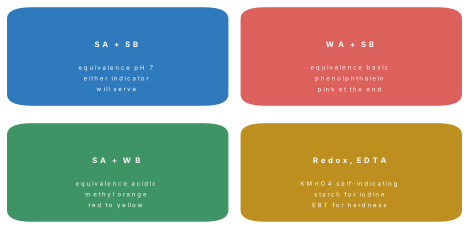
The equivalence-point pH decides the indicator: strong acid–weak base (acidic salt) → methyl orange; weak acid–strong base (basic salt) → phenolphthalein; strong–strong → either (steep jump covers both ranges). Weak acid–weak base has no sharp jump and neither indicator works well — the option students rarely expect.
Problem. A 20.0 mL portion of sodium hydroxide solution is exactly neutralised by 40.0 mL of 0.1 N sulphuric acid. Find the normality of the base, and name the indicator you would trust for this pair. Solution. N₁V₁ = N₂V₂ gives N(base) × 20.0 = 0.1 × 40.0, so N(base) = 4.0/20.0 = 0.2 N. Strong acid against strong base ends at pH 7, where either phenolphthalein or methyl orange changes within the steep jump — the rare titration that forgives the indicator choice.
22.2 Separation techniques: filtration, sublimation, evaporation, precipitation, crystallization, distillation, paper chromatography and atmolysis
Every separation buys purity by spending a difference in a physical property:
| Technique | Property exploited | Choose it when… | School example |
|---|---|---|---|
| Filtration (gravity/vacuum) | Particle size vs pore size | An insoluble solid must leave a liquid | Sand from salt solution; the filtrate still needs evaporation for the salt |
| Sublimation | A solid with high vapour pressure below its melting point | One solid sublimes, the rest does not | NH₄Cl, iodine, camphor or naphthalene away from sand/salt; collect on a cold surface |
| Evaporation | Solvent volatility | The dissolved solid is heat-stable and the solvent is not wanted | NaCl from seawater (identity yes, high purity no) |
| Crystallization | Solubility varies with temperature/solvent | A purer solid is required; impurities stay in mother liquor | Benzoic acid from hot water; impure CuSO₄ recrystallized. Fractional crystallization separates salts of differing solubility curves |
| Precipitation | Selective formation of a sparingly soluble compound | One ion/component can be thrown down quantitatively | BaSO₄ gravimetry; softening water by precipitating CaCO₃ |
| Simple distillation | Volatility/boiling point | Volatile liquid + non-volatile impurity, or boiling points far apart (roughly more than 25–30 K) | Pure water from salt water; ethanol from wash (partly) |
| Fractional distillation | Small boiling-point difference; repeated condense–revaporize in a column | Close-boiling miscible liquids | Benzene/toluene; petroleum fractions; ethanol–water stops at the 95.6% azeotrope |
| Steam distillation | Immiscible liquids boil when their vapour pressures sum to atmospheric | A heat-sensitive, water-immiscible organic must distil below 100 °C | Aniline, essential oils (eucalyptus, clove) |
| Vacuum distillation | Lowering external pressure lowers boiling point | High-boiling or heat-sensitive liquids | Glycerol purification; vacuum evaporation of milk/sugar liquors |
| Paper chromatography | Partition between water held on cellulose (stationary) and a moving solvent | Tiny, coloured or colourless mixtures must be fingerprinted | Amino acids (ninhydrin spray), plant pigments, ink dyes |
| Atmolysis | Graham's law: diffusion/effusion rate ∝ 1/√M through a porous barrier | Gases of different molar mass, classically isotopes | H₂ escapes 4× faster than O₂; historical UF₆ isotope enrichment |
In paper chromatography the sample is spotted on a pencil baseline above the solvent level (ink would run; submerging the spot would wash it away). As solvent climbs by capillarity, components partition repeatedly and travel different distances. The retardation factor,
is characteristic only for the stated paper, solvent, temperature and saturation — which is why standards run on the same sheet convict or acquit an unknown. Colourless spots are located with UV light, iodine vapour or a spray reagent.
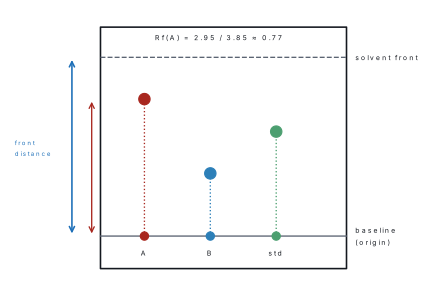
Atmolysis deserves its one calculation: at the same temperature and pressure, Graham's law gives rate(H₂)/rate(O₂) = √(32/2) = 4. A porous pot therefore enriches the faster, lighter gas on the far side; repeating the stage multiplies a tiny enrichment — historically the hard road to ²³⁵UF₆/²³⁸UF₆ separation, now largely replaced by gas centrifuges.
22.3 Acid–base, redox and complexometric titrations; choice of indicator
A titration delivers a standard solution (the titrant, in the burette) to a measured volume of analyte until the equivalence point — exact stoichiometric consumption. The end point is what the indicator shows; good method design makes the two coincide within a drop. A primary standard can be weighed and trusted (pure, stable, non-hygroscopic, ideally high molar mass: anhydrous Na₂CO₃, oxalic acid, potassium hydrogen phthalate, K₂Cr₂O₇). NaOH, KMnO₄ and Na₂S₂O₃ solutions are secondary standards and must be standardized. At equivalence, equivalents of titrant = equivalents of analyte (N₁V₁ = N₂V₂), or work in moles with the equation ratio — the safer modern habit.
Acid–base indicators follow the equivalence pH
| Titration | Salt at equivalence | Equivalence pH | Indicator (range, colour change) |
|---|---|---|---|
| Strong acid–strong base | Neutral | 7, with a huge vertical jump | Phenolphthalein (8.2–10, colourless→pink) or methyl orange (3.1–4.4, red→yellow/orange end point) |
| Strong acid–weak base (for example HCl vs NH₄OH) | Acidic (NH₄⁺ hydrolyses) | About 5 | Methyl orange or methyl red (4.2–6.3) |
| Weak acid–strong base (CH₃CO₂H vs NaOH) | Basic (CH₃CO₂⁻ hydrolyses) | About 8.7 | Phenolphthalein |
| Weak acid–weak base | Depends on Kₐ/K_b | No steep jump | No satisfactory single visual indicator |
Sodium carbonate titrated with HCl shows two end points: phenolphthalein fades when CO₃²⁻ has become HCO₃⁻ (half-neutralization), and methyl orange then marks HCO₃⁻ → CO₂ + H₂O. Comparing the two volumes analyses NaOH/Na₂CO₃ mixtures — an old examination favourite built from Ch. 7's hydrolysis.
Permanganometric titrations
In acid, permanganate is a five-electron oxidant:
MnO₄⁻ + 8H⁺ + 5e⁻ → Mn²⁺ + 4H₂O.
Its own purple colour is the indicator: the end point is the first permanent pale pink that survives about 30 seconds of swirling. The medium must be dilute H₂SO₄ — HCl would itself be oxidized to Cl₂, and HNO₃ is an oxidant in its own right. Oxalate titrations are run at 60–70 °C and start slowly until Mn²⁺ autocatalyses them:
2KMnO₄ + 5H₂C₂O₄ + 3H₂SO₄ → K₂SO₄ + 2MnSO₄ + 10CO₂ + 8H₂O.
Fe²⁺, oxalate and H₂O₂ are standard analytes; KMnO₄ is standardized against sodium oxalate or oxalic acid. Read the upper meniscus of the dark solution, and remember that in neutral or alkaline solution permanganate stops at MnO₂ — a different electron count and a different equivalent weight.
Problem. 25.0 mL of 0.0500 mol L⁻¹ oxalic acid required 20.0 mL of acidified KMnO₄. Find the KMnO₄ concentration.
Solution. Moles of oxalic acid = 0.0250 × 0.0500 = 1.25×10⁻³ mol. The equation ratio is 2 MnO₄⁻ : 5 H₂C₂O₄, so moles of KMnO₄ = (2/5)(1.25×10⁻³) = 5.00×10⁻⁴ mol. Concentration = 5.00×10⁻⁴ / 0.0200 = 0.0250 mol L⁻¹. Writing the balanced molecular equation first makes normality arithmetic unnecessary.
Iodimetry versus iodometry — similar names, opposite directions
Iodimetry (direct) titrates a reducing analyte with a standard iodine solution; starch turns blue at the first excess of I₂. Vitamin C and sulfite are classic analytes. Iodometry (indirect) is far commoner: an oxidizing analyte liberates I₂ from excess KI, and that iodine is titrated with standard sodium thiosulfate,
I₂ + 2S₂O₃²⁻ → 2I⁻ + S₄O₆²⁻.
Copper estimation is the model: 2Cu²⁺ + 4I⁻ → 2CuI↓ + I₂; the I₂ found equals the Cu²⁺ taken, one-to-one in moles of electrons. Dichromate, chlorine/bleaching powder and dissolved oxygen (Winkler method) are handled the same way. Add starch only when the iodine colour has faded to pale straw: added early, the starch–iodine complex forms too strongly/adsorbs I₂ and the end point drags and overshoots. The end point is blue → colourless; in copper work a little thiocyanate near the end frees iodine adsorbed on CuI.
Complexometric (EDTA) titrations
EDTA (used as its disodium salt) is a hexadentate chelator that binds metal ions in a strict 1:1 ratio regardless of the metal's charge: M²⁺ + H₂Y²⁻ → MY²⁻ + 2H⁺. Because protons are released, the solution is buffered. At pH 10 (NH₃/NH₄Cl buffer) with Eriochrome Black T, Ca²⁺/Mg²⁺ first hold the indicator in a wine-red complex; EDTA strips the metals away and the free indicator turns blue — the standard total-hardness titration. At pH about 12, Mg(OH)₂ precipitates and murexide lets Ca²⁺ alone be found; Mg²⁺ follows by difference. Interfering Fe³⁺/Cu²⁺ can be masked (triethanolamine, cyanide where permitted) — masking is selectivity by competitive complexation. Results are conventionally reported as mg L⁻¹ of equivalent CaCO₃. The same chelation principle, scaled up, is water softening, detergent building and the lead-poisoning therapy of Chapters 14–15.
Five traps in the analytical room: limewater turns milky and then clear again in excess CO₂, the clearing as telling as the cloud; group II runs H₂S in acid and group IV in alkaline solution — the same gas, opposite pH, different families; Lassaigne's blood red means nitrogen and sulphur together, not sulphur alone; iodometric titrations add starch near the end point, not at the start, lest the complex trap the iodine; and phenolphthalein is colourless in acid and pink in base — the pink appears on the basic side of the jump.
Formula and fact sheet
| Topic | Must-know |
|---|---|
| Anion gases | CO₂ lime-water milky→clear; SO₂ dichromate green; H₂S PbS black; NO₂⁻ brown fumes |
| Confirmations | SO₄²⁻ BaSO₄/acid-proof; NO₃⁻ brown ring; PO₄³⁻ yellow molybdate; AgCl soluble NH₄OH, AgBr sparingly, AgI insoluble |
| Cation groups | HCl → H₂S/HCl → NH₄OH → H₂S/NH₄OH → (NH₄)₂CO₃ → soluble Mg/Na/K; NH₄⁺ tested first |
| Spot colours | Fe³⁺/SCN⁻ red; Cu²⁺/NH₃ deep blue; Ni²⁺/DMG rosy red; flames Na yellow, K lilac, Ca brick, Sr crimson, Ba green |
| Lassaigne | N Prussian blue; S violet nitroprusside/black PbS; N+S blood-red SCN⁻; X as AgX after HNO₃ boil |
| Food tests | Molisch violet ring; Benedict brick-red; starch-iodine blue-black; Biuret violet; Sudan/grease spot fats |
| Separations | Sublime NH₄Cl/I₂; fractional for close b.p.; steam below 100 °C; R_f = spot/front; H₂ atmolyses 4× O₂ |
| Indicators | Methyl orange acidic end point; phenolphthalein basic; weak–weak no sharp visual end point |
| Redox | KMnO₄ self-indicating in H₂SO₄, 5 e⁻ in acid; iodometry: liberated I₂ vs S₂O₃²⁻, starch late |
| EDTA | 1:1 metal binding; EBT at pH 10 wine-red → blue; hardness as mg L⁻¹ CaCO₃ |
Rapid-revision tables and high-yield facts
| Item | Value or rule |
|---|---|
| Group II medium | H₂S in acid |
| Group III | NH₄Cl then NH₄OH |
| Phenolphthalein range | 8.2–10.0 |
| Methyl orange range | 3.1–4.4 |
| KMnO₄ | self-indicator |
| Iodometric titrant | Na₂S₂O₃ with starch |
| R_f | solute distance / solvent distance |
| Graham's law | rate ∝ 1/√density |
| Titration balance | N₁V₁ = N₂V₂ |
| Steam distillation | aniline, essential oils |
Chapter summary
- Anion analysis begins with acid-evolved gases and ends with precipitate confirmations whose acid/ammonia solubilities separate look-alikes.
- Cation groups are solubility cliffs climbed in order; group reagents work because pH controls S²⁻, OH⁻ and CO₃²⁻ availability.
- Organic tests are the functional-group reactions of Chapters 17–20 read backwards from product to structure, with benzene and phenol as the standing bromine-test traps.
- Lassaigne's fusion converts covalent N, S and halogens into CN⁻, S²⁻ and X⁻ so inorganic colour chemistry can see them.
- Molisch, Benedict, iodine, Biuret, ninhydrin and grease-spot tests identify the three great food classes by their reactive groups.
- Separation choice is property choice: volatility for distillation, solubility for crystallization, partition for chromatography and √M for atmolysis.
- An indicator is chosen from the pH of the salt at equivalence, not from habit; the end point is an observation that must be engineered onto the equivalence point.
- Permanganate counts five electrons in acid and announces itself; iodine methods split into direct iodimetry and indirect iodometry with late starch.
- EDTA's 1:1 chelation plus a metal-sensitive dye turns water hardness into a clean wine-red-to-blue measurement.
Practice questions
Set A — Recall (25 questions)
- A carbonate with dilute acid evolves a gas that turns lime waterabluebblackcgreendmilky
- Hydrogen sulfide is confirmed when lead-ethanoate paper turnsablackbredcbluedyellow
- The sulfate test gives a white precipitate with BaCl₂ that is insoluble in diluteaammoniabwater onlycHCldethanol
- The brown-ring test is the classic confirmation forachloridebnitrateccarbonatedsulfide
- Silver chloride precipitate dissolves readily in diluteaNH₄OHbHNO₃cH₂SO₄dNaCl solution
- Silver iodide is yellow and in ammonium hydroxide it isasolublebredissolved as Ag metalcgaseousdinsoluble
- Group I cations are precipitated by diluteaH₂SbHClcNH₄OHd(NH₄)₂CO₃
- Fe³⁺ with potassium thiocyanate gives a colour described asaPrussian bluebcanary yellowcblood-reddapple green
- Excess NH₄OH added to Cu²⁺ solution gives a deep-blue colour due toaCu(OH)₂b[Cu(NH₃)₄]²⁺cCu₂OdCuS
- Dimethylglyoxime gives a rosy-red precipitate withaNi²⁺bZn²⁺cCa²⁺dNa⁺
- A C=C bond is commonly detected by decolorization of bromine inawater onlybFehling solutionclime waterdCCl₄
- Neutral FeCl₃ gives a violet colour withaethanolbbenzenecphenoldacetone
- A carboxylic acid is distinguished from phenol by brisk effervescence withaNaHCO₃bNa metalcNaOHdNH₄OH
- Tollens' reagent is reduced to a silver mirror by anaordinary ketonebethercaldehydedalkane
- Prussian blue in Lassaigne's test confirms the elementasulfurbnitrogencchlorinedphosphorus
- Sodium nitroprusside gives a violet colour with the Lassaigne ionaCN⁻bSCN⁻ onlycCl⁻dS²⁻
- A violet ring in Molisch's test indicates aaproteinbfatccarbohydratednucleic acid only
- The violet colour in Biuret's test indicatesareducing sugarbpeptide bonds (protein)cstarchdcholesterol
- Iodine solution gives a blue-black colour withastarchbglucoseccellulose powder onlydalbumin
- Ammonium chloride can be separated from sand byafiltration drybprecipitationcatmolysisdsublimation
- Two miscible liquids with close boiling points are best separated byasimple evaporationbfractional distillationcfiltrationdsublimation
- Steam distillation is chosen for a water-immiscible organic liquid that isaionicbsoluble in waterca gasdheat-sensitive at its normal b.p.
- In paper chromatography, R_f is the ratio of distance moved by the spot to distance moved by theapaper edgebbaselinecsolvent frontdspray reagent
- In acidified KMnO₄ titrations, the indicator isaKMnO₄ itselfbphenolphthaleincstarchdmethyl orange
- In the EDTA hardness titration at pH 10, Eriochrome Black T changes at the end point from wine-red toayellowbcolourlesscbluedgreen
Answers and explanations — Set A
1. (d) — CaCO₃ precipitates in lime water; excess CO₂ clears it as soluble Ca(HCO₃)₂.
2. (a) — black PbS is one of qualitative analysis's least ambiguous colours.
3. (c) — BaSO₄ survives acid that would dissolve BaCO₃/BaSO₃.
4. (b) — the brown nitrosyl–iron complex forms only at the acid junction.
5. (a) — [Ag(NH₃)₂]⁺ complex formation dissolves AgCl.
6. (d) — AgI's lattice/covalency defeats even concentrated ammonia.
7. (b) — AgCl, Hg₂Cl₂ and PbCl₂ are the insoluble-chloride trio.
8. (c) — thiocyanatoiron(III) complexes.
9. (b) — tetraamminecopper(II) (with axial waters in solution).
10. (a) — Ni(dmg)₂, a square-planar chelate precipitate.
11. (d) — the inert solvent keeps substitution side-reactions quieter than water.
12. (c) — an iron–phenoxide charge-transfer colour.
13. (a) — RCO₂H is stronger than carbonic acid; phenol is not (Ch. 18).
14. (c) — Ag(I) is reduced while the aldehyde is oxidized to carboxylate.
15. (b) — cyanide from the fusion becomes the ferrocyanide that precipitates with Fe³⁺.
16. (d) — the thionitroprusside ion is intensely violet even at low S²⁻ levels.
17. (c) — acid-dehydrated sugar fragments condense with α-naphthol.
18. (b) — Cu²⁺ coordinates to peptide nitrogens in alkali.
19. (a) — iodine sits inside the amylose helix.
20. (d) — NH₄Cl dissociates/sublimes and recombines on the cool surface.
21. (b) — the column multiplies simple distillations.
22. (d) — combined vapour pressures let the mixture boil below 100 °C.
23. (c) — both distances are measured from the origin line.
24. (a) — the first permanent pale pink is excess MnO₄⁻ itself.
25. (c) — free Eriochrome Black T is blue at pH 10; its Mg/Ca complex is wine-red.
Set B — Understanding (15 questions)
- Lime water turned milky by CO₂ becomes clear again in excess CO₂ because insoluble CaCO₃ converts to solubleaCaObCaCl₂cCa(HCO₃)₂dCa(OH)₂
- The sulfate precipitate is tested with dilute HCl mainly to distinguish BaSO₄ from acid-soluble barium salts ofanitratebphosphate onlycchloridedcarbonate/sulfite
- Pb²⁺ can be separated from Ag⁺ and Hg₂²⁺ in Group I because PbCl₂ is appreciably soluble inahot waterbcold ammoniacbenzenedconc. HNO₃ only
- Benzene fails Baeyer's test despite DU = 4 because oxidation/addition would destroy itsaσ bondsbaromatic stabilizationchydrogen atomsdring size
- Phenol decolorizes bromine water, yet this is not evidence of an alkene because the reaction is electrophilic substitution giving aadibromide oilbblue complexcsilver mirrordwhite tribromophenol precipitate
- Lassaigne fusion is necessary before ionic tests because elements in organic compounds are mostly boundaas free ionsbcovalentlycas metalsdin crystals only
- If an organic compound contains both N and S, FeCl₃ on the fusion extract may give blood-red colour due to formation ofaFeSbPrussian bluecthiocyanate complexdFe(OH)₃ only
- Sucrose does not reduce Benedict's solution until hydrolysed because its anomeric carbons are locked in theaglycosidic bond (no free reducing end)bpeptide bondcester bonddhydrogen bond
- A single free amino acid gives little/no Biuret colour because Biuret requires at least twoaamino groupsbpeptide bondsccarboxyl groupsdside chains
- Recrystallization usually purifies better than simple evaporation because soluble impurities tend to remain in theamother liquorbvapourcfilter paperdcrystal lattice always
- Vacuum distillation protects a heat-sensitive liquid by lowering its boiling point through reducedamolar massbvolumecpolaritydexternal pressure
- In atmolysis, H₂ diffuses through a porous wall faster than O₂ by a factor of abouta2b8c4d16
- Phenolphthalein is the right indicator for CH₃CO₂H titrated with NaOH because at equivalence the acetate solution isabasic (pH about 8.7)bstrongly acidiccneutral alwaysdbuffered at pH 4
- Dilute HCl must not acidify a permanganate titration because MnO₄⁻ can oxidize chloride toaClO⁻ onlybMnCl₂ precipitatecHCl gas onlydCl₂ (extra oxidant consumption)
- In iodometry, starch is added near the end point rather than at the start to avoid a sluggish end point from a very strong/adsorbedathiosulfate–starch saltbstarch–iodine complexcCuI precipitatedblue litmus change
Answers and explanations — Set B
1. (c) — CO₂ + CaCO₃ + H₂O ⇌ Ca(HCO₃)₂, the temporary-hardness equilibrium.
2. (d) — both would also precipitate with Ba²⁺ from neutral solution.
3. (a) — collect the white Group I ppt, wash with hot water, and Pb²⁺ alone enters the filtrate.
4. (b) — DU counts the ring; reagents meet a stabilized π sextet.
5. (d) — precipitate + HBr formation mark substitution, unlike clean alkene addition in CCl₄.
6. (b) — sodium converts them to NaCN/Na₂S/NaX that ordinary reagents can see.
7. (c) — SCN⁻ + Fe³⁺ gives red thiocyanato complexes, masking the separate N test.
8. (a) — glucose C1 and fructose C2 are both engaged in the sucrose link.
9. (b) — the chromophore is a Cu²⁺ complex of consecutive peptide nitrogens.
10. (a) — evaporation, by contrast, deposits everything that was dissolved.
11. (d) — boiling begins when vapour pressure equals the (now lower) external pressure.
12. (c) — √(32/2) = √16 = 4.
13. (a) — acetate hydrolysis puts the steep part of the curve inside phenolphthalein's range.
14. (d) — permanganate would be spent on the acid medium, inflating the titre.
15. (b) — with much I₂ present the complex releases iodine too slowly for a sharp disappearance.
Set C — Application (10 questions)
- A salt with dilute H₂SO₄ gives a choking gas that turns acidified dichromate paper green. The anion isacarbonatebsulfitecsulfidednitrite
- A white Group I precipitate turns black on adding NH₄OH. The cation isaAg⁺bPb²⁺cHg₂²⁺dBa²⁺
- Which C₅H₁₀O ketone gives a positive iodoform test?apentan-2-onebpentan-3-oneccyclopentanoldpentanal
- A Lassaigne extract, boiled with dilute HNO₃ and treated with AgNO₃, gives a pale-yellow precipitate only sparingly soluble in conc. NH₄OH. The halogen isafluorinebiodinecchlorinedbromine
- A food extract gives a violet Biuret test and a yellow xanthoproteic test. It contains mainlyastarchbfatcproteindglucose
- Iodine crystals mixed with sand are best separated byasublimationbfiltrationcatmolysisdprecipitation
- Benzene (b.p. 80 °C) and toluene (b.p. 111 °C) in one liquid mixture are best separated byapaper chromatographybfiltrationcsublimationdfractional distillation
- On a chromatogram a spot moves 4.2 cm while the solvent front moves 7.0 cm. Its R_f isa0.42b0.60c1.67d0.70
- For titrating aqueous NH₃ (weak base) with standard HCl, the suitable indicator isamethyl orangebphenolphthaleincstarchdEriochrome Black T
- A 50.0 mL water sample at pH 10 needs 10.0 mL of 0.0100 mol L⁻¹ EDTA. Its hardness as mg L⁻¹ CaCO₃ isa100b200c50d400
Answers and explanations — Set C
1. (b) — SO₂ reduces orange Cr₂O₇²⁻ to green Cr³⁺ (Ch. 13's sulfur-dioxide signature).
2. (c) — Hg₂Cl₂ disproportionates in ammonia to black Hg mixed with white HgNH₂Cl.
3. (a) — only pentan-2-one contains the CH₃CO– unit demanded by the haloform reaction.
4. (d) — AgBr is the middle member of the solubility ladder.
5. (c) — peptide bonds plus aromatic residues: a protein answering both of its name tests.
6. (a) — iodine vaporizes and re-deposits as crystals on the cold funnel; sand stays.
7. (d) — an 31 K gap still rewards a fractionating column for clean cuts at scale or purity.
8. (b) — R_f = 4.2/7.0 = 0.60 (dimensionless, and never above 1 for the spot).
9. (a) — equivalence gives acidic NH₄Cl solution near pH 5, inside methyl orange's range.
10. (b) — moles EDTA = 0.0100×0.0100 = 1.00×10⁻⁴ = moles CaCO₃ equivalent = 10.0 mg in 50.0 mL, i.e. 200 mg L⁻¹.