Chapter 4 · Physical Chemistry · 2 questions in the paper · 30 min read
Chemical Bonding and Shapes of Molecules
What the syllabus asks for 4
- Electronic theory of valency; ionic, covalent and coordinate bonds; Lewis structures of s- and p-block compounds
- VSEPR theory and the shapes of simple molecules; valence bond theory, sigma and pi bonds, hybridization
- Dipole moment, ionic character of covalent bonds and bond length
- Hydrogen bonding, metallic bonding and van der Waals forces
Chemical bonding carries about two questions in the paper (our estimate from the MEC topic list), and its ideas — shape, hybridisation, polarity, hydrogen bonding — reappear in organic, inorganic and states-of-matter questions. The favourite question types are: the shape or hybridisation of a given molecule or ion, a bond-angle or dipole-moment order, counting σ and π bonds, a Fajans'-rule comparison, and "why does water boil so high?". One counting formula (the steric number) answers most shape questions in seconds.
- Ionic, covalent and coordinate bonds; where coordinate bonds occur (NH₄⁺, H₃O⁺, H₃N→BF₃, O₃, CO, complex ions); exceptions to the octet rule.
- Steric number = bond pairs + lone pairs on the central atom; fast formula SN = ½(V + M − c + a).
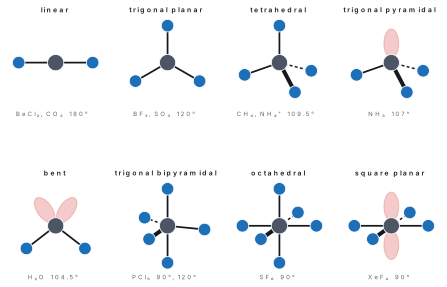
- Shapes and angles: linear 180°, trigonal planar 120°, tetrahedral 109.5°, NH₃ 107°, H₂O 104.5°, TBP, octahedral, see-saw, T-shape, square planar.
- Hybridisation sp, sp², sp³, sp³d, sp³d², sp³d³; σ from head-on overlap, π from sideways overlap; single = σ, double = σ + π, triple = σ + 2π.
- Dipole moment μ = q × d (debye); symmetric molecules have μ = 0; NH₃ > NF₃; % ionic character = μ(observed)/μ(ionic) × 100.
- Fajans' rules; bond length falls with bond order and with s character.
- Hydrogen bonding (F, O, N), metallic bonding (electron sea) and van der Waals forces, with their effects on boiling point, solubility and density.
4.1 Electronic theory of valency; ionic, covalent and coordinate bonds; Lewis structures
The electronic theory of valency
Kossel and Lewis (1916) explained bonding by the stability of the noble gases: atoms combine so as to reach a stable noble-gas configuration — eight outer electrons (an octet), or two (a duplet) for H (in H₂), Li⁺ and Be²⁺. They do this by transferring electrons (ionic bond), by sharing them (covalent bond), or by sharing a pair that one atom supplies (coordinate bond). Only the valence electrons take part; in a Lewis symbol they are shown as dots round the element symbol.
Ionic, covalent and coordinate bonds
| Ionic (electrovalent) | Covalent | Coordinate (dative) | |
|---|---|---|---|
| Formed by | complete transfer of electrons | mutual sharing of electron pairs | sharing of a pair supplied by one atom (donor) to another (acceptor) |
| Favoured by | low IE of the metal, high EA of the non-metal, high lattice energy | similar, fairly high electronegativities | a lone pair on the donor, a vacant orbital on the acceptor |
| Example | Na⁺Cl⁻, Mg²⁺O²⁻ | H₂, Cl₂, CH₄, H₂O | NH₄⁺, H₃O⁺, H₃N→BF₃ |
| Directional? | no (so no isomerism) | yes (so shapes and isomerism) | yes |
| Property | Ionic compounds | Covalent (molecular) compounds |
|---|---|---|
| State and melting point | crystalline solids, high mp and bp | gases, liquids or soft solids, low mp and bp |
| Conductivity | conduct when molten or in water, not as solids | non-conductors (except graphite, and those that ionise in water, like HCl) |
| Solubility | in polar solvents (water) | in non-polar solvents (benzene, CCl₄) |
| Reactions | fast (between ions) | slow (bonds must break) |
Giant covalent solids (diamond, SiO₂) are the exception to "low melting point": every atom is held in a three-dimensional covalent network.
A coordinate (dative) bond is a covalent bond in which both shared electrons come from one atom. It is shown by an arrow from the donor to the acceptor, as in H₃N→BF₃. Once formed it is identical to an ordinary covalent bond: all four N–H bonds in NH₄⁺ are the same.
Coordinate bonds occur in NH₄⁺ (H⁺ ← :NH₃), H₃O⁺, H₃N→BF₃, Al₂Cl₆ (two Cl→Al bridges), the complex ions such as [Cu(NH₃)₄]²⁺, and in the Lewis structures of O₃, CO (C≡O with one dative bond), HNO₃ and N₂O₅.
Lewis structures and formal charge
To draw one: (1) add up the valence electrons (add one for each negative charge, subtract one for each positive charge); (2) put the least electronegative atom (never H) in the centre and join the atoms by single bonds; (3) complete the octets of the outer atoms; (4) put any electrons left on the central atom; (5) if the central atom is still short of an octet, convert lone pairs on neighbours into double or triple bonds. The best structure has the smallest formal charges:
where V = valence electrons of the free atom, L = non-bonding (lone-pair) electrons on it and B = electrons in its bonds.
Problem. Find the formal charges in the Lewis structure :C≡O: (one lone pair on each atom, a triple bond).
Solution. C: V = 4, L = 2, B = 6 → 4 − 2 − 3 = −1. O: V = 6, L = 2, B = 6 → 6 − 2 − 3 = +1. The charges oppose the electronegativity difference, which is why CO has a very small dipole moment (about 0.1 D).
| Failure of the octet rule | Examples |
|---|---|
| Incomplete octet | BeCl₂ (4 electrons round Be), BF₃ and AlCl₃ (6) |
| Expanded octet (period 3 onwards, using d orbitals) | PCl₅ (10), SF₆ (12), IF₇ (14), H₂SO₄ (S has 12) |
| Odd-electron molecules | NO, NO₂, ClO₂ |
| Noble-gas compounds | XeF₂, XeF₄, XeF₆, XeO₃ |
The octet rule also says nothing about the shapes of molecules or the energies of bonds — which is what the next two theories add.
4.2 VSEPR theory and shapes; valence bond theory, σ and π bonds, hybridisation
VSEPR theory
The valence shell electron pair repulsion theory (Sidgwick and Powell; developed by Nyholm and Gillespie) says:
- The shape of a molecule depends on the number of electron pairs (bond pairs and lone pairs) round the central atom.
- The pairs repel one another and take up positions as far apart as possible.
- Repulsion falls in the order lone pair–lone pair > lone pair–bond pair > bond pair–bond pair, so lone pairs squeeze the bond angles.
- A double or triple bond counts as one region (one "pair") for shape.
Steric number (SN) = number of atoms bonded to the central atom + number of lone pairs on it. The fast way to find it:
V = valence electrons of the central atom; M = number of monovalent atoms attached (H, F, Cl, Br, I — oxygen and sulphur count as 0); c = charge of a cation; a = charge of an anion. Lone pairs = SN − number of bonded atoms. The SN also gives the hybridisation: 2 sp, 3 sp², 4 sp³, 5 sp³d, 6 sp³d², 7 sp³d³.
| SN | Bond pairs | Lone pairs | Shape | Angle | Examples |
|---|---|---|---|---|---|
| 2 | 2 | 0 | linear | 180° | BeCl₂, CO₂, HCN, NO₂⁺ |
| 3 | 3 | 0 | trigonal planar | 120° | BF₃, SO₃, NO₃⁻, CO₃²⁻ |
| 3 | 2 | 1 | bent (V-shaped) | < 120° | SO₂ (119°), O₃ (117°), NO₂⁻ |
| 4 | 4 | 0 | tetrahedral | 109.5° | CH₄, CCl₄, NH₄⁺, SO₄²⁻, ClO₄⁻ |
| 4 | 3 | 1 | trigonal pyramidal | 107° (NH₃) | NH₃, PCl₃, H₃O⁺, XeO₃, ClO₃⁻ |
| 4 | 2 | 2 | bent | 104.5° (H₂O) | H₂O, H₂S, OF₂, NH₂⁻ |
| 5 | 5 | 0 | trigonal bipyramidal | 90°, 120° | PCl₅, PF₅ |
| 5 | 4 | 1 | see-saw | — | SF₄, TeCl₄ |
| 5 | 3 | 2 | T-shaped | about 90° | ClF₃, BrF₃ |
| 5 | 2 | 3 | linear | 180° | XeF₂, I₃⁻, ICl₂⁻ |
| 6 | 6 | 0 | octahedral | 90° | SF₆, PCl₆⁻ |
| 6 | 5 | 1 | square pyramidal | — | BrF₅, IF₅ |
| 6 | 4 | 2 | square planar | 90° | XeF₄, ICl₄⁻ |
| 7 | 7 | 0 | pentagonal bipyramidal | 72°, 90° | IF₇ |
In a trigonal bipyramid, lone pairs always take the equatorial positions (they have more room there), which is why SF₄ is a see-saw, ClF₃ a T and XeF₂ linear.
Problem. Find the hybridisation and shape of SF₄, ClF₃, XeF₄ and NO₃⁻.
Solution. SF₄: ½(6 + 4) = 5 → sp³d; 4 bonded atoms, 1 lone pair → see-saw. ClF₃: ½(7 + 3) = 5 → sp³d; 3 bonded, 2 lone pairs → T-shaped. XeF₄: ½(8 + 4) = 6 → sp³d²; 4 bonded, 2 lone pairs → square planar. NO₃⁻: ½(5 + 0 + 1) = 3 → sp²; 3 bonded, no lone pair → trigonal planar (O counts 0).
Bond-angle orders worth knowing.
- Lone pairs squeeze the angle: CH₄ (109.5°) > NH₃ (107°) > H₂O (104.5°).
- Down a group the central atom becomes less electronegative, the bond pairs sit farther from it and repel less: NH₃ (107°) > PH₃ (93.5°) > AsH₃ (92°); H₂O (104.5°) > H₂S (92°).
- Electronegative outer atoms pull the bond pairs away from the centre: NF₃ (102°) < NH₃ (107°); OF₂ (103°) < H₂O (104.5°) < Cl₂O (111°, where the large Cl atoms also crowd each other).
Valence bond theory: σ and π bonds
A covalent bond forms when half-filled atomic orbitals of two atoms overlap and the two electrons, of opposite spin, pair up between the nuclei. The greater the overlap, the stronger the bond.
| Sigma (σ) bond | Pi (π) bond | |
|---|---|---|
| Overlap | head-on, along the internuclear axis (s–s, s–p, p–p, hybrid orbitals) | sideways, of parallel p orbitals, above and below the axis |
| Strength | stronger (greater overlap) | weaker |
| Rotation about it | free | restricted (cis–trans isomerism) |
| Existence | can exist alone | forms only after a σ bond |
| Electron density | on the axis | above and below the axis (a nodal plane on the axis) |
A single bond is one σ; a double bond is σ + π; a triple bond is σ + 2π. Counting examples: C₂H₆ 7σ; C₂H₄ 5σ + 1π; C₂H₂ 3σ + 2π; N₂ 1σ + 2π; CO₂ 2σ + 2π; HCN 2σ + 2π; benzene 12σ + 3π.
Hybridisation
Hybridisation is the mixing of atomic orbitals of nearly equal energy on the same atom to give the same number of new, equivalent orbitals (hybrid orbitals) with definite directions. Hybrid orbitals form σ bonds or hold lone pairs; π bonds are formed by the unhybridised p orbitals left over.
| Hybridisation | Orbitals mixed | Geometry | Angle | s character | Examples |
|---|---|---|---|---|---|
| sp | s + p | linear | 180° | 50 % | BeCl₂, C₂H₂, CO₂ (C) |
| sp² | s + 2p | trigonal planar | 120° | 33 % | BF₃, C₂H₄, benzene, graphite |
| sp³ | s + 3p | tetrahedral | 109.5° | 25 % | CH₄, diamond, NH₃ and H₂O (with lone pairs) |
| sp³d | s + 3p + d | trigonal bipyramidal | 90°, 120° | 20 % | PCl₅, SF₄, ClF₃, XeF₂ |
| sp³d² | s + 3p + 2d | octahedral | 90° | 17 % | SF₆, XeF₄, BrF₅ |
| sp³d³ | s + 3p + 3d | pentagonal bipyramidal | 72°, 90° | 14 % | IF₇, XeF₆ (distorted) |
More s character means a shorter, stronger bond held closer to the nucleus, and a more electronegative atom: sp C > sp² C > sp³ C. That is why ethyne's C–H hydrogen is acidic (Unit 17).
4.3 Dipole moment, ionic character of covalent bonds and bond length
Dipole moment
In a bond between atoms of different electronegativity the shared pair is pulled towards the more electronegative atom, giving partial charges δ+ and δ−. The dipole moment is
(charge × distance). It is a vector; in chemistry its arrow is drawn from the positive towards the negative end. Unit: the debye, 1 D = 3.33 × 10⁻³⁰ C m.
A molecule's dipole moment is the vector sum of its bond moments (and lone-pair moments). Symmetrical molecules have μ = 0 even with polar bonds: CO₂, BeCl₂, BF₃, CH₄, CCl₄, PCl₅, SF₆, XeF₄, trans-1,2-dichloroethene and p-dichlorobenzene. Bent and pyramidal molecules are polar: H₂O 1.85 D, NH₃ 1.47 D, SO₂, H₂S.
| Comparison | Order and reason |
|---|---|
| NH₃ (1.47 D) > NF₃ (0.23 D) | in NH₃ the lone-pair moment adds to the N←H bond moments; in NF₃ it opposes the N→F bond moments |
| HF > HCl > HBr > HI | electronegativity difference falls |
| CH₃Cl > CH₂Cl₂ > CHCl₃ > CCl₄ (= 0) | the C–Cl moments cancel more and more as the molecule becomes symmetrical |
| o- > m- > p-dichlorobenzene (= 0) | the angle between the two C–Cl moments widens from 60° to 120° to 180° |
Uses: a zero dipole moment proves a symmetrical shape (CO₂ is linear, H₂O is not); the moment measures bond polarity and percentage ionic character:
Problem. A diatomic molecule has μ = 1.2 D and bond length 1.0 Å. Find its percentage ionic character (e = 1.6 × 10⁻¹⁹ C, 1 D = 3.33 × 10⁻³⁰ C m).
Solution. If fully ionic, μ = 1.6 × 10⁻¹⁹ × 1.0 × 10⁻¹⁰ = 1.6 × 10⁻²⁹ C m = 4.8 D. % ionic = 1.2/4.8 × 100 = 25 %. (Shortcut: e × 1 Å = 4.8 D.)
Ionic character in covalent bonds and Fajans' rules
Every polar covalent bond has some ionic character; a large electronegativity difference (Δχ about 1.7 or more on the Pauling scale) makes a bond mainly ionic. Conversely, an ionic bond has some covalent character when the cation polarises (distorts) the electron cloud of the anion. Fajans' rules — covalent character increases when:
| Factor | Example |
|---|---|
| the cation is small | LiCl is more covalent than NaCl; BeCl₂ is covalent |
| the cation charge is high | NaCl < MgCl₂ < AlCl₃ in covalent character |
| the anion is large | LiI > LiBr > LiCl > LiF |
| the anion charge is high | covalent character rises from F⁻ to O²⁻ to N³⁻ |
| the cation has a pseudo-noble-gas (18-electron) shell | CuCl is more covalent than NaCl although Cu⁺ and Na⁺ are similar in size |
More covalent character means a lower melting point and better solubility in organic solvents: NaCl (801 °C) > MgCl₂ (714 °C) > AlCl₃ (sublimes near 180 °C).
Bond length, bond order and bond energy
Bond length is the equilibrium distance between the nuclei of two bonded atoms. It decreases as bond order increases, as the atoms get smaller and as the s character of the hybrid orbitals increases; bond energy moves the other way.
| Bond | C–C | benzene C–C (order 1.5) | C=C | C≡C | C–H (sp³ / sp² / sp) |
|---|---|---|---|---|---|
| Length (pm) | 154 | 139 | 134 | 120 | 109 / 108 / 106 |
In a molecule with resonance (O₃, NO₃⁻, CO₃²⁻, benzene) all the equivalent bonds have the same intermediate length — the real structure is a hybrid of the Lewis structures, and the bond order is averaged (C–O bond order 4/3 in CO₃²⁻). Halogen bond energies are an exam favourite: Cl–Cl (243) > Br–Br (193) > F–F (158) > I–I (151 kJ mol⁻¹); F–F is abnormally weak because the lone pairs on the two small F atoms repel each other.
4.4 Hydrogen bonding, metallic bonding and van der Waals forces
Hydrogen bonding
A hydrogen bond is the attraction between a hydrogen atom covalently bonded to a small, highly electronegative atom (F, O or N) and a lone pair on another such atom: X–H···Y. It is much weaker than a covalent bond (about 10–40 kJ mol⁻¹ against about 400) but stronger than van der Waals forces.
- Intermolecular hydrogen bonds join different molecules (H₂O, HF, NH₃, alcohols, carboxylic acids — which form dimers): they raise boiling points, viscosity and solubility in water.
- Intramolecular hydrogen bonds form within one molecule (o-nitrophenol, salicylaldehyde, salicylic acid): they lower the boiling point and the solubility, because the molecule's own H-bond is no longer available to its neighbours — o-nitrophenol is steam-volatile, p-nitrophenol is not.
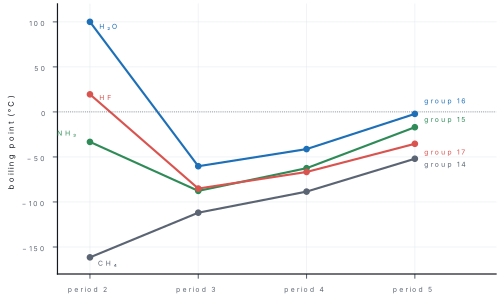
Effects to quote: H₂O (100 °C), HF (19.5 °C) and NH₃ (−33 °C) boil far above the hydrides of the next elements; ice is less dense than water because each water molecule is hydrogen-bonded tetrahedrally to four others in an open cage, which collapses partly on melting (water is densest at 4 °C); ethanol, glucose and ammonia dissolve in water; HF is a weak acid and forms the HF₂⁻ ion (KHF₂); the double helix of DNA and the α-helix of proteins are held by hydrogen bonds. Water boils higher than HF although F–H···F is the stronger bond, because each H₂O molecule averages two hydrogen bonds (two H atoms and two lone pairs) while HF averages one.
Metallic bonding
In the electron sea (electron gas) model, a metal is a lattice of positive ions (kernels) immersed in a "sea" of valence electrons that belong to the whole crystal and move freely. The attraction between the kernels and the mobile electrons is the metallic bond. It explains electrical and thermal conductivity (mobile electrons), lustre, malleability and ductility (layers of kernels slide without breaking the bond) and generally high melting points. The bond is stronger with more valence electrons and smaller kernels: m.p. Na 98 °C < Mg 650 °C < Al 660 °C, and Li 181 °C > Na 98 °C > K 63 °C. Transition metals, with many d electrons available, are very hard and high melting; mercury, with a tightly held 6s² pair, is a liquid.
van der Waals forces
van der Waals forces are the weak attractions between molecules (and noble-gas atoms):
| Type | Between | Example |
|---|---|---|
| Dipole–dipole (Keesom) | polar molecules | HCl, SO₂, CH₃Cl |
| Dipole–induced dipole (Debye) | a polar and a non-polar molecule | HCl with Ar; O₂ dissolved in water |
| London (dispersion) forces | all molecules, the only force between non-polar ones; due to momentary dipoles | noble gases, H₂, Cl₂, I₂, CH₄ |
| Ion–dipole (not van der Waals, but often asked with them) | an ion and a polar molecule | Na⁺ hydrated by water |
London forces grow with the size of the electron cloud (molar mass, polarisability) and with the surface area of contact. Hence the boiling points rise He < Ne < Ar < Kr < Xe; F₂ and Cl₂ are gases, Br₂ a liquid and I₂ a solid at room temperature; and among isomers, branching lowers the boiling point: n-pentane (36 °C) > isopentane (28 °C) > neopentane (9.5 °C).
| Force | Typical energy (kJ mol⁻¹) |
|---|---|
| Ionic bonding (lattice energy) | about 600–4000 |
| Covalent bond | about 150–1000 |
| Metallic bonding (enthalpy of atomisation) | about 60–850 |
| Hydrogen bond | about 10–40 |
| van der Waals forces | below about 10 |
An ordinary C–H hydrogen (as in CH₄) is not polar enough to form hydrogen bonds — that is why CH₄ fits the normal boiling-point trend while NH₃, H₂O and HF do not. (Only when carbon carries strongly electron-withdrawing groups, as in CHCl₃, can a weak C–H···O bond form — chloroform with acetone.) And a hydrogen bond lies between an H on one electronegative atom and a lone pair on another; HCl, with a large, less electronegative Cl, forms only dipole–dipole attractions.
Formula and fact sheet
| Item | Formula or fact |
|---|---|
| Formal charge | V − L − B/2 |
| Steric number | ½(V + M − c + a); lone pairs = SN − bonded atoms |
| SN → hybridisation | 2 sp, 3 sp², 4 sp³, 5 sp³d, 6 sp³d², 7 sp³d³ |
| Repulsion order | lp–lp > lp–bp > bp–bp |
| Dipole moment | μ = q × d; 1 D = 3.33 × 10⁻³⁰ C m; e × 1 Å = 4.8 D |
| % ionic character | μ(observed)/(e × d) × 100 |
| Bonds | single σ; double σ + π; triple σ + 2π |
| Bond length order | C–C 154 > benzene 139 > C=C 134 > C≡C 120 pm |
| Shapes to remember | |
|---|---|
| Linear | BeCl₂, CO₂, HCN, C₂H₂, NO₂⁺, XeF₂, I₃⁻ |
| Trigonal planar | BF₃, SO₃, NO₃⁻, CO₃²⁻, C₂H₄ (each C) |
| Bent | H₂O, H₂S, SO₂, O₃, NO₂⁻, OF₂ |
| Tetrahedral | CH₄, CCl₄, NH₄⁺, SO₄²⁻, ClO₄⁻ |
| Pyramidal | NH₃, PCl₃, H₃O⁺, XeO₃, ClO₃⁻ |
| See-saw / T-shaped | SF₄ / ClF₃, BrF₃ |
| TBP / octahedral | PCl₅ / SF₆, PCl₆⁻ |
| Square pyramidal / square planar | BrF₅, IF₅ / XeF₄, ICl₄⁻ |
| Pentagonal bipyramidal | IF₇ |
Bond angles: CH₄ 109.5°, NH₃ 107°, H₂O 104.5°, NF₃ 102°, PH₃ 93.5°, H₂S 92°, SO₂ 119°, O₃ 117°. Dipole moments: μ = 0 for CO₂, BF₃, CH₄, CCl₄, PCl₅, SF₆, XeF₄; H₂O 1.85 D, NH₃ 1.47 D, NF₃ 0.23 D. Boiling points: H₂O 100 °C > HF 19.5 °C > NH₃ −33 °C.
Chapter summary
- Atoms bond to reach a noble-gas configuration: ionic (transfer), covalent (sharing), coordinate (a pair donated by one atom — NH₄⁺, H₃O⁺, H₃N→BF₃). The octet rule fails for BF₃, PCl₅, SF₆, NO and xenon fluorides.
- Formal charge = V − L − B/2; the best Lewis structure minimises formal charges.
- VSEPR: shape from the steric number SN = ½(V + M − c + a); lp–lp > lp–bp > bp–bp squeezes angles: CH₄ 109.5° > NH₃ 107° > H₂O 104.5°.
- Lone pairs in a trigonal bipyramid go equatorial: SF₄ see-saw, ClF₃ T-shaped, XeF₂ linear; XeF₄ is square planar.
- σ bonds come from head-on overlap, π bonds from sideways overlap; double = σ + π, triple = σ + 2π. Hybridisation sp, sp², sp³, sp³d, sp³d², sp³d³ for SN 2–7; more s character, shorter and stronger bond.
- μ = q × d (debye); symmetric molecules have μ = 0; NH₃ > NF₃; % ionic character = μ(obs)/(e × d) × 100. Fajans: small, highly charged cations and large anions raise covalent character.
- Bond length falls as bond order and s character rise; resonance makes equivalent bonds equal.
- Hydrogen bonds (F, O, N) explain the high boiling points of H₂O, HF and NH₃, ice floating and o-nitrophenol's volatility; metallic bonds are an electron sea; London forces grow with size and surface area.
Practice questions
Set A — Recall (20 questions)
- According to the electronic theory of valency of Kossel and Lewis, atoms combine in order toaincrease their atomic massblose all their valence electronscbecome radicalsdattain a stable noble-gas configuration
- A coordinate (dative) bond is present inaCH₄bNH₄⁺cH₂OdNaCl
- A molecule with four bond pairs and no lone pair on the central atom isatetrahedralbsquare planarctrigonal pyramidaldsee-saw
- The bond angle in a regular tetrahedral molecule such as CH₄ isa90°b120°c109.5°d104.5°
- The hybridisation of each carbon atom in ethyne (C₂H₂) isasp³bspcsp²dsp³d
- According to VSEPR theory, the order of repulsion between electron pairs isabp–bp > lp–bp > lp–lpblp–bp > lp–lp > bp–bpclp–lp = lp–bp = bp–bpdlp–lp > lp–bp > bp–bp
- A π bond is formed by theasideways overlap of p orbitalsbhead-on overlap of s orbitalschead-on overlap of p orbitalsdaxial overlap of s and p orbitals
- The unit of dipole moment used in chemistry is theaångströmbcoulombcdebyednewton metre
- Which molecule has zero dipole moment?aCO₂bH₂OcNH₃dHCl
- Hydrogen bonding occurs when hydrogen is covalently bonded toaany non-metalba metal atomccarbonda small, highly electronegative atom (F, O or N)
- Ice floats on water becauseaice contains trapped airbice has stronger van der Waals forceschydrogen bonding gives ice an open cage structuredwater is densest at 0 °C
- The electron sea model explains the bonding inaionic solidsbmetalscmolecular solidsdcovalent network solids
- The attraction between non-polar molecules such as I₂, or between noble-gas atoms, is due toadipole–dipole forcesbhydrogen bondscLondon dispersion forcesdion–dipole forces
- The shape of the SF₆ molecule isaoctahedralbtrigonal bipyramidalcsquare planardpentagonal bipyramidal
- The hybridisation of phosphorus in PCl₅ isasp³bsp³d²cdsp²dsp³d
- Which molecule does NOT obey the octet rule?aCH₄bBF₃cNH₃dH₂O
- Ionic compounds conduct electricityawhen molten or dissolved in waterbonly as solidscin all statesdnever
- Which bond is the shortest?aC–C in ethanebC=C in ethenecC≡C in ethynedC–C in benzene
- The numbers of σ and π bonds in a nitrogen molecule area3σ, 0πb2σ, 1πc1σ, 1πd1σ, 2π
- By Fajans' rules, the covalent character of an ionic compound increases when the cation isalarge and singly chargedbsmall and highly chargedclarge and highly chargeddof noble-gas configuration and large
Answers and explanations — Set A
1. (d) — The Kossel–Lewis theory: atoms transfer or share electrons to reach an octet (or duplet), the configuration of a noble gas.
2. (b) — In NH₄⁺ the nitrogen lone pair is donated to H⁺. CH₄ and H₂O have ordinary covalent bonds; NaCl is ionic.
3. (a) — SN 4 with no lone pair gives a tetrahedron (CH₄). Square planar needs two lone pairs on an SN of 6.
4. (c) — 109.5° (109° 28′). 104.5° is water, 120° trigonal planar, 90° octahedral.
5. (b) — Each C forms two σ bonds (to C and H) and two π bonds: SN 2, sp, linear.
6. (d) — Lone pairs are held by one nucleus only, spread wider and repel most.
7. (a) — Sideways (lateral) overlap of parallel p orbitals; head-on overlap gives σ bonds.
8. (c) — The debye, 1 D = 3.33 × 10⁻³⁰ C m. The SI unit is the coulomb metre, not the coulomb.
9. (a) — CO₂ is linear, so its two C=O moments cancel. Bent H₂O, pyramidal NH₃ and HCl are polar.
10. (d) — Only F, O and N are small and electronegative enough to leave H strongly δ+ and to offer a compact lone pair.
11. (c) — In ice each molecule is H-bonded tetrahedrally to four others, an open, low-density cage; water is densest at 4 °C, not 0 °C.
12. (b) — Metal kernels in a sea of mobile valence electrons (Drude–Lorentz model).
13. (c) — Momentary dipoles inducing dipoles: London (dispersion) forces, the only attraction between non-polar particles.
14. (a) — SN = ½(6 + 6) = 6, no lone pair: octahedral, all angles 90°.
15. (d) — SN = ½(5 + 5) = 5: sp³d, trigonal bipyramidal.
16. (b) — Boron in BF₃ has only six electrons round it (incomplete octet).
17. (a) — The ions must be free to move: in the melt or in solution. In the solid they are locked in the lattice.
18. (c) — C≡C 120 pm < C=C 134 pm < benzene 139 pm < C–C 154 pm: higher bond order, shorter bond.
19. (d) — N≡N is one σ and two π bonds.
20. (b) — A small, highly charged cation polarises the anion strongly. Noble-gas cations polarise less than pseudo-noble-gas ones of the same size.
Set B — Understanding (14 questions)
- The correct order of bond angle isaCH₄ > NH₃ > H₂ObH₂O > NH₃ > CH₄cNH₃ > CH₄ > H₂OdCH₄ = NH₃ = H₂O
- The shape of ClF₃ isatrigonal planarbtrigonal pyramidalcT-shapeddsee-saw
- XeF₄ is square planar because the xenon atom hasafour bond pairs and no lone pairbfour bond pairs and two lone pairscfour bond pairs and one lone pairdsix bond pairs
- Which pair of species has the same shape?aNH₃ and BF₃bH₂O and CO₂cSF₄ and CH₄dNH₄⁺ and SO₄²⁻
- The dipole moment of NF₃ (0.23 D) is much smaller than that of NH₃ (1.47 D) because in NF₃anitrogen has no lone pairbthe molecule is planarcthe lone-pair moment opposes the N–F bond momentsdfluorine is less electronegative than nitrogen
- Which hydride has the highest boiling point?aH₂ObH₂ScH₂SedH₂Te
- o-Nitrophenol is more volatile than p-nitrophenol because o-nitrophenol hasaa higher molar massbstronger intermolecular hydrogen bondscno hydrogen bonding at alldintramolecular hydrogen bonding
- Which chloride has the most covalent character?aNaClbAlCl₃cMgCl₂dKCl
- The hybridisation and shape of NH₄⁺ areasp³, tetrahedralbsp³, trigonal pyramidalcsp², trigonal planarddsp², square planar
- Which statement about σ and π bonds is correct?aa π bond can exist without a σ bondba π bond is stronger than a σ bondcthe π bond prevents free rotation about a double bondda triple bond has two σ bonds and one π bond
- Which molecule has a non-zero dipole moment?aBF₃bCCl₄cCO₂dCHCl₃
- Which species is linear?aI₃⁻bH₂OcSO₂dNO₂⁻
- The boiling points of the noble gases rise from He to Xe becauseahydrogen bonding increasesbLondon forces grow with atomic size and polarisabilityctheir ionisation energies increasedthey begin to form covalent bonds
- The melting points of the alkali metals fall from Li to Cs becauseathe number of valence electrons fallsbthe metals become non-metallicclarger kernels hold the electron sea less stronglydtheir atomic masses decrease
Answers and explanations — Set B
1. (a) — All have SN 4; lone pairs squeeze the angle: 109.5° (0 lp) > 107° (1 lp) > 104.5° (2 lp).
2. (c) — SN = ½(7 + 3) = 5; three bond pairs and two equatorial lone pairs leave a T shape.
3. (b) — SN = ½(8 + 4) = 6: octahedral arrangement with the two lone pairs opposite each other (trans), leaving the four F atoms in a square.
4. (d) — Both are SN 4 with no lone pair: tetrahedral. NH₃ is pyramidal but BF₃ planar; H₂O bent but CO₂ linear; SF₄ see-saw but CH₄ tetrahedral.
5. (c) — In NF₃ the bond moments point from N to F, away from the lone pair, so they largely cancel its moment; in NH₃ all point the same way and add.
6. (a) — Only water forms hydrogen bonds; the others boil higher down the group only through London forces, still far below 100 °C.
7. (d) — The O–H···O=N bond forms inside the ortho molecule, so its molecules do not stick to one another; para molecules H-bond to their neighbours.
8. (b) — Al³⁺ is the smallest, most highly charged cation, so it polarises Cl⁻ the most (AlCl₃ sublimes at about 180 °C).
9. (a) — SN = ½(5 + 4 − 1) = 4 with four bonded H: sp³ tetrahedral, like CH₄. NH₃, with a lone pair, is the pyramidal one.
10. (c) — Twisting would break the sideways p–p overlap, so rotation about C=C is restricted; a π bond forms only after a σ bond and is weaker.
11. (d) — In CHCl₃ the three C–Cl moments and the C–H moment do not cancel. BF₃, CCl₄ and CO₂ are symmetrical.
12. (a) — I₃⁻: SN = ½(7 + 2 + 1) = 5, three equatorial lone pairs, the two I atoms axial: linear. H₂O, SO₂ and NO₂⁻ are bent.
13. (b) — Bigger atoms have bigger, more polarisable electron clouds, so the momentary dipoles and London forces are larger.
14. (c) — All have one valence electron; as the kernel grows, the mobile electrons are farther from it and the metallic bond weakens (Li 181 °C, Cs 28 °C).
Set C — Application (10 questions)
- The numbers of σ and π bonds in acrylonitrile, CH₂=CH–C≡N, area5σ, 3πb6σ, 3πc6σ, 2πd7σ, 2π
- The hybridisation of iodine in ICl₄⁻ isasp³bdsp²csp³ddsp³d²
- HCl has a dipole moment of 1.03 D and a bond length of 127 pm. Its percentage ionic character is about (e = 1.6 × 10⁻¹⁹ C, 1 D = 3.33 × 10⁻³⁰ C m)a17 %b83 %c50 %d6 %
- In the Lewis structure of ozone, O=O⁺–O⁻, the formal charge on the central oxygen atom isa0b−1c+1d+2
- Which molecule has a see-saw shape?aSF₄bXeF₄cCF₄dSiF₄
- The numbers of lone pairs on xenon in XeF₂, XeF₄ and XeF₆ are respectivelya2, 2, 1b3, 2, 1c1, 2, 3d3, 1, 2
- In which species are all the bond lengths equal?aPCl₅bSF₄cCO₃²⁻dClF₃
- The correct order of bond angle isaPH₃ > NH₃ > AsH₃bAsH₃ > PH₃ > NH₃cNH₃ = PH₃ = AsH₃dNH₃ > PH₃ > AsH₃
- H₂O boils at 100 °C and HF at 19.5 °C, although the F–H···F hydrogen bond is the stronger one. The reason is thataeach water molecule forms on average two hydrogen bonds, HF only onebwater has the larger molar masscwater has no lone pairsdHF is a non-polar molecule
- Which molecule has the largest bond angle?aH₂ObOF₂cCl₂OdH₂S
Answers and explanations — Set C
1. (b) — Count bond by bond: C–H × 3 (3σ), C=C (1σ + 1π), C–C (1σ), C≡N (1σ + 2π): 6σ and 3π. Option (c) forgets the π bond of C=C.
2. (d) — SN = ½(7 + 4 + 1) = 6: sp³d², with two lone pairs, so the ion is square planar. dsp² is the square-planar hybridisation of complexes such as [Ni(CN)₄]²⁻, not of ICl₄⁻.
3. (a) — μ(obs) = 1.03 × 3.33 × 10⁻³⁰ = 3.43 × 10⁻³⁰ C m; μ(ionic) = 1.6 × 10⁻¹⁹ × 1.27 × 10⁻¹⁰ = 2.03 × 10⁻²⁹ C m; 3.43/20.3 × 100 ≈ 17 %. Option (b) is the covalent share.
4. (c) — Central O: V = 6, one lone pair (L = 2), three bonds (B = 6): 6 − 2 − 3 = +1. The singly bonded end O carries −1.
5. (a) — SF₄: SN = ½(6 + 4) = 5 with one equatorial lone pair → see-saw. XeF₄ is square planar; CF₄ and SiF₄ are tetrahedral.
6. (b) — SN = ½(8 + n): XeF₂ 5 − 2 = 3; XeF₄ 6 − 4 = 2; XeF₆ 7 − 6 = 1 lone pair.
7. (c) — Resonance makes the three C–O bonds of CO₃²⁻ identical (bond order 4/3). In PCl₅ the axial bonds are longer than the equatorial ones; SF₄ and ClF₃ also have two kinds of bond.
8. (d) — 107° > 93.5° > 92°: down the group the central atom becomes larger and less electronegative, the bond pairs sit farther out and repel less.
9. (a) — Each H₂O has two H atoms and two lone pairs, so it can average two hydrogen bonds per molecule; HF has three lone pairs but only one H, so it averages one.
10. (c) — Cl₂O about 111° > H₂O 104.5° > OF₂ 103° > H₂S 92°. Electronegative F pulls the bond pairs outward (smaller angle); the bulky Cl atoms push each other apart.