Chapter 14 · Inorganic Chemistry · 4 questions in the paper · 40 min read
Metallurgy and the Chemistry of Metals
What the syllabus asks for 5
- Metallurgical principles: ores, gangue, flux, slag, concentration, calcination, roasting, smelting, bessemerization, aluminothermy, electrolytic reduction, poling, electro-refining and zone refining
- Alkali and alkaline-earth metals; sodium, sodium hydroxide and sodium carbonate
- 3d transition metals; shapes of complex ions; crystal field theory of octahedral complexes
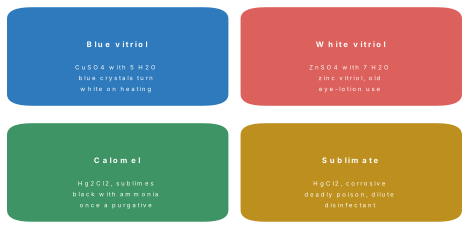
- Copper, zinc, mercury, silver and iron: occurrence, extraction and properties; blue vitriol, white vitriol, calomel and corrosive sublimate
- Steel by the basic oxygen and open-hearth processes; corrosion of iron
Metallurgy is the branch of chemistry that turns a rocky ore into a useful metal, and this chapter carries about four of the fifty Chemistry questions — one of the heaviest inorganic units in the paper. The questions are of three kinds: a named step with its definition (calcination, roasting, poling, zone refining), a metal with its ore, reagent or characteristic compound (blue vitriol, white vitriol, calomel, corrosive sublimate), and a property of the 3d series explained by electronic configuration or crystal field theory. Almost every mark here is recall of a name, a formula or a colour, so the tables in this chapter are the part to learn by heart.
- The vocabulary of extraction, each with one example: ore, mineral, gangue, flux, slag, concentration, calcination, roasting, smelting, bessemerisation, aluminothermy, electrolytic reduction, poling, electro-refining, zone refining.
- Calcination = heating without air; roasting = heating in excess air. Slag = flux + gangue; gangue is the impurity, slag is the product that removes it.
- Sodium by Down's cell (fused NaCl + CaCl₂, graphite anode, iron cathode); NaOH by Castner–Kellner (mercury cathode); Na₂CO₃ by Solvay with the ammonia-recovery loop.
- The 3d series: configuration, variable oxidation states, colour, paramagnetism, catalysis, alloy formation — and Zn is not a transition metal (d¹⁰ in atom and ion).
- Crystal field theory: t₂g below eg by Δ₀, high spin when Δ₀ < P, colour from d–d transitions, μ = √(n(n+2)) BM, the spectrochemical series.
- Copper: roast, smelt, bessemerise, blister copper, electro-refine; blue vitriol CuSO₄·5H₂O. Zinc: blende, roast, reduce with coke; white vitriol ZnSO₄·7H₂O.
- Mercury from cinnabar through HgO; calomel Hg₂Cl₂ against corrosive sublimate HgCl₂. Silver by cyanide leaching and the Parkes process. Iron in the blast furnace, zone by zone.
- Steel by the basic oxygen and open-hearth processes; rusting as an electrochemical cell and the four ways to stop it.
14.1 Metallurgical principles
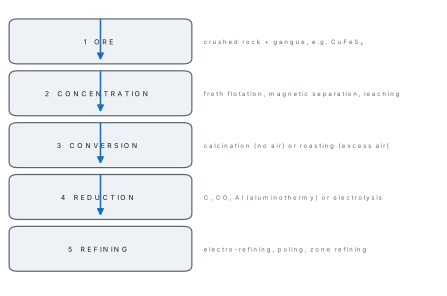
Few metals occur free. The reactive ones are found as oxides, sulphides, carbonates or silicates, mixed with worthless rock, and the whole business of metallurgy is to separate the metal compound from the rock and then pull the metal out of the compound. Every extraction, from iron to sodium, follows the same five stages, and the paper tests the name, the purpose and one example of each.
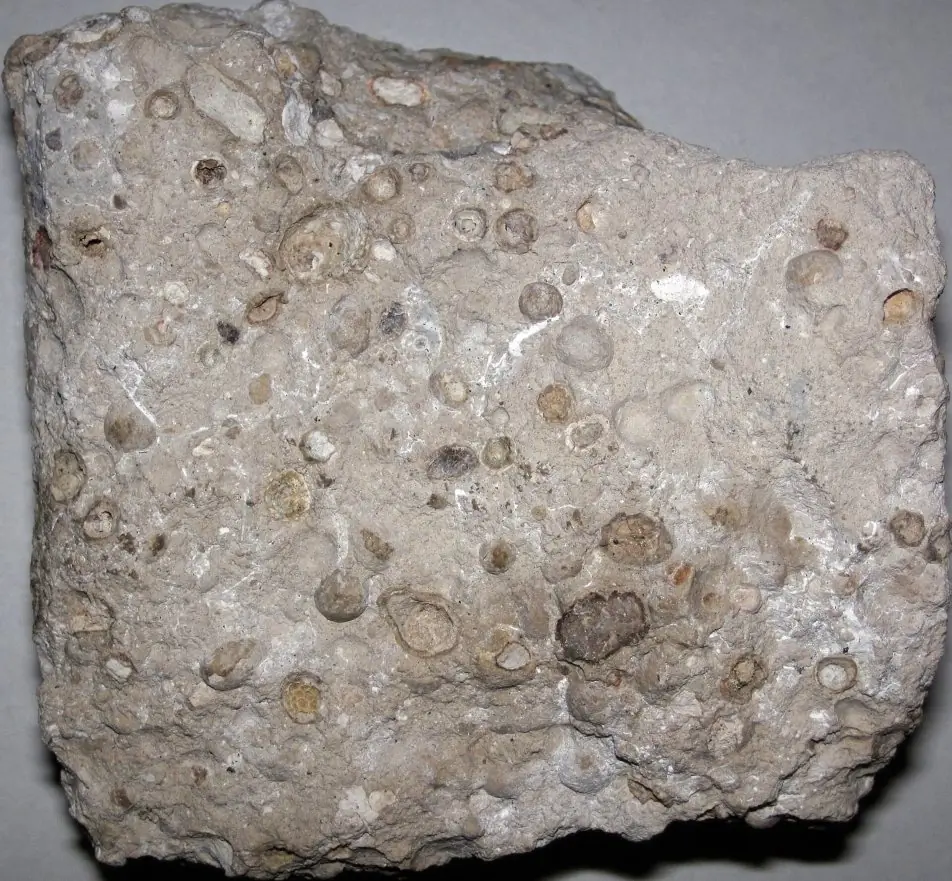
The vocabulary, defined once
A mineral is a naturally occurring inorganic substance with a definite chemical composition and a characteristic crystal structure. An ore is a mineral (or a mixture of minerals) from which a metal can be extracted profitably — the word "profitably" is part of the definition, which is why bauxite is an ore of aluminium and ordinary clay is not. The gangue is the unwanted earthy matter — sand, clay, limestone, rock — mixed with the ore.
A flux is a substance added to the charge to combine with the gangue and form a fusible product. A slag is that fusible product. The slag melts at a lower temperature than the gangue alone, floats on the molten metal because it is less dense, and protects the metal from re-oxidation by the air.
The choice of flux is fixed by the chemistry of the gangue, and this is the one rule worth memorising:
| Gangue | Nature | Flux used | Slag formed |
|---|---|---|---|
| SiO₂ (sand) | acidic | basic flux: CaO (from limestone) | CaSiO₃ (calcium silicate) |
| CaO or MgO | basic | acidic flux: SiO₂ (sand) | CaSiO₃ or MgSiO₃ |
| FeO | basic | acidic flux: SiO₂ | FeSiO₃ |
| P₂O₅ | acidic | basic flux: CaO | Ca₃(PO₄)₂ |
Acidic gangue needs a basic flux, and basic gangue needs an acidic flux. The slag must be of the opposite character to the gangue so that the two combine.
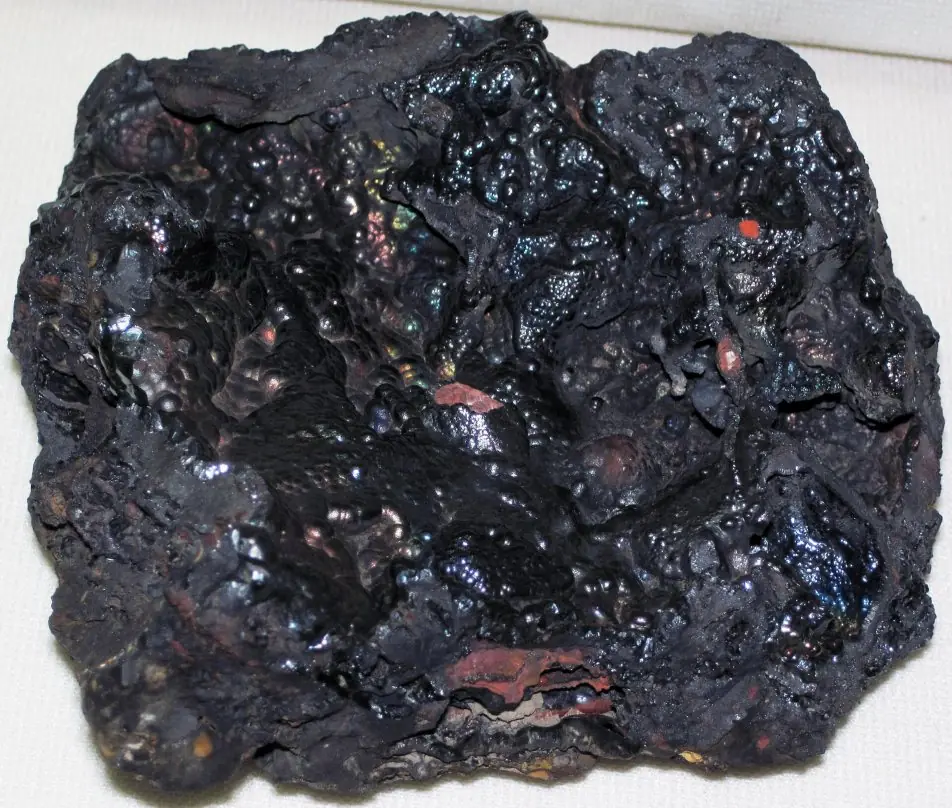
Gangue is the impurity that is already in the ore; slag is the new compound made when flux is added to it. A question that says "the impurity present in an ore is called" wants gangue; one that says "the fusible mass formed by flux and impurity" wants slag. Mixing these two up is the commonest single error in this unit.
Concentration (dressing) of the ore
Concentration is the removal of gangue from the crushed ore. It is a physical separation: the chemical nature of the ore does not change, only its purity.
| Method | Used for | How it works |
|---|---|---|
| Hand picking | large lumps | visible difference in colour or lustre |
| Washing / levigation | oxide ores of Fe, Sn (heavy) | gangue is lighter and is washed away in a stream of water |
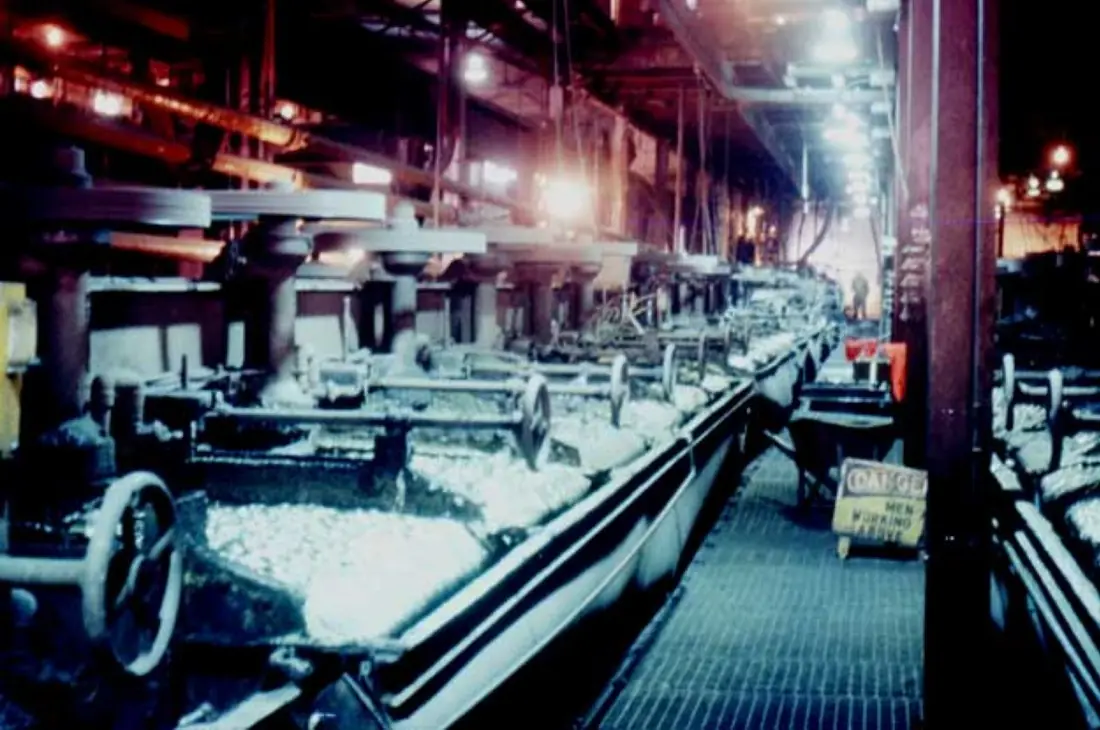
| Froth flotation | sulphide ores (Cu, Zn, Pb, Ag) | powdered ore + water + pine oil (frother) + a collector such as sodium ethyl xanthate; air is blown through. The sulphide particles are wetted by oil, stick to the froth and rise; the gangue is wetted by water and sinks |
| Magnetic separation | ores containing Fe₃O₄ (magnetite), and wolframite | the magnetic ore is held by an electromagnet while the non-magnetic gangue falls away |
| Gravity separation | oxide ores | the heavier ore settles faster on a shaking Wilfley table |
| Leaching | bauxite (with hot NaOH), Ag and Au (with dilute NaCN) | the ore is dissolved selectively in a reagent and recovered from the solution; used when the ore and the gangue differ chemically |
Froth flotation is the method the paper asks about most often, and its two-part logic is worth stating: the collector makes the sulphide surface water-repellent, and the frother makes a stable foam that carries those particles to the top. Depressants and activators (NaCN, CuSO₄) are used to separate one sulphide from another in complex ores.
Calcination and roasting — the two that are always confused
Calcination is the heating of an ore strongly in the absence of air (or in a limited supply of air) to drive off water and carbon dioxide and to decompose the compound. Roasting is the heating of an ore strongly in excess air so that the ore is oxidised and volatile impurities such as sulphur, arsenic and antimony are removed as their oxides.
| Calcination | Roasting | |
|---|---|---|
| Air | absent or limited | excess |
| What is removed | water of crystallisation, CO₂ | S (as SO₂), As, Sb, and carbon |
| Chemical change | decomposition | oxidation |
| Used for | carbonates, hydrated oxides | sulphide ores |
| Example | CaCO₃ → CaO + CO₂ | 2ZnS + 3O₂ → 2ZnO + 2SO₂ |
| Second example | Al₂O₃·2H₂O → Al₂O₃ + 2H₂O | 2CuFeS₂ + O₂ → Cu₂S + 2FeS + SO₂ |
A calcined ore is decomposed; a roasted ore is oxidised. Both leave a metal oxide behind, which is why the next step is the same for both — reduction.
- Roasting a sulphide produces the oxide plus SO₂ — never the metal directly, and never SO₃ at furnace temperature.
- Calcination of limestone is the same reaction as the one in a lime kiln, so a question about "the reaction in the zone of slag formation of a blast furnace" is asking about calcination, not roasting.
Reduction: smelting, aluminothermy and electrolysis
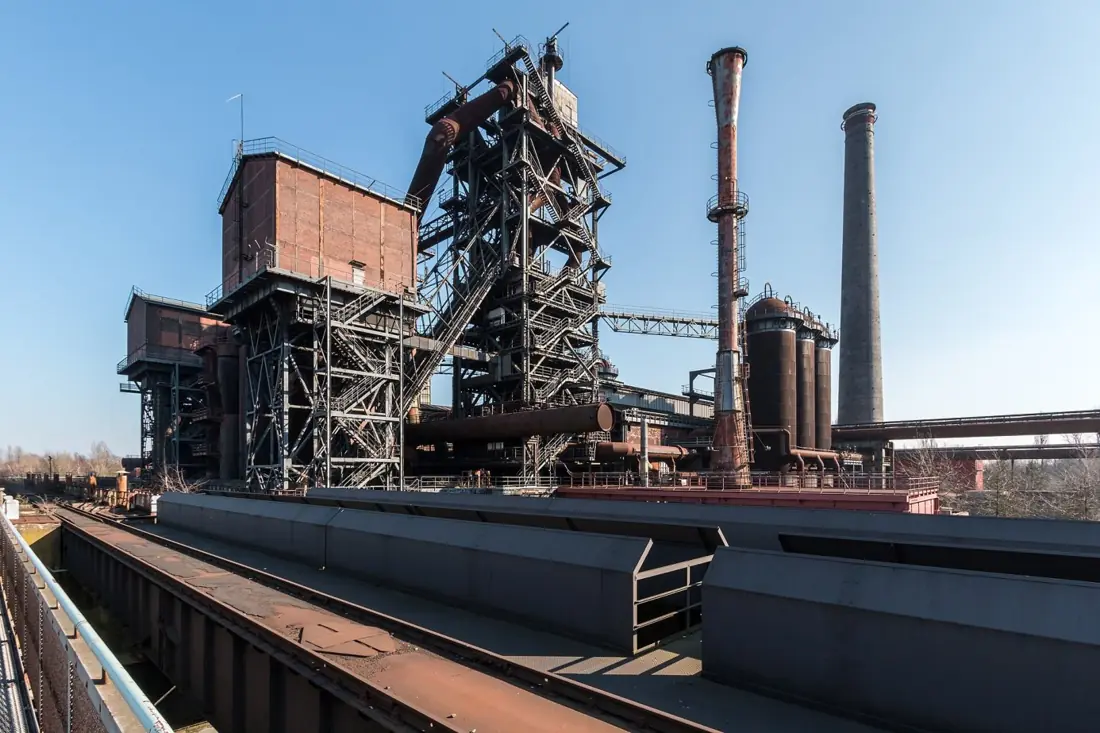
Smelting is the reduction of a roasted or calcined ore at high temperature in the presence of a flux, giving molten metal and molten slag. The reducing agent is chosen from the reactivity of the metal:
| Method | Reducing agent | Metals | Example |
|---|---|---|---|
| Carbon reduction (smelting) | coke, C | Zn, Fe, Pb, Sn | ZnO + C → Zn + CO |
| Carbon monoxide | CO | Fe (blast furnace) | Fe₂O₃ + 3CO → 2Fe + 3CO₂ |
| Aluminothermy (thermite) | Al powder | Cr, Mn, Fe, and metals whose oxides are very stable | Cr₂O₃ + 2Al → 2Cr + Al₂O₃ |
| Hydrogen reduction | H₂ | W, Mo | WO₃ + 3H₂ → W + 3H₂O |
| Electrolytic reduction | electric current | Na, K, Mg, Ca, Al (very reactive) | 2NaCl → 2Na + Cl₂ |
| Self-reduction | the ore itself | Cu, Pb | Cu₂S + 2Cu₂O → 6Cu + SO₂ |
| Displacement | a more reactive metal | Ag, Au | 2Na[Ag(CN)₂] + Zn → 2Ag + Na₂[Zn(CN)₄] |
Aluminothermy (the Goldschmidt process) works because aluminium has a very high affinity for oxygen: the reaction is so exothermic that the temperature rises above 2000 °C and the metal comes out molten. The mixture of Fe₂O₃ and Al is the thermite used to weld railway tracks. Metals low in the electrochemical series (Cu, Ag, Au, Hg) can be obtained by heating their oxides alone; metals high in the series (Na, Mg, Al) can only be obtained by electrolysis of a fused salt, because no chemical reducing agent is strong enough.
Refining
| Method | Principle | Metal |
|---|---|---|
| Liquation | the metal has a lower melting point than its impurities and is allowed to flow away | Sn, Pb, Bi |
| Distillation | the metal is volatile | Zn, Hg, Cd |
| Poling | molten metal is stirred with green wood; the gases (CH₄, CO) reduce the oxide back to metal | Cu (blister copper) |
| Cupellation | the impurity is oxidised and absorbed by a bone-ash cupel | Ag (from Pb) |
| Electro-refining | impure metal is the anode, pure metal the cathode; metal dissolves and redeposits | Cu, Zn, Ag, Al, Ni |
| Zone refining | a molten zone is moved slowly along a rod; impurities stay in the melt and are swept to one end | Si, Ge (semiconductor grade) |
| Vapour phase (Mond) | the metal forms a volatile compound which is decomposed elsewhere | Ni: Ni + 4CO → Ni(CO)₄ at 60 °C, decomposed at 180 °C |
Electro-refining of copper uses the impure blister copper as the anode, a thin sheet of pure copper as the cathode, and acidified copper sulphate as the electrolyte. Copper dissolves from the anode, migrates as Cu²⁺ and deposits on the cathode at 99.95 % purity; less active impurities (Ag, Au, Pt) fall as anode mud and are recovered, while more active ones (Fe, Ni, Zn) stay in solution. Zone refining relies on the fact that an impurity is more soluble in the melt than in the solid: the molten zone carries the impurity along and leaves pure crystal behind it, and repeating the pass gives the 99.9999999 % silicon needed for chips.
Problem. A copper charge contains 120 kg of ore that is 10 % SiO₂ by mass. How much limestone, 90 % pure CaCO₃, must be added to remove all the silica as slag? (Ca = 40, Si = 28, O = 16, C = 12)
Solution. Mass of SiO₂ = 0.10 × 120 = 12 kg = 12/60 = 0.20 kmol. CaO + SiO₂ → CaSiO₃, so 0.20 kmol of CaO is needed = 0.20 × 56 = 11.2 kg. CaCO₃ → CaO + CO₂, so CaCO₃ needed = 0.20 × 100 = 20.0 kg. At 90 % purity: 20.0/0.90 = 22.2 kg of limestone.
14.2 Alkali and alkaline-earth metals; sodium, sodium hydroxide and sodium carbonate
Occurrence and the trends down the group
The alkali metals (group 1: Li, Na, K, Rb, Cs) have the configuration ns¹ and the alkaline-earth metals (group 2: Be, Mg, Ca, Sr, Ba) have ns². Both are so reactive that they are never found free.
| Metal | Chief minerals |
|---|---|
| Na | rock salt NaCl, Chile saltpetre NaNO₃, borax Na₂B₄O₇·10H₂O, feldspar |
| K | sylvine KCl, carnallite KCl·MgCl₂·6H₂O, saltpetre KNO₃ |
| Mg | magnesite MgCO₃, dolomite CaCO₃·MgCO₃, carnallite, sea water |
| Ca | limestone CaCO₃, gypsum CaSO₄·2H₂O, fluorspar CaF₂, apatite |
Trends down group 1. Atomic and ionic radius increase, ionisation energy and electronegativity decrease, metallic character and reactivity increase, melting point decreases (Li 180 °C to Cs 28.5 °C, because the atoms are held by weaker metallic bonding as the size grows), density generally increases (Li 0.53 to Cs 1.87 g cm⁻³, with potassium lighter than sodium as the one exception), and the hydration enthalpy of the ion decreases — Li⁺ is the most heavily hydrated and therefore has the largest hydrated radius but the highest hydration energy.
Trends down group 2. The same fall in ionisation energy and rise in reactivity, but the group is harder, denser and much less reactive than group 1 because of the extra nuclear charge and the pair of electrons. Two solubility trends are examined:
- Hydroxides become more soluble down the group: Be(OH)₂ is insoluble and amphoteric, Mg(OH)₂ is sparingly soluble, Ca(OH)₂ is fairly soluble, Ba(OH)₂ is very soluble.
- Sulphates and carbonates become less soluble down the group, and the thermal stability of the carbonates increases down the group, because the larger cation polarises the carbonate ion less.
Chemical character. Sodium reacts vigorously with water: 2Na + 2H₂O → 2NaOH + H₂. It burns in air to the monoxide and, on strong heating, to the peroxide Na₂O₂. It dissolves in liquid ammonia to give a deep blue solution of solvated electrons, which is a strong reducing agent. Sodium is stored under kerosene because it would otherwise react with the moisture and oxygen of the air. Calcium reacts with cold water more gently than sodium (Ca + 2H₂O → Ca(OH)₂ + H₂), magnesium only with hot water or steam (Mg + H₂O → MgO + H₂), and beryllium not at all. Oxides: BeO and Al₂O₃ are amphoteric, MgO and CaO are basic.
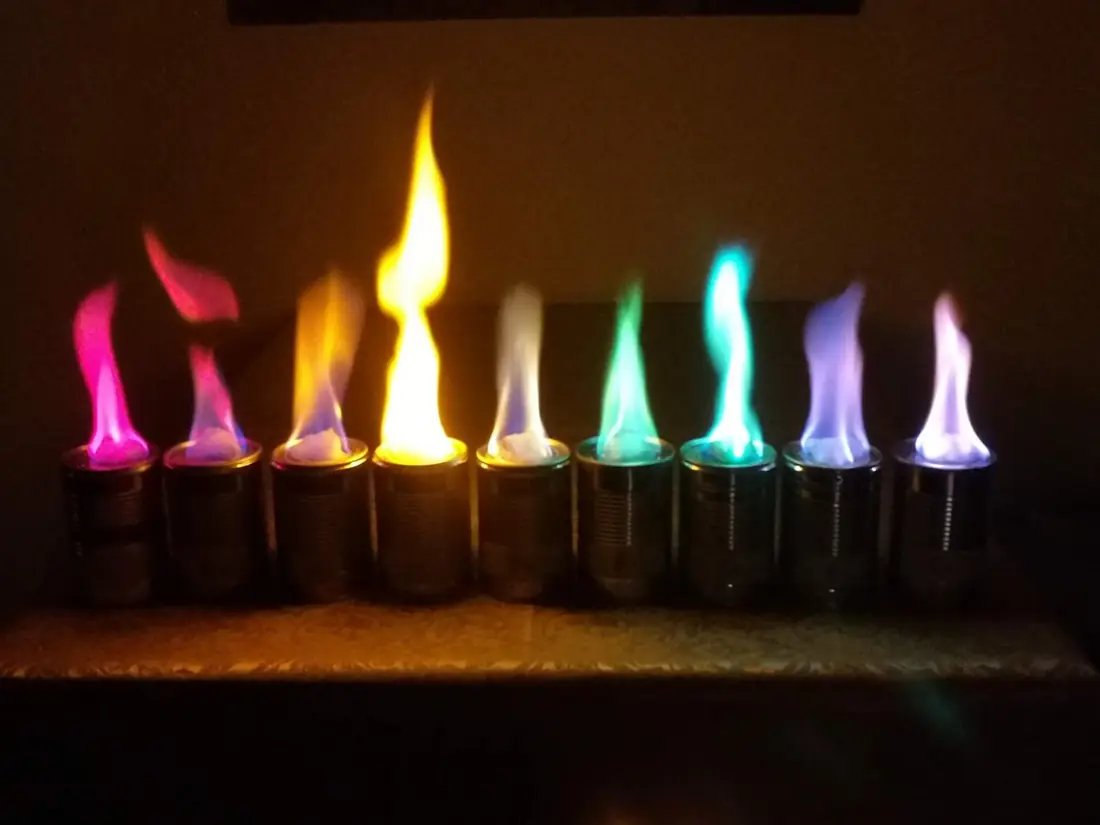
Flame colours are worth a line each: Li crimson, Na golden yellow, K lilac, Rb red-violet, Cs blue; Ca brick red, Sr crimson, Ba apple green. Sodium street lamps are yellow for this reason.
Sodium by Down's cell
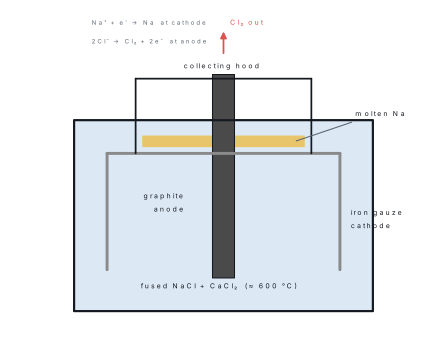
Sodium cannot be reduced by carbon or aluminium — it is too reactive — so it is made by electrolysis of fused sodium chloride. The melting point of pure NaCl is 801 °C, too high to work comfortably, so about 40 % calcium chloride is added: the mixture melts near 600 °C and the CaCl₂ also lowers the solubility of the metal in the melt.
- Anode: graphite (carbon), at the centre. Chlorine is liberated: 2Cl⁻ → Cl₂ + 2e⁻.
- Cathode: a ring of iron gauze around the anode. Sodium is deposited: Na⁺ + e⁻ → Na.
- The bell above the cathode collects the molten sodium, which is less dense than the melt and floats up; the chlorine is drawn off from the central hood. The two products must be kept apart, or they recombine.
Uses of sodium: as a coolant in fast-breeder nuclear reactors (it has a low melting point and a high heat capacity), in sodium-vapour lamps, in the manufacture of Na₂O₂, NaCN and sodium amalgam, and as a reducing agent in organic chemistry.
Sodium hydroxide — the Castner–Kellner process
Castner–Kellner electrolyses concentrated brine with a flowing mercury cathode and a graphite anode. Sodium is discharged at the mercury in preference to hydrogen because of the high overvoltage of hydrogen on mercury, and it dissolves to form sodium amalgam. The amalgam is run into a separate decomposer where water oxidises it:
- At the mercury cathode: Na⁺ + e⁻ → Na (dissolves in Hg).
- At the graphite anode: 2Cl⁻ → Cl₂ + 2e⁻.
- In the decomposer: 2Na + 2H₂O → 2NaOH + H₂.
The mercury is pumped back, so it is a continuous process, and the NaOH produced is very pure and free of chloride. The older diaphragm cell and the modern membrane cell do the same overall reaction without mercury; the membrane cell avoids both the mercury hazard and the asbestos diaphragm, and is what new plants build.
Properties and uses. NaOH is a white, deliquescent solid that absorbs CO₂ from the air (2NaOH + CO₂ → Na₂CO₃ + H₂O) and dissolves in water with a large release of heat. It is used in soap making (saponification of fats), in paper and textile processing, in rayon, in petroleum refining, in the extraction of alumina from bauxite, and as a drain cleaner.
Sodium carbonate — the Solvay (ammonia–soda) process
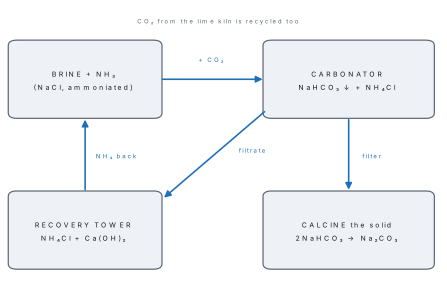
Solvay's genius was to use a cheap, recyclable base (ammonia) to make an insoluble salt (sodium bicarbonate) precipitate out of brine, and then to recover the ammonia with lime. Five steps, and every equation is examinable.
Step 1 — carbon dioxide and lime. Limestone is calcined in a kiln: CaCO₃ → CaO + CO₂. The CO₂ goes to the carbonating tower; the CaO is slaked: CaO + H₂O → Ca(OH)₂, and the milk of lime goes to the ammonia-recovery tower.
Step 2 — brine saturated with ammonia. Purified brine is saturated with NH₃ in an absorption tower. The ammonia makes the solution alkaline, which is what allows it to absorb CO₂ in quantity.
Step 3 — carbonation. CO₂ is bubbled through the ammoniated brine under pressure: NaCl + NH₃ + CO₂ + H₂O → NaHCO₃↓ + NH₄Cl. Sodium bicarbonate is only sparingly soluble, and the presence of NH₄Cl and unchanged NaCl (the common-ion effect) pushes it out of solution almost completely. It is filtered off.
Step 4 — calcination of the bicarbonate. 2NaHCO₃ → Na₂CO₃ + CO₂ + H₂O. The CO₂ is returned to step 3, so no carbon dioxide is wasted.
Step 5 — ammonia recovery. The filtrate contains NH₄Cl. It is heated with milk of lime: 2NH₄Cl + Ca(OH)₂ → 2NH₃ + CaCl₂ + 2H₂O, and the ammonia is returned to step 2. This loop is what makes the process economic: the only raw materials consumed are brine and limestone, and the only waste is calcium chloride.
Overall: CaCO₃ + 2NaCl → Na₂CO₃ + CaCl₂.
Properties and uses. Anhydrous Na₂CO₃ (soda ash) is a white powder; the decahydrate Na₂CO₃·10H₂O is washing soda, which effloresces in dry air. It is used in glass making, soap and detergent manufacture, water softening (it precipitates Ca²⁺ as CaCO₃), paper making, and in the laboratory as a primary standard for acids. Na₂CO₃ + 2HCl → 2NaCl + H₂O + CO₂.
The process depends on NaHCO₃ being sparingly soluble so that it crystallises out. Potassium bicarbonate is much more soluble, so it never precipitates and the ammonia-soda route fails for K₂CO₃ — potassium carbonate is still made from wood ash or by the carbonation of KOH.
Problem. A Solvay plant treats 585 kg of pure NaCl a day with excess limestone and ammonia, and the overall yield of Na₂CO₃ is 80 %. What mass of soda ash is obtained? (Na = 23, Cl = 35.5, C = 12, O = 16)
Solution. NaCl = 585/58.5 = 10 kmol. From CaCO₃ + 2NaCl → Na₂CO₃ + CaCl₂, 2 mol NaCl give 1 mol Na₂CO₃, so 10 kmol NaCl give 5 kmol Na₂CO₃. Mass = 5 × 106 = 530 kg at 100 %; at 80 %: 530 × 0.80 = 424 kg.
14.3 3d transition metals: complex shapes and crystal field theory
A transition metal has an incomplete d subshell in some common oxidation state (Sc → Zn across the 3d row; Zn, with only d¹⁰ Zn²⁺, sits on the honorary bench). The nearness of 4s and 3d energies yields the family's party tricks: variable oxidation states (Mn: +2 to +7), coloured compounds, paramagnetism (unpaired d electrons, counted by the spin-only moment \mu = \sqrt{n(n+2)} BM conceptually), catalysis (empty d orbitals and easy redox swapping), and a passion for complex ions — a central metal accepting lone pairs from ligands (NH₃, H₂O, Cl⁻, CN⁻, en…; chelating ligands like EDTA grip with several teeth — and are used clinically to drag Pb²⁺ out of poisoned patients, Ch. 15).
| Coordination no. | Geometry | Familiar examples |
|---|---|---|
| 2 | linear | [Ag(NH₃)₂]⁺ (Tollens'), [AuCl₂]⁻ |
| 4 | tetrahedral | [Zn(NH₃)₄]²⁺, [NiCl₄]²⁻, [FeCl₄]⁻ |
| 4 | square planar | [Ni(CN)₄]²⁻, [Pt(NH₃)₂Cl₂] (cisplatin — the cis form is the anticancer drug; geometry is destiny) |
| 6 | octahedral | [Fe(CN)₆]⁴⁻, [Cu(NH₃)₄(H₂O)₂]²⁺, [Cr(H₂O)₆]³⁺, haem's Fe |
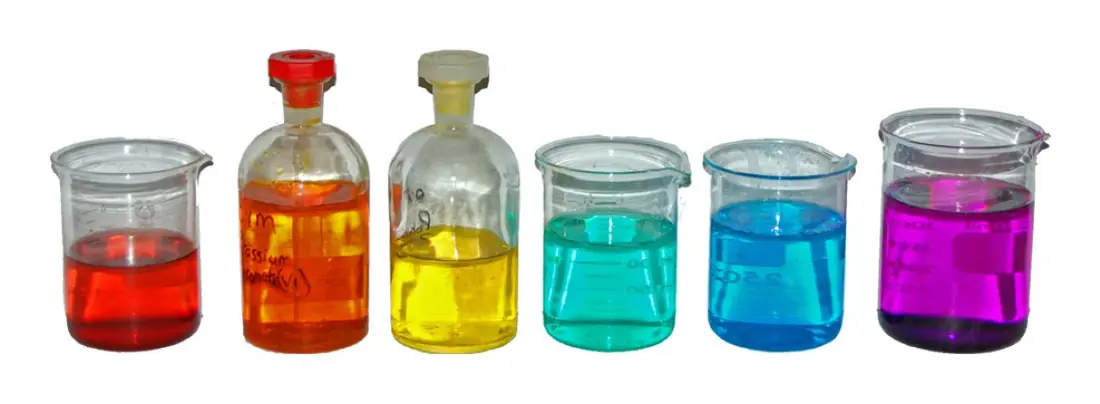
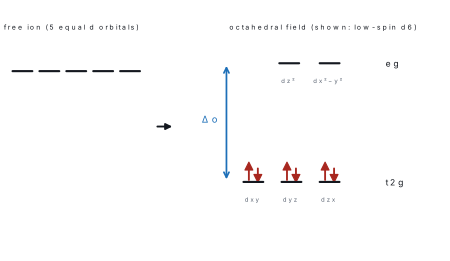
Crystal field theory treats ligands as point charges approaching the metal. In an octahedral complex they march down the x, y, z axes — straight at the d_{z^2} and d_{x^2-y^2} orbitals (e_g, repelled upward) while d_{xy}, d_{yz}, d_{zx} point between the axes (t₂g, sheltered, lower). The gap is Δo, sized by the ligand (spectrochemical series: I⁻, Br⁻, Cl⁻, F⁻, OH⁻, H₂O < NH₃, en < CN⁻, CO), the metal's oxidation state and row. Electrons then face a rent-vs-roommates decision: if Δo is small (weak field), they spread out obeying Hund (high spin, e.g. [FeF₆]³⁻ d⁵ all unpaired); if Δo is large (strong field), they pair up in t₂g first (low spin, e.g. [Fe(CN)₆]³⁻ with one unpaired). Absorbing a photon of energy Δo promotes an electron t₂g → e_g: the absorbed colour is removed and the complementary colour is seen (red absorbed → blue-green observed, as in Cu²⁺'s aqua complex; d⁰ Sc³⁺ and d¹⁰ Zn²⁺ have no d–d moves and stay colourless).
14.4 Copper, zinc, mercury, silver and iron (with their signature salts)
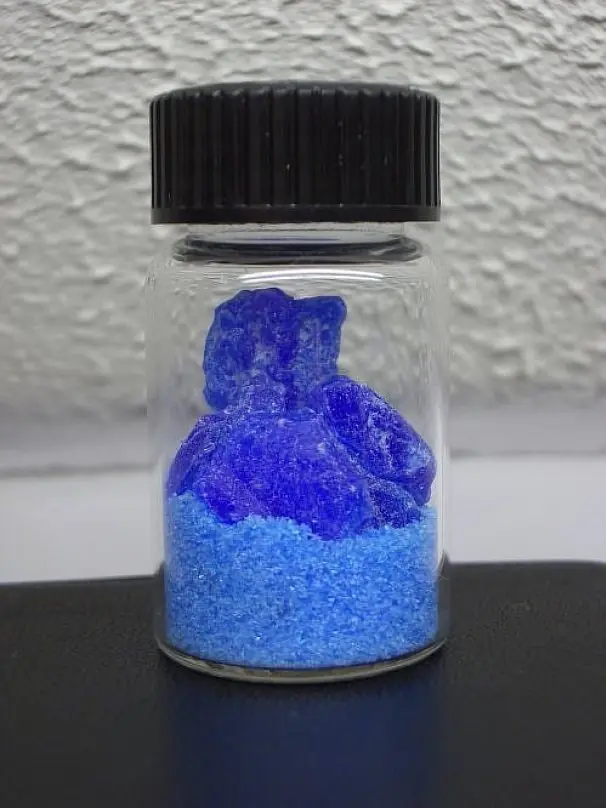
Copper — chief ore copper pyrites/chalcopyrite CuFeS₂ (also cuprite Cu₂O, malachite CuCO₃·Cu(OH)₂, azurite). Froth-float, roast gently (only part-oxidize), smelt to a matte of Cu₂S + FeS, slag off Fe as FeSiO₃, bessemerize to blister copper, electrorefine (acidsulphate bath: impure anode dissolves, pure Cu plates the cathode; Ag, Au, Pt drop as valuable anode mud; more reactive impurities stay in solution). The metal is the wiring/coinage standard (alloys brass Cu–Zn, bronze Cu–Sn). Blue vitriol, CuSO₄·5H₂O, is the signature salt: deep blue crystals (4 waters coordinate Cu²⁺, the 5th is H-bonded) turning white on heating as the anhydrous salt forms — the classic test for water; with lime it makes Bordeaux mixture, the vineyards' fungicide; Fehling's solution uses its tartrate complex to detect reducing sugars (Ch. 19). In moist air copper slowly coats with green basic carbonate — the skin of old roofs and temple bells.
Zinc — ores zinc blende ZnS and calamine ZnCO₃. Roast/calcine to ZnO, reduce with coke at ~1400 K; zinc (b.p. 1180 K) leaves as vapour and is condensed (a built-in distillation refining; care to stop it reoxidizing). Amphoteric like Al (Zn + 2NaOH (hot) → Na₂ZnO₂ + H₂), it galvanizes iron (sacrificial coat, Ch. 10) and fills dry cells (the can is the anode). White vitriol, ZnSO₄·7H₂O, is its colourless everyday salt; ZnO is "philosopher's wool" (from burning Zn) and calamine lotion's ZnO/Fe₂O₃ is a first-aid-box citizen.
Mercury — from cinnabar HgS, which merely roasts in air: HgS + O₂ → Hg + SO₂ (the oxide first formed also self-reduces: 2HgO → 2Hg + O₂ when hot). The liquid metal (m.p. −39 °C, vapour poisonous) amalgamates most metals (not iron — hence iron flasks), fills thermometers and barometers (retreating, post-Minamata conventions — Ch. 15). Two chlorides must never be confused: calomel, Hg₂Cl₂ — white, Hg(I) — with NH₄OH turns black (HgNH₂Cl + Hg), the test for Hg₂²⁺; and corrosive sublimate, HgCl₂ — Hg(II), violently poisonous protein coagulant (albumen is the antidote: milk/egg-white give it innocent protein to curdle), whose solution with excess KI gives the Nessler complex (K₂[HgI₄]).
Silver — native and as argentite Ag₂S; extracted by the cyanide process: Ag₂S + 4NaCN ⇌ 2Na[Ag(CN)₂] + Na₂S (air oxidizes the sulphide on), then zinc dust displaces the metal: 2Na[Ag(CN)₂] + Zn → Na₂[Zn(CN)₄] + 2Ag↓. Best electrical conductor of all metals; untarnished by air alone but blackened by trace H₂S (Ag₂S film); AgNO₃ (lunar caustic) blackens skin (to Ag) and with halides gives the Ch. 13 precipitates; AgBr emulsions powered a century of photography (light → Ag nuclei → developer amplifies).
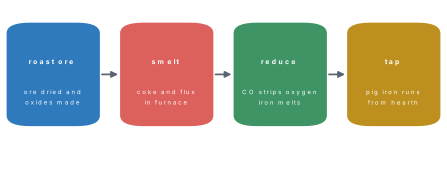
Iron — ores haematite Fe₂O₃ (chief), magnetite Fe₃O₄, siderite FeCO₃, iron pyrites FeS₂ (usually left for its sulphur). The blast furnace is charged with ore + coke + limestone; descending solids meet rising heat: coke burns at the tuyères (≈ 2000 K), CO forms (C + CO₂ ⇌ 2CO) and does the reducing upstairs (Fe₂O₃ → Fe₃O₄ → FeO → Fe), limestone calcines and its CaO fluxes silica to a molten CaSiO₃ slag floating on the iron. Out flows pig iron (~4 % C plus Si, Mn, P, S — hard, brittle, low-melting) much of it cast directly (cast iron, ~3 % C) or converted: wrought iron (pig iron's carbon burnt out in a puddling furnace — the purest, softest, weldable form) and steel (0.1–1.5 % C, tuned by alloying).
14.5 Steel: basic oxygen and open hearth; corrosion of iron
| Basic oxygen process (LD) | Open-hearth (Siemens–Martin) | |
|---|---|---|
| Charge | ~70 % molten pig iron + scrap, lime flux | pig iron + scrap + ore, any proportions |
| Heat source | oxidation itself — a water-cooled lance blows pure O₂ onto the melt (no fuel) | producer-gas flames over a shallow hearth, regenerative chequer-work recycles waste heat |
| Chemistry | C → CO/CO₂; Si, Mn, P oxidized into the basic slag (CaO-rich lining grabs P as calcium phosphate) | same oxidation, slower and sampled as it goes |
| Time/control | ~20–30 min per heat, huge tonnage, less mid-course correction | 6–10 hours, analysis before tapping — the quality-control classic, now largely superseded |
| Nitrogen | low (pure O₂: no air N₂) — better than old Bessemer (air-blown: brittle nitrided steel) | moderate |
Corrosion (rusting) is an electrochemical duet (Ch. 10) needing water and oxygen (both — the classic three-tube school proof): at anodic spots Fe → Fe²⁺ + 2e⁻; at cathodic spots O₂ + 2H₂O + 4e⁻ → 4OH⁻; the Fe²⁺ is further oxidized by air to hydrated ferric oxide, Fe₂O₃·xH₂O, the flaky, non-protective rust (in the dry-salt air of the Terai winter and the monsoon's wet both electrolytes and O₂ abound). Salts accelerate (conductivity), acid rain too; attached nobler metals (Cu rivets) create ruthless local cells. Defences: barrier coats (paint, oil, plastic, tin plate — works only until scratched, whereupon Fe, the baser metal, rusts faster), galvanizing (Zn is baser still: it corrodes sacrificially and protects even at scratches — the tin/zinc contrast is a perennial question), cathodic protection with Mg blocks on pipelines and hulls, alloying (stainless steel's Cr₂O₃ skin), and keeping the metal dry/earthed in design.
Problem. In copper electrorefining a current is passed for 10 hours depositing 3.175 kg of pure copper at the cathode. (a) Average current used (F = 96 500 C). (b) What happens to the Ag and Fe impurities in the anode?
Solution. (a) Cu²⁺ + 2e⁻ → Cu: moles = 3175/63.5 = 50 mol ⇒ 100 F of charge = 9.65×10⁶ C over 36 000 s ⇒ I = 268 A (refineries do indeed run hundreds of amps per cell, many cells in series). (b) Silver (and Au, Pt) — nobler than Cu — never ionizes: as the anode dissolves around it, it simply falls as anode mud (recovered eagerly). Iron/zinc, baser than copper, ionize but their ions lose the discharge race to Cu²⁺ at the cathode and accumulate in the electrolyte — icily obedient to Ch. 10's series.
Tin is nobler than iron: a pinhole in tinplate makes the exposed iron the anode of a cell and rusting accelerates there. Zinc is baser: a scratch in galvanizing sacrifices the surrounding zinc and the iron stays cathodic and safe. One sentence, one recurring mark.
Problem. 25.0 g of blue vitriol CuSO₄·5H₂O (M = 250) is heated until constant mass at ~230 °C. What mass of white residue remains, and what mass of water left? Solution. Moles of vitriol = 25.0/250 = 0.1 mol; each mole carries one mole of CuSO₄ (M = 160) and five of water. Residue = 0.1 × 160 = 16.0 g of anhydrous CuSO₄; water lost = 0.5 × 18 = 9.0 g. The blue that leaves is the water of crystallisation holding the copper's d–d colour — anhydrous CuSO₄ is white until a drop of water returns the blue, the classic test for water itself.
Formula and fact sheet
| Topic | Must-know |
|---|---|
| Sequence | concentrate → calcine/roast → reduce (ladder: roast < carbon < electrolysis) → refine |
| Special words | gangue, flux, slag; matte (Cu₂S/FeS); blister Cu; anode mud; oleum-adjacent: cryolite for Al |
| Named rigs | froth flotation (sulphides, NaCN depressant); Bayer (bauxite); Downs (Na); Hall–Héroult (Al); Bessemer converter (Cu self-reduction); zone refining (Si/Ge) |
| s-block | flames (Na yellow); Downs Na; chlor-alkali NaOH; Solvay Na₂CO₃ (KHCO₃ too soluble for K); lime cycle; PoP CaSO₄·½H₂O |
| Complexes | CN 6 octahedral / 4 tetrahedral / 4 square planar (cisplatin!) / 2 linear; t₂g–eg split Δo; strong field = low spin |
| Big five metals | Cu blue vitriol CuSO₄·5H₂O⇌white; Zn white vitriol, distils, galvanizes; Hg calomel vs corrosive sublimate; Ag cyanide process; Fe blast furnace |
| Steel & rust | LD (O₂ lance, 30 min) vs open hearth (slow, sampled); rust Fe₂O₃·xH₂O needs O₂+H₂O; Zn sacrificial, Sn only a barrier |
Chapter summary
- Ores are concentrated (flotation owns the sulphides), converted to oxides (calcination without air, roasting with it), then reduced by the cheapest agent the Ellingham ladder allows — carbon for the middle class, electricity for the aristocrats, self-reduction for copper and mercury.
- Refining polishes with green poles, electric baths and moving molten zones; impurities are sorted by the same electrochemical series that runs the cells.
- The s-block supplies sodium's industrial trio (metal, hydroxide, carbonate) by Downs, chlor-alkali and Solvay routes, and calcium's lime cycle closes on itself.
- Transition metals wear complexes whose colours, spins and geometries crystal-field splitting predicts — from tetraammine blue to chemotherapy's cisplatin.
- Iron's blast furnace and the two steel converters turn carbon content into a dial (pig ≫ cast > steel > wrought), while rust — a wet electrochemical cell — is fought by smarter neighbours: zinc above all.
Practice questions
Set A — Recall (25 questions)
- The rocky impurities associated with an ore are calledaslagbmattecfluxdgangue
- Froth flotation is used to concentrate mainlyasulphide oresboxide oresccarbonate oresdnative metals only
- Calcination is heating the ore stronglyain excess airbwith cokecin absence/limited supply of airdunder pressure only
- In the extraction of aluminium, cryolite is used toareduce aluminablower the melting point of alumina and conduct electricitycoxidize impuritiesdform anode mud
- Blister copper is impure mainly because of dissolvedaSO₂ (escaping gas blisters)bCO₂chydrogendnitrogen pores from air blast chemistry minor
- Zone refining is used to obtain ultra-pureaironbcopper for wires mainlycsodiumdgermanium and silicon
- The flame colour of sodium salts isalilacbgolden yellowccrimsondapple green
- Sodium carbonate is manufactured by theaHaber processbContact processcSolvay (ammonia-soda) processdOstwald process
- Washing soda has the formulaaNa₂CO₃bNa₂CO₃·10H₂OcNaHCO₃dNaOH
- Plaster of Paris isaCaSO₄·½H₂ObCaSO₄·2H₂OcCaOdCa(OH)₂
- In an octahedral crystal field, the lower set of d-orbitals isae_gbd_{z^2} alone lowest alwayscboth equaldt_{2g}
- Which complex is square planar?a[Zn(NH₃)₄]²⁺b[FeCl₄]⁻c[Ni(CN)₄]²⁻d[Ag(NH₃)₂]⁺
- A strong-field ligand among the following isaCN⁻bH₂OcF⁻dI⁻
- Zn²⁺ salts are colourless because Zn²⁺ has the configurationa3d⁵b3d⁰c3d¹⁰ (no d–d transition possible)d4s¹ leftover
- Blue vitriol isaZnSO₄·7H₂ObCuSO₄·5H₂OcFeSO₄·7H₂OdCuSO₄ anhydrous blue form stated
- Calomel isaHgCl₂bHgScHgOdHg₂Cl₂
- Corrosive sublimate is another name foraHg₂Cl₂bAgNO₃cHgCl₂dZnCl₂
- The chief ore of copper isacupritebchalcopyrite (copper pyrites) CuFeS₂csideritedbauxite
- In the blast furnace, the main reducing agent for iron oxide isacarbon monoxidebcarbon directly everywherechydrogendlimestone
- The purest commercial form of iron isapig ironbcast ironcsteel high-carbondwrought iron
- Stainless steel resists rust mainly due to alloying withacarbonbchromium (and nickel)csulphurdphosphorus
- The anode mud in copper electrorefining contains valuableaFe and ZnbslagccryolitedAg, Au and Pt metals
- Mercury is obtained from cinnabar (HgS) simply byaelectrolysisbcarbon reduction arccroasting in airddistillation of the ore unchanged
- Galvanization protects iron because zincais more reactive and corrodes sacrificiallybis noblercis harder glass-likeddoes not conduct
- The compound used to test for water (turning blue) is anhydrousaZnSO₄bCaCl₂cCuSO₄ (white → blue on hydration)dNa₂CO₃ white stays
Answers and explanations — Set A
1. (d) — gangue; flux is what you add to remove it, slag the removed product.
2. (a) — sulphide grains are oil-wet and float in the froth; oxides are usually gravity/magnetic customers.
3. (c) — carbonates and hydrates are expelled without oxidation (air is roasting's partner).
4. (b) — alumina melts at 2073 °C; in cryolite the bath runs near 950 °C and conducts.
5. (a) — SO₂ evolved on solidifying blisters the cake (the copper is ~98 % pure under the pimples).
6. (d) — semiconductor-grade Si/Ge: impurities travel with the molten zone (they prefer the melt).
7. (b) — the insistent sodium doublet at 589 nm; potassium's lilac hides behind it (view through cobalt glass).
8. (c) — ammonia-soda: precipitable NaHCO₃ is the pivot.
9. (b) — the decahydrate (effloresces to the monohydrate in dry air). (a) is soda ash.
10. (a) — hemihydrate; it sets by re-forming gypsum (the dihydrate, option (b)).
11. (d) — the between-axes trio sits lower; the axis-pointing e_g pair is raised.
12. (c) — dsp² in [Ni(CN)₄]²⁻ (d⁸ with strong field); (a)/(b) tetrahedral, (d) linear.
13. (a) — CN⁻ (and CO) sits at the strong end of the spectrochemical series; I⁻ is weakest here.
14. (c) — full d shell: no electron can be promoted within it, so visible light passes unabsorbed.
15. (b) — and its white anhydrous sibling is the water-test of Q25.
16. (d) — mercury(I) chloride, the calomel-electrode solid of Ch. 10.
17. (c) — mercury(II) chloride, sublimable and corrosively poisonous: not to be swapped with (a) at the dispensary shelf.
18. (b) — copper pyrites carries most of the world's copper (often under 1 % Cu in the rock — flotation earns its keep).
19. (a) — CO does the real reducing in the stack; coke's carbon regenerates it and provides heat.
20. (d) — wrought iron (<0.1 % C): soft, malleable, weldable; pig and cast irons sit at the carbon-rich end.
21. (b) — a self-healing Cr₂O₃ film makes it "stainless" (typically ≥ 10.5 % Cr; Ni steadies the austenite).
22. (d) — the nobler metals never dissolve and drop beneath the anode as a foreshore of treasure.
23. (c) — HgS + O₂ → Hg + SO₂: mercury's compounds are too feeble to need a separate reductant.
24. (a) — zinc is the anode of the natural cell formed; (b) describes tin — and gives the opposite (bad) outcome at scratches, §14.5.
25. (c) — CuSO₄ (white) + 5H₂O → CuSO₄·5H₂O (blue): the reagent that blushes at water. (Cobalt chloride paper is the pink-blue cousin.)
Set B — Understanding (15 questions)
- Aluminium cannot be extracted by carbon reduction of Al₂O₃ although zinc can from ZnO, becauseaAl₂O₃ is rarerbaluminium evaporatescΔG for forming Al₂O₃ stays too negative for carbon at workable Tdcarbon is oxidized by air first always equally for Zn too
- In froth flotation of a PbS–ZnS mixed ore, NaCN is added as a depressant toafloat both mineralsboxidize PbScdissolve the ganguedprevent ZnS from floating (forms a complex layer) while PbS floats
- Roasting and calcination both produce the oxide but differ in that roasting is used for sulphide ores because it needsaair/oxygen to oxidize the sulphidebno heatcabsence of airdcryolite
- Potassium carbonate cannot be made by the Solvay process becauseaKCl is unavailablebKHCO₃ is too soluble to precipitatecNH₃ reacts violently with KdCO₂ is not absorbed by potash brine chemically at all
- The blue colour of [Cu(H₂O)₆]²⁺ solution is explained by d–d transitions in which the complex absorbs mainly theablue part of lightbno light chemical reaction makes dyecultraviolet onlydorange-red part (complementary colour seen)
- [Fe(CN)₆]⁴⁻ is diamagnetic while [FeF₆]³⁻ is strongly paramagnetic (5 unpaired e⁻) mainly because CN⁻ is aaweak ligandbstrong-field ligand causing pairing (low spin) while F⁻ allows high spincreducing agent changing Fe number permanentlydlarger ion hiding electrons
- Scandium(III) compounds are white/colourless while titanium(III) are violet because Sc³⁺ hasaone d electronbfilled p shell glowcno d electrons (d⁰) for d–d absorptiondf electrons
- Tin-plated iron rusts faster at a scratch than bare iron, but galvanized iron does not, because relative to iron, tin is nobler while zinc isabaser (sacrificial anode)bequally noble alsocinert gas familydsofter filler only
- During copper electrorefining, silver and gold do not contaminate the cathode copper because theyaevaporatebare not oxidized at the anode (nobler than Cu) and fall as anode mudcplate first on cathode then dissolvedform gases
- The thermite reaction (Fe₂O₃ + 2Al → Al₂O₃ + 2Fe) is used for welding because it isahighly exothermic, giving molten iron in placebendothermic coolingcelectrolytic fastda slow rust process
- The basic oxygen process needs no external fuel becauseaelectricity heats itblimestone decomposes releasing heat netcscrap iron burns chemically without oxygen sourcedoxidation of C, Si, Mn and P in the melt supplies the heat
- Mercury thermometers are being phased out principally because mercury vapour (and spilled Hg in the environment) isaradioactivebflammableca cumulative neurotoxin (methylated in food chains — Minamata)dcostly only as glass tubes break cheap
- Adding concentrated ammonia dropwise to CuSO₄ first gives a pale-blue precipitate which then dissolves to a deep blue solution. The two stages areaCu(OH)₂ precipitates, then [Cu(NH₃)₄]²⁺ forms in excess NH₃breduction then oxidationcneutralization then electrolysisdformation of two oxides
- Wrought iron is preferred over cast iron for making chains and anchors because it isahigher in carbonbrust-proof intrinsically fullyccheaper always in all timesdmalleable and tough (low carbon), whereas cast iron is brittle
- A salt bridge of ideas: EDTA is injected in lead poisoning because itaoxidizes Pbbchelates Pb²⁺ into a soluble excretable complexcprecipitates Pb in bonesdneutralizes acid only plain
Answers and explanations — Set B
1. (c) — the Ellingham verdict: C could reduce Al₂O₃ only above ~2000 °C (and then makes Al₄C₃). Electrolysis is the practical road.
2. (d) — cyanide complexes Zn at the surface (zinc stays down); later CuSO₄ activates the ZnS for its own float — selective flotation.
3. (a) — sulphide-to-oxide is oxidation work (2ZnS + 3O₂ → …): air is a reagent in roasting, an exclusion in calcination.
4. (b) — the entire Solvay economy hangs on NaHCO₃'s modest solubility; KHCO₃ stays in solution and nothing crystallizes out.
5. (d) — we see the complement of what is absorbed: a colour wheel belongs in your head beside the Δo diagram.
6. (b) — pairing driven by a big Δo (both are Fe d⁵/d⁶ neighbour cases; the magnet tells the ligand's strength).
7. (c) — Ti³⁺ is d¹: one electron to promote, hence colour; Sc³⁺ has an argon core only.
8. (a) — Ch. 10's series doing neighbourhood watch: Fe is between Zn and Sn.
9. (b) — nobility here is a refusal to ionize: the copper dissolves around them and gravity collects the fee.
10. (a) — ΔH ≈ −850 kJ per equation, enough to pour white-hot iron directly into a rail joint.
11. (d) — the impurities are the fuel; scrap is even added as a coolant.
12. (c) — elemental Hg vapour crosses lung and blood–brain barriers, and aquatic bacteria convert spills to methylmercury, the food-chain concentrating poison of Minamata Bay.
13. (a) — base first (OH⁻ from NH₄OH precipitates the hydroxide), ligand second (excess NH₃ complexes it away): a complete qualitative-analysis story in one test tube (Ch. 22 again).
14. (d) — cast iron pours beautifully (engine blocks, stoves) but snaps; wrought iron/steel flex and weld — carbon content is the personality dial.
15. (b) — chelation therapy: six-toothed EDTA wraps Pb²⁺, and the kidney can evict the parcel (CaNa₂EDTA is the clinical salt, so the body's Ca²⁺ is not stripped).
Set C — Application (10 questions)
- An ore of iron is strongly attracted by a magnet. The best first concentration method isafroth flotationbmagnetic separationcleaching with NaOHdcalcination straight
- Which pair of substances tests for a Cu²⁺ salt in the laboratory by colour changes (in sequence pale blue ppt → deep blue solution)?aNaOH then HClbBaCl₂ then AgNO₃cNH₄OH added first dropwise, then in excessdK₂Cr₂O₇ then heat
- The slag formed in the blast furnace (with limestone flux) is mainlyaCaSiO₃bFeSiO₃cCaCO₃dSiO₂ solid crust
- Identify the geometry and spin of the octahedral complex [Fe(CN)₆]³⁻ (Fe³⁺, d⁵; CN⁻ strong field):ahigh spin, 5 unpairedblow spin, 0 unpaired always any d-countctetrahedral, 3 unpaireddlow spin, 1 unpaired electron
- A sample of CuSO₄ solution decolourizes on adding excess KI with a white precipitate and brown colour (iodometric Cu estimation). The white precipitate isaK₂SO₄bCuI₂ unstable namingcCuIdI₂ solid white claim
- Which of these reactions will actually occur on mixing at room conditions?aZn + CuSO₄ → ZnSO₄ + CubCu + ZnSO₄ → CuSO₄ + ZncAg + Cu(NO₃)₂ → AgNO₃ + CudFe + MgSO₄ → FeSO₄ + Mg
- Good-quality steel for surgical instruments (stainless) typically contains aboutamercury coatingbleadcextra sulphurdchromium (with nickel)
- In the Solvay tower, the compound that precipitates and is filtered off isaNa₂CO₃bNaHCO₃cNH₄CldCa(HCO₃)₂ cake
- A blue crystal salt turns white on heating and blue again with a drop of water; with excess NH₄OH its solution is deep blue. The salt isaCuSO₄·5H₂ObZnSO₄·7H₂OcFeSO₄·7H₂OdNa₂CO₃·10H₂O
- White precipitate of Hg₂Cl₂ with ammonium hydroxide turnsaredbblackcblueddissolves colourless like AgCl fully
Answers and explanations — Set C
1. (b) — magnetite-type behaviour: pull the ore away from the gangue with a magnet before anything expensive.
2. (c) — Cu(OH)₂↓ then [Cu(NH₃)₄]²⁺ (with its coordinated waters): the two-act signature of Cu²⁺ in Ch. 22's group III/II crossover.
3. (a) — CaO (from CaCO₃) + SiO₂ → CaSiO₃, the floating blanket that also shields the iron from reoxidation.
4. (d) — strong field: t₂g⁵ eg⁰ leaves a single unpaired electron (measured μ ≈ 2.3 BM; the high-spin fluoride twin shows ~5.9).
5. (c) — 2Cu²⁺ + 4I⁻ → Cu₂I₂↓ (written 2CuI) + I₂; the liberated iodine is then titrated with thiosulphate (Ch. 22's iodometry — white Cu(I) iodide, not a Cu(II) iodide).
6. (a) — only the metal standing above in the series displaces downward.
7. (d) — 18/8-type stainless (Cr/Ni) keeps the scalpel bright and autoclavable.
8. (b) — sodium bicarbonate is the harvest; calcining it gives the soda ash.
9. (a) — blue vitriol passes all three gates (colour, dehydration, ammine complex).
10. (b) — black mixture (HgNH₂Cl + finely divided Hg) distinguishes Hg₂²⁺ from Ag⁺ (whose AgCl dissolves, option (d)'s decoy) in Group I analysis.