Chapter 2 · Physical Chemistry · 2 questions in the paper · 29 min read
Atomic Structure
What the syllabus asks for 3
- Rutherford's and Bohr's atomic models; the spectrum of hydrogen
- de Broglie's equation and Heisenberg's uncertainty principle
- Orbitals and quantum numbers; the Aufbau principle, Pauli's exclusion principle and Hund's rule; electronic configuration
Atomic structure carries about two questions in the paper (our estimate from the MEC topic list). They are among the most predictable in Physical Chemistry: a Bohr-model number (radius, speed or energy, almost always as a ratio in n and Z), a hydrogen-spectrum question (series, wavelength, number of lines), a de Broglie or uncertainty calculation, or a quantum-number rule (which set is allowed, how many nodes, the configuration of Cr, Cu or a transition-metal ion). Learn the proportionalities and most questions take under a minute.
- Rutherford's α-scattering conclusions, and why the model fails (stability, line spectra).
- Bohr: mvr = nh/2\pi; r \propto n^2/Z (0.529 Å), v \propto Z/n (2.18 × 10⁶ m s⁻¹), E \propto -Z^2/n^2 (−13.6 eV); KE = −E, PE = 2E.
- Hydrogen spectrum: 1/\lambda = R_H Z^2 (1/n_1^2 - 1/n_2^2); the five series and their regions; number of lines n(n-1)/2.
- de Broglie \lambda = h/mv = h/p; Heisenberg \Delta x \cdot \Delta p \geq h/4\pi.
- The four quantum numbers and their allowed values; radial nodes n - l - 1, angular nodes l.
- Aufbau (n + l rule), Pauli and Hund; the Cr and Cu exceptions; ions lose 4s electrons before 3d; counting unpaired electrons.
2.1 Rutherford's and Bohr's atomic models; the spectrum of hydrogen
Rutherford's nuclear model (1911)
Rutherford (with Geiger and Marsden) fired a beam of α-particles (He²⁺ nuclei) at a very thin gold foil and counted the flashes they made on a zinc sulphide screen placed all around it.
| Observation | Conclusion |
|---|---|
| Most α-particles passed straight through | Most of the atom is empty space |
| A few were deflected through large angles | The positive charge is concentrated in a tiny region — the nucleus — that repels the α-particles |
| A very small fraction bounced straight back | The nucleus is extremely small and holds almost all the mass |
The model: a tiny, dense, positive nucleus (radius about 10⁻¹⁵ m) with electrons revolving round it in circular paths like planets (atom radius about 10⁻¹⁰ m — about 10⁵ times larger). Electrostatic attraction supplies the centripetal force.
Why it failed. (1) Stability: by classical electromagnetic theory an accelerating (revolving) charge radiates energy, so the electron should spiral into the nucleus in a fraction of a microsecond — atoms would collapse. (2) Spectra: a spiralling electron would give a continuous spectrum, but atoms give line spectra. (3) It says nothing about how the electrons are arranged.
Bohr's model (1913)
- Electrons revolve only in certain permitted circular orbits — stationary states — in which they do not radiate energy.
- Only those orbits are allowed in which the angular momentum is a whole-number multiple of h/2\pi: mvr = nh/2\pi, n = 1, 2, 3, \ldots
- Energy is emitted or absorbed only when an electron jumps between orbits, as one photon: \Delta E = E_2 - E_1 = h\nu.
For a one-electron species with nuclear charge Z (H, He⁺, Li²⁺, Be³⁺) these give:
| Quantity | Formula | Hydrogen, n = 1 | Varies as |
|---|---|---|---|
| Radius | r_n = 0.529\,n^2/Z Å | 0.529 Å (Bohr radius) | n^2/Z |
| Speed | v_n = 2.18\times10^{6}\,Z/n m s⁻¹ | 2.18 × 10⁶ m s⁻¹ | Z/n |
| Total energy | E_n = -13.6\,Z^2/n^2 eV | −13.6 eV = −2.18 × 10⁻¹⁸ J | Z^2/n^2 |
| Kinetic energy | KE = -E_n | +13.6 eV | Z^2/n^2 |
| Potential energy | PE = 2E_n | −27.2 eV | Z^2/n^2 |
| Angular momentum | nh/2\pi | h/2\pi | n |
| Time for one revolution | 2\pi r/v | 1.5 × 10⁻¹⁶ s | n^3/Z^2 |
Hydrogen levels: E₁ = −13.6, E₂ = −3.40, E₃ = −1.51, E₄ = −0.85, E∞ = 0 eV. The energy is negative because the electron is bound; zero means a free electron at rest at infinity. As n increases the energy rises (becomes less negative) and the gaps between levels shrink. Ionisation energy from the ground state is 13.6 Z² eV: H 13.6 eV (1312 kJ mol⁻¹), He⁺ 54.4 eV, Li²⁺ 122.4 eV.
Problem. Compare the radius, speed and energy of the electron in the n = 2 orbit of He⁺ with those in the n = 1 orbit of hydrogen.
Solution. He⁺: Z = 2, n = 2. Radius ∝ n²/Z = 4/2 = 2, so r = 2 × 0.529 = 1.058 Å (twice hydrogen's). Speed ∝ Z/n = 1, so it is the same, 2.18 × 10⁶ m s⁻¹. Energy ∝ Z²/n² = 4/4 = 1, so it is the same, −13.6 eV. No formula beyond the ratios is needed.
| Defect of Bohr's model | What it could not explain |
|---|---|
| Many-electron atoms | Works only for one-electron species; fails even for He |
| Fine structure | Each line, at high resolution, is a group of close lines |
| Zeeman and Stark effects | Splitting of lines in magnetic and electric fields |
| Dual nature and uncertainty | Treats the electron as a particle on a definite path, which de Broglie and Heisenberg forbid |
| Molecules | Cannot explain chemical bonding or molecular shapes |
The spectrum of hydrogen
Light comes in packets (photons) of energy E = h\nu = hc/\lambda (Planck). The wavenumber \bar{\nu} = 1/\lambda is the number of waves per unit length. A useful shortcut: E (eV) = 1240/λ (nm).
When hydrogen at low pressure is excited in a discharge tube, its light, passed through a prism, gives sharp bright lines on a dark background: an emission line spectrum. Light passed through cool hydrogen shows dark lines at the same wavelengths: an absorption spectrum. Hot solids give continuous spectra, atoms give line spectra and molecules give band spectra. Every hydrogen line fits the Rydberg equation, which Bohr's model derives:
with R_H = 1.097\times10^{7} m⁻¹ (109 678 cm⁻¹); Z = 1 for hydrogen.
| Series | n₁ | n₂ | Region | First (longest) line | Series limit (shortest) |
|---|---|---|---|---|---|
| Lyman | 1 | 2, 3, 4 … | ultraviolet | ≈ 122 nm | 91.2 nm |
| Balmer | 2 | 3, 4, 5 … | visible | 656 nm (Hα, red) | 365 nm |
| Paschen | 3 | 4, 5, 6 … | near infrared | 1875 nm | 820 nm |
| Brackett | 4 | 5, 6, 7 … | infrared | 4051 nm | 1458 nm |
| Pfund | 5 | 6, 7, 8 … | far infrared | 7458 nm | 2279 nm |
The four visible Balmer lines are Hα 656 nm (red), Hβ 486 nm (blue-green), Hγ 434 nm (blue-violet) and Hδ 410 nm (violet). Within a series the lines crowd together towards the series limit (n_2 = \infty).
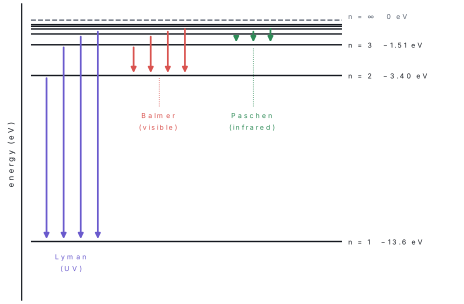
How many lines? When electrons in a sample of atoms fall from level n₂ to level n₁ by every possible route, the number of distinct lines is \Delta n(\Delta n + 1)/2 with \Delta n = n_2 - n_1; from level n to the ground state this is n(n-1)/2. A single atom can give at most n_2 - n_1 lines on one trip down.
Problem. Find the wavelength of the line emitted in the jump n = 4 → n = 2 in hydrogen.
Solution. Rydberg: 1/\lambda = 1.097\times10^{7}(1/4 - 1/16) = 1.097\times10^{7}\times0.1875 = 2.06\times10^{6} m⁻¹, so λ = 4.86 × 10⁻⁷ m = 486 nm (Hβ, blue-green). Energy route: ΔE = 3.40 − 0.85 = 2.55 eV, and λ = 1240/2.55 = 486 nm.
Problem. Electrons in a sample of hydrogen atoms are excited to n = 6. How many lines can appear in the emission spectrum, and how many of them belong to the Balmer series?
Solution. All lines: 6 × 5/2 = 15. Balmer lines end on n = 2 and can start from n = 3, 4, 5 or 6: 4 lines.
- The first line of a series is its longest wavelength (smallest energy gap, n_2 = n_1 + 1); the series limit (n_2 = \infty) is its shortest.
- For He⁺ or Li²⁺ multiply the wavenumber by Z² — not by Z.
- Wavelength is inversely proportional to (1/n_1^2 - 1/n_2^2): a ratio of wavelengths is the inverse ratio of these brackets. First Lyman : first Balmer = (5/36) : (3/4) = 5 : 27.
2.2 de Broglie's equation and Heisenberg's uncertainty principle
de Broglie's wave–particle duality (1924)
Light behaves both as a wave (diffraction) and as particles (photoelectric effect). de Broglie proposed that every moving particle also has a wave associated with it:
For an electron accelerated from rest through a potential difference of V volts, KE = eV, so λ ≈ 12.27/√V Å. Because λ ∝ 1/m, the wave is noticeable only for microscopic particles. Davisson and Germer (1927) confirmed it by diffracting electrons from a nickel crystal; the electron microscope uses the same idea.
Bohr's rule from waves. A stable orbit must hold a whole number of electron waves: 2\pi r = n\lambda = nh/mv, which rearranges to mvr = nh/2\pi — Bohr's postulate.
Problem. Find the de Broglie wavelength of (i) a 0.15 kg cricket ball bowled at 40 m s⁻¹, (ii) an electron moving at 2.18 × 10⁶ m s⁻¹ (m = 9.1 × 10⁻³¹ kg, h = 6.63 × 10⁻³⁴ J s).
Solution. (i) λ = 6.63 × 10⁻³⁴/(0.15 × 40) = 1.1 × 10⁻³⁴ m — hopelessly small to detect. (ii) λ = 6.63 × 10⁻³⁴/(9.1 × 10⁻³¹ × 2.18 × 10⁶) = 3.3 × 10⁻¹⁰ m, about the size of an atom — in fact equal to the circumference of the first Bohr orbit, 2π × 0.529 Å = 3.3 Å.
Heisenberg's uncertainty principle (1927)
It is impossible to determine simultaneously, with complete accuracy, both the position and the momentum (or velocity) of a microscopic particle such as an electron: \Delta x \cdot \Delta p \geq h/4\pi, that is \Delta x \cdot \Delta v \geq h/4\pi m.
The more exactly the position is fixed, the less exactly the momentum is known (and vice versa); if \Delta x = 0 then \Delta p would be infinite. A similar relation holds for energy and time, \Delta E \cdot \Delta t \geq h/4\pi. The uncertainty is not a fault of instruments — observing an electron needs a photon, which disturbs it. Consequence: a definite orbit (exact radius and exact speed together) has no meaning, so we speak only of the probability of finding an electron, i.e. of orbitals.
Problem. Find the minimum uncertainty in velocity of (i) an electron confined within 1.0 nm, (ii) a 10 g bullet whose position is known to within 1 μm. (m_e = 9.1 × 10⁻³¹ kg, h = 6.63 × 10⁻³⁴ J s)
Solution. Δv = h/(4π m Δx). (i) 6.63 × 10⁻³⁴/(4π × 9.1 × 10⁻³¹ × 1.0 × 10⁻⁹) = 5.8 × 10⁴ m s⁻¹ — large. (ii) 6.63 × 10⁻³⁴/(4π × 0.010 × 1.0 × 10⁻⁶) = 5.3 × 10⁻²⁷ m s⁻¹ — utterly negligible.
The bound is h/4\pi, not h and not h/2\pi — setters put all three values among the options. And the principle is about simultaneous measurement: position alone, or momentum alone, can be measured as precisely as you like.
2.3 Orbitals and quantum numbers; Aufbau, Pauli and Hund; electronic configuration
Orbit and orbital
| Orbit (Bohr) | Orbital (quantum mechanics) |
|---|---|
| a definite circular path round the nucleus | a three-dimensional region where the probability of finding the electron is maximum |
| two-dimensional, fixed radius | three-dimensional, with a shape (s, p, d, f) |
| violates the uncertainty principle | consistent with it |
| holds up to 2n² electrons | holds at most 2 electrons |
The four quantum numbers
| Quantum number | Symbol | Allowed values | Tells us |
|---|---|---|---|
| Principal | n | 1, 2, 3, … (K, L, M, N …) | shell; size and main energy |
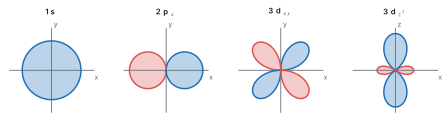
| Azimuthal (angular momentum) | l | 0 to (n − 1); 0 = s, 1 = p, 2 = d, 3 = f | subshell and shape |
| Magnetic | m (mₗ) | −l … 0 … +l, i.e. 2l + 1 values | orientation in space |
| Spin | s (mₛ) | +½ or −½ | direction of spin |
| Counting rule | Formula | Examples |
|---|---|---|
| Subshells in shell n | n | n = 3: 3s, 3p, 3d |
| Orbitals in a subshell | 2l + 1 | s 1, p 3, d 5, f 7 |
| Electrons in a subshell | 2(2l + 1) | s 2, p 6, d 10, f 14 |
| Orbitals in shell n | n² | n = 3: 9 |
| Electrons in shell n | 2n² | n = 3: 18 |
| Radial (spherical) nodes | n − l − 1 | 3s: 2; 3p: 1; 3d: 0; 4d: 1 |
| Angular nodes (nodal planes) | l | s 0, p 1, d 2 |
| Total nodes | n − 1 | 4f: 3 |
| Orbital angular momentum | √(l(l + 1)) · h/2π | s: 0; p: √2 · h/2π |
Subshells that do not exist — 1p, 2d and 3f — are favourite distractors: l must always be less than n.
Filling the orbitals: three rules
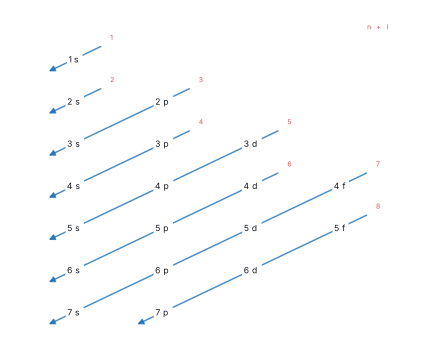
Aufbau principle. In the ground state electrons occupy orbitals in order of increasing energy. The order follows the (n + l) rule: the lower n + l fills first; if two subshells have equal n + l, the one with lower n fills first. Pauli's exclusion principle. No two electrons in an atom can have the same set of all four quantum numbers — so an orbital holds at most two electrons, with opposite spins. Hund's rule of maximum multiplicity. Electrons do not pair in degenerate orbitals (for example the three 2p) until each has one electron; the single electrons have parallel spins.
Electronic configurations, exceptions and ions
| Species | Configuration | Unpaired e⁻ |
|---|---|---|
| N (7) | 1s² 2s² 2p³ | 3 |
| O (8) | 1s² 2s² 2p⁴ | 2 |
| K (19) | [Ar] 4s¹ | 1 |
| Sc (21) | [Ar] 3d¹ 4s² | 1 |
| Cr (24) | [Ar] 3d⁵ 4s¹ (not 3d⁴ 4s²) | 6 |
| Mn (25) | [Ar] 3d⁵ 4s² | 5 |
| Fe (26) | [Ar] 3d⁶ 4s² | 4 |
| Cu (29) | [Ar] 3d¹⁰ 4s¹ (not 3d⁹ 4s²) | 1 |
| Zn (30) | [Ar] 3d¹⁰ 4s² | 0 |
| Fe²⁺ / Fe³⁺ | [Ar] 3d⁶ / [Ar] 3d⁵ | 4 / 5 |
| Cu⁺ / Cu²⁺ | [Ar] 3d¹⁰ / [Ar] 3d⁹ | 0 / 1 |
| Mn²⁺ / Cr³⁺ / Zn²⁺ | [Ar] 3d⁵ / [Ar] 3d³ / [Ar] 3d¹⁰ | 5 / 3 / 0 |
- Exceptions: Cr and Cu (also Mo 4d⁵ 5s¹, Ag 4d¹⁰ 5s¹, Au 5d¹⁰ 6s¹) take one 4s (ns) electron into the d subshell because half-filled (d⁵) and completely filled (d¹⁰) subshells are extra stable (symmetry and greater exchange energy).
- Ions: electrons are removed first from the shell of highest n — 4s before 3d, although 4s filled first. Fe²⁺ is [Ar] 3d⁶, not [Ar] 3d⁴ 4s². Fe³⁺ (d⁵) is more stable than Fe²⁺ (d⁶), which is why iron(II) salts are slowly oxidised in air.
- A species with unpaired electrons is paramagnetic (attracted by a magnet); with all electrons paired it is diamagnetic. Spin-only magnetic moment \mu = \sqrt{n(n+2)} BM for n unpaired electrons: Fe³⁺ (5) 5.92 BM, Cu²⁺ (1) 1.73 BM.
Problem. Write the configurations of Fe (Z = 26), Fe²⁺ and Fe³⁺ and give the number of unpaired electrons in each.
Solution. Fe: [Ar] 3d⁶ 4s². In the five 3d orbitals Hund's rule puts one electron in each and pairs the sixth: 4 unpaired. Fe²⁺: remove the two 4s electrons → [Ar] 3d⁶, 4 unpaired. Fe³⁺: remove one more from 3d → [Ar] 3d⁵, 5 unpaired (one in each d orbital).
"l below n, m within ±l, s only ±½." A set fails if l ≥ n (2, 2, …), if |m| > l (2, 1, −2, …) or if s is anything but ±½. Nodes: radial n − l − 1, angular l, total n − 1.
Formula and fact sheet
| Quantity | Formula / value |
|---|---|
| Bohr radius | r_n = 0.529\,n^2/Z Å |
| Bohr speed | v_n = 2.18\times10^{6}\,Z/n m s⁻¹ |
| Bohr energy | E_n = -13.6\,Z^2/n^2 eV = -2.18\times10^{-18}\,Z^2/n^2 J = -1312\,Z^2/n^2 kJ mol⁻¹ |
| KE and PE | KE = −E; PE = 2E; PE/KE = −2 |
| Angular momentum | mvr = nh/2\pi |
| Photon | E = h\nu = hc/\lambda; E (eV) = 1240/λ (nm); 1 eV = 1.6 × 10⁻¹⁹ J |
| Rydberg | 1/\lambda = R_H Z^2 (1/n_1^2 - 1/n_2^2), R_H = 1.097\times10^{7} m⁻¹ |
| Number of lines | \Delta n(\Delta n + 1)/2; to ground state n(n-1)/2 |
| de Broglie | \lambda = h/mv = h/p = h/\sqrt{2m\,KE}; electron through V volts: 12.27/√V Å |
| Heisenberg | \Delta x\cdot\Delta p \geq h/4\pi; \Delta x\cdot\Delta v \geq h/4\pi m |
| Orbitals and electrons | subshell 2l + 1 and 2(2l + 1); shell n² and 2n² |
| Nodes | radial n − l − 1; angular l; total n − 1 |
| Spin-only moment | \mu = \sqrt{n(n+2)} BM |
Ionisation energies: H 13.6 eV, He⁺ 54.4 eV, Li²⁺ 122.4 eV. Series: Lyman (n₁ = 1, UV), Balmer (2, visible), Paschen (3, IR), Brackett (4, IR), Pfund (5, far IR). Aufbau order: 1s 2s 2p 3s 3p 4s 3d 4p 5s 4d 5p 6s 4f 5d 6p 7s 5f 6d 7p. Exceptions: Cr 3d⁵ 4s¹, Cu 3d¹⁰ 4s¹.
Chapter summary
- Rutherford: most of the atom is empty; positive charge and mass sit in a nucleus about 10⁻¹⁵ m across. The model fails on stability and on line spectra.
- Bohr: stationary orbits with mvr = nh/2\pi; photons only on jumps, \Delta E = h\nu. For one-electron species r \propto n^2/Z, v \propto Z/n, E = -13.6\,Z^2/n^2 eV.
- Hydrogen lines obey 1/\lambda = R_H(1/n_1^2 - 1/n_2^2): Lyman (UV), Balmer (visible), Paschen, Brackett, Pfund (IR). A sample falling from level n gives n(n-1)/2 lines.
- de Broglie: \lambda = h/mv; significant only for tiny masses; 2\pi r = n\lambda gives Bohr's rule.
- Heisenberg: \Delta x\cdot\Delta p \geq h/4\pi, so orbits give way to orbitals (probability regions).
- Quantum numbers n, l (0 to n − 1), m (−l to +l), s (±½); radial nodes n − l − 1, angular nodes l.
- Aufbau by (n + l), Pauli (two electrons per orbital, opposite spins), Hund (no pairing until each degenerate orbital has one). Cr 3d⁵ 4s¹ and Cu 3d¹⁰ 4s¹; ions lose 4s before 3d.
Practice questions
Set A — Recall (20 questions)
- Rutherford's α-particle scattering experiment showed thataelectrons revolve in fixed circular orbitsbatoms are indivisiblecthe positive charge and most of the mass sit in a tiny nucleusdelectrons behave as waves
- Most α-particles passed through the gold foil without deflection. This showed thatamost of the atom is empty spacebthe nucleus is positively chargedcα-particles carry a positive chargedgold atoms are very heavy
- Rutherford's nuclear model could NOT explainathe large-angle scattering of α-particlesbthe existence of a small, dense nucleuscwhy most α-particles pass straight throughdthe stability of the atom and its line spectrum
- According to Bohr, the angular momentum of an electron in the nth orbit isanh/\pibnh/2\pich/2\pi ndn^2h/2\pi
- The energy of the electron in the ground state of the hydrogen atom isa−13.6 eVb+13.6 eVc−3.4 eVd0 eV
- The radius of the first Bohr orbit of hydrogen is abouta0.529 nmb1.058 Åc0.529 Åd2.116 Å
- The Balmer series of the hydrogen spectrum lies mainly in theaultraviolet regionbinfrared regioncmicrowave regiondvisible region
- The lines of the Lyman series are produced by electron transitions ending atan = 2bn = 1cn = 3dn = ∞
- de Broglie's equation for a particle of mass m moving with speed v isaλ = mv/hbλ = h/mvcλ = hv/mdλ = hm/v
- Heisenberg's uncertainty principle is written asaΔx · Δp = 0bΔx · Δp ≤ h/4πcΔx · Δp ≥ h/4πdΔx/Δp ≥ h/4π
- The uncertainty principle is of practical importance only foramicroscopic particles such as electronsbheavy bodies such as a cricket ballcbodies at restdcharged bodies of any size
- The maximum number of electrons in a shell of principal quantum number n isan²b2nc2l + 1d2n²
- For l = 2, the number of allowed values of the magnetic quantum number isa2b3c5d7
- The shape of an orbital is decided by theaprincipal quantum numberbazimuthal quantum numbercmagnetic quantum numberdspin quantum number
- "No two electrons in an atom can have the same set of all four quantum numbers." This isaHund's rulebthe Aufbau principlecHeisenberg's principledPauli's exclusion principle
- Hund's rule of maximum multiplicity states thataelectrons pair in degenerate orbitals only after each has onebelectrons fill orbitals in order of increasing energycan orbital holds at most two electronsdelectrons of opposite spin attract each other
- The shape of a p orbital isasphericalbdumbbellccloverleafdring-shaped
- The ground-state electronic configuration of chromium (Z = 24) isa[Ar] 3d⁴ 4s²b[Ar] 3d⁶c[Ar] 3d³ 4s² 4p¹d[Ar] 3d⁵ 4s¹
- By the Aufbau principle, the subshell filled immediately after 4s isa4pb4dc3dd5s
- The total number of orbitals in the shell with n = 3 isa9b3c6d18
Answers and explanations — Set A
1. (c) — Large-angle deflections and rebounds need a small, massive, positive centre: the nucleus. Fixed orbits (a) are Bohr's idea; wave behaviour (d) is de Broglie's.
2. (a) — An undeflected particle met nothing on its way, so most of the atom is empty space. Option (b) follows from the deflected particles, not the undeflected ones.
3. (d) — A revolving electron should radiate, spiral into the nucleus and give a continuous spectrum; the model explains (a), (b) and (c).
4. (b) — Bohr's quantum condition mvr = nh/2π. The other forms are distortions of it.
5. (a) — E₁ = −13.6 eV; the negative sign shows a bound electron. −3.4 eV is the n = 2 level.
6. (c) — r₁ = 0.529 Å = 0.0529 nm. (a) has the right digits but the wrong unit; 2.116 Å is n = 2.
7. (d) — n₁ = 2: its first four lines (656, 486, 434, 410 nm) are visible. Lyman is ultraviolet; Paschen, Brackett and Pfund are infrared.
8. (b) — Lyman lines end on n = 1, Balmer on 2, Paschen on 3.
9. (b) — λ = h/mv = h/p: wavelength is inversely proportional to momentum.
10. (c) — The product of the uncertainties can never be smaller than h/4π.
11. (a) — For an electron the uncertainty is comparable to atomic sizes and speeds; for heavy bodies it is immeasurably small.
12. (d) — 2n² (2, 8, 18, 32). n² is the number of orbitals; 2l + 1 counts orbitals in one subshell.
13. (c) — m runs from −2 to +2: −2, −1, 0, +1, +2, five values (five d orbitals).
14. (b) — l fixes the shape (s, p, d, f); n fixes size and energy, m the orientation, s the spin.
15. (d) — Pauli's principle; it limits an orbital to two electrons of opposite spin.
16. (a) — Degenerate orbitals are first singly occupied with parallel spins; (b) is Aufbau and (c) follows from Pauli.
17. (b) — Two lobes on opposite sides of a nodal plane; s is spherical and most d orbitals are cloverleaf-shaped.
18. (d) — The half-filled 3d⁵ subshell is extra stable, so one 4s electron moves into 3d.
19. (c) — 4s has n + l = 4; 3d, 4p and 5s all have 5, and among them 3d has the lowest n.
20. (a) — n² = 9 orbitals (one 3s, three 3p, five 3d). 18 is the number of electrons.
Set B — Understanding (14 questions)
- The radii of the first three Bohr orbits of hydrogen are in the ratioa1 : 2 : 3b1 : 4 : 9c1 : 8 : 27d1 : 1/2 : 1/3
- As n increases, the energy gap between successive Bohr orbits of hydrogenaincreasesbremains constantcfirst increases, then decreasesddecreases
- In Bohr's model the speed of the electron is proportional toaZ/nbn/Zcn²dZ²/n²
- The total energy of an electron in a hydrogen orbit is −3.4 eV. Its kinetic and potential energies are respectivelya−3.4 eV and +6.8 eVb+6.8 eV and −3.4 eVc+3.4 eV and −6.8 eVd+3.4 eV and −3.4 eV
- An electron and a proton have the same de Broglie wavelength. They must have the sameaspeedbkinetic energycmomentumdtotal energy
- Which set of quantum numbers (n, l, m, s) is NOT allowed?a2, 2, 1, +½b2, 1, 0, +½c3, 2, −2, −½d4, 0, 0, −½
- An electron with n = 3 and l = 1 is in aa3s orbitalb3d orbitalc4p orbitald3p orbital
- The number of unpaired electrons in Fe³⁺ (Z = 26) isa3b5c4d6
- The electronic configuration of Cu²⁺ (Z = 29) isa[Ar] 3d⁹b[Ar] 3d⁸ 4s¹c[Ar] 3d¹⁰d[Ar] 3d⁷ 4s²
- In a many-electron atom, which of these subshells has the highest energy?a4sb3dc4pd5s
- The number of radial nodes in a 4d orbital isa0b2c1d3
- Writing nitrogen as 1s² 2s² 2pₓ² 2pᵧ¹, with 2p_z empty, violatesathe Aufbau principlebHund's rulecPauli's exclusion principledthe (n + l) rule
- Bohr's idea of a fixed circular orbit is rejected today mainly becauseait fixes position and momentum together, which uncertainty forbidsbelectrons have no masscthe nucleus is not positively chargeddhydrogen gives a continuous spectrum
- Bohr's quantum condition follows from de Broglie's idea if the circumference of an allowed orbit equalsaλ/nbnλ/2c2nλdnλ
Answers and explanations — Set B
1. (b) — r ∝ n², so 1² : 2² : 3² = 1 : 4 : 9.
2. (d) — E ∝ −1/n², so the levels crowd together: 1→2 is 10.2 eV but 2→3 only 1.89 eV and 3→4 0.66 eV.
3. (a) — v = 2.18 × 10⁶ Z/n m s⁻¹: faster for a larger nuclear charge, slower in outer orbits. n²/Z is the radius dependence.
4. (c) — KE = −E = +3.4 eV and PE = 2E = −6.8 eV; check KE + PE = −3.4 eV.
5. (c) — λ = h/p, so equal wavelengths mean equal momenta. With different masses their speeds and kinetic energies (p²/2m) differ.
6. (a) — For n = 2, l can only be 0 or 1. The other sets obey l < n, |m| ≤ l and s = ±½.
7. (d) — n = 3 is the third shell and l = 1 is a p subshell: 3p.
8. (b) — Fe³⁺ = [Ar] 3d⁵: one electron in each of the five d orbitals.
9. (a) — Cu is [Ar] 3d¹⁰ 4s¹; remove the 4s electron, then one 3d electron: [Ar] 3d⁹.
10. (d) — n + l: 4s = 4, 3d = 5, 4p = 5, 5s = 5. For equal n + l the higher n has the higher energy, so 5s.
11. (c) — Radial nodes = n − l − 1 = 4 − 2 − 1 = 1. The 4d orbital also has 2 angular nodes, 3 nodes in all.
12. (b) — The 2p orbitals are degenerate; pairing in 2pₓ while 2p_z is empty breaks Hund's rule. No orbital holds more than two electrons, so Pauli is obeyed.
13. (a) — An orbit means an exact radius and an exact speed at the same time, which Heisenberg's principle rules out.
14. (d) — 2πr = nλ = nh/mv rearranges to mvr = nh/2π.
Set C — Application (11 questions)
- The wavelength of the line emitted when the electron of a hydrogen atom falls from n = 3 to n = 2 is (R_H = 1.097 × 10⁷ m⁻¹)a656 nmb486 nmc122 nmd1875 nm
- The ratio of the wavelength of the first line of the Lyman series to that of the first line of the Balmer series isa27 : 5b3 : 4c5 : 27d4 : 9
- The energy needed to remove the electron from He⁺ in its ground state isa13.6 eVb54.4 eVc27.2 eVd122.4 eV
- The de Broglie wavelength of an electron moving at 1.0 × 10⁶ m s⁻¹ is (m = 9.1 × 10⁻³¹ kg, h = 6.63 × 10⁻³⁴ J s)a7.3 × 10⁻¹² mb1.4 × 10⁻⁹ mc7.3 × 10⁻⁸ md7.3 × 10⁻¹⁰ m
- The position of an electron is known to within 1.0 × 10⁻¹⁰ m. The minimum uncertainty in its velocity is (m = 9.1 × 10⁻³¹ kg, h = 6.63 × 10⁻³⁴ J s)a7.3 × 10⁶ m s⁻¹b1.2 × 10⁶ m s⁻¹c5.8 × 10⁵ m s⁻¹d5.8 × 10³ m s⁻¹
- The radius of the second Bohr orbit of He⁺ is (radius of the first orbit of hydrogen = 0.529 Å)a1.058 Åb0.529 Åc2.116 Åd0.265 Å
- Electrons in a sample of hydrogen atoms fall from n = 5 to n = 2 by all possible routes. The number of different spectral lines isa3b6c10d4
- The number of electrons with l = 2 in an atom of iron (Z = 26) isa2b8c12d6
- The wavelength of the series limit of the Balmer series of hydrogen is (R_H = 1.097 × 10⁷ m⁻¹)a91.2 nmb656 nmc365 nmd820 nm
- The energy of a photon of wavelength 663 nm is (h = 6.63 × 10⁻³⁴ J s, c = 3.0 × 10⁸ m s⁻¹)a3.0 × 10⁻¹⁸ Jb3.0 × 10⁻¹⁹ Jc1.5 × 10⁻¹⁹ Jd3.0 × 10⁻²⁸ J
- The ratio of the energy of the electron in the second orbit of hydrogen to that in the third orbit of Li²⁺ isa1 : 4b4 : 1c1 : 9d9 : 4
Answers and explanations — Set C
1. (a) — 1/λ = R(1/4 − 1/9) = 5R/36, so λ = 36/(5 × 1.097 × 10⁷) = 6.56 × 10⁻⁷ m = 656 nm (Hα). 486 nm is 4 → 2; 122 nm is 2 → 1; 1875 nm is 4 → 3.
2. (c) — λ ∝ 1/(1/n₁² − 1/n₂²): Lyman (2 → 1) bracket 3/4, Balmer (3 → 2) bracket 5/36; λ_L : λ_B = (5/36) : (3/4) = 5 : 27.
3. (b) — IE = 13.6 Z² = 13.6 × 4 = 54.4 eV. Option (c) multiplies by Z instead of Z²; (d) is Li²⁺ (Z = 3).
4. (d) — λ = h/mv = 6.63 × 10⁻³⁴/(9.1 × 10⁻³¹ × 1.0 × 10⁶) = 7.3 × 10⁻¹⁰ m (about 7 Å).
5. (c) — Δv = h/(4πmΔx) = 6.63 × 10⁻³⁴/(4π × 9.1 × 10⁻³¹ × 10⁻¹⁰) = 5.8 × 10⁵ m s⁻¹. (a) omits 4π; (b) uses h/2π.
6. (a) — r = 0.529 × n²/Z = 0.529 × 4/2 = 1.058 Å. (c) forgets Z (hydrogen's n = 2); (d) is He⁺ n = 1.
7. (b) — Δn = 3, lines = Δn(Δn + 1)/2 = 3 × 4/2 = 6 (5→4, 5→3, 5→2, 4→3, 4→2, 3→2). A single atom gives at most 3; 10 lines would need a fall to n = 1.
8. (d) — Fe: 1s² 2s² 2p⁶ 3s² 3p⁶ 3d⁶ 4s². l = 2 means d electrons: 6. Option (c) counts the p electrons (l = 1).
9. (c) — For n₂ = ∞, 1/λ = R/4, so λ = 4/R = 3.65 × 10⁻⁷ m ≈ 365 nm. 91.2 nm is the Lyman limit and 820 nm the Paschen limit.
10. (b) — E = hc/λ = 6.63 × 10⁻³⁴ × 3.0 × 10⁸/(663 × 10⁻⁹) = 3.0 × 10⁻¹⁹ J (≈ 1.9 eV). Option (d) forgets to convert nm to m.
11. (a) — E ∝ Z²/n²: hydrogen n = 2 gives 1/4; Li²⁺ n = 3 gives 9/9 = 1. Ratio 1/4 : 1 = 1 : 4 (−3.4 eV against −13.6 eV).