Chapter 16 · Organic Chemistry · 3 questions in the paper · 29 min read
General Organic Chemistry
What the syllabus asks for 3
- Tetravalency and catenation of carbon; classification of organic compounds; alkyl and aryl groups; functional groups and homologous series
- IUPAC nomenclature of aliphatic compounds; isomerism
- Homolytic and heterolytic fission; electrophiles, nucleophiles, carbocations, carbanions and free radicals; inductive and resonance effects
Organic chemistry becomes manageable when you stop memorizing molecules one at a time and start reading their architecture. This chapter, worth about 3 questions, supplies that grammar: how carbon builds frameworks, how functional groups create families, how IUPAC names encode structure, how the same formula can represent different substances, and how electrons move when bonds break. These ideas decide nearly every mechanism in Chapters 17–20.
- Carbon is tetravalent (four covalent bonds in neutral compounds) and strongly catenating: it links to itself in long chains, branches and rings, using single, double and triple bonds.
- A functional group is the reactive atom or bond pattern defining a family. A homologous series has the same functional group and general formula, with successive members differing by CH₂ (14 mass units).
- Remove H from an alkane to get an alkyl group (CH₃–, C₂H₅–). Remove H from an arene ring to get an aryl group (phenyl, C₆H₅–). Benzyl (C₆H₅CH₂–) is an aralkyl group, not an aryl group.
- Count unsaturation before drawing isomers: degree of unsaturation = (2C + 2 + N - H - X)/2. Each ring or π bond contributes one; a triple bond contributes two. Oxygen does not enter the formula.
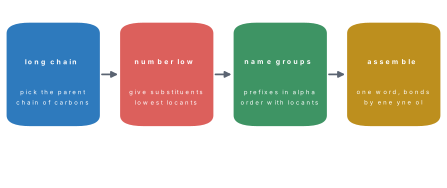
- IUPAC naming: identify the senior functional group, choose the parent chain containing it (and maximum multiple bonds), number for lowest locants, then cite substituents alphabetically. Principal-group order for school work: acid > anhydride > ester > acid halide > amide > nitrile > aldehyde > ketone > alcohol > amine > alkene > alkyne.
- Structural isomers differ in connectivity: chain, position, functional-group, metamerism and tautomerism. Stereoisomers have the same connectivity but different spatial arrangement: geometrical (cis/trans or E/Z) and optical isomerism are the school forms.
- A carbon carrying four different groups is normally a stereogenic/chiral centre. Enantiomers are non-superimposable mirror images; diastereomers are stereoisomers that are not mirror images; a meso compound is achiral through internal symmetry despite stereocentres.
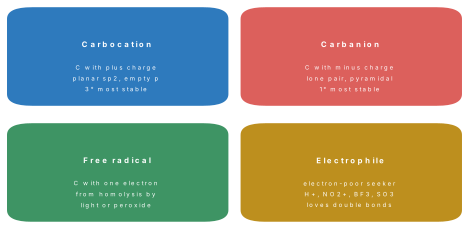
- Homolysis splits a bond one electron to each atom and gives free radicals (fishhook arrows). Heterolysis sends both electrons to one atom and gives ions (double-headed curly arrow).
- Carbocation stability generally increases methyl → 1° → 2° → 3°, and allylic/benzylic resonance gives extra stabilization. Simple alkyl carbanions show the reverse substitution trend. Free radicals broadly follow the carbocation order.
- An electrophile accepts an electron pair; a nucleophile donates one. Carbocations are electrophiles, carbanions are nucleophiles.
- The inductive effect is permanent σ-electron displacement toward a more electronegative atom/group (−I) or away from a donor (+I), weakening rapidly with distance. Resonance delocalizes π electrons or a lone pair over a conjugated system; the true structure is the hybrid, not a mixture flickering between drawings.
16.1 Tetravalency and catenation; classification; alkyl and aryl groups; functional groups and homologous series
Carbon has four valence electrons. In ordinary neutral organic compounds it shares four pairs of electrons, acquiring an octet while retaining a formal charge of zero. The four bonds may be arranged as four single bonds (tetrahedral, sp³), a double and two single bonds (trigonal planar, sp²), or a triple and one single bond/two double bonds (linear, sp). Charged carbon is the deliberate exception encountered later in the chapter: a carbocation has three bonds and an empty p orbital; a carbanion has three bonds and a lone pair.
Catenation is self-linking. It is exceptionally strong in carbon because the small atom forms strong C–C and C–H bonds and can also use p orbitals effectively in multiple bonds. Chains can branch, close into rings and support many functional groups. Silicon sits below carbon but forms weaker Si–Si bonds and much stronger Si–O bonds, so silicon chemistry flows toward silicate networks rather than an equally rich family of discrete Si-chain molecules.
Classification by carbon skeleton
| Class | Meaning | Examples |
|---|---|---|
| Acyclic/aliphatic | Open chain, straight or branched | butane, 2-methylpropane, but-2-ene |
| Alicyclic | Ring with broadly aliphatic behaviour | cyclopropane, cyclohexane |
| Aromatic | Cyclic conjugated system with special stability; benzene is the prototype | benzene, phenol, aniline |
| Heterocyclic | Ring contains an atom other than carbon | furan (O in ring), pyridine (N in ring), thiophene (S in ring) |
Compounds are also called saturated when the carbon framework has only single bonds and unsaturated when it contains a double bond, triple bond or ring equivalent. A ring creates the same hydrogen deficiency as one π bond even though cycloalkanes do not behave like alkenes in addition reactions.
Alkyl, aryl and related groups
A group obtained by removing one hydrogen from an alkane is an alkyl group, general formula CₙH₂ₙ₊₁–: methyl CH₃– (from methane), ethyl CH₃CH₂–, propyl CH₃CH₂CH₂– and propan-2-yl/isopropyl (CH₃)₂CH–. The atom bearing the free valence dictates names such as butan-2-yl. Carbon atoms are described as 1°, 2°, 3° or 4° according to how many other carbons are attached to them; alcohols and alkyl halides are similarly classified by the carbon carrying –OH or halogen.
An aryl group is formed by removing hydrogen directly from an aromatic ring. Phenyl is C₆H₅–; a methylphenyl group is tolyl. By contrast, C₆H₅CH₂– is benzyl: its free valence is on a saturated carbon next to the ring, making it an aralkyl group. This distinction matters in reactivity — a benzylic carbocation or radical is resonance-stabilized through the benzylic carbon, whereas a phenyl cation has its empty orbital in the ring plane and is very unstable. Two other pattern names recur: vinyl, CH₂=CH–, and allyl, CH₂=CH–CH₂–.
Functional groups and homologous series
The carbon skeleton is the stage; the functional group is usually where the action occurs. Members of one family therefore have similar chemistry, while physical properties change gradually as the hydrocarbon part grows.
| Family | Functional pattern | Typical suffix/prefix | Example |
|---|---|---|---|
| Alkane | C–C, C–H only | -ane | propane |
| Alkene | C=C | -ene | but-2-ene |
| Alkyne | C≡C | -yne | pent-1-yne |
| Alcohol | –OH on carbon | -ol / hydroxy- | propan-2-ol |
| Ether | C–O–C | alkoxy- (or ether name) | methoxyethane |
| Aldehyde | –CHO, terminal carbonyl | -al / oxo- | butanal |
| Ketone | C–CO–C | -one / oxo- | pentan-3-one |
| Carboxylic acid | –CO₂H | -oic acid | ethanoic acid |
| Ester | –CO₂R | alkyl …-oate | methyl ethanoate |
| Acid halide | –COX | -oyl halide | ethanoyl chloride |
| Amide | –CONH₂ or substituted | -amide | ethanamide |
| Nitrile | –C≡N | -nitrile / cyano- | propanenitrile |
| Amine | –NH₂, –NHR, –NR₂ | -amine / amino- | ethanamine |
| Haloalkane | C–F/Cl/Br/I | halo- prefix | 2-bromobutane |
| Nitro compound | –NO₂ | nitro- prefix | nitroethane |
A homologous series shares a general formula and functional group, has a common method of preparation, shows similar chemical reactions and displays gradual changes in melting point, boiling point, density and solubility. Adjacent members differ by –CH₂–. Useful general formulae for acyclic compounds are:
| Series | General formula | Also fits |
|---|---|---|
| Alkanes | CₙH₂ₙ₊₂ | — |
| Alkenes | CₙH₂ₙ | cycloalkanes |
| Alkynes | CₙH₂ₙ₋₂ | dienes, cycloalkenes |
| Monohydric alcohols/ethers | CₙH₂ₙ₊₂O | each other (functional isomers) |
| Aldehydes/ketones | CₙH₂ₙO | each other |
| Carboxylic acids/esters | CₙH₂ₙO₂ | each other |
The degree of unsaturation (DU, also index of hydrogen deficiency) packs that comparison into one calculation:
Halogen X is counted as hydrogen because both are monovalent; nitrogen adds one available hydrogen equivalent; divalent oxygen or sulfur does not alter the count. Benzene, C₆H₆, has DU = 4 — one ring plus three π bonds. DU never tells you which rings or π bonds are present, but it prevents impossible structures when enumerating isomers.
Problem. (a) Name (CH₃)₂CH–CH₂–CH(CH₃)–CH₃ by IUPAC. (b) How many structural isomers does C₄H₉Br have? (c) Count σ and π bonds in CH₂=CH–C≡CH. Solution. (a) The longest chain holds five carbons with methyls at C2 and C4: 2,4-dimethylpentane. (b) The butyl skeleton offers four carbon environments — 1-bromo-, 2-bromo-, 1-bromo-2-methylpropane and 2-bromo-2-methylpropane: 4 isomers. (c) Vinylacetylene: four C–H σ bonds plus three C–C σ bonds = 7 σ; one double bond (1 π) plus one triple bond (2 π) = 3 π. Naming, counting and bookkeeping: the chapter's three exam verbs.
16.2 IUPAC nomenclature of aliphatic compounds and isomerism
A reliable four-pass naming routine
- Seniority pass. Find the principal functional group. It decides the suffix and should be included in the parent chain. The carbon of –COOH, –CHO or –CN is counted in the chain.
- Parent pass. Choose the longest continuous carbon chain containing the principal group; if there is a tie, prefer the chain with more multiple bonds, then more substituents.
- Numbering pass. Give the principal group the lowest possible locant. Next consider multiple bonds (for an enyne, the direction giving the lower locant to the first cited multiple bond, normally the alkene), then substituents as a set. If a set is tied, give the lower locant to the substituent cited first alphabetically.
- Assembly pass. Write substituents alphabetically with locants, ignoring multiplicative prefixes such as di- and tri- in alphabetization. Separate numbers with commas and numbers from words with hyphens: 3-ethyl-2,4-dimethylhexane.
When a lower-priority group is present it becomes a prefix: –OH is hydroxy- in the presence of a ketone, C=O is oxo- in the presence of a carboxylic acid, –NH₂ is amino-, –OR is alkoxy-, and halogens and –NO₂ are always prefixes in substitutive names. The parent chain name drops its terminal “e” before a vowel-starting suffix (pentan-2-one), while locants for unsaturation are placed immediately before -ene or -yne in modern format (but-2-ene, pent-1-yne).
Problem. Name CH₃–C(CH₃)₂–CH₂–CHO and calculate its degree of unsaturation.
Solution. The aldehyde carbon must be C-1. Numbering from –CHO gives CHO = C1, CH₂ = C2, the substituted carbon = C3 and one methyl carbon completes a four-carbon butanal parent. Two additional methyl groups sit on C3, so the name is 3,3-dimethylbutanal. Its molecular formula is C₆H₁₂O. Hence DU = (2×6 + 2 − 12)/2 = 1, accounted for by C=O. The trap is to call the branched left-hand end “tert-butyl” and lose the requirement that the aldehyde carbon begins the parent chain.
Isomerism: same formula, different substance
Isomers have the same molecular formula but different structures and therefore at least some different properties. First ask whether atom-to-atom connections differ.
Structural (constitutional) isomerism
- Chain isomerism: different carbon skeleton. C₄H₁₀ is CH₃CH₂CH₂CH₃ (butane) or (CH₃)₃CH (2-methylpropane).
- Position isomerism: same skeleton and functional group at a different position. Butan-1-ol and butan-2-ol; but-1-ene and but-2-ene.
- Functional-group isomerism: different functional family. C₂H₆O is ethanol or methoxymethane; C₃H₆O is propanal or propanone.
- Metamerism: different alkyl groups flank a polyvalent functional atom/group, as in ethoxyethane versus 1-methoxypropane (both C₄H₁₀O), or different substitution patterns around a ketone/secondary amine.
- Tautomerism: rapidly interconverting structural isomers differing chiefly in position of a proton and a π bond, classically keto ⇌ enol. For simple ketones the keto form dominates overwhelmingly. Tautomers are distinct chemical species in equilibrium; resonance forms are not.
Useful alkane counts are C₄H₁₀ = 2, C₅H₁₂ = 3, C₆H₁₄ = 5 and C₇H₁₆ = 9 structural isomers. When counting substituted compounds, work skeleton by skeleton and mark symmetry-equivalent positions only once.
Stereoisomerism
Geometrical isomerism occurs when rotation is restricted — most often about C=C, but also in some rings. Each alkene carbon must carry two different substituents. In but-2-ene, cis has the two CH₃ groups on the same side and trans has them opposite. When all four substituents are different, cis/trans language has no clear reference pair; the E/Z system assigns priority to the two groups on each carbon by atomic number (Cahn–Ingold–Prelog rules). High-priority groups on the same side give Z (zusammen, together); opposite sides give E (entgegen, opposite).
Optical isomerism is the school label for chirality at stereogenic centres. A tetrahedral carbon attached to four different groups lacks a symmetry plane through that arrangement and exists as two enantiomers. Enantiomers rotate plane-polarized light by equal magnitudes in opposite directions and have identical melting points, boiling points and spectra in achiral environments. In a chiral environment — an enzyme pocket, receptor or chiral reagent — they can behave very differently, which is why drug stereochemistry matters. An equal mixture is a racemate and shows no net rotation (external compensation).
Stereoisomers that are not mirror images are diastereomers; they generally have different physical properties and can be separated by ordinary crystallization or chromatography. A meso compound contains stereocentres but also an internal symmetry element, so the molecule is superposable on its mirror image and optically inactive (internal compensation). Thus “has two stereocentres” does not automatically mean “has four optically active forms”. Likewise, R/S is a configuration label assigned from viewing priorities; it does not by itself predict whether rotation is (+) or (−).
Identical drawings produced by turning the paper over are not new isomers, and resonance forms are not isomers. Conversely, a chiral constitutional isomer represents a pair of enantiomers when a question asks for total stereoisomers. Always check whether the wording says structural, stereoisomers or optically active forms.
16.3 Bond fission, reactive intermediates and electronic effects
Homolytic and heterolytic fission
A covalent bond contains two electrons, so there are only two ways to divide them.
| Feature | Homolysis | Heterolysis |
|---|---|---|
| Electron division | One electron to each fragment | Both electrons to one fragment |
| Products | Two free radicals | A cation and an anion |
| Arrow | Single-barbed “fishhook” arrow | Double-barbed curly arrow |
| Favoured by | Heat, UV light, peroxides; nonpolar/gas-phase conditions | Polar solvents and polarized bonds; stable ions |
| Typical chemistry | Radical chain substitution, combustion | Ionic substitution, elimination and addition mechanisms |
For A–B heterolysis, the electron pair normally follows the more electronegative atom. In (CH₃)₃C–Br, heterolysis gives (CH₃)₃C⁺ + Br⁻; in aqueous solvent the ions are solvated and the tertiary carbocation is relatively stable. Homolysis of the same bond would give (CH₃)₃C• + Br•.
Problem. tert-Butyl bromide reacts rapidly with aqueous NaOH. Which fission begins the reaction, and which species attacks which?
Solution. Water is polar and Br is more electronegative than carbon, so heterolysis is favoured: the C–Br pair moves to Br, producing the tertiary carbocation (CH₃)₃C⁺ and Br⁻. The carbocation is the electron-pair acceptor (electrophile). Hydroxide, with lone pairs, is the electron-pair donor (nucleophile) and attacks it. UV-driven homolysis to two radicals tells a different story and is not the script under aqueous ionic conditions.
Carbocations, carbanions and free radicals
| Intermediate | Carbon electrons/geometry | Stability pattern | Usual reactivity |
|---|---|---|---|
| Carbocation, C⁺ | 6 valence electrons; usually planar sp² with empty p orbital | 3° > 2° > 1° > methyl; allyl/benzyl resonance strongly stabilizing | Electrophile; rearranges by hydride/alkyl shift if a better cation can form |
| Free radical, C• | 7 valence electrons; near-planar at carbon; one unpaired electron | Benzyl/allyl and 3° > 2° > 1° > methyl (context dependent) | Abstracts atoms, adds to π bonds, combines with another radical |
| Carbanion, C⁻ | 8 valence electrons; lone pair, often pyramidal unless resonance flattens it | Methyl > 1° > 2° > 3° for alkyl substitution; resonance and −I/−R groups stabilize | Nucleophile and strong base |
Why are tertiary carbocations and radicals relatively stable? Neighbouring C–H/C–C σ bonds can donate electron density into the empty or half-filled p orbital (hyperconjugation), and alkyl groups exert a weak electron-releasing inductive effect. A positive charge or unpaired electron is spread over a larger region. In a carbanion, alkyl donation pushes still more electron density onto an already negative carbon and destabilizes it; electron-withdrawing and resonance-accepting groups (carbonyl, nitrile, nitro) stabilize carbanions by dispersal.
Electrophiles and nucleophiles
An electrophile (“electron-pair loving”, despite acting as an acceptor) is electron-poor: H⁺, NO₂⁺, Br⁺ equivalents, BF₃, AlCl₃, carbocations and the δ+ carbon of a carbonyl or alkyl halide. A nucleophile has an electron pair available: OH⁻, CN⁻, halide ions, NH₃, H₂O, thiolates, carbanions and the π electrons of an alkene/arene. The curly arrow always starts at the nucleophile's electron pair (or a bond) and points to the electrophilic atom/bond — never the reverse.
Basicity and nucleophilicity are not synonyms. Basicity is an equilibrium affinity for a proton; nucleophilicity is a rate of attack at an electrophilic atom, often carbon. Solvent, size and polarizability matter. In protic solvents, larger and less strongly solvated I⁻ is generally more nucleophilic than F⁻ even though F⁻ is more basic. A bulky base such as tert-butoxide can remove a proton yet be a poor nucleophile at crowded carbon.
Inductive effect: a σ-bond tug that fades with distance
If X is more electronegative than carbon in C–X, the bonding electrons sit closer to X. That polarity is relayed weakly through adjacent σ bonds. Electron-withdrawing groups have a −I effect: –NO₂, –CN, –COOH, carbonyl groups and halogens, with halogen order F > Cl > Br > I. Electron-releasing alkyl groups have a modest +I effect relative to hydrogen, increasing roughly tert-butyl > isopropyl > ethyl > methyl. The effect is permanent but becomes small after about three bonds.
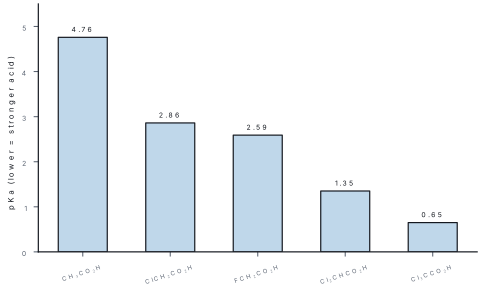
This explains carboxylic-acid strength. A −I substituent stabilizes the negatively charged carboxylate ion and pulls the acid equilibrium toward ionization. One chlorine near the acid increases strength, more chlorines increase it further, and moving chlorine farther away weakens the effect. Conversely, +I alkyl groups destabilize a nearby carboxylate slightly and make a carbocation slightly more stable.
Resonance: delocalization through a conjugated π system
Resonance appears when π electrons or a lone pair can overlap through adjacent p orbitals: π–π conjugation in butadiene/benzene, lone pair–π conjugation in phenoxide or an amide, and π–empty-p overlap in an allyl cation. Only electrons move in resonance drawings; atomic nuclei and σ frameworks stay fixed. Each drawing is a contributing structure, and the actual molecule is a lower-energy hybrid with fractional bond orders. Equivalent contributors contribute equally — acetate has two equivalent C–O bonds, benzene has six equal C–C bonds.
A group that donates π/lone-pair density into a conjugated system has a +R (or +M) effect: –NH₂, –OH, –OR and halogens (although halogens are simultaneously −I). A group that withdraws by π conjugation has a −R effect: –NO₂, –CN, –CHO, –COR and –CO₂H when conjugated with the system. Resonance requires orbital alignment; twisting a π system out of coplanarity reduces it.
High-yield consequences are best read from the ion or molecule left after reaction:
- Phenol is more acidic than ethanol because phenoxide is resonance-stabilized by the ring, whereas ethoxide localizes negative charge on oxygen.
- Aniline is a weaker base than an alkylamine because nitrogen's lone pair is delocalized into the benzene ring and less available to bind H⁺.
- Carboxylate is stabilized by two equivalent resonance forms, one reason carboxylic acids are far more acidic than alcohols.
- Amide nitrogen is weakly basic and the C–N bond has partial double-bond character because the nitrogen lone pair conjugates with C=O; this is the electronic basis of the planar peptide bond.
- Allyl and benzyl cations/radicals disperse charge or spin over several carbons and form more readily than ordinary primary systems.
| Effect | Path | Distance behaviour | Needs π system? | Classic readout |
|---|---|---|---|---|
| Inductive | Through σ bonds | Falls rapidly with each bond | No | Chloroacetic-acid strengths |
| Resonance | Through overlapping p orbitals | Can extend across the conjugated system | Yes (or adjacent p/lone pair) | Phenol acidity, aniline basicity |
| Hyperconjugation | Neighbouring σ(C–H/C–C) → p/π* | Immediate neighbour | Needs adjacent p/π system | Carbocation and alkene stability |
Positive centre? Ask what donates (+I, hyperconjugation, +R). Negative centre? Ask what withdraws or delocalizes (−I, −R). Radical? Donation and delocalization both help. That one question unlocks most order-of-stability items.
Five swaps the paper sets: lowest locants beat alphabetical order — number first for smallest locant set, then alphabetise prefixes; tautomerism is not resonance — tautomers move a proton and are distinct compounds in equilibrium, resonance moves only electrons within one compound; carbanion stability reverses the cation order because alkyl groups donate into an already negative carbon; inductive effects travel σ bonds and fade within a few carbons, resonance travels π systems across the whole molecule; and phenyl (C₆H₅) is not benzyl (C₆H₅CH₂) — one carbon's difference, a different compound family.
Formula and fact sheet
| Topic | Must-know |
|---|---|
| Carbon framework | Tetravalent, catenating; chains/branches/rings; single/multiple bonds |
| Group names | Alkyl CₙH₂ₙ₊₁–; phenyl C₆H₅– is aryl; benzyl C₆H₅CH₂– is aralkyl |
| Homologues | Same functional group/general formula; differ by CH₂ (14 u) |
| Unsaturation | DU = (2C + 2 + N − H − X)/2; O ignored |
| IUPAC | Senior group → parent chain → lowest locants → alphabetical substituents |
| Isomer map | Structural: chain/position/functional/metamer/tautomer. Stereo: geometrical/optical |
| Chirality | Enantiomers = mirror pair; racemate inactive; meso has internal symmetry |
| Fission | Homolysis → radicals; heterolysis → ions |
| Stability | Cation/radical helped by alkyl substitution and resonance; anion helped by withdrawal/resonance |
| Electronic effects | −I/+I through σ, fades fast; +R/−R through conjugation, needs orbital overlap |
Rapid-revision tables and high-yield facts
| Item | Rule or value |
|---|---|
| Alkyl / phenyl | CₙH₂ₙ₊₁ / C₆H₅ |
| Series step | CH₂ (14 u) |
| Alkane/ene/yne | CₙH₂₊₂ / CH₂ₙ / CH₂ₙ₋₂ |
| Lowest locants | before alphabetical courtesy |
| Cation stability | 3° > 2° > 1° > CH₃⁺ |
| Anion stability | CH₃⁻ > 1° > 2° > 3° |
| Electrophiles | H⁺, NO₂⁺, BF, SO₃ |
| Nucleophiles | OH⁻, CN⁻, NH₃, H₂O |
| +M / −M | –OH, –NH₂ / –NO₂, –CHO |
| Chiral centre | four different groups |
Chapter summary
- Carbon's tetravalency, strong self-linking and multiple bonding create an enormous set of stable molecular architectures.
- Functional groups and homologous series convert that diversity into learnable families; alkyl, aryl and benzyl must be distinguished by where the free valence lies.
- Degree of unsaturation counts rings plus π bonds and is the fastest check before drawing or naming structures.
- IUPAC names are built by seniority, parent selection, low-locant numbering and alphabetical assembly.
- Structural isomers differ in connectivity; stereoisomers keep connectivity but differ in arrangement. E/Z, enantiomers, diastereomers, racemates and meso forms each answer a different question.
- Homolysis makes radicals, heterolysis makes ions. Curly arrows track electron pairs from nucleophile to electrophile.
- Alkyl donation and hyperconjugation stabilize carbocations/radicals but destabilize carbanions; resonance can dominate all three.
- Inductive effects fade through σ bonds, while resonance operates only where p orbitals overlap; acid/base and intermediate-strength orders usually reveal which effect controls the system.
Practice questions
Set A — Recall (25 questions)
- Tetravalency of carbon means that a neutral carbon atom normally formsatwo covalent bondsbone ionic bondcsix covalent bondsdfour covalent bonds
- Catenation is the ability of an element to formachains and rings by self-linkingbonly ionic crystalschydrogen bonds onlydisotopes
- The phenyl group has the formulaaC₆H₅CH₂–bCH₃–cC₆H₅–dC₆H₁₁–
- The group C₆H₅CH₂– is calledaphenylbbenzylctolyldvinyl
- The general formula of an acyclic alkyne with one triple bond isaCₙH₂ₙ₋₂bCₙH₂ₙ₊₂cCₙH₂ₙdCₙHₙ
- Successive members of a homologous series differ byaCHbC₂H₂cCH₃dCH₂
- The suffix for an alcohol as the principal functional group isa-alb-olc-oned-oate
- The suffix for a carboxylic acid isa-amideb-nitrilec-oic acidd-oyl chloride
- Ethanol and methoxymethane (C₂H₆O) areachain isomersbfunctional-group isomerscenantiomersdtautomers
- Butane and 2-methylpropane areachain isomersbposition isomerscgeometrical isomersdmetamers
- Butan-1-ol and butan-2-ol areachain isomersboptical isomers onlycfunctional isomersdposition isomers
- Metamers differ in the alkyl groups attached around aacarbon–carbon triple bondbbenzene ring onlycpolyvalent functional atom or groupdchiral centre only
- Keto–enol tautomerism involves migration of a proton together with relocation of aaπ bondbringchalogen atomdmethyl group
- Geometrical isomerism in an alkene requires restricted rotation and, at each alkene carbon,atwo identical groupsbone hydrogen only totalctwo different substituentsda triple bond
- A common chiral centre is a tetrahedral carbon attached toathree identical groupsbfour different groupsctwo double bondsdonly hydrogen atoms
- A racemic mixture contains equal amounts of twoastructural isomersbhomologuescdiastereomersdenantiomers
- Homolytic fission of a covalent bond producesatwo ionsbone proton onlyctwo free radicalsda coordinate bond
- Heterolytic fission of a covalent bond producesatwo radicalsba cation and an anionctwo neutral atoms alwaysdan isotope pair
- An electrophile is a species thataaccepts an electron pairbdonates an electron pairchas an unpaired electron onlydis always negatively charged
- A nucleophile is a species thataaccepts a proton onlybis always a metal cationclacks electronsddonates an electron pair to an electrophilic centre
- A simple carbocation is usually planar because its carbon isasp³ with a lone pairbsp² with an empty p orbitalcsp with two lone pairsdbonded to five groups
- A carbanion is a carbon species carryingapositive charge and no lone pairbfour bonds and positive chargecone unpaired electron onlydnegative charge and a lone pair
- The inductive effect is transmitted mainly throughaπ bonds onlybhydrogen bonds in solventcσ bonds and decreases with distancedcrystal lattice energy
- A group with a strong −I effect isa–NO₂b–CH₃c–C(CH₃)₃d–H
- Resonance contributing structures differ only in the distribution ofaatomsbisotopescelectronsdσ-bond connectivity
Answers and explanations — Set A
1. (d) — four shared electron pairs complete carbon's octet in a neutral molecule.
2. (a) — strong C–C bonds allow chains, branches and rings.
3. (c) — phenyl is benzene minus one ring hydrogen.
4. (b) — benzyl's free valence is on the CH₂ next to the ring, so it is aralkyl rather than aryl.
5. (a) — one triple bond gives DU = 2 relative to an alkane.
6. (d) — the constant homologous increment is CH₂, 14 u.
7. (b) — replace the final -e of the parent hydride pattern appropriately: propan-2-ol.
8. (c) — for example CH₃CO₂H is ethanoic acid.
9. (b) — an alcohol and an ether share C₂H₆O but have different functional groups.
10. (a) — both are C₄H₁₀ alkanes, but the carbon skeleton changes from straight to branched.
11. (d) — only the –OH locant changes on the same four-carbon skeleton.
12. (c) — classic metamers are ethers/ketones/amines with different alkyl distribution around O, C=O or N.
13. (a) — proton shift is coupled to movement of unsaturation between C=O/C–C and C=C/C–O forms.
14. (c) — if either alkene carbon carries two identical substituents, exchanging sides gives the same molecule.
15. (b) — four different substituents normally remove symmetry at that tetrahedral centre.
16. (d) — equal enantiomers cancel optical rotation by external compensation.
17. (c) — each fragment receives one electron from the bond.
18. (b) — the atom taking both bonding electrons becomes anionic; the other becomes cationic.
19. (a) — electrophiles are Lewis-acidic electron-pair acceptors.
20. (d) — nucleophiles supply the pair used to form the new bond.
21. (b) — the empty p orbital is perpendicular to the plane of the three σ bonds.
22. (d) — a carbanion has an octet with a lone pair and behaves as a base/nucleophile.
23. (c) — σ polarization is relayed weakly and fades after a few bonds.
24. (a) — the nitro group is strongly electron-withdrawing by both induction and resonance when conjugated.
25. (c) — nuclei and σ connectivity stay in place; only π/lone-pair placement changes among contributors.
Set B — Understanding (15 questions)
- Carbon forms far more discrete compounds than silicon mainly because carbon combines strong self-linking with stableaionic bonds onlybmetallic bondingcmultiple bonds and strong C–H/C–C bondsda complete octet without sharing
- The benzyl carbocation is unusually stable for a primary cation because its positive charge isaneutralized by the ringbconverted to a lone pairchidden inside the nucleusddelocalized into the benzene π system
- The order of simple alkyl carbocation stability 3° > 2° > 1° is explained chiefly byahyperconjugation and weak +I donationbionic size alonecstronger C–H bonds in 3° ionsdabsence of electrons
- Simple alkyl carbanion stability decreases with more alkyl substitution because alkyl groupsawithdraw electronsbdonate electron density to an already negative centrecform hydrogen bonds to carbondremove the lone pair
- An allyl radical is more stable than a simple primary alkyl radical mainly because the unpaired electron isapaired by oxygenblost as radiationclocated in a σ bondddelocalized over the π system
- Trichloroethanoic acid is much stronger than ethanoic acid because three Cl atomsamake the molecule heavierbstabilize carboxylate by a strong −I effectcdonate protons themselvesdprevent hydration
- Phenol is much more acidic than ethanol because phenoxide ion isaa stronger basebunable to hold chargecresonance-stabilized by the ringdprotonated on carbon
- Aniline is a weaker base than ethylamine because the nitrogen lone pair in aniline isadelocalized into the benzene ringbremoved by oxidationctied in an N–H π bonddshielded by a methyl group
- Chlorine attached to benzene is overall deactivating in electrophilic substitution because itsa+I effect dominatesb−I withdrawal outweighs lone-pair +R donationcmass slows collisionsdπ bond breaks permanently
- The E/Z system becomes necessary when an alkene hasafour substituents with no obvious common cis/trans pairbany double bondca ringdonly hydrogen substituents
- A meso compound can contain stereocentres yet be optically inactive because the molecule hasano carbon atomsba triple bondcequal amounts of two compoundsdinternal symmetry making it superposable on its mirror image
- Two enantiomers may have identical boiling points yet interact differently with an enzyme because the enzyme binding site isaachiralbmade only of carboncchiraldat absolute zero
- Iodide can be a better nucleophile than fluoride in a protic solvent although fluoride is more basic, mainly because iodide isalarger, polarizable and less strongly solvatedbsmaller and less polarizablecpositively chargedda free radical
- A chlorine substituent affects acidity less when it is farther from –CO₂H because inductionatravels only through spacebreverses after one carboncrequires a π bonddweakens rapidly through σ bonds
- Resonance forms of benzene do not represent two rapidly interconverting cyclohexatrienes because the actual molecule isaone of the drawings at a timeba single delocalized hybrid with equal C–C bondsca mixture of isomersdnonplanar
Answers and explanations — Set B
1. (c) — small carbon atoms form strong σ frameworks and effective pπ–pπ bonds; silicon prefers Si–O networks.
2. (d) — the empty benzylic p orbital overlaps the ring π system, spreading charge to ortho/para positions.
3. (a) — neighbouring C–H σ donation into the empty p orbital becomes more effective with substitution.
4. (b) — electron donation intensifies, rather than relieves, negative charge at carbon.
5. (d) — resonance structures place the radical at either allylic terminus; the hybrid shares it.
6. (b) — the anion's charge is stabilized inductively by three electronegative chlorine atoms.
7. (c) — phenoxide charge is dispersed into the ring; ethoxide has no comparable π reservoir.
8. (a) — conjugation lowers lone-pair availability for protonation; anilinium formation also sacrifices that resonance.
9. (b) — halogens are a useful tug-of-war example: −I controls overall rate, while +R influences orientation.
10. (a) — CIP priority supplies an unambiguous high-priority group on each alkene carbon.
11. (d) — internal compensation within one achiral molecule, unlike a 50:50 racemic mixture.
12. (c) — a chiral receptor forms diastereomeric complexes with two enantiomers, so binding energies can differ.
13. (a) — nucleophilicity is kinetic and solvent-dependent; protic solvation particularly suppresses small F⁻.
14. (d) — each additional σ bond attenuates relayed polarization.
15. (b) — electron delocalization is simultaneous in the hybrid; no nuclei or σ bonds oscillate between Kekulé forms.
Set C — Application (10 questions)
- The IUPAC name of CH₃–CH(Cl)–CH(CH₃)–CH₂–CH₃ isa4-chloro-3-methylpentaneb2-chloro-3-methylpentanec2-methyl-3-chloropentaned1-chloro-2-methylpentane
- The IUPAC name of CH₃–CO–CH₂–CH(OH)–CH₃ isa2-hydroxypentan-4-onebpentane-2,4-diolc4-hydroxypentan-2-oned4-oxopentan-2-ol
- The degree of unsaturation of C₆H₁₀ isa2b1c3d4
- How many saturated acyclic aldehyde/ketone structural isomers have formula C₄H₈O?a2b5c4d3
- The number of structural isomers of hexane, C₆H₁₄, isa3b6c5d9
- Which compound is chiral?abutan-2-olbbutan-1-olcpropan-2-old2-methylpropan-2-ol
- Which alkene can exist as E/Z isomers?apropeneb2-methylpropenecethenedbut-2-ene
- Which acid is the strongest?aCH₃CO₂HbFCH₂CO₂HcClCH₂CO₂HdBrCH₂CO₂H
- Which carbocation is most stable?a(CH₃)₃C⁺bCH₃⁺cCH₃CH₂⁺d(CH₃)₂CH⁺
- Which carbanion is most stabilized by resonance?atert-butyl anionbbenzyl anioncethyl aniondmethyl anion
Answers and explanations — Set C
1. (b) — the five-carbon chain gives locant set 2,3 from the left; alphabetically chloro is cited before methyl.
2. (c) — ketone outranks alcohol, so the ketone takes locant 2 and –OH becomes the hydroxy prefix at C4.
3. (a) — DU = (2×6 + 2 − 10)/2 = 2: two rings/π bonds in any combination, or one triple bond.
4. (d) — butanal, 2-methylpropanal and butan-2-one.
5. (c) — hexane; 2- and 3-methylpentane; 2,2- and 2,3-dimethylbutane.
6. (a) — C-2 of butan-2-ol carries –OH, –H, –CH₃ and –CH₂CH₃.
7. (d) — each C of but-2-ene carries H and CH₃; the other alkenes have an alkene carbon with identical substituents.
8. (b) — fluorine has the strongest halogen −I effect, stabilizing FCH₂CO₂⁻ most effectively.
9. (a) — the tertiary cation benefits most from hyperconjugation/inductive donation by three methyl groups.
10. (b) — benzyl anion delocalizes its lone pair/negative charge into the aromatic π system; alkyl anions cannot.