Chapter 20 · Organic Chemistry · 3 questions in the paper · 26 min read
Nitro Compounds, Amines and Organometallics
What the syllabus asks for 3
- Nitroalkanes and nitrobenzene
- Amines: classification, preparation of primary amines, basicity, Hofmann's separation; aniline
- Organolithium, organocopper and organocadmium compounds; the Grignard reagent
Nitrogen appears in this 3-question chapter in two opposite electronic costumes. In a nitro group it is positively polarized, electron-withdrawing and reducible; in an amine it carries a lone pair and behaves as a base/nucleophile. Organometallic reagents supply the opposite carbon polarity — a nucleophilic carbon — and therefore complete many of the syntheses begun in earlier chapters. Track oxidation level and carbon count, and most named reactions in this unit stop being isolated facts.
- A nitro compound is R–NO₂ (bond through N); an alkyl nitrite is R–O–N=O. RX + AgNO₂ mainly gives the nitroalkane, while ionic KNO₂ mainly gives the alkyl nitrite — the classic ambident-nucleophile contrast.
- Primary/secondary nitroalkanes have acidic α-H (nitronate resonance) and dissolve in NaOH; tertiary nitroalkanes do not. Complete reduction (Sn/HCl, Fe/HCl, H₂/Ni) gives a primary amine.
- Nitrobenzene is made by benzene + conc. HNO₃/H₂SO₄ (NO₂⁺). Reduction menu: Sn/HCl → aniline; Zn/NH₄Cl (neutral) → N-phenylhydroxylamine; alkaline reducing couples → azoxybenzene/azobenzene/hydrazobenzene depending on conditions; strong-acid electrolytic route → p-aminophenol. –NO₂ is strongly deactivating and meta-directing.
- Amines are 1°, 2° or 3° by the number of carbon groups on nitrogen. C₃H₉N has four isomers: propan-1-amine, propan-2-amine, N-methylethanamine and trimethylamine.
- Primary amines are prepared cleanly by reducing nitro compounds, nitriles (RCH₂NH₂) or amides (LiAlH₄); by Hofmann bromamide degradation of a primary amide (one carbon fewer); by Gabriel phthalimide synthesis (avoids over-alkylation); and less cleanly by ammonolysis of RX.
- Basicity: aliphatic amines > NH₃ >> aniline. In water, methylamines follow (CH₃)₂NH > CH₃NH₂ > (CH₃)₃N > NH₃ because inductive donation competes with solvation/steric effects. Aniline is weak because its lone pair is delocalized into the ring; electron-withdrawing ring groups weaken it further.
- Hoffmann separation uses diethyl oxalate: 1° → solid oxamide derivative, 2° → liquid oxamic ester, 3° → no reaction; fractions are then hydrolysed back to amines. Hinsberg's benzenesulfonyl chloride gives the parallel diagnostic separation.
- Nitrous acid separates amine classes: 1° aliphatic → N₂ effervescence and alcohol mixture; aniline at 0–5 °C → benzenediazonium salt; 2° → yellow oily N-nitrosamine; 3° aliphatic → soluble nitrite salt with no N₂. Only primary amines give the carbylamine test.
- Aniline is acetylated to acetanilide; diazotized and coupled to azo dyes; and its ring is so activated that bromine water gives white 2,4,6-tribromoaniline. Protect –NH₂ as –NHCOCH₃ before controlled nitration.
- A Grignard reagent RMgX is made from RX + Mg in dry ether. It behaves as R⁻: acids/water → RH, CO₂ → RCO₂H, HCHO → 1° alcohol, other aldehyde → 2° alcohol, ketone → 3° alcohol, ester (2 equivalents) → 3° alcohol, nitrile → ketone after hydrolysis.
- Reactivity/selectivity: RLi is more reactive/basic than RMgX; Gilman reagents R₂CuLi and organocadmiums R₂Cd are softer/less reactive — both can convert RCOCl to a ketone without adding again, and Gilman reagents excel at coupling and conjugate addition.
20.1 Nitroalkanes and nitrobenzene
Nitroalkanes: a nitrogen group with an acidic α-carbon
The nitro group is best drawn as a resonance hybrid, R–N⁺(=O)O⁻ ↔ R–N⁺(O⁻)=O, with two equal N–O bonds and powerful –I/–R electron withdrawal. Nitroalkanes are classified 1°, 2° or 3° by the carbon attached to NO₂. They are distinct functional isomers of alkyl nitrites, where oxygen is attached to carbon.
Laboratory preparation treats a primary (or suitable secondary) alkyl bromide/iodide with silver nitrite in aqueous ethanol: C₂H₅Br + AgNO₂ → C₂H₅NO₂ + AgBr. AgNO₂ is appreciably covalent, so nitrogen attack is favoured; ionic KNO₂ attacks mainly through oxygen and gives ethyl nitrite. Industrially, alkanes undergo vapour-phase radical nitration with HNO₃ near 400 °C (useful mixtures of nitromethane, nitroethane and nitropropanes).
Nitroalkanes are polar, relatively high-boiling and sparingly soluble in water. Their signature is the acidity of an α-hydrogen: nitromethane has pKₐ about 10 because the conjugate nitronate anion is resonance-stabilized. Primary and secondary nitroalkanes therefore dissolve in NaOH, form salts and can be α-halogenated or condensed with aldehydes (the Henry/nitroaldol reaction); a tertiary nitroalkane has no α-H and fails these tests. With nitrous acid, a primary nitroalkane gives a nitrolic acid whose alkali salt is red, a secondary gives a blue pseudonitrol, and a tertiary gives no colour — the nitro counterpart of the Victor Meyer distinction.
Acidic hydrolysis is powerful but must be worded carefully. Boiling a primary nitroalkane with concentrated HCl gives a carboxylic acid and hydroxylamine. Under the milder Nef conditions — form the nitronate salt in base, then acidify — a primary nitroalkane gives an aldehyde and a secondary one a ketone. Reduction is the synthetic headline: Sn/HCl, Fe/HCl or H₂/Ni carries RNO₂ to RNH₂, while Zn/NH₄Cl can stop at an N-alkylhydroxylamine.
Nitrobenzene: preparation, reduction menu and ring behaviour
Benzene is nitrated below about 60 °C with concentrated HNO₃/H₂SO₄. The active electrophile is nitronium, NO₂⁺. Nitrobenzene is a pale-yellow, bitter-almond-smelling oil; like several nitroarenes it is toxic, oxidizing haemoglobin Fe²⁺ to Fe³⁺ (methaemoglobinaemia).
Reduction can stop at several oxidation levels, and in alkaline solution partly reduced molecules condense in pairs:
| Medium/reagent | Main product | Reading of the result |
|---|---|---|
| Sn/HCl, Fe/HCl or H₂/catalyst | Aniline | Complete six-electron reduction |
| Zn dust + NH₄Cl (neutral aqueous) | N-Phenylhydroxylamine | Reduction pauses before aniline |
| Alkaline glucose or arsenious oxide/NaOH | Azoxybenzene | Nitrosobenzene + phenylhydroxylamine condense |
| Zn/NaOH in methanol; also LiAlH₄ | Azobenzene | Azoxy compound reduced one stage further |
| Zn dust + aqueous NaOH | Hydrazobenzene | N–N single-bond stage |
| Electrolytic, strongly acidic | p-Aminophenol | Phenylhydroxylamine undergoes acid-catalysed rearrangement |
The school value of the table is the medium, not a claim that every industrial reactor gives one textbook product regardless of stoichiometry. Nitrobenzene itself resists further electrophilic substitution: –NO₂ withdraws by –I and –R, destabilizing the σ-complex especially for ortho/para attack, so forced nitration gives m-dinitrobenzene and Friedel–Crafts reactions essentially fail (nitrobenzene is even used as an inert solvent for some of them). Nitro groups are explosophores — TNT is 2,4,6-trinitrotoluene — and nitrobenzene's great constructive use is reduction to aniline for dyes, drugs and polymers.
Problem. Methyl magnesium bromide is made from 0.3 mol of magnesium with excess CH₃Br, then poured onto crushed dry ice (CO₂) and worked up with acid. How many moles of acid form, and what mass of acetic acid is that? (M of CH₃COOH = 60 g/mol.) Why must every trace of water be gone before the CO₂ arrives? Solution. One Mg gives one Grignard, and one Grignard fixes one CO₂: 0.3 mol of CH₃COOMgBr, hydrolysed to 0.3 mol acetic acid, a mass of 0.3 × 60 = 18 g. Water must be absent because its O–H proton is far more acidic than anything else present: it would protonate the carbanion carbon instantly, giving methane and Mg(OH)Br — the reagent suiciding on the solvent instead of carboxylating.
20.2 Amines: classification, preparation, basicity, Hoffmann separation and aniline
Classification and clean routes to primary amines
Count carbon groups attached to nitrogen: RNH₂ is primary, R₂NH secondary, R₃N tertiary and R₄N⁺X⁻ a quaternary ammonium salt. “Aromatic amine” in the strict reactivity sense means N is bonded directly to the ring (aniline); benzylamine has an insulating CH₂ and behaves as an aliphatic amine. Amines with N–H bonds hydrogen-bond (less strongly than alcohols), smell fishy at low molar mass and form water-soluble salts with acids — a purification handle used throughout pharmaceutical chemistry.
| Route to a 1° amine | Carbon-count rule | Main caution |
|---|---|---|
| Reduce RNO₂ or ArNO₂ | Same carbon skeleton | Choose the reduction medium; alkaline conditions may dimerize nitrobenzene |
| RX + excess NH₃ (ammonolysis), then base | Same R | Product amine is also nucleophilic → 2°, 3° and R₄N⁺ mixtures unless NH₃ is in large excess |
| Reduce RCN (H₂/Ni, Na/EtOH Mendius, or LiAlH₄) | Nitrile C becomes CH₂NH₂; versus RX→RCN this is +1 C overall | A clean chain-extension route |
| Reduce RCONH₂ with LiAlH₄ | Same total C; carbonyl C becomes CH₂ | Strong hydride tolerates few other reducible groups |
| Hofmann bromamide: RCONH₂ + Br₂/NaOH | One carbon fewer (Ch. 19) | Only a primary amide gives the classic reaction |
| Gabriel synthesis: potassium phthalimide + RX, then hydrazinolysis/hydrolysis | Same R | RX must be SN2-competent (1°/methyl); aryl halides fail, so not a route to aniline |
Aniline is manufactured by catalytic reduction of nitrobenzene. Laboratory alternatives are phenol with NH₃ under forcing catalytic conditions and chlorobenzene with NH₃ under Cu-catalysed high-pressure amination.
Basicity: donation, solvation and resonance compete
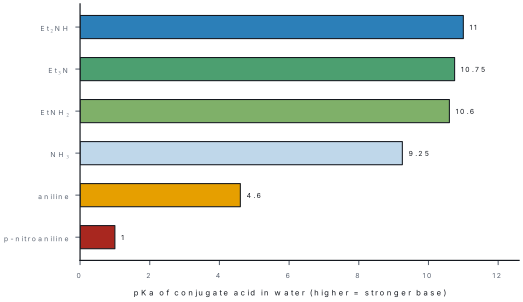
A base is compared by the pKₐ of its conjugate acid (pKₐH): the higher the pKₐH, the stronger the base. Alkyl groups donate electron density and should give 3° > 2° > 1°, but in water the ammonium ions are stabilized by hydrogen-bonding solvation best when they carry more N–H bonds and less steric shielding. The observed aqueous methyl order is therefore (CH₃)₂NH > CH₃NH₂ > (CH₃)₃N > NH₃; for ethyl groups Et₂NH > Et₃N > EtNH₂ > NH₃. In the gas phase, where solvation vanishes, the polarizability/inductive order 3° > 2° > 1° emerges. An examiner who gives no solvent usually expects the aqueous textbook order — read the stem.
Aniline is in another league altogether (pKₐH ≈ 4.6 versus about 10–11 for alkylamines). Its lone pair is an integral part of the ring π system in the free base; protonation forms anilinium, whose nitrogen has no lone pair left to conjugate, so the base is stabilized relative to its conjugate acid. p-Methyl and p-methoxy groups donate and make aniline a little stronger; p-NO₂ withdraws by –I/–R and makes p-nitroaniline feeble (pKₐH ≈ 1.0). Benzylamine (pKₐH ≈ 9.3) shows how one CH₂ breaks the conjugation and restores an alkylamine-like base.
Separating and identifying 1°, 2° and 3° amines
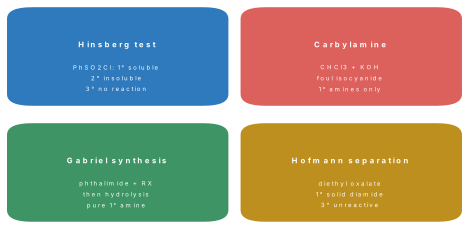
Hoffmann's separation shakes the mixture with diethyl oxalate. A primary amine gives a solid dialkyl oxamide; a secondary amine gives a liquid ethyl oxamate (an oxamic ester); a tertiary amine does not react. Fractional distillation removes the tertiary amine first and then the secondary amine's liquid derivative, leaving the primary derivative as a solid residue. Hydrolysis of each derivative with KOH regenerates its amine.
Hinsberg's test uses benzenesulfonyl chloride in NaOH. A primary sulfonamide still has an acidic N–H and dissolves in alkali; a secondary sulfonamide has no N–H and remains insoluble; a tertiary amine forms no sulfonamide. Acidification reprecipitates the primary derivative, and vigorous hydrolysis returns the amines.
Cold nitrous acid (NaNO₂ + dilute HCl) is the fastest classifier. A primary aliphatic amine forms an unstable diazonium ion that loses N₂ with brisk effervescence, leaving mainly alcohol-derived products. A secondary amine gives a yellow oily N-nitrosamine (no gas). A tertiary aliphatic amine simply forms a soluble nitrite salt. Aniline is the celebrated special case: its diazonium salt survives at 0–5 °C long enough to become synthetic gold (next paragraph). The carbylamine test (CHCl₃ + alcoholic KOH → foul isocyanide) is positive only for primary amines, aliphatic or aromatic.
Aniline: a weak base with a fiercely reactive ring
Aniline is a colourless oil that darkens in air. It forms salts with acids, is alkylated (usually to mixtures) by alkyl halides and is acylated smoothly: acetic anhydride gives acetanilide, in which the amide nitrogen is a tamer, still ortho/para-directing donor. Benzoyl chloride in aqueous NaOH gives benzanilide under Schotten–Baumann conditions.
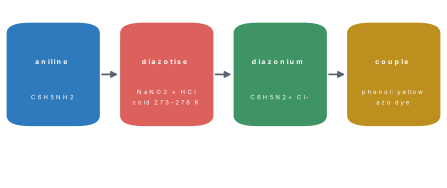
Diazotization at 0–5 °C with NaNO₂/HCl gives benzenediazonium chloride. Warming with water replaces N₂⁺ by OH (phenol); CuCl or CuBr gives chloro-/bromobenzene (Sandmeyer); KI gives iodobenzene; hypophosphorous acid replaces the group by H; and coupling with phenol in mild alkali or with β-naphthol gives orange to red azo dyes. The diazonium group is thus a removable steering wheel fixed to the ring through aniline.
Free –NH₂ activates the ring so strongly that bromine water instantly precipitates white 2,4,6-tribromoaniline. Direct nitration is messy: acid oxidizes aniline and converts much of it to meta-directing anilinium. The examination solution is protection — acetylate to acetanilide, nitrate (para major), then hydrolyse. Concentrated H₂SO₄ and heat ultimately give sulfanilic acid (p-aminobenzenesulfonic acid, an internal salt important in dye and drug history), while Friedel–Crafts reactions fail because the basic nitrogen binds the Lewis-acid catalyst.
Problem. Four isomeric amines C₃H₉N are available. Sample A gives brisk N₂ with cold HNO₂ and a foul carbylamine odour. Sample B gives a yellow oil with HNO₂ and no gas. Sample C gives neither result. Classify A–C.
Solution. A is a primary amine (propan-1-amine or propan-2-amine; the two tests fix the class, not the skeleton). B is the only secondary isomer, N-methylethanamine. C is trimethylamine, tertiary. One gas syringe and one unforgettable smell have done the work of a spectrum — provided the class logic was learned, not the odour by experience.
Predict the order of basic strength in water: ethylamine, diethylamine, triethylamine, ammonia.
Three effects compete: (a) the +I (inductive) effect of alkyl groups pushes electrons toward nitrogen: 3° > 2° > 1°; (b) solvation of the conjugate acid by hydrogen bonding is best for the least crowded ion: 1° > 2° > 3°; (c) steric hindrance also increases with substitution. Balancing them for ethylamines in water gives (C₂H₅)₂NH > (C₂H₅)₃N > C₂H₅NH₂ > NH₃.
The traps: in the gas phase (no solvation) the order is purely inductive, 3° > 2° > 1° > NH₃; and aniline is far weaker than all of these because its lone pair is delocalised into the benzene ring.
The carbylamine (foul-smelling isocyanide) test is given by primary amines only; Hoffmann bromamide converts an amide into an amine with one carbon fewer (the carbonyl carbon is lost as carbonate); and aniline's diazotisation must be done at 0–5 °C — the diazonium salt decomposes (to phenol, releasing N₂) if the mixture warms up.
20.3 Organolithium, organocopper and organocadmium compounds; the Grignard reagent
An organometallic compound contains a direct carbon–metal bond. Because carbon is more electronegative than Li, Mg, Cu or Cd, that bond is polarized Cδ−–Mδ+, making carbon behave as a nucleophile/strong base. The art is choosing the metal to tune ferocity.
Organolithium reagents (RLi) are made from an organic halide and lithium metal in dry ether or hydrocarbon, or by halogen–lithium exchange. They often exist as aggregates and are more reactive and more strongly basic than Grignard reagents. They are protonated instantly by water/alcohols to RH, add to carbonyl compounds and CO₂, deprotonate weak C–H acids and exchange with aryl/vinyl halides. n-BuLi solutions can ignite in air; “dry and inert atmosphere” is a safety instruction, not a style preference.
Organocopper reagents used at this level are chiefly lithium diorganocuprates, R₂CuLi (Gilman reagents), from 2 RLi + CuI. Copper makes carbon softer and more selective: a Gilman reagent couples with an alkyl/aryl/vinyl halide to form a C–C bond (Corey–House synthesis, one route to unsymmetrical alkanes that Wurtz cannot manage cleanly), converts an acid chloride to a ketone and stops, and adds 1,4 (conjugate) to an α,β-unsaturated carbonyl where a Grignard reagent often adds 1,2 to C=O.
Organocadmium reagents (R₂Cd) are made by transmetallation, 2 RMgX + CdCl₂ → R₂Cd + 2 MgXCl. They are still less reactive: acid chlorides are converted to ketones, but the ketone/ester/nitrile functions are largely left alone. That selectivity made them textbook favourites; cadmium's severe toxicity (Ch. 15) means modern laboratories prefer cuprates or organozinc reagents, a good example of methodology changing under toxicology.
The Grignard reagent
Magnesium turnings react with RX in rigorously dry ether or THF to give RMgX. Iodides and bromides form most readily; aryl/vinyl bromides work, chlorides may need THF/initiation. The solution contains solvated species in Schlenk equilibrium (2 RMgX ⇌ R₂Mg + MgX₂), but the school formula RMgX captures its chemistry: treat R as a carbanion equivalent.
| Grignard partner | After aqueous workup | Carbon-count lesson |
|---|---|---|
| H₂O, ROH, RCO₂H, terminal alkyne (any acidic H) | RH (the reagent is destroyed) | Why solvents/substrates must be dry and proton-free |
| D₂O | RD | A clean way to label one C–H position |
| CO₂ (dry ice), then H₃O⁺ | RCO₂H | +1 carbon |
| Methanal (HCHO) | RCH₂OH, primary alcohol | +1 carbon |
| Any other aldehyde | Secondary alcohol | New C–C bond at carbonyl carbon |
| Ketone | Tertiary alcohol | Three carbon groups on carbinol C |
| Ester with 2 RMgX | Tertiary alcohol (formate ester gives secondary) | The ketone formed first is attacked again |
| Nitrile, then hydrolysis | Ketone | Addition stops at an imine salt until workup |
| Epoxide (oxirane) | Primary alcohol after ring opening at the less hindered carbon | +2 carbons from ethylene oxide |
| Sulfur, then workup | Thiol RSH | Electrophilic heteroatoms also accept R |
Two limitations decide many synthesis questions. A Grignard reagent cannot be prepared from a halide that also carries an acidic proton (–OH, –NH, –CO₂H, terminal –C≡CH) or a carbonyl/ nitro group, because the reagent would attack its own precursor. And because acid chlorides and esters pass through a ketone stage, excess RMgX adds twice; use R₂Cd or R₂CuLi when the ketone itself is the target.
Want maximum force/basicity? RLi. General carbon nucleophile? RMgX. Need to stop at a ketone or couple two carbons? R₂CuLi (or the older, toxic R₂Cd of the textbooks).
CH₃–MgBr reacts first by addition to the carbonyl carbon; water (work-up) then protonates the alkoxide. So ask what the carbonyl compound is:
- With formaldehyde (HCHO): CH₃–CH₂–OH — a primary alcohol (ethanol), one carbon added.
- With any other aldehyde (e.g. ethanal): a secondary alcohol, CH₃–CH(OH)–CH₃.
- With a ketone (e.g. propanone): a tertiary alcohol, (CH₃)₃C–OH.
- With CO₂ (dry ice): after hydrolysis, a carboxylic acid with one extra carbon — CH₃–COOH.
One mechanism (nucleophilic addition of the carbanion-like CH₃⁻) predicts all four answers — and also why the reagent is destroyed by water, alcohol or any –OH/–NH compound (it simply grabs the proton, giving methane).
Five swaps the paper loves here: AgNO₂ gives the nitroalkane, KNO₂ the alkyl nitrite — same anion, two mouths; Sn/HCl gives aniline but Zn/NaOH gives azobenzene and Zn/NH₄Cl the hydroxylamine — the medium steers the reduction; amine classes count carbons on nitrogen, amide classes count carbonyls on nitrogen; the carbylamine and diazotisation tests need a primary amine's N–H hydrogens, which secondary and tertiary lack; and any acidic hydrogen — water, alcohol, terminal alkyne — kills a Grignard, so dry ether is not a preference but a condition of existence.
Formula and fact sheet
| Topic | Must-know |
|---|---|
| Nitro vs nitrite | R–NO₂ from AgNO₂; R–O–N=O mainly from KNO₂ |
| Nitro tests | 1°/2° dissolve in NaOH (α-H); HNO₂ colours: red (1°), blue (2°), none (3°) |
| Nitrobenzene reduction | Acid → aniline; neutral → phenylhydroxylamine; alkaline → azoxy/azo/hydrazo dimers |
| 1° amine routes | RNO₂ ↓, RCN ↓ (→RCH₂NH₂), RCONH₂ + LiAlH₄, Hofmann (−1 C), Gabriel (clean, SN2 halide) |
| Basicity | Water: Et₂NH > Et₃N > EtNH₂ > NH₃ >> aniline; pKₐH aniline 4.6, p-nitroaniline about 1 |
| Separation | Hoffmann = diethyl oxalate; Hinsberg = PhSO₂Cl/NaOH (1° soluble, 2° insoluble, 3° none) |
| Amine tests | HNO₂: 1° N₂↑, 2° yellow nitrosamine, 3° salt only; carbylamine = 1° only |
| Aniline | Diazotize 0–5 °C; couple to azo dyes; Br₂ water → tribromoaniline; acetylate before nitration |
| Organometallics | RLi fiercest; RMgX general; R₂CuLi couples/stops at ketone; R₂Cd ketone from RCOCl but toxic |
| Grignard outcomes | CO₂ → acid; HCHO → 1° ROH; RCHO → 2° ROH; ketone/ester → 3° ROH; H₂O → RH |
Rapid-revision tables and high-yield facts
| Item | Rule or value |
|---|---|
| Ambident nitrite | AgNO₂ → C-attack; KNO₂ → O-attack |
| Nitrobenzene | HNO₃/H₂SO₄, 333 K |
| Alkaline reduction | Zn/NaOH → azobenzene |
| Basicity | R₂NH-type > RNH₂ > NH₃ > ArNH₂ |
| Aqueous methylamines | 2° > 1° > 3° |
| Diazotisation | 273–278 K, NaNO₂ + HCl |
| Grignard solvent | dry ether |
| Organocadmium | 2 RMgX + CdCl₂ |
| Gilman | R₂CuLi couples with R'X |
| Hofmann bromamide | amide → amine, −1 C |
Chapter summary
- The nitro group withdraws electrons, acidifies an α-C–H and can be reduced all the way to an amine or stopped/dimerized at intermediate oxidation levels by choosing the medium.
- Nitrobenzene's ring is deactivated and meta-directing, in complete contrast to the aniline produced from it.
- Primary-amine synthesis is an exercise in carbon bookkeeping: nitrile reduction extends, Hofmann degradation shortens, and Gabriel protects nitrogen from over-alkylation.
- Aqueous basicity balances alkyl donation against solvation; resonance makes aniline and especially p-nitroaniline feeble bases.
- Hoffmann and Hinsberg separations exploit the presence or absence of N–H bonds; nitrous acid and the carbylamine reaction identify amine class in test tubes.
- Diazotization converts aniline into a versatile leaving group for phenols, haloarenes and azo dyes, while ring protection tames aniline for controlled substitution.
- Organometallic carbon is nucleophilic: lithium gives force, magnesium gives generality, and copper/cadmium give the selectivity needed to stop at ketones or form chosen C–C bonds.
Practice questions
Set A — Recall (25 questions)
- In a nitroalkane, the alkyl group is attached to the nitro group throughaoxygenbhydrogenccarbon of NO₂dnitrogen
- An alkyl halide treated with AgNO₂ gives mainly theanitroalkanebalkyl nitritecamineddiazonium salt
- Primary and secondary nitroalkanes dissolve in NaOH because they possess an acidica–OH groupbhalogencα-hydrogendring
- Complete reduction of a nitroalkane with Sn/HCl gives aanitrilebprimary aminecsecondary aminedamide
- Nitrobenzene is prepared by treating benzene with concentrated HNO₃ and concentratedaH₂SO₄bHClcNaOHdH₃PO₄ only
- Nitrobenzene reduced with Sn/HCl givesaphenolbchlorobenzenecazobenzene onlydaniline
- Nitrobenzene reduced with Zn/NH₄Cl in neutral medium gives mainlyaanilinebN-phenylhydroxylaminechydrazobenzenedbenzene
- The nitro group in electrophilic aromatic substitution is deactivating andaortho-directing onlybpara-directing onlycmeta-directingdnon-directing
- A secondary amine has how many carbon groups attached to nitrogen?aonebtwocthreedfour
- The number of isomeric amines of formula C₃H₉N isa4b2c5d7
- Gabriel synthesis of a primary amine starts from potassiumacyanidebpermanganatecnitritedphthalimide
- Hofmann bromamide reaction uses Br₂ with aqueousaHClbNH₃cNaOHdH₂SO₄ only
- Reduction of a nitrile R–C≡N gives the amineaRCH₂NH₂bRNH₂cR₂NHdRCONH₂
- Hoffmann's separation of amine mixtures uses diethylaetherbcarbonatecoxalatedsulfate
- Hinsberg's reagent isaacetyl chloridebbenzenesulfonyl chloridecchloroform/KOHdnitrous acid
- A primary aliphatic amine with cold nitrous acid evolves mainlyaO₂bH₂cNO₂dN₂
- A secondary amine with nitrous acid forms a yellow oilyadiazonium saltbisocyanidecN-nitrosaminednitroalkane
- The carbylamine test is given only byatertiary aminesbprimary aminescamidesdnitriles
- Diazotization of aniline is carried out at abouta0–5 °Cb100 °Cc−80 °Cd200 °C
- Aniline with bromine water rapidly precipitatesap-bromoaniline onlybN-bromoaniline onlycbromobenzened2,4,6-tribromoaniline
- Aniline with acetic anhydride givesabenzanilidebacetanilidecsulfanilic aciddphenyl acetate
- A Grignard reagent is prepared from an organic halide and Mg in dryawaterbaqueous HClcethanoldether
- Passing CO₂ into RMgX followed by acidification gives aaketonebprimary amineccarboxylic aciddnitrile
- A Gilman reagent has the general formulaaR₂CuLibR₂CdcRMgXdR₄C
- An organocadmium reagent converts an acid chloride mainly into aatertiary alcoholbaldehydecketonedcarboxylic acid
Answers and explanations — Set A
1. (d) — R–NO₂ versus the nitrite connectivity R–O–N=O.
2. (a) — covalent AgNO₂ delivers attack through nitrogen; KNO₂ reverses the major site.
3. (c) — deprotonation gives a resonance-stabilized nitronate salt.
4. (b) — NO₂ is reduced by six electrons to NH₂.
5. (a) — mixed acid generates NO₂⁺ and absorbs the water formed.
6. (d) — isolated as anilinium salt until the mixture is basified.
7. (b) — neutral conditions stop at the hydroxylamine oxidation level.
8. (c) — ortho/para σ-complexes place positive charge where –NO₂ destabilizes it most.
9. (b) — amine class counts groups on N, not the class of the attached carbon.
10. (a) — two primary, one secondary and one tertiary isomer.
11. (d) — the imide nitrogen is alkylated once, then the amine is released.
12. (c) — strongly alkaline bromine first N-brominates the amide.
13. (a) — the nitrile carbon is reduced to CH₂NH₂.
14. (c) — the differing physical states of the oxalate derivatives make the separation.
15. (b) — PhSO₂Cl; sulfonyl, not carbonyl, chemistry.
16. (d) — an aliphatic diazonium ion cannot survive loss of N₂.
17. (c) — N-nitrosamines are the classic yellow oils (and notable carcinogens).
18. (b) — two N–H bonds are needed to reach the isocyanide product.
19. (a) — diazonium salts decompose on warming, especially when dry.
20. (d) — all activated ortho/para positions are brominated.
21. (b) — N-acetylation; the amide product is much less basic than aniline.
22. (d) — ether/THF solvates Mg and contains no acidic proton.
23. (c) — carboxylation inserts one carbon as –CO₂H.
24. (a) — lithium diorganocuprate, from 2 RLi + CuI.
25. (c) — R₂Cd is too mild to add to the ketone product appreciably.
Set B — Understanding (15 questions)
- The two N–O bonds of a nitro group are equal because the π bond and charge arealocalized on nitrogenbabsentcdelocalized over both oxygensdshared with carbon
- KNO₂ and AgNO₂ can give different major products from RX because nitrite is an ambident nucleophile that can attack throughacarbon or hydrogenba metal onlyctwo carbonsdnitrogen or oxygen
- A tertiary nitroalkane does not form a sodium salt in NaOH because it has noaα-hydrogenbnitrogencoxygendalkyl group
- Further electrophilic substitution on nitrobenzene is slow because –NO₂ withdraws ring electrons bya+I and +Rb−I and −Rchydrogen bondingdsteric bulk only
- Azoxy/azobenzene products appear in alkaline reduction of nitrobenzene because nitrosobenzene and phenylhydroxylamine canaevaporatebbe protonated onlycform benzenedcondense with each other
- Ammonolysis of an alkyl halide tends to give a mixture of amine classes because the primary amine product is itselfaacidicbnucleophilic toward more RXcvolatile onlydaromatic
- In water, dimethylamine is a stronger base than trimethylamine mainly because inductive donation is outweighed in the tertiary case by poorer solvation and greateraresonancebatomic masscsteric hindrance around nitrogendπ bonding
- Aniline is a far weaker base than ethylamine because its nitrogen lone pair isadelocalized into the benzene ringbremoved by oxidation in watercbonded to three carbonsdin a hydrogen bond only
- p-Nitroaniline is a weaker base than aniline because –NO₂adonates electrons into nitrogenbwithdraws electrons (−I/−R)cadds an N–H bonddmakes nitrogen sp
- Benzylamine is much more basic than aniline because the CH₂ group prevents direct conjugation of the lone pair with thearingbsolventcmethyl groupdcounter-ion
- In Hinsberg separation, the sulfonamide from a primary amine dissolves in NaOH because it still has an acidicaC–Hbring proton onlycS–HdN–H
- Benzenediazonium salts are usable at 0–5 °C but decompose on warming mainly by loss of the exceptionally stable moleculeaCO₂bH₂cN₂dHCl
- Aniline is acetylated before nitration to moderate ring activation and prevent the amino group from being protonated/oxidized to aameta-directing anilinium speciesbstronger donorcdiazonium saltdnitro group
- Organolithium compounds are generally more reactive than Grignard reagents because the C–Li bond is moreacovalent and nonpolarbsterically shieldedcaromaticdpolar (carbon more anionic)
- Gilman and organocadmium reagents stop at ketones from acid chlorides because they are less reactive toward the ketone carbonyl than aaprotonbGrignard reagentcalkanedhalide ion
Answers and explanations — Set B
1. (c) — the hybrid has N–O bond order 1.5 at each oxygen.
2. (d) — ion pairing/covalency changes which terminus of NO₂⁻ attacks.
3. (a) — the nitronate anion cannot be formed by α-deprotonation.
4. (b) — both withdrawal modes raise the energy of the cationic σ-complex.
5. (d) — two partly reduced nitrogen fragments couple N–N before further reduction.
6. (b) — each alkylation product can compete with NH₃ for remaining RX.
7. (c) — in the gas phase the order changes, which is the giveaway that solvation is speaking.
8. (a) — protonation spends the very lone pair that resonance had been stabilizing.
9. (b) — para withdrawal can conjugate directly with the amino-bearing ring position.
10. (a) — an sp³ CH₂ breaks p-orbital continuity between N and the ring.
11. (d) — the sulfonyl group makes that N–H proton unusually acidic.
12. (c) — N≡N formation is a powerful thermodynamic sink.
13. (a) — –NH₃⁺ is deactivating/meta-directing; acetanilide remains ortho/para-directing and calmer.
14. (d) — greater ionic character means greater carbanion-like force.
15. (b) — RMgX would add to the ketone as soon as it formed, continuing to a tertiary alcohol.
Set C — Application (10 questions)
- 1-Bromopropane converted through Gabriel synthesis givesapropan-2-aminebpropan-1-aminectrimethylaminedaniline
- Propanamide treated with Br₂/NaOH givesapropylaminebpropanenitrilecethylamineddimethylamine
- Propanenitrile reduced with LiAlH₄ givesapropan-1-aminebethylaminecpropanamidedpropane
- Nitrobenzene reduced with Zn dust and aqueous NaOH (strong alkaline conditions) gives mainlyaanilinebazoxybenzene onlycphenoldhydrazobenzene
- Aniline diazotized and then treated with alkaline β-naphthol gives an orange-redaesterbnitro compoundcazo dyedamide
- A C₃H₉N amine gives a yellow oily product with HNO₂ but evolves no nitrogen. It isaN-methylethanaminebpropan-1-aminectrimethylaminedpropan-2-amine
- CH₃MgI + propanone, followed by aqueous workup, givesapropan-2-olbethanolcbutan-2-oned2-methylpropan-2-ol
- C₆H₅MgBr + CO₂, followed by acidification, givesaphenolbbenzoic acidcbenzaldehydedphenylacetic acid
- Two equivalents of CH₃COCl with (CH₃)₂Cd give mainlyapropanoneb2-methylpropan-2-olcethanaldethanoic acid
- CH₃Br →(KCN, then LiAlH₄) gives the final amineamethylaminebethylaminecdimethylaminedmethanamide
Answers and explanations — Set C
1. (b) — Gabriel transfers the intact n-propyl group to nitrogen without over-alkylation.
2. (c) — Hofmann removes the carbonyl carbon: CH₃CH₂CONH₂ → CH₃CH₂NH₂.
3. (a) — CH₃CH₂–C≡N becomes CH₃CH₂–CH₂NH₂; count all three carbons in a straight chain.
4. (d) — the alkaline dimer is carried to the N–N single-bond stage.
5. (c) — electrophilic diazonium coupling creates the extended –N=N– chromophore.
6. (a) — only the secondary C₃H₉N isomer forms an N-nitrosamine without diazotization gas.
7. (d) — methyl adds to (CH₃)₂C=O, giving (CH₃)₃COH after workup.
8. (b) — carboxylation places –CO₂H exactly where MgBr was attached.
9. (a) — each methyl of (CH₃)₂Cd acetylates once and stops: CH₃COCH₃.
10. (b) — CH₃Br → CH₃CN (two carbons) → CH₃CH₂NH₂.