Chapter 10 · Physical Chemistry · 1 question in the paper · 34 min read
Electrochemistry
What the syllabus asks for 3
- Electrolytic cells and the qualitative and quantitative laws of electrolysis
- Standard electrode potential, the standard hydrogen and calomel electrodes, the electrochemical series and its uses
- Galvanic cells and their standard emf; primary, secondary and hydrogen–oxygen fuel cells
Electrochemistry is the chemistry of electrons that travel through a wire instead of jumping between atoms. The paper carries about one question from this chapter (our estimate from the MEC topic list), and it comes in three shapes: a Faraday's-law calculation with 96 500 C in it, a cell-potential subtraction, or a fact about a named cell (SHE, calomel, lead–acid, fuel cell) with one word changed. The two ideas that decide most marks are that oxidation is always at the anode in both kinds of cell, and that E° is an intensive property — doubling a half-reaction does not double the voltage.
- Electrolytic cell: electrical → chemical, anode positive, cathode negative. Galvanic cell: chemical → electrical, anode negative, cathode positive. Oxidation at the anode in both.
- Faraday's first law m = ZIt with Z = E/96500; second law m_1/m_2 = E_1/E_2; one faraday (96 500 C) deposits one gram equivalent.
- Standard electrode potential is a reduction potential, measured against the SHE, which is fixed at 0.00 V (1 M H⁺, 1 atm H₂, 298 K, Pt).
- Calomel electrode: a secondary reference, Hg₂Cl₂/Hg in KCl, 0.24 V when saturated.
- The electrochemical series gives reactivity, displacement, cell emf and the products of electrolysis.
- E^\circ_{\text{cell}} = E^\circ_{\text{cathode}} - E^\circ_{\text{anode}}; positive means spontaneous. E^\circ is intensive.
- Nernst: E = E^\circ - \frac{0.059}{n}\log Q at 298 K; \Delta G^\circ = -nFE^\circ.
- Primary (dry cell, 1.5 V), secondary (lead–acid 2 V per cell, lithium-ion) and fuel cells (H₂–O₂, water is the only product); rusting is an electrochemical cell.
10.1 Electrolytic cells and the qualitative and quantitative laws of electrolysis
The electrolytic cell
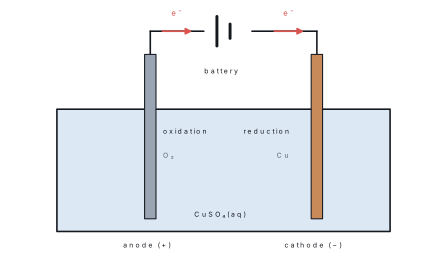
Electrolysis is the decomposition of an electrolyte by the passage of a direct electric current. The apparatus — two electrodes dipping into the electrolyte, connected to a source of direct current — is an electrolytic cell. It converts electrical energy into chemical energy.
- The anode is the electrode connected to the positive terminal of the supply. Oxidation happens there: anions lose electrons.
- The cathode is the electrode connected to the negative terminal. Reduction happens there: cations gain electrons.
- In the external circuit electrons travel from the anode to the positive terminal of the battery, and from its negative terminal to the cathode. Inside the electrolyte the current is carried by ions, not electrons.
- The electrolyte must be an ionic conductor — a molten salt, or a solution of an acid, base or salt. Solid ionic compounds do not conduct.
Products of electrolysis — the qualitative laws
What appears at the electrodes depends on three things: the electrolyte, the material of the electrodes and the concentration. The rules of preferential discharge are:
- At the cathode, the ion that is more easily reduced — the one with the higher (more positive) standard reduction potential — is discharged first. In aqueous solution Cu²⁺, Ag⁺ and H⁺ compete; Na⁺, K⁺, Ca²⁺, Mg²⁺ and Al³⁺ are never discharged from water, because hydrogen is liberated instead.
- At the anode, the species more easily oxidised is discharged. With inert electrodes in water, OH⁻/H₂O is oxidised to O₂ unless a concentrated halide is present, when Cl₂, Br₂ or I₂ appears.
| Electrolyte | Electrodes | At cathode | At anode |
|---|---|---|---|
| Molten NaCl | inert | Na | Cl₂ |
| Aqueous NaCl (concentrated brine) | inert | H₂ | Cl₂ |
| Dilute NaCl solution | inert | H₂ | O₂ |
| Aqueous CuSO₄ | platinum (inert) | Cu | O₂ |
| Aqueous CuSO₄ | copper | Cu (pure) | Cu dissolves |
| Acidified water | platinum | H₂ | O₂ |
| Molten Al₂O₃ in cryolite | carbon | Al | O₂ (which burns the carbon to CO₂) |
The copper-refining case is the important exception: with copper electrodes, copper dissolves at the anode and is deposited at the cathode, so the concentration of CuSO₄ stays constant and impure copper is refined.
In an electrolytic cell the anode is positive; in a galvanic cell the anode is negative. What never changes is that oxidation occurs at the anode and reduction at the cathode. A question that says "oxidation occurs at the positive electrode" is wrong for a galvanic cell, and "at the cathode" is wrong for both.
Faraday's first law
The mass of a substance deposited or liberated at an electrode is directly proportional to the quantity of electricity passed through the electrolyte: m \propto Q, or m = ZQ = ZIt, where I is the current in amperes, t the time in seconds and Z the electrochemical equivalent — the mass deposited by one coulomb.
E is the equivalent weight in g equiv⁻¹, equal to the molar mass divided by the number of electrons in the half-reaction (E = M/n). The constant 96 500 C is one faraday (F), the charge on one mole of electrons.
Faraday's second law
When the same quantity of electricity is passed through several electrolytes in series, the masses of the substances deposited are proportional to their equivalent weights: \frac{m_1}{m_2} = \frac{E_1}{E_2}. Equivalently, one faraday deposits one gram equivalent of any substance.
| Substance | Half-reaction | n | E = M/n | Mass from 96 500 C |
|---|---|---|---|---|
| Ag | Ag⁺ + e⁻ → Ag | 1 | 108 | 108 g |
| Cu | Cu²⁺ + 2e⁻ → Cu | 2 | 31.75 | 31.75 g |
| Al | Al³⁺ + 3e⁻ → Al | 3 | 9 | 9 g |
| H₂ | 2H⁺ + 2e⁻ → H₂ | 2 | 1 | 1 g (11.2 L at STP) |
| O₂ | 2H₂O → O₂ + 4H⁺ + 4e⁻ | 4 | 8 | 8 g (5.6 L at STP) |
| Cl₂ | 2Cl⁻ → Cl₂ + 2e⁻ | 2 | 35.5 | 35.5 g (11.2 L at STP) |
Problem. A current of 9.65 A is passed through silver nitrate solution for 100 s. Find the mass of silver deposited (Ag = 108).
Solution. Q = It = 9.65 \times 100 = 965 C. Moles of electrons = \frac{965}{96\,500} = 0.010 mol. Ag⁺ + e⁻ → Ag, so 0.010 mol of Ag is deposited: m = 0.010 \times 108 = \mathbf{1.08} g. By the formula: Z = \frac{108}{96\,500} = 1.119 \times 10^{-3} g C⁻¹, and m = 1.119 \times 10^{-3} \times 965 = 1.08 g.
Problem. What charge is needed to deposit 1.0 g of copper from copper sulphate solution? How long will it take at 1.0 A? (Cu = 63.5)
Solution. Moles of Cu = 1.0/63.5 = 0.0157 mol. Cu²⁺ + 2e⁻ → Cu needs 2 mol of electrons per mole of copper, so n(e^-) = 0.0315 mol. Q = 0.0315 \times 96\,500 = \mathbf{3040} C (about 3.0 × 10³ C). t = Q/I = 3040/1.0 = \mathbf{3040} s ≈ 51 min.
Problem. 965 C is passed through acidified water between platinum electrodes. What volume of hydrogen and of oxygen, at STP, is liberated?
Solution. 965 C = 0.010 mol of electrons. Cathode: 2H⁺ + 2e⁻ → H₂, so H₂ = 0.010/2 = 0.005 mol = 0.005 \times 22\,400 = 112 mL. Anode: 2H₂O → O₂ + 4H⁺ + 4e⁻, so O₂ = 0.010/4 = 0.0025 mol = 56 mL. The volumes are in the 2 : 1 ratio the formula of water demands.
Convert everything to moles of electrons first: n(e^-) = \frac{It}{96\,500}. Then divide by the number of electrons in the half-reaction to get moles of substance, and multiply by the molar mass. Nearly every Faraday question falls to this single chain, and it avoids the equivalent-weight formula going upside down.
10.2 Standard electrode potential, the SHE and the calomel electrode, and the electrochemical series
Electrode potential
When a metal is dipped into a solution of its own ions, two opposing processes start: metal atoms leave the lattice as ions (oxidation), and ions from solution deposit on the metal (reduction). A separation of charge builds up until the two rates balance, leaving the metal with a definite potential relative to the solution — its electrode potential.
The standard electrode potential E^\circ of a half-cell is the potential of that half-cell measured against the standard hydrogen electrode at 298 K, with every ion at 1 mol L⁻¹ (or 1 bar for gases). By IUPAC convention it is quoted as a reduction potential: it refers to the half-reaction written as a reduction, M^{n+} + ne^- \rightarrow M.
A single electrode potential cannot be measured on its own — only a difference between two electrodes can. So one electrode is chosen as the zero and everything is quoted against it.
The standard hydrogen electrode (SHE)
The SHE is a platinum plate coated with finely divided platinum black, dipping into 1 M H⁺ (strictly, unit activity) with hydrogen gas bubbled over it at 1 atm and 298 K.
- Platinum black is used because it adsorbs hydrogen and catalyses the electrode reaction; platinum itself does not take part.
- To measure the potential of another electrode, it is paired with the SHE and the reading of the voltmeter is the required potential — sign included.
- If the unknown electrode is the cathode, the reading is its reduction potential; if it is the anode, the reading is the negative of that.
| Feature | Standard hydrogen electrode | Calomel electrode |
|---|---|---|
| Composition | Pt black, 1 M H⁺, H₂ at 1 atm | Hg over Hg₂Cl₂ paste in KCl solution |
| Electrode reaction | 2H⁺ + 2e⁻ → H₂ | Hg₂Cl₂ + 2e⁻ → 2Hg + 2Cl⁻ |
| Potential at 25 °C | 0.00 V by definition | 0.28 V (1 M KCl), 0.24 V (saturated) |
| Role | primary reference | secondary reference |
| Practical drawback | needs a constant supply of pure H₂; fragile; hard to set up | — |
The calomel electrode
A calomel electrode is mercury in contact with a paste of mercury(I) chloride (calomel, Hg₂Cl₂) and potassium chloride solution, with a platinum wire for contact.
Its potential depends on the chloride concentration, because Cl⁻ appears in the half-reaction. The saturated calomel electrode (SCE) is the laboratory standard: 0.2415 V at 25 °C. It is preferred to the SHE because it is compact, portable, needs no hydrogen gas and gives a steady, reproducible potential — which is why it is called a secondary reference electrode.
Only the SHE is defined as 0.00 V. A calomel electrode has a real potential of about +0.24 V, so a reading taken against it must be corrected before it is quoted against the SHE. Options that call calomel "the zero of the scale" are wrong.
The electrochemical series
Arranging the standard reduction potentials in order gives the electrochemical series (activity series). The values below are the ones the paper uses.
| Half-reaction (reduction) | E^\circ (V) | Half-reaction (reduction) | E^\circ (V) |
|---|---|---|---|
| F₂ + 2e⁻ → 2F⁻ | +2.87 | 2H⁺ + 2e⁻ → H₂ | 0.00 |
| MnO₄⁻ + 8H⁺ + 5e⁻ → Mn²⁺ + 4H₂O | +1.51 | Pb²⁺ + 2e⁻ → Pb | −0.13 |
| Au³⁺ + 3e⁻ → Au | +1.50 | Sn²⁺ + 2e⁻ → Sn | −0.14 |
| Cl₂ + 2e⁻ → 2Cl⁻ | +1.36 | Ni²⁺ + 2e⁻ → Ni | −0.25 |
| Cr₂O₇²⁻ + 14H⁺ + 6e⁻ → 2Cr³⁺ + 7H₂O | +1.33 | Fe²⁺ + 2e⁻ → Fe | −0.44 |
| O₂ + 4H⁺ + 4e⁻ → 2H₂O | +1.23 | Zn²⁺ + 2e⁻ → Zn | −0.76 |
| Br₂ + 2e⁻ → 2Br⁻ | +1.09 | Al³⁺ + 3e⁻ → Al | −1.66 |
| Ag⁺ + e⁻ → Ag | +0.80 | Mg²⁺ + 2e⁻ → Mg | −2.37 |
| Fe³⁺ + e⁻ → Fe²⁺ | +0.77 | Na⁺ + e⁻ → Na | −2.71 |
| Cu²⁺ + 2e⁻ → Cu | +0.34 | K⁺ + e⁻ → K | −2.93 |
| I₂ + 2e⁻ → 2I⁻ | +0.54 | Li⁺ + e⁻ → Li | −3.05 |
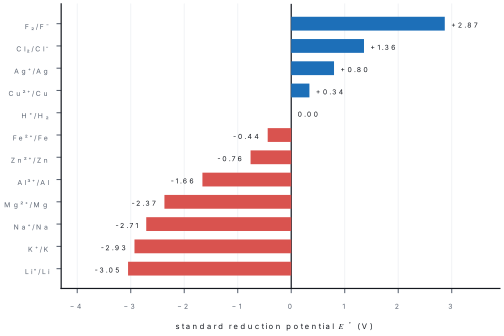
The four uses of the series — every one of them is examinable.
- Reactivity and reducing strength. The lower (more negative) the E^\circ, the more
reactive the metal and the stronger its reducing power: K > Na > Mg > Al > Zn > Fe > Pb
H > Cu > Ag > Au. Metals above hydrogen displace H₂ from dilute acids; copper, silver and gold do not.
- Displacement reactions. A metal higher in the series displaces a metal lower down from a solution of its salt: Zn + CuSO₄ → ZnSO₄ + Cu. The reverse never happens spontaneously. The same rule predicts halogen displacement: Cl₂ + 2KBr → 2KCl + Br₂.
- Cell emf. E^\circ_{\text{cell}} = E^\circ_{\text{cathode}} - E^\circ_{\text{anode}}. A positive value means the reaction as written is spontaneous.
- Predicting the products of electrolysis. At the cathode, the ion with the higher E^\circ is discharged; at the anode, the species with the lower E^\circ is oxidised. This is why copper, not hydrogen, is deposited from CuSO₄ solution, and why sodium is never obtained from aqueous NaCl.
Two sentences that answer half the questions
"Higher E^\circ wins the electrons" — that is the cathode. "Lower E^\circ loses them" — that is the anode. Everything else (displacement, corrosion, electrolysis products) is this one rule applied twice.
10.3 Galvanic cells and their standard emf; primary, secondary and hydrogen–oxygen fuel cells
The galvanic (voltaic) cell
A galvanic cell converts the chemical energy of a spontaneous redox reaction into electrical energy. The two half-reactions are carried out in separate compartments joined by a salt bridge, so that the electrons must travel through an external wire to get from the reducing agent to the oxidising agent.
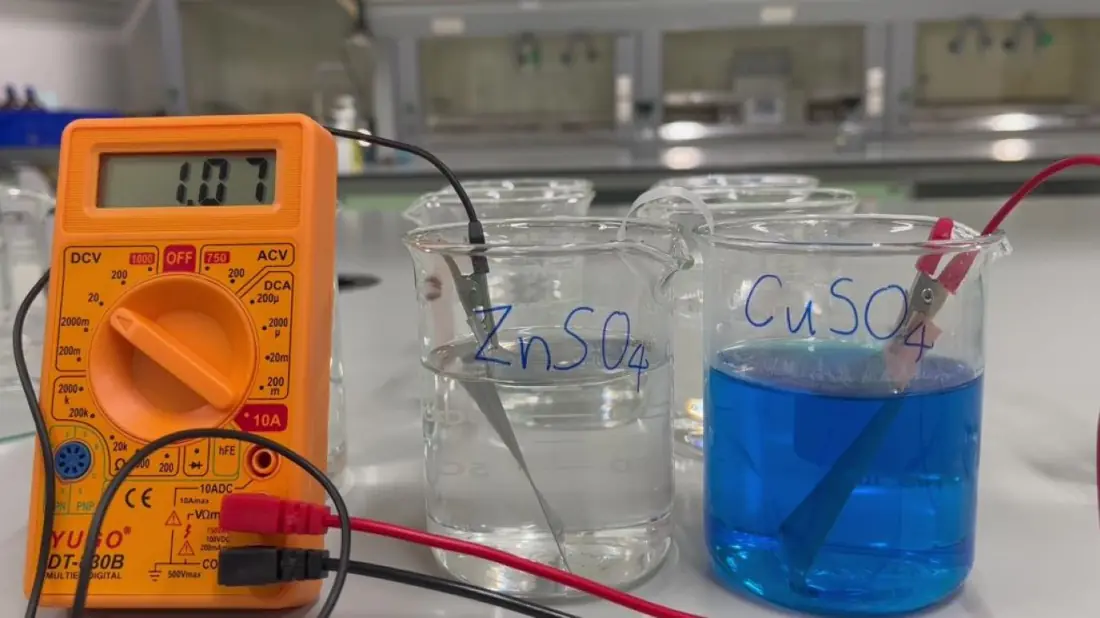
In the Daniell cell, zinc is dipped into ZnSO₄ and copper into CuSO₄.
- Anode (negative): zinc is oxidised, Zn → Zn²⁺ + 2e⁻. Electrons leave the cell here.
- Cathode (positive): copper ions are reduced, Cu²⁺ + 2e⁻ → Cu.
- Salt bridge: a tube of KCl or KNO₃ in agar. It lets ions move — cations towards the cathode compartment, anions towards the anode — so that both solutions stay electrically neutral. Without it the cell stops after a few seconds.
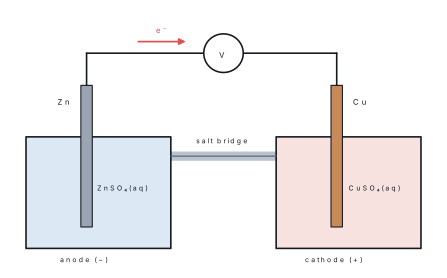
Cell notation writes the same cell on one line:
- The anode is written on the left and the cathode on the right.
- A single bar
|is a phase boundary; the double bar||is the salt bridge. - By convention the cell emf is the potential of the right-hand electrode minus that of the left-hand one, which is why the anode must be on the left for a positive reading.
Standard emf of the cell
For the Daniell cell: E^\circ = (+0.34) - (-0.76) = \mathbf{1.10} V.
- A positive E^\circ_{\text{cell}} means the cell reaction as written is spontaneous and the cell delivers current.
- A negative value means the reaction runs the other way; the cell as written is electrolytic, not galvanic.
- E^\circ_{\text{cell}} = 0 means the cell is dead — equilibrium has been reached.
E^\circ is a potential difference, an intensive property, like temperature. Multiplying the coefficients of a half-reaction by 2 doubles \Delta G^\circ and doubles the number of electrons n, but leaves E^\circ unchanged, because \Delta G^\circ = -nFE^\circ and both \Delta G^\circ and n double. Zn²⁺ + 2e⁻ → Zn has E^\circ = -0.76 V; so does 2Zn²⁺ + 4e⁻ → 2Zn. Only when you reverse a half-reaction does the sign flip. This is the single most common wrong key in electrochemistry papers.
Free energy and the equilibrium constant. The electrical work a cell can do is the decrease in free energy:
with n the number of moles of electrons transferred and F = 96\,500 C mol⁻¹. For the Daniell cell, n = 2 and E^\circ = 1.10 V: \Delta G^\circ = -2(96\,500)(1.10) = -2.12 \times 10^5 J mol⁻¹ = −212 kJ mol⁻¹. At equilibrium E = 0 and \Delta G = 0, so E^\circ = \frac{0.059}{n}\log K at 298 K.
The Nernst equation
Real cells do not run at 1 M. The emf depends on concentration:
where Q is the reaction quotient in the same form as an equilibrium constant.
- If the products are at low concentration (Q < 1), E > E^\circ.
- If the reactants are at low concentration (Q > 1), E < E^\circ.
- As the cell discharges, Q rises and E falls until Q = K and E = 0: the cell is flat.
Problem. Find the emf at 298 K of Zn | Zn²⁺(0.01 M) || Cu²⁺(1 M) | Cu, given E^\circ = 1.10 V.
Solution. The cell reaction is Zn + Cu²⁺ → Zn²⁺ + Cu, so Q = [\text{Zn}^{2+}]/[\text{Cu}^{2+}] = 0.01/1 = 0.01 and n = 2. E = 1.10 - \frac{0.059}{2}\log(0.01) = 1.10 - 0.0295(-2) = 1.10 + 0.059 = \mathbf{1.16} V. Diluting the anode compartment makes the cell stronger, because the zinc has more room to dissolve.
Primary, secondary and fuel cells
| Cell | Anode | Cathode | Electrolyte | emf | Rechargeable |
|---|---|---|---|---|---|
| Leclanché dry cell (primary) | zinc can | MnO₂ + carbon rod | NH₄Cl + ZnCl₂ paste | 1.5 V | no |
| Alkaline cell (primary) | zinc powder | MnO₂ | KOH | 1.5 V | no |
| Lead–acid accumulator (secondary) | Pb | PbO₂ | dilute H₂SO₄ | 2 V per cell | yes |
| Lithium-ion (secondary) | graphite (LiC₆) | LiCoO₂ | Li salt in organic solvent | 3.7 V | yes |
| H₂–O₂ fuel cell | porous carbon with H₂ | porous carbon with O₂ | KOH or polymer membrane | 1.23 V | continuous |
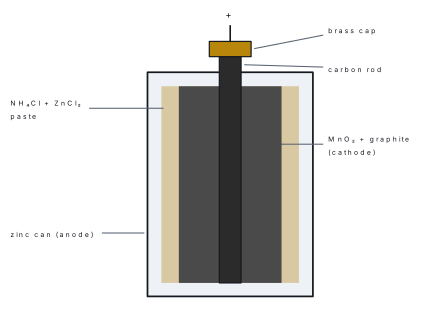
The dry cell. The zinc container is itself the anode; a central carbon rod with MnO₂ and graphite powder is the cathode; the paste of NH₄Cl and ZnCl₂ is the electrolyte.
- Anode: Zn → Zn²⁺ + 2e⁻
- Cathode: 2MnO₂ + 2H⁺ + 2e⁻ → Mn₂O₃ + H₂O
- Overall: Zn + 2MnO₂ + 2NH₄⁺ → Zn²⁺ + Mn₂O₃ + 2NH₃ + H₂O
The zinc can is gradually eaten away, which is why an old dry cell leaks. It cannot be recharged because the electrode reactions are not easily reversed.
The lead–acid accumulator. Six cells in series give the familiar 12 V car battery.
- Anode: Pb + SO₄²⁻ → PbSO₄ + 2e⁻
- Cathode: PbO₂ + 4H⁺ + SO₄²⁻ + 2e⁻ → PbSO₄ + 2H₂O
- Overall: Pb + PbO₂ + 2H₂SO₄ → 2PbSO₄ + 2H₂O
Both electrodes become lead(II) sulphate on discharge, and the sulphuric acid is diluted — which is why the density of the electrolyte is used to test the state of charge. Recharging reverses both half-reactions exactly.
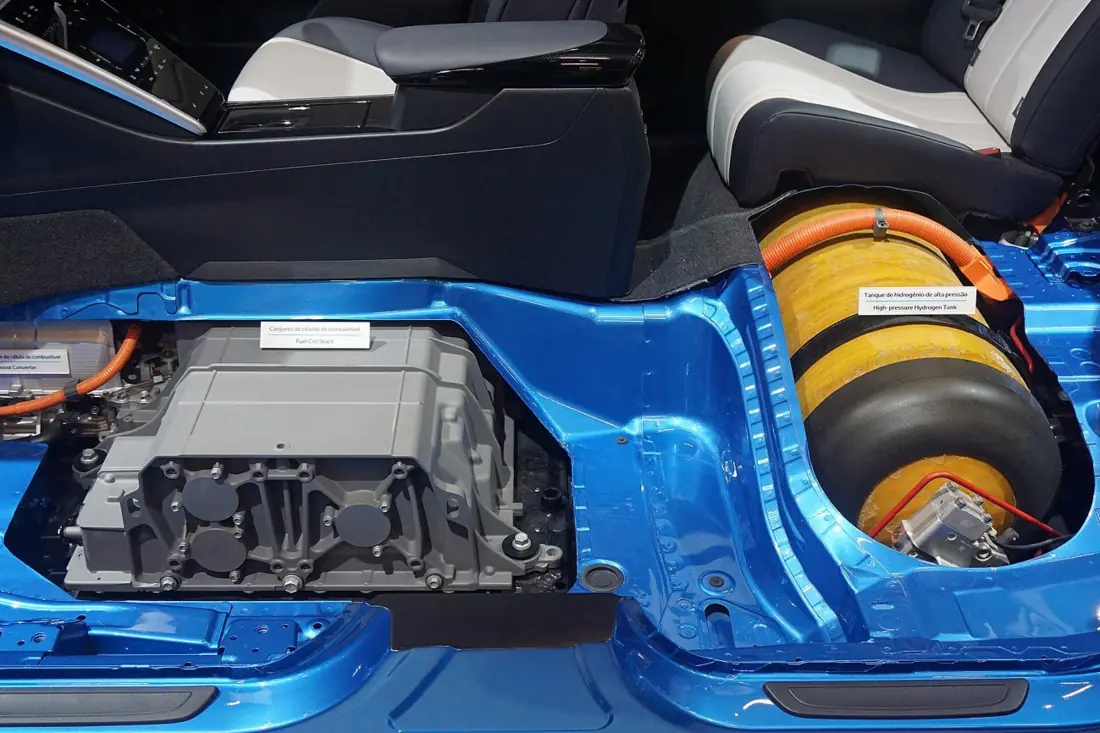
The hydrogen–oxygen fuel cell. Hydrogen is fed to the anode and oxygen to the cathode of porous carbon electrodes; the only product is water.
- Anode (alkaline): 2H₂ + 4OH⁻ → 4H₂O + 4e⁻
- Cathode (alkaline): O₂ + 2H₂O + 4e⁻ → 4OH⁻
- Overall: 2H₂ + O₂ → 2H₂O
Its efficiency is about 70 %, far above the 30–40 % of a heat engine, because it is not limited by the Carnot cycle. Fuel cells powered the Apollo spacecraft and are the model for hydrogen vehicles.
Corrosion as an electrochemical cell
Rusting is not a simple combination of iron with oxygen; it needs both oxygen and water, and it happens through tiny short-circuited galvanic cells on the metal surface.
- At anodic patches (where the metal is strained or less protected), iron dissolves: Fe → Fe²⁺ + 2e⁻.
- The electrons travel through the metal to cathodic patches, where dissolved oxygen is reduced: O₂ + 2H₂O + 4e⁻ → 4OH⁻.
- The ions meet and precipitate iron(II) hydroxide, which is oxidised further by air to hydrated iron(III) oxide — rust, Fe₂O₃·xH₂O.
The water film acts as the electrolyte and the metal itself is the wire, so iron is the anode and is consumed. Anything that makes iron the cathode protects it:
| Method | How it works |
|---|---|
| Galvanising (zinc coating) | zinc has the lower E^\circ (−0.76 V), so it oxidises in place of iron — a sacrificial coating that still protects a scratched surface |
| Cathodic protection | blocks of Mg or Zn are bolted to pipelines and hulls and corrode instead of the steel |
| Painting, greasing, enamelling | keeps out water and oxygen — a barrier, useless once broken |
| Alloying (stainless steel) | chromium forms a thin adherent oxide film that seals the surface |
| Tin plating | tin has a higher E^\circ; it protects only while the coat is intact, and makes rusting faster once scratched |
A tin coating protects iron only as a physical barrier. Once the tin is scratched, the iron — lower in the series — becomes the anode and corrodes faster than it would unprotected. Zinc is the opposite: it keeps protecting even when scratched, because it is sacrificed.
Formula and fact sheet
| Quantity | Relation | Note |
|---|---|---|
| Quantity of electricity | Q = It | coulomb = ampere × second |
| One faraday | F = 96\,500 C mol⁻¹ = N_Ae | charge of 1 mol of electrons |
| Faraday's first law | m = ZIt = \frac{EIt}{96\,500} | Z = electrochemical equivalent |
| Faraday's second law | \frac{m_1}{m_2} = \frac{E_1}{E_2} | same charge, series cells |
| Equivalent weight | E = M/n | n = electrons per formula unit |
| Mass from charge | n(e^-) = \frac{It}{96\,500} | then ÷ n, × M |
| Cell emf | E^\circ_{\text{cell}} = E^\circ_{\text{cathode}} - E^\circ_{\text{anode}} | positive = spontaneous |
| Free energy | \Delta G^\circ = -nFE^\circ | J mol⁻¹ |
| Nernst (298 K) | E = E^\circ - \frac{0.059}{n}\log Q | Q = reaction quotient |
| Equilibrium | E^\circ = \frac{0.059}{n}\log K | at equilibrium E = 0 |
| SHE | 2H⁺ + 2e⁻ → H₂, E^\circ = 0.00 V | 1 M H⁺, 1 atm, 298 K, Pt black |
| Calomel | Hg₂Cl₂ + 2e⁻ → 2Hg + 2Cl⁻ | 0.28 V (1 M KCl), 0.24 V (saturated) |
| Electrolytic cell | Galvanic cell | |
|---|---|---|
| Energy change | electrical → chemical | chemical → electrical |
| Source of drive | external battery | spontaneous redox reaction |
| Anode sign | positive | negative |
| Cathode sign | negative | positive |
| Oxidation | at the anode | at the anode |
| Reduction | at the cathode | at the cathode |
| Electron flow (external) | anode → battery → cathode | anode → cathode |
| Example | electrolysis of brine | Daniell cell, dry cell |
Numbers worth carrying in: 1 F = 96 500 C; 1 F deposits 108 g Ag, 31.75 g Cu, 9 g Al, 1 g H₂ (11.2 L at STP), 8 g O₂ (5.6 L at STP), 35.5 g Cl₂ (11.2 L at STP); dry cell 1.5 V; lead–acid 2 V per cell (12 V for six); lithium-ion 3.7 V; H₂–O₂ fuel cell 1.23 V.
Chapter summary
- An electrolytic cell uses electrical energy to drive a non-spontaneous reaction; the anode is positive and the cathode negative, but oxidation is at the anode and reduction at the cathode in every cell.
- Products of electrolysis follow preferential discharge: the ion with the higher E^\circ is reduced at the cathode; with inert electrodes in water, O₂ appears at the anode unless a concentrated halide gives Cl₂, Br₂ or I₂.
- Faraday's first law: m = ZIt with Z = E/96\,500; second law: m_1/m_2 = E_1/E_2, and one faraday deposits one gram equivalent.
- E^\circ is a reduction potential measured against the SHE (0.00 V; 1 M H⁺, 1 atm H₂, 298 K, Pt black); the calomel electrode is a portable secondary reference at about 0.24 V.
- The electrochemical series gives reactivity, displacement, cell emf and electrolysis products; higher E^\circ gains electrons, lower E^\circ loses them.
- E^\circ_{\text{cell}} = E^\circ_{\text{cathode}} - E^\circ_{\text{anode}}; positive means spontaneous; E^\circ is intensive, so doubling a half-reaction leaves it unchanged.
- Nernst: E = E^\circ - (0.059/n)\log Q at 298 K; \Delta G^\circ = -nFE^\circ; at equilibrium E = 0 and E^\circ = (0.059/n)\log K.
- Primary cells (dry cell 1.5 V, alkaline) cannot be recharged; secondary cells (lead–acid 2 V per cell, lithium-ion) can; fuel cells (H₂–O₂) run continuously and give only water.
- Rusting is an electrochemical cell with iron as the anode; galvanising and cathodic protection work by sacrificing a metal with a lower E^\circ.
Practice questions
Set A — Recall (25 questions)
- In an electrolytic cell, oxidation takes place at theacathodebanodecsalt bridgedelectrolyte
- In a galvanic cell, the cathode is the electrode whereaoxidation occursbelectrons leave the cellcreduction occursdzinc dissolves
- The SI unit of quantity of electricity is theacoulombbamperecvoltdfarad
- One faraday is equal toa1 Cb9 650 Cc6.02 × 10²³ Cd96 500 C
- Faraday's first law states that the mass deposited at an electrode is proportional to theacurrent onlybtime onlycquantity of electricity passeddequivalent weight
- The electrochemical equivalent of a substance is the mass deposited bya1 coulombb1 amperec96 500 coulombd1 mole of electrons
- The standard hydrogen electrode is assigned a potential ofa1.00 Vb−0.76 Vc+0.34 Vd0.00 V
- In the standard hydrogen electrode, the H⁺ concentration and the H₂ pressure area0.1 M and 1 atmb1 M and 1 atmc1 M and 0.1 atmd0.1 M and 0.1 atm
- Standard electrode potentials are quoted asareduction potentialsboxidation potentialscionisation potentialsddissociation potentials
- The calomel electrode is used as aaprimary standardbfuel cellcsecondary reference electrodedsalt bridge
- The potential of the saturated calomel electrode at 25 °C is abouta0.00 Vb0.28 Vc0.80 Vd0.24 V
- Metals placed above hydrogen in the electrochemical seriesaare noblebdisplace hydrogen from dilute acidsccannot be oxidiseddhave positive E^\circ values
- The emf of the cell Zn | Zn²⁺ || Cu²⁺ | Cu isa0.42 Vb0.76 Vc1.10 Vd1.56 V
- The standard emf of a cell is given byaE^\circ_{\text{cathode}} - E^\circ_{\text{anode}}bE^\circ_{\text{anode}} - E^\circ_{\text{cathode}}cE^\circ_{\text{cathode}} + E^\circ_{\text{anode}}dtheir product
- A lead–acid accumulator is an example of aaprimary cellbfuel cellcdry celldsecondary cell
- The electrolyte in a lead–acid battery isadilute HClbdilute H₂SO₄cNH₄Cl pastedmolten NaCl
- The fuel used at the anode of a hydrogen–oxygen fuel cell isahydrogenbmethanecmethanoldammonia
- In the Leclanché dry cell the anode is theacarbon rodbMnO₂ powderczinc candgraphite powder
- The emf of a single lead–acid cell is abouta1.5 Vb2.0 Vc1.1 Vd12 V
- Rusting of iron is essentiallyaa thermal decompositionba photochemical changeca simple combination with oxygendan electrochemical process
- In the rusting of iron, the iron acts as theaanodebcathodecelectrolytedsalt bridge
- The Nernst equation at 298 K isaE = E^\circ - 0.059n\log QbE = E^\circ - \frac{0.059}{n}\log QcE = E^\circ + \frac{0.059}{n}\log QdE = E^\circ - \frac{n}{0.059}\log Q
- The relation between standard free-energy change and standard emf isa\Delta G^\circ = nFE^\circb\Delta G^\circ = -nE^\circc\Delta G^\circ = -FE^\circ/nd\Delta G^\circ = -nFE^\circ
- The charge carried by one mole of electrons is calledaone coulombbone amperecone faradaydone volt
- Which of these is a primary cell?aLeclanché dry cellblead–acid accumulatorcnickel–cadmium celldlithium-ion cell
Answers and explanations — Set A
1. (b) — Oxidation is loss of electrons and always happens at the anode. In an electrolytic cell the anode is the electrode connected to the positive terminal.
2. (c) — Reduction at the cathode in every cell. In a galvanic cell the cathode is positive and electrons arrive there from the external circuit.
3. (a) — The coulomb is the unit of charge; the ampere is charge per second.
4. (d) — 96 500 C, the charge on one mole of electrons (N_A e).
5. (c) — m = ZQ, and Q = It, so mass depends on current and time only through the charge they produce.
6. (a) — Z = E/96\,500 is the mass per coulomb. The mass per mole of electrons is the equivalent weight itself.
7. (d) — Zero, by definition; it is the reference against which every other electrode is quoted.
8. (b) — Unit activity of H⁺ (1 M in practice), H₂ at 1 atm, 298 K, on platinum black.
9. (a) — IUPAC uses reduction potentials. An oxidation potential is the same number with the sign reversed.
10. (c) — It is a secondary reference: stable and portable, but its potential is about +0.24 V, not zero.
11. (d) — 0.2415 V for the saturated electrode; 0.28 V is the 1 M KCl value.
12. (b) — They have negative E^\circ and are oxidised by H⁺. Copper and silver lie below hydrogen and do not.
13. (c) — 0.34 - (-0.76) = 1.10 V. Option (b) is the zinc potential alone; (d) is the Zn–Ag cell.
14. (a) — Cathode minus anode, which is the same as right minus left in cell notation.
15. (d) — It is rechargeable, so it is a secondary cell. Primary cells cannot be recharged.
16. (b) — Dilute sulphuric acid; both electrodes become PbSO₄ on discharge and the acid is diluted.
17. (a) — Hydrogen is oxidised at the anode and oxygen reduced at the cathode; the only product is water.
18. (c) — The zinc container is oxidised to Zn²⁺. The carbon rod is the cathode, where MnO₂ is reduced.
19. (b) — 2 V per cell; six in series give the 12 V car battery.
20. (d) — Anodic and cathodic sites on the surface form short-circuited galvanic cells, with iron as the anode.
21. (a) — Iron dissolves as Fe²⁺ and releases electrons, so it is oxidised and is the anode.
22. (b) — E = E^\circ - \frac{0.059}{n}\log Q; the sign is negative because the emf falls as products accumulate.
23. (d) — \Delta G^\circ = -nFE^\circ; the negative sign shows that a spontaneous cell releases free energy.
24. (c) — One faraday, 96 500 C mol⁻¹.
25. (a) — The dry cell cannot be recharged. The other three are secondary cells.
Set B — Understanding (15 questions)
- In both galvanic and electrolytic cells, oxidation always occurs at theacathodebpositive electrode of a galvanic cellcanodedelectrode joined to the negative terminal
- E^\circ for Zn²⁺ + 2e⁻ → Zn is −0.76 V. For 2Zn²⁺ + 4e⁻ → 2Zn, E^\circ isa−0.76 Vb−1.52 Vc−0.38 Vd+0.76 V
- A galvanic cell has E^\circ_{\text{cell}} = +1.10 V. The cell reaction isanon-spontaneousbat equilibriumcspontaneous only on heatingdspontaneous
- The salt bridge in a galvanic cellacarries electrons between the electrodesbcompletes the circuit and keeps the solutions neutralcblocks all ion movementdsupplies the driving voltage
- Copper does not displace hydrogen from dilute hydrochloric acid becauseaits E^\circ lies above that of hydrogenbit is too densecit forms a covalent hydridedits E^\circ lies below that of hydrogen
- In the electrolysis of concentrated aqueous NaCl with inert electrodes, the gas at the cathode isaCl₂bO₂cH₂dHCl
- In the electrolysis of aqueous CuSO₄ using copper electrodes, the concentration of CuSO₄afalls steadilybstays unchangedcrises steadilydfalls to zero
- The same current passes through two cells in series. The masses of copper and silver deposited are in the ratio of theiraatomic massesbmolar massescvalenciesdequivalent weights
- E^\circ is +0.80 V for silver and −0.76 V for zinc. In a cell built from them, zincais the cathodebis reducedcis oxidised and is the anodeddoes not react
- The calomel electrode is preferred to the hydrogen electrode because itais compact and needs no hydrogen supplybhas a potential of exactly zerocis a primary celldcontains no mercury
- A cell reaction has E^\circ_{\text{cell}} = 0.20 V. The reaction isaat equilibriumbnon-spontaneouscimpossibledspontaneous with a small driving force
- The overall reaction in a hydrogen–oxygen fuel cell isa2H₂O → 2H₂ + O₂b2H₂ + O₂ → 2H₂OcH₂ + O₂ → H₂O₂d2H₂ + O₂ → 2H₂O₂
- Galvanising protects iron because zincais oxidised in place of ironbis less reactive than ironcforms an alloy with ironddissolves oxygen
- The notation Zn | Zn²⁺(1 M) || Cu²⁺(1 M) | Cu shows thatazinc is the cathodebthe double line is a wireczinc is the anode and copper the cathodedelectrons flow from copper to zinc
- When a galvanic cell has reached equilibrium, its emf isamaximumbequal to E^\circcnegativedzero
Answers and explanations — Set B
1. (c) — Oxidation is loss of electrons, and the electrode where electrons are released is the anode by definition, whatever its charge.
2. (a) — E^\circ is intensive. Doubling the coefficients doubles both \Delta G^\circ and n, so \Delta G^\circ = -nFE^\circ leaves E^\circ unchanged.
3. (d) — A positive E^\circ_{\text{cell}} gives a negative \Delta G^\circ, which is the condition for spontaneity.
4. (b) — Ions move through the bridge to balance charge; electrons never travel through it.
5. (a) — Copper's E^\circ is +0.34 V, above hydrogen's 0.00 V, so H⁺ cannot oxidise it. Zinc, at −0.76 V, can be oxidised and does displace hydrogen.
6. (c) — Water is reduced in preference to Na⁺: 2H₂O + 2e⁻ → H₂ + 2OH⁻. Chlorine appears at the anode.
7. (b) — Copper dissolves at the anode and is deposited at the cathode at the same rate, so the concentration is unchanged. This is the basis of electro-refining.
8. (d) — Faraday's second law: equal charge deposits masses in the ratio of equivalent weights, 31.75 : 108, not of molar masses.
9. (c) — The lower E^\circ is oxidised, so zinc is the anode and dissolves; silver is deposited at the cathode.
10. (a) — No gas supply, no fragile platinum black, and a steady reproducible potential — hence "secondary reference".
11. (d) — Positive but small: spontaneous, with a modest driving force. \Delta G^\circ = -nF(0.20) is negative but not large.
12. (b) — Hydrogen is oxidised, oxygen reduced, and water is the only product.
13. (a) — Zinc has the lower E^\circ and is sacrificed, so it protects iron even where the coating is broken.
14. (c) — Anode on the left, cathode on the right; the double bar is the salt bridge, and electrons flow from zinc to copper in the wire.
15. (d) — At equilibrium Q = K and the Nernst equation gives E = 0; the cell is flat.
Set C — Application (10 questions)
- A current of 9.65 A is passed through AgNO₃ solution for 100 s. The mass of silver deposited is (Ag = 108)a2.16 gb1.08 gc0.54 gd10.8 g
- The charge needed to deposit 1.0 g of copper from CuSO₄ is (Cu = 63.5, F = 96 500)a1 520 Cb96 500 Cc6 080 Cd3 040 C
- The time needed to deposit 0.635 g of copper at 1.0 A is (Cu = 63.5)a1 930 sb965 sc3 860 sd96.5 s
- In the electrolysis of acidified water, 965 C liberates at STPa224 mL H₂ and 112 mL O₂b56 mL H₂ and 112 mL O₂c112 mL H₂ and 56 mL O₂d112 mL of each
- For the cell Zn | Zn²⁺ || Ag⁺ | Ag, E^\circ_{\text{cell}} is (E^\circ: Zn = −0.76 V, Ag = +0.80 V)a0.04 Vb1.56 Vc0.76 Vd1.10 V
- For the Daniell cell (E^\circ = 1.10 V, n = 2), \Delta G^\circ is abouta−212 kJ mol⁻¹b−106 kJ mol⁻¹c+212 kJ mol⁻¹d−424 kJ mol⁻¹
- For Zn | Zn²⁺(0.01 M) || Cu²⁺(1 M) | Cu at 298 K, the emf is abouta1.16 Vb1.10 Vc1.04 Vd0.96 V
- The mass of aluminium deposited by 96 500 C from AlCl₃ is (Al = 27)a27 gb13.5 gc54 gd9.0 g
- A current of 2.0 A flows for 30 min through CuSO₄ solution. The mass of copper deposited is (Cu = 63.5)a2.37 gb1.18 gc0.59 gd4.74 g
- Three cells in series carry the same charge. The masses of Ag, Cu and Al deposited are in the ratio (Ag = 108, Cu = 63.5, Al = 27)a108 : 63.5 : 27b1 : 2 : 3c108 : 31.75 : 9d54 : 31.75 : 27
Answers and explanations — Set C
1. (b) — Q = 9.65 \times 100 = 965 C = 0.010 mol e⁻; Ag⁺ + e⁻ → Ag gives 0.010 mol = 1.08 g. Option (a) doubles it by using n = 1 twice.
2. (d) — 1.0/63.5 = 0.0157 mol Cu, needing 0.0315 mol e⁻; Q = 0.0315 \times 96\,500 = 3040 C. Option (a) forgets that two electrons are needed per copper ion.
3. (a) — 0.635/63.5 = 0.010 mol Cu → 0.020 mol e⁻ → 1930 C, and at 1.0 A that is 1930 s. Option (b) uses one electron per copper.
4. (c) — 965 C = 0.010 mol e⁻; H₂ = 0.005 mol = 112 mL, O₂ = 0.0025 mol = 56 mL, the 2 : 1 volume ratio of water.
5. (b) — 0.80 - (-0.76) = 1.56 V. Option (a) subtracts the magnitudes instead of the signed values; (d) is the Zn–Cu cell.
6. (a) — \Delta G^\circ = -nFE^\circ = -2(96\,500)(1.10) = -2.12 \times 10^5 J mol⁻¹. Option (b) forgets the factor n = 2.
7. (a) — E = 1.10 - \frac{0.059}{2}\log(0.01) = 1.10 + 0.059 = 1.16 V. Option (c) subtracts instead of adding.
8. (d) — 96 500 C = 1 mol e⁻; Al³⁺ + 3e⁻ → Al gives 1/3 mol = 9 g. Option (a) ignores the three electrons.
9. (b) — Q = 2.0 \times 1800 = 3600 C = 0.0373 mol e⁻ → 0.0187 mol Cu = 1.18 g. Option (a) uses 63.5 g per mole of electrons.
10. (c) — Faraday's second law: masses ∝ equivalent weights, 108 : 31.75 : 9. Option (a) uses molar masses and ignores the valencies.