Chapter 18 · Organic Chemistry · 4 questions in the paper · 30 min read
Haloalkanes, Haloarenes, Alcohols, Phenols and Ethers
What the syllabus asks for 5
- Monohaloalkanes: nomenclature, isomerism, preparation and properties; SN1 and SN2 mechanisms
- Chloroform and chlorobenzene
- Monohydric alcohols: preparation and properties; oxo process, hydroboration–oxidation and fermentation; types of ethanol
- Phenol: preparation and properties
- Ethers: Williamson's synthesis and the properties of diethyl ether
This is a 4-question chapter built around one bond competition: carbon–halogen bonds can be replaced by carbon–oxygen bonds, and the resulting alcohols, phenols and ethers then show how structure controls acidity, hydrogen bonding and reactivity. Learn haloalkanes by mechanism (SN1, SN2, elimination), chloroform and chlorobenzene by their special traps, and oxygen compounds by asking whether oxygen carries H (alcohol/phenol) or bridges two carbons (ether).
- Monohaloalkanes are named as halo-substituted alkanes and classified 1°, 2° or 3° by the carbon bearing X. C₄H₉Cl has four structural isomers; 2-chlorobutane is chiral, so five stereoisomers exist in total.
- For the same R, nucleophilic substitution reactivity is generally RI > RBr > RCl >> RF because C–X lengthens/weakens and halide leaving-group ability improves down the group.
- SN2: one concerted backside-attack step, rate = k[RX][Nu], inversion of configuration, methyl/1° fastest, strong nucleophile and polar aprotic solvent favoured. SN1: ionization to a planar carbocation is rate-determining, rate = k[RX], 3°/allylic/benzylic fastest, racemization/rearrangement possible, polar protic solvent favoured.
- Haloalkane conversions: aqueous OH⁻ → alcohol; KCN → nitrile (chain +1 C); AgCN → isocyanide; NH₃ → amines; alkoxide → ether; alcoholic KOH → alkene; Mg/dry ether → Grignard reagent; reduction → alkane; Na/dry ether → Wurtz coupling.
- Chloroform is made by chlorinating/hydrolysing ethanol or propanone with bleaching powder. In air/light it oxidizes to poisonous phosgene, so it is stored dark with about 1% ethanol stabilizer. With a primary amine and alcoholic KOH it gives the foul carbylamine (isocyanide) test; with phenol/KOH it is the Reimer–Tiemann reagent.
- Chlorobenzene is made by Cl₂/FeCl₃ chlorination or from a diazonium salt (CuCl). Its C–Cl bond has partial double-bond character and the carbon is sp², so ordinary SN1/SN2 fails; Dow's process needs aqueous NaOH at about 623 K under pressure to reach phenol.
- Monohydric alcohols (one –OH, CₙH₂ₙ₊₂O for saturated acyclic members) are isomeric with ethers. Industrial routes: alkene hydration (Markovnikov), hydroboration–oxidation (anti-Markovnikov), the oxo process (alkene + CO + H₂ → aldehyde → primary alcohol, one extra carbon) and fermentation by yeast enzymes.
- Alcohol landmarks: Na → alkoxide + H₂; conc. H₂SO₄ with ethanol gives ethene at 443 K but ethoxyethane with excess ethanol at 413 K; oxidation 1° → aldehyde → acid, 2° → ketone, 3° resists mild oxidation. Lucas reagent (conc. HCl/ZnCl₂): 3° cloudy at once, 2° in minutes, 1° essentially clear at room temperature.
- Ethanol forms: rectified spirit is the 95.6% azeotrope; absolute alcohol is nearly water-free; denatured/methylated spirit is made undrinkable; power alcohol is an ethanol–petrol fuel blend.
- Phenol is made industrially mainly from cumene (co-product propanone), and in school preparations from chlorobenzene (Dow), benzenesulfonate fusion or a diazonium salt. It is acidic (pKₐ ≈ 10): dissolves in NaOH but does not effervesce with NaHCO₃.
- Phenol signatures: violet colour with neutral FeCl₃; bromine water → white 2,4,6-tribromophenol; Kolbe–Schmitt (CO₂/NaOH, then acid) → salicylic acid; Reimer–Tiemann (CHCl₃/KOH) → salicylaldehyde; diazonium coupling → orange azo dye.
- Williamson ether synthesis is SN2: an alkoxide/phenoxide attacks a preferably primary alkyl halide. Diethyl ether is volatile, forms explosive peroxides in air/light, forms oxonium salts with strong acids, and is cleaved by hot concentrated HI.
18.1 Monohaloalkanes: nomenclature, isomerism, preparation and properties; SN1 and SN2
A monohaloalkane replaces one H of an alkane by F, Cl, Br or I. The substitutive name uses a halo- prefix: CH₃CH₂CHBrCH₃ is 2-bromobutane and (CH₃)₃CCl is 2-chloro-2-methylpropane. If halogens differ, cite alphabetically. The class 1°, 2° or 3° is read from the carbon carrying halogen, regardless of chain length. Two structural cousins deserve separate labels: allylic/benzylic halides (X on a saturated carbon next to a π system) ionize unusually easily, while vinylic/aryl halides (X directly on sp² carbon) resist normal substitution.
The C–X bond is polarized Cδ+–Xδ−, so carbon is electrophilic. Bond enthalpy and length pull in opposite educational directions: C–F is shortest and strongest; C–I is longest and easiest to break, and I⁻ is also a weak, stable base — an excellent leaving group. Haloalkanes cannot donate hydrogen bonds and are mostly insoluble in water, despite being polar; boiling points increase with size and polarizability.
Preparation
- From alkanes: Cl₂ or Br₂ with UV/heat gives radical substitution, usually as a mixture.
- From alkenes: HX adds by Markovnikov orientation (HBr/peroxide reverses orientation); X₂ gives a vicinal dihalide rather than a monohaloalkane.
- From alcohols: HCl/ZnCl₂, HBr, red P/I₂, PCl₃/PCl₅ or SOCl₂ replace –OH by halogen. SOCl₂ is often clean for chlorides because SO₂ and HCl leave as gases.
- Halogen exchange: NaI in acetone converts RCl/RBr to RI (Finkelstein), driven by precipitation of NaCl/NaBr from acetone; AgF-type reagents can install F (Swarts).
Substitution mechanisms: SN2 versus SN1
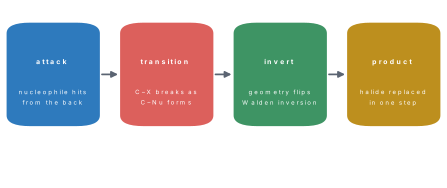
SN2 is a single choreographed step. The nucleophile approaches carbon from the side opposite the leaving group; the C–Nu bond forms as the C–X bond breaks through one pentacoordinate transition state. Because attack occurs from behind, a stereogenic carbon undergoes Walden inversion. Crowding defines the rate order methyl > 1° > 2° >> 3°; even a primary neopentyl halide is slow because bulk one carbon away blocks the backside. Polar aprotic solvents (acetone, DMF, DMSO) solvate the counter-cation more than the anionic nucleophile and therefore often accelerate SN2.
SN1 begins with slow heterolysis to a planar carbocation. The nucleophile can then attack either face, so an optically active secondary/tertiary substrate tends toward racemization (often with some excess inversion because the leaving group may still shield one face as an ion pair). Carbocation stability gives the order 3° ≈ benzylic/allylic > 2° >> 1°/methyl, and hydride or alkyl shifts may rearrange the skeleton before capture. Water/alcohols help by solvating both ions; the nucleophile need not appear in the rate law because it arrives after the slow step.
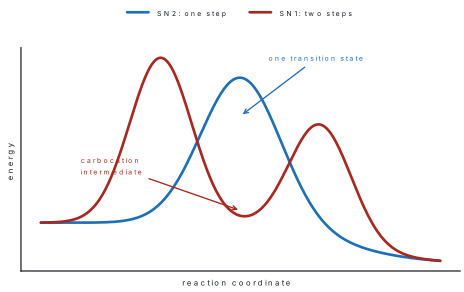
| Evidence | SN1 | SN2 |
|---|---|---|
| Rate law | k[RX] | k[RX][Nu] |
| Substrate order | 3° > 2° >> 1°, methyl | Methyl > 1° > 2° >> 3° |
| Stereochemistry | Racemization (planar ion) | Inversion |
| Rearrangement | Common if a better cation exists | No carbocation, so no ionic rearrangement |
| Solvent that helps | Polar protic | Polar aprotic for anionic nucleophiles |
| Nucleophile strength | Less important to rate | Stronger nucleophile, faster reaction |
Substitution competes with elimination. Hot alcoholic KOH removes HX, usually to the Saytzeff alkene. Heat, a strong/bulky base and a tertiary substrate push toward elimination; a strong non-bulky nucleophile in a polar aprotic solvent pushes a primary substrate toward SN2. Exam questions are often decided by spotting aqueous vs alcoholic KOH: aqueous favours alcohol formation, alcoholic favours alkene formation.
Useful conversions from RX include RON with aqueous hydroxide; RCN with ethanolic KCN (the one-carbon homologation used before hydrolysis to an acid in Ch. 19); RNC with AgCN because the ambident cyanide attacks through N under covalent AgCN conditions; amines with excess NH₃ (over-alkylation is the practical problem); ethers with alkoxides; alkyl nitrites with KNO₂ but mainly nitroalkanes with AgNO₂ (the same ambident-ion logic); thiols/thioethers with KSH/RSNa; alkanes by reduction; coupled alkanes by Wurtz reaction; and RMgX with Mg in dry ether, the Grignard doorway to Ch. 20.
Problem. Predict the pathway and product when (i) CH₃Br and (ii) (CH₃)₃CBr react with aqueous KOH.
Solution. (i) Methyl bromide offers an unhindered backside and cannot form CH₃⁺ usefully, so SN2 gives methanol. (ii) tert-Butyl bromide cannot be attacked from behind, but it ionizes to a tertiary carbocation; water/hydroxide capture gives tert-butanol by SN1 (alkene by elimination becomes important on heating with alcoholic base). The substrate, not a memorized halide label, chooses the mechanism.
Problem. Fermentation runs C₆H₁₂O₆ → 2 C₂H₅OH + 2 CO₂ under yeast zymase. From 90 g of glucose (M = 180), what masses of ethanol and carbon dioxide form? Why does the brew stop near 15 % alcohol? Solution. 90 g glucose = 0.5 mol; the equation doubles it: 1 mol ethanol = 46 g and 1 mol CO₂ = 44 g (the bubbles of bread and beer alike). The brew stalls because ethanol itself denatures the yeast's enzymes near 15 % — the product poisoning the catalyst, which is why distillation, not fermentation, makes spirits strong.
18.2 Chloroform and chlorobenzene
Chloroform, CHCl₃ (trichloromethane)
Industrial chloroform comes from methane chlorination. The laboratory preparation heats ethanol or propanone with bleaching powder and water, then distils. Bleaching powder does three jobs: it supplies chlorine, oxidizes ethanol to ethanal, chlorinates the methyl group to a trichloromethyl carbonyl compound, and its Ca(OH)₂ cleaves that intermediate. From ethanol the sequence passes through chloral, CCl₃CHO, which alkali splits into CHCl₃ and formate; propanone similarly gives CHCl₃ and acetate. This is the same haloform logic as the iodoform test in Ch. 19.
Chloroform is a dense, volatile, sweet-smelling, nonflammable liquid once used as an anaesthetic but abandoned for liver/cardiac toxicity. Its most important storage reaction is slow oxidation in air and light:
2CHCl₃ + O₂ → 2COCl₂ + 2HCl.
The product COCl₂ is phosgene, a war-gas-level pulmonary poison. Chloroform is therefore kept in dark, nearly full bottles with about 1% ethanol: ethanol converts traces of phosgene into comparatively harmless diethyl carbonate. On strong heating with concentrated HNO₃, chloroform gives chloropicrin, CCl₃NO₂. Hot aqueous KOH hydrolyses it to potassium formate. Zinc/HCl reduces it stepwise (first toward CH₂Cl₂), while silver powder couples two molecules to ethyne (Ch. 17).
Alcoholic KOH removes HCl from CHCl₃ to make highly reactive dichlorocarbene, :CCl₂. That intermediate powers two name reactions: the carbylamine reaction, in which a primary amine with CHCl₃/alcoholic KOH forms an intensely foul isocyanide (a test for a primary amine), and the Reimer–Tiemann formylation of phenol in §18.4.
Chlorobenzene, C₆H₅Cl
Benzene with Cl₂/FeCl₃ in the dark gives chlorobenzene by electrophilic substitution. Industrially, the Raschig–Hooker process passes benzene, HCl and air over a copper catalyst. In the laboratory it is also made from benzene diazonium chloride with CuCl/HCl (Sandmeyer reaction, Ch. 20).
Chlorobenzene looks like “CH₃Cl on a ring” only in a formula-counting sense. The C–Cl bond is shorter/stronger because a chlorine lone pair conjugates with the ring (partial C=Cl character), the carbon is sp², a phenyl cation would place positive charge in an orbital that cannot be resonance-stabilized by the ring, and the ring blocks backside SN2 attack. Hence aqueous KOH at room temperature does nothing useful. Dow's process forces hydrolysis with aqueous NaOH near 623 K and about 300 atm, giving sodium phenoxide and then phenol on acidification. Nitro groups ortho/para to Cl can change the story by stabilizing an addition intermediate for nucleophilic aromatic substitution — a contrast worth one line and no more at this level.
The ring still does electrophilic substitution, more slowly than benzene and under ortho/para direction by Cl (Ch. 17). Sodium in dry ether couples two molecules to biphenyl (Fittig); chlorobenzene plus an alkyl halide/Na gives an alkylbenzene (Wurtz–Fittig). Reduction can return benzene. Condensation of two molecules of chlorobenzene with chloral in concentrated H₂SO₄ gives DDT, historically a powerful insecticide and now a standard example of persistence and bioaccumulation in environmental chemistry (Ch. 21).
18.3 Monohydric alcohols: preparation and properties; oxo process, hydroboration–oxidation, fermentation and types of ethanol
A monohydric alcohol has one hydroxyl group. It is primary, secondary or tertiary from the carbon bearing –OH. The –OH group makes alcohols polar, hydrogen-bonding liquids with much higher boiling points and greater water solubility than comparable hydrocarbons/ethers; both effects fade as the hydrocarbon chain grows. Ethanol's complete miscibility with water is a small-chain privilege, not a property of every alcohol.
Preparation, with the regiochemistry made explicit
- Acid-catalysed hydration of alkenes gives Markovnikov alcohol. Ethene is hydrated industrially with steam over H₃PO₄ on a support at high temperature/pressure to ethanol.
- Hydroboration–oxidation (BH₃·THF or B₂H₆, then H₂O₂/OH⁻) adds H and OH across C=C in a syn, concerted manner. Boron attaches to the less hindered carbon and oxidation replaces B by OH with retention at that carbon, so the net result is anti-Markovnikov alcohol without carbocation rearrangement. Ethene gives ethanol; propene gives propan-1-ol.
- Oxo process (hydroformylation): an alkene + CO + H₂ over Co/Rh catalysis inserts a formyl carbon to make an aldehyde with one more carbon; hydrogenation then gives the primary alcohol. Ethene → propanal → propan-1-ol is the clean school example. Modern phosphine-modified rhodium catalysts favour the straight-chain aldehyde used for detergent alcohols and plasticizers.
- From haloalkanes: aqueous KOH/NaOH substitution, best for primary substrates; tertiary systems may eliminate.
- By reduction: aldehydes give primary alcohols and ketones secondary alcohols with H₂/catalyst, NaBH₄ or LiAlH₄; esters/acids need stronger reduction (Ch. 19). Grignard addition to carbonyl compounds builds more complex alcohols (Ch. 20).
- From primary amines: nitrous acid replaces –NH₂ by –OH with N₂ evolution, but carbocation rearrangement/alkene by-products make it a better test than preparation.
Fermentation is enzyme chemistry. Yeast invertase hydrolyses sucrose to glucose and fructose; zymase then converts glucose anaerobically:
C₆H₁₂O₆ → 2C₂H₅OH + 2CO₂.
Starch from grain/potato must first be malted/enzymatically saccharified to sugars. Rising ethanol inhibits yeast, so naturally fermented liquor stops near 12–15% alcohol; stronger spirit requires distillation. This route now also supplies fuel bioethanol, with a food-versus-fuel and land-use debate that belongs in Ch. 21.
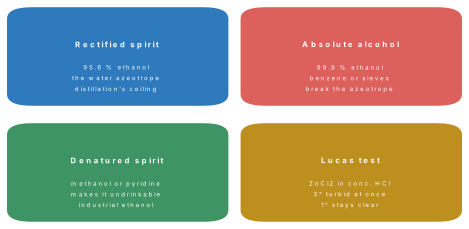
Types of ethanol. Distillation cannot pass the ethanol–water azeotrope at about 95.6% ethanol, called rectified spirit. Removing the last water (azeotropic distillation, drying agents or molecular sieves) gives absolute alcohol. Denatured alcohol/methylated spirit contains methanol and bitter/aversive additives so industrial ethanol is not diverted for drinking; denaturing does not make it safe — methanol metabolizes to formic acid and can blind or kill. Power alcohol is ethanol blended with petrol as motor fuel; modern E10-type blends are its descendants.
Chemical properties
Alcohols are very weak acids (ethanol pKₐ ≈ 16) and weak bases at oxygen. Sodium gives an alkoxide and hydrogen more gently than with water: 2ROH + 2Na → 2RONa + H₂. Alkoxides are strong bases and good nucleophiles (the Williamson reagents of §18.5).
Substitution of –OH. –OH is a poor leaving group until protonated or converted by a reagent such as SOCl₂/PCl₅/PBr₃. With HX the alcohol order is 3° > 2° > 1° because the mechanism leans SN1 under acidic aqueous conditions, and HX reactivity is HI > HBr > HCl. Lucas reagent (concentrated HCl + anhydrous ZnCl₂) turns that order into a stopwatch: tertiary alcohol clouds immediately as insoluble alkyl chloride forms, secondary in about five minutes, primary remains clear at room temperature. Allylic/benzylic primary alcohols can break the simple stopwatch by forming stabilized cations.
Dehydration with conc. H₂SO₄/Al₂O₃ gives alkenes, ease 3° > 2° > 1°, commonly Saytzeff. Ethanol is the condition trap: excess ethanol with conc. H₂SO₄ at about 413 K gives ethoxyethane by intermolecular dehydration, whereas excess acid at about 443 K gives ethene by intramolecular dehydration.
Oxidation distinguishes the classes. A primary alcohol under controlled conditions (PCC, or distillation away from oxidant) stops at the aldehyde; strong aqueous K₂Cr₂O₇/KMnO₄ carries it to the carboxylic acid. A secondary alcohol gives a ketone. A tertiary alcohol has no H on the carbinol carbon and resists mild oxidation, preferring dehydration under hot acid. Passing vapours over heated Cu dehydrogenates 1° → aldehyde and 2° → ketone; a tertiary alcohol dehydrates to an alkene. Ethanol and other CH₃–CH(OH)– alcohols give the iodoform test (yellow CHI₃) with I₂/NaOH because they are oxidized to a methyl carbonyl compound in situ.
The older Victor Meyer distinction converts ROH to RI, then to RNO₂ with AgNO₂, and treats with HNO₂/alkali: primary gives a red nitrolic-acid salt, secondary a blue pseudonitrol, tertiary remains essentially colourless. It is longer than Lucas and now largely of examination-historical interest.
18.4 Phenol: preparation and properties
Phenol is hydroxybenzene — not a typical alcohol. The –OH oxygen is attached to sp² carbon, its lone pair conjugates with the ring, and the phenoxide ion is resonance-stabilized. Those two facts make phenol much more acidic and its ring much more reactive to electrophiles than ethanol/benzene comparisons might suggest.
Preparation. The dominant industrial route is the cumene process: benzene + propene → cumene (isopropylbenzene); air oxidation to cumene hydroperoxide; acid-catalysed cleavage to phenol + propanone. School preparations remain valuable mechanisms in miniature: chlorobenzene by Dow's process; sodium benzenesulfonate fused with NaOH and acidified; and benzene diazonium chloride warmed with water, releasing N₂ to give phenol.
Phenol forms colourless, hygroscopic crystals (m.p. about 43 °C) that pinken on oxidation in air. It is only moderately soluble in cold water, is corrosive to skin (the old name is carbolic acid) and was Lister's original surgical antiseptic — now replaced by safer agents.
Acidity. Phenol (pKₐ ≈ 10.0) is about a million times stronger an acid than ethanol because phenoxide delocalizes charge to ortho/para ring carbons and because the ring carbon is sp². It reacts with Na to give H₂ and with NaOH to form soluble sodium phenoxide, but it does not liberate CO₂ from NaHCO₃: carbonic acid (first pKₐ ≈ 6.4) is stronger, so CO₂ passed into phenoxide actually reprotonates it to phenol. Electron-withdrawing –NO₂ groups increase phenol acidity (2,4,6-trinitrophenol is picric acid, pKₐ ≈ 0.4); electron-donating methyl groups make cresols slightly weaker acids.
Reactions at oxygen and at the ring. Zinc dust distillation removes oxygen to benzene. Ammonia under forcing catalytic conditions can replace –OH by –NH₂ (aniline). Phenol is acylated by acetic anhydride/acyl chlorides to phenyl esters; benzoyl chloride in aqueous NaOH gives phenyl benzoate by Schotten–Baumann conditions. Sodium phenoxide undergoes Kolbe–Schmitt carboxylation with CO₂ under pressure/heat; acidification gives salicylic acid, the precursor of aspirin. With CHCl₃/KOH, dichlorocarbene chemistry gives mainly salicylaldehyde (Reimer–Tiemann). With phthalic anhydride/conc. H₂SO₄ it condenses to phenolphthalein, colourless in acid and pink in alkali. Diazonium salts couple at the para position in mild alkali to give orange azo dyes.
The strongly activating –OH group directs ortho/para. Bromine water is decolorized instantly and white 2,4,6-tribromophenol precipitates — even with dilute phenol — because water partly converts phenol to the still more reactive phenoxide. Dilute HNO₃ gives o-/p-nitrophenols; concentrated acid pushes toward picric acid. Sulfonation is reversible and condition-dependent. Neutral FeCl₃ gives an intense violet/purple coloration, a standard phenol test; Libermann's nitroso test (NaNO₂/conc. H₂SO₄, then dilution/alkali) gives the classic blue-green to red colour play.
Use NaHCO₃ deliberately: a carboxylic acid effervesces and dissolves as its salt; phenol does not. NaOH dissolves phenol as phenoxide. That two-reagent ladder — NaHCO₃, then NaOH — is an entire qualitative-analysis answer.
18.5 Ethers: Williamson synthesis and properties of diethyl ether
An ether has C–O–C connectivity. Symmetrical ethers have the same group on both sides; unsymmetrical ethers differ and show metamerism with other ethers/alcohols of the same formula. In substitutive IUPAC names ethoxyethane (not the casual “diethyl ether” alone) makes the smaller alkoxy side explicit; CH₃OC₆H₅ is methoxybenzene (anisole).
Williamson synthesis treats an alkoxide or phenoxide with an alkyl halide. Mechanistically it is SN2, so the halide partner should be methyl or primary — and never an aryl halide. The disconnection is chosen accordingly: to make tert-butyl ethyl ether, use sodium tert-butoxide + ethyl iodide, not sodium ethoxide + tert-butyl iodide (which eliminates). Phenoxide + CH₃I gives anisole, whereas CH₃O⁻ + chlorobenzene fails because the aryl C–Cl bond will not undergo backside attack.
Diethyl ether is prepared commercially by continuous dehydration of ethanol with conc. H₂SO₄ near 413 K (excess ethanol, ether distilled out) and by Williamson from sodium ethoxide + ethyl bromide. It is a very volatile liquid (b.p. 34.6 °C), only slightly soluble in water, an excellent solvent for organics and Grignard reagents, and a former anaesthetic. Having no O–H bond, it cannot donate hydrogen bonds to itself; hence its boiling point is far below its functional isomer butan-1-ol (b.p. 117 °C).
Ethers are relatively inert — that is why they are solvents — but oxygen is a Lewis base. Cold concentrated H₂SO₄ or HCl forms soluble oxonium salts. Concentrated HBr and especially HI cleave C–O: with two identical ethyl groups, one equivalent of hot conc. HI gives ethanol + ethyl iodide first, and excess/hotter HI converts the ethanol too, netting two ethyl iodide molecules (water takes the oxygen). PCl₅ can convert diethyl ether to ethyl chloride. Chlorine in the dark substitutes α-hydrogens to chlorinated ethers.
The safety reaction is slow autoxidation in air/light at the α-C–H bond to hydroperoxides and polymeric peroxides. They concentrate in the still pot and may explode on heating or friction. Store ether dark, cool and tightly closed; test old stock for peroxide and never distil an ether to dryness. The same warning returns in laboratory-safety questions because it is a real accident mechanism, not a textbook ornament.
Five swaps the paper sets: aqueous KOH substitutes (alcohol), alcoholic KOH eliminates (alkene) — same halide, different destiny; SN1 racemises (planar cation, both faces), SN2 inverts (backside attack); the iodoform test catches ethanol and methyl carbinols/ketones, not methanol or propan-1-ol; phenol brominates three times in water but once in CS₂, the solvent taming the ring; and Williamson synthesis needs a primary halide — tertiary partners eliminate instead of substituting.
Problem. A student attempts to prepare tert-butyl methyl ether by heating tert-butyl bromide with sodium methoxide (\text{CH}_3\text{ONa}). What major product actually forms, and what reagent pair must be used instead?
Solution. Because tert-butyl bromide is 3^\circ and \text{CH}_3\text{O}^- is a strong base, E2 elimination dominates to give 2-methylpropene ((\text{CH}_3)_2\text{C=CH}_2). Williamson synthesis requires an unhindered (1^\circ/methyl) halide: react sodium tert-butoxide ((\text{CH}_3)_3\text{CONa}) with iodomethane (\text{CH}_3\text{I}) via S_N2.
Formula and fact sheet
| Topic | Must-know |
|---|---|
| SN1 vs SN2 | SN1: cation, k[RX], 3° fast, racemize/rearrange. SN2: backside, k[RX][Nu], methyl/1° fast, invert |
| RX exits | aq KOH → ROH; alc KOH → alkene; KCN → RCN; AgCN → RNC; RO⁻ → ether; Mg → RMgX; Na → Wurtz alkane |
| CHCl₃ | From ethanol/propanone + bleaching powder; air/light → phosgene; 1% ethanol stabilizer; :CCl₂ for carbylamine/Reimer–Tiemann |
| C₆H₅Cl | Strong short C–Cl, no easy SN; Dow NaOH 623 K/pressure → phenol; Fittig → biphenyl; + chloral → DDT |
| Alcohol prep | Hydration Markovnikov; hydroboration–oxidation anti-Markovnikov; oxo +CO then reduce; fermentation C₆H₁₂O₆ → 2EtOH + 2CO₂ |
| Ethanol grades | Rectified 95.6%; absolute dry; denatured undrinkable; power alcohol = fuel blend |
| Alcohol tests | Lucas 3° instant > 2° minutes > 1° clear; oxidation 1° aldehyde/acid, 2° ketone, 3° resistant; EtOH iodoform positive |
| Phenol | Cumene process (+ acetone); NaOH yes, NaHCO₃ no; FeCl₃ violet; Br₂ water white tribromophenol; Kolbe salicylic acid; Reimer–Tiemann salicylaldehyde |
| Ethers | Williamson RO⁻ + primary RX; ethoxyethane b.p. 34.6 °C; HI cleaves; old ether may contain explosive peroxides |
Rapid-revision tables and high-yield facts
| Item | Rule or value |
|---|---|
| SN2 | one step, inversion, 1° fastest |
| SN1 | two steps, racemisation, 3° fastest |
| C–X reactivity | RI > RBr > RCl |
| Best halide prep | SOCl₂ (gaseous by-products) |
| Chloroform storage | dark bottle, ethanol, vs phosgene |
| Dow process | chlorobenzene → phenol, 350 °C |
| Rectified spirit | 95.6 % ethanol azeotrope |
| Hydroboration | anti-Markovnikov alcohol |
| Phenol + Br₂ water | 2,4,6-tribromophenol |
| Williamson | RONa + 1° R'X |
Chapter summary
- Monohaloalkanes react through a mechanistic fork: unhindered substrates invite concerted SN2 backside attack, while cation-stabilizing substrates ionize in SN1; bases and heat open the elimination side-road.
- The leaving-group order RI > RBr > RCl >> RF and the aqueous/alcoholic KOH distinction settle a large share of conversion questions.
- Chloroform's examination identity is haloform preparation, phosgene formation in air and dichlorocarbene reactions; chlorobenzene's is a strong aryl C–Cl bond that refuses ordinary substitution until Dow conditions.
- Alcohols combine hydrogen bonding with four reaction exits — alkoxide formation, substitution, dehydration and oxidation — whose class orders identify 1°, 2° and 3° alcohols.
- Hydroboration–oxidation and hydration are regiochemical opposites, the oxo process adds a carbon before reduction, and fermentation is enzyme-limited ethanol production.
- Phenol's acidity and ring activation both flow from conjugation with the ring: phenoxide is stabilized, NaHCO₃ is not decomposed, and bromine water gives instant tribromination.
- Williamson synthesis succeeds when the SN2 partner is chosen as the less hindered halide; diethyl ether is a useful inert solvent whose peroxide formation is its defining hazard.
Practice questions
Set A — Recall (25 questions)
- A primary haloalkane has the halogen attached to a carbon bonded to how many other carbons?athreebfourctwodone
- For the same alkyl group, the usual order of reactivity in nucleophilic substitution isaRI > RBr > RCl >> RFbRF > RCl > RBr > RIcRCl > RI > RF > RBrdall equal
- The Finkelstein reaction commonly uses NaI inawaterbbenzene onlycacetonedconcentrated acid
- The rate law for an SN2 reaction isak[RX] onlybk[RX][nucleophile]ck[nucleophile] onlydindependent of both
- The key intermediate in an SN1 reaction is aacarbocationbcarbanioncfree radical onlydcarbene only
- SN2 attack at a stereogenic carbon normally causesaretention alwaysbelimination onlyccomplete racemization onlydinversion of configuration
- Chloroform slowly oxidizes in air and light to the poisonous gasachlorinebphosgeneccarbon monoxide onlydhydrogen cyanide
- Chloroform for storage is commonly stabilized with about 1% ofaphenolbethercethanoldbleach
- Chlorobenzene is prepared directly from benzene using Cl₂ in the presence ofasunlightbFeCl₃cNaNH₂daqueous KOH
- Dow's process converts chlorobenzene to phenol using aqueous NaOH at high temperature andapressureblow pressurecUV lightdelectrolysis only
- Ethanol with excess concentrated H₂SO₄ at about 443 K gives mainlyaethoxyethanebethanoic acidcethanaldethene
- Lucas reagent is concentrated HCl with anhydrousaFeCl₃bAlCl₃cZnCl₂dCuSO₄
- Hydroboration–oxidation of a terminal alkene gives theaanti-Markovnikov alcoholbMarkovnikov alcoholcketone onlydalkyne
- In the oxo process, an alkene reacts with CO and H₂ to form first anaesterbepoxidecaldehydedamine
- The yeast enzyme system that converts glucose to ethanol and CO₂ is calledadiastasebzymasecureasedinvertase only
- Rectified spirit contains about what percentage of ethanol?a40%b100%c70%d95.6%
- Denatured alcohol is ethanol made unfit for drinking by adding substances such asasugarbwater onlycmethanol and bitterantsdcarbon dioxide
- The cumene process for phenol gives the valuable co-productaethanolbpropanonecbenzenedformaldehyde
- Phenol does not liberate CO₂ fromaNaHCO₃bNaOHcNa metaldhot water
- Phenol with bromine water gives a white precipitate ofabromobenzenebpicric acidco-bromophenol onlyd2,4,6-tribromophenol
- Neutral FeCl₃ with phenol gives a characteristic colour that isagreen onlybvioletcorange onlydcolourless
- The Kolbe–Schmitt reaction of sodium phenoxide gives, after acidification,abenzoic acidbphthalic acidccinnamic aciddsalicylic acid
- The Reimer–Tiemann reaction converts phenol mainly intoasalicylic acidbchlorobenzenecsalicylaldehydedanisole
- Williamson synthesis combines an alkoxide with an alkylahalidebalcoholcaldehydednitrile
- Old diethyl ether exposed to air may contain explosiveaozonides onlybhydridescperoxidesdcarbides
Answers and explanations — Set A
1. (d) — primary means the C–X carbon is attached to one other carbon (CH₃X is the methyl special case).
2. (a) — weaker/longer C–X bonds and better leaving groups down the halogen group.
3. (c) — NaCl/NaBr precipitate from acetone and pull the exchange forward.
4. (b) — both partners meet in the single rate-determining transition state.
5. (a) — slow ionization precedes nucleophile capture.
6. (d) — backside attack turns the tetrahedron inside out (Walden inversion).
7. (b) — COCl₂ formation is why light/air exposure is a storage emergency.
8. (c) — ethanol scavenges phosgene to diethyl carbonate.
9. (b) — the Lewis acid polarizes Cl₂ for electrophilic aromatic substitution.
10. (a) — roughly 623 K and 300 atm force aryl C–Cl hydrolysis.
11. (d) — intramolecular dehydration wins at the higher temperature with excess acid.
12. (c) — ZnCl₂ helps convert –OH into a better leaving group under strongly acidic conditions.
13. (a) — boron, later replaced by OH, goes to the less substituted carbon.
14. (c) — hydroformylation adds H and –CHO across the double bond; reduction then gives the alcohol.
15. (b) — invertase acts earlier on sucrose; zymase is the glucose-to-ethanol enzyme system.
16. (d) — the ethanol–water minimum-boiling azeotrope.
17. (c) — methanol/pyridine/bitterants deter drinking; the mixture remains poisonous.
18. (b) — cumene hydroperoxide cleavage gives phenol and acetone, both saleable.
19. (a) — phenol is weaker than carbonic acid, so bicarbonate does not deprotonate it with effervescence.
20. (d) — all activated ortho/para positions brominate in aqueous medium.
21. (b) — a coloured iron–phenoxide complex.
22. (d) — ortho carboxylation gives o-hydroxybenzoic (salicylic) acid.
23. (c) — o-hydroxybenzaldehyde, through dichlorocarbene generated from CHCl₃/KOH.
24. (a) — specifically an SN2-suitable, preferably primary, alkyl halide.
25. (c) — α-hydroperoxide formation is the reason old ether is treated as hazardous waste.
Set B — Understanding (15 questions)
- RI reacts faster than RCl in many substitutions mainly because the C–I bond is weaker/longer and I⁻ is aastronger basebsmaller ioncbetter leaving groupdstronger nucleophile toward protons
- Methyl halides react fastest by SN2 mainly because the carbon undergoing attack isatertiarybaromaticcmost able to form a carbocationdleast sterically hindered
- Tertiary halides react fastest by SN1 mainly because they form the most stableacarbocationbcarbanioncalkene onlydtransition metal complex
- An optically active secondary halide may racemize in SN1 because the carbocation intermediate isatetrahedralbplanar and attacked from either facecbonded to halogendconverted to an alkane
- A polar protic solvent favours SN1 chiefly byahiding the substratebmaking the nucleophile bulkycremoving waterdsolvating/stabilizing the ions formed
- Chlorobenzene resists hydrolysis by aqueous NaOH under mild conditions because its C–Cl bond has partial double-bond character and the carbon isasp³bsp² with an unstable phenyl-cation routecmetallicdfully ionic
- In laboratory chloroform preparation, bleaching powder performs oxidation, chlorination and alkalineareduction onlybpolymerizationchydrolysis/cleavagednitration
- Butan-1-ol boils much higher than its isomer ethoxyethane mainly because alcohol molecules can form intermolecularahydrogen bondsbionic bondscC=C bondsdcoordinate bonds to carbon
- Tertiary alcohols dehydrate more readily than primary alcohols under acid mainly because an E1-like pathway passes through a more stableaalkoxidebcarbocationcaldehydedradical anion
- Controlled oxidation of a primary alcohol can be stopped at the aldehyde; excess strong aqueous oxidant usually continues to theacarboxylic acidbketonecalkanedether
- Ethanol gives the iodoform test although it is not a methyl ketone because the reagent first oxidizes it toamethanolbethyl iodide onlycethanedethanal (a CH₃CO– precursor)
- Phenol is far more acidic than ethanol because phenoxide is stabilized byahydrogen bonding onlyba positive chargecresonance with the ringdprecipitation
- p-Nitrophenol is more acidic than phenol mainly because –NO₂awithdraws electrons and stabilizes phenoxidebdonates electronscadds a protondblocks ionization
- Phenol undergoes electrophilic substitution much faster than benzene because –OH is a strongameta directorbalkyl groupcleaving groupd+R activating group
- Williamson synthesis with a tertiary alkyl halide usually fails to give the ether because the basic alkoxide causesaSN2 accelerationbelimination to an alkenecoxidationdaromatic substitution
Answers and explanations — Set B
1. (c) — leaving-group quality tracks the stability/weak basicity of the departing anion and the ease of C–X cleavage.
2. (d) — the backside trajectory is open; SN1 arguments point the other way for CH₃⁺.
3. (a) — hyperconjugation/+I donation from three alkyl groups stabilizes the ion.
4. (b) — loss of tetrahedral information at a planar sp² centre produces both configurations.
5. (d) — hydrogen-bond donation and high polarity lower the ionization barrier.
6. (b) — resonance strengthens C–Cl, SN2 geometry is blocked and phenyl cations are prohibitively unstable.
7. (c) — the trichlorinated carbonyl intermediate is cleaved by alkali to chloroform and a carboxylate.
8. (a) — ether oxygen can accept but not donate an H-bond to another ether molecule.
9. (b) — protonated –OH leaves as water most easily when the resulting cation is tertiary.
10. (a) — aldehydes hydrate/oxidize further under aqueous dichromate or permanganate conditions.
11. (d) — CH₃CH(OH)– compounds are iodoform-positive for the same reason after oxidation.
12. (c) — charge is delocalized to ortho/para carbons in phenoxide, unlike localized ethoxide.
13. (a) — para –NO₂ can withdraw by both induction and resonance from phenoxide.
14. (d) — lone-pair donation raises ring electron density, especially at ortho/para positions.
15. (b) — an SN2-inaccessible halide plus a strong base is an E2 invitation; swap which partner carries the tert-butyl group.
Set C — Application (10 questions)
- Counting stereoisomers separately, the total number of monochlorobutane isomers (C₄H₉Cl) isa4b5c6d8
- 2-Bromo-2-methylpropane with warm aqueous KOH gives mainlyabutan-2-olb2-methylpropene onlyc2-methylpropan-2-oldbutan-1-ol
- CH₃Br with KCN in ethanol gives mainlyaethanenitrilebmethyl isocyanidecmethanedmethylamine directly
- Hydroboration–oxidation of propene givesapropan-2-olbpropanalcpropanonedpropan-1-ol
- Ethene subjected to the oxo process and then hydrogenation givesaethanolbpropan-2-olcpropan-1-oldbutan-1-ol
- An alcohol gives instant cloudiness with Lucas reagent and resists mild oxidation. It is most likelyatertiarybprimarycsecondarydmethanol
- Excess ethanol heated with concentrated H₂SO₄ at about 413 K gives mainlyaethenebethanalcethanoic aciddethoxyethane
- Sodium phenoxide + CO₂ under pressure, followed by acidification, givesabenzoic acidbsalicylic acidcsalicylaldehydedaspirin directly
- Phenol + CHCl₃/aqueous KOH, followed by acid workup, gives mainlyasalicylaldehydebchlorobenzenecbenzoic aciddphenyl acetate
- Sodium phenoxide + CH₃I givesatoluenebmethoxybenzene (anisole)ciodobenzenedphenylethanone
Answers and explanations — Set C
1. (b) — four constitutional isomers, and 2-chlorobutane contributes an enantiomeric pair: 3 + 2 = 5.
2. (c) — SN1 capture of the tertiary cation by water/hydroxide gives tert-butanol under aqueous conditions.
3. (a) — CH₃–C≡N has two carbons; ionic KCN attacks through carbon rather than giving the isocyanide.
4. (d) — net anti-Markovnikov hydration places –OH on C1.
5. (c) — CO contributes the extra carbon: ethene → propanal → propan-1-ol.
6. (a) — rapid SN1 chloride formation and no carbinol C–H for normal oxidation identify a tertiary alcohol.
7. (d) — intermolecular dehydration at the lower temperature; 443 K would give ethene.
8. (b) — Kolbe–Schmitt ortho carboxylation.
9. (a) — Reimer–Tiemann ortho formylation via dichlorocarbene.
10. (b) — Williamson methylation of phenoxide; the ring is not methylated at carbon under these conditions.