Unit 1 · General and Physical Chemistry · 8 teaching hours · 26 min read
Volumetric Analysis
What the syllabus asks for 7
- Introduction to gravimetric analysis, volumetric analysis and equivalent weight
- Relationship between equivalent weight, atomic weight and valency
- Equivalent weight of compounds: acid, base, salt, oxidizing and reducing agents
- Concentration units: percentage, g/L, molarity, molality, normality, formality, ppm and ppb
- Primary and secondary standard substances
- Law of equivalence and normality equation
- Titration and its types: acid-base titration, redox titration (with numerical problems)
Quantitative analysis answers one question: how much of something is present. This unit teaches the volume-measuring route to that answer. You take a solution of accurately known concentration, run it into a measured volume of the unknown until the reaction is exactly complete, read the burette, and turn that reading into a mass or a percentage. Everything after this — the arithmetic of equivalents, the concentration units, the choice of indicator — exists only to make that one reading trustworthy.
Two marks-rich things appear almost every year: an equivalent-weight / n-factor question (very often KMnO₄ in different media), and a titration numerical solved with N_1V_1 = N_2V_2. Learn to write the n-factor of any species in five seconds and the numericals become one-line problems.
1.1 Introduction to gravimetric analysis, volumetric analysis and equivalent weight
Analytical chemistry splits into two halves. Qualitative analysis asks what is present; quantitative analysis asks how much. Classical quantitative analysis then splits again, according to what you actually measure on the bench.
Gravimetric analysis is the quantitative estimation of a substance by measuring the mass of a pure, stable compound of known composition into which the substance has been converted.
Volumetric analysis (also called titrimetric analysis) is the quantitative estimation of a substance by measuring the volume of a solution of known concentration that reacts exactly with it.
In a gravimetric estimation of sulphate, for example, the sulphate is precipitated as barium sulphate, and the precipitate is filtered, washed, ignited and weighed:
BaCl₂ + Na₂SO₄ → BaSO₄↓ + 2NaCl
From the mass of BaSO₄ (molar mass 233) the mass of SO₄²⁻ (96) follows by simple proportion. Chloride is estimated the same way as AgCl, and iron as Fe₂O₃.
| Feature | Gravimetric analysis | Volumetric analysis |
|---|---|---|
| Quantity measured | Mass of a precipitate | Volume of a standard solution |
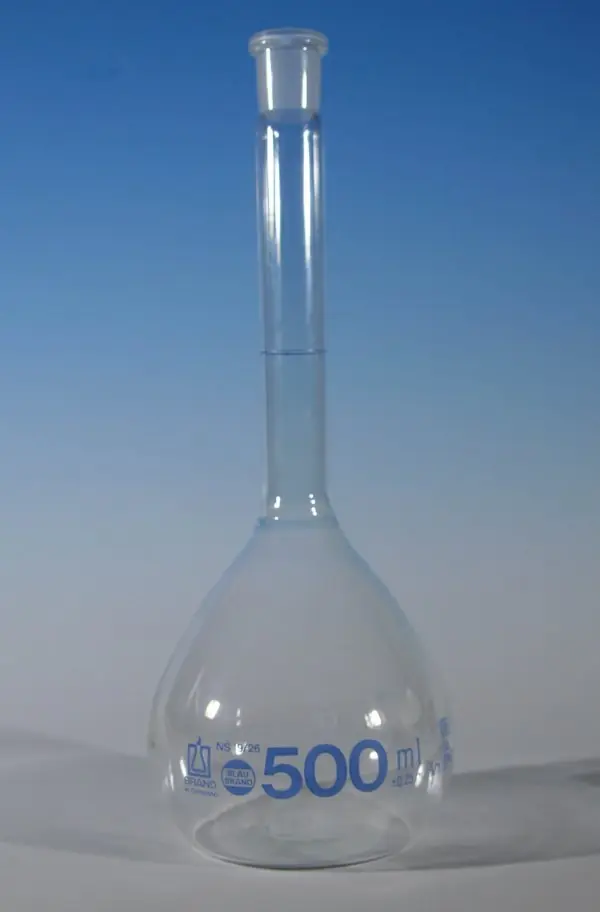
| Chief apparatus | Analytical balance, crucible, furnace | Burette, pipette, volumetric flask |
| Speed | Slow (hours to days) | Fast (minutes) |
| Accuracy | Very high (to 0.01 mg) | High (to about 0.1 %) |
| Indicator needed | No | Usually yes |
| Suits | Small numbers of very accurate results | Routine repeated analysis |
Volumetric work needs a common currency in which "exactly enough" can be expressed. That currency is the equivalent.
The equivalent weight (E) of a substance is the number of parts by mass of it that combine with or displace 1.008 parts by mass of hydrogen, 8 parts of oxygen, or 35.5 parts of chlorine.
Expressed as a mass in grams it is called one gram equivalent. In modern language,
where the n-factor is the number of "reacting units" the species supplies per formula unit.
Equivalent weight is a pure number (a relative mass), so it has no unit; the gram equivalent has the unit g.
1.2 Relationship between equivalent weight, atomic weight and valency
One atom of hydrogen has valency 1 and a relative atomic mass of 1.008, so by definition one equivalent of hydrogen is 1.008. Now take an element X of atomic weight A and valency v. One atom of X combines with v atoms of hydrogen, so A parts of X combine with 1.008v parts of hydrogen. Therefore the mass of X that combines with 1.008 parts of hydrogen is A/v:
Rearranged, this gives the two forms the board also asks for:
| Element | Atomic weight | Valency | Equivalent weight |
|---|---|---|---|
| H | 1.008 | 1 | 1.008 |
| O | 16 | 2 | 8 |
| Cl | 35.5 | 1 | 35.5 |
| Mg | 24 | 2 | 12 |
| Al | 27 | 3 | 9 |
| Ca | 40 | 2 | 20 |
| Fe (ferrous) | 56 | 2 | 28 |
| Fe (ferric) | 56 | 3 | 18.67 |
Iron has two equivalent weights because it shows two valencies, and KMnO₄ has three because it is reduced to a different product in acidic, neutral and strongly alkaline media. Always ask "in which reaction?" before quoting an equivalent weight. Atomic weight and molar mass are fixed; equivalent weight is not.
1.3 Equivalent weight of compounds: acid, base, salt, oxidizing and reducing agents
For a compound, replace "valency" by the n-factor — the number of reacting units the formula unit supplies. What counts as a unit depends on the class of compound.
| Class | n-factor is | E = |
|---|---|---|
| Acid | basicity = number of replaceable H⁺ | molar mass / basicity |
| Base | acidity = number of replaceable OH⁻ | molar mass / acidity |
| Salt | total positive (or negative) charge per formula unit | molar mass / total charge |
| Oxidising agent | number of electrons gained per formula unit | molar mass / electrons gained |
| Reducing agent | number of electrons lost per formula unit | molar mass / electrons lost |
Worked values you should know by heart:
| Substance | Molar mass | n-factor | Equivalent weight |
|---|---|---|---|
| HCl | 36.5 | 1 | 36.5 |
| H₂SO₄ | 98 | 2 | 49 |
| H₃PO₄ (full neutralisation) | 98 | 3 | 32.67 |
| NaOH | 40 | 1 | 40 |
| Ca(OH)₂ | 74 | 2 | 37 |
| Na₂CO₃ | 106 | 2 | 53 |
| CaCO₃ | 100 | 2 | 50 |
| Al₂(SO₄)₃ | 342 | 6 | 57 |
| K₂Cr₂O₇ (acid medium) | 294 | 6 | 49 |
| H₂C₂O₄·2H₂O (as reductant) | 126 | 2 | 63 |
| FeSO₄·7H₂O (as reductant) | 278 | 1 | 278 |
| Mohr's salt FeSO₄·(NH₄)₂SO₄·6H₂O | 392 | 1 | 392 |
| Na₂S₂O₃·5H₂O (with I₂) | 248 | 1 | 248 |
| I₂ (as oxidant) | 254 | 2 | 127 |
The three equivalent weights of potassium permanganate
KMnO₄ (molar mass 158) is reduced to a different manganese species in each medium, so it gains a different number of electrons:
| Medium | Half reaction | Electrons gained | E |
|---|---|---|---|
| Acidic (dil. H₂SO₄) | MnO₄⁻ + 8H⁺ + 5e⁻ → Mn²⁺ + 4H₂O | 5 | 158/5 = 31.6 |
| Neutral or faintly alkaline | MnO₄⁻ + 2H₂O + 3e⁻ → MnO₂ + 4OH⁻ | 3 | 158/3 = 52.67 |
| Strongly alkaline | MnO₄⁻ + e⁻ → MnO₄²⁻ | 1 | 158/1 = 158 |
Each half reaction is balanced in both mass and charge — check the acidic one: charge on the left is (-1) + 8(+1) + 5(-1) = +2, and on the right +2.
Problem. Calculate the equivalent weight of (a) H₃PO₄ when it reacts with NaOH to give Na₂HPO₄, (b) K₂Cr₂O₇ acting as an oxidising agent in acidic medium, and (c) Na₂CO₃ in its reaction with dilute HCl.
Solution.
(a) 2NaOH + H₃PO₄ → Na₂HPO₄ + 2H₂O. Only two of the three hydrogens are replaced, so the effective basicity is 2, not 3.
(b) The reduction half reaction is Cr₂O₇²⁻ + 14H⁺ + 6e⁻ → 2Cr³⁺ + 7H₂O. Charge check: left (-2) + 14 - 6 = +6; right 2 \times (+3) = +6. Six electrons are gained, so the n-factor is 6:
(c) Na₂CO₃ + 2HCl → 2NaCl + H₂O + CO₂. One formula unit neutralises two H⁺, so the n-factor is 2 (this also equals the total positive charge, 2 \times 1, on the two sodium ions):
1.4 Concentration units: percentage, g/L, molarity, molality, normality, formality, ppm and ppb
Concentration is the amount of solute in a stated amount of solvent or solution. Which unit you choose depends on what you can measure.
| Unit | Symbol | Definition | Usual unit |
|---|---|---|---|
| Percentage by mass | % w/w | mass of solute per 100 g of solution | — |
| Percentage by mass/volume | % w/v | mass (g) of solute per 100 cm³ of solution | — |
| Percentage by volume | % v/v | volume of solute per 100 cm³ of solution | — |
| Strength | S | mass (g) of solute per litre of solution | g L⁻¹ |
| Molarity | M | moles of solute per litre of solution | mol L⁻¹ |
| Molality | m | moles of solute per kilogram of solvent | mol kg⁻¹ |
| Normality | N | gram equivalents of solute per litre of solution | eq L⁻¹ |
| Formality | F | formula masses of solute per litre of solution | mol L⁻¹ |
| Parts per million | ppm | parts of solute per 10⁶ parts of solution | — |
| Parts per billion | ppb | parts of solute per 10⁹ parts of solution | — |
The working formulas:
If a concentrated reagent bottle gives the percentage by mass p and the density d (in g cm⁻³), then one litre of it weighs 1000d g and contains 10pd g of solute, so
Molarity, normality, formality and any "per volume" unit change with temperature, because the volume of the solution expands on heating. Molality, percentage by mass and mole fraction involve only masses, so they are temperature independent. This is a favourite one-mark question.
Formality is used for ionic solids, which contain no discrete molecules. A solution made by dissolving 58.5 g of NaCl in water and making it up to one litre is 1 F, because "one mole of NaCl molecules" does not exist in the solution — only Na⁺ and Cl⁻ ions.
ppm and ppb are for very dilute solutions, and for dilute aqueous solutions (density ≈ 1 g cm⁻³) 1 ppm is the same as 1 mg L⁻¹ and 1 ppb the same as 1 μg L⁻¹. The national standard for arsenic in drinking water in Nepal is 50 ppb, i.e. 0.05 mg of arsenic per litre — a limit set because many Terai tube-wells exceed the 10 ppb WHO guideline.
Worked example 1.2 — preparing a standard solution
Problem. What mass of anhydrous sodium carbonate is required to prepare 250 cm³ of 0.1 N Na₂CO₃ solution?
Solution. Equivalent weight of Na₂CO₃ = 106/2 = 53.
Gram equivalents required = N \times V_{\text{(L)}} = 0.1 \times 0.250 = 0.025 eq.
So 1.325 g is weighed accurately, dissolved in distilled water, and the solution is made up to the 250 cm³ mark of a volumetric flask.
Problem. A bottle of concentrated sulphuric acid is labelled "98 % by mass, density 1.84 g cm⁻³". Calculate its molarity, normality and molality.
Solution. Molar mass of H₂SO₄ = 98 g mol⁻¹, E = 49.
For molality, take 100 g of the acid: it contains 98 g (= 1 mol) of H₂SO₄ and only 2 g (= 0.002 kg) of water.
The huge molality is not a mistake — concentrated sulphuric acid is nearly pure solute, so there is very little solvent to divide by.
1.5 Primary and secondary standard substances
A titration is only as good as the solution whose concentration you claim to know.
A primary standard is a substance of such high purity and stability that a standard solution can be prepared simply by weighing it accurately and dissolving it in a known volume of solvent.
A secondary standard is a substance whose solution cannot be standardised by direct weighing; its concentration must be found by titrating it against a primary standard.
A primary standard must satisfy all of the following:
- Available in a state of high purity (99.9 % or better).
- Stable in air — it must not absorb moisture (hygroscopic), lose water of crystallisation (efflorescent), or absorb CO₂.
- Highly soluble in water, and the solution must be stable on storing.
- A high equivalent weight, so that the weighing error is a small fraction of the mass taken.
- It must react rapidly, completely and in one definite way (stoichiometrically).
| Primary standards | Secondary standards |
|---|---|
| Oxalic acid, H₂C₂O₄·2H₂O | Hydrochloric acid, HCl |
| Anhydrous sodium carbonate, Na₂CO₃ | Sodium hydroxide, NaOH |
| Potassium dichromate, K₂Cr₂O₇ | Potassium permanganate, KMnO₄ |
| Potassium hydrogen phthalate | Sodium thiosulphate, Na₂S₂O₃·5H₂O |
| Silver nitrate, AgNO₃; sodium chloride, NaCl | Iodine solution |
Why the right-hand column fails: NaOH is deliquescent and absorbs CO₂ from the air, so the pellets you weigh are part Na₂CO₃ and part water. Concentrated HCl gives off fumes, so its concentration drifts. KMnO₄ is always slightly contaminated with MnO₂ and is slowly reduced by traces of organic matter in the water, so it is standardised freshly against oxalic acid.
1.6 Law of equivalence and normality equation
In any chemical reaction, substances react in the ratio of their equivalents. One gram equivalent of an acid exactly neutralises one gram equivalent of a base; one gram equivalent of an oxidising agent exactly oxidises one gram equivalent of a reducing agent — whatever the mole ratio in the balanced equation.
Let a volume V_1 (cm³) of a solution of normality N_1 exactly react with a volume V_2 of normality N_2. Since normality is gram equivalents per litre, the number of milliequivalents in a volume V cm³ of normality N is
By the law of equivalence the two must be equal at the end point, so
Writing N = M \times n for each solution gives the equivalent molarity equation
and putting N_1 = N_2 for the same solute before and after adding water gives the dilution formula M_1V_1 = M_2V_2.
The equation N_1V_1 = N_2V_2 needs no balanced equation and no stoichiometric coefficients — that is its whole advantage. But if you substitute molarities into it you will be wrong whenever the n-factors differ. For molarity you must use n_1M_1V_1 = n_2M_2V_2. Mixing the two is the single commonest error in this unit.
Problem. Commercial hydrochloric acid is 11.6 N. What volume of it is needed to prepare 500 cm³ of 0.1 N HCl?
Solution. The number of equivalents does not change on dilution, so
Measure 4.31 cm³ of the concentrated acid, add it to about 200 cm³ of water (never water to acid), then make up to 500 cm³.
1.7 Titration and its types: acid-base titration, redox titration
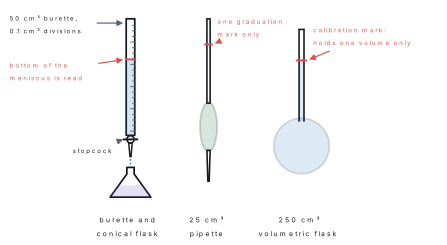
Titration is the process of determining the concentration of a solution by adding to a measured volume of it, from a burette, just enough of a standard solution for the reaction to be exactly complete.
The vocabulary is examined on its own:
| Term | Meaning |
|---|---|
| Titrant | the standard solution in the burette |
| Titrate / analyte | the solution of unknown concentration in the flask |
| Aliquot | the measured portion of analyte delivered by the pipette |
| Equivalence point | the point at which chemically equivalent amounts have reacted |
| End point | the point at which the indicator changes colour — the observed equivalence point |
| Titration error | the (small) difference between end point and equivalence point |
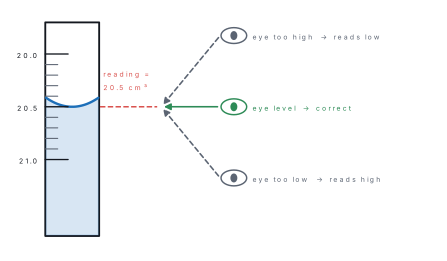
| Concordant readings | two or more burette readings agreeing within 0.1 cm³ |
A titration is repeated until two concordant readings are obtained, and the mean of the concordant readings is used in the calculation. The first, rough titration is discarded.
Types of titration
| Type | Reaction used | Typical example | Indicator |
|---|---|---|---|
| Acid-base (neutralisation) | H⁺ + OH⁻ → H₂O | NaOH vs HCl | phenolphthalein, methyl orange |
| Redox | electron transfer | KMnO₄ vs FeSO₄ | self-indicating |
| Precipitation | formation of an insoluble salt | AgNO₃ vs NaCl | potassium chromate (Mohr) |
| Complexometric | formation of a complex ion | EDTA vs Ca²⁺, Mg²⁺ | Eriochrome black T |
| Iodometric / iodimetric | I₂ ⇌ 2I⁻ | Na₂S₂O₃ vs liberated I₂ | starch (blue-black) |
Acid-base titration
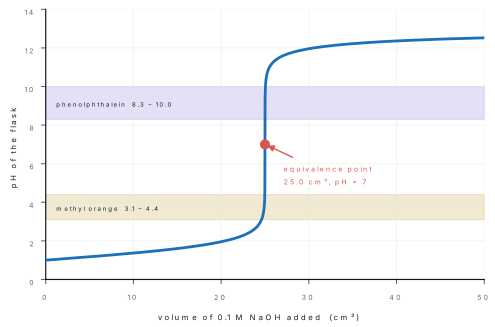
The four possible combinations behave differently near the equivalence point, and this decides the indicator (developed fully in Unit 2):
| Acid vs base | pH at equivalence | Suitable indicator |
|---|---|---|
| Strong acid vs strong base | 7 | methyl orange or phenolphthalein |
| Weak acid vs strong base | > 7 | phenolphthalein |
| Strong acid vs weak base | < 7 | methyl orange |
| Weak acid vs weak base | ≈ 7, no sharp jump | none reliable — use a pH meter |
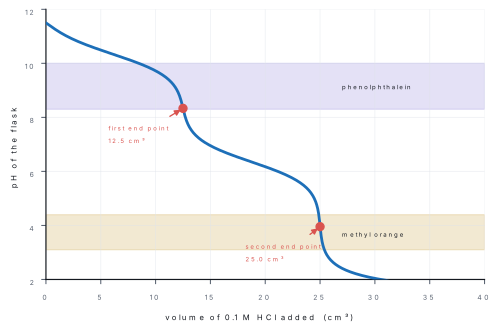
Sodium carbonate is a special case worth knowing, because it is neutralised in two stages and therefore has two end points:
Na₂CO₃ + HCl → NaHCO₃ + NaCl (first stage, pH ≈ 8.3, phenolphthalein)
NaHCO₃ + HCl → NaCl + H₂O + CO₂ (second stage, pH ≈ 4.0, methyl orange)
Phenolphthalein therefore measures half the carbonate and methyl orange measures all of it. This is the basis of the double-indicator method used to analyse mixtures of NaOH, Na₂CO₃ and NaHCO₃.
Problem. 25.0 cm³ of a sodium carbonate solution required 22.5 cm³ of 0.1 N hydrochloric acid for complete neutralisation using methyl orange. Calculate the normality and the strength (in g L⁻¹) of the sodium carbonate solution, and the mass of Na₂CO₃ in 250 cm³ of it.
Solution. Using the normality equation with acid = 1, base = 2:
Equivalent weight of Na₂CO₃ = 53, so
In 250 cm³ (= 0.250 L) the mass is 4.77 \times 0.250 = 1.19\ \text{g}.
Redox titration
Here the titrant oxidises or reduces the analyte, and the n-factor is the number of electrons transferred. The two classic Nepali-syllabus systems are:
Permanganometry. KMnO₄ in dilute sulphuric acid titrated against oxalic acid or a ferrous salt. KMnO₄ is self-indicating: the purple MnO₄⁻ is decolourised as long as reductant remains, and the first permanent pale-pink tinge is the end point.
2KMnO₄ + 5H₂C₂O₄ + 3H₂SO₄ → K₂SO₄ + 2MnSO₄ + 10CO₂ + 8H₂O
2KMnO₄ + 10FeSO₄ + 8H₂SO₄ → K₂SO₄ + 2MnSO₄ + 5Fe₂(SO₄)₃ + 8H₂O
Dichrometry. K₂Cr₂O₇ is a primary standard and its solution keeps indefinitely, but it is not self-indicating; an external or internal redox indicator (diphenylamine) is used.
K₂Cr₂O₇ + 6FeSO₄ + 7H₂SO₄ → K₂SO₄ + Cr₂(SO₄)₃ + 3Fe₂(SO₄)₃ + 7H₂O
Hydrochloric acid is itself oxidised by KMnO₄ (2MnO₄⁻ + 16H⁺ + 10Cl⁻ → 2Mn²⁺ + 5Cl₂ + 8H₂O), so extra permanganate is consumed and the result comes out too high. Nitric acid is an oxidising agent and would oxidise the Fe²⁺ itself. Oxalic acid titrations must also be warmed to 60–70 °C, because the reaction is slow in the cold.
Problem. 20.0 cm³ of 0.1 N KMnO₄ solution was required to oxidise 25.0 cm³ of an oxalic acid solution in hot dilute H₂SO₄. Calculate the normality, molarity and strength of the oxalic acid solution, given that the acid is the dihydrate H₂C₂O₄·2H₂O.
Solution. By the law of equivalence,
Oxalic acid loses 2 electrons per molecule (C₂O₄²⁻ → 2CO₂ + 2e⁻), so its n-factor is 2 and E = 126/2 = 63:
Problem. 3.92 g of pure Mohr's salt, FeSO₄·(NH₄)₂SO₄·6H₂O (molar mass 392), was dissolved in dilute H₂SO₄ and the solution made up to 250 cm³. 25.0 cm³ of this solution required 20.0 cm³ of KMnO₄ solution for oxidation. Find the normality of the KMnO₄ solution and the mass of KMnO₄ in one litre of it.
Solution. Mohr's salt supplies one Fe²⁺ per formula unit and Fe²⁺ loses one electron, so its n-factor is 1 and E = 392.
Equivalents of Mohr's salt taken = 3.92/392 = 0.0100 eq in 250 cm³.
Milliequivalents in the 25.0 cm³ aliquot = 0.04 \times 25.0 = 1.00 meq.
In acidic medium E(\text{KMnO}_4) = 158/5 = 31.6, so the mass per litre is
Chapter summary
- Gravimetric analysis weighs a precipitate; volumetric analysis measures the volume of a standard solution. Volumetric work is faster, gravimetric more accurate.
- E = \text{molar mass}/n\text{-factor}, and for an element E = \text{atomic weight}/\text{valency}. The n-factor is basicity for an acid, acidity for a base, total ionic charge for a salt, and electrons transferred for a redox reagent.
- KMnO₄ has three equivalent weights: 31.6 (acidic, 5e⁻), 52.67 (neutral, 3e⁻) and 158 (strongly alkaline, 1e⁻).
- Key concentration relations: M = w \times 1000/(M_w V_{\text{cm}^3}), N = M \times n, S = N \times E, M = 10pd/M_w, m = 1000M/(1000d - MM_w). Molality and percentage by mass do not change with temperature; molarity and normality do.
- A primary standard (oxalic acid, Na₂CO₃, K₂Cr₂O₇) is pure, stable and of high equivalent weight, so it can be weighed directly; a secondary standard (HCl, NaOH, KMnO₄, Na₂S₂O₃) must be titrated against one.
- Law of equivalence \Rightarrow N_1V_1 = N_2V_2 (milliequivalents when V is in cm³), or n_1M_1V_1 = n_2M_2V_2 in molarities.
- In a permanganate titration, acidify with dilute H₂SO₄ only; KMnO₄ is self-indicating, while K₂Cr₂O₇ needs an indicator but is itself a primary standard.
- Na₂CO₃ titrated with HCl gives two end points: phenolphthalein at the bicarbonate stage (half the carbonate) and methyl orange at complete neutralisation.
Practice questions
Group A — Multiple choice (1 mark each)
- The equivalent weight of KMnO₄ in acidic medium is [1]a158b79c52.67d31.6
- Which of the following is a primary standard substance? [1]aNaOHbHClcK₂Cr₂O₇dKMnO₄
- The concentration unit that does not change with temperature is [1]amolaritybnormalitycmolalitydformality
- A 0.1 M solution of H₂SO₄ is the same as [1]a0.05 Nb0.1 Nc0.2 Nd0.4 N
- In the titration of oxalic acid against KMnO₄ the indicator used is [1]aphenolphthaleinbmethyl orangecstarchdnone — KMnO₄ is self-indicating
- 1 ppm of fluoride in drinking water is the same as [1]a1 g L⁻¹b1 mg L⁻¹c1 μg L⁻¹d1 mol L⁻¹
Answers to Group A
1. (d) — MnO₄⁻ gains 5 electrons, so E = 158/5 = 31.6.
2. (c) — K₂Cr₂O₇ is pure, non-hygroscopic, stable and of high equivalent weight.
3. (c) — molality uses the mass of solvent, and mass does not expand on heating.
4. (c) — N = M \times n = 0.1 \times 2 = 0.2 N.
5. (d) — the purple permanganate colour itself marks the end point.
6. (b) — for dilute aqueous solutions the density is 1 g cm⁻³, so 1 part in 10⁶ = 1 mg per 1000 g ≈ 1 mg L⁻¹.
Group B — Short answer (5 marks each)
- Define equivalent weight. Calculate the equivalent weight of KMnO₄ in acidic, neutral and strongly alkaline media, writing the half reaction in each case. [5]
- What mass of oxalic acid dihydrate is needed to prepare 500 cm³ of a 0.1 N solution? [5]
- 25.0 cm³ of 0.1 N NaOH was exactly neutralised by 20.0 cm³ of sulphuric acid. Calculate the normality, molarity and strength in g L⁻¹ of the acid. [5]
- Distinguish between a primary and a secondary standard substance. Give two examples of each and state why sodium hydroxide cannot be a primary standard. [5]
- Concentrated nitric acid is 70 % by mass and has a density of 1.42 g cm⁻³. Calculate its molarity, and the volume of it needed to prepare 1.00 L of 0.5 M HNO₃. [5]
- Why is only dilute sulphuric acid used to acidify a potassium permanganate titration, and why must an oxalic acid titration be carried out hot? [5]
Answers to Group B
1. Acidic: MnO₄⁻ + 8H⁺ + 5e⁻ → Mn²⁺ + 4H₂O, E = 158/5 = 31.6. Neutral or faintly alkaline: MnO₄⁻ + 2H₂O + 3e⁻ → MnO₂ + 4OH⁻, E = 158/3 = 52.67. Strongly alkaline: MnO₄⁻ + e⁻ → MnO₄²⁻, E = 158/1 = 158.
2. E(\text{H}_2\text{C}_2\text{O}_4\cdot 2\text{H}_2\text{O}) = 126/2 = 63. Equivalents needed = 0.1 \times 0.500 = 0.05, so w = 0.05 \times 63 = 3.15\ \text{g}.
3. N_{\text{acid}} = (0.1 \times 25.0)/20.0 = 0.125\ \text{N}; M = N/n = 0.125/2 = 0.0625\ \text{M}; S = N \times E = 0.125 \times 49 = 6.125\ \text{g L}^{-1}.
4. A primary standard is pure, stable, highly soluble and of high equivalent weight, so a standard solution follows from one accurate weighing (oxalic acid, K₂Cr₂O₇). A secondary standard must be titrated against a primary standard (HCl, KMnO₄). NaOH is deliquescent and absorbs CO₂ from the air to form Na₂CO₃, so the mass weighed is not pure NaOH.
5. M = 10pd/M_w = (10 \times 70 \times 1.42)/63 = 994/63 = 15.78\ \text{M}. For the dilution, M_1V_1 = M_2V_2: V_1 = (0.5 \times 1000)/15.78 = 31.7\ \text{cm}^3.
6. HCl would itself be oxidised by permanganate (2MnO₄⁻ + 16H⁺ + 10Cl⁻ → 2Mn²⁺ + 5Cl₂ + 8H₂O), consuming extra KMnO₄ and giving a high result; HNO₃ is an oxidising agent and would oxidise the reductant in the flask. Only dilute H₂SO₄ merely supplies H⁺. The oxalate–permanganate reaction is very slow at room temperature (it is autocatalysed by the Mn²⁺ it produces), so the flask is warmed to 60–70 °C to get a sharp end point.
Group C — Long answer (8 marks each)
- (a) State the law of equivalence and use it to derive the normality equation N_1V_1 = N_2V_2. [3](b) 1.06 g of anhydrous sodium carbonate was dissolved in water and the solution made up to 250 cm³. 25.0 cm³ of this solution required 20.0 cm³ of hydrochloric acid for complete neutralisation. Calculate the normality of the acid and its strength in g L⁻¹. [5]
- (a) What is a redox titration? Write the balanced equation for the titration of ferrous sulphate with potassium permanganate in acidic medium and give the n-factor of each reagent. [3](b) 2.00 g of an impure sample of Mohr's salt was dissolved in dilute H₂SO₄ and made up to 250 cm³. 25.0 cm³ of this solution required 10.0 cm³ of 0.05 N KMnO₄. Calculate the percentage purity of the sample. [5]
Answers to Group C
1.(b) E(\text{Na}_2\text{CO}_3) = 106/2 = 53, so the equivalents taken are 1.06/53 = 0.0200 eq in 250 cm³, i.e. 20.0 meq.
The 25.0 cm³ aliquot contains 20.0 \times (25.0/250) = 2.00 meq. Therefore
and S = N \times E = 0.100 \times 36.5 = 3.65\ \text{g L}^{-1}.
2.(a) A redox titration is one in which the titrant and analyte react by transfer of electrons, the end point being fixed by a redox indicator or by the titrant's own colour.
2KMnO₄ + 10FeSO₄ + 8H₂SO₄ → K₂SO₄ + 2MnSO₄ + 5Fe₂(SO₄)₃ + 8H₂O
n-factor of KMnO₄ = 5 (MnO₄⁻ + 8H⁺ + 5e⁻ → Mn²⁺ + 4H₂O); n-factor of FeSO₄ = 1 (Fe²⁺ → Fe³⁺ + e⁻).
2.(b) Milliequivalents of KMnO₄ used = 0.05 \times 10.0 = 0.500 meq, so the 25.0 cm³ aliquot contained 0.500 meq of Mohr's salt.
In the full 250 cm³, meq = 0.500 \times 10 = 5.00 meq = 5.00\times10^{-3} eq.
Since E = 392 (n-factor 1), the mass of pure Mohr's salt is
Practise more: Chemistry question bank