Unit 9 · Organic Chemistry · 3 teaching hours · 25 min read
Haloarenes
What the syllabus asks for 7
- Introduction; nomenclature and isomerism
- Preparation of chlorobenzene from benzene and benzene diazonium chloride
- Physical properties
- Low reactivity vs haloalkanes in nucleophilic substitution
- Reduction of chlorobenzene; electrophilic substitution reactions
- Action with Na: Fittig and Wurtz-Fittig reaction; action with chloral
- Uses
A haloarene is what you get when a halogen atom is bonded directly to a carbon of a benzene ring. Chlorobenzene, C₆H₅Cl, is the parent member. On paper it looks like a close cousin of chloroethane, but its chemistry is completely different: it refuses to react with aqueous alkali, silver nitrate gives no precipitate with it, and it will not form a Grignard reagent under ordinary conditions. That single contrast — why is the C–Cl bond of chlorobenzene so unreactive? — is the heart of this short unit, and it is asked in almost every board paper.
Three things, in order of how often they appear: (1) the resonance explanation of the short, strong, low-polarity C–X bond and the resulting low reactivity towards nucleophiles; (2) the named reactions — Sandmeyer/Gattermann, Fittig, Wurtz–Fittig, and chloral → DDT, with correct reagents and conditions; (3) electrophilic substitution, where –Cl is deactivating but ortho–para directing. Learn to write every equation balanced.
9.1 Introduction; nomenclature and isomerism
Organic halogen compounds that contain a benzene ring fall into two families, and telling them apart is the first thing you must do in any question.
| Family | Halogen sits on | Example | Behaviour |
|---|---|---|---|
| Haloarene (aryl halide) | a ring carbon (sp²) | chlorobenzene, C₆H₅Cl | very unreactive to nucleophiles |
| Aralkyl halide (side-chain halide) | a carbon of the side chain (sp³) | benzyl chloride, C₆H₅CH₂Cl | reacts like a haloalkane — very reactive |
C₆H₅CH₂Cl contains a benzene ring, but the chlorine is on the side chain, so it is an aralkyl halide. It gives an instant white precipitate with alcoholic AgNO₃ and is hydrolysed by warm water; chlorobenzene does neither. Examiners set this pair deliberately.
Naming. Number the ring so that the substituents get the lowest possible locants, and cite the halogen as a prefix (chloro–, bromo–, iodo–, fluoro–). For disubstituted rings the old prefixes ortho (1,2), meta (1,3) and para (1,4) are still used and are accepted by NEB.
| Structure | IUPAC name | Common name |
|---|---|---|
| C₆H₅Cl | chlorobenzene | phenyl chloride |
| C₆H₅Br | bromobenzene | phenyl bromide |
| 1,2-C₆H₄Cl₂ | 1,2-dichlorobenzene | o-dichlorobenzene |
| 1,4-C₆H₄Cl₂ | 1,4-dichlorobenzene | p-dichlorobenzene |
| 4-CH₃–C₆H₄–Cl | 1-chloro-4-methylbenzene | p-chlorotoluene |
| 4-O₂N–C₆H₄–Cl | 1-chloro-4-nitrobenzene | p-nitrochlorobenzene |
| C₆H₅CH₂Cl | (chloromethyl)benzene | benzyl chloride |
Isomerism. A monohaloarene such as C₆H₅Cl has no positional isomer — all six ring carbons are equivalent. Isomerism starts with the second substituent. C₆H₄Cl₂ has exactly three positional isomers, and their melting points are a classic data question.
| Isomer | m.p. / °C | b.p. / °C | Why |
|---|---|---|---|
| 1,2- (ortho) | −17 | 180 | low symmetry, poor packing |
| 1,3- (meta) | −25 | 173 | lowest symmetry, packs worst |
| 1,4- (para) | +53 | 174 | symmetrical, packs tightly in the crystal |
The para isomer melts far higher than the other two because its symmetrical, almost linear shape lets the molecules stack neatly in the solid lattice, so more energy is needed to break the lattice. Boiling points, which depend on molecular attraction in the liquid, are almost the same for all three.
Note also that C₆H₄ClBr gives three isomers, while a trisubstituted ring C₆H₃Cl₃ gives three (1,2,3-, 1,2,4- and 1,3,5-).
9.2 Preparation of chlorobenzene from benzene and from benzene diazonium chloride
From benzene — direct halogenation
Benzene reacts with chlorine in the dark, in the presence of a Lewis-acid halogen carrier (anhydrous AlCl₃, FeCl₃ or iron filings), to give chlorobenzene:
- C₆H₆ + Cl₂ --(anhyd. AlCl₃, dark)--> C₆H₅Cl + HCl
The catalyst works by generating the electrophile: AlCl₃ + Cl₂ → AlCl₄⁻ + Cl⁺. Sunlight must be excluded, because in UV light and without a catalyst chlorine adds to the ring instead of substituting, giving benzene hexachloride (BHC, gammexane):
- C₆H₆ + 3Cl₂ --(UV light)--> C₆H₆Cl₆
On an industrial scale chlorobenzene is made by the Raschig process, in which benzene vapour, hydrogen chloride and air are passed over a copper(II) chloride catalyst at about 500 K:
- 2C₆H₆ + 2HCl + O₂ --(CuCl₂, 500 K)--> 2C₆H₅Cl + 2H₂O
From benzene diazonium chloride
Direct halogenation cannot be stopped cleanly at one substitution and cannot put a halogen at a chosen position. The diazonium route can. Aniline is diazotised at 273–278 K:
- C₆H₅NH₂ + NaNO₂ + 2HCl --(273–278 K)--> C₆H₅N₂⁺Cl⁻ + NaCl + 2H₂O
The diazonium salt is then decomposed. Two named methods are examinable:
| Name | Reagent | Equation |
|---|---|---|
| Sandmeyer reaction | CuCl dissolved in conc. HCl, warm | C₆H₅N₂⁺Cl⁻ --(CuCl/HCl)--> C₆H₅Cl + N₂↑ |
| Gattermann reaction | freshly prepared Cu powder + conc. HCl | C₆H₅N₂⁺Cl⁻ --(Cu/HCl)--> C₆H₅Cl + N₂↑ |
Both give bromobenzene with CuBr/HBr. Iodobenzene needs no catalyst at all — warming the diazonium solution with KI is enough:
- C₆H₅N₂⁺Cl⁻ + KI → C₆H₅I + KCl + N₂↑
Fluorobenzene is made by a different route, the Balz–Schiemann reaction: the diazonium fluoroborate is precipitated with HBF₄ and then heated dry.
- C₆H₅N₂⁺BF₄⁻ --Δ--> C₆H₅F + N₂↑ + BF₃
Problem. 39.0 g of benzene is treated with excess chlorine over anhydrous AlCl₃ in the dark. If the yield of chlorobenzene is 80 %, what mass is obtained?
Solution. Molar mass of C₆H₆ = (6 × 12) + (6 × 1) = 78 g mol⁻¹. Moles of benzene = 39.0 / 78 = 0.500 mol.
The equation C₆H₆ + Cl₂ → C₆H₅Cl + HCl is 1 : 1, so theoretical moles of chlorobenzene = 0.500 mol.
Molar mass of C₆H₅Cl = (6 × 12) + (5 × 1) + 35.5 = 112.5 g mol⁻¹. Theoretical mass = 0.500 × 112.5 = 56.25 g.
Actual mass = 80 % of 56.25 g = 0.80 × 56.25 = 45.0 g.
Problem. 9.30 g of aniline is diazotised completely and the diazonium salt is decomposed by the Sandmeyer reaction. Calculate (i) the volume of N₂ liberated at STP and (ii) the mass of chlorobenzene formed if the Sandmeyer step is 75 % efficient.
Solution. Molar mass of C₆H₅NH₂ = (6 × 12) + (5 × 1) + 14 + (2 × 1) = 93 g mol⁻¹. Moles of aniline = 9.30 / 93 = 0.100 mol.
Each mole of aniline gives one mole of C₆H₅N₂⁺Cl⁻, which gives one mole of N₂ on decomposition.
(i) Moles of N₂ = 0.100 mol. At STP, 1 mol occupies 22.4 L, so volume = 0.100 × 22.4 = 2.24 L.
(ii) Theoretical chlorobenzene = 0.100 × 112.5 = 11.25 g. At 75 % efficiency, mass = 0.75 × 11.25 = 8.44 g (3 s.f.).
9.3 Physical properties
| Property | Chlorobenzene | Bromobenzene | Iodobenzene |
|---|---|---|---|
| State at 298 K | colourless liquid | colourless liquid | colourless liquid |
| Melting point / °C | −45 | −31 | −31 |
| Boiling point / °C | 132 | 156 | 188 |
| Density / g cm⁻³ | 1.11 | 1.49 | 1.83 |
| Dipole moment / D | 1.69 | 1.70 | 1.70 |
| Solubility in water | insoluble | insoluble | insoluble |
The trends to remember:
- All haloarenes are denser than water and are insoluble in water but freely soluble in benzene, ether and other organic solvents. They cannot form hydrogen bonds with water, and a lot of energy would be needed to break the water–water hydrogen bonds to make room for the large non-polar molecule.
- Boiling point rises down the halogen group (Cl → Br → I) because the molecule gets larger and more polarisable, so van der Waals forces get stronger.
- For isomeric dihalobenzenes the para isomer always has the highest melting point (symmetry and packing), as the table in §9.1 shows.
- Haloarenes are colourless, sweet-smelling, poisonous liquids and are steam-volatile, which is how chlorobenzene is separated from the reaction mixture in the laboratory.
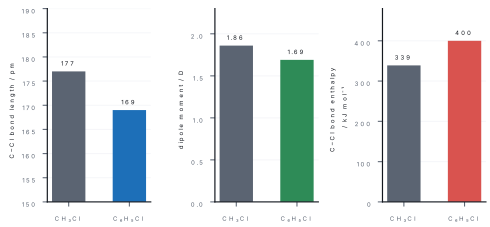
Both have one C–Cl bond, yet μ(C₆H₅Cl) = 1.69 D while μ(CH₃Cl) = 1.86 D. Two reasons: the chlorine's lone pair is partly delocalised into the ring (an electron flow towards Cl's own carbon opposing the inductive pull), and the carbon holding the Cl is sp² (33 % s-character), which is more electronegative than the sp³ carbon of CH₃Cl, so it lets go of its electrons less easily. A shorter bond also means a smaller charge separation distance.
9.4 Low reactivity compared with haloalkanes in nucleophilic substitution
Warm chloroethane with aqueous KOH and you get ethanol in minutes. Boil chlorobenzene with aqueous KOH for hours and nothing happens. The measured rates differ by a factor of the order of 10⁵ to 10⁶.
There are four reasons, and a full-mark answer gives all four.
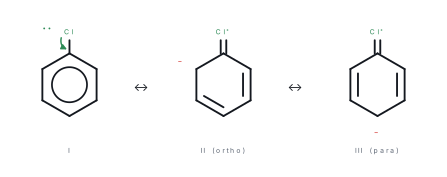
1. Resonance shortens and strengthens the C–Cl bond. As the resonance figure shows, a lone pair on chlorine overlaps with the ring π system. The C–Cl bond therefore acquires partial double-bond character. A double bond is shorter and stronger than a single bond, so the C–Cl bond length falls from 177 pm in chloromethane to 169 pm in chlorobenzene, and the bond becomes much harder to break. A nucleophile must break this bond, so substitution is slow.
2. The carbon is sp² hybridised. In chlorobenzene the carbon carrying Cl is sp² (33 % s-character); in chloromethane it is sp³ (25 % s-character). The sp² carbon is more electronegative, holds its bonding electrons closer, and so forms a shorter, stronger and less polar C–Cl bond. A less polar bond means a smaller δ⁺ on carbon — exactly the site a nucleophile is looking for.
3. Repulsion by the π electron cloud. The benzene ring is a thick sandwich of π electron density above and below the plane. An approaching nucleophile, which is itself an electron-rich species, is repelled before it can reach the carbon.
4. Neither mechanism is available.
| why it is blocked | |
|---|---|
| SN1 | would require a phenyl cation, C₆H₅⁺. The empty orbital lies in the ring plane, perpendicular to the π cloud, so it gets no resonance stabilisation. The cation is far too unstable to form. |
| SN2 | requires the nucleophile to attack from directly behind the C–Cl bond. That position is occupied by the rest of the benzene ring — the attack is physically impossible. |
A very common error is to write C₆H₅Cl + NaOH → C₆H₅OH at room temperature. It does not happen. The industrial Dow process needs 10 % aqueous NaOH at 623 K and about 300 atm, and the product is sodium phenoxide, which must then be acidified:
- C₆H₅Cl + 2NaOH --(623 K, 300 atm)--> C₆H₅ONa + NaCl + H₂O
- C₆H₅ONa + HCl → C₆H₅OH + NaCl
Similarly, ammonolysis to aniline needs NH₃ at 475 K and 60 atm over Cu₂O.
Electron-withdrawing groups switch the reactivity back on. If a strongly –R group such as –NO₂ sits ortho or para to the halogen, the negative charge of the intermediate can be delocalised onto the nitro oxygen atoms, and nucleophilic substitution becomes easy. The effect is dramatic:
| Compound | Conditions needed for hydrolysis |
|---|---|
| chlorobenzene | 623 K, 300 atm NaOH |
| p-nitrochlorobenzene | aqueous NaOH, 435 K |
| 2,4-dinitrochlorobenzene | warm aqueous Na₂CO₃ |
| 2,4,6-trinitrochlorobenzene (picryl chloride) | boiling water alone |
A nitro group at the meta position has almost no effect, because the negative charge of the intermediate never reaches the meta carbon. That test — does the activating group sit ortho/para or meta? — is a favourite Group B question.
9.5 Reduction of chlorobenzene; electrophilic substitution reactions
Reduction
Chlorobenzene is reduced to benzene by nascent hydrogen. Nickel–aluminium alloy in aqueous alkali is the standard laboratory reagent; zinc dust and hydrochloric acid, or hydrogen over a palladium catalyst, also work.
- C₆H₅Cl + 2[H] --(Ni–Al alloy / NaOH)--> C₆H₆ + HCl
Reduction is not a nucleophilic substitution — the hydrogen atom arrives as a neutral radical-like species, not as a hydride nucleophile, which is why it succeeds where OH⁻ fails.
Electrophilic substitution
Although the ring is deactivated, it is still aromatic and still reacts with strong electrophiles. Chlorine is one of that small group of substituents that are deactivating but ortho–para directing, and you must be able to explain the apparent contradiction:
- Deactivating, because the –I (inductive) effect of the electronegative chlorine pulls electron density out of the ring, so the ring is less nucleophilic than benzene and reacts more slowly.
- Ortho–para directing, because the +R (resonance) effect pushes lone-pair density into the ring, and the resonance structures put that extra electron density specifically at the ortho and para carbons. Whatever attack does occur therefore happens there.
The para product usually dominates, because the bulky electrophile and the chlorine atom get in each other's way at the ortho position (steric hindrance).
| Reaction | Reagents and conditions | Products |
|---|---|---|
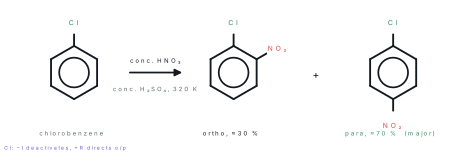
| Nitration | conc. HNO₃ + conc. H₂SO₄, 320 K | o-nitrochlorobenzene (≈30 %) + p-nitrochlorobenzene (≈70 %) |
| Halogenation | Cl₂, anhyd. AlCl₃ (or FeCl₃) | o- and p-dichlorobenzene (p major) |
| Sulphonation | conc. (or fuming) H₂SO₄, Δ | o- and p-chlorobenzenesulphonic acid (p major) |
| Friedel–Crafts alkylation | CH₃Cl, anhyd. AlCl₃ | o- and p-chlorotoluene |
| Friedel–Crafts acylation | CH₃COCl, anhyd. AlCl₃ | o- and p-chloroacetophenone |
Problem. 45.0 g of chlorobenzene is nitrated. 90 % of it is converted into mononitro products, in which the ortho : para ratio is 30 : 70. Calculate the mass of p-nitrochlorobenzene obtained. (C = 12, H = 1, N = 14, O = 16, Cl = 35.5)
Solution. Moles of C₆H₅Cl = 45.0 / 112.5 = 0.400 mol.
Moles converted = 0.400 × 0.90 = 0.360 mol. Moles of the para isomer = 0.360 × 0.70 = 0.252 mol.
Molar mass of C₆H₄ClNO₂ = (6 × 12) + (4 × 1) + 35.5 + 14 + (2 × 16) = 72 + 4 + 35.5 + 14 + 32 = 157.5 g mol⁻¹.
Mass = 0.252 × 157.5 = 39.7 g (3 s.f.).
(The ortho isomer accounts for 0.108 mol, that is 17.0 g.)
9.6 Action with sodium: Fittig and Wurtz–Fittig reactions; action with chloral
Fittig reaction
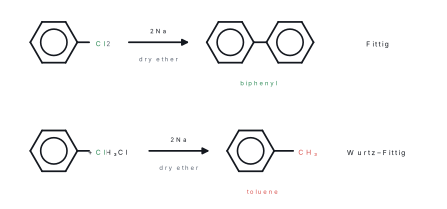
Two molecules of a haloarene are coupled by sodium in dry ether. The product is a biaryl:
- 2C₆H₅Cl + 2Na --(dry ether)--> C₆H₅–C₆H₅ + 2NaCl
The product, biphenyl (diphenyl), is a white crystalline solid, m.p. 71 °C, used as a heat-transfer fluid.
Wurtz–Fittig reaction
A haloarene and a haloalkane together, with sodium in dry ether, give an alkylbenzene. This is the standard way of putting a straight alkyl chain on a ring without the rearrangements that spoil Friedel–Crafts alkylation:
- C₆H₅Cl + 2Na + CH₃Cl --(dry ether)--> C₆H₅CH₃ + 2NaCl
- C₆H₅Br + 2Na + C₂H₅Br --(dry ether)--> C₆H₅C₂H₅ + 2NaBr
Three couplings compete in a Wurtz–Fittig mixture: aryl + aryl (Fittig, gives biphenyl), alkyl + alkyl (Wurtz, gives an alkane) and aryl + alkyl (the product you want). The ether must be absolutely dry, because sodium reacts violently with water and the organosodium intermediate is destroyed by even a trace of moisture.
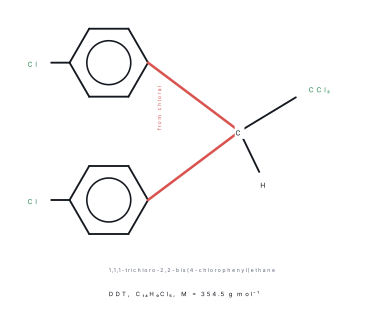
Action with chloral — the synthesis of DDT
Chloral (trichloroethanal, CCl₃CHO) condenses with two molecules of chlorobenzene in the presence of concentrated sulphuric acid:
- CCl₃CHO + 2C₆H₅Cl --(conc. H₂SO₄)--> (4-ClC₆H₄)₂CH–CCl₃ + H₂O
The product is DDT, systematically 1,1,1-trichloro-2,2-bis(4-chlorophenyl)ethane, C₁₄H₉Cl₅. Check the balance: carbon 2 + 12 = 14, hydrogen 1 + 10 = 11 (9 in DDT + 2 in water), chlorine 3 + 2 = 5, oxygen 1 = 1. The reaction is an electrophilic substitution in which the protonated aldehyde is the electrophile and the chlorine atoms direct the attack to the para positions.
DDT was the first modern synthetic insecticide and saved millions of lives from malaria and typhus, but it is chemically very stable, fat-soluble and non-biodegradable. It therefore bioaccumulates up food chains. Its agricultural use is banned in Nepal and in most countries under the Stockholm Convention, though small quantities are still permitted for malaria vector control.
Problem. 14.74 g of chloral is condensed with an excess of chlorobenzene in concentrated sulphuric acid. Calculate (i) the mass of chlorobenzene consumed and (ii) the mass of DDT formed, assuming complete reaction. (Molar masses: chloral 147.4, chlorobenzene 112.5, DDT 354.5 g mol⁻¹)
Solution. Moles of chloral = 14.74 / 147.4 = 0.1000 mol.
From CCl₃CHO + 2C₆H₅Cl → DDT + H₂O, the ratio chloral : chlorobenzene : DDT is 1 : 2 : 1.
(i) Moles of chlorobenzene = 2 × 0.1000 = 0.200 mol. Mass = 0.200 × 112.5 = 22.5 g.
(ii) Moles of DDT = 0.1000 mol. Mass = 0.1000 × 354.5 = 35.45 g.
Check by mass conservation: 14.74 + 22.5 = 37.24 g in; 35.45 g DDT + (0.100 × 18) = 1.80 g water = 37.25 g out. The small difference is rounding.
9.7 Uses
| Compound | Use |
|---|---|
| Chlorobenzene | solvent for paints, rubber, waxes and adhesives; heat-transfer medium |
| Chlorobenzene | feedstock for phenol (Dow process) and for aniline (ammonolysis) |
| Chlorobenzene | intermediate for o- and p-nitrochlorobenzene → azo dyes and drugs |
| Chlorobenzene + chloral | manufacture of DDT (vector control only) |
| p-Dichlorobenzene | moth repellent, toilet deodorant block, space fumigant |
| Benzotrichloride, C₆H₅CCl₃ | hydrolysed to benzoic acid |
| Iodobenzene, bromobenzene | laboratory reagents for making Grignard and organolithium compounds |
| Chlorinated aromatics generally | starting materials for pesticides, fungicides and pharmaceuticals |
Most of these uses are now tightly regulated. Chlorinated aromatics are persistent in soil and water and are toxic to aquatic life, so laboratory residues must never be poured down the sink.
Chapter summary
- A haloarene has the halogen on an sp² ring carbon (C₆H₅Cl); an aralkyl halide has it on the side chain (C₆H₅CH₂Cl) and behaves like a haloalkane.
- C₆H₄Cl₂ has three positional isomers; the para isomer has much the highest melting point because of symmetrical crystal packing.
- Preparation: C₆H₆ + Cl₂ --(anhyd. AlCl₃, dark)--> C₆H₅Cl + HCl; industrially 2C₆H₆ + 2HCl + O₂ --(CuCl₂, 500 K)--> 2C₆H₅Cl + 2H₂O (Raschig).
- From the diazonium salt: Sandmeyer (CuCl/HCl) and Gattermann (Cu/HCl), both giving C₆H₅Cl + N₂↑; KI alone gives iodobenzene.
- Haloarenes are colourless, sweet-smelling, steam-volatile liquids, denser than and insoluble in water; boiling point rises Cl → Br → I.
- Low reactivity to nucleophiles has four causes: resonance gives partial double-bond character (C–Cl 169 pm vs 177 pm), the sp² carbon is more electronegative, the π cloud repels the nucleophile, and neither SN1 (unstable phenyl cation) nor SN2 (no backside approach) is possible.
- –NO₂ groups ortho or para to the halogen switch nucleophilic substitution on; picryl chloride is hydrolysed by boiling water alone.
- –Cl is deactivating but ortho–para directing: –I effect slows the ring down, +R effect decides where the electrophile lands. Nitration gives about 30 % ortho and 70 % para.
- Named reactions: reduction C₆H₅Cl + 2[H] → C₆H₆ + HCl; Fittig 2C₆H₅Cl + 2Na → C₆H₅–C₆H₅ + 2NaCl; Wurtz–Fittig C₆H₅Cl + 2Na + CH₃Cl → C₆H₅CH₃ + 2NaCl; CCl₃CHO + 2C₆H₅Cl --(conc. H₂SO₄)--> DDT + H₂O.
Practice questions
Group A — Multiple choice (1 mark each)
- The C–Cl bond length is shortest in [1]achloromethanebchloroethanecchlorobenzenedbenzyl chloride
- Chlorobenzene is treated with sodium metal in dry ether. The product is [1]atoluenebbiphenylcbenzenedphenol
- In the Sandmeyer reaction, benzene diazonium chloride is warmed with [1]aCu/HClbCuCl/HClcCu₂O/NH₃dKI
- The –Cl group in chlorobenzene is [1]aactivating and o,p-directingbactivating and m-directingcdeactivating and o,p-directingddeactivating and m-directing
- Which compound is hydrolysed simply by boiling it with water? [1]achlorobenzenebp-nitrochlorobenzenec2,4-dinitrochlorobenzened2,4,6-trinitrochlorobenzene
- DDT is prepared by treating chlorobenzene with [1]aethanal and NaOHbchloral and conc. H₂SO₄cpropanone and HCldchloroform and KOH
- The dipole moment of chlorobenzene (1.69 D) is less than that of chloromethane (1.86 D) mainly because [1]achlorobenzene is a bigger moleculebthe C–Cl bond is longer in chlorobenzenecthe lone pair on Cl is delocalised into the ring and the carbon is sp²dchlorobenzene is non-polar
Answers to Group A
1. (c) — resonance gives the ring C–Cl bond partial double-bond character, so it is shortest (169 pm).
2. (b) — this is the Fittig reaction, 2C₆H₅Cl + 2Na → C₆H₅–C₆H₅ + 2NaCl.
3. (b) — Cu(I) chloride in concentrated HCl; copper powder with HCl would be the Gattermann reaction.
4. (c) — the –I effect deactivates the ring, while the +R effect places electron density at the ortho and para carbons.
5. (d) — three nitro groups ortho/para to the chlorine delocalise the negative charge of the intermediate completely.
6. (b) — CCl₃CHO + 2C₆H₅Cl → DDT + H₂O.
7. (c) — delocalisation opposes the inductive pull and the sp² carbon holds its electrons more tightly.
Group B — Short answer (5 marks each)
- Explain, with resonance structures, why chlorobenzene does not react with aqueous NaOH at room temperature while chloroethane does. [5]
- How is chlorobenzene prepared from aniline? Give all equations and conditions. [5]
- Chlorine is a deactivating group, yet it directs an incoming electrophile to the ortho and para positions. Explain this apparent contradiction and illustrate it with the nitration of chlorobenzene. [5]
- Distinguish between the Fittig and the Wurtz–Fittig reaction with balanced equations. Why must the ether be perfectly dry? [5]
- 78.0 g of benzene is chlorinated in the dark over anhydrous AlCl₃. The yield of chlorobenzene is 70 %. Calculate the mass of chlorobenzene obtained and the volume of HCl gas liberated at STP. [5]
Answers to Group B
1. A lone pair on chlorine overlaps the ring π system, so the C–Cl bond has partial double-bond character (169 pm, compared with 177 pm in chloroethane) and is much harder to break. The carbon holding the chlorine is sp², hence more electronegative, giving a shorter, stronger and less polar bond with a smaller δ⁺ on carbon. The π electron cloud repels the incoming OH⁻. Finally neither mechanism is open: SN1 would need the very unstable phenyl cation (its empty orbital is in the ring plane and gets no resonance help), and SN2 would need backside attack, which the ring blocks. Chloroethane has none of these obstacles: its sp³ carbon carries a large δ⁺ and is freely open to backside attack.
2. Diazotise, then apply the Sandmeyer reaction. C₆H₅NH₂ + NaNO₂ + 2HCl --(273–278 K)--> C₆H₅N₂⁺Cl⁻ + NaCl + 2H₂O C₆H₅N₂⁺Cl⁻ --(CuCl / conc. HCl, warm)--> C₆H₅Cl + N₂↑ The temperature must be held at 273–278 K (an ice–salt bath) or the diazonium salt decomposes to phenol. The Gattermann variant, using copper powder and concentrated HCl, gives the same product in slightly lower yield.
3. Chlorine exerts two opposing effects. Its –I effect withdraws electron density from the whole ring, so the ring is less nucleophilic than benzene and every electrophilic substitution is slower — the ring is deactivated. Its +R effect donates a lone pair into the ring, and the resonance structures that result carry the extra negative charge specifically on the ortho and para carbons. So although attack is slow, when it happens it happens at those positions. Nitration with conc. HNO₃ and conc. H₂SO₄ at 320 K gives about 30 % o-nitrochlorobenzene and 70 % p-nitrochlorobenzene, the para isomer dominating because the ortho position is sterically crowded by the chlorine atom.
4. Fittig couples two aryl halides: 2C₆H₅Cl + 2Na --(dry ether)--> C₆H₅–C₆H₅ + 2NaCl Wurtz–Fittig couples an aryl halide with an alkyl halide: C₆H₅Cl + 2Na + CH₃Cl --(dry ether)--> C₆H₅CH₃ + 2NaCl The ether must be perfectly dry because sodium reacts violently with water, and the organosodium intermediate (C₆H₅Na) is instantly destroyed by moisture, giving benzene instead of the coupled product.
5. Moles of benzene = 78.0 / 78 = 1.00 mol. C₆H₆ + Cl₂ → C₆H₅Cl + HCl, a 1 : 1 : 1 reaction. Theoretical chlorobenzene = 1.00 × 112.5 = 112.5 g; at 70 % yield, mass = 0.70 × 112.5 = 78.75 g. HCl is produced in step with the chlorobenzene, so moles of HCl = 0.70 mol. Volume at STP = 0.70 × 22.4 = 15.68 L.
Group C — Long answer (8 marks each)
- (a) Give two methods of preparing chlorobenzene, with equations and conditions. [3](b) Explain fully why haloarenes are far less reactive than haloalkanes towards nucleophiles. [3](c) State the conditions under which chlorobenzene can be converted to phenol, and name the process. [2] [8]
- (a) Write balanced equations, with reagents and conditions, for the reaction of chlorobenzene with: sodium in dry ether; a mixture of sodium and chloromethane in dry ether; chloral in conc. H₂SO₄; nickel–aluminium alloy in NaOH. [4](b) Draw the structure of DDT and give its systematic name. [2](c) 22.5 g of chlorobenzene reacts completely with excess chloral. Calculate the mass of DDT formed. (DDT = 354.5 g mol⁻¹) [2] [8]
- (a) Account for the effect of the –Cl group on both the rate and the orientation of electrophilic substitution in chlorobenzene. [3](b) Arrange chlorobenzene, p-nitrochlorobenzene and 2,4-dinitrochlorobenzene in order of increasing ease of hydrolysis and justify the order. [3](c) Why does p-dichlorobenzene melt at 53 °C while the ortho isomer melts at −17 °C? [2] [8]
Outline answers to Group C
1. (a) Direct chlorination, C₆H₆ + Cl₂ --(anhyd. AlCl₃, dark)--> C₆H₅Cl + HCl; and the Sandmeyer reaction, C₆H₅N₂⁺Cl⁻ --(CuCl/HCl)--> C₆H₅Cl + N₂↑ (the Raschig process is an acceptable third). (b) The four reasons of §9.4: resonance shortening and strengthening the C–Cl bond; the more electronegative sp² carbon giving a less polar bond; π-cloud repulsion of the nucleophile; and the unavailability of both SN1 (unstable phenyl cation) and SN2 (no backside approach). (c) The Dow process: 10 % aqueous NaOH at 623 K and about 300 atm gives sodium phenoxide, C₆H₅Cl + 2NaOH → C₆H₅ONa + NaCl + H₂O, which is then acidified, C₆H₅ONa + HCl → C₆H₅OH + NaCl.
2. (a) 2C₆H₅Cl + 2Na --(dry ether)--> C₆H₅–C₆H₅ + 2NaCl (Fittig); C₆H₅Cl + 2Na + CH₃Cl --(dry ether)--> C₆H₅CH₃ + 2NaCl (Wurtz–Fittig); CCl₃CHO + 2C₆H₅Cl --(conc. H₂SO₄)--> (4-ClC₆H₄)₂CH–CCl₃ + H₂O; C₆H₅Cl + 2[H] --(Ni–Al/NaOH)--> C₆H₆ + HCl. (b) Two 4-chlorophenyl rings joined to one carbon that also carries a hydrogen atom and a –CCl₃ group; 1,1,1-trichloro-2,2-bis(4-chlorophenyl)ethane. (c) Moles of C₆H₅Cl = 22.5 / 112.5 = 0.200 mol; two moles of chlorobenzene give one mole of DDT, so moles of DDT = 0.100 mol and mass = 0.100 × 354.5 = 35.45 g.
3. (a) Rate: the –I effect of chlorine withdraws electron density, making the ring less nucleophilic, so substitution is slower than in benzene — chlorine is deactivating. Orientation: the +R effect feeds the chlorine lone pair into the ring, concentrating electron density at the ortho and para carbons, so the electrophile attacks there; para usually predominates on steric grounds. (b) chlorobenzene < p-nitrochlorobenzene < 2,4-dinitrochlorobenzene. Each nitro group placed ortho or para to the chlorine withdraws electrons by –R and stabilises the negatively charged intermediate formed when the nucleophile adds, so the more such groups there are, the milder the conditions needed. (c) The para isomer is symmetrical and almost linear, so its molecules pack tightly and regularly into the crystal lattice; more energy is needed to break that lattice. The ortho isomer is bent and packs poorly, giving a much weaker lattice and a far lower melting point.
Practise more: Chemistry question bank