Unit 19 · Applied Chemistry · 4 teaching hours · 18 min read
Cement
What the syllabus asks for 6
- Introduction
- Raw materials for cement production
- Main steps in cement production: crushing and grinding, strong heating, final grinding
- Types of cement: OPC and PPC
- Portland cement process with flow-sheet diagram
- Cement Industry in Nepal
Cement is the powder that turns sand, gravel and water into rock. Nepal alone consumes several million tonnes of it every year — in the pillars of a Kathmandu apartment, in a Karnali suspension-bridge anchor block, in every canal and culvert. Chemically it is a mixture of calcium silicates and aluminates made by roasting limestone with clay, and its usefulness comes from one property: mixed with water it sets and hardens hydraulically, that is, even under water.
Four repeat questions: the raw materials and the oxide each supplies; the three stages of manufacture with the rotary-kiln temperature zones and the reactions in each; the role of gypsum; and a comparison of OPC with PPC. A flow-sheet diagram is worth full marks on its own — practise drawing it.
19.1 Introduction
Portland cement is a finely ground hydraulic binder made by burning a proportioned mixture of calcareous (lime-bearing) and argillaceous (clay-bearing) materials at about 1400–1500 °C and grinding the resulting clinker with a little gypsum. Mixed with water it sets and hardens by hydration, and does so under water as well as in air.
Joseph Aspdin patented it in Leeds in 1824 and called it Portland cement because the set product resembled the building stone quarried on the Isle of Portland. Cement with sand and water gives mortar; with sand, aggregate and water it gives concrete; with steel bars embedded, reinforced concrete (RCC).
| Oxide | Symbol | Percentage in OPC | Supplied by |
|---|---|---|---|
| Calcium oxide (lime) | CaO | 60–67 % | limestone |
| Silica | SiO₂ | 17–25 % | clay, shale, sand |
| Alumina | Al₂O₃ | 3–8 % | clay, bauxite |
| Ferric oxide | Fe₂O₃ | 0.5–6 % | clay, iron ore |
| Magnesia | MgO | 0.1–4 % | dolomitic limestone |
| Sulphur trioxide | SO₃ | 1–3 % | added gypsum |
Two ratios control the quality of the raw mix:
Too much lime leaves free lime in the clinker, which slakes slowly in the hardened concrete and cracks it — the cement is unsound. Too little lime gives a weak, quick-setting cement.
19.2 Raw materials for cement production
| Class | Material | Oxide supplied |
|---|---|---|
| Calcareous | limestone, chalk, marl, sea shells | CaO |
| Argillaceous | clay, shale, slate | SiO₂, Al₂O₃, Fe₂O₃ |
| Corrective | sand or quartzite; bauxite or laterite; iron ore or pyrite cinder | SiO₂; Al₂O₃; Fe₂O₃ |
| Retarder | gypsum, CaSO₄·2H₂O (2–5 %, added at the end) | SO₃ |
| Fuel | coal, petroleum coke, furnace oil | — |
| Pozzolana (for PPC only) | fly ash, volcanic ash, calcined clay | reactive SiO₂ |
Roughly 1.5 tonnes of limestone and 0.4 tonne of clay are needed per tonne of cement, which is why every cement plant sits on top of a limestone deposit rather than near its customers.
19.3 Main steps in cement production
(a) Crushing, grinding and mixing. Quarried limestone is crushed to about 25 mm, blended with clay in the correct proportion and ground fine. Two routes exist:
| Wet process | Dry process | |
|---|---|---|
| Raw mix prepared as | slurry with 35–50 % water | dry powder ("raw meal") |
| Mixing quality | excellent, easy to correct | needs careful blending silos |
| Fuel needed | high (water must be boiled off) | low — about 40 % less |
| Used today | old or very wet deposits | almost all modern plants, with preheaters |
(b) Strong heating (burning) in the rotary kiln. The raw mix is fed into the upper end of a steel cylinder 60–150 m long and 3–8 m across, lined with refractory brick, inclined about 1 in 30 and rotating at 1–2 revolutions per minute. Pulverised coal and hot air are blown in at the lower end, so the charge slides down against the rising flame and gets hotter as it travels.
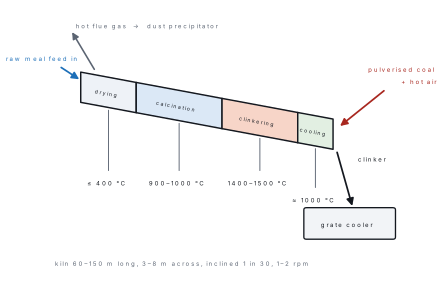
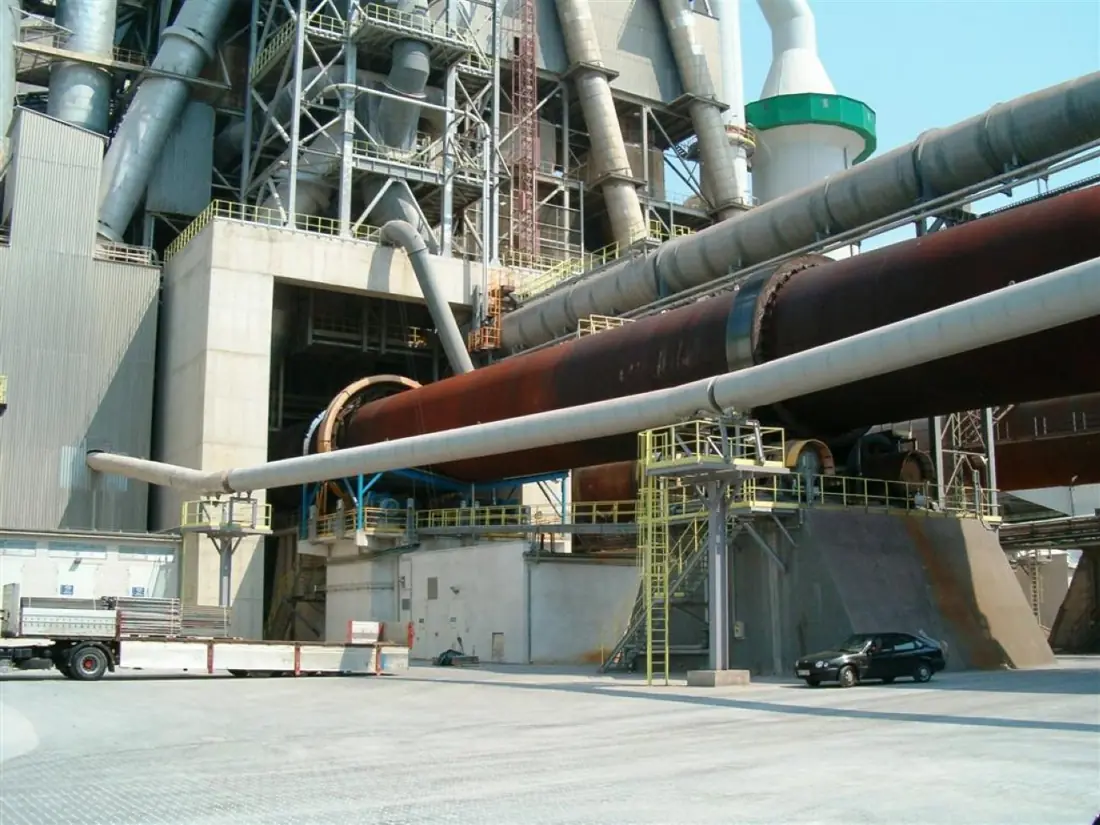
The chemistry happens zone by zone:
| Zone | Temperature | What happens |
|---|---|---|
| Drying | up to 400 °C | free and combined water driven off |
| Calcination | 900–1000 °C | CaCO₃ --Δ--> CaO + CO₂↑; clay decomposes to its oxides |
| Clinkering (burning) | 1400–1500 °C | lime combines with SiO₂, Al₂O₃ and Fe₂O₃; about a quarter of the charge melts and binds the rest into nodules |
| Cooling | 1000 °C → 100 °C | rapid cooling in a grate cooler fixes the crystal forms |
2CaO + SiO₂ → Ca₂SiO₄ (dicalcium silicate, C₂S)
3CaO + SiO₂ → Ca₃SiO₅ (tricalcium silicate, C₃S)
3CaO + Al₂O₃ → Ca₃Al₂O₆ (tricalcium aluminate, C₃A)
4CaO + Al₂O₃ + Fe₂O₃ → Ca₄Al₂Fe₂O₁₀ (tetracalcium aluminoferrite, C₄AF)
The greenish-black nodules that leave the kiln, 5–25 mm across, are clinker.
(c) Final grinding. Cooled clinker is ground in a ball mill with 2–5 % gypsum to a powder so fine that most of it passes a 90 μm sieve (specific surface about 300–350 m² kg⁻¹), and bagged in 50 kg sacks.
Without gypsum, C₃A hydrates within minutes and the cement undergoes a flash set: it stiffens before it can be placed, and is then useless. Gypsum reacts with C₃A to form a coating of ettringite on each grain, which slows the reaction and gives a working time of about 30 minutes to 10 hours:
Ca₃Al₂O₆ + 3CaSO₄·2H₂O + 26H₂O → Ca₆Al₂(SO₄)₃(OH)₁₂·26H₂O
Bogue compounds and the setting reactions
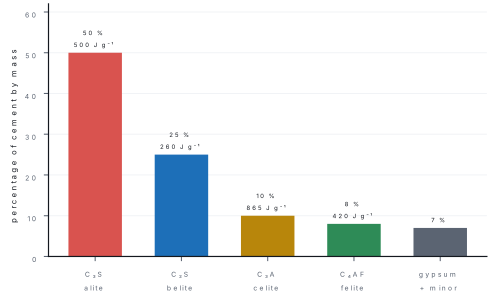
The four compounds formed in the clinker were first identified by R. H. Bogue, and the properties of a cement follow directly from how much of each it contains.
| Compound | Formula | % in OPC | Rate of hydration | Contribution |
|---|---|---|---|---|
| C₃S, alite | 3CaO·SiO₂ | 45–55 | fast (hours to days) | early strength, first 7 days; 500 J g⁻¹ |
| C₂S, belite | 2CaO·SiO₂ | 20–30 | slow (weeks to a year) | later strength, after 28 days; 260 J g⁻¹ |
| C₃A, celite | 3CaO·Al₂O₃ | 8–12 | immediate (minutes) | flash set; little strength; 865 J g⁻¹; poor sulphate resistance |
| C₄AF, felite | 4CaO·Al₂O₃·Fe₂O₃ | 6–10 | fast | grey colour, little strength; 420 J g⁻¹ |
Setting and hardening are hydration reactions. Both silicates give the same binding gel — calcium silicate hydrate, called tobermorite gel — plus calcium hydroxide:
2Ca₃SiO₅ + 6H₂O → Ca₃Si₂O₇·3H₂O + 3Ca(OH)₂
2Ca₂SiO₄ + 4H₂O → Ca₃Si₂O₇·3H₂O + Ca(OH)₂
Ca₃Al₂O₆ + 6H₂O → Ca₃Al₂(OH)₁₂
The interlocking needles of gel are what hold the concrete together, and because the reaction is hydration rather than drying, fresh concrete must be cured (kept wet) for at least a week.
Problem. A kiln produces 1.00 tonne of clinker containing 65 % CaO. The limestone used is 95 % CaCO₃ by mass. Calculate (a) the mass of limestone required and (b) the mass of CO₂ released. (Ca = 40, C = 12, O = 16)
Solution.
CaO needed = 0.65 × 1000 = 650 kg.
CaCO₃ --Δ--> CaO + CO₂↑, so 100 kg CaCO₃ gives 56 kg CaO and 44 kg CO₂.
(a) Pure CaCO₃ required = 650 × 100/56 = 1160.7 kg. Limestone (95 % pure) = 1160.7 / 0.95 = 1222 kg ≈ 1.22 tonne.
(b) CO₂ released = 650 × 44/56 = 510.7 kg, i.e. about half a tonne of CO₂ per tonne of clinker before counting the coal burnt. This is why cement manufacture is one of the largest industrial sources of carbon dioxide.
Problem. A raw mix analyses as CaO 64 %, SiO₂ 21 %, Al₂O₃ 6 %, Fe₂O₃ 3 %. Find the hydraulic modulus and the silica modulus and comment.
Solution.
The hydraulic modulus is close to the required value of about 2, so the lime content is acceptable — a little high, so free lime must be watched. The silica modulus, 2.33, is below the usual range 2.5–4.0: the mix carries rather much alumina and iron oxide, which will raise the C₃A content, make the cement set faster and lower its sulphate resistance. Adding sand would correct it.
19.4 Types of cement: OPC and PPC
| Ordinary Portland Cement (OPC) | Portland Pozzolana Cement (PPC) | |
|---|---|---|
| Made by grinding | clinker + 2–5 % gypsum | clinker + gypsum + 15–35 % pozzolana (fly ash, volcanic ash, calcined clay) |
| Early strength | high — good for precast work and cold weather | lower at 7 days |
| Strength at 28–90 days | high | equal or higher |
| Heat of hydration | high; risks thermal cracking in thick pours | low — suited to dams and raft foundations |
| Durability | free lime left in the paste can be leached | pozzolana consumes the free lime, giving denser, less permeable concrete, better resistance to sulphates and chlorides |
| Cost and CO₂ | higher (more clinker) | lower; the pozzolana is often a waste product |
| Grades sold in Nepal | OPC 33, 43, 53 (28-day strength in N mm⁻²) | PPC (most bagged cement sold for house building) |
The pozzolana has no cementing power by itself. It works by reacting with the calcium hydroxide that the silicates release:
Ca(OH)₂ + SiO₂ (reactive) + H₂O → calcium silicate hydrate gel
So the weakest and most soluble product of ordinary hydration is converted into more of the strong binding gel.
Problem. A cement contains 50 % C₃S, 25 % C₂S, 10 % C₃A and 8 % C₄AF. Using the heats of hydration 500, 260, 865 and 420 J g⁻¹, estimate the heat evolved by 1 kg of this cement. What is the figure if 30 % of the cement is replaced by fly ash, which evolves no heat?
Solution. Heat per gram of cement is the sum of (fraction × heat):
For 1 kg, heat evolved = 435.1 × 1000 = 4.35 × 10⁵ J ≈ 435 kJ.
With 30 % replacement by inert fly ash, only 0.70 kg of cement is present, so
q = 0.70 × 435 = 305 kJ per kg of blended cement, a fall of 30 %.
That reduction is exactly why PPC is specified for massive pours such as a dam or a large raft foundation, where trapped heat would crack the concrete as it cools.
19.5 Portland cement process with flow-sheet diagram
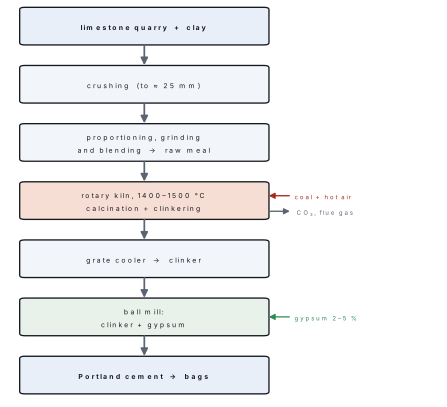
In the wet process the first two boxes are replaced by wet grinding to a slurry, which is fed straight into a longer kiln; everything after the kiln is identical. The dry process has displaced it almost everywhere because evaporating the slurry water wastes about 40 % more fuel.
19.6 Cement industry in Nepal
Nepal is well supplied with the main raw material: thick limestone beds run through the Mahabharat range and the inner Terai, in Udayapur, Makwanpur, Dhading, Palpa, Arghakhanchi, Dang and Surkhet districts. Coal, gypsum and iron ore, however, are almost entirely imported, mainly from India.
| Plant | Place | Note |
|---|---|---|
| Himal Cement Company | Chobhar, Kathmandu | Nepal's first cement plant, built with German aid; in production from 1975, closed in 2002 after protests over dust and air pollution |
| Hetauda Cement Industry | Lamsure, Makwanpur | state-owned, established 2033 B.S. (1976), commercial production from December 1985, about 260,000 t yr⁻¹ |
| Udayapur Cement Industry | Jaljale, Udayapur | state-owned, established 2044 B.S. (1987), Japanese-built, brand "Gaida", about 800 t of clinker per day |
| Hongshi–Shivam Cement | Dhading | Nepal–China joint venture; the country's largest plant, about 2.4 million t yr⁻¹ |
| Shivam, CG, Arghakhanchi, Ghorahi, Sarbottam and others | Makwanpur, Palpa, Dang, Arghakhanchi | the private plants that now supply most of the market |
Around fifty cement factories operate in the country, with a combined grinding capacity of roughly 22–25 million tonnes a year, although only about twenty of them run their own kilns; the rest grind imported or domestic clinker. Nepal became self-sufficient in cement at the start of this decade and has since begun exporting small quantities to India. Per-capita consumption is about 250 kg a year.
The industry's problems are equally clear: plants run far below capacity, imported coal makes energy costly, limestone quarrying scars the Chure and Mahabharat hills, and kiln dust and CO₂ remain an environmental burden — the reason modern plants fit electrostatic precipitators and increasingly sell PPC, which needs less clinker per bag.
Chapter summary
- Cement is a hydraulic binder of calcium silicates and aluminates; Aspdin patented Portland cement in 1824.
- Composition of OPC: CaO 60–67 %, SiO₂ 17–25 %, Al₂O₃ 3–8 %, Fe₂O₃ 0.5–6 %. Hydraulic modulus ≈ 2; silica modulus 2.5–4. Excess lime makes cement unsound.
- Raw materials: calcareous (limestone), argillaceous (clay), correctives (sand, bauxite, iron ore) and 2–5 % gypsum added after burning.
- Three stages: crushing/grinding (wet or dry process) → burning in a rotary kiln → final grinding with gypsum.
- Kiln zones: drying (to 400 °C), calcination 900–1000 °C (CaCO₃ → CaO + CO₂↑), clinkering 1400–1500 °C (formation of C₃S, C₂S, C₃A, C₄AF), then rapid cooling.
- Bogue compounds: C₃S gives early strength, C₂S later strength, C₃A causes flash set and most of the heat, C₄AF gives the grey colour. Gypsum retards C₃A by forming ettringite.
- Setting: 2Ca₃SiO₅ + 6H₂O → Ca₃Si₂O₇·3H₂O + 3Ca(OH)₂ and 2Ca₂SiO₄ + 4H₂O → Ca₃Si₂O₇·3H₂O + Ca(OH)₂; the gel binds the aggregate, so concrete must be cured wet.
- OPC = clinker + gypsum; PPC = clinker + gypsum + 15–35 % pozzolana, which consumes free Ca(OH)₂, lowers the heat of hydration and improves durability.
- Nepal has abundant limestone; about fifty plants, roughly 22–25 Mt yr⁻¹ grinding capacity, self-sufficient since about 2020, with Hongshi–Shivam in Dhading the largest and Hetauda and Udayapur the state-owned plants.
Practice questions
Group A — Multiple choice (1 mark each)
- The approximate percentage of lime (CaO) in ordinary Portland cement is [1]a20–25 %b40–45 %c60–67 %d80–85 %
- Gypsum is added to cement clinker to [1]aincrease strengthbretard the setting timecgive colourdreduce the cost
- The temperature of the clinkering zone of a rotary kiln is about [1]a500 °Cb900 °Cc1450 °Cd2000 °C
- Which Bogue compound is mainly responsible for early strength? [1]aC₂SbC₃ScC₃AdC₄AF
- PPC differs from OPC in containing [1]amore gypsumbno limec15–35 % pozzolanadiron oxide
- Nepal's largest cement plant is located in [1]aDhadingbChobharcJaljale, UdayapurdBiratnagar
Answers to Group A
1. (c) — lime is the largest single oxide.
2. (b) — it stops the flash set caused by C₃A.
3. (c) — 1400–1500 °C, where partial fusion forms clinker.
4. (b) — C₃S hydrates in hours to days.
5. (c) — fly ash or another reactive silica.
6. (a) — the Hongshi–Shivam plant in Dhading, about 2.4 Mt yr⁻¹.
Group B — Short answer (5 marks each)
- What is cement? Give the average composition of OPC and state the two moduli that control the raw mix. [5]
- Name the raw materials used in cement manufacture and state the oxide each supplies. [5]
- Describe the zones of a rotary kiln with their temperatures and the chemical changes in each. [5]
- What are Bogue compounds? Give their formulae and the property each controls. Why is gypsum added? [5]
- Distinguish between OPC and PPC, and explain the chemistry by which a pozzolana improves durability. [5]
- 2.0 tonnes of limestone containing 90 % CaCO₃ is decomposed in a kiln. Calculate the mass of CaO formed and the mass of CO₂ released. [5]
Answers to Group B
1. See §19.1: a hydraulic binder of calcium silicates and aluminates made by burning limestone with clay at 1400–1500 °C and grinding the clinker with gypsum. CaO 60–67 %, SiO₂ 17–25 %, Al₂O₃ 3–8 %, Fe₂O₃ 0.5–6 %. Hydraulic modulus CaO/(SiO₂+Al₂O₃+Fe₂O₃) ≈ 2 and silica modulus SiO₂/(Al₂O₃+Fe₂O₃) = 2.5–4.
2. Calcareous — limestone, chalk, marl (CaO); argillaceous — clay, shale (SiO₂, Al₂O₃, Fe₂O₃); correctives — sand (SiO₂), bauxite (Al₂O₃), iron ore (Fe₂O₃); gypsum (SO₃) added at the grinding stage.
3. Drying zone up to 400 °C, water removed; calcination zone 900–1000 °C, CaCO₃ → CaO + CO₂↑ and the clay breaks down; clinkering zone 1400–1500 °C, where 2CaO + SiO₂ → Ca₂SiO₄, 3CaO + SiO₂ → Ca₃SiO₅, 3CaO + Al₂O₃ → Ca₃Al₂O₆ and 4CaO + Al₂O₃ + Fe₂O₃ → Ca₄Al₂Fe₂O₁₀; then rapid cooling to about 100 °C.
4. C₃S (3CaO·SiO₂) early strength; C₂S (2CaO·SiO₂) later strength; C₃A (3CaO·Al₂O₃) flash set, most heat, poor sulphate resistance; C₄AF (4CaO·Al₂O₃·Fe₂O₃) grey colour, little strength. Gypsum reacts with C₃A to form ettringite, coating the grains and giving a workable setting time.
5. See the table in §19.4. Pozzolana reacts with the Ca(OH)₂ set free during hydration: Ca(OH)₂ + SiO₂ + H₂O → calcium silicate hydrate gel. Removing the soluble calcium hydroxide and adding more gel makes the concrete denser, less permeable and more resistant to sulphate and chloride attack, while lowering the heat of hydration.
6. Mass of CaCO₃ = 0.90 × 2000 = 1800 kg. From CaCO₃ → CaO + CO₂, 100 kg gives 56 kg CaO and 44 kg CO₂. CaO = 1800 × 56/100 = 1008 kg; CO₂ = 1800 × 44/100 = 792 kg.
Group C — Long answer (8 marks each)
- Describe the manufacture of Portland cement by the dry process, with a flow-sheet diagram, the reactions in the kiln and the role of gypsum. [8]
- (a) What are the setting and hardening reactions of cement? Write the equations for C₃S and C₂S. [4](b) A cement contains 45 % C₃S, 30 % C₂S, 12 % C₃A and 8 % C₄AF. Taking heats of hydration of 500, 260, 865 and 420 J g⁻¹, calculate the heat evolved per kilogram, and say whether this cement is suitable for a thick dam wall. [4]
Answers to Group C
1. Quarried limestone and clay are crushed to about 25 mm, proportioned, ground and blended to a dry raw meal; the meal is burnt in a rotary kiln (60–150 m, inclined 1 in 30, 1–2 rpm) fired with pulverised coal, passing through drying, calcination (900–1000 °C, CaCO₃ → CaO + CO₂↑) and clinkering (1400–1500 °C, forming C₃S, C₂S, C₃A and C₄AF) zones; the clinker is cooled in a grate cooler and ground with 2–5 % gypsum, which prevents the flash set caused by C₃A, and the cement is bagged. The flow sheet is the one drawn in §19.5.
2. (a) Setting and hardening are hydration reactions producing tobermorite (calcium silicate hydrate) gel and calcium hydroxide: 2Ca₃SiO₅ + 6H₂O → Ca₃Si₂O₇·3H₂O + 3Ca(OH)₂ (fast, early strength) and 2Ca₂SiO₄ + 4H₂O → Ca₃Si₂O₇·3H₂O + Ca(OH)₂ (slow, later strength). The interlocking gel needles bind the aggregate, so the concrete must be kept wet while curing. (b) q = 0.45(500) + 0.30(260) + 0.12(865) + 0.08(420) = 225 + 78 + 103.8 + 33.6 = 440.4 J g⁻¹, so 440 kJ per kg. This is higher than an ordinary cement (≈435 kJ kg⁻¹) because of its large C₃A content, so it is not suitable for a thick dam wall; a low-heat PPC should be used instead.
Practise more: Chemistry question bank