Unit 8 · Organic Chemistry · 8 teaching hours · 28 min read
Haloalkanes
What the syllabus asks for 8
- Introduction; nomenclature, isomerism and classification of monohaloalkanes
- Preparation from alkanes, alkenes and alcohols
- Physical properties
- Chemical properties; substitution reactions SN1 and SN2 (basic concept)
- Formation of alcohol, nitrile, amine, ether, thioether, carbylamines, nitrite and nitroalkane
- Elimination reaction (dehydrohalogenation, Saytzeff's rule); Reduction; Wurtz reaction
- Preparation of trichloromethane from ethanol and propanone
- Chemical properties of trichloromethane: oxidation, reduction, action on silver powder, conc. nitric acid, propanone, aqueous alkali
Replace one hydrogen of an alkane by a halogen and the molecule stops being inert. The halogen pulls electron density away from the carbon it is attached to, leaving that carbon electron-poor and open to attack by anything carrying a lone pair. That single polarised bond, C–X, is the doorway from hydrocarbons into alcohols, amines, nitriles, ethers and almost everything else in the rest of this book. Haloalkanes are therefore studied less for themselves than as the central junction of organic synthesis.
In R–X the carbon carries a partial positive charge (Cδ⁺–Xδ⁻), so the halogen leaves as X⁻ and a nucleophile takes its place. Every reaction in Section 8.5 is the same reaction with a different nucleophile. The only question the examiner can really ask is which nucleophile, and by which mechanism — SN1 or SN2?
8.1 Introduction; nomenclature, isomerism and classification of monohaloalkanes
A haloalkane (alkyl halide) is an alkane in which one or more hydrogen atoms have been replaced by halogen atoms. A monohaloalkane contains just one halogen and has the general formula CₙH₂ₙ₊₁X, written R–X.
Nomenclature. In the IUPAC system the halogen is named as a prefix — fluoro-, chloro-, bromo-, iodo- — on the longest chain that contains the halogenated carbon, numbered so that the substituents get the lowest locants. The older common name is simply "alkyl halide".
| Structure | IUPAC name | Common name |
|---|---|---|
| CH₃Cl | chloromethane | methyl chloride |
| CH₃CH₂Br | bromoethane | ethyl bromide |
| CH₃CH₂CH₂I | 1-iodopropane | n-propyl iodide |
| (CH₃)₂CHCl | 2-chloropropane | isopropyl chloride |
| (CH₃)₃CBr | 2-bromo-2-methylpropane | tert-butyl bromide |
| CH₃CH(CH₃)CH₂Cl | 1-chloro-2-methylpropane | isobutyl chloride |
Classification. Monohaloalkanes are classified by the nature of the carbon carrying the halogen:
| Class | Halogen-bearing carbon is joined to | Example |
|---|---|---|
| Primary (1°) | one (or no) other carbon | CH₃CH₂CH₂Br |
| Secondary (2°) | two other carbons | (CH₃)₂CHBr |
| Tertiary (3°) | three other carbons | (CH₃)₃CBr |
This classification is not bookkeeping — it decides the mechanism. Primary halides react by SN2, tertiary halides by SN1.
Isomerism. Monohaloalkanes show three kinds of isomerism:
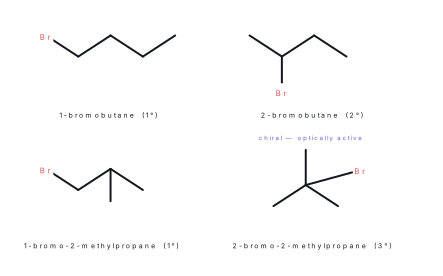
- Chain isomerism — different carbon skeletons, e.g. 1-bromobutane and 1-bromo-2-methylpropane.
- Position isomerism — the same skeleton with the halogen on a different carbon, e.g. 1-bromobutane and 2-bromobutane.
- Optical isomerism — when the halogen-bearing carbon has four different groups, e.g. 2-bromobutane, which exists as a pair of non-superimposable mirror images.
C₄H₉Br has exactly four structural isomers, and they are worth knowing by heart because examiners ask for them year after year.
8.2 Preparation from alkanes, alkenes and alcohols
From alkanes — free radical halogenation
In the presence of ultraviolet light or at 573–773 K, an alkane reacts with chlorine or bromine by a free radical chain mechanism:
CH₄ + Cl₂ --UV light--> CH₃Cl + HCl
| Step | Reaction |
|---|---|
| Initiation | Cl₂ --hv--> 2Cl• |
| Propagation | CH₄ + Cl• → CH₃• + HCl ; CH₃• + Cl₂ → CH₃Cl + Cl• |
| Termination | CH₃• + Cl• → CH₃Cl ; 2Cl• → Cl₂ ; 2CH₃• → C₂H₆ |
The method is cheap but a poor laboratory preparation: the chloromethane formed is itself attacked, giving CH₂Cl₂, CHCl₃ and CCl₄, and a higher alkane gives a mixture of position isomers as well. Reactivity of the halogens falls F₂ > Cl₂ > Br₂ > I₂; fluorination is explosive and iodination is reversible, so only chlorination and bromination are useful. Iodination can be forced by adding an oxidising agent (HIO₃ or conc. HNO₃) to destroy the HI as it forms.
From alkenes
Addition of hydrogen halide — Markovnikov's rule. The hydrogen adds to the doubly bonded carbon that already carries more hydrogens:
CH₃CH=CH₂ + HBr → CH₃CHBrCH₃ (2-bromopropane, major)
The reason is the stability of the intermediate carbocation: the secondary cation CH₃C⁺HCH₃ is more stable than the primary CH₃CH₂C⁺H₂.
Peroxide (Kharasch) effect. In the presence of benzoyl peroxide the addition of HBr only goes the other way, because the mechanism becomes free radical:
CH₃CH=CH₂ + HBr --peroxide--> CH₃CH₂CH₂Br (1-bromopropane)
HCl and HI show no peroxide effect — the H–Cl bond is too strong to break homolytically and the C–I bond is too weak to survive.
Reactivity of the hydrogen halides towards an alkene is HI > HBr > HCl > HF.
From alcohols — the standard laboratory route
This is the method to quote unless a question says otherwise, because it gives one product in good yield.
| Reagent | Equation | Note |
|---|---|---|
| Conc. HCl + anhyd. ZnCl₂ | C₂H₅OH + HCl → C₂H₅Cl + H₂O | ZnCl₂ is a catalyst; the mixture is Lucas reagent |
| NaBr + conc. H₂SO₄ | C₂H₅OH + HBr → C₂H₅Br + H₂O | HBr generated in situ |
| Red P + I₂ | 3C₂H₅OH + PI₃ → 3C₂H₅I + H₃PO₃ | PI₃ made in the flask |
| PCl₃ | 3C₂H₅OH + PCl₃ → 3C₂H₅Cl + H₃PO₃ | |
| PCl₅ | C₂H₅OH + PCl₅ → C₂H₅Cl + POCl₃ + HCl | |
| SOCl₂ | C₂H₅OH + SOCl₂ → C₂H₅Cl + SO₂↑ + HCl↑ | Darzen's process — best of all |
Thionyl chloride is preferred because both by-products are gases that simply escape, leaving pure haloalkane with nothing to separate.
The ease of replacement of –OH follows the order 3° > 2° > 1°, which is the basis of the Lucas test: a tertiary alcohol gives an oily turbidity at once, a secondary alcohol in about five minutes, and a primary alcohol only on heating.
Halogen exchange. Two named reactions convert one haloalkane into another:
- Finkelstein reaction: R–Cl + NaI --dry acetone--> R–I + NaCl↓ (NaCl is insoluble in acetone, so it precipitates and drives the equilibrium.)
- Swarts reaction: CH₃Br + AgF → CH₃F + AgBr (also with Hg₂F₂ or SbF₃); this is how fluoroalkanes and freons are made.
8.3 Physical properties
Haloalkanes are colourless liquids (the first few members are gases) with a sweetish smell.
| Property | Trend | Reason |
|---|---|---|
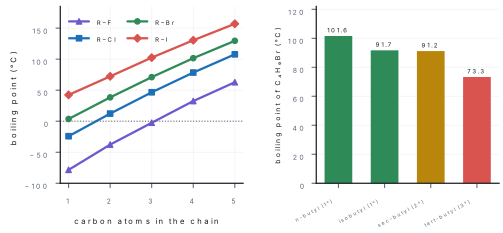
| Boiling point, same alkyl group | RI > RBr > RCl > RF | heavier, more polarisable halogen → stronger van der Waals forces |
| Boiling point, same halogen | rises with chain length | larger surface area of contact |
| Effect of branching | branched isomer boils lower | a branched molecule is more spherical, so less surface contact |
| Density | RI > RBr > RCl; bromides and iodides sink in water | heavy halogen atom |
| Solubility | insoluble in water, soluble in benzene, ether, alcohol | cannot make hydrogen bonds strong enough to break water's own |
| Dipole moment | CH₃Cl (1.86 D) > CH₃F (1.85) > CH₃Br (1.79) > CH₃I (1.64) | product of charge separation and bond length |
The last row is a favourite short question. Fluorine is the most electronegative atom, yet CH₃F does not have the largest dipole moment, because the C–F bond is so short that the charges are not far enough apart.
8.4 Chemical properties; substitution reactions SN1 and SN2
Because the halogen is more electronegative than carbon, the C–X bond is polarised Cδ⁺–Xδ⁻. A nucleophile (an electron-rich species: OH⁻, CN⁻, NH₃, RO⁻, RS⁻, NO₂⁻) attacks the positive carbon and the halide leaves as X⁻ with the bonding pair. The result is nucleophilic substitution, written SN.
The C–X bond gets weaker and longer down the group, so the leaving group leaves more easily:
| Bond | C–F | C–Cl | C–Br | C–I |
|---|---|---|---|---|
| Bond length (pm) | 139 | 178 | 193 | 214 |
| Bond enthalpy (kJ mol⁻¹) | 452 | 351 | 293 | 234 |
| Reactivity in substitution | least | greatest |
Order of reactivity: R–I > R–Br > R–Cl > R–F. Iodide is the best leaving group because the C–I bond is the weakest, even though iodine is the least electronegative halogen.
The SN2 mechanism
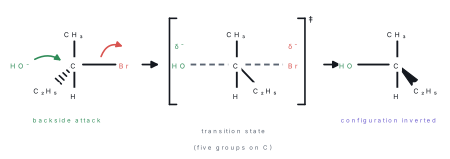
SN2 means substitution, nucleophilic, bimolecular. It happens in one step: the nucleophile attacks the carbon from the side exactly opposite to the leaving group (backside attack) while the halide is still leaving. At the half-way point the carbon is joined to five things in a transition state in which the three unchanged groups lie in a plane.
Because the nucleophile comes in from the back, the other three groups are pushed through the plane like an umbrella turning inside out in the wind. The product therefore has the opposite configuration from the reactant. This is Walden inversion, and it is the proof that the mechanism is SN2.
The SN1 mechanism
SN1 means substitution, nucleophilic, unimolecular. It happens in two steps:
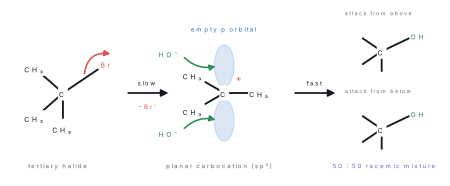
- Step 1 (slow, rate-determining). The C–X bond breaks heterolytically on its own, giving a flat, sp²-hybridised carbocation and X⁻.
- Step 2 (fast). The nucleophile attacks the carbocation.
The nucleophile does not appear in the rate law at all, because it joins the reaction only after the slow step is over. Doubling the hydroxide concentration does not change the rate — the single most quotable difference between the two mechanisms.
The carbocation is planar, so the nucleophile can attack either face with equal ease. A single enantiomer of the halide therefore gives a 50 : 50 mixture of both product enantiomers — a racemic mixture. This is racemisation.
Energy profiles and the choice of mechanism
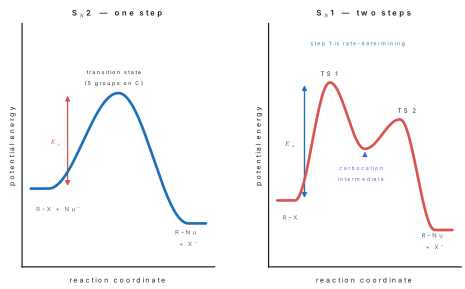
The two mechanisms look completely different on an energy profile. SN2 has one hump — one transition state, no intermediate. SN1 has two humps with a well between them: the well is the carbocation, a real (if short-lived) species that can be detected.
| SN1 | SN2 | |
|---|---|---|
| Molecularity of slow step | 1 (only R–X) | 2 (R–X and Nu⁻) |
| Steps | two | one |
| Rate law | rate = k[\text{RX}] | rate = k[\text{RX}][\text{Nu}^-] |
| Intermediate | carbocation | none — only a transition state |
| Stereochemistry | racemisation | inversion (Walden) |
| Favoured by | 3° > 2° > 1° halide | CH₃X > 1° > 2° > 3° |
| Nucleophile | weak, low concentration | strong, high concentration |
| Solvent | polar protic (water, ethanol) | polar aprotic (acetone, DMSO) |
| Rearrangement | possible (carbocation can shift) | never |
For SN1 the order is 3° > 2° > 1° because a tertiary carbocation is the most stable (three alkyl groups push electron density in). For SN2 the order is exactly reversed, CH₃X > 1° > 2° > 3°, because the three bulky groups on a tertiary carbon physically block the backside attack — steric hindrance. The only order that stays the same for both is the leaving group: R–I > R–Br > R–Cl > R–F.
Problem. The hydrolysis of bromomethane by hydroxide ion in aqueous acetone has rate 2.0\times10^{-4}\ \text{mol L}^{-1}\text{s}^{-1} when [\text{CH}_3\text{Br}] = 0.10\ \text{M} and [\text{OH}^-] = 0.10\ \text{M}. (a) Find the rate constant. (b) What is the rate if the hydroxide concentration alone is doubled? (c) What would the answer to (b) be for 2-bromo-2-methylpropane, and why?
Solution. (a) Bromomethane is a primary (in fact methyl) halide, so the mechanism is SN2 and the rate law is second order overall:
(b) The rate is first order in hydroxide, so doubling [\text{OH}^-] doubles the rate:
(c) 2-Bromo-2-methylpropane is tertiary, so it reacts by SN1 with rate =k[\text{RBr}]. Hydroxide takes no part in the slow step, so doubling [\text{OH}^-] leaves the rate unchanged.
8.5 Formation of alcohol, nitrile, amine, ether, thioether, carbylamine, nitrite and nitroalkane
Every reaction below is nucleophilic substitution. Learn the table as one reaction with eight different nucleophiles.
| Reagent and conditions | Nucleophile | Product | Class |
|---|---|---|---|
| KOH or NaOH, aqueous, warm | OH⁻ | C₂H₅OH | alcohol |
| moist Ag₂O | OH⁻ | C₂H₅OH | alcohol |
| KCN, alcoholic | ⁻C≡N (through carbon) | CH₃CH₂CN, propanenitrile | nitrile |
| AgCN, alcoholic | ⁻N≡C (through nitrogen) | CH₃CH₂NC, ethyl isocyanide | carbylamine (isocyanide) |
| NH₃, alcoholic, excess, sealed tube | NH₃ | C₂H₅NH₂ | primary amine |
| R'ONa, dry (Williamson) | R'O⁻ | C₂H₅OC₂H₅ | ether |
| R'SNa or KSH | R'S⁻ / HS⁻ | C₂H₅SC₂H₅ / C₂H₅SH | thioether / thiol |
| KNO₂, aqueous alcohol | O–N=O (through oxygen) | C₂H₅–O–N=O | alkyl nitrite |
| AgNO₂, alcoholic | ⁻NO₂ (through nitrogen) | C₂H₅NO₂ | nitroalkane |
Written out with equations:
- C₂H₅Br + KOH(aq) → C₂H₅OH + KBr
- C₂H₅Br + KCN → C₂H₅CN + KBr
- C₂H₅Br + AgCN → C₂H₅NC + AgBr
- C₂H₅Br + 2NH₃ → C₂H₅NH₂ + NH₄Br
- C₂H₅Br + C₂H₅ONa → C₂H₅OC₂H₅ + NaBr
- C₂H₅Br + C₂H₅SNa → C₂H₅SC₂H₅ + NaBr
- C₂H₅Br + KNO₂ → C₂H₅ONO + KBr
- C₂H₅Br + AgNO₂ → C₂H₅NO₂ + AgBr
KCN and KNO₂ are ionic, so the anion attacks through the atom that carries the negative charge most freely (C of CN⁻, O of NO₂⁻), giving the nitrile and the alkyl nitrite. AgCN and AgNO₂ are largely covalent, so the carbon and the oxygen are tied up in the bond to silver and the attack must happen through the nitrogen, giving the isocyanide and the nitroalkane. Potassium → C or O; silver → N.
The ammonolysis reaction does not stop at the primary amine: the amine produced is itself a nucleophile, so a mixture of primary, secondary and tertiary amines and finally the quaternary ammonium salt is obtained. A large excess of ammonia favours the primary amine.
8.6 Elimination reaction; reduction; the Wurtz reaction
Dehydrohalogenation and Saytzeff's rule
Heated with alcoholic potassium hydroxide, a haloalkane loses HX and becomes an alkene. The base takes a hydrogen from the carbon next to the one carrying the halogen (the β-carbon), so the reaction is called β-elimination:
CH₃CH₂Br + KOH(alc.) --Δ--> CH₂=CH₂ + KBr + H₂O
The same reagent, two different solvents, two different answers. In water the hydroxide acts as a nucleophile and you get the alcohol (substitution). In alcohol it acts as a base, pulling off a β-hydrogen, and you get the alkene (elimination). Losing a mark here is the most avoidable mistake in the whole unit.
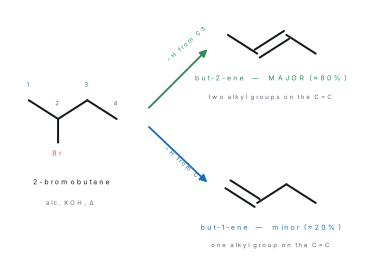
When the halide has two different β-carbons, two alkenes are possible. Saytzeff's (Zaitsev's) rule says the major product is the more substituted alkene — the one with more alkyl groups attached to the doubly bonded carbons — because it is the more stable.
The ease of dehydrohalogenation is 3° > 2° > 1°, and for the same alkyl group R–I > R–Br > R–Cl.
Reduction
Reduction replaces the halogen by hydrogen and gives back the parent alkane:
C₂H₅Br + 2[H] --Zn/HCl--> C₂H₆ + HBr
Suitable reducing agents are Zn + HCl, Zn–Cu couple in ethanol, LiAlH₄ in dry ether, and H₂ over a nickel catalyst.
The Wurtz reaction
Two molecules of haloalkane are joined by metallic sodium in dry ether:
2C₂H₅Br + 2Na --dry ether--> C₄H₁₀ + 2NaBr
This is the standard way of climbing from a small alkane to one with twice as many carbon atoms, so it can only make alkanes with an even number of carbons from a single halide. If two different halides are used, three products form (R–R, R–R' and R'–R') and separating them is a nuisance. Tertiary halides give alkenes instead, by elimination.
Problem. 21.8 g of bromoethane is treated with excess sodium in dry ether. Calculate the mass and the volume at STP of the alkane formed, assuming the reaction is complete. (C = 12, H = 1, Br = 80)
Solution. The Wurtz reaction is
2C₂H₅Br + 2Na → C₄H₁₀ + 2NaBr
M(\text{C}_2\text{H}_5\text{Br}) = 24 + 5 + 80 = 109\ \text{g mol}^{-1}, so
Two moles of halide give one mole of butane, so n(\text{C}_4\text{H}_{10}) = 0.100\ \text{mol} and
Problem. A monobromoalkane contains 58.4% bromine by mass. Find its molecular formula, and name and classify all its structural isomers. (C = 12, H = 1, Br = 80)
Solution. A monobromoalkane is CₙH₂ₙ₊₁Br, of molar mass
The mass fraction of bromine is
The formula is C₄H₉Br, and its four isomers are
| Isomer | Name | Class |
|---|---|---|
| CH₃CH₂CH₂CH₂Br | 1-bromobutane | 1° |
| CH₃CH₂CHBrCH₃ | 2-bromobutane | 2° |
| (CH₃)₂CHCH₂Br | 1-bromo-2-methylpropane | 1° |
| (CH₃)₃CBr | 2-bromo-2-methylpropane | 3° |
8.7 Preparation of trichloromethane from ethanol and propanone
Trichloromethane, CHCl₃, is the old anaesthetic chloroform. It is made industrially and in the laboratory by the haloform reaction, in which bleaching powder supplies both the chlorine and the alkali.
Bleaching powder in water provides the two reagents:
CaOCl₂ + H₂O → Ca(OH)₂ + Cl₂
From ethanol — three steps
| Step | Reaction | What happens |
|---|---|---|
| 1. Oxidation | CH₃CH₂OH + Cl₂ → CH₃CHO + 2HCl | ethanol → ethanal |
| 2. Chlorination | CH₃CHO + 3Cl₂ → CCl₃CHO + 3HCl | ethanal → trichloroethanal (chloral) |
| 3. Hydrolysis | 2CCl₃CHO + Ca(OH)₂ → 2CHCl₃ + (HCOO)₂Ca | chloral → chloroform + calcium methanoate |
From propanone — two steps
Propanone already has the carbonyl group, so no oxidation step is needed and the yield is better. This is the preferred method.
| Step | Reaction |
|---|---|
| 1. Chlorination | CH₃COCH₃ + 3Cl₂ → CCl₃COCH₃ + 3HCl |
| 2. Hydrolysis | 2CCl₃COCH₃ + Ca(OH)₂ → 2CHCl₃ + (CH₃COO)₂Ca |
In both routes the crude chloroform distils over with steam, and is purified by shaking with concentrated sulphuric acid, washing with dilute alkali and water, drying over anhydrous calcium chloride and redistilling at 334 K.
Ethanol needs three steps (oxidation, chlorination, hydrolysis) because the carbonyl group has to be made first. Propanone needs only two (chlorination, hydrolysis). Same reagent — bleaching powder — same final step, one step fewer, higher yield.
8.8 Chemical properties of trichloromethane
Chloroform is a colourless, sweet-smelling, heavy liquid (density 1.49 g cm⁻³, b.p. 61 °C), almost insoluble in water, non-inflammable, and a good solvent for fats, oils, waxes, resins, rubber and iodine.
Oxidation — the reason chloroform is kept in a dark bottle
In air and sunlight chloroform is slowly oxidised to phosgene (carbonyl chloride), an extremely poisonous gas used as a war gas in 1915:
2CHCl₃ + O₂ --light--> 2COCl₂ + 2HCl
This is why chloroform is stored in dark brown bottles filled to the brim (to keep out light and air) with about 1% ethanol added. The ethanol destroys any phosgene that does form, turning it into harmless diethyl carbonate:
COCl₂ + 2C₂H₅OH → (C₂H₅O)₂CO + 2HCl
Reduction
CHCl₃ + 2[H] --Zn/HCl--> CH₂Cl₂ + HCl
Zinc dust and water give dichloromethane; with excess reducing agent the reduction goes all the way to methane, CHCl₃ + 6[H] → CH₄ + 3HCl.
Action on silver powder
Heated with silver powder, chloroform loses all its chlorine and the two carbon skeletons join, giving ethyne:
2CHCl₃ + 6Ag → C₂H₂↑ + 6AgCl
Action with concentrated nitric acid
CHCl₃ + HNO₃ → CCl₃NO₂ + H₂O
The product, trichloronitromethane, is chloropicrin — a tear gas, and a soil fumigant and insecticide.
Action with propanone
In the presence of dilute potassium hydroxide, chloroform adds across the carbonyl group of propanone:
CHCl₃ + CH₃COCH₃ --dil. KOH--> (CH₃)₂C(OH)CCl₃
The product, 1,1,1-trichloro-2-methylpropan-2-ol, is chloretone, once widely used as a hypnotic and sedative.
Action with aqueous alkali
Boiled with aqueous sodium hydroxide, chloroform is hydrolysed to a salt of methanoic acid:
CHCl₃ + 4NaOH → HCOONa + 3NaCl + 2H₂O
The carbylamine reaction
Warmed with a primary amine and alcoholic KOH, chloroform gives an isocyanide with an appalling smell — the standard test for a primary amine:
C₆H₅NH₂ + CHCl₃ + 3KOH → C₆H₅NC + 3KCl + 3H₂O
| Reagent | Product | Name of product |
|---|---|---|
| O₂ + light | COCl₂ | phosgene |
| Zn/HCl | CH₂Cl₂ | dichloromethane |
| Ag powder, Δ | C₂H₂ | ethyne |
| conc. HNO₃ | CCl₃NO₂ | chloropicrin |
| propanone + dil. KOH | (CH₃)₂C(OH)CCl₃ | chloretone |
| NaOH(aq), boil | HCOONa | sodium methanoate |
| RNH₂ + alc. KOH | RNC | isocyanide (carbylamine test) |
Uses of chloroform. Solvent for fats, oils, rubber, resins and iodine; manufacture of chloretone, chloropicrin and the refrigerant Freon-22 (CHCl₃ + 2HF --SbF₅--> CHClF₂ + 2HCl); a preservative for anatomical specimens; and formerly a general anaesthetic, now abandoned because it damages the liver.
Problem. Chloroform is prepared from 9.20 g of ethanol by the bleaching powder method. Calculate the theoretical mass of chloroform, and the actual mass if the yield is 60%. (C = 12, H = 1, O = 16, Cl = 35.5)
Solution. Over the three steps one molecule of ethanol gives one molecule of chloroform:
CH₃CH₂OH → CH₃CHO → CCl₃CHO → CHCl₃
M(\text{C}_2\text{H}_5\text{OH}) = 46\ \text{g mol}^{-1}, so
Therefore n(\text{CHCl}_3) = 0.200\ \text{mol}, and with M(\text{CHCl}_3) = 12 + 1 + 3(35.5) = 119.5\ \text{g mol}^{-1}:
Chapter summary
- A monohaloalkane is CₙH₂ₙ₊₁X. It is 1°, 2° or 3° according to the number of carbons on the halogen-bearing carbon, and shows chain, position and (when that carbon has four different groups) optical isomerism. C₄H₉Br has four structural isomers.
- Preparation: free radical halogenation of alkanes (gives mixtures); Markovnikov addition of HX to alkenes, reversed for HBr by peroxides; and — best — alcohols with conc. HX/ZnCl₂, PCl₃, PCl₅ or SOCl₂ (Darzen's process). Finkelstein (NaI/acetone) and Swarts (AgF) exchange halogens.
- Boiling point rises RF < RCl < RBr < RI and with chain length, and falls with branching. Dipole moments run CH₃Cl > CH₃F > CH₃Br > CH₃I.
- Reactivity in nucleophilic substitution is R–I > R–Br > R–Cl > R–F, because the C–X bond enthalpy falls in that order.
- SN2: one step, backside attack, rate = k[\text{RX}][\text{Nu}^-], transition state with five groups on carbon, inversion of configuration, favoured by CH₃X > 1° > 2° > 3° and strong nucleophiles.
- SN1: two steps through a planar carbocation, rate = k[\text{RX}], racemisation, favoured by 3° > 2° > 1°, weak nucleophiles and polar protic solvents. Its energy profile has two humps and an intermediate well; the SN2 profile has one hump and none.
- The eight nucleophiles: OH⁻ → alcohol; KCN → nitrile but AgCN → isocyanide; NH₃ → amine; R'ONa → ether (Williamson); R'SNa → thioether; KNO₂ → alkyl nitrite but AgNO₂ → nitroalkane. Potassium attacks through C or O, silver through N.
- Aqueous KOH substitutes (alcohol); alcoholic KOH eliminates (alkene), the more substituted alkene being the major product by Saytzeff's rule. Reduction gives the alkane; the Wurtz reaction (2RX + 2Na, dry ether) doubles the chain.
- Chloroform is made from ethanol (3 steps) or propanone (2 steps) with bleaching powder. It is oxidised in air and light to poisonous phosgene, so it is kept in dark bottles with 1% ethanol; with Ag it gives ethyne, with conc. HNO₃ chloropicrin, with propanone chloretone, and with aqueous NaOH sodium methanoate.
Practice questions
Group A — Multiple choice (1 mark each)
- The number of structural isomers of C₄H₉Br is [1]a2b3c4d5
- Which haloalkane is most reactive towards nucleophilic substitution? [1]aCH₃CH₂FbCH₃CH₂ClcCH₃CH₂BrdCH₃CH₂I
- An SN2 reaction proceeds with [1]aretention of configurationbinversion of configurationcracemisationdno stereochemical change
- The intermediate in an SN1 reaction is [1]aa carbanionba free radicalca carbocationda carbene
- Bromoethane heated with alcoholic KOH gives [1]aethanolbethenecethanedethoxyethane
- Bromoethane warmed with silver cyanide gives mainly [1]apropanenitrilebethyl isocyanidecethylaminedethanol
- Chloroform is stored in dark bottles because in light and air it forms [1]achloropicrinbchloretonecphosgenedethyne
- The reagent that converts ethanol to chloroethane with only gaseous by-products is [1]aPCl₅bPCl₃cSOCl₂dconc. HCl
Answers to Group A
1. (c) — 1-bromobutane, 2-bromobutane, 1-bromo-2-methylpropane and 2-bromo-2-methylpropane.
2. (d) — the C–I bond is the weakest (234 kJ mol⁻¹), so iodide is the best leaving group.
3. (b) — backside attack turns the molecule inside out (Walden inversion).
4. (c) — the slow step is heterolysis of C–X to give a planar carbocation.
5. (b) — alcoholic KOH acts as a base and eliminates HBr.
6. (b) — AgCN is covalent, so attack is through nitrogen and an isocyanide is formed.
7. (c) — 2CHCl₃ + O₂ → 2COCl₂ + 2HCl.
8. (c) — Darzen's process; SO₂ and HCl both escape as gases.
Group B — Short answer (5 marks each)
- Define a haloalkane. Write the structures, IUPAC names and classification (1°, 2°, 3°) of all the isomers of C₄H₉Br, and state which one is optically active. [5]
- How is bromoethane prepared from(a) ethene and(b) ethanol? Why is thionyl chloride the best reagent for making chloroethane from ethanol? [5]
- Explain the SN2 mechanism with a suitable example. Why does it give inversion of configuration, and why is a tertiary halide unreactive by this route? [5]
- Distinguish between SN1 and SN2 mechanisms under five headings. [5]
- What happens when bromoethane is treated with(a) KCN,(b) AgCN,(c) AgNO₂,(d) KNO₂,(e) sodium ethoxide? Give equations and name the products. [5]
- State Saytzeff's rule. Predict and explain the major product when 2-bromobutane is heated with alcoholic KOH. [5]
- 21.8 g of bromoethane is heated with sodium in dry ether. Name the reaction, write the equation, and calculate the volume of gas produced at STP. [5]
- How is chloroform prepared from propanone? Why is this route preferred to the one starting from ethanol? [5]
Answers to Group B
2. (a) Ethene + HBr → CH₃CH₂Br; the addition needs no peroxide because ethene is symmetrical, so Markovnikov's rule does not arise. (b) Ethanol is warmed with NaBr and conc. H₂SO₄, which generates HBr in the flask: C₂H₅OH + HBr → C₂H₅Br + H₂O. Thionyl chloride is best for the chloride because C₂H₅OH + SOCl₂ → C₂H₅Cl + SO₂↑ + HCl↑ — both by-products are gases and escape, so the haloalkane is obtained pure with no separation step.
4.
| SN1 | SN2 | |
|---|---|---|
| Steps | two | one |
| Rate law | k[\text{RX}] | k[\text{RX}][\text{Nu}^-] |
| Intermediate | carbocation | none (transition state only) |
| Stereochemistry | racemisation | inversion |
| Favoured by | 3° halide, weak nucleophile, protic solvent | 1° halide, strong nucleophile, aprotic solvent |
6. Saytzeff's rule: in a dehydrohalogenation the alkene with the greater number of alkyl groups on the doubly bonded carbons is the major product, because alkyl groups release electrons into the double bond (hyperconjugation and inductive effect) and stabilise it. 2-Bromobutane can lose a β-hydrogen from C1 or C3. Loss from C3 gives but-2-ene, CH₃CH=CHCH₃, which is disubstituted; loss from C1 gives but-1-ene, CH₂=CHCH₂CH₃, which is monosubstituted. But-2-ene is therefore the major product (about 80%).
7. The Wurtz reaction: 2C₂H₅Br + 2Na → C₄H₁₀ + 2NaBr. n(\text{C}_2\text{H}_5\text{Br}) = 21.8/109 = 0.200\ \text{mol}, so n(\text{C}_4\text{H}_{10}) = 0.100\ \text{mol} and
8. Bleaching powder in water gives Ca(OH)₂ and Cl₂. Then CH₃COCH₃ + 3Cl₂ → CCl₃COCH₃ + 3HCl, and 2CCl₃COCH₃ + Ca(OH)₂ → 2CHCl₃ + (CH₃COO)₂Ca. Propanone is preferred because it already contains the carbonyl group, so the oxidation step needed with ethanol is unnecessary: two steps instead of three, and a higher yield.
Group C — Long answer (8 marks each)
- (a) Describe the SN1 and SN2 mechanisms of hydrolysis of a haloalkane, using suitable examples, and draw the energy profile of each. [5](b) Explain why 2-bromo-2-methylpropane hydrolyses by SN1 while bromomethane hydrolyses by SN2. [3]
- (a) How is trichloromethane prepared from ethanol? Give all three equations. [4](b) What happens when chloroform is treated with (i) air and sunlight, (ii) silver powder, (iii) conc. HNO₃, (iv) aqueous NaOH? Give equations. [4]
- An organic compound A, C₃H₇Br, reacts with aqueous KOH to give B, and with alcoholic KOH to give C, C₃H₆. A with KCN gives D, and A with sodium in dry ether gives E, C₆H₁₄. Identify A to E, write all the equations, and state the mechanism by which A reacts with aqueous KOH if A is the 2-bromo isomer. [8]
Answers to Group C
1.(b) In 2-bromo-2-methylpropane the halogen-bearing carbon carries three methyl groups. They release electron density by the inductive effect and by hyperconjugation, so the carbocation left behind when Br⁻ departs is strongly stabilised, and the slow heterolysis of step 1 becomes easy — SN1. The same three methyl groups also crowd the back of the carbon, so backside attack is sterically blocked and SN2 is impossible. Bromomethane is the opposite case: the CH₃⁺ cation would be very unstable, so SN1 is ruled out, while the carbon is completely unhindered and the nucleophile can reach it easily — SN2.
2.(a) CaOCl₂ + H₂O → Ca(OH)₂ + Cl₂; CH₃CH₂OH + Cl₂ → CH₃CHO + 2HCl; CH₃CHO + 3Cl₂ → CCl₃CHO + 3HCl; 2CCl₃CHO + Ca(OH)₂ → 2CHCl₃ + (HCOO)₂Ca.
2.(b) (i) 2CHCl₃ + O₂ → 2COCl₂ + 2HCl (phosgene). (ii) 2CHCl₃ + 6Ag → C₂H₂ + 6AgCl (ethyne). (iii) CHCl₃ + HNO₃ → CCl₃NO₂ + H₂O (chloropicrin). (iv) CHCl₃ + 4NaOH → HCOONa + 3NaCl + 2H₂O (sodium methanoate).
3. A = C₃H₇Br (1-bromopropane or 2-bromopropane). B = propan-1-ol or propan-2-ol, C₃H₇OH: C₃H₇Br + KOH(aq) → C₃H₇OH + KBr. C = propene, CH₃CH=CH₂: C₃H₇Br + KOH(alc.) → CH₃CH=CH₂ + KBr + H₂O. D = butanenitrile (or 2-methylpropanenitrile), C₃H₇CN: C₃H₇Br + KCN → C₃H₇CN + KBr. E = hexane, C₆H₁₄, by the Wurtz reaction: 2C₃H₇Br + 2Na → C₆H₁₄ + 2NaBr.
If A is 2-bromopropane it is a secondary halide. Secondary halides sit on the borderline, but with a strong nucleophile such as concentrated aqueous hydroxide the reaction is mainly SN2, giving propan-2-ol with inversion at the chiral centre; in a highly ionising solvent with dilute hydroxide it drifts towards SN1 and partial racemisation.
Practise more: Chemistry question bank