Unit 20 · Applied Chemistry · 3 teaching hours · 17 min read
Paper and Pulp
What the syllabus asks for 5
- Introduction
- Raw materials and their sources
- Stages in production of paper
- Flow-sheet diagram for paper production
- Quality of paper
Every page of this book began as a tree, a stalk of babiyo grass or an old newspaper. Paper is a thin mat of cellulose fibres felted together from a water suspension; making it is essentially one chemical problem — how to strip away the lignin that glues the fibres together in a plant, without destroying the cellulose itself. This unit follows that problem from the forest to the reel.
Name the raw materials and the two kinds of pulping; describe the stages (pulping → washing and screening → bleaching → beating and sizing → sheet formation → drying and calendering); draw the flow sheet; and list the properties by which paper quality is judged. The recovery of chemicals in the Kraft process is the favourite extra-mark question.
20.1 Introduction
Pulp is a fibrous mass of cellulose obtained by breaking down plant material mechanically or chemically. Paper is the sheet formed when a dilute water suspension of pulp is drained on a wire screen, pressed and dried, so that the fibres bond to one another through hydrogen bonds between their –OH groups.
The fibre is cellulose, (C₆H₁₀O₅)ₙ, a linear polymer of β-glucose units with n running into the thousands. Along with it, plant cell walls contain:
| Component | Nature | Wanted in paper? |
|---|---|---|
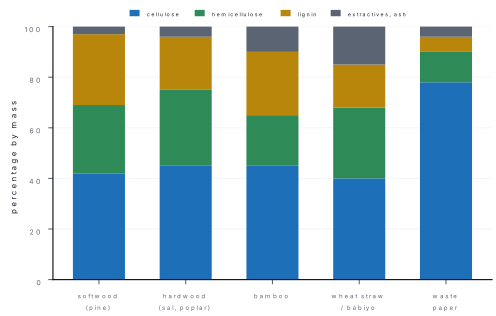
| Cellulose, 40–50 % | long β-1,4-glucose chains; strong, white, insoluble | yes — it is the fibre |
| Hemicellulose, 20–30 % | short branched sugar polymers | partly — helps fibres bond |
| Lignin, 18–30 % | cross-linked aromatic polymer, brown, binds fibres | no — it is stiff and yellows in light |
| Extractives, 2–8 % | resins, fats, tannins | no — they make pitch spots |
Paper was invented in China by Ts'ai Lun in about 105 AD from rags and bark, and Nepal has its own old tradition: lokta paper, hand-made from the inner bark of the Himalayan Daphne bholua shrub, has carried scriptures and lal purja land certificates for centuries because it resists insects and lasts for generations.
20.2 Raw materials and their sources
| Class | Examples | Source |
|---|---|---|
| Softwood (long fibre, 3–5 mm) | pine, fir, spruce | conifer plantations; gives strength |
| Hardwood (short fibre, 1–2 mm) | sal, poplar, eucalyptus, birch | forests; gives smoothness and bulk |
| Non-wood fibre | babiyo (sabai) grass, rice and wheat straw, bagasse, jute, bamboo, kans grass | Terai farms and river banks — the main Nepali source |
| Bast fibre | lokta bark, rags, cotton linters | Himalayan shrubs, textile waste |
| Recycled fibre | waste paper, cartons | urban waste — now over half of world furnish |
| Chemicals | NaOH, Na₂S, Na₂SO₄, lime, Cl₂/ClO₂, H₂O₂ | imported in Nepal |
| Fillers and sizes | china clay, CaCO₃, TiO₂, talc, rosin, alum, starch | mineral suppliers |
A rule of thumb: about 2.2 tonnes of oven-dry wood yield one tonne of bleached chemical pulp, because roughly half of the wood substance is dissolved away.
20.3 Stages in production of paper
(a) Preparation of the wood. Logs are debarked, chipped to pieces about 20 mm × 20 mm × 4 mm and screened, so that the cooking liquor can penetrate quickly and evenly.
(b) Pulping. The chips are broken down into individual fibres.
| Mechanical pulping | Chemical pulping | |
|---|---|---|
| How | logs ground against a wet revolving stone, or chips refined between discs | chips cooked with chemicals in a digester |
| Lignin | left in the pulp | dissolved out |
| Yield | 90–95 % | 45–55 % |
| Fibre strength | low (fibres are cut) | high |
| Colour stability | poor — newsprint yellows | good |
| Used for | newsprint, cheap magazine paper | printing, writing, packaging paper |
The important chemical route is the sulphate or Kraft process (Kraft is German for "strength"). Chips are cooked with white liquor — a solution of sodium hydroxide and sodium sulphide — at about 170 °C and 7–8 atm for 2–4 hours. The alkali breaks the ether links of lignin and the HS⁻ ion attacks it further, so the lignin dissolves as soluble sodium salts, leaving the cellulose fibres intact. The spent liquor, now dark brown, is called black liquor.
The older sulphite process cooks the chips instead with calcium or magnesium bisulphite solution containing free SO₂, which converts lignin into soluble lignosulphonic acids:
2SO₂ + CaCO₃ + H₂O → Ca(HSO₃)₂ + CO₂↑
It gives a paler pulp that is easier to bleach, but a weaker one, and its waste liquor is hard to recover; most mills have moved to the Kraft process.
Black liquor is concentrated in multiple-effect evaporators to about 65 % solids and burnt in a recovery furnace. Its organic matter provides all the steam the mill needs, while the sodium salts collect as a molten smelt of Na₂CO₃ and Na₂S:
Na₂SO₄ + 2C → Na₂S + 2CO₂↑
The smelt is dissolved to give green liquor and then causticised with slaked lime to regenerate the cooking alkali:
Na₂CO₃ + Ca(OH)₂ → 2NaOH + CaCO₃↓
The calcium carbonate "lime mud" is filtered off and reburnt in a lime kiln, so the lime is recycled too:
CaCO₃ --Δ--> CaO + CO₂↑ and CaO + H₂O → Ca(OH)₂
More than 95 % of the chemicals go round this loop again.
(c) Washing and screening. The pulp is washed free of black liquor on rotary vacuum washers and screened to remove knots, uncooked chips, sand and grit.
(d) Bleaching. Unbleached Kraft pulp is brown (it is the paper of cement sacks). The residual lignin is removed in stages with oxygen, chlorine dioxide and hydrogen peroxide. Chlorine dioxide is generated on site because it cannot be stored:
2NaClO₃ + 4HCl → 2ClO₂↑ + Cl₂↑ + 2NaCl + 2H₂O
Bleaching with Cl₂ gas chlorinates the lignin and produces dioxins and other organochlorine poisons in the effluent. Modern mills are ECF (elemental chlorine free, using ClO₂) or TCF (totally chlorine free, using O₂, O₃ and H₂O₂). Do not write "bleaching with bleaching powder" as a modern method.
(e) Beating (refining) and stock preparation. The wet pulp is passed between rotating bars, which fray and swell the fibre walls so that more –OH groups are exposed and the fibres bond better. Then additives go in:
| Additive | Purpose |
|---|---|
| Rosin soap + alum, Al₂(SO₄)₃ | sizing — deposits aluminium resinate on the fibres so ink does not spread |
| China clay, CaCO₃, TiO₂, talc | loading — fills the gaps, giving opacity, whiteness and smoothness |
| Starch, cellulose gums | dry strength |
| Dyes, optical brighteners | colour, whiteness |
6C₁₉H₂₉COONa + Al₂(SO₄)₃ → 2(C₁₉H₂₉COO)₃Al + 3Na₂SO₄
(f) Sheet formation on the paper machine. A very dilute stock, about 0.5 % fibre in water, flows from the headbox onto a moving endless wire mesh. Water drains through the wire and is sucked away, leaving a wet web of about 20 % solids; press rolls squeeze it to 40 %; steam-heated drying cylinders take it to 94–95 %; calender rolls press it smooth and the sheet is wound on a reel and slit.
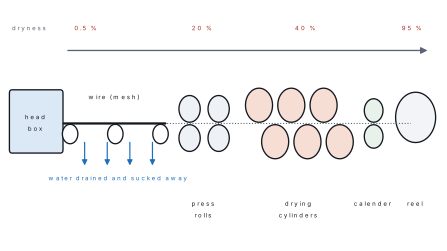
20.4 Flow sheet for paper production

Problem. A digester is charged with 5.0 tonnes of oven-dry wood containing 45 % cellulose, 26 % hemicellulose, 25 % lignin and 4 % extractives. Cooking dissolves all the lignin and extractives and half of the hemicellulose. Calculate the pulp yield.
Solution.
Cellulose retained = 0.45 × 5000 = 2250 kg Hemicellulose retained = ½ × 0.26 × 5000 = 650 kg Lignin and extractives retained = 0
Mass of pulp = 2250 + 650 = 2900 kg
The yield of a real Kraft cook is 45–50 %, lower than this, because some cellulose is also degraded by the hot alkali. Mechanical pulping keeps everything and so gives 90–95 %.
Problem. How much slaked lime is needed to causticise green liquor so as to regenerate 1000 kg of NaOH, and what mass of lime mud is produced? (Na = 23, O = 16, H = 1, C = 12, Ca = 40)
Solution. Na₂CO₃ + Ca(OH)₂ → 2NaOH + CaCO₃↓
M(NaOH) = 40, so moles of NaOH = 1000/40 = 25 kmol.
From the equation, Ca(OH)₂ needed = 25/2 = 12.5 kmol.
M[Ca(OH)₂] = 40 + 2(16+1) = 74, so mass = 12.5 × 74 = 925 kg.
CaCO₃ formed = 12.5 kmol × 100 = 1250 kg of lime mud.
Burning this mud in the lime kiln gives back 12.5 × 56 = 700 kg of CaO, which is slaked and used again — the loop closes.
20.5 Quality of paper
Paper is sold and specified by measurable properties, not by appearance alone.
| Property | Meaning and unit | Typical value |
|---|---|---|
| Grammage (GSM) | mass per unit area, g m⁻² | newsprint 45, photocopy 70–80, card 200+ |
| Caliper | thickness, μm | 100 μm for 80 gsm |
| Bulk | caliper ÷ grammage, cm³ g⁻¹ | 1.2–1.5 |
| Brightness | % of blue light reflected | newsprint 58, copier paper 90+ |
| Opacity | % of light stopped; raised by TiO₂ and clay | > 90 % for printing paper |
| Tensile, burst and tear strength | resistance to pulling, bursting, tearing | high in long-fibre Kraft |
| Sizing (Cobb value) | water absorbed in 60 s, g m⁻² | low for writing paper |
| Ash content | % of mineral filler left on ignition | 5–20 % |
| pH | acid-free paper has pH 7–9 | archival paper is alkaline |
| Smoothness and finish | calendered, machine or glazed | — |
Rosin–alum sizing leaves the sheet slightly acidic (pH 4.5–5.5). Over decades the acid hydrolyses the cellulose chains and the paper turns brown and brittle — the reason old books fall apart. Documents meant to last are made on acid-free paper sized with synthetic sizes and filled with CaCO₃, which buffers the sheet to pH 7–9. Nepali lokta paper, made with an alkaline ash cook and no alum, survives for centuries for the same reason.
Problem. A sheet of A4 paper measures 210 mm × 297 mm and the paper is 80 g m⁻². Find (a) the mass of one sheet, (b) the mass of a ream of 500 sheets, and (c) the number of sheets that can be cut from 1 tonne of such paper.
Solution.
(a) Area = 0.210 × 0.297 = 0.06237 m² mass = 80 × 0.06237 = 4.99 g ≈ 5.0 g
(b) Ream = 500 × 4.99 = 2495 g = 2.50 kg
(c) Number of sheets = 1 000 000 g ÷ 4.99 g = 2.0 × 10⁵ sheets, that is about 400 reams per tonne.
Paper and pulp in Nepal
Nepal's one large integrated mill, Bhrikuti Pulp and Paper at Gaindakot in Nawalparasi, was built in the mid-1980s with Chinese assistance and used babiyo (sabai) grass and paddy straw rather than wood. It supplied much of the country's paper, was privatised in 1992 and closed in 2011, and Nepal now imports most of its paper from India, China and Indonesia. The mills still working are small ones that recycle waste paper, together with several hundred cottage units in the hill districts producing lokta paper for notebooks, gift wrap and export. The attraction of Nepal's non-wood fibres is clear from the composition chart: less lignin means a milder cook, less chemical and less effluent — but they are bulky, seasonal and low in ash-free fibre, which is why a mill must sit close to its fields.
Chapter summary
- Paper is a mat of cellulose fibres, (C₆H₁₀O₅)ₙ, bonded by hydrogen bonds; pulping is the removal of lignin, which is brown, stiff and light-sensitive.
- Wood is roughly 45 % cellulose, 25 % hemicellulose and 25 % lignin; non-wood fibres such as babiyo grass and straw contain much less lignin.
- Raw materials: softwood (long fibre, strength), hardwood (short fibre, smoothness), non-wood fibre, rags and lokta bark, and recycled waste paper.
- Mechanical pulping gives 90–95 % yield but weak, yellowing pulp; chemical pulping gives 45–55 % yield of strong, stable fibre.
- Kraft (sulphate) process: cook chips with white liquor (NaOH + Na₂S) at 170 °C for 2–4 h; the sulphite process uses Ca(HSO₃)₂ with free SO₂.
- Chemical recovery: burn black liquor (Na₂SO₄ + 2C → Na₂S + 2CO₂↑), dissolve the smelt to green liquor, causticise it (Na₂CO₃ + Ca(OH)₂ → 2NaOH + CaCO₃↓) and reburn the lime mud (CaCO₃ → CaO + CO₂↑; CaO + H₂O → Ca(OH)₂).
- Stages: chipping → pulping → washing and screening → bleaching (ECF with ClO₂, not Cl₂) → beating, sizing with rosin + alum and loading with clay → sheet formation on the Fourdrinier wire → pressing, drying, calendering, reeling.
- Quality is measured by grammage (g m⁻²), caliper, brightness, opacity, tensile, burst and tear strength, sizing, ash content and pH; acid-free paper lasts longest.
- Bhrikuti Pulp and Paper, Gaindakot, worked on babiyo grass and straw from the mid-1980s until 2011; Nepal's living paper tradition is hand-made lokta paper.
Practice questions
Group A — Multiple choice (1 mark each)
- The chief chemical constituent of paper is [1]aligninbcellulosecstarchdhemicellulose
- The white liquor used in the Kraft process contains [1]aNaOH and Na₂SbCa(HSO₃)₂ and SO₂cNaOCl and NaOHdNaClO₃ and HCl
- Lignin must be removed from pulp mainly because it [1]ais too expensivebdissolves the cellulosecis brown and makes the paper yellow in lightdprevents drying
- Causticisation of green liquor is represented by [1]aCaCO₃ → CaO + CO₂bNa₂CO₃ + Ca(OH)₂ → 2NaOH + CaCO₃cNa₂SO₄ + 2C → Na₂S + 2CO₂d2SO₂ + CaCO₃ + H₂O → Ca(HSO₃)₂ + CO₂
- Rosin and alum are added to pulp for [1]ableachingbloadingcsizingddrying
- The grammage of ordinary photocopy paper is about [1]a10 g m⁻²b45 g m⁻²c80 g m⁻²d300 g m⁻²
Answers to Group A
1. (b) — the fibre itself is cellulose.
2. (a) — sodium hydroxide with sodium sulphide.
3. (c) — residual lignin oxidises in light and yellows the sheet.
4. (b) — lime converts carbonate back to hydroxide.
5. (c) — aluminium resinate stops ink spreading.
6. (c) — 70–80 g m⁻² is the usual office grade.
Group B — Short answer (5 marks each)
- What are pulp and paper? Name the raw materials used for papermaking in Nepal and state one advantage of non-wood fibre. [5]
- Compare mechanical and chemical pulping under yield, strength, colour stability and use. [5]
- Describe the Kraft process, giving the composition of white liquor, the cooking conditions and the equations of chemical recovery. [5]
- What is the purpose of (i) bleaching, (ii) beating, (iii) sizing and (iv) loading? Name one chemical used in each. [5]
- List six properties by which the quality of paper is judged and explain why acid-free paper lasts longer. [5]
- 4.0 tonnes of oven-dry straw contains 40 % cellulose, 28 % hemicellulose and 17 % lignin. If cooking removes all the lignin and one-quarter of the hemicellulose, calculate the mass of pulp and the percentage yield. [5]
Answers to Group B
1. Pulp is the fibrous cellulose mass got by breaking plant material down mechanically or chemically; paper is the sheet formed when dilute pulp is drained on a wire, pressed and dried. Nepali raw materials: babiyo (sabai) grass, rice and wheat straw, bagasse, bamboo, lokta bark and waste paper. Non-wood fibre contains much less lignin, so it needs a milder cook, less chemical and less energy.
2. See the table in §20.3: mechanical 90–95 % yield, weak short fibres, yellows in light, used for newsprint; chemical 45–55 % yield, strong fibres, colour-stable, used for printing, writing and packaging paper.
3. Chips are cooked with white liquor (NaOH + Na₂S) at about 170 °C and 7–8 atm for 2–4 hours; lignin dissolves, leaving cellulose. Recovery: Na₂SO₄ + 2C → Na₂S + 2CO₂↑ in the furnace; Na₂CO₃ + Ca(OH)₂ → 2NaOH + CaCO₃↓ in the causticiser; CaCO₃ --Δ--> CaO + CO₂↑ and CaO + H₂O → Ca(OH)₂ in the lime kiln.
4. (i) Bleaching removes residual lignin and whitens the pulp — ClO₂ or H₂O₂. (ii) Beating frays and swells the fibres so they bond — mechanical, no chemical. (iii) Sizing makes the sheet resist ink spread — rosin with alum, Al₂(SO₄)₃. (iv) Loading fills the gaps for opacity and smoothness — china clay, CaCO₃ or TiO₂.
5. Grammage, caliper, brightness, opacity, strength (tensile, burst, tear), sizing or Cobb value, ash content, pH, smoothness. Acid-free paper (pH 7–9) is not slowly hydrolysed at its glycosidic links, so the cellulose chains keep their length and the sheet does not become brown and brittle.
6. Cellulose retained = 0.40 × 4000 = 1600 kg. Hemicellulose retained = ¾ × 0.28 × 4000 = 840 kg. Lignin retained = 0. Pulp = 1600 + 840 = 2440 kg; yield = 2440/4000 × 100 = 61 %.
Group C — Long answer (8 marks each)
- Describe the manufacture of paper from wood by the Kraft process with a flow-sheet diagram, giving the stages from chipping to reeling and the equations of chemical recovery. [8]
- (a) What is meant by the grammage of paper? A reel of paper 1.2 m wide and 4000 m long weighs 336 kg. Find its grammage. [4](b) Explain how bleaching is carried out in a modern mill and why elemental chlorine has been abandoned. [4]
Answers to Group C
1. Logs are debarked and chipped; the chips are cooked in a digester with white liquor (NaOH + Na₂S) at 170 °C for 2–4 h, which dissolves the lignin; the pulp is blown, washed and screened; it is bleached with O₂, ClO₂ and H₂O₂; beaten, sized with rosin–alum and loaded with china clay; formed into a web on the Fourdrinier wire from a 0.5 % suspension; pressed, dried on steam cylinders, calendered, reeled and cut. The black liquor is evaporated and burnt (Na₂SO₄ + 2C → Na₂S + 2CO₂↑), the smelt dissolved to green liquor and causticised (Na₂CO₃ + Ca(OH)₂ → 2NaOH + CaCO₃↓), and the lime mud reburnt (CaCO₃ → CaO + CO₂↑; CaO + H₂O → Ca(OH)₂). Draw the flow sheet of §20.4.
2. (a) Grammage is the mass of one square metre of the paper, in g m⁻². Area = 1.2 × 4000 = 4800 m²; mass = 336 kg = 336 000 g. Grammage = 336 000 / 4800 = 70 g m⁻². (b) Bleaching is done in stages: an oxygen stage removes about half the residual lignin cheaply, then chlorine dioxide (made on site by 2NaClO₃ + 4HCl → 2ClO₂↑ + Cl₂↑ + 2NaCl + 2H₂O) oxidises the rest, with alkaline extraction and hydrogen peroxide stages between. Elemental chlorine was abandoned because it chlorinates lignin to dioxins and other toxic, persistent organochlorines that pass into the river; ECF and TCF sequences avoid them.
Practise more: Chemistry question bank