Unit 18 · Applied Chemistry · 4 teaching hours · 17 min read
Chemistry in the service of mankind
What the syllabus asks for 5
- Polymers: addition and condensation polymers; elastomers and fibres; natural and synthetic polymers
- Synthetic polymers: polythene, PVC, Teflon, polystyrene, nylon and bakelite
- Dyes: introduction; types of dyes on the basis of structure and method of application
- Drugs: characteristics; natural and synthetic drugs; classification of common drugs; habit-forming drugs and drug addiction
- Pesticides: introduction to insecticides, herbicides and fungicides
This unit is a survey of the four families of manufactured chemicals that changed ordinary life: polymers, dyes, drugs and pesticides. Nothing here is hard, but there is a great deal to know — monomers, linkages, classes, examples — and the examiner asks for exactly those names and examples. Read it as a set of tables to be learned rather than as theory to be derived.
Almost every question is one of four kinds: distinguish addition from condensation polymerisation with examples; give the monomer, type and use of a named polymer; classify dyes by structure or by method of application; or classify drugs and explain antiseptic versus disinfectant. Learn the tables.
18.1 Polymers: addition and condensation; elastomers and fibres; natural and synthetic
A polymer is a very large molecule built by joining many small repeating units. Each small unit is a monomer, and the process is polymerisation. The number of monomer units in one chain is the degree of polymerisation, n.
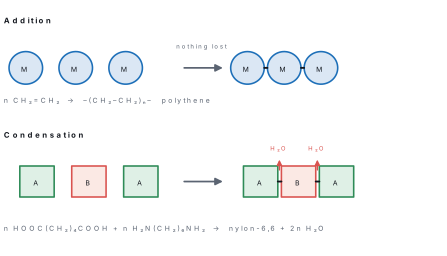
| Addition polymerisation | Condensation polymerisation | |
|---|---|---|
| Monomer | one unsaturated monomer (C=C) | two bifunctional monomers (or one with two different groups) |
| Small molecule lost | none | H₂O, HCl or NH₃ at every link |
| Empirical formula | same as the monomer | different from the monomers |
| Mechanism | chain (free radical, ionic or coordination) | step growth |
| Examples | polythene, PVC, Teflon, polystyrene, polypropene | nylon-6,6, terylene, bakelite, silicones |
Polymers are also classified by behaviour:
| Class | Intermolecular force | Behaviour | Examples |
|---|---|---|---|
| Elastomers | weakest; coiled chains, few cross-links | stretch several times their length and snap back | natural rubber, buna-S, neoprene |
| Fibres | strongest; hydrogen bonding, close packing | thread-like, high tensile strength, sharp melting point | nylon-6,6, terylene, silk |
| Thermoplastics | intermediate; linear or lightly branched | soften on heating, can be remoulded again and again | polythene, PVC, polystyrene |
| Thermosetting | three-dimensional cross-links | set permanently on moulding; char rather than melt | bakelite, melamine, urea–formaldehyde |
and by origin: natural (starch, cellulose, proteins, natural rubber, DNA), semi-synthetic (rayon, cellulose acetate, vulcanised rubber) and synthetic (polythene, PVC, nylon, bakelite).
Problem. A sample of PVC has an average molar mass of 93,750 g mol⁻¹. Calculate its degree of polymerisation. (C = 12, H = 1, Cl = 35.5)
Solution. The monomer is chloroethene, CH₂=CHCl:
M(monomer) = 2(12) + 3(1) + 35.5 = 62.5 g mol⁻¹
In addition polymerisation nothing is lost, so the polymer mass is simply n times the monomer mass:
The chain contains 1500 chloroethene units.
18.2 Synthetic polymers: polythene, PVC, Teflon, polystyrene, nylon and bakelite
| Polymer | Monomer(s) | Type | Conditions | Uses |
|---|---|---|---|---|
| Polythene (LDPE) | ethene, CH₂=CH₂ | addition | 1000–2000 atm, 350–570 K, trace O₂ | branched and flexible: carrier bags, squeeze bottles, cable insulation |
| Polythene (HDPE) | ethene | addition | Ziegler–Natta catalyst TiCl₄ + Al(C₂H₅)₃, 6–7 atm, 333–343 K | linear and tough: buckets, pipes, the black rooftop water tanks of Kathmandu |
| PVC | chloroethene, CH₂=CHCl | addition | free-radical initiator, 350 K | pipes, raincoats, floor tiles, wire insulation |
| Teflon (PTFE) | tetrafluoroethene, CF₂=CF₂ | addition | persulphate catalyst, high pressure | non-stick cookware, gaskets, plumbers' tape; inert and heat-resistant |
| Polystyrene | styrene, C₆H₅CH=CH₂ | addition | free-radical initiator | thermocol packing, disposable cups, insulation |
| Nylon-6,6 | hexamethylenediamine + adipic acid | condensation | ~553 K, high pressure | ropes, fishing nets, parachutes, tyre cord, textiles |
| Bakelite | phenol + methanal (HCHO) | condensation | acid or alkali catalyst, heat | electrical switches, plugs, saucepan handles — a thermoset |
Repeat units, written out:
- Polythene: –(CH₂–CH₂)ₙ–
- PVC: –(CH₂–CHCl)ₙ–
- Teflon: –(CF₂–CF₂)ₙ–
- Polystyrene: –(CH₂–CH(C₆H₅))ₙ–
- Nylon-6,6: –[NH–(CH₂)₆–NH–CO–(CH₂)₄–CO]ₙ– (an amide linkage)
n H₂N(CH₂)₆NH₂ + n HOOC(CH₂)₄COOH → –[NH(CH₂)₆NHCO(CH₂)₄CO]ₙ– + 2n H₂O
The two 6s are the numbers of carbon atoms in each monomer: six in hexamethylenediamine and six in adipic acid. Nylon-6 is made from a single monomer, caprolactam, which also has six carbons. Do not write nylon-6,6 as an addition polymer — it loses water at every link, so it is a condensation polymer.
Problem. 14.6 g of adipic acid reacts completely with hexamethylenediamine to give nylon-6,6. Calculate the mass of polymer and the mass of water formed. (Adipic acid M = 146, hexamethylenediamine M = 116)
Solution. Moles of adipic acid = 14.6 / 146 = 0.100 mol, and the two monomers react 1 : 1, so 0.100 mol of the diamine (11.6 g) is used.
Each link expels two molecules of water, so each repeat unit has mass
M(repeat unit) = 146 + 116 − 2(18) = 226 g mol⁻¹
Mass of nylon = 0.100 × 226 = 22.6 g
Mass of water = 0.200 × 18 = 3.6 g
Check: 14.6 + 11.6 = 26.2 g in, and 22.6 + 3.6 = 26.2 g out. Mass is conserved.
18.3 Dyes
A dye is a coloured organic compound that can be fixed firmly to a fabric and keeps its colour on exposure to light, washing and mild acids or alkalis.
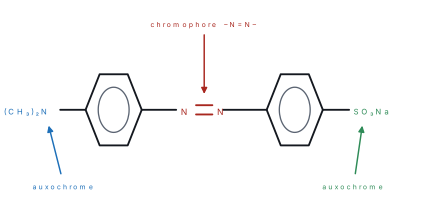
According to Witt's theory, a dye molecule needs two kinds of group:
- A chromophore — the colour-bearing group, always unsaturated: –N=N– (azo), –NO₂, –NO, >C=O, –C=C– or a quinonoid ring.
- An auxochrome — a group such as –OH, –NH₂, –NHR, –NR₂, –SO₃H or –COOH that deepens the colour and, more importantly, binds the dye to the fibre.
A compound with a chromophore but no auxochrome is merely coloured (a chromogen), not a dye: azobenzene is orange but washes straight out of cloth.
Classification by structure
| Structural class | Chromophore | Examples |
|---|---|---|
| Azo dyes | –N=N– | methyl orange, congo red, aniline yellow |
| Triphenylmethane dyes | quinonoid ring | malachite green, magenta (rosaniline) |
| Indigoid dyes | >C=O with C=C | indigo, tyrian purple |
| Anthraquinone dyes | two >C=O on a fused ring | alizarin |
| Nitro and nitroso dyes | –NO₂, –NO | picric acid, naphthol yellow S |
| Phthalein dyes | quinonoid | phenolphthalein, fluorescein |
Classification by method of application
| Application class | How it is fixed | Fibres | Example |
|---|---|---|---|
| Acid dyes | sodium salts of sulphonic acids; dyed from an acid bath | wool, silk, nylon | methyl orange, orange II |
| Basic dyes | coloured cation binds acidic sites in the fibre | wool, silk, mordanted cotton | malachite green, aniline yellow |
| Direct dyes | applied straight from a hot neutral bath | cotton, rayon | congo red |
| Vat dyes | reduced to a soluble colourless leuco form, absorbed, then re-oxidised in the fibre by air | cotton | indigo (the blue of denim) |
| Mordant dyes | a metal salt (alum, chrome) is fixed first and the dye forms a coloured complex with it | cotton, wool | alizarin — red with Al³⁺, violet with Fe³⁺ |
| Disperse dyes | fine insoluble particles dissolve into the fibre | polyester, nylon, acetate | disperse red |
| Reactive dyes | form a covalent bond with –OH of cellulose | cotton | procion dyes |
| Ingrain (azoic) dyes | the dye is synthesised inside the fibre by coupling | cotton | para red |
Indigo (nīl) was one of the oldest trade dyes of the Terai and the north Indian plains, and is still the vat dye that colours denim.
18.4 Drugs
A drug is a chemical substance, natural or synthetic, of low molecular mass that interacts with a biological target to give a therapeutic effect — the diagnosis, prevention, relief or cure of disease. Treatment of disease with chemicals is chemotherapy.
Characteristics of a good drug
- It should be effective at a small dose against the specific disease.
- It should show selective toxicity: destroy the pathogen without harming the patient's own cells.
- It should have minimum side effects and should not be habit-forming.
- It should be stable on storage, cheap, and easy to administer and absorb.
- Its products should be excreted, not stored in the body.
Natural and synthetic drugs
| Natural drug | Source | Synthetic drug | Made from |
|---|---|---|---|
| Quinine | bark of Cinchona | Chloroquine | synthetic antimalarial |
| Morphine, codeine | opium poppy latex | Aspirin | salicylic acid + ethanoic anhydride |
| Penicillin | mould Penicillium notatum | Paracetamol | p-aminophenol |
| Reserpine | Rauwolfia serpentina (sarpagandha, grown in the Nepali Terai) | Sulphadiazine | sulphanilic acid derivatives |
Classification of common drugs
| Class | Action | Examples |
|---|---|---|
| Analgesic | relieves pain | aspirin, paracetamol, ibuprofen, morphine (narcotic) |
| Antipyretic | brings down fever | paracetamol, aspirin |
| Antibiotic | produced by micro-organisms; kills or inhibits other micro-organisms | penicillin, amoxicillin, streptomycin, chloramphenicol |
| Antiseptic | kills microbes on living tissue | dettol (chloroxylenol), tincture of iodine, boric acid |
| Disinfectant | kills microbes on non-living surfaces | 1 % phenol, bleaching powder, formalin |
| Tranquilliser / sedative | relieves anxiety, induces calm or sleep | diazepam, chlordiazepoxide, barbiturates |
| Antacid | neutralises excess acid in the stomach | Mg(OH)₂, Al(OH)₃, NaHCO₃, omeprazole |
| Antihistamine | suppresses allergy | cetirizine, chlorpheniramine |
| Antimalarial | kills the malaria parasite | chloroquine, quinine, artemisinin |
| Anaesthetic | causes loss of sensation | general: diethyl ether, halothane, N₂O; local: lignocaine |
Phenol is an antiseptic at about 0.2 % and a disinfectant at 1 %. The difference is not the compound but where and how strongly it is used: antiseptics go on living tissue, disinfectants on floors, drains and instruments. Writing "phenol is a disinfectant" without the concentration loses the mark.
Habit-forming drugs and drug addiction. Some drugs act on the central nervous system and produce dependence: the user needs ever-larger doses (tolerance), and stopping causes withdrawal symptoms.
| Type | Effect | Examples |
|---|---|---|
| Stimulants | excite the nervous system | caffeine, nicotine, amphetamine, cocaine |
| Depressants / sedatives | slow the nervous system | alcohol, barbiturates, diazepam |
| Narcotic analgesics | kill pain and induce sleep and euphoria | opium, morphine, heroin ("brown sugar"), codeine |
| Hallucinogens | distort perception | cannabis (gānjā, charas), LSD |
Addiction damages the liver, brain, kidneys and heart; injecting drugs spreads HIV and hepatitis B through shared needles. In Nepal the Narcotic Drugs (Control) Act, 2033 B.S. (1976) prohibits the cultivation, production, sale, trafficking and consumption of cannabis, opium and coca products, and makes addiction itself punishable; treatment is through counselling, rehabilitation centres and community support.
18.5 Pesticides: insecticides, herbicides and fungicides
A pesticide is any chemical used to kill or control organisms that damage crops, stored food or health. The three groups examined are named after their target.
| Group | Target | Examples | Notes |
|---|---|---|---|
| Insecticides | insects | DDT, BHC/lindane (organochlorines); malathion, parathion, chlorpyrifos (organophosphates); carbaryl (carbamate); pyrethrins and neem oil (natural) | organochlorines persist for years; organophosphates break down faster but are acutely toxic nerve poisons |
| Herbicides (weedicides) | weeds | 2,4-D, glyphosate, atrazine, sodium chlorate, paraquat | 2,4-D kills broad-leaved weeds and leaves cereals standing |
| Fungicides | fungi, moulds, blights | Bordeaux mixture (CuSO₄ + Ca(OH)₂), copper oxychloride, sulphur dust, mancozeb | Bordeaux mixture is still sprayed on potato and tomato blight in the hills |
Why they are regulated. DDT does not break down; it dissolves in fat and is passed up the food chain, so its concentration multiplies at every step — biomagnification.
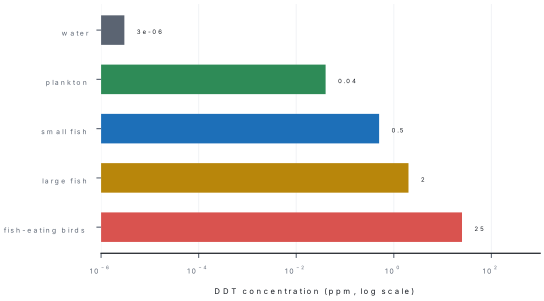
Pesticide residues on vegetables, poisoning of the farmers who spray without protection, death of bees and fish, and the growth of resistant pests are the other costs. In Nepal, pesticides are registered and controlled by the Plant Quarantine and Pesticide Management Centre under the Pesticide Act, 2048 B.S. (1991). More than twenty pesticides are banned outright — among them DDT, aldrin, dieldrin, endrin, BHC, methyl parathion and endosulfan — and paraquat, chlorpyrifos and phorate were added in recent years. Rapid residue-testing laboratories, such as the one at the Kalimati fruit and vegetable market in Kathmandu, screen incoming produce before it reaches the retail stalls.
Problem. Classify each of the following and, in one line, say what it does: paracetamol, amoxicillin, tincture of iodine, magnesium hydroxide, diazepam, 2,4-D, indigo, Teflon.
Solution.
| Substance | Class | Action |
|---|---|---|
| Paracetamol | analgesic and antipyretic | relieves pain and lowers fever |
| Amoxicillin | antibiotic | kills bacteria; made from a penicillin nucleus |
| Tincture of iodine | antiseptic | kills microbes on a cut, i.e. on living tissue |
| Magnesium hydroxide | antacid | neutralises excess HCl in the stomach: Mg(OH)₂ + 2HCl → MgCl₂ + 2H₂O |
| Diazepam | tranquilliser | relieves anxiety; habit-forming, so prescription-only |
| 2,4-D | herbicide | kills broad-leaved weeds in a cereal field |
| Indigo | vat dye | the blue of denim; applied as its soluble leuco form |
| Teflon | addition polymer (PTFE) | non-stick, chemically inert coating |
Chapter summary
- A polymer is many monomers joined; n is the degree of polymerisation and M(polymer) = n × M(monomer) for an addition polymer.
- Addition polymerisation needs an unsaturated monomer and loses nothing; condensation polymerisation needs bifunctional monomers and expels H₂O, HCl or NH₃ at each link.
- Elastomers stretch and recover (rubber), fibres are strong and thread-like (nylon), thermoplastics remould on heating (polythene), thermosets do not (bakelite).
- Key polymers: polythene (ethene), PVC (chloroethene), Teflon (tetrafluoroethene), polystyrene (styrene) — all addition; nylon-6,6 (hexamethylenediamine + adipic acid) and bakelite (phenol + methanal) — both condensation.
- A dye needs a chromophore (–N=N–, –NO₂, >C=O, quinonoid) for colour and an auxochrome (–OH, –NH₂, –SO₃H) to deepen it and fix it to the fibre.
- Dyes by structure: azo, triphenylmethane, indigoid, anthraquinone, nitro, phthalein. By application: acid, basic, direct, vat, mordant, disperse, reactive and ingrain.
- A good drug is effective at low dose, selectively toxic, non habit-forming and excretable. Classes: analgesic, antipyretic, antibiotic, antiseptic, disinfectant, tranquilliser, antacid, antihistamine, antimalarial, anaesthetic.
- Antiseptics act on living tissue, disinfectants on non-living surfaces — often the same compound at different concentrations (phenol 0.2 % vs 1 %).
- Habit-forming drugs: stimulants, depressants, narcotic analgesics and hallucinogens; controlled in Nepal by the Narcotic Drugs (Control) Act, 2033.
- Pesticides are insecticides, herbicides or fungicides. Persistent organochlorines such as DDT biomagnify up the food chain and are banned in Nepal.
Practice questions
Group A — Multiple choice (1 mark each)
- Which of the following is a condensation polymer? [1]apolythenebPVCcnylon-6,6dTeflon
- The monomer of Teflon is [1]aCH₂=CHClbCF₂=CF₂cCH₂=CH₂dC₆H₅CH=CH₂
- In Witt's theory, –N=N– is a [1]aauxochromebchromophorecmordantdleuco group
- Indigo is applied to cotton as a [1]aacid dyebbasic dyecvat dyeddisperse dye
- Which is used as an antacid? [1]aaspirinbdiazepamcMg(OH)₂dchloroquine
- 2,4-D is a [1]afungicidebherbicidecinsecticidedrodenticide
Answers to Group A
1. (c) — water is eliminated at every amide link.
2. (b) — tetrafluoroethene gives –(CF₂–CF₂)ₙ–.
3. (b) — the azo group carries the colour.
4. (c) — it is reduced to the soluble leuco form, absorbed, then air-oxidised inside the fibre.
5. (c) — Mg(OH)₂ + 2HCl → MgCl₂ + 2H₂O.
6. (b) — 2,4-dichlorophenoxyacetic acid kills broad-leaved weeds.
Group B — Short answer (5 marks each)
- Distinguish between addition and condensation polymerisation, with two examples of each. [5]
- Give the monomer, type of polymerisation and one use of polythene, PVC, polystyrene and bakelite. [5]
- What is a dye? Explain Witt's theory with methyl orange as the example, and classify dyes on the basis of their method of application. [5]
- Define a drug. State four characteristics of a good drug and distinguish between an antiseptic and a disinfectant with examples. [5]
- A sample of polythene has an average molar mass of 42,000 g mol⁻¹. Find its degree of polymerisation. [5]
- What are habit-forming drugs? Name the four types with one example each and state two harmful effects of drug addiction. [5]
Answers to Group B
1. See the table in §18.1. Addition: unsaturated monomer, nothing eliminated, same empirical formula (polythene, PVC). Condensation: bifunctional monomers, a small molecule such as H₂O eliminated, different empirical formula (nylon-6,6, bakelite).
2. Polythene — ethene, addition, carrier bags and water tanks. PVC — chloroethene, addition, pipes and raincoats. Polystyrene — styrene, addition, thermocol packing. Bakelite — phenol + methanal, condensation, electrical switches.
3. A dye is a coloured compound that can be fixed to a fabric and resists light and washing. Witt: a chromophore gives colour and an auxochrome deepens it and binds the dye to the fibre. In methyl orange the chromophore is –N=N– and the auxochromes are –N(CH₃)₂ and –SO₃Na. By application: acid, basic, direct, vat, mordant, disperse, reactive and ingrain dyes (one example each, as in §18.3).
4. A drug is a low-molecular-mass chemical that acts on a biological target to diagnose, prevent or cure disease. Good drug: effective at a small dose, selectively toxic, few side effects, not habit-forming (also stable, cheap, excretable). An antiseptic (dettol, tincture of iodine) is applied to living tissue; a disinfectant (1 % phenol, bleaching powder) to floors, drains and instruments. Phenol is an antiseptic at 0.2 % and a disinfectant at 1 %.
5. Monomer is ethene, M = 28 g mol⁻¹. n = 42000/28 = \mathbf{1500} units.
6. Habit-forming (addictive) drugs act on the central nervous system and cause tolerance and dependence. Stimulants — amphetamine; depressants — barbiturates; narcotic analgesics — morphine; hallucinogens — cannabis. Harmful effects: damage to liver, brain and kidneys; spread of HIV and hepatitis B through shared needles; loss of study, work and family life. Controlled in Nepal by the Narcotic Drugs (Control) Act, 2033.
Group C — Long answer (8 marks each)
- (a) Classify polymers on the basis of the mode of polymerisation, of physical properties and of origin, giving two examples of each class. [5](b) Write the equation for the formation of nylon-6,6 and calculate the mass of nylon obtained from 29.2 g of adipic acid with excess diamine. [3]
- (a) Classify dyes on the basis of structure, with an example of each. [4](b) What are pesticides? Distinguish between insecticides, herbicides and fungicides with two examples each, and give two harmful effects of using persistent pesticides such as DDT. [4]
Answers to Group C
1. (a) By mode: addition (polythene, PVC) and condensation (nylon-6,6, bakelite). By physical property: elastomers (natural rubber, buna-S), fibres (nylon-6,6, terylene), thermoplastics (polythene, polystyrene), thermosets (bakelite, melamine). By origin: natural (starch, cellulose), semi-synthetic (rayon, cellulose acetate) and synthetic (nylon, PVC). (b) n H₂N(CH₂)₆NH₂ + n HOOC(CH₂)₄COOH → –[NH(CH₂)₆NHCO(CH₂)₄CO]ₙ– + 2n H₂O. Moles of adipic acid = 29.2 / 146 = 0.200 mol; repeat-unit mass = 146 + 116 − 36 = 226 g mol⁻¹; mass of nylon = 0.200 × 226 = 45.2 g (with 0.400 × 18 = 7.2 g of water).
2. (a) Azo (methyl orange), triphenylmethane (malachite green), indigoid (indigo), anthraquinone (alizarin), nitro (picric acid), phthalein (phenolphthalein). (b) A pesticide is a chemical used to kill or control pests. Insecticides kill insects (DDT, malathion); herbicides kill weeds (2,4-D, glyphosate); fungicides kill fungi (Bordeaux mixture, sulphur dust). Harmful effects of DDT-type pesticides: they persist for years and biomagnify up the food chain, poisoning fish and birds at the top; residues remain on food and cause chronic poisoning of farmers; pests also develop resistance. DDT is banned in Nepal for this reason.
Practise more: Chemistry question bank