Unit 5 · General and Physical Chemistry · 7 teaching hours · 22 min read
Electrochemistry
What the syllabus asks for 7
- Electrode potential and standard electrode potential
- Types of electrodes: standard hydrogen electrode and calomel electrode
- Electrochemical series and its applications
- Voltaic cell: Zn-Cu cell, Ag-Cu cell
- Cell potential and standard cell potential
- Relationship between cell potential and free energy
- Commercial batteries and fuel cells (hydrogen/oxygen)
Electrochemistry is about the two-way traffic between chemical energy and electrical energy. A redox reaction that happens spontaneously can be made to push electrons round a wire — that is a cell, and it is how a torch, a mobile phone and an electric vehicle are powered. Run in reverse, electricity forces an unwilling reaction to go — that is electrolysis, and it is how aluminium, chlorine and electroplated metal are made.
Three things dominate the board paper: describing the Daniell cell with its electrode reactions and cell notation, using the electrochemical series or the Nernst equation to calculate an EMF, and linking EMF to free energy through \Delta G^{\circ} = -nFE^{\circ}_{cell}. Every one of these is a full-mark question if the signs are right.
5.1 Electrode potential and standard electrode potential
Dip a strip of zinc into water. A few Zn atoms leave the metal as Zn²⁺ ions, leaving their electrons behind:
Zn(s) ⇌ Zn²⁺(aq) + 2e⁻
The metal becomes slightly negative and the layer of solution touching it slightly positive. This electrical double layer stops the process almost at once, and an equilibrium potential difference is set up across the metal–solution boundary.
The electrode potential of an electrode is the potential difference developed between the metal and its solution when the two are in contact and at equilibrium. It measures the tendency of the electrode to lose electrons (oxidation potential) or to gain them (reduction potential).
A metal that loses electrons readily, such as zinc, builds up a negative charge and has a positive oxidation potential. A metal that prefers to take electrons back, such as copper, behaves the other way round. By international convention we always tabulate reduction potentials, and
The value depends on concentration, temperature and gas pressure, so a reference set of conditions is fixed.
The standard electrode potential is the electrode potential measured at 298 K when every ion in the solution is at unit concentration (1 M, strictly unit activity) and every gas is at 1 bar, relative to the standard hydrogen electrode which is assigned exactly 0.000 V.
A voltmeter needs two contacts, so any measurement gives a difference between two electrodes. That is why every tabulated E^{\circ} is a value relative to the hydrogen electrode, not an absolute number.
5.2 Types of electrodes: standard hydrogen electrode and calomel electrode
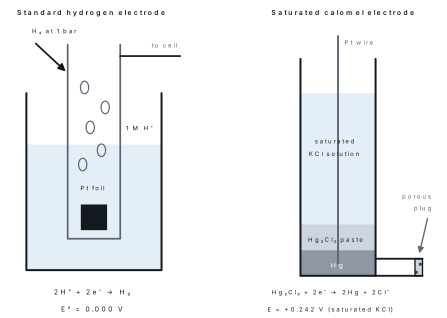
Standard hydrogen electrode (SHE). A strip of platinum foil coated with finely divided platinum black is dipped in a 1 M solution of H⁺ ions, and pure hydrogen gas at 1 bar is bubbled over it at 298 K. The platinum takes no part in the reaction; it only provides a surface for the electron transfer and a path for the current. Its half-reaction is
2H⁺(aq) + 2e⁻ ⇌ H₂(g), E° = 0.000 V (by definition)
It is the primary reference electrode, but it is awkward: it needs a supply of very pure hydrogen at constant pressure, the solution must be exactly 1 M, and the platinum surface is poisoned by traces of arsenic or sulphide.
Calomel electrode. For daily laboratory work a secondary reference electrode is used instead. The calomel electrode consists of mercury covered with a paste of mercury(I) chloride, Hg₂Cl₂ (calomel), in contact with a potassium chloride solution, with a platinum wire dipping into the mercury:
Hg(l) | Hg₂Cl₂(s) | KCl(aq)
Hg₂Cl₂(s) + 2e⁻ ⇌ 2Hg(l) + 2Cl⁻(aq)
Its potential depends only on the chloride concentration, which is easy to fix:
| KCl solution | Electrode potential |
|---|---|
| Saturated | +0.242 V |
| 1.0 M | +0.280 V |
| 0.1 M | +0.334 V |
It is compact, robust, and keeps a steady potential, so it is the reference half of almost every pH meter.
5.3 Electrochemical series and its applications
Arranging the standard reduction potentials of all electrodes in increasing order gives the electrochemical series (also called the activity series or the electromotive series).
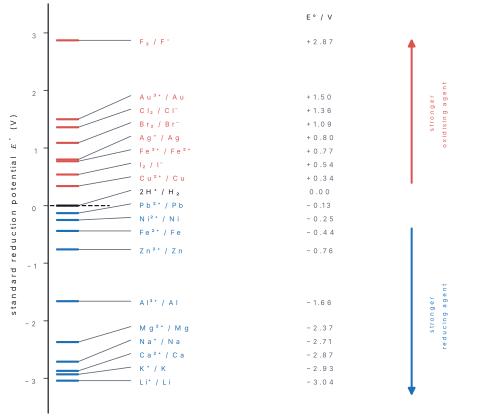
Li K Ca Na Mg Al Zn Fe Ni Sn Pb H Cu Hg Ag Pt Au — "Little Katie Can Name Mg All Zinc Ferrous Nickel Snow Pblue Here Cup Hg Again Pt, Au." Everything above hydrogen displaces it from dilute acids; everything below does not.
Applications of the electrochemical series
- Relative strength of reducing agents. The more negative E^{\circ}, the greater the tendency to lose electrons. Li is the strongest reducing agent in the list; Au is the weakest.
- Relative strength of oxidising agents. The more positive E^{\circ}, the greater the tendency to gain electrons. F₂ is the strongest oxidising agent known in aqueous solution.
- Predicting displacement reactions. A metal displaces from solution any metal lying below it. Zn (−0.76) displaces Cu (+0.34): Zn + CuSO₄ → ZnSO₄ + Cu. Copper cannot displace zinc.
- Liberation of hydrogen from acids. Metals above hydrogen (Zn, Fe, Mg, Al) dissolve in dilute HCl or H₂SO₄ giving H₂; Cu, Ag, Hg and Au do not.
- Calculating the EMF of a cell and deciding which electrode is the anode.
- Predicting the feasibility of a redox reaction: if the calculated E^{\circ}_{cell} is positive the reaction goes as written.
- Products of electrolysis. When two cations compete at the cathode, the one with the higher reduction potential is discharged first.
- Corrosion and its prevention. Iron is protected by coating with a more easily oxidised metal (zinc — galvanising), which corrodes sacrificially.
5.4 Voltaic cell: Zn-Cu cell, Ag-Cu cell
If zinc is dropped into copper sulphate solution, the reaction Zn + Cu²⁺ → Zn²⁺ + Cu occurs at once, but the electrons pass directly from Zn to Cu²⁺ and all the energy appears as heat. A voltaic (galvanic) cell separates the two half-reactions so the electrons are forced to travel through an external wire, where they can do useful work.
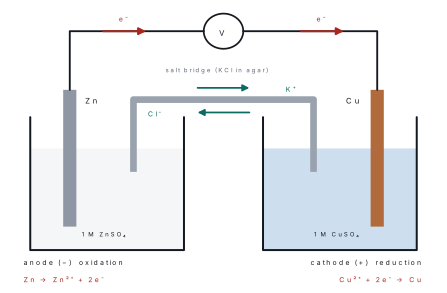
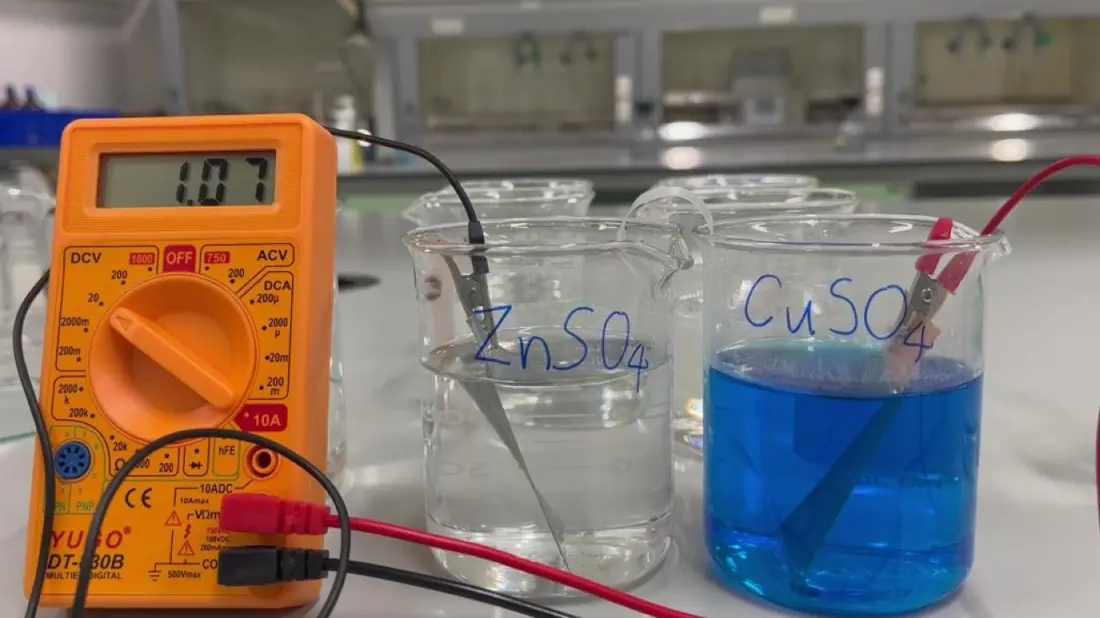
The Daniell cell (Zn–Cu cell). A zinc rod stands in 1 M ZnSO₄ in one beaker and a copper rod in 1 M CuSO₄ in another. The rods are joined by a wire through a voltmeter, and the two solutions by a salt bridge — an inverted U-tube packed with a saturated solution of KCl (or KNO₃) set in agar jelly.
| Electrode | Name | Sign | Process | Half-reaction |
|---|---|---|---|---|
| Zn | Anode | − | Oxidation | Zn(s) → Zn²⁺(aq) + 2e⁻ |
| Cu | Cathode | + | Reduction | Cu²⁺(aq) + 2e⁻ → Cu(s) |
Overall: Zn(s) + Cu²⁺(aq) → Zn²⁺(aq) + Cu(s), E^{\circ}_{cell} = 1.10 V
The cell is written, by IUPAC convention, with the anode on the left, a single bar for a phase boundary and a double bar for the salt bridge:
Zn(s) | Zn²⁺(1 M) || Cu²⁺(1 M) | Cu(s)
- It completes the electrical circuit by allowing ions to move between the two half-cells.
- It keeps both solutions electrically neutral: its anions move to the anode compartment (which is gaining Zn²⁺) and its cations to the cathode compartment (which is losing Cu²⁺).
- It prevents the two solutions from mixing, and eliminates the liquid-junction potential that would otherwise appear.
The Ag–Cu cell. Here copper is the more easily oxidised metal, so copper is now the anode and silver the cathode:
Cu(s) | Cu²⁺(1 M) || Ag⁺(1 M) | Ag(s)
| Electrode | Half-reaction | E^{\circ} / V |
|---|---|---|
| Anode (Cu) | Cu(s) → Cu²⁺(aq) + 2e⁻ | -0.34 (oxidation) |
| Cathode (Ag) | 2Ag⁺(aq) + 2e⁻ → 2Ag(s) | +0.80 (reduction) |
Overall: Cu(s) + 2Ag⁺(aq) → Cu²⁺(aq) + 2Ag(s), E^{\circ}_{cell} = 0.46 V
The silver half-reaction had to be doubled to balance the two electrons, but E^{\circ} stays at +0.80 V. Electrode potential is an intensive property — it is energy per unit charge, so it does not depend on how much reaction you write. Only \Delta G scales with n.
Electrolytic cells — the reverse process. If an external source pushes current the other way, a non-spontaneous reaction can be driven. That is an electrolytic cell.
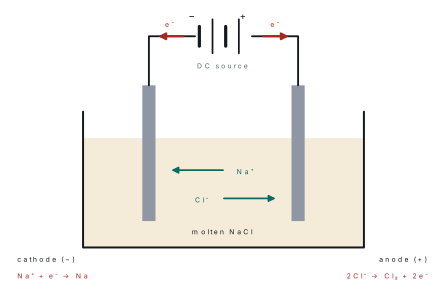
| Galvanic (voltaic) cell | Electrolytic cell | |
|---|---|---|
| Energy change | Chemical → electrical | Electrical → chemical |
| Reaction | Spontaneous, \Delta G < 0 | Non-spontaneous, \Delta G > 0 |
| Anode | Negative, oxidation | Positive, oxidation |
| Cathode | Positive, reduction | Negative, reduction |
| Electrolytes | Two, joined by a salt bridge | One, both electrodes in it |
| Example | Daniell cell, dry cell | Electroplating, extraction of Na, Al |
Note that oxidation always happens at the anode and reduction always at the cathode. Only the signs swap.
5.5 Cell potential and standard cell potential
The cell potential or electromotive force is the potential difference between the two electrodes of a cell when no current is drawn. Under standard conditions it is the standard cell potential E^{\circ}_{cell}, and
where both values are standard reduction potentials.
A positive E^{\circ}_{cell} means the reaction as written is spontaneous. If the answer comes out negative, the cell has been written backwards.
When the concentrations are not 1 M the EMF changes, and the Nernst equation gives the correction. For a general cell reaction aA + bB \rightarrow cC + dD involving n electrons,
The constant follows from 2.303RT/F = 2.303 \times 8.314 \times 298 / 96500 = 0.0591 V. Pure solids and pure liquids do not appear in Q.
Problem. For the Daniell cell at 298 K, E^{\circ}(\text{Zn}^{2+}/\text{Zn}) = -0.76 V and E^{\circ}(\text{Cu}^{2+}/\text{Cu}) = +0.34 V. Write the cell reaction and calculate E^{\circ}_{cell}. Then find the EMF when [Zn²⁺] = 0.10 M and [Cu²⁺] = 0.010 M.
Solution. Copper has the higher (more positive) reduction potential, so copper is reduced and is the cathode; zinc is oxidised at the anode.
Anode: Zn → Zn²⁺ + 2e⁻ ; Cathode: Cu²⁺ + 2e⁻ → Cu ; overall Zn + Cu²⁺ → Zn²⁺ + Cu, with n = 2.
For the non-standard concentrations, Q = [\text{Zn}^{2+}]/[\text{Cu}^{2+}] (the two solids are omitted):
Raising the product-ion concentration lowers the EMF, exactly as Le Chatelier's principle predicts.
Put the products of the cell reaction on top of Q. If Q > 1 the log is positive and the EMF falls below E^{\circ}; if Q < 1 the EMF rises. A cell runs down because Q climbs towards K, at which point E_{cell} = 0 and the battery is flat.
5.6 Relationship between cell potential and free energy
The electrical work a cell can deliver is (charge transferred) × (potential difference). For n moles of electrons the charge is nF, where F = 96500 C mol⁻¹ is the Faraday constant — the charge on one mole of electrons, F = N_A e = (6.022\times10^{23})(1.602\times10^{-19}) C.
At constant temperature and pressure, the maximum non-expansion work obtainable from a process equals \Delta G:
A cell working reversibly transfers nF coulombs through a potential difference E_{cell}, doing electrical work nFE_{cell} on the surroundings. Work done by the system is negative, so
Combining this with \Delta G^{\circ} = -2.303RT\log K from Unit 4,
So a spontaneous cell reaction (\Delta G < 0) is exactly one with a positive EMF, and a large EMF means a large equilibrium constant.
Problem. For the cell Cu(s) | Cu²⁺(1 M) || Ag⁺(1 M) | Ag(s), E^{\circ}(\text{Cu}^{2+}/\text{Cu}) = +0.34 V and E^{\circ}(\text{Ag}^{+}/\text{Ag}) = +0.80 V. Calculate E^{\circ}_{cell}, \Delta G^{\circ} and the equilibrium constant at 298 K.
Solution. The cell reaction is Cu + 2Ag⁺ → Cu²⁺ + 2Ag, so n = 2.
\Delta G^{\circ} is large and negative and K enormous, so copper metal reduces silver ions essentially completely — the basis of the silver-mirror deposits seen when a copper wire is left in silver nitrate solution.
Problem. The EMF of the cell Zn(s) | Zn²⁺(1 M) || H⁺(unknown) | H₂(1 bar), Pt is 0.5827 V at 298 K. Given E^{\circ}(\text{Zn}^{2+}/\text{Zn}) = -0.76 V, calculate the pH of the acid solution.
Solution. The cell reaction is Zn + 2H⁺ → Zn²⁺ + H₂, with n = 2, and
Applying the Nernst equation, with the pure solid and the gas at 1 bar omitted,
Now \log(1/[\text{H}^{+}]^{2}) = -2\log[\text{H}^{+}] = 2\,\text{pH}, so
The solution has pH 3. This is precisely how a pH meter works, except that a glass electrode and a calomel electrode replace the zinc and hydrogen electrodes.
Faraday's laws of electrolysis
The same constant F governs how much substance an electric current deposits.
First law. The mass of a substance liberated at an electrode is directly proportional to the quantity of electricity passed: m = Zit, where Q = it and Z is the electrochemical equivalent.
Second law. When the same quantity of electricity is passed through different electrolytes, the masses liberated are proportional to their equivalent weights.
In practice: 1 faraday (96500 C) deposits one gram-equivalent, i.e. \dfrac{\text{molar mass}}{n} grams, where n is the number of electrons in the electrode half-reaction.
Problem. A current of 5.0 A is passed for 30 minutes through a solution of copper(II) sulphate using inert electrodes. Calculate (a) the mass of copper deposited at the cathode and (b) the volume of oxygen liberated at the anode, measured at STP. (Cu = 63.5, F = 96500 C mol⁻¹, molar volume at STP = 22400 cm³.)
Solution. First find the charge passed:
(a) At the cathode, Cu²⁺ + 2e⁻ → Cu, so 2 mol of electrons give 1 mol of Cu:
(b) At the anode, 2H₂O → O₂ + 4H⁺ + 4e⁻, so 4 mol of electrons give 1 mol of O₂:
5.7 Commercial batteries and fuel cells (hydrogen/oxygen)
A battery is one or more galvanic cells packaged for use. Primary cells cannot be recharged because the electrode reaction is not reversible; secondary cells (accumulators) can.
| Battery | Anode | Cathode | Electrolyte | EMF | Type |
|---|---|---|---|---|---|
| Dry (Leclanché) cell | Zn can | graphite rod in MnO₂ + C | NH₄Cl + ZnCl₂ paste | ≈1.5 V | Primary |
| Lead storage battery | Pb | PbO₂ | 38 % H₂SO₄ | 2.0 V per cell | Secondary |
| Nickel–cadmium cell | Cd | NiO(OH) | KOH | ≈1.2 V | Secondary |
| Lithium-ion cell | graphite holding Li | LiCoO₂ | Li salt in organic solvent | ≈3.7 V | Secondary |
Dry cell. Anode: Zn(s) → Zn²⁺(aq) + 2e⁻. Cathode: 2MnO₂(s) + 2NH₄⁺(aq) + 2e⁻ → Mn₂O₃(s) + 2NH₃(aq) + H₂O(l). It runs down because the zinc case is eaten away and NH₃ collects round the cathode.
Lead storage battery. Used in every car and in inverter backup systems during load-shedding. On discharge:
- Anode: Pb(s) + SO₄²⁻(aq) → PbSO₄(s) + 2e⁻
- Cathode: PbO₂(s) + SO₄²⁻(aq) + 4H⁺(aq) + 2e⁻ → PbSO₄(s) + 2H₂O(l)
- Overall: Pb + PbO₂ + 2H₂SO₄ → 2PbSO₄ + 2H₂O
On charging the whole reaction is reversed, regenerating Pb and PbO₂ and restoring the acid. Because sulphuric acid is consumed on discharge, the state of charge can be checked by measuring the density of the acid with a hydrometer.
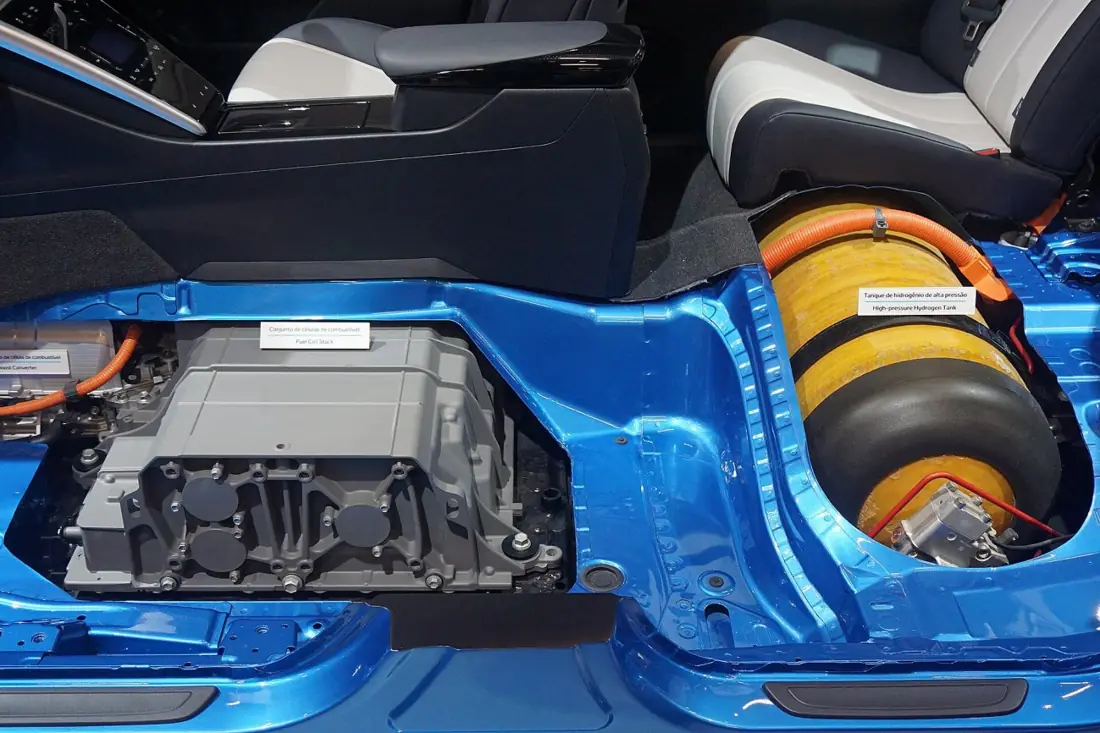
Fuel cells. A fuel cell is a galvanic cell in which the reactants are supplied continuously from outside, so the cell never "runs down". The hydrogen–oxygen fuel cell used on the Apollo spacecraft is the standard example.
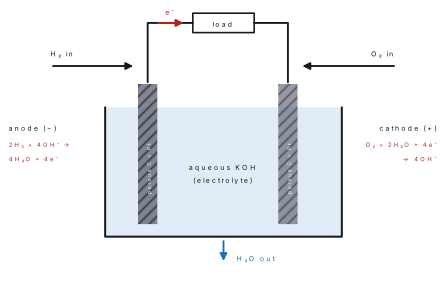
- Anode: 2H₂(g) + 4OH⁻(aq) → 4H₂O(l) + 4e⁻
- Cathode: O₂(g) + 2H₂O(l) + 4e⁻ → 4OH⁻(aq)
- Overall: 2H₂(g) + O₂(g) → 2H₂O(l), E^{\circ}_{cell} = 1.23 V
Advantages: efficiency of 70–75 % against about 40 % for a thermal power station, because the energy is not first turned into heat; no smoke, no oxides of nitrogen or sulphur, and the only product is drinkable water; it runs continuously as long as fuel is supplied. Disadvantages: the platinum catalyst is expensive, and hydrogen is difficult to store and transport safely.
Chapter summary
- Electrode potential arises from the electrical double layer at a metal–solution boundary; only differences can be measured, so all E^{\circ} values are quoted against the SHE (1 M H⁺, H₂ at 1 bar, 298 K, defined as 0.000 V). The calomel electrode (+0.242 V saturated) is the practical secondary reference.
- The electrochemical series orders standard reduction potentials. More negative = better reducing agent; more positive = better oxidising agent. A metal displaces any metal below it, and metals above hydrogen liberate H₂ from dilute acids.
- In a galvanic cell, oxidation occurs at the negative anode (written on the left) and reduction at the positive cathode. Daniell cell: Zn | Zn²⁺(1 M) || Cu²⁺(1 M) | Cu, E^{\circ}_{cell} = 1.10 V. Ag–Cu cell: Cu | Cu²⁺ || Ag⁺ | Ag, E^{\circ}_{cell} = 0.46 V.
- E^{\circ}_{cell} = E^{\circ}_{cathode} - E^{\circ}_{anode}; positive means spontaneous. E^{\circ} is intensive and is never multiplied by a stoichiometric coefficient.
- Nernst equation: E_{cell} = E^{\circ}_{cell} - \frac{0.0591}{n}\log Q at 298 K.
- \Delta G = -nFE_{cell}, \Delta G^{\circ} = -nFE^{\circ}_{cell} and \log K = nE^{\circ}_{cell}/0.0591, with F = 96500 C mol⁻¹.
- Faraday: Q = it; 96500 C liberates one gram-equivalent of any substance.
- Primary cells (dry cell) cannot be recharged; secondary cells (lead storage, Ni–Cd, Li-ion) can. The H₂–O₂ fuel cell is fed continuously, E^{\circ}_{cell} = 1.23 V, and produces only water.
Practice questions
Group A — Multiple choice (1 mark each)
- The standard electrode potential of the standard hydrogen electrode at 298 K is [1]a0.00 Vb0.242 Vc1.00 Vd−0.76 V
- In a galvanic cell the anode is [1]apositive and reduction occursbnegative and oxidation occurscnegative and reduction occursdpositive and oxidation occurs
- Which of these metals cannot liberate hydrogen from dilute hydrochloric acid? [1]aZnbFecMgdCu
- For the cell Zn | Zn²⁺ || Cu²⁺ | Cu, given E^{\circ} values of −0.76 V and +0.34 V, the standard cell potential is [1]a0.42 Vb1.10 Vc−1.10 Vd0.34 V
- The quantity of charge carried by one mole of electrons is about [1]a9650 Cb96500 Cc1.6\times10^{-19} Cd6.02\times10^{23} C
- If E^{\circ}_{cell} is positive, then \Delta G^{\circ} for the cell reaction is [1]apositivebzerocnegativedunpredictable
Answers to Group A
1. (a) — it is the arbitrary zero of the whole scale.
2. (b) — electrons are released there, so it is the negative terminal of a galvanic cell.
3. (d) — copper lies below hydrogen in the electrochemical series.
4. (b) — E^{\circ}_{cell} = 0.34 - (-0.76) = 1.10 V.
5. (b) — one faraday, F = N_Ae \approx 96500 C mol⁻¹.
6. (c) — \Delta G^{\circ} = -nFE^{\circ}_{cell}, and n and F are positive.
Group B — Short answer (5 marks each)
- Define electrode potential and standard electrode potential. Describe the construction and working of the standard hydrogen electrode with a labelled diagram, and give two of its limitations. [5]
- What is a salt bridge? Give its three functions. Describe the Daniell cell, writing the electrode reactions, the overall reaction and the cell notation. [5]
- State any five applications of the electrochemical series. [5]
- Calculate the EMF at 298 K of the cell Zn(s) | Zn²⁺(0.01 M) || Cu²⁺(0.1 M) | Cu(s), given E^{\circ}_{cell} = 1.10 V. [5]
- A current of 1.5 A is passed through a silver nitrate solution for 20 minutes. Calculate the mass of silver deposited. (Ag = 108) [5]
- Explain with electrode reactions the working of the hydrogen–oxygen fuel cell, and state two advantages over a thermal power plant. [5]
Answers to Group B
4. The cell reaction is Zn + Cu²⁺ → Zn²⁺ + Cu with n = 2, so
5. Q = it = 1.5 \times 20 \times 60 = 1800 C. Since Ag⁺ + e⁻ → Ag needs one electron per silver atom,
6. Anode: 2H₂ + 4OH⁻ → 4H₂O + 4e⁻. Cathode: O₂ + 2H₂O + 4e⁻ → 4OH⁻. Overall 2H₂ + O₂ → 2H₂O, E^{\circ}_{cell} = 1.23 V. Advantages: much higher conversion efficiency (about 70 % against 40 %) because no heat engine is involved, and no polluting emissions — the product is pure water.
Group C — Long answer (8 marks each)
- (a) Derive the relation \Delta G^{\circ} = -nFE^{\circ}_{cell} and hence obtain an expression relating E^{\circ}_{cell} to the equilibrium constant. [4](b) For the cell Cu | Cu²⁺(1 M) || Ag⁺(1 M) | Ag, E^{\circ}_{cell} = 0.46 V. Calculate \Delta G^{\circ} and K at 298 K, and comment on the extent of the reaction. [4]
- (a) With a labelled diagram, describe the construction, discharge and charging reactions of the lead storage battery. [5](b) Distinguish between a galvanic cell and an electrolytic cell on any three grounds, and state Faraday's two laws of electrolysis. [3]
Answers to Group C
1.(b) The cell reaction Cu + 2Ag⁺ → Cu²⁺ + 2Ag transfers n = 2 electrons.
K is very large, so the reaction goes essentially to completion: copper dissolves and silver is deposited almost quantitatively.
2.(a) Lead plates packed with spongy Pb form the anode, plates packed with PbO₂ the cathode, both dipping in about 38 % H₂SO₄. Discharge: Pb + SO₄²⁻ → PbSO₄ + 2e⁻ at the anode and PbO₂ + SO₄²⁻ + 4H⁺ + 2e⁻ → PbSO₄ + 2H₂O at the cathode, overall Pb + PbO₂ + 2H₂SO₄ → 2PbSO₄ + 2H₂O, giving 2.0 V per cell. Charging drives the same equation backwards: 2PbSO₄ + 2H₂O → Pb + PbO₂ + 2H₂SO₄.
2.(b) Galvanic: spontaneous, converts chemical to electrical energy, anode negative, two electrolytes joined by a salt bridge. Electrolytic: non-spontaneous, converts electrical to chemical energy, anode positive, one electrolyte. Faraday's first law: the mass liberated at an electrode is proportional to the quantity of electricity passed, m = Zit. Second law: with the same quantity of electricity, the masses liberated in different electrolytes are proportional to their equivalent weights.
Practise more: Chemistry question bank