Unit 17 · Organic Chemistry · 2 teaching hours · 13 min read
Organometallic Compounds
What the syllabus asks for 4
- Introduction, general formula and examples of organolithium, organocopper and organocadmium compounds
- Nature of metal-carbon bond
- Grignard reagent: preparation using haloalkane and haloarene
- Reaction with water, aldehydes and ketones (preparation of 1, 2, 3 alcohols), carbon dioxide, HCN, RCN, ester and acid chloride
An organometallic compound contains a direct metal–carbon bond. That single requirement is what makes these compounds so useful: in almost every other organic molecule carbon is the electron-poor end of its bonds, but a metal is less electronegative than carbon, so here the carbon is electron-rich and behaves as a carbanion. A compound that supplies a nucleophilic carbon lets you join two carbon skeletons together, and that is how most alcohols, acids and ketones are built in the laboratory.
One question dominates: how a Grignard reagent is prepared and what it gives with each reagent — especially the aldehyde/ketone route to 1°, 2° and 3° alcohols and the CO₂ route to carboxylic acids. Learn the reactivity order RLi > RMgX > R₂Cd and be able to explain it from electronegativity.
17.1 Introduction, general formula and examples
An organometallic compound is one in which at least one carbon atom of an organic group is bonded directly to a metal atom, C–M.
By this definition sodium ethoxide C₂H₅–O–Na and sodium ethanoate CH₃COONa are not organometallic, because the metal is joined to oxygen, not to carbon. Ethylmagnesium bromide C₂H₅–Mg–Br is.
| Class | General formula | Examples | Made from |
|---|---|---|---|
| Organolithium | R–Li | CH₃Li (methyllithium), C₄H₉Li (n-butyllithium), C₆H₅Li | R–X + 2Li → R–Li + LiX, in dry ether or hexane |
| Organomagnesium (Grignard) | R–Mg–X | CH₃MgI, C₂H₅MgBr, C₆H₅MgBr | R–X + Mg, dry ether |
| Organocopper (Gilman reagent) | R₂CuLi | (CH₃)₂CuLi, lithium dimethylcuprate | 2RLi + CuI → R₂CuLi + LiI |
| Organocadmium | R₂Cd | (CH₃)₂Cd, (C₂H₅)₂Cd | 2RMgX + CdCl₂ → R₂Cd + MgCl₂ + MgX₂ |
The three non-Grignard classes exist because chemists need different levels of reactivity:
- Organolithiums are the most reactive. They add even to crowded ketones and can pull a proton off a benzene ring. They catch fire in air, so they are handled in an inert atmosphere.
- Organocuprates are the most selective. They couple with haloalkanes (R₂CuLi + R'X → R–R', the Corey–House synthesis) yet leave an ester or a nitrile in the same molecule untouched.
- Organocadmiums are the least reactive. They convert an acid chloride into a ketone and stop there, whereas a Grignard reagent would attack the ketone again and give a tertiary alcohol:
CH₃COCl + (CH₃)₂Cd → CH₃COCH₃ + CH₃CdCl
17.2 Nature of the metal–carbon bond
Carbon has a Pauling electronegativity of 2.55, and every metal here is lower. The shared pair is therefore pulled towards carbon, giving the polarity
Cδ⁻ — Mδ⁺
The larger the electronegativity difference, the more ionic the bond, the more carbanion-like the carbon, and the more reactive the reagent.
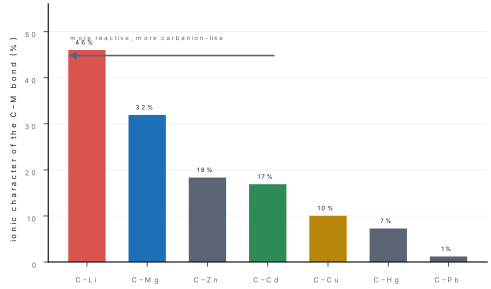
| Bond | Δ(electronegativity) | Ionic character | Consequence |
|---|---|---|---|
| C–Li | 1.57 | ≈ 46 % | nearly a free carbanion; violently reactive |
| C–Mg | 1.24 | ≈ 32 % | strongly polar covalent; the working compromise |
| C–Cd | 0.86 | ≈ 17 % | mildly polar; attacks only acid chlorides |
| C–Pb | 0.22 | ≈ 1 % | essentially covalent and unreactive (tetraethyllead) |
The reactive site is the carbon, not the metal. Because it carries a partial negative charge, it attacks any electron-poor centre — the carbon of a C=O group, the carbon of CO₂, or the hydrogen of any O–H, N–H or S–H bond.
17.3 Grignard reagent: preparation from haloalkane and haloarene
An alkyl- or aryl-magnesium halide, R–Mg–X, made by the action of magnesium on a haloalkane or haloarene in dry ether. Victor Grignard received the 1912 Nobel Prize for it.
CH₃CH₂Br + Mg --dry (C₂H₅)₂O--> CH₃CH₂MgBr (ethylmagnesium bromide)
C₆H₅Br + Mg --dry ether--> C₆H₅MgBr (phenylmagnesium bromide)
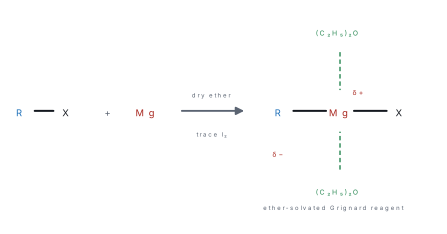
Conditions that matter.
- The ether must be absolutely dry and the apparatus moisture-free; the Mg turnings are cleaned to expose fresh metal and a crystal of iodine is added to start the reaction.
- The ether is not just a solvent: the oxygen lone pairs coordinate to the magnesium, satisfying its electron demand and keeping the reagent dissolved. Tetrahydrofuran (THF) does the job even better.
- Reactivity of the halide: R–I > R–Br > R–Cl, and alkyl > aryl.
- Haloarenes are far less reactive because the C–X bond has partial double-bond character. Bromobenzene and iodobenzene work in ether, but chlorobenzene will not react in ether at all — it needs THF at reflux (66 °C).
Any compound with an active hydrogen — water, alcohol, acid, amine, even a terminal alkyne — protonates the carbanion carbon and the reagent is gone: CH₃MgI + H₂O → CH₄↑ + Mg(OH)I. This is why the whole preparation is done under anhydrous conditions, and why you never wash a Grignard mixture with water until the reaction you wanted is finished.
17.4 Reactions of the Grignard reagent
Every reaction follows the same pattern: the δ− carbon attacks an electron-poor carbon (or hydrogen), giving a magnesium salt, which is then hydrolysed with dilute acid to release the organic product.
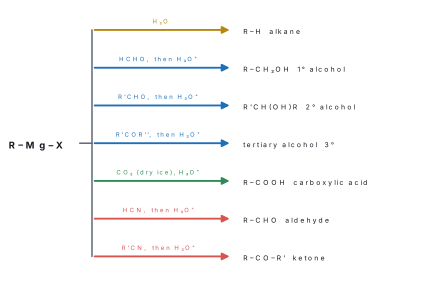
| Reagent | Intermediate | Final product after H₃O⁺ |
|---|---|---|
| Water (or ROH, NH₃, RCOOH) | — | alkane R–H + Mg(OH)X |
| Methanal, HCHO | R–CH₂–OMgX | primary alcohol R–CH₂OH |
| Any other aldehyde, R'CHO | R'RCH–OMgX | secondary alcohol |
| Ketone, R'COR'' | R'R''RC–OMgX | tertiary alcohol |
| Carbon dioxide (solid CO₂) | R–COOMgX | carboxylic acid R–COOH (one C more) |
| Hydrogen cyanide, HCN | RCH=N–MgX | aldehyde R–CHO |
| Nitrile, R'CN | R'(R)C=N–MgX | ketone R–CO–R' |
| Ester, R'COOR'' (2 equivalents) | — | tertiary alcohol with two identical R groups |
| Acid chloride, R'COCl (1 equivalent, cold) | — | ketone R–CO–R'; excess RMgX gives the 3° alcohol |
Worked through with real formulae:
CH₃MgI + HCHO → CH₃CH₂OMgI --H₃O⁺--> CH₃CH₂OH + Mg(OH)I
CH₃MgI + CH₃CHO → (CH₃)₂CHOMgI --H₃O⁺--> (CH₃)₂CHOH (propan-2-ol, 2°)
CH₃MgI + CH₃COCH₃ → (CH₃)₃COMgI --H₃O⁺--> (CH₃)₃COH (2-methylpropan-2-ol, 3°)
C₂H₅MgBr + CO₂ → C₂H₅COOMgBr --H₃O⁺--> C₂H₅COOH (propanoic acid)
CH₃COOC₂H₅ + 2CH₃MgI → (CH₃)₃COMgI + C₂H₅OMgI --H₃O⁺--> (CH₃)₃COH + C₂H₅OH
Problem. Give two different Grignard routes to 2-methylbutan-2-ol, CH₃CH₂C(CH₃)₂OH.
Solution. A tertiary alcohol comes from a ketone, so break one of the three C–C bonds at the alcohol carbon. The piece you remove becomes the Grignard reagent and what is left becomes the ketone.
Route 1 — break the ethyl group:
CH₃CH₂MgBr + CH₃COCH₃ → CH₃CH₂C(CH₃)₂OMgBr --H₃O⁺--> CH₃CH₂C(CH₃)₂OH
Route 2 — break a methyl group:
CH₃MgI + CH₃CH₂COCH₃ → CH₃CH₂C(CH₃)₂OMgI --H₃O⁺--> CH₃CH₂C(CH₃)₂OH
(Butan-2-one is the ketone in Route 2.) A third route uses an ester: CH₃COOC₂H₅ would give 2-methylbutan-2-ol only if the two added groups were identical, which here they are — 2 CH₃MgI on ethyl propanoate C₂H₅COOC₂H₅ gives the same alcohol.
Problem. 10.9 g of bromoethane is converted into a Grignard reagent, which is poured onto excess solid CO₂ and then hydrolysed. Calculate the mass of acid obtained if the overall yield is 75 %. (C = 12, H = 1, O = 16, Br = 80)
Solution.
Molar mass of C₂H₅Br = 2(12) + 5(1) + 80 = 109 g mol⁻¹, so moles = 10.9 / 109 = 0.100 mol.
The Grignard reagent is formed 1 : 1, and carbonation adds exactly one carbon:
C₂H₅MgBr + CO₂ → C₂H₅COOMgBr --H₃O⁺--> C₂H₅COOH
Product is propanoic acid, C₂H₅COOH, M = 3(12) + 6(1) + 2(16) = 74 g mol⁻¹.
Theoretical mass = 0.100 × 74 = 7.40 g. At 75 % yield, mass = 7.40 × 0.75 = 5.55 g.
Problem. 0.60 g of an organic compound liberates 224 cm³ of methane, measured at STP, when treated with excess methylmagnesium iodide. How many active hydrogen atoms does one molecule contain if its molar mass is 60 g mol⁻¹? Suggest a structure.
Solution. Each active hydrogen releases one molecule of methane:
CH₃MgI + R–OH → CH₄↑ + R–OMgI
Moles of CH₄ = 0.224 / 22.4 = 0.0100 mol.
Moles of compound = 0.60 / 60 = 0.0100 mol.
Ratio = 0.0100 : 0.0100 = 1 active hydrogen per molecule.
With M = 60 and one active H the compound could be ethanoic acid CH₃COOH or propan-1-ol C₃H₇OH. Sodium hydrogen carbonate settles it: the acid gives brisk CO₂ effervescence, the alcohol does not.
Chapter summary
- An organometallic compound has a direct C–M bond; C₂H₅ONa and CH₃COONa do not qualify.
- Classes: R–Li (organolithium), R–Mg–X (Grignard), R₂CuLi (Gilman cuprate), R₂Cd (organocadmium). Reactivity RLi > RMgX > R₂Cd; R₂Cd converts RCOCl into a ketone and stops there.
- Carbon (2.55) is more electronegative than every one of these metals, so the bond is Cδ⁻–Mδ⁺. Ionic character: C–Li ≈ 46 %, C–Mg ≈ 32 %, C–Cd ≈ 17 %. More ionic means more carbanion-like and more reactive.
- Preparation: R–X + Mg in dry ether → RMgX; reactivity R–I > R–Br > R–Cl. The ether coordinates to Mg. Chlorobenzene needs THF at reflux, not ether.
- Any active hydrogen kills the reagent: CH₃MgI + H₂O → CH₄↑ + Mg(OH)I (the basis of Zerewitinoff's method).
- Alcohols: HCHO → 1°, RCHO → 2°, ketone → 3°. CO₂ → carboxylic acid with one extra carbon. HCN → aldehyde, R'CN → ketone, ester (2 equiv.) → 3° alcohol with two identical groups, acid chloride → ketone then 3° alcohol.
Practice questions
Group A — Multiple choice (1 mark each)
- Which is not an organometallic compound? [1]aC₂H₅MgBrbCH₃LicC₂H₅ONad(CH₃)₂Cd
- A Grignard reagent reacts with methanal to give, after hydrolysis, a [1]aprimary alcoholbsecondary alcoholctertiary alcoholdketone
- The C–M bond is most ionic in [1]aC–PbbC–CdcC–MgdC–Li
- Ethylmagnesium bromide poured on solid CO₂ and then hydrolysed gives [1]aethanoic acidbpropanoic acidcethanoldpropan-1-ol
- Dry ether is used in preparing a Grignard reagent because [1]ait is cheapbits oxygen lone pairs coordinate to magnesiumcit reacts with the halidedit oxidises magnesium
Answers to Group A
1. (c) — sodium is bonded to oxygen, not to carbon.
2. (a) — HCHO supplies only one carbon substituent, so R–CH₂OH results.
3. (d) — lithium has the lowest electronegativity, Δχ = 1.57.
4. (b) — carbonation adds one carbon to the ethyl group.
5. (b) — coordination stabilises the magnesium and keeps RMgX in solution.
Group B — Short answer (5 marks each)
- Define an organometallic compound. Give the general formula and one example each of organolithium, organocopper and organocadmium compounds. [5]
- Explain the nature of the carbon–metal bond and use it to account for the reactivity order RLi > RMgX > R₂Cd. [5]
- How is ethylmagnesium bromide prepared? State three precautions and explain why chlorobenzene does not form a Grignard reagent in ether. [5]
- How would you obtain (i) propan-1-ol, (ii) propan-2-ol and (iii) 2-methylpropan-2-ol from a Grignard reagent? Give equations. [5]
- 21.8 g of bromoethane is converted to its Grignard reagent and treated with excess methanal, then hydrolysed. Calculate the mass of alcohol formed at 80 % yield. [5]
Answers to Group B
1. See §17.1. R–Li (CH₃Li), R₂CuLi ((CH₃)₂CuLi), R₂Cd ((CH₃)₂Cd).
2. Carbon (χ = 2.55) is more electronegative than the metals, so the bonding pair lies nearer carbon: Cδ⁻–Mδ⁺. The bigger the electronegativity difference the more ionic the bond and the freer the carbanion. Δχ is 1.57 for C–Li (≈46 % ionic), 1.24 for C–Mg (≈32 %) and 0.86 for C–Cd (≈17 %), giving RLi > RMgX > R₂Cd.
3. C₂H₅Br + Mg --dry ether--> C₂H₅MgBr. Precautions: (i) all apparatus and the ether must be perfectly dry, since water destroys the reagent; (ii) clean Mg turnings and a crystal of iodine are used to start the reaction; (iii) the mixture is kept away from air and moisture and gently refluxed. Chlorobenzene fails because the C–Cl bond in a haloarene has partial double-bond character (resonance) and is too strong to be attacked by Mg in ether; THF at 66 °C is needed instead.
4. (i) C₂H₅MgBr + HCHO → C₂H₅CH₂OMgBr --H₃O⁺--> CH₃CH₂CH₂OH (1°). (ii) CH₃MgI + CH₃CHO → (CH₃)₂CHOMgI --H₃O⁺--> (CH₃)₂CHOH. (iii) CH₃MgI + CH₃COCH₃ → (CH₃)₃COMgI --H₃O⁺--> (CH₃)₃COH.
5. Moles of C₂H₅Br = 21.8 / 109 = 0.200 mol. With HCHO the ethyl group gains one carbon, so the product is propan-1-ol, C₃H₇OH, M = 60 g mol⁻¹. Theoretical mass = 0.200 × 60 = 12.0 g; at 80 % yield, mass = 9.6 g.
Group C — Long answer (8 marks each)
- (a) How is a Grignard reagent prepared from a haloalkane and from a haloarene? Give equations and conditions. [3](b) Describe its reactions with water, carbon dioxide, an ester and a nitrile, giving the product in each case. [5]
- (a) Show how 1°, 2° and 3° alcohols are prepared from Grignard reagents, using ethanal, methanal and propanone as the carbonyl compounds. [5](b) 0.90 g of a compound of molar mass 90 g mol⁻¹ liberates 448 cm³ of methane at STP with excess CH₃MgI. How many active hydrogen atoms has it? [3]
Answers to Group C
1. (a) CH₃CH₂Br + Mg --dry ether--> CH₃CH₂MgBr; C₆H₅Br + Mg --dry ether--> C₆H₅MgBr. Absolutely anhydrous conditions, clean magnesium, a crystal of iodine to initiate; chlorobenzene requires THF at 66 °C. (b) Water: CH₃MgI + H₂O → CH₄↑ + Mg(OH)I (alkane). CO₂: C₂H₅MgBr + CO₂ → C₂H₅COOMgBr, then H₃O⁺ gives propanoic acid. Ester: two equivalents add, giving a tertiary alcohol with two identical groups, e.g. CH₃COOC₂H₅ + 2CH₃MgI → (CH₃)₃COH after hydrolysis. Nitrile: addition to C≡N gives a ketimine salt which hydrolyses to a ketone, CH₃MgI + CH₃CN → CH₃C(=NMgI)CH₃ --H₃O⁺--> CH₃COCH₃.
2. (a) HCHO + CH₃MgI → ethanol (1°); CH₃CHO + CH₃MgI → propan-2-ol (2°); CH₃COCH₃ + CH₃MgI → 2-methylpropan-2-ol (3°). Each requires acid hydrolysis of the alkoxide intermediate R–OMgI. (b) Moles of CH₄ = 0.448 / 22.4 = 0.0200 mol. Moles of compound = 0.90 / 90 = 0.0100 mol. Ratio 2 : 1, so the molecule has 2 active hydrogen atoms — consistent with lactic acid, CH₃CH(OH)COOH (M = 90), which has one –OH and one –COOH hydrogen.
Practise more: Chemistry question bank