Unit 21 · Applied Chemistry · 2 teaching hours · 20 min read
Nuclear Chemistry and Applications of Radioactivity
What the syllabus asks for 9
- Natural and artificial radioactivity
- Units of radioactivity
- Nuclear reactions
- Nuclear fission and fusion reactions
- Nuclear power and nuclear weapons
- Industrial uses of radioactivity
- Medical uses of radioactivity
- Radiocarbon dating
- Harmful effects of nuclear radiations
Ordinary chemistry rearranges electrons; nuclear chemistry rearranges the nucleus itself. Because nuclear binding energies are about a million times larger than bond energies, a gram of uranium can release as much energy as three tonnes of coal — and the same radiation that images a patient's thyroid will, in a large enough dose, destroy the tissue it passes through. This unit covers both sides of that bargain.
Distinguish natural from artificial radioactivity; complete and balance nuclear equations (mass number and atomic number must balance on both sides); define the curie, becquerel, gray and sievert; explain fission and fusion with equations; and give named examples of industrial and medical uses. Radiocarbon dating numericals appear regularly.
21.1 Natural and artificial radioactivity
Radioactivity is the spontaneous disintegration of an unstable nucleus with the emission of α-particles, β-particles or γ-rays. It is a nuclear property: it is unaffected by temperature, pressure, or the chemical state of the element.
Natural radioactivity was discovered by Henri Becquerel in 1896, when a uranium salt fogged a wrapped photographic plate; Marie and Pierre Curie isolated polonium and radium from pitchblende in 1898. Every nucleus with Z > 83 is naturally radioactive, and a few lighter ones (⁴⁰₁₉K, ¹⁴₆C) are as well.
| Property | α-particle | β-particle | γ-ray |
|---|---|---|---|
| Nature | helium nucleus, ⁴₂He²⁺ | fast electron, ⁰₋₁e | electromagnetic wave |
| Charge | +2 | −1 | 0 |
| Mass (u) | 4 | 1/1837 | 0 |
| Speed | ≈ 0.1 c | up to 0.99 c | c |
| Deflection in a field | small, towards −ve plate | large, towards +ve plate | none |
| Ionising power | very high (10 000) | medium (100) | low (1) |
| Penetrating power | low — stopped by paper | medium — stopped by 3 mm Al | very high — needs thick lead |
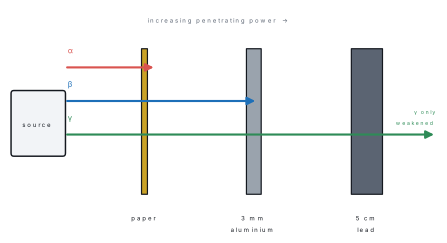
Emission changes the nucleus according to the group displacement law:
| Emission | Change in mass number A | Change in atomic number Z | Example |
|---|---|---|---|
| α | −4 | −2 | ²³⁸₉₂U → ²³⁴₉₀Th + ⁴₂He |
| β | 0 | +1 | ²³⁴₉₀Th → ²³⁴₉₁Pa + ⁰₋₁e |
| γ | 0 | 0 | excited nucleus loses energy only |
Artificial (induced) radioactivity was discovered by Irène Curie and Frédéric Joliot in 1934. Bombarding aluminium with α-particles gave a radioactive isotope of phosphorus that does not occur in nature:
²⁷₁₃Al + ⁴₂He → ³⁰₁₅P + ¹₀n
³⁰₁₅P → ³⁰₁₄Si + ⁰₊₁e (positron, half-life 2.5 min)
| Natural radioactivity | Artificial radioactivity |
|---|---|
| Shown by heavy nuclei, mostly Z > 83 | can be induced in almost any element |
| Spontaneous; cannot be started or stopped | produced by bombardment in a reactor or accelerator |
| Emits α, β, γ | often emits positrons or neutrons as well |
| Half-lives usually long | usually short, which is why such isotopes are safer in medicine |
21.2 Units of radioactivity
| Quantity | SI unit | Older unit | Relation |
|---|---|---|---|
| Activity (disintegrations per second) | becquerel, Bq = 1 dps | curie, Ci | 1 Ci = 3.7 × 10¹⁰ Bq |
| rutherford, Rd | 1 Rd = 10⁶ Bq | ||
| Absorbed dose (energy per kg of tissue) | gray, Gy = 1 J kg⁻¹ | rad | 1 rad = 0.01 Gy |
| Equivalent dose (absorbed dose × quality factor) | sievert, Sv | rem | 1 rem = 0.01 Sv |
| Exposure (ionisation in air) | C kg⁻¹ | roentgen, R | 1 R = 2.58 × 10⁻⁴ C kg⁻¹ |
The curie was originally the activity of 1 g of radium-226. The quality factor Q is 1 for β and γ, but 20 for α-particles, because an α deposits its energy over a very short track and does far more damage per joule.
21.3 Nuclear reactions
A nuclear reaction is a change in the composition of a nucleus caused by bombardment with a particle. The first artificial transmutation was carried out by Rutherford in 1919:
¹⁴₇N + ⁴₂He → ¹⁷₈O + ¹₁H , written in short as ¹⁴N(α, p)¹⁷O
Chadwick's discovery of the neutron (1932) used the same technique:
⁹₄Be + ⁴₂He → ¹²₆C + ¹₀n
- The sum of the mass numbers (superscripts) is the same on both sides.
- The sum of the atomic numbers (subscripts) is the same on both sides.
- Mass and energy together are conserved: the small mass loss Δm appears as energy, E = \\Delta m\\,c^2, where 1 u releases 931.5 MeV.
| Chemical reaction | Nuclear reaction |
|---|---|
| Involves outer electrons only | involves the nucleus |
| Element identity is preserved | one element changes into another |
| Energy change 10–1000 kJ mol⁻¹ | energy change ≈ 10⁹ kJ mol⁻¹ |
| Rate depends on temperature, pressure, catalyst | independent of all of these |
| Mass is conserved | measurable mass is converted to energy |
21.4 Nuclear fission and fusion reactions
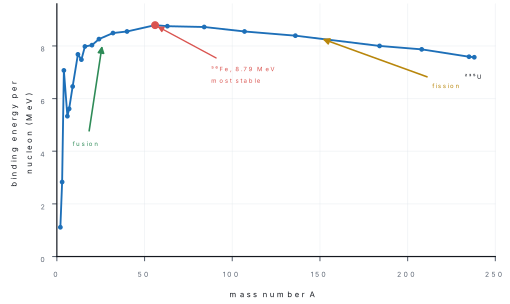
Nuclear fission is the splitting of a heavy nucleus into two nuclei of comparable mass, with the release of neutrons and a large amount of energy:
²³⁵₉₂U + ¹₀n → ¹⁴¹₅₆Ba + ⁹²₃₆Kr + 3¹₀n + 200 MeV
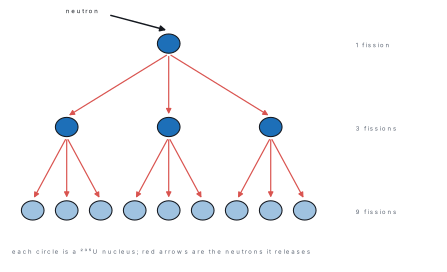
Because each fission releases more neutrons than it consumes, a chain reaction is possible once the sample exceeds its critical mass (about 15 kg for pure ²³⁵U). Below that size too many neutrons escape from the surface.
Nuclear fusion is the joining of two light nuclei into a heavier one. It powers the Sun, where the overall change is
4 ¹₁H → ⁴₂He + 2 ⁰₊₁e + 26.7 MeV
and the reaction used in thermonuclear devices and in experimental reactors is
²₁H + ³₁H → ⁴₂He + ¹₀n + 17.6 MeV
| Fission | Fusion | |
|---|---|---|
| Nuclei | heavy (²³⁵U, ²³⁹Pu) split | light (²H, ³H) combine |
| Starting condition | a slow neutron | 10⁷–10⁸ K ("thermonuclear") |
| Energy per reaction | ≈ 200 MeV | ≈ 17.6 MeV |
| Energy per nucleon | ≈ 0.85 MeV | ≈ 3.5 MeV — fusion is richer |
| Products | radioactive fission fragments | mostly non-radioactive helium |
| Control | achieved (reactors) | not yet achieved commercially |
Problem. Each fission of ²³⁵U releases 200 MeV. Calculate the energy released by the complete fission of 1.00 g of ²³⁵U. (1 MeV = 1.602 × 10⁻¹³ J, N_A = 6.022 × 10²³ mol⁻¹)
Solution.
Number of nuclei in 1.00 g:
Energy = 2.56 × 10²¹ × 200 MeV = 5.12 × 10²³ MeV
That is 8.2 × 10⁷ kJ from one gram. Burning one gram of coal gives about 30 kJ, so uranium yields nearly three million times more energy per gram.
21.5 Nuclear power and nuclear weapons
In a nuclear reactor the chain reaction is held at exactly one new fission per fission — a controlled chain reaction — and the heat raises steam for a turbine.
| Part | Material | Function |
|---|---|---|
| Fuel | UO₂ enriched to 3–4 % ²³⁵U, or ²³⁹Pu | undergoes fission |
| Moderator | graphite, heavy water D₂O, or ordinary water | slows fast neutrons so they can be captured by ²³⁵U |
| Control rods | boron steel or cadmium | absorb surplus neutrons; pushed in to slow the reactor down |
| Coolant | water, CO₂, liquid sodium | carries the heat to the boiler |
| Shield | thick concrete and lead | stops neutrons and γ-rays escaping |
A nuclear weapon is the same reaction left uncontrolled: two sub-critical pieces of ²³⁵U or ²³⁹Pu are slammed together to exceed the critical mass, and the whole chain runs in about a microsecond. The bomb dropped on Hiroshima in 1945 used ²³⁵U and that on Nagasaki ²³⁹Pu. A hydrogen bomb uses a fission bomb only as a trigger, to reach the 10⁸ K needed for the fusion of deuterium and lithium deuteride, and is far more powerful.
A reactor uses fuel enriched to only 3–4 % ²³⁵U, far below the ~90 % needed for a weapon, and the assembly cannot be held together long enough for a nuclear explosion. The real dangers of a reactor are a steam or hydrogen explosion and the escape of radioactive fission products — what happened at Chernobyl (1986) and Fukushima (2011).
Nepal has no nuclear power plant; its electricity is hydro. But radioisotopes are imported and used daily in Nepali hospitals and industry, which is why the Nepal Atomic Energy Act and a national regulatory framework exist.
21.6 Industrial uses of radioactivity
| Use | Isotope | Principle |
|---|---|---|
| Thickness gauge for paper, plastic and steel sheet | ⁸⁵Kr, ⁹⁰Sr (β) | transmitted intensity falls as thickness rises; the rollers adjust automatically |
| Level gauge in sealed tanks and cement silos | ⁶⁰Co (γ) | γ-beam is blocked when material reaches the detector |
| Industrial radiography of welds and castings | ⁶⁰Co, ¹⁹²Ir (γ) | cracks show as dark lines on film — a "γ X-ray" for steel |
| Leak detection in buried pipelines | ²⁴Na (t½ = 15 h) | the tracer collects at the leak and is found with a counter at the surface |
| Engine wear and lubricant testing | ⁵⁹Fe | activity of the oil measures metal worn off the piston rings |
| Food preservation and sterilisation of syringes | ⁶⁰Co | γ-rays kill bacteria and insects without heating |
| Smoke detectors | ²⁴¹Am (α) | smoke absorbs the α-particles and the ionisation current falls |
| Polymerisation and vulcanisation | ⁶⁰Co | radiation starts free-radical cross-linking |
21.7 Medical uses of radioactivity
| Purpose | Isotope | Use |
|---|---|---|
| Thyroid imaging and treatment | ¹³¹I (t½ 8 d) | iodine concentrates in the thyroid; small doses scan it, large doses destroy a tumour |
| General imaging (bone, heart, kidney) | ⁹⁹ᵐTc (t½ 6 h) | pure γ-emitter, short-lived — the workhorse of nuclear medicine |
| PET scanning | ¹⁸F (t½ 110 min) | as fluorodeoxyglucose, it shows where tissue is most active |
| Cancer radiotherapy (teletherapy) | ⁶⁰Co (t½ 5.3 y) | a focused γ-beam kills dividing tumour cells |
| Brachytherapy (implants) | ¹²⁵I, ¹⁹²Ir | the source is placed inside or beside the tumour |
| Blood volume, circulation studies | ²⁴Na, ⁵¹Cr | tracer dilution |
| Sterilisation of sutures, syringes, dressings | ⁶⁰Co | cold sterilisation of sealed packets |
| Bone-marrow and leukaemia therapy | ³²P (β) | concentrates in rapidly dividing tissue |
The isotopes chosen for diagnosis are γ-emitters with short half-lives, so that they leave the body quickly; those chosen for therapy are α- or β-emitters, whose short range concentrates the damage on the tumour.
Problem. (a) Convert 2.5 mCi of ⁹⁹ᵐTc to becquerel. (b) If this activity is injected at 8 a.m., what will it be at 2 p.m. (t½ = 6 h)? (c) A 60 kg worker absorbs 1.2 J of γ-radiation. Find the absorbed dose in gray and the equivalent dose in sievert.
Solution.
(a) 1 Ci = 3.7 × 10¹⁰ Bq, so 2.5 × 10⁻³ × 3.7 × 10¹⁰ = 9.25 × 10⁷ Bq (92.5 MBq).
(b) From 8 a.m. to 2 p.m. is 6 h = one half-life, so the activity falls to ½ × 9.25 × 10⁷ = 4.63 × 10⁷ Bq.
(c) Absorbed dose = energy ÷ mass = 1.2 / 60 = 0.020 Gy = 20 mGy. For γ-rays the quality factor Q = 1, so equivalent dose = 0.020 × 1 = 0.020 Sv = 20 mSv. That single exposure equals the whole annual limit for a radiation worker.
21.8 Radiocarbon dating
Cosmic-ray neutrons in the upper atmosphere convert nitrogen into radioactive carbon-14:
¹⁴₇N + ¹₀n → ¹⁴₆C + ¹₁H
The ¹⁴C mixes into atmospheric CO₂ and enters every living thing through photosynthesis, so a living organism keeps a fixed ¹⁴C level giving about 15.3 disintegrations per minute per gram of carbon. At death the intake stops and the ¹⁴C decays with a half-life of 5730 years:
¹⁴₆C → ¹⁴₇N + ⁰₋₁e
Comparing the activity of a dead sample with that of living matter therefore gives its age. The method was developed by W. F. Libby (Nobel Prize 1960) and works up to about 50 000 years — beyond that too little ¹⁴C is left.
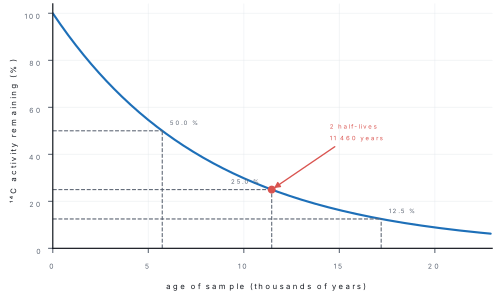
Problem. A wooden beam taken from an old temple gives 12.0 disintegrations per minute per gram of carbon, while fresh wood of the same kind gives 15.3. The half-life of ¹⁴C is 5730 years. Estimate the age of the beam.
Solution.
t = 2.01 × 10³ years, so the timber was cut about 2000 years ago.
Check: the activity has fallen only to 78 % of its original value, much less than one half-life, so an age well under 5730 years is reasonable.
21.9 Harmful effects of nuclear radiations
Radiation damages tissue by ionising the molecules it passes through. The ions and free radicals formed (especially from water) break DNA strands and destroy enzymes.
| Effect | Description |
|---|---|
| Somatic — in the exposed person | burns, hair loss, nausea and vomiting, fall in white cell count, sterility, cataract, leukaemia and other cancers years later |
| Genetic — in the descendants | mutation of the germ cells, causing inherited defects |
| Acute radiation sickness | a whole-body dose above about 1 Sv; above 5 Sv death is likely within weeks |
| Environmental | fallout isotopes ⁹⁰Sr (follows calcium into bone) and ¹³¹I (into the thyroid); waste that stays dangerous for thousands of years |
Recommended limits are 1 mSv per year for the public and 20 mSv per year for radiation workers, against a natural background of about 2–3 mSv a year (much of it radon gas seeping from the ground). Protection rests on three things: distance (intensity falls as 1/r²), shielding (lead, concrete) and time (minimum exposure), with film badges or dosimeters worn to record the dose received.
Chapter summary
- Radioactivity is the spontaneous disintegration of an unstable nucleus; discovered by Becquerel (1896), it is unaffected by temperature, pressure or chemical combination.
- α = ⁴₂He (high ionising, low penetrating), β = ⁰₋₁e, γ = electromagnetic (low ionising, high penetrating). α emission: A − 4, Z − 2; β emission: A same, Z + 1.
- Artificial radioactivity (Joliot-Curie, 1934): ²⁷₁₃Al + ⁴₂He → ³⁰₁₅P + ¹₀n, and ³⁰₁₅P → ³⁰₁₄Si + ⁰₊₁e.
- Units: activity 1 Bq = 1 dps, 1 Ci = 3.7 × 10¹⁰ Bq; absorbed dose 1 Gy = 1 J kg⁻¹ = 100 rad; equivalent dose 1 Sv = 100 rem.
- In every nuclear equation the mass numbers and the atomic numbers must balance; the mass defect appears as energy, with 1 u = 931.5 MeV.
- Fission: ²³⁵₉₂U + ¹₀n → ¹⁴¹₅₆Ba + ⁹²₃₆Kr + 3¹₀n + 200 MeV, giving a chain reaction above the critical mass. Fusion: ²₁H + ³₁H → ⁴₂He + ¹₀n + 17.6 MeV, needing 10⁷–10⁸ K.
- Reactor parts: fuel (3–4 % ²³⁵U), moderator (graphite or D₂O), control rods (boron or cadmium), coolant and concrete shield; a weapon is the same reaction uncontrolled.
- Industrial uses: thickness and level gauges, radiography of welds (⁶⁰Co, ¹⁹²Ir), leak detection (²⁴Na), sterilisation and food preservation, smoke detectors (²⁴¹Am). Medical uses: ⁹⁹ᵐTc imaging, ¹³¹I thyroid, ⁶⁰Co teletherapy, ³²P.
- Radiocarbon dating: ¹⁴₇N + ¹₀n → ¹⁴₆C + ¹₁H; living carbon gives 15.3 dpm g⁻¹; t½ = 5730 y; t = (2.303/λ) log(N₀/N).
- Radiation causes somatic and genetic damage; limits are 1 mSv yr⁻¹ (public) and 20 mSv yr⁻¹ (workers); protect by distance, shielding and time.
Practice questions
Group A — Multiple choice (1 mark each)
- Which radiation has the greatest penetrating power? [1]aαbβcγdall are equal
- When a nucleus emits an α-particle, its atomic number [1]aincreases by 1bdecreases by 2cdecreases by 4dis unchanged
- 1 curie is equal to [1]a3.7 × 10¹⁰ Bqb10⁶ Bqc1 J kg⁻¹d100 rem
- The moderator in a nuclear reactor is used to [1]aabsorb neutronsbslow down neutronsccool the coredenrich the fuel
- The half-life of ¹⁴C used in radiocarbon dating is [1]a5730 daysb1600 yearsc5730 yearsd4.5 × 10⁹ years
- The isotope most widely used for diagnostic imaging is [1]a⁶⁰Cob²³⁵Uc⁹⁹ᵐTcd²⁴¹Am
Answers to Group A
1. (c) — γ-rays are uncharged and massless, so they ionise little and travel far.
2. (b) — α emission removes 2 protons and 2 neutrons.
3. (a) — the activity of 1 g of radium-226.
4. (b) — slow (thermal) neutrons are captured by ²³⁵U far more readily.
5. (c) — 5730 years.
6. (c) — ⁹⁹ᵐTc is a short-lived pure γ-emitter.
Group B — Short answer (5 marks each)
- Distinguish between natural and artificial radioactivity with one example of each. [5]
- Compare α, β and γ radiations under nature, charge, ionising power and penetrating power. [5]
- Define becquerel, curie, gray and sievert, and state the relations between the SI and the older units. [5]
- What is nuclear fission? Write the equation for the fission of ²³⁵U and explain the terms chain reaction and critical mass. [5]
- Give four industrial and four medical applications of radioactivity, naming the isotope used in each. [5]
- A sample of charcoal from a cave gives 3.83 dpm per gram of carbon, while living wood gives 15.3. Calculate the age of the charcoal (t½ = 5730 years). [5]
Answers to Group B
1. Natural radioactivity is the spontaneous disintegration of heavy nuclei found in nature (²³⁸₉₂U → ²³⁴₉₀Th + ⁴₂He); artificial radioactivity is induced by bombarding a stable nucleus with particles (²⁷₁₃Al + ⁴₂He → ³⁰₁₅P + ¹₀n, followed by ³⁰₁₅P → ³⁰₁₄Si + ⁰₊₁e). Natural activity occurs mostly for Z > 83 and has long half-lives; induced activity can be made in almost any element and is usually short-lived.
2. See the table in §21.1: α is ⁴₂He²⁺, charge +2, ionising power ≈ 10 000, stopped by paper; β is an electron, charge −1, ionising power ≈ 100, stopped by 3 mm of aluminium; γ is an electromagnetic wave, no charge, ionising power 1, needs thick lead.
3. Becquerel = one disintegration per second; curie = 3.7 × 10¹⁰ Bq; gray = absorbed dose of 1 J kg⁻¹ (1 rad = 0.01 Gy); sievert = absorbed dose × quality factor (1 rem = 0.01 Sv). For β and γ, Q = 1; for α, Q = 20.
4. Fission is the splitting of a heavy nucleus into two lighter nuclei with the release of neutrons and energy: ²³⁵₉₂U + ¹₀n → ¹⁴¹₅₆Ba + ⁹²₃₆Kr + 3¹₀n + 200 MeV. The three neutrons can cause three further fissions, so the process becomes self-sustaining — a chain reaction. The critical mass is the smallest mass of fissile material in which enough neutrons are retained (rather than escaping through the surface) for the chain to continue; for pure ²³⁵U it is about 15 kg.
5. Industrial: thickness gauges (⁸⁵Kr), radiography of welds (⁶⁰Co or ¹⁹²Ir), pipeline leak detection (²⁴Na), smoke detectors (²⁴¹Am). Medical: thyroid scan and therapy (¹³¹I), general imaging (⁹⁹ᵐTc), cancer teletherapy (⁶⁰Co), sterilisation of syringes (⁶⁰Co) or bone-marrow therapy (³²P).
6. 3.83/15.3 = 0.25, that is ¼ of the original activity = 2 half-lives. Age = 2 × 5730 = 11 460 years. By formula: λ = 0.693/5730 = 1.209 × 10⁻⁴ yr⁻¹; t = (2.303/1.209 × 10⁻⁴) log 4 = 1.905 × 10⁴ × 0.602 = 1.15 × 10⁴ years.
Group C — Long answer (8 marks each)
- (a) What are nuclear fission and nuclear fusion? Write one equation for each and compare them under four headings. [4](b) Describe the parts of a nuclear reactor and the function of each, and explain why a reactor cannot explode like a bomb. [4]
- (a) Explain the principle of radiocarbon dating and state its limitations. [4](b) Each fission of ²³⁵U releases 200 MeV. Calculate the energy released when 0.50 g of ²³⁵U undergoes complete fission. (1 MeV = 1.602 × 10⁻¹³ J) [4]
Answers to Group C
1. (a) Fission is the splitting of a heavy nucleus (²³⁵₉₂U + ¹₀n → ¹⁴¹₅₆Ba + ⁹²₃₆Kr + 3¹₀n); fusion is the union of light nuclei (²₁H + ³₁H → ⁴₂He + ¹₀n + 17.6 MeV). Compare on the nuclei involved, the starting condition (a slow neutron versus 10⁷–10⁸ K), energy per nucleon (0.85 versus 3.5 MeV) and products (radioactive fragments versus helium) — see the table in §21.4. (b) Fuel (UO₂, 3–4 % ²³⁵U) provides the fissile nuclei; the moderator (graphite or D₂O) slows the fast neutrons; control rods of boron or cadmium absorb surplus neutrons and hold the multiplication factor at 1; the coolant carries heat to the boiler; the concrete-and-lead shield stops radiation. It cannot explode like a bomb because the fuel is far too dilute in ²³⁵U and the core would blow itself apart long before a nuclear explosion could build up; the hazards are steam or hydrogen explosions and the escape of fission products.
2. (a) Cosmic-ray neutrons make ¹⁴C in the atmosphere (¹⁴₇N + ¹₀n → ¹⁴₆C + ¹₁H); it enters living matter as CO₂ and stays at a steady level of 15.3 dpm per gram of carbon. On death the intake stops and the ¹⁴C decays (¹⁴₆C → ¹⁴₇N + ⁰₋₁e, t½ = 5730 y), so the age follows from t = (2.303/λ) log(N₀/N). Limitations: only for once-living material; an upper limit of about 50 000 years; it assumes the atmospheric ¹⁴C level has been constant, which fossil-fuel burning and bomb tests have disturbed; and the sample must not be contaminated with modern carbon. (b) N = (0.50/235) × 6.022 × 10²³ = 1.28 × 10²¹ nuclei. Energy = 1.28 × 10²¹ × 200 = 2.56 × 10²³ MeV = 2.56 × 10²³ × 1.602 × 10⁻¹³ = 4.1 × 10¹⁰ J (4.1 × 10⁷ kJ).
Practise more: Chemistry question bank