Unit 15 · Organic Chemistry · 3 teaching hours · 17 min read
Nitro Compounds
What the syllabus asks for 6
- Nitroalkanes: introduction, nomenclature, isomerism
- Preparation from haloalkane and alkane; physical properties; reduction
- Nitrobenzene: preparation from benzene; physical properties
- Reduction in different media
- Electrophilic substitution: nitration, sulphonation, bromination
- Uses of nitro-compounds
A nitro compound carries the group –NO₂ bonded to carbon through nitrogen. That one detail separates a nitroalkane, R–NO₂, from an alkyl nitrite, R–O–N=O, which has the same molecular formula but is joined through oxygen. Nitro compounds matter for two reasons: they are the standard doorway to amines (and therefore to dyes and drugs), and the nitro group is the textbook example of a strongly deactivating, meta-directing substituent on a benzene ring.
Three things come up almost every year: reduction of nitrobenzene in different media (the four-product table — learn it cold), why nitrobenzene is meta-directing and less reactive than benzene, and the preparation of nitroalkanes from haloalkanes with silver nitrite versus sodium nitrite.
15.1 Nitroalkanes: introduction, nomenclature, isomerism
A nitroalkane is a compound obtained by replacing one hydrogen atom of an alkane by a nitro group, –NO₂. General formula: CₙH₂ₙ₊₁NO₂, i.e. R–NO₂.
In the nitro group the nitrogen is positively charged and one oxygen negatively charged, but the two N–O bonds are found experimentally to be identical (both 122 pm). The group is a resonance hybrid, and the negative charge is shared equally by the two oxygens.
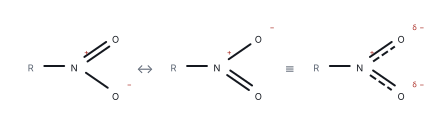
Naming is simple: name the parent alkane, number the chain so the nitro group gets the lowest number, and put nitro- as a prefix. Nitroalkanes are classified as primary (1°), secondary (2°) or tertiary (3°) by the number of hydrogen atoms on the carbon bearing the nitro group.
| Formula | IUPAC name | Class | α-hydrogens |
|---|---|---|---|
| CH₃NO₂ | nitromethane | 1° | 3 |
| CH₃CH₂NO₂ | nitroethane | 1° | 2 |
| CH₃CH₂CH₂NO₂ | 1-nitropropane | 1° | 2 |
| (CH₃)₂CHNO₂ | 2-nitropropane | 2° | 1 |
| (CH₃)₃CNO₂ | 2-methyl-2-nitropropane | 3° | 0 |
Nitroalkanes show four kinds of isomerism:
| Type | Example pair |
|---|---|
| Chain isomerism | 1-nitrobutane and 1-nitro-2-methylpropane (C₄H₉NO₂) |
| Position isomerism | 1-nitropropane and 2-nitropropane (C₃H₇NO₂) |
| Functional isomerism (metamerism) | nitroethane CH₃CH₂NO₂ and ethyl nitrite CH₃CH₂–O–N=O (C₂H₅NO₂) |
| Tautomerism | the nitro form and the aci form, possible only when α-H is present |
The nitro–aci tautomerism is worth writing out, because everything acidic about nitroalkanes follows from it:
CH₃–NO₂ ⇌ CH₂=N(OH)→O (nitro form ⇌ aci form)
Because the aci form is an –OH group, 1° and 2° nitroalkanes are weak acids and dissolve in aqueous NaOH; 3° nitroalkanes, having no α-H, do not.
| Nitroalkane | pKa | Dissolves in NaOH? |
|---|---|---|
| Nitromethane | 10.2 | yes |
| Nitroethane | 8.6 | yes |
| 2-Nitropropane | 7.7 | yes |
| 2-Methyl-2-nitropropane | — (no α-H) | no |
15.2 Preparation of nitroalkanes, physical properties and reduction
(a) From haloalkanes (Victor Meyer's method). A haloalkane refluxed with silver nitrite in ethanol gives the nitroalkane as the main product:
CH₃CH₂Br + AgNO₂ → CH₃CH₂NO₂ + AgBr↓
The nitrite ion is ambident: it can attack through N (giving R–NO₂) or through O (giving R–O–N=O). With AgNO₂ the covalent character of the Ag–O bond leaves nitrogen free, so the nitroalkane dominates. With ionic NaNO₂ or KNO₂ in ethanol the alkyl nitrite dominates. Writing "R–X + NaNO₂ → R–NO₂" in an answer loses the mark. (In the polar aprotic solvent DMF, NaNO₂ does give mainly the nitroalkane — the Kornblum modification.)
Reactivity for the substitution follows 1° > 2° > 3°, and iodides react fastest.
(b) From alkanes (vapour-phase nitration). Industrially, an alkane and nitric acid vapour are passed together at 400–450 °C:
CH₄ + HNO₃ --400–450 °C--> CH₃NO₂ + H₂O
The reaction is a free-radical chain, so with higher alkanes a mixture of all possible mononitro products (plus C–C cleavage products) is obtained. Nitromethane, nitroethane and the two nitropropanes are all made commercially this way from propane.
Physical properties.
- Nitromethane and its homologues are colourless, pleasant-smelling liquids (they turn yellow on standing in light).
- The nitro group is strongly polar — nitromethane has a dipole moment of 3.46 D — so the molecules attract one another by strong dipole–dipole forces and boil much higher than their molecular mass suggests.
- They are only sparingly soluble in water (no O–H or N–H to donate a hydrogen bond) but are excellent solvents themselves, and are denser than water (nitromethane 1.14 g cm⁻³).
- 1° and 2° nitroalkanes are weakly acidic (see the pKa table above); all nitroalkanes are toxic.
| Compound | M (g mol⁻¹) | Dipole moment (D) | Boiling point (°C) |
|---|---|---|---|
| Butane, C₄H₁₀ | 58 | 0 | −0.5 |
| Propanone, CH₃COCH₃ | 58 | 2.9 | 56 |
| Nitromethane, CH₃NO₂ | 61 | 3.46 | 101 |
| Nitroethane, C₂H₅NO₂ | 75 | 3.2 | 114 |
Reduction. Complete reduction gives a primary amine — the most useful reaction of the whole class:
CH₃CH₂NO₂ + 6[H] --Sn/HCl--> CH₃CH₂NH₂ + 2H₂O
Controlled (partial) reduction with zinc dust and aqueous ammonium chloride stops at the N-alkylhydroxylamine:
CH₃CH₂NO₂ + 4[H] --Zn/NH₄Cl--> CH₃CH₂NHOH + H₂O
| Reagent | Electrons supplied | Product |
|---|---|---|
| Sn/HCl, Fe/HCl, H₂ + Ni, LiAlH₄ | 6[H] | primary amine, R–NH₂ |
| Zn dust + NH₄Cl(aq), neutral | 4[H] | N-alkylhydroxylamine, R–NHOH |
Problem. Three bottles contain 1-nitropropane, 2-nitropropane and 2-methyl-2-nitropropane. How would you identify each using nitrous acid?
Solution. Treat each with HNO₂ (NaNO₂ + dilute HCl, cold) and then add NaOH.
| Nitroalkane | Intermediate formed | Observation |
|---|---|---|
| 1-Nitropropane (1°, 2 α-H) | nitrolic acid, C₂H₅C(NO₂)=N–OH | blood-red solution with NaOH |
| 2-Nitropropane (2°, 1 α-H) | pseudonitrole, (CH₃)₂C(NO₂)NO | blue colour |
| 2-Methyl-2-nitropropane (3°, no α-H) | no reaction | remains colourless |
The test works because HNO₂ attacks the α-carbon. A 1° nitroalkane still has one α-H left after attack and can tautomerise to the coloured nitrolic acid salt; a 2° one has none left and stays as the blue pseudonitrole; a 3° one has no α-H to attack in the first place.
15.3 Nitrobenzene: preparation from benzene, physical properties
Benzene is nitrated by a nitrating mixture — 1 : 1 concentrated nitric acid and concentrated sulphuric acid — at a carefully held 50–60 °C:
C₆H₆ + HNO₃ --conc. H₂SO₄, 50–60 °C--> C₆H₅NO₂ + H₂O
The sulphuric acid is not a spectator. It protonates nitric acid and pulls out water, generating the actual electrophile, the nitronium ion:
HNO₃ + 2H₂SO₄ → NO₂⁺ + H₃O⁺ + 2HSO₄⁻
The NO₂⁺ then attacks the benzene ring in the usual two steps (attack giving an arenium ion, then loss of H⁺). Above about 60 °C the product itself is nitrated further to m-dinitrobenzene, which is why the temperature must be controlled with a water bath.
Physical properties of nitrobenzene. A pale yellow oily liquid smelling of bitter almonds; m.p. 5.7 °C, b.p. 211 °C, density 1.20 g cm⁻³; insoluble in water but miscible with ethanol, ether and benzene; steam-volatile; and highly poisonous — it is absorbed through the skin and converts haemoglobin to methaemoglobin.
15.4 Reduction of nitrobenzene in different media
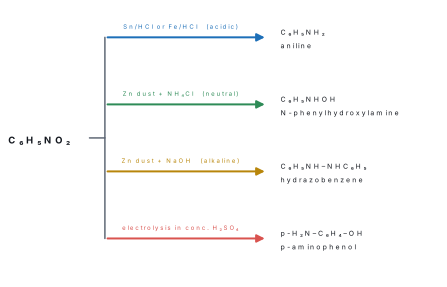
Nitrobenzene is the classic substrate whose reduction product depends entirely on the medium. This is the single most examined table in the unit.
| Medium | Reagent | Product | Equation |
|---|---|---|---|
| Acidic | Sn + conc. HCl, or Fe + HCl, or H₂/Ni | aniline | C₆H₅NO₂ + 6[H] → C₆H₅NH₂ + 2H₂O |
| Neutral | Zn dust + NH₄Cl(aq) | N-phenylhydroxylamine | C₆H₅NO₂ + 4[H] → C₆H₅NHOH + H₂O |
| Weakly alkaline | Na₃AsO₃ (sodium arsenite) | azoxybenzene | 2C₆H₅NO₂ + 6[H] → C₆H₅N(O)=NC₆H₅ + 3H₂O |
| Alkaline (mild) | LiAlH₄, or Zn + NaOH (limited) | azobenzene | 2C₆H₅NO₂ + 8[H] → C₆H₅N=NC₆H₅ + 4H₂O |
| Strongly alkaline | Zn dust + NaOH (excess) | hydrazobenzene | 2C₆H₅NO₂ + 10[H] → C₆H₅NHNHC₆H₅ + 4H₂O |
| Electrolytic, conc. H₂SO₄ | cathodic H, then rearrangement | p-aminophenol | C₆H₅NO₂ + 4[H] → p-H₂NC₆H₄OH + H₂O |
| Selective (for dinitro) | (NH₄)₂S or NH₄SH | m-nitroaniline | m-C₆H₄(NO₂)₂ + 3H₂S → m-NO₂C₆H₄NH₂ + 3S↓ + 2H₂O |
The industrial route to aniline uses iron filings and a little HCl (the Béchamp reduction), and the whole equation balances neatly:
4C₆H₅NO₂ + 9Fe + 4H₂O → 4C₆H₅NH₂ + 3Fe₃O₄
Acidic → the most reduced single-ring product (aniline). Neutral → stops halfway (–NHOH). Alkaline → two rings couple (azoxy → azo → hydrazo, in order of increasing reduction). Electrolytic in strong acid → the –NHOH rearranges onto the ring, giving p-aminophenol (this is the industrial route to paracetamol).
Problem. 39.0 g of benzene is nitrated with a 75 % yield, and all the nitrobenzene formed is reduced by Sn/HCl with an 80 % yield. Calculate the mass of aniline obtained. (C = 12, H = 1, N = 14, O = 16)
Solution.
Moles of benzene = 39.0 / 78 = 0.500 mol.
Step 1, nitration (1 : 1 stoichiometry): moles of nitrobenzene = 0.500 × 0.75 = 0.375 mol. (Mass = 0.375 × 123 = 46.1 g.)
Step 2, reduction (1 : 1 stoichiometry): moles of aniline = 0.375 × 0.80 = 0.300 mol.
Molar mass of aniline C₆H₅NH₂ = 6(12) + 7(1) + 14 = 93 g mol⁻¹.
Mass of aniline = 0.300 × 93 = 27.9 g.
15.5 Electrophilic substitution in nitrobenzene
The nitro group withdraws electrons both inductively (−I, nitrogen is positive) and by resonance (−R, it pulls π electron density out of the ring). The ring is therefore electron-poor and strongly deactivated: nitrobenzene is nitrated about 10⁷ times more slowly than benzene itself, and Friedel–Crafts alkylation or acylation fails completely on it.
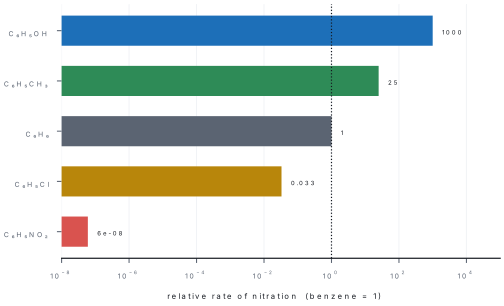
The group is also meta-directing. Attack at the ortho or para position would put the positive charge of the intermediate arenium ion on the carbon that already carries the positively charged nitrogen — an intolerable arrangement. Only meta attack avoids this, so the meta product forms.
| Reaction | Conditions | Product |
|---|---|---|
| Nitration | conc. HNO₃ + conc. H₂SO₄, 95–100 °C | m-dinitrobenzene |
| Sulphonation | fuming H₂SO₄ (SO₃ + H₂SO₄), ~100 °C | m-nitrobenzenesulphonic acid |
| Bromination | Br₂ + anhydrous FeBr₃, ~100 °C | m-bromonitrobenzene |
C₆H₅NO₂ + HNO₃ --conc. H₂SO₄, 100 °C--> m-C₆H₄(NO₂)₂ + H₂O
C₆H₅NO₂ + H₂SO₄ --SO₃, 100 °C--> m-NO₂–C₆H₄–SO₃H + H₂O
C₆H₅NO₂ + Br₂ --FeBr₃, 100 °C--> m-NO₂–C₆H₄–Br + HBr
The three reactions are the same electrophilic substitutions as for benzene, but every one needs a higher temperature and a stronger catalyst, because the ring is deactivated. Compare: benzene brominates at room temperature with FeBr₃; nitrobenzene needs 100 °C.
Problem. Starting from benzene, how would you prepare (a) m-nitroaniline and (b) p-nitroaniline? Explain why the order of steps differs.
Solution.
(a) m-Nitroaniline. Nitrate twice, then reduce one group selectively.
C₆H₆ --HNO₃/H₂SO₄, 55 °C--> C₆H₅NO₂ --HNO₃/H₂SO₄, 100 °C--> m-C₆H₄(NO₂)₂
then m-C₆H₄(NO₂)₂ + 3H₂S --(NH₄)₂S--> m-NO₂C₆H₄NH₂ + 3S↓ + 2H₂O
Both nitro groups are meta-directing, so the second nitration necessarily gives the 1,3-isomer; ammonium sulphide is mild enough to reduce only one of them.
(b) p-Nitroaniline. Here the amino group must be introduced first, because –NH₂ is ortho/para-directing:
C₆H₅NO₂ --Sn/HCl--> C₆H₅NH₂ --(CH₃CO)₂O--> C₆H₅NHCOCH₃ --HNO₃/H₂SO₄--> p-NO₂C₆H₄NHCOCH₃ --H₃O⁺, hydrolysis--> p-NO₂C₆H₄NH₂
The acetyl group is needed because free aniline is protonated by the nitrating mixture to –NH₃⁺, which is meta-directing, and is also oxidised by nitric acid.
Why the order differs: the directing effect of the group already on the ring fixes where the next one goes. Put –NO₂ on first for a meta product, –NH₂ (as its amide) on first for a para product.
15.6 Uses of nitro compounds
| Compound | Use |
|---|---|
| Nitromethane, nitroethane | solvents for cellulose acetate, resins, waxes and paints; fuel for model and drag-racing engines |
| Nitroalkanes generally | starting materials for amines, hydroxylamines and, on chlorination, chloropicrin CCl₃NO₂ (a soil fumigant) |
| Nitrobenzene | about 97 % goes to make aniline, and hence azo dyes, rubber chemicals and drugs; also a solvent, a mild oxidising agent (Skraup quinoline synthesis) and "oil of mirbane", the almond scent of cheap soaps and shoe polish |
| p-Aminophenol (from nitrobenzene) | manufacture of paracetamol |
| 2,4,6-Trinitrotoluene (TNT) | high explosive; melts at 80 °C, so it can be poured into shells |
| 2,4,6-Trinitrophenol (picric acid) | explosive, yellow dye, and an antiseptic for burns |
| Nitroglycerine | the explosive in dynamite; in tiny doses a vasodilator for angina |
| Aromatic nitro drugs | chloramphenicol, nitrofurantoin and metronidazole — the last is prescribed widely in Nepal for giardiasis and amoebic dysentery |
| Nitro musks | fixatives in cheap perfumes |
Chapter summary
- Nitroalkanes are R–NO₂ (CₙH₂ₙ₊₁NO₂); the nitro group is a resonance hybrid with two identical N–O bonds. Alkyl nitrites R–O–N=O are their functional isomers.
- Nitroalkanes show chain, position, functional and nitro–aci tautomeric isomerism. Only 1° and 2° (α-H present) are acidic and dissolve in NaOH.
- Preparation: R–X + AgNO₂ → R–NO₂ (with NaNO₂ you get the nitrite instead); CH₄ + HNO₃ at 400–450 °C → CH₃NO₂ + H₂O.
- Reduction: 6[H] gives R–NH₂; 4[H] with Zn/NH₄Cl stops at R–NHOH.
- Nitrobenzene: C₆H₆ + HNO₃ (conc. H₂SO₄, 50–60 °C) → C₆H₅NO₂ + H₂O, electrophile NO₂⁺. Pale yellow oil, b.p. 211 °C, bitter-almond smell, poisonous.
- Reduction of nitrobenzene: acidic → aniline; neutral → phenylhydroxylamine; alkaline → azoxy, azo, hydrazobenzene; electrolytic in conc. H₂SO₄ → p-aminophenol; (NH₄)₂S reduces only one group of a dinitro compound.
- –NO₂ is −I and −R, so it deactivates the ring (≈10⁷ times slower nitration) and is meta-directing: nitration, sulphonation and bromination all give the m-product, and Friedel–Crafts fails.
- Uses: aniline and dye manufacture, paracetamol, solvents, TNT, picric acid, nitroglycerine, metronidazole.
Practice questions
Group A — Multiple choice (1 mark each)
- The functional isomer of nitroethane is [1]anitromethanebethyl nitritec2-nitropropanedethanamine
- Reduction of nitrobenzene with zinc dust and aqueous ammonium chloride gives [1]aanilinebazobenzenecN-phenylhydroxylaminedp-aminophenol
- Nitration of nitrobenzene gives mainly [1]ao-dinitrobenzenebm-dinitrobenzenecp-dinitrobenzened1,3,5-trinitrobenzene
- Which nitroalkane gives no colour with nitrous acid? [1]anitromethanebnitroethanec2-nitropropaned2-methyl-2-nitropropane
- The electrophile in the nitration of benzene is [1]aNO₂⁻bNO₂⁺cHNO₃dNO⁺
Answers to Group A
1. (b) — both are C₂H₅NO₂, but the nitrite is joined through oxygen.
2. (c) — a neutral medium stops the reduction at 4[H].
3. (b) — –NO₂ is meta-directing.
4. (d) — it is tertiary and has no α-hydrogen to attack.
5. (b) — the nitronium ion, generated by H₂SO₄ from HNO₃.
Group B — Short answer (5 marks each)
- What happens when a haloalkane is treated with (i) silver nitrite and (ii) sodium nitrite in ethanol? Explain the difference. [5]
- Nitromethane boils at 101 °C while butane, of almost the same molecular mass, boils at −0.5 °C. Account for this, and explain why nitromethane is still only sparingly soluble in water. [5]
- How is nitrobenzene prepared from benzene? Give the equation, the conditions, and the role of concentrated sulphuric acid. [5]
- Explain, with reasons, why nitrobenzene undergoes electrophilic substitution more slowly than benzene and gives the meta product. [5]
- 24.6 g of nitrobenzene is completely reduced by Sn/HCl. Calculate the mass of aniline formed if the yield is 90 %. [5]
Answers to Group B
1. AgNO₂ gives mainly the nitroalkane (CH₃CH₂Br + AgNO₂ → CH₃CH₂NO₂ + AgBr), because the Ag–O bond is largely covalent and leaves the nitrogen lone pair as the better nucleophilic site. NaNO₂ is ionic, the nitrite ion attacks through oxygen, and the alkyl nitrite CH₃CH₂–O–N=O is the main product. The nitrite ion is ambident — it has two nucleophilic sites.
2. Nitromethane has a very large dipole moment (3.46 D), so dipole–dipole attraction between molecules is strong and a lot of energy is needed to separate them; butane is non-polar and held only by weak London forces. Nitromethane can accept hydrogen bonds from water but has no O–H or N–H of its own to donate, and its hydrocarbon part is hydrophobic, so it cannot fit into water's hydrogen-bonded network — hence low solubility.
3. C₆H₆ + HNO₃ --conc. H₂SO₄, 50–60 °C--> C₆H₅NO₂ + H₂O. Conditions: 1 : 1 nitrating mixture, water bath at 50–60 °C, reflux. H₂SO₄ protonates nitric acid and removes water to generate the electrophile: HNO₃ + 2H₂SO₄ → NO₂⁺ + H₃O⁺ + 2HSO₄⁻. Above 60 °C, m-dinitrobenzene is formed.
4. The –NO₂ group is electron-withdrawing both inductively (the N carries a positive charge) and by resonance (it delocalises ring π electrons onto its oxygens). The ring therefore has less electron density available for an electrophile, and the arenium-ion intermediate is destabilised — nitration is about 10⁷ times slower than for benzene. For ortho and para attack one canonical form of the intermediate places the positive charge on the ring carbon bearing the positive nitrogen, which is strongly destabilising; meta attack never does, so the meta isomer is formed.
5. Moles of C₆H₅NO₂ = 24.6 / 123 = 0.200 mol. The reaction is 1 : 1, so theoretical aniline = 0.200 mol = 0.200 × 93 = 18.6 g. Actual mass = 18.6 × 0.90 = 16.74 g.
Group C — Long answer (8 marks each)
- (a) Describe the reduction of nitrobenzene in acidic, neutral, strongly alkaline and electrolytic (conc. H₂SO₄) media, giving the product and a balanced equation in each case. [5](b) How are 1°, 2° and 3° nitroalkanes distinguished by the nitrous acid test? [3]
- (a) Starting from benzene, show how m-nitroaniline and p-nitroaniline are prepared, explaining why the order of the steps must differ. [5](b) 78 g of benzene is nitrated (70 % yield) and the product is reduced to aniline (85 % yield). Find the mass of aniline obtained. [3]
Answers to Group C
1. (a) Use the table in §15.4: acidic (Sn/HCl) → aniline, C₆H₅NO₂ + 6[H] → C₆H₅NH₂ + 2H₂O; neutral (Zn/NH₄Cl) → N-phenylhydroxylamine, C₆H₅NO₂ + 4[H] → C₆H₅NHOH + H₂O; strongly alkaline (Zn/NaOH excess) → hydrazobenzene, 2C₆H₅NO₂ + 10[H] → C₆H₅NHNHC₆H₅ + 4H₂O; electrolytic in conc. H₂SO₄ → p-aminophenol, C₆H₅NO₂ + 4[H] → p-H₂NC₆H₄OH + H₂O (the –NHOH formed first rearranges in strong acid). (b) 1° → blood-red nitrolic acid salt with NaOH; 2° → blue pseudonitrole; 3° → no reaction (no α-hydrogen). See Worked example 15.1.
2. (a) As in Worked example 15.3: nitrate twice then reduce with (NH₄)₂S for the meta isomer; for the para isomer reduce first, protect the –NH₂ as acetanilide, nitrate, then hydrolyse. (b) Moles of benzene = 78 / 78 = 1.00 mol. Nitrobenzene = 1.00 × 0.70 = 0.70 mol. Aniline = 0.70 × 0.85 = 0.595 mol = 0.595 × 93 = 55.3 g.
Practise more: Chemistry question bank