Unit 3 · General and Physical Chemistry · 7 teaching hours · 36 min read
Chemical Kinetics
What the syllabus asks for 10
- Introduction
- Rate of reactions: average and instantaneous
- Rate law and its expressions
- Rate constant, its unit and significance
- Order and molecularity
- Integrated rate equation for zero and first order reaction
- Half-life of zero and first order reactions
- Collision theory; activation energy and activated complex
- Factors affecting rate: concentration, temperature (Arrhenius equation), catalyst (energy profile diagram)
- Catalysis and types: homogeneous, heterogeneous and enzyme catalysis
Thermodynamics tells you whether a reaction can happen. It says nothing about how long it will take. The conversion of diamond into graphite releases energy and is perfectly spontaneous, yet a diamond ring survives a lifetime unchanged. Petrol and air sitting in a fuel tank are thermodynamically doomed, but nothing happens until a spark arrives. Chemical kinetics supplies the missing half of the story: the rate of a reaction, the concentration terms that control it, and the energy barrier that a collision must clear.
One MCQ on order versus molecularity or on the units of k; one 5-mark numerical on a first-order reaction, a half-life or the Arrhenius equation; and very often a drawing question — the energy-profile diagram with and without a catalyst, or the Maxwell-Boltzmann curve at two temperatures. The two equations you must be able to write from memory are k = \frac{2.303}{t}\log\frac{[A]_0}{[A]} and \log\frac{k_2}{k_1} = \frac{E_a}{2.303R}\left(\frac{T_2-T_1}{T_1T_2}\right).
3.1 Introduction
Chemical kinetics is the branch of chemistry that deals with the rate of a chemical reaction, the factors that affect that rate, and the mechanism — the sequence of elementary steps — by which reactants become products.
By speed, reactions fall into three broad classes.
| Class | Time scale | Examples |
|---|---|---|
| Very fast (ionic) | 10⁻¹² – 10⁻³ s | AgNO₃ + NaCl → AgCl↓ + NaNO₃; HCl + NaOH → NaCl + H₂O |
| Very slow | months to millions of years | rusting of iron, 4Fe + 3O₂ → 2Fe₂O₃; chemical weathering of limestone in the Mahabharat hills; formation of coal |
| Moderate (measurable) | minutes to hours | 2H₂O₂ → 2H₂O + O₂; hydrolysis of an ester; inversion of cane sugar |
Only the middle class is convenient to study in the laboratory. Very fast ionic reactions need special relaxation techniques; very slow ones show no measurable change during a practical class.
Why the subject matters: it fixes the residence time of a reactor in the Hetauda cement works, the expiry date printed on a strip of paracetamol, the rate at which food spoils in the Terai heat, and how long the chlorine added to a Kathmandu water tank stays effective.
3.2 Rate of reactions: average and instantaneous
The rate of a reaction is the change in the concentration of a reactant or a product per unit time. For the reaction R → P,
The minus sign makes the rate a positive quantity, because \Delta[\text{R}] is itself negative. The SI unit is mol L⁻¹ s⁻¹ (for gases, atm s⁻¹ is also used).
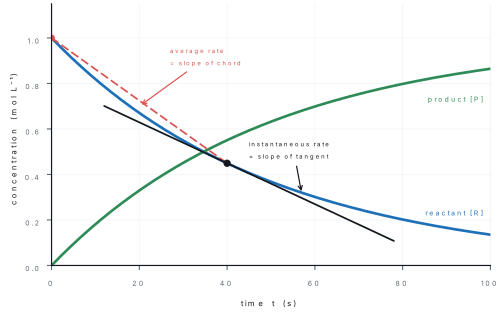
The average rate is the slope of the chord joining two points on the concentration-time curve. It is a blunt instrument: a reactant is used up fastest at the start and slowest at the end, so an average taken over a long interval describes neither.
The instantaneous rate is the rate at one particular moment — the limit of the average rate as the interval shrinks to zero:
Graphically it is the slope of the tangent drawn to the curve at that instant. The instantaneous rate at t = 0 is called the initial rate, and it is the quantity used to find the rate law, because at t = 0 the concentrations are exactly what you made them and no product has yet accumulated.
Rate of reaction versus rate of change of a single species
For a reaction with unequal coefficients the species disappear and appear at different numerical rates. For
the single quantity called the rate of reaction is
For N₂ + 3H₂ → 2NH₃, hydrogen disappears three times as fast as nitrogen and ammonia appears twice as fast as nitrogen is used up. Divide by the coefficient before you equate anything. Writing -d[\text{H}_2]/dt = +d[\text{NH}_3]/dt is wrong by a factor of 1.5.
Problem. In the reaction 2N₂O₅ → 4NO₂ + O₂, the concentration of N₂O₅ falls from 0.50 mol L⁻¹ to 0.40 mol L⁻¹ in 100 s. Calculate (a) the average rate of disappearance of N₂O₅, (b) the average rate of the reaction, and (c) the rates of formation of NO₂ and of O₂.
Solution.
(a) -\dfrac{\Delta[\text{N}_2\text{O}_5]}{\Delta t} = \dfrac{0.50 - 0.40}{100} = 1.0\times10^{-3} mol L⁻¹ s⁻¹.
(b) Divide by the coefficient of N₂O₅, which is 2:
(c) \dfrac{\Delta[\text{NO}_2]}{\Delta t} = 4r = 4 \times 5.0\times10^{-4} = 2.0\times10^{-3} mol L⁻¹ s⁻¹ and \dfrac{\Delta[\text{O}_2]}{\Delta t} = 1 \times r = 5.0\times10^{-4} mol L⁻¹ s⁻¹.
Check the arithmetic against the stoichiometry: NO₂ appears four times as fast as O₂, and 2.0×10⁻³ is indeed four times 5.0×10⁻⁴.
3.3 Rate law and its expressions
The rate law (or rate equation) is the experimentally determined expression that relates the rate of a reaction to the concentrations of the reactants, each raised to some power. For A + B → products,
where x and y are found by experiment and k is the rate constant.
The powers x and y cannot be read off the balanced equation. They must be measured. The table below makes the point; in every row the balanced equation would predict something different from what is observed.
| Reaction | Balanced equation suggests | Observed rate law | Overall order |
|---|---|---|---|
| 2N₂O₅ → 4NO₂ + O₂ | [\text{N}_2\text{O}_5]^2 | r = k[\text{N}_2\text{O}_5] | 1 |
| H₂ + I₂ → 2HI | [\text{H}_2][\text{I}_2] | r = k[\text{H}_2][\text{I}_2] | 2 |
| 2NO₂ + F₂ → 2NO₂F | [\text{NO}_2]^2[\text{F}_2] | r = k[\text{NO}_2][\text{F}_2] | 2 |
| CHCl₃ + Cl₂ → CCl₄ + HCl | [\text{CHCl}_3][\text{Cl}_2] | r = k[\text{CHCl}_3][\text{Cl}_2]^{1/2} | 1.5 |
| 2H₂O₂ → 2H₂O + O₂ | [\text{H}_2\text{O}_2]^2 | r = k[\text{H}_2\text{O}_2] | 1 |
The reason is mechanism. A balanced equation is only a bookkeeping statement of what goes in and what comes out; the rate is fixed by the slowest step of the sequence, and only the species in that step appear in the rate law.
Finding the rate law: the initial-rate method
Run the reaction several times, changing one concentration at a time, and measure the initial rate each time.
- If doubling [A] doubles the rate, the order in A is 1 (2^1 = 2).
- If doubling [A] quadruples the rate, the order in A is 2 (2^2 = 4).
- If doubling [A] leaves the rate unchanged, the order in A is 0 (2^0 = 1).
Problem. For the reaction A + 2B → C the following initial rates were measured at 298 K.
| Experiment | [A] / mol L⁻¹ | [B] / mol L⁻¹ | initial rate / mol L⁻¹ s⁻¹ |
|---|---|---|---|
| 1 | 0.10 | 0.10 | 2.0 × 10⁻³ |
| 2 | 0.20 | 0.10 | 4.0 × 10⁻³ |
| 3 | 0.10 | 0.20 | 8.0 × 10⁻³ |
Find the order with respect to each reactant, the overall order, the rate law and the value of k with its units.
Solution.
Let r = k[\text{A}]^{x}[\text{B}]^{y}.
Experiments 1 and 2 ([B] constant): [A] is doubled and the rate doubles, so 2^{x} = 2 and x = 1.
Experiments 1 and 3 ([A] constant): [B] is doubled and the rate becomes four times larger, so 2^{y} = 4 and y = 2.
Hence the rate law is r = k[\text{A}][\text{B}]^{2} and the overall order is 1 + 2 = 3 — even though the coefficient of A in the equation is 1 and of B is 2, which would have predicted order 3 by coincidence but the wrong individual orders.
From experiment 1,
The units are those of a third-order rate constant, which confirms the order.
3.4 Rate constant, its unit and significance
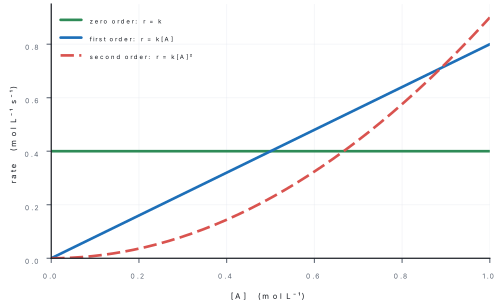
For r = k[\text{A}]^{x}[\text{B}]^{y}, the rate constant k is the rate of the reaction when the concentration of every reactant is unity. It is therefore also called the specific reaction rate.
Units of the rate constant
Rearranging the rate law, k = r/[\,]^{n} where n is the overall order. With r in mol L⁻¹ s⁻¹ and concentration in mol L⁻¹,
| Overall order n | Units of k |
|---|---|
| 0 | mol L⁻¹ s⁻¹ |
| 1 | s⁻¹ |
| 2 | L mol⁻¹ s⁻¹ (= mol⁻¹ L s⁻¹) |
| 3 | L² mol⁻² s⁻¹ |
| \tfrac{1}{2} | mol^{1/2} L^{-1/2} s⁻¹ |
Count the power of "mol" in the units of k and subtract it from 1. If k is in L mol⁻¹ s⁻¹ the power of mol is -1, so n = 1-(-1) = 2: second order. Notice that a first-order k is the only one whose units contain no concentration at all, which is why a first-order rate constant can be quoted in s⁻¹, min⁻¹ or year⁻¹ without any reference to volume.
Significance of k
- It is a measure of the intrinsic speed of a reaction, free of the accident of how concentrated the solution happens to be. Two reactions can be compared only through their rate constants, never through their rates.
- It is independent of concentration but depends on temperature — roughly doubling for every 10 K rise — and on the presence of a catalyst.
- A large k means a fast reaction. For the same order, the reaction with the larger k goes faster at any given concentration.
- Its units reveal the overall order, as in the box above.
- It is characteristic of a particular reaction at a particular temperature, so it is tabulated in data books and used to calculate rates, half-lives and activation energies.
Problem. The rate constant of a reaction is 3.0\times10^{-2} L mol⁻¹ s⁻¹. (a) What is the order of the reaction? (b) Write its rate law for a single reactant A. (c) Calculate the rate when [A] = 0.20 mol L⁻¹, and (d) state what happens to that rate if [A] is trebled.
Solution.
(a) The units contain mol⁻¹, so 1-n = -1 and n = 2: the reaction is second order.
(b) r = k[\text{A}]^{2}.
(c) r = 3.0\times10^{-2} \times (0.20)^{2} = 3.0\times10^{-2}\times0.040 = 1.2\times10^{-3} mol L⁻¹ s⁻¹.
(d) Rate \propto [\text{A}]^{2}, so trebling [A] multiplies the rate by 3^{2} = 9; the new rate is 1.08\times10^{-2} mol L⁻¹ s⁻¹. The rate constant itself does not change.
3.5 Order and molecularity
The order of a reaction is the sum of the powers of the concentration terms in the experimentally determined rate law. The molecularity of a reaction is the number of reactant species (atoms, ions or molecules) that take part in a single elementary step, as written in the balanced equation for that step.
| Order | Molecularity | |
|---|---|---|
| How obtained | experimentally, from the rate law | theoretically, by counting species in an elementary step |
| Possible values | 0, 1, 2, 3, and fractional values | 1, 2, 3 only — whole numbers |
| Can it be zero? | yes (photochemical and surface reactions) | no |
| Applies to | overall reaction or an elementary step | an elementary step only |
| Effect of conditions | can change (pseudo-order in excess solvent) | fixed |
For an elementary reaction — one that happens in a single step — order and molecularity are equal. They differ for complex reactions, which proceed in several steps.
Fractional order. The observed law r = k[\text{CHCl}_3][\text{Cl}_2]^{1/2} gives order 1.5. No molecule can be "half" present in a collision; the half-power is the fingerprint of a chain mechanism in which Cl₂ ⇌ 2Cl· supplies the reacting atom.
Zero order. In the decomposition of ammonia on a hot tungsten surface, 2NH₃ → N₂ + 3H₂, the metal is saturated with adsorbed NH₃, so adding more ammonia cannot speed anything up: r = k. The photochemical combination H₂ + Cl₂ → 2HCl is zero order in both gases because the rate is set by the intensity of the light.
Pseudo-order (pseudo-unimolecular) reactions. Hydrolysis of cane sugar,
C₁₂H₂₂O₁₁ + H₂O → C₆H₁₂O₆ + C₆H₁₂O₆,
is bimolecular, and the true rate law is r = k'[\text{C}_{12}\text{H}_{22}\text{O}_{11}][\text{H}_2\text{O}]. But water is the solvent and is present in vast excess, so [\text{H}_2\text{O}] hardly changes and is absorbed into the constant: r = k[\text{C}_{12}\text{H}_{22}\text{O}_{11}]. The reaction is second order in reality and first order in behaviour — a pseudo-first-order reaction. The acid hydrolysis of an ester, CH₃COOC₂H₅ + H₂O → CH₃COOH + C₂H₅OH, is the other standard example.
3.6 Integrated rate equation for zero and first order reaction
The rate law is a differential equation. Integrating it gives a relation between concentration and time that can be tested directly against experimental data.
For A → products with r = k[\text{A}]^{0} = k,
Integrate from [\text{A}]_0 at t = 0 to [\text{A}] at time t:
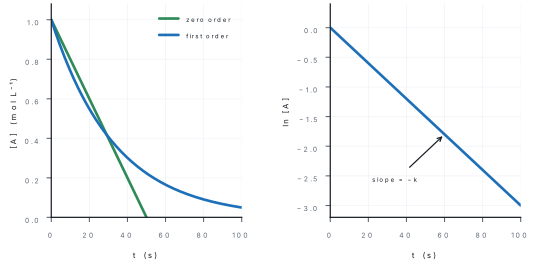
A plot of [\text{A}] against t is therefore a straight line of slope -k and intercept [\text{A}]_0. The reactant is used up at a steady rate and vanishes completely at t = [\text{A}]_0/k.
For A → products with r = k[\text{A}],
Integrating between the same limits,
Two other useful forms follow at once:
So \ln[\text{A}] (or \log[\text{A}]) against t is a straight line — of slope -k in the natural-log form and -k/2.303 in the base-10 form. A first-order reaction never truly finishes; the concentration decays exponentially towards zero.
Because only the ratio [\text{A}]_0/[\text{A}] appears, any quantity proportional to the amount left can be substituted — the volume of KMnO₄ needed to titrate the residual H₂O₂, the pressure of a gas, the angle of optical rotation, or the mass of an undecayed radioactive sample. Units cancel in the ratio, so no conversion to mol L⁻¹ is needed.
Problem. A first-order reaction is 25 % complete in 40 minutes. Calculate (a) the rate constant, (b) the time needed for the reaction to be 75 % complete.
Solution.
(a) Take [\text{A}]_0 = 100. If 25 % has reacted, [\text{A}] = 75.
\log 1.3333 = 0.1249, so k = 0.057575 \times 0.1249 = 7.19\times10^{-3}\ \text{min}^{-1}.
(b) For 75 % completion, [\text{A}] = 25:
Note the structure of the answer: 75 % completion leaves one quarter, which is two successive halvings, so t = 2t_{1/2} — and indeed t_{1/2} = 0.693/k = 96.4 min gives 2t_{1/2} = 193 min. Use this as a check.
Problem. The decomposition of NH₃ on a hot tungsten wire is zero order with k = 2.0\times10^{-2} mol L⁻¹ s⁻¹. If the initial concentration of NH₃ is 0.50 mol L⁻¹, find (a) the concentration left after 10 s, (b) the time for the concentration to fall to half its initial value, and (c) the time for the ammonia to disappear completely.
Solution.
(a) [\text{A}] = [\text{A}]_0 - kt = 0.50 - (2.0\times10^{-2})(10) = 0.50 - 0.20 = 0.30 mol L⁻¹.
(b) t_{1/2} = \dfrac{[\text{A}]_0}{2k} = \dfrac{0.50}{2 \times 2.0\times10^{-2}} = \dfrac{0.50}{0.040} = 12.5\ \text{s}.
(c) Complete reaction means [\text{A}] = 0, so t = \dfrac{[\text{A}]_0}{k} = \dfrac{0.50}{2.0\times10^{-2}} = 25\ \text{s}, which is exactly 2t_{1/2}. A zero-order reaction, unlike a first-order one, does come to a definite end.
3.7 Half-life of zero and first order reactions
The half-life t_{1/2} of a reaction is the time in which the concentration of a reactant falls to one half of its initial value.
Zero order. Put [\text{A}] = [\text{A}]_0/2 in [\text{A}] = [\text{A}]_0 - kt:
The half-life is directly proportional to the initial concentration.
First order. Put [\text{A}] = [\text{A}]_0/2 in k = \frac{2.303}{t}\log\frac{[\text{A}]_0}{[\text{A}]}:
The half-life is independent of the initial concentration — the single most useful fact in this chapter.
Because each half-life removes half of whatever is left, the fraction of reactant surviving after n half-lives is (1/2)^{n}:
| Half-lives elapsed | 0 | 1 | 2 | 3 | 4 | 5 |
|---|---|---|---|---|---|---|
| Fraction left | 1 | 1/2 | 1/4 | 1/8 | 1/16 | 1/32 |
| Per cent completed | 0 | 50 | 75 | 87.5 | 93.75 | 96.875 |
t_{99\%} = 6.64\,t_{1/2} and t_{99.9\%} \approx 10\,t_{1/2} for a first-order reaction, because t = \frac{2.303}{k}\log 100 = \frac{2 \times 2.303}{k} and \frac{3 \times 2.303}{k} respectively, while t_{1/2} = 0.693/k.
Problem. The half-life of the first-order decomposition of N₂O₅ at a certain temperature is 20 minutes. (a) What fraction of the sample remains after one hour? (b) If 4.0 g of N₂O₅ was taken, what mass has decomposed in one hour? (c) Calculate the rate constant.
Solution.
(a) One hour is 60 min, which is 60/20 = 3 half-lives, so the fraction left is (1/2)^{3} = 1/8 = 0.125, i.e. 12.5 %.
(b) Mass left = 4.0 \times 1/8 = 0.50 g, so the mass decomposed is 4.0 - 0.50 = 3.5 g.
(c) k = \dfrac{0.693}{t_{1/2}} = \dfrac{0.693}{20} = 3.47\times10^{-2}\ \text{min}^{-1} ( = 5.78\times10^{-4} s⁻¹ ).
3.8 Collision theory; activation energy and activated complex
Collision theory pictures a reaction as the outcome of collisions between reactant molecules. Its three statements are:
- Molecules must collide before they can react.
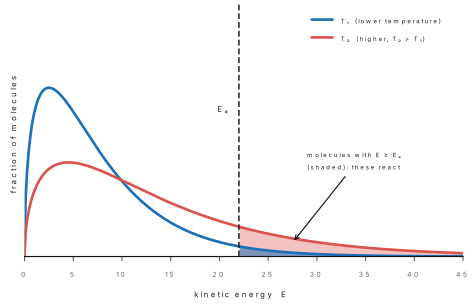
- Only a small fraction of collisions are effective: the colliding molecules must carry at least a certain minimum energy.
- The molecules must also collide with the correct orientation of the reacting bonds.
For a bimolecular gas reaction the number of collisions per unit volume per second, the collision frequency Z, is enormous — of the order of 10³⁰ L⁻¹ s⁻¹ at room temperature and ordinary pressures. If every collision worked, all gas reactions would be over in microseconds. They are not, so
where e^{-E_a/RT} is the fraction of collisions with energy at least E_a and P is the steric (orientation) factor, a number between 0 and 1.
The activation energy E_a is the minimum extra energy, over and above the average energy of the reactant molecules, that colliding molecules must possess for the collision to lead to products. Its unit is kJ mol⁻¹.
The activated complex (or transition state) is the short-lived, unstable arrangement of atoms at the top of the energy barrier, in which the old bonds are partly broken and the new bonds are partly formed. It cannot be isolated.
For the gas-phase reaction H₂ + I₂ → 2HI the activated complex is a four-centre arrangement often written [H⋯H⋯I⋯I]‡, in which both the H—H and the I—I bonds are stretched and two H—I bonds are forming.
E_{\text{threshold}} = E_{\text{average of reactants}} + E_a. The threshold energy is the absolute energy a collision must reach; the activation energy is the extra energy needed, measured from the reactant level. A small E_a means a fast reaction; a large E_a means a slow one.
3.9 Factors affecting rate: concentration, temperature (Arrhenius equation), catalyst (energy profile diagram)
(a) Nature and physical state of the reactants
Ionic reactions in solution are almost instantaneous because no covalent bond has to break; reactions that require the breaking of strong bonds are slow. Powdered CaCO₃ dissolves in dilute HCl far faster than a marble chip of the same mass, because the surface area exposed is much larger. This is why lump limestone is crushed before being fed to a lime kiln.
(b) Concentration (and pressure for gases)
Increasing the concentration increases the number of molecules per unit volume, hence the collision frequency, hence the rate. Quantitatively the effect is fixed by the order: for r = k[\text{A}]^{2} doubling [A] quadruples the rate, whereas for a zero-order reaction it changes nothing. For gaseous reactants, increasing the pressure has the same effect as increasing the concentration.
(c) Temperature — the Arrhenius equation
A rise of 10 K near room temperature typically doubles or trebles the rate. The ratio k_{T+10}/k_{T} is called the temperature coefficient and usually lies between 2 and 3. The reason is not the small increase in collision frequency (collision frequency goes only as \sqrt{T}, about 1.6 % for 10 K near 300 K) but the sharp growth of the high-energy tail of the Maxwell-Boltzmann curve.
Arrhenius (1889) found that rate constants obey
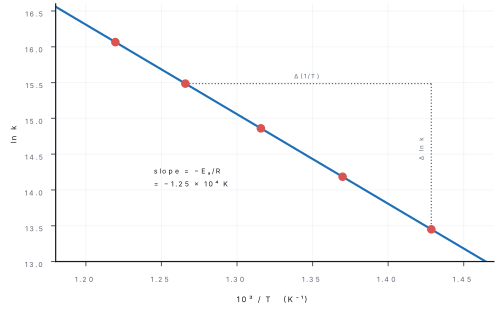
where A is the frequency (pre-exponential) factor, with the same units as k, E_a the activation energy, R = 8.314 J K⁻¹ mol⁻¹ and T the absolute temperature. Taking natural logarithms,
A graph of \ln k against 1/T is a straight line of slope -E_a/R and intercept \ln A; this is how E_a is measured.
Writing the equation at two temperatures and subtracting,
Problem. The rate constant of a reaction doubles when the temperature is raised from 300 K to 310 K. Calculate the activation energy. (R = 8.314 J K⁻¹ mol⁻¹, \log 2 = 0.3010.)
Solution.
with k_2/k_1 = 2, T_1 = 300 K, T_2 = 310 K:
This is the classic result: an activation energy of about 50 kJ mol⁻¹ is what makes a reaction roughly twice as fast for every 10 K near room temperature.
Problem. For a first-order reaction k = 2.0\times10^{-5} s⁻¹ at 300 K and 8.0\times10^{-5} s⁻¹ at 320 K. Calculate the activation energy and the frequency factor. (\log 4 = 0.6021.)
Solution.
For the frequency factor, use \log k = \log A - \dfrac{E_a}{2.303RT} at 300 K:
A carries the units of k, here s⁻¹, because the exponential term is dimensionless.
(d) Catalyst — the energy profile diagram
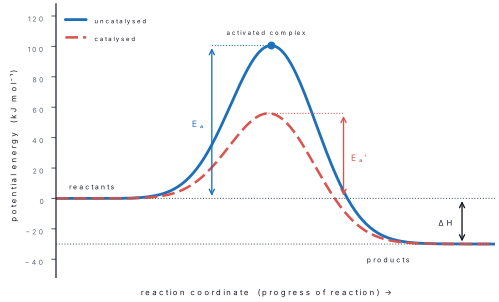
A catalyst is a substance that alters the rate of a reaction without being consumed, and provides an alternative path of lower activation energy. It does this by forming an unstable intermediate with a reactant; when that intermediate breaks down to give the product, the catalyst is regenerated.
Three consequences must be stated carefully, because the board asks about them.
- A catalyst lowers E_a for the forward and the backward reaction by the same amount, so it speeds both up equally and does not shift the position of equilibrium — only the time taken to reach it.
- It does not change \Delta H, because \Delta H depends only on the energies of the reactants and products, not on the path between them.
- It cannot make a thermodynamically impossible reaction happen.
(e) Other factors
Surface area of a solid catalyst or reactant, intensity of light for photochemical reactions such as H₂ + Cl₂ → 2HCl and photosynthesis, and the nature of the solvent all affect the rate.
3.10 Catalysis and types: homogeneous, heterogeneous and enzyme catalysis
Catalysis is the process by which the rate of a reaction is changed by a catalyst. A positive catalyst speeds the reaction up; a negative catalyst (inhibitor) slows it down, as glycerol does for the decomposition of H₂O₂.
Two supporting terms:
- A promoter (activator) is a substance that has no catalytic power of its own but increases the activity of a catalyst — Mo with Fe in the Haber process.
- A catalytic poison destroys the activity of a catalyst — As₂O₃ poisons the V₂O₅ of the contact process, so the SO₂ must be purified first.
(a) Homogeneous catalysis
The catalyst and the reactants are in the same phase.
| Reaction | Catalyst | Phase |
|---|---|---|
| 2SO₂ + O₂ → 2SO₃ (lead-chamber process) | NO(g) | all gases |
| CH₃COOC₂H₅ + H₂O → CH₃COOH + C₂H₅OH | H⁺(aq) from dilute HCl | all in solution |
| C₁₂H₂₂O₁₁ + H₂O → 2C₆H₁₂O₆ | H⁺(aq) | all in solution |
| 2H₂O₂ → 2H₂O + O₂ | I⁻(aq) | all in solution |
In the lead-chamber process the mechanism is easy to see: 2NO + O₂ → 2NO₂, then NO₂ + SO₂ → SO₃ + NO. The NO is used in the first step and returned in the second, so it does not appear in the overall equation.
(b) Heterogeneous catalysis
The catalyst is in a different phase from the reactants — almost always a solid catalysing gases or liquids. Reaction occurs on the surface: the reactants are adsorbed on active centres, which weakens their bonds and holds them in a favourable orientation; the product then desorbs.
| Reaction | Catalyst | Process |
|---|---|---|
| N₂ + 3H₂ ⇌ 2NH₃ | finely divided Fe with Mo promoter | Haber process |
| 2SO₂ + O₂ ⇌ 2SO₃ | V₂O₅ (solid) | contact process |
| 4NH₃ + 5O₂ → 4NO + 6H₂O | Pt gauze | Ostwald process |
| vegetable oil + H₂ → vanaspati ghee | Ni (solid) | oil hydrogenation |
| 2KClO₃ → 2KCl + 3O₂ | MnO₂ (solid) | laboratory oxygen |
The hydrogenation of mustard or soyabean oil over nickel to make the solid vanaspati ghee sold in Nepali shops is the most familiar industrial example of heterogeneous catalysis in the country.
(c) Enzyme catalysis
Enzymes are protein molecules produced by living cells that catalyse biochemical reactions; they are also called biocatalysts. A colloidal enzyme molecule has a cavity of a definite shape — the active site — into which only a substrate of matching shape fits, the "lock-and-key" picture.
| Enzyme | Reaction catalysed | Source |
|---|---|---|
| Invertase | sucrose → glucose + fructose | yeast |
| Zymase | C₆H₁₂O₆ → 2C₂H₅OH + 2CO₂ | yeast |
| Diastase (amylase) | starch → maltose | malt, saliva |
| Maltase | maltose → glucose | yeast |
| Urease | CO(NH₂)₂ + H₂O → 2NH₃ + CO₂ | soyabean |
| Pepsin | proteins → peptides | gastric juice |
Characteristics of enzyme catalysis: extremely high efficiency (one molecule can transform millions of substrate molecules per minute), very high specificity (urease attacks urea and nothing else), activity confined to a narrow optimum temperature (typically 298–310 K, because higher temperatures denature the protein) and a narrow optimum pH (usually 5–7), and sensitivity to inhibitors and activators. The fermentation of rice in making jaand and raksi runs on the enzymes of yeast, and the souring of milk into dahi on those of Lactobacillus.
In the permanganate-oxalic acid titration of Unit 1, the first few drops of KMnO₄ decolourise slowly and the rest almost instantly. The Mn²⁺ produced by the reaction catalyses the reaction itself — autocatalysis. It is why that titration is carried out warm, at about 60 °C, to get the first drops going.
Chapter summary
- Kinetics deals with rates, the factors affecting them and mechanism. Average rate is the slope of a chord, instantaneous rate the slope of the tangent, on a concentration-time graph; the unit is mol L⁻¹ s⁻¹.
- For aA + bB → cC + dD the rate of reaction is -\frac{1}{a}\frac{d[\text{A}]}{dt} = \frac{1}{c}\frac{d[\text{C}]}{dt}: always divide by the stoichiometric coefficient.
- The rate law r = k[\text{A}]^{x}[\text{B}]^{y} is experimental; its powers need not match the coefficients in the balanced equation.
- k is the specific reaction rate, has units (\text{mol L}^{-1})^{1-n}\text{s}^{-1}, is independent of concentration and increases with temperature.
- Order is experimental and may be zero or fractional; molecularity is theoretical and is a small whole number. They are equal only for elementary reactions. Reactions like ester hydrolysis are pseudo-first-order because the solvent is in excess.
- Zero order: [\text{A}] = [\text{A}]_0 - kt and t_{1/2} = [\text{A}]_0/2k; the plot of [\text{A}] against t is linear.
- First order: k = \frac{2.303}{t}\log\frac{[\text{A}]_0}{[\text{A}]} and t_{1/2} = 0.693/k, independent of the initial concentration; the plot of \ln[\text{A}] against t is linear with slope -k.
- Collision theory: r = ZPe^{-E_a/RT}. Only collisions with energy at least E_a and the right orientation succeed; the activated complex sits at the top of the barrier.
- Arrhenius: k = Ae^{-E_a/RT}, so \ln k against 1/T is linear with slope -E_a/R, and \log\frac{k_2}{k_1} = \frac{E_a}{2.303R}\left(\frac{T_2-T_1}{T_1T_2}\right).
- A catalyst provides a path of lower E_a, lowers the barrier equally in both directions, and changes neither \Delta H nor the equilibrium position. Catalysis is homogeneous (NO in the lead-chamber process), heterogeneous (Fe in the Haber process) or enzymatic (zymase in fermentation).
Practice questions
Group A — Multiple choice (1 mark each)
- The unit of the rate constant of a zero-order reaction is [1]as⁻¹bmol L⁻¹ s⁻¹cL mol⁻¹ s⁻¹dL² mol⁻² s⁻¹
- For a first-order reaction the half-life is [1]aproportional to [\text{A}]_0binversely proportional to [\text{A}]_0cindependent of [\text{A}]_0dproportional to [\text{A}]_0^{2}
- The observed rate law for 2N₂O₅ → 4NO₂ + O₂ is r = k[\text{N}_2\text{O}_5]. The overall order is [1]a0b1c2d3
- Which of the following quantities can never be fractional? [1]aorderbmolecularitycratedrate constant
- A catalyst increases the rate of a reaction because it [1]aincreases the number of collisionsblowers the activation energycmakes \Delta H more negativedshifts the equilibrium to the right
- The hydrolysis of ethyl acetate in a large excess of water is [1]azero orderbpseudo-first ordercsecond orderdthird order
- If trebling the concentration of the single reactant makes the rate nine times larger, the order of the reaction is [1]a1b2c3d1/2
- In a plot of \ln k against 1/T the slope is equal to [1]a-E_a/Rb+E_a/Rc-E_a/2.303Rd\ln A
Answers to Group A
1. (b) — k has units (\text{mol L}^{-1})^{1-n}\text{s}^{-1}; for n = 0 this is mol L⁻¹ s⁻¹.
2. (c) — t_{1/2} = 0.693/k contains no concentration term.
3. (b) — the order is the power in the experimental rate law, not the coefficient.
4. (b) — molecularity counts whole molecules in one step, so it is 1, 2 or 3.
5. (b) — it offers an alternative path over a lower barrier; \Delta H and K are unaffected.
6. (b) — truly bimolecular, but [\text{H}_2\text{O}] is constant, so it behaves as first order.
7. (b) — 3^{x} = 9 gives x = 2.
8. (a) — from \ln k = \ln A - E_a/RT.
Group B — Short answer (5 marks each)
- Distinguish between the average rate and the instantaneous rate of a reaction. For 4NH₃ + 5O₂ → 4NO + 6H₂O, write the rate of reaction in terms of each species. If O₂ is consumed at 2.5\times10^{-3} mol L⁻¹ s⁻¹, at what rate is NO formed? [5]
- A first-order reaction has a rate constant of 1.15\times10^{-3} s⁻¹. How long will 5.0 g of the reactant take to be reduced to 3.0 g? [5]
- The half-life of a first-order reaction is 10 minutes. Calculate the rate constant and the time required for the reaction to be 90 % complete. [5]
- For a zero-order reaction k = 1.0\times10^{-2} mol L⁻¹ s⁻¹ and [\text{A}]_0 = 0.40 mol L⁻¹. Find the half-life and the time at which [\text{A}] = 0.10 mol L⁻¹. [5]
- The rate constant of a reaction at 300 K is 4.5\times10^{-3} s⁻¹ and its activation energy is 60 kJ mol⁻¹. Calculate the rate constant at 320 K. [5]
- Define catalysis. Distinguish between homogeneous and heterogeneous catalysis with one example of each, and state three characteristics of enzyme catalysis. [5]
Answers to Group B
1. The average rate is the concentration change divided by a finite time interval — the slope of the chord; the instantaneous rate is the limit of that as the interval tends to zero — the slope of the tangent. For the given reaction,
So r = \frac{1}{5}(2.5\times10^{-3}) = 5.0\times10^{-4} mol L⁻¹ s⁻¹ and \frac{d[\text{NO}]}{dt} = 4r = 2.0\times10^{-3} mol L⁻¹ s⁻¹.
2. Mass is proportional to concentration, so the ratio 5.0/3.0 may be used directly: t = \frac{2.303}{1.15\times10^{-3}}\log\frac{5.0}{3.0} = 2002.6 \times 0.2218 = 444\ \text{s} (7 min 24 s).
3. k = 0.693/10 = 6.93\times10^{-2} min⁻¹. For 90 % completion 10 % remains, so t = \frac{2.303}{6.93\times10^{-2}}\log 10 = 33.24 \times 1 = 33.2 min.
4. t_{1/2} = \frac{[\text{A}]_0}{2k} = \frac{0.40}{0.020} = 20\ \text{s}. From [\text{A}] = [\text{A}]_0 - kt, t = \frac{0.40-0.10}{1.0\times10^{-2}} = 30\ \text{s}.
5. \log\frac{k_2}{k_1} = \frac{60000}{2.303\times8.314} \times\frac{20}{300\times320} = 3133.1 \times 2.0833\times10^{-4} = 0.6528, so k_2/k_1 = 4.50 and k_2 = 4.50 \times 4.5\times10^{-3} = 2.02\times10^{-2} s⁻¹.
6. Catalysis is the change in the rate of a reaction brought about by a substance (the catalyst) that is not consumed. In homogeneous catalysis the catalyst is in the same phase as the reactants — NO(g) in 2SO₂ + O₂ → 2SO₃ in the lead-chamber process. In heterogeneous catalysis it is in a different phase — solid Fe for N₂ + 3H₂ ⇌ 2NH₃ in the Haber process, where reaction occurs on the adsorbing surface. Enzyme catalysis is (i) extremely efficient, one molecule turning over millions of substrate molecules per minute, (ii) highly specific, one enzyme for one substrate (urease acts only on urea), and (iii) restricted to a narrow optimum temperature (about 298–310 K) and pH, because the protein is denatured outside it.
Group C — Long answer (8 marks each)
- (a) Derive the integrated rate equation for a first-order reaction and show that its half-life is independent of the initial concentration. [5](b) A first-order reaction is found to be 30 % decomposed in 40 minutes. Calculate its rate constant and half-life. [3]
- (a) Distinguish between the order and the molecularity of a reaction, with one example of each of a zero-order and a fractional-order reaction. Explain what is meant by a pseudo-first-order reaction. [4](b) The rate constant of a reaction is 2.0\times10^{-4} s⁻¹ at 500 K and 4.0\times10^{-3} s⁻¹ at 600 K. Calculate the activation energy. [4]
- (a) State the postulates of collision theory. Define activation energy and activated complex, and use the Maxwell-Boltzmann distribution to explain why a 10 K rise in temperature can double the rate. [4](b) Draw the potential-energy profile for an exothermic reaction with and without a catalyst. If a catalyst lowers the activation energy from 75 kJ mol⁻¹ to 50 kJ mol⁻¹, by what factor does the rate increase at 300 K? [4]
Answers to Group C
1.(a) See the derivation box in §3.6: from -d[\text{A}]/dt = k[\text{A}], separating variables and integrating gives k = \frac{2.303}{t}\log\frac{[\text{A}]_0}{[\text{A}]}. Putting [\text{A}] = [\text{A}]_0/2 makes the logarithm \log 2 = 0.3010, so t_{1/2} = 2.303 \times 0.3010/k = 0.693/k. The initial concentration has cancelled, so t_{1/2} does not depend on it.
1.(b) 30 % decomposed leaves 70 %:
2.(a) Order is the sum of the powers of the concentration terms in the experimental rate law; it is found by experiment and may be 0, fractional or a whole number. Molecularity is the number of species colliding in one elementary step; it is deduced from the equation for that step and must be 1, 2 or 3. Zero order: 2NH₃ → N₂ + 3H₂ on a hot tungsten surface, r = k. Fractional order: CHCl₃ + Cl₂ → CCl₄ + HCl, r = k[\text{CHCl}_3][\text{Cl}_2]^{1/2}, order 1.5. A pseudo-first-order reaction is one whose true order is higher but which behaves as first order because one reactant — usually the solvent — is in such large excess that its concentration is effectively constant, as in CH₃COOC₂H₅ + H₂O → CH₃COOH + C₂H₅OH.
2.(b) \log\frac{4.0\times10^{-3}}{2.0\times10^{-4}} = \log 20 = 1.3010.
3.(a) Postulates: molecules must collide; only collisions carrying at least the activation energy are effective; the colliding molecules must also be correctly oriented, which is allowed for by the steric factor P in r = ZPe^{-E_a/RT}. Activation energy is the minimum extra energy above the average that colliding molecules must have to react; the activated complex is the unstable partly-bonded arrangement at the top of the barrier. On the Maxwell-Boltzmann curve, raising the temperature by 10 K raises the collision frequency by less than 2 %, but the area of the tail beyond E_a — the fraction of molecules with enough energy — roughly doubles, because that fraction is e^{-E_a/RT} and the exponent is large. It is this exponential factor, not the collision frequency, that doubles the rate.
3.(b) The diagram is the one in §3.9(d): the same reactant and product levels, the same \Delta H, but a lower peak for the catalysed path. The rates are in the ratio of the exponential factors:
The catalysed reaction is about twenty-two thousand times faster, even though \Delta H and the equilibrium constant are unchanged.
Practise more: Chemistry question bank