Unit 14 · Organic Chemistry · 9 teaching hours · 30 min read
Carboxylic Acid and its Derivatives
What the syllabus asks for 11
- Introduction, nomenclature, isomerism of aliphatic and aromatic carboxylic acids
- Preparation of monocarboxylic acids from aldehydes, nitriles, dicarboxylic acid, sodium alkoxide, trihaloalkanes
- Preparation of benzoic acid from alkyl benzene
- Physical properties
- Chemical properties: alkalies, metal oxides, metal carbonates, metal bicarbonates, PCl3, LiAlH4, dehydration
- Hell-Volhard-Zelinsky reaction
- Electrophilic substitution of benzoic acid: bromination, nitration, sulphonation
- Effect of constituents on acidic strength; abnormal behaviour of methanoic acid
- Derivatives (acid halides, amides, esters, anhydrides): preparation from carboxylic acid
- Comparative physical and chemical properties: hydrolysis, ammonolysis, amines, alcoholysis, reduction
- Claisen condensation; Hofmann bromamide reaction; amphoteric nature of amide; relative reactivity of acid derivatives
A carboxylic acid contains the carboxyl group, —COOH: a carbonyl group and a hydroxyl group on the same carbon. Neither group behaves as it would alone. The —OH loses its proton far more readily than an alcohol does, and the >C=O refuses the addition reactions of Unit 13. Both facts come from one cause — delocalisation in the carboxylate ion. This unit then follows the acid into its four derivatives: acid halides, anhydrides, esters and amides.
Three questions dominate: (1) why is a carboxylic acid more acidic than phenol and alcohol, explained with the resonance of RCOO⁻; (2) the effect of substituents on acid strength, with pK_a values; (3) a comparison of the four derivatives — preparation from the acid, hydrolysis, ammonolysis, alcoholysis, reduction, and the reactivity order RCOCl > (RCO)₂O > RCOOR′ > RCONH₂. Add the four named reactions: HVZ, Claisen, Hofmann bromamide and Schotten–Baumann.
14.1 Introduction, nomenclature and isomerism
A monocarboxylic acid has one —COOH group; the saturated open-chain series is CₙH₂ₙO₂, general formula R—COOH. Acids with two carboxyl groups are dicarboxylic. When —COOH is attached directly to a benzene ring the acid is aromatic.
A carboxylic acid is an organic compound containing the carboxyl group, —COOH, in which a hydroxyl group is attached to a carbonyl carbon. In water it ionises to give a carboxylate ion and a hydrogen ion: RCOOH + H₂O ⇌ RCOO⁻ + H₃O⁺.
IUPAC rules. Replace the final -e of the parent alkane by -oic acid. The carboxyl carbon is always C-1, so it never takes a locant. Two carboxyl groups give -dioic acid (and the -e is kept). For the aromatic series the parent name is benzoic acid.
| Formula | IUPAC name | Common name |
|---|---|---|
| HCOOH | methanoic acid | formic acid |
| CH₃COOH | ethanoic acid | acetic acid |
| CH₃CH₂COOH | propanoic acid | propionic acid |
| CH₃(CH₂)₂COOH | butanoic acid | butyric acid |
| (CH₃)₂CHCOOH | 2-methylpropanoic acid | isobutyric acid |
| ClCH₂COOH | 2-chloroethanoic acid | chloroacetic acid |
| HOOC—COOH | ethanedioic acid | oxalic acid |
| HOOC—CH₂—COOH | propanedioic acid | malonic acid |
| C₆H₅COOH | benzoic acid | benzoic acid |
| C₆H₅CH₂COOH | phenylethanoic acid | phenylacetic acid |
| o-HOC₆H₄COOH | 2-hydroxybenzoic acid | salicylic acid |
Isomerism. Carboxylic acids show:
- Chain isomerism — butanoic acid and 2-methylpropanoic acid, both C₄H₈O₂.
- Position isomerism of a substituent — 2-chlorobutanoic, 3-chlorobutanoic and 4-chlorobutanoic acid. In aromatic acids the ortho, meta and para isomers, e.g. the three methylbenzoic (toluic) acids.
- Functional isomerism with esters and with hydroxy-carbonyl compounds. C₃H₆O₂ is propanoic acid, methyl ethanoate or ethyl methanoate.
- Metamerism among the ester isomers — methyl propanoate, ethyl ethanoate and propyl methanoate are all C₄H₈O₂.
C₄H₈O₂ therefore has two acids and four esters (methyl propanoate, ethyl ethanoate, propyl methanoate, isopropyl methanoate).
14.2 Preparation of monocarboxylic acids
From aldehydes — oxidation
Any oxidising agent that will attack an aldehyde works; acidified dichromate is the standard laboratory reagent:
3CH₃CHO + K₂Cr₂O₇ + 4H₂SO₄ → 3CH₃COOH + K₂SO₄ + Cr₂(SO₄)₃ + 4H₂O
Primary alcohols give the same acid, passing through the aldehyde: CH₃CH₂OH + 2[O] → CH₃COOH + H₂O.
From nitriles — hydrolysis
A nitrile has the same number of carbons as the acid it gives. Hydrolysis is done with dilute mineral acid or with alkali followed by acidification:
CH₃CN + 2H₂O + HCl → CH₃COOH + NH₄Cl
CH₃CN + H₂O + NaOH → CH₃COONa + NH₃↑
Because the nitrile itself is made from a haloalkane (R—X + KCN → R—CN + KX), this is the standard way of adding one carbon to a chain.
From dicarboxylic acids — decarboxylation
Dicarboxylic acids lose CO₂ on gentle heating:
HOOC—COOH --423 K--> HCOOH + CO₂↑
HOOC—CH₂—COOH --413 K--> CH₃COOH + CO₂↑
From sodium alkoxide — carbonylation
Sodium alkoxide absorbs carbon monoxide under pressure to give the sodium salt of the next higher acid, which is then acidified:
CH₃ONa + CO --425 K, 3 atm--> CH₃COONa
CH₃COONa + HCl → CH₃COOH + NaCl
From trihaloalkanes — hydrolysis
Three halogens on the same carbon hydrolyse to an unstable orthoacid, which loses two molecules of water:
CHCl₃ + 4NaOH → HCOONa + 3NaCl + 2H₂O
CH₃CCl₃ + 4NaOH → CH₃COONa + 3NaCl + 2H₂O
Nitrile hydrolysis and the Grignard route (RMgX + CO₂ → RCOOMgX --H₃O⁺--> RCOOH) add one carbon. Oxidation of an alcohol or aldehyde keeps the carbon count. Decarboxylation of a diacid removes one carbon. In a conversion question, count the carbons first and the route chooses itself.
14.3 Preparation of benzoic acid from an alkylbenzene
Hot alkaline potassium permanganate attacks the benzylic carbon and degrades the whole side chain to a single —COOH group, however long the side chain is — provided it carries at least one hydrogen on the carbon joined to the ring:
C₆H₅CH₃ + 2KMnO₄ → C₆H₅COOK + 2MnO₂↓ + KOH + H₂O
C₆H₅COOK + HCl → C₆H₅COOH↓ + KCl
Ethylbenzene, propylbenzene and isopropylbenzene all give benzoic acid too. tert-Butylbenzene, C₆H₅C(CH₃)₃, has no benzylic hydrogen and is not oxidised — a favourite examiner's trap.
Students often write the ring being broken open. KMnO₄ cannot oxidise the aromatic ring under these conditions; it burns the side chain back to the ring and stops. So C₆H₅CH₂CH₂CH₃ gives benzoic acid, not butanoic acid or phenylpropanoic acid.
14.4 Physical properties
The first three acids are pungent-smelling liquids miscible with water; butanoic acid smells of rancid butter; from about C₁₀ they are waxy, odourless solids. Pure ethanoic acid freezes at 16.6 °C to an ice-like solid, so it is called glacial acetic acid — in a Kathmandu winter a bottle on the shelf may set solid.
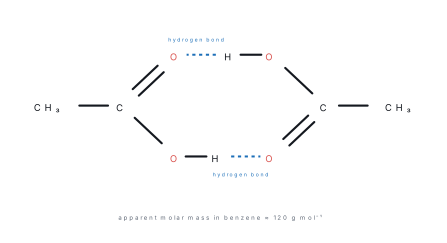
Carboxylic acids boil higher than alcohols of similar molar mass because they form two hydrogen bonds between each pair of molecules, giving a cyclic dimer:
| Compound | M (g mol⁻¹) | Boiling point |
|---|---|---|
| Propane | 44 | −42 °C |
| Ethanal | 44 | 21 °C |
| Propan-1-ol | 60 | 97 °C |
| Ethanoic acid | 60 | 118 °C |
Solubility in water falls steeply as the chain grows: methanoic to butanoic acid are miscible, pentanoic is partly soluble, and the higher ones are insoluble but dissolve in ethanol and ether. Aromatic acids are only slightly soluble in cold water — benzoic acid crystallises out on cooling, which is how it is purified.
14.5 Chemical properties
Acidic reactions
A carboxylic acid is a weak acid: K_a of ethanoic acid is 1.75\times10^{-5}, so only about 1.3 % of the molecules are ionised in a 0.1 M solution. It is nevertheless a far stronger acid than an alcohol or a phenol, and it neutralises all four of the following:
CH₃COOH + NaOH → CH₃COONa + H₂O (with an alkali)
2CH₃COOH + CaO → (CH₃COO)₂Ca + H₂O (with a metal oxide)
2CH₃COOH + Na₂CO₃ → 2CH₃COONa + H₂O + CO₂↑ (with a carbonate)
CH₃COOH + NaHCO₃ → CH₃COONa + H₂O + CO₂↑ (with a bicarbonate)
2CH₃COOH + 2Na → 2CH₃COONa + H₂↑ (with an active metal)
Brisk effervescence of CO₂ with cold NaHCO₃ solution is the standard test for a carboxylic acid. Phenol, which is also acidic, gives no effervescence because it is too weak to displace carbonic acid. This single test separates an acid from a phenol in every NEB "distinguish between" question.
Substitution of the —OH group
With PCl₃, PCl₅ or SOCl₂ the hydroxyl group is replaced by chlorine, giving an acid chloride:
3CH₃COOH + PCl₃ → 3CH₃COCl + H₃PO₃
CH₃COOH + PCl₅ → CH₃COCl + POCl₃ + HCl
CH₃COOH + SOCl₂ → CH₃COCl + SO₂↑ + HCl↑
Thionyl chloride is preferred because both by-products are gases and escape, leaving pure acid chloride.
With an alcohol (esterification), conc. H₂SO₄ as catalyst and dehydrating agent:
CH₃COOH + C₂H₅OH ⇌ CH₃COOC₂H₅ + H₂O
Reduction with LiAlH₄
Lithium aluminium hydride in dry ether reduces the carboxyl group all the way to a primary alcohol:
CH₃COOH + 4[H] --LiAlH₄, then H₂O--> CH₃CH₂OH + H₂O
Sodium borohydride reduces aldehydes and ketones but is too mild to reduce a carboxylic acid. Neither does H₂/Ni. Only LiAlH₄ (or diborane, B₂H₆) works. If a question offers NaBH₄ on RCOOH, the answer is "no reaction".
Dehydration
Heating with P₂O₅ removes water from two molecules to give the anhydride:
2CH₃COOH --P₂O₅, Δ--> (CH₃CO)₂O + H₂O
Decarboxylation
The dry sodium salt heated with soda-lime loses CO₂ as carbonate:
CH₃COONa + NaOH --CaO, Δ--> CH₄↑ + Na₂CO₃
This shortens the chain by one carbon and is the standard laboratory preparation of methane.
14.6 Hell–Volhard–Zelinsky (HVZ) reaction
An aliphatic acid with at least one α-hydrogen is halogenated at the α carbon by chlorine or bromine in the presence of a small amount of red phosphorus:
CH₃COOH + Cl₂ --red P--> ClCH₂COOH + HCl
ClCH₂COOH + Cl₂ --red P--> Cl₂CHCOOH + HCl
Cl₂CHCOOH + Cl₂ --red P--> Cl₃CCOOH + HCl
The phosphorus is not a catalyst in the ordinary sense: it reacts with the halogen to form PCl₃, which converts a little of the acid into its acid chloride. The acid chloride enolises far more readily than the acid does, and it is the enol that the halogen attacks. The α-halo acid produced then exchanges with more of the starting acid.
The α-halo acids are valuable intermediates: with aqueous KOH they give α-hydroxy acids, with alcoholic KOH unsaturated acids, and with NH₃ they give α-amino acids — this is a standard preparation of glycine from ethanoic acid.
Methanoic acid, HCOOH, has no α-carbon at all, and benzoic acid has no α-H either. Neither undergoes the HVZ reaction. Benzoic acid halogenates on the ring instead (Section 14.7).
14.7 Electrophilic substitution of benzoic acid
The —COOH group is strongly electron-withdrawing (−I and −R). It therefore deactivates the ring towards electrophilic attack and directs the incoming group to the meta position, because the ortho and para positions carry a partial positive charge in the resonance structures.
| Reaction | Reagent and conditions | Product |
|---|---|---|
| Bromination | Br₂ / FeBr₃, warm | 3-bromobenzoic acid + HBr |
| Nitration | conc. HNO₃ + conc. H₂SO₄, 373 K | 3-nitrobenzoic acid + H₂O |
| Sulphonation | fuming H₂SO₄ (oleum), Δ | 3-sulphobenzoic acid + H₂O |
C₆H₅COOH + Br₂ --FeBr₃--> m-BrC₆H₄COOH + HBr
C₆H₅COOH + HNO₃ --conc. H₂SO₄, 373 K--> m-O₂NC₆H₄COOH + H₂O
C₆H₅COOH + H₂SO₄ (fuming) → m-HO₃SC₆H₄COOH + H₂O
All three need harsher conditions than benzene itself — higher temperature, stronger catalyst — which is exactly what "deactivated ring" means. Benzoic acid does not undergo Friedel–Crafts alkylation or acylation at all, because the AlCl₃ complexes with the carboxyl group and the ring is too deactivated.
14.8 Effect of substituents on acid strength; methanoic acid
Why a carboxylic acid is acidic at all
Removing the proton gives the carboxylate ion, RCOO⁻, in which the negative charge is shared equally between the two oxygen atoms. Both carbon–oxygen bonds in ethanoate are the same length, 127 pm — between a C=O (122 pm) and a C—O (143 pm). This delocalisation lowers the energy of the anion a great deal, so the ionisation equilibrium lies much further to the right than it does for an alcohol, whose anion RO⁻ has the charge stuck on one atom.
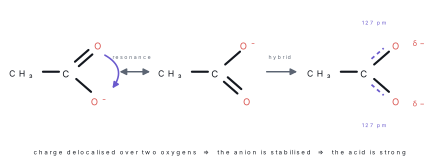
The same argument, applied three times, gives the order that NEB asks for every year:
RCOOH > H₂CO₃ > C₆H₅OH > H₂O > ROH
Ethanoic acid (pK_a 4.76) beats phenol (pK_a 10.0) because in phenoxide the charge is spread over carbon atoms, which are less electronegative than oxygen, and only two of the contributing structures carry it. Ethanol (pK_a 16) has no delocalisation at all.
Effect of substituents
An electron-withdrawing group (−I) pulls charge away from the carboxylate ion, spreads it further and stabilises it, so the acid is stronger. An electron-releasing group (+I) pushes charge onto the ion, destabilises it, and makes the acid weaker. The effect dies away rapidly with distance — it is roughly one-third as strong at each successive carbon.
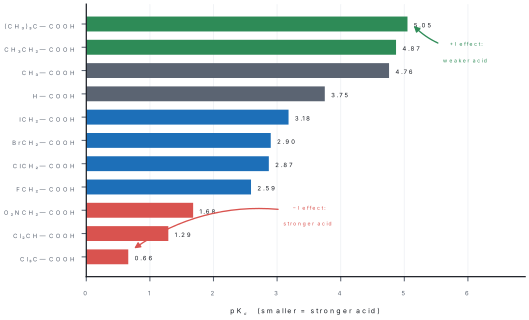
Read off the trends:
- Number of substituents: CH₃COOH 4.76 → ClCH₂COOH 2.87 → Cl₂CHCOOH 1.29 → Cl₃CCOOH 0.66. Trichloroethanoic acid is about 12 000 times stronger than ethanoic acid.
- Electronegativity of the halogen: F > Cl > Br > I (2.59 < 2.87 < 2.90 < 3.18), exactly the order of −I strength.
- Distance: 2-chlorobutanoic acid (pK_a 2.86) is far stronger than 4-chlorobutanoic acid (pK_a 4.52), which is barely stronger than butanoic acid itself (4.82).
- Alkyl groups weaken: HCOOH 3.75 < CH₃COOH 4.76 < CH₃CH₂COOH 4.87 < (CH₃)₃CCOOH 5.05.
For aromatic acids, benzoic acid (pK_a 4.20) is stronger than ethanoic acid because the sp² ring carbon is more electronegative than an sp³ alkyl carbon. Electron-withdrawing ring substituents (—NO₂, —Cl) strengthen it further, and electron-releasing ones (—CH₃, —OCH₃) weaken it.
Abnormal behaviour of methanoic acid
Methanoic acid, H—COOH, is the only carboxylic acid whose carboxyl group is attached to hydrogen and not to carbon. It therefore contains a complete aldehydic (—CHO) grouping, and behaves partly as an aldehyde:
- It is the strongest of the simple aliphatic acids (pK_a 3.75) because there is no alkyl group to push electrons in.
- It is a reducing agent. It gives a silver mirror with Tollens' reagent and a red precipitate with Fehling's solution, which no other carboxylic acid does:
HCOOH + 2[Ag(NH₃)₂]⁺ + 2OH⁻ → 2Ag↓ + CO₂↑ + 4NH₃ + 2H₂O
HCOOH + 2CuO → Cu₂O↓ + CO₂↑ + H₂O
- It decolourises acidified KMnO₄ and reduces mercury(II) chloride to mercury(I) chloride.
- It cannot form an anhydride. With concentrated sulphuric acid it simply dehydrates to carbon monoxide: HCOOH --conc. H₂SO₄, Δ--> CO↑ + H₂O. This is the laboratory preparation of CO.
- It has no α-hydrogen, so it gives no HVZ reaction.
- Heating its sodium salt gives sodium oxalate and hydrogen, not a ketone.
14.9 The four derivatives and their preparation from the acid
Replacing the —OH of —COOH by —Cl, —OCOR, —OR′ or —NH₂ gives the four derivatives. All of them can be hydrolysed back to the parent acid, which is why they are called derivatives of it.
| Derivative | General formula | Example | Preparation from CH₃COOH |
|---|---|---|---|
| Acid chloride | RCOCl | ethanoyl chloride, CH₃COCl | CH₃COOH + SOCl₂ → CH₃COCl + SO₂ + HCl |
| Anhydride | (RCO)₂O | ethanoic anhydride, (CH₃CO)₂O | 2CH₃COOH --P₂O₅, Δ--> (CH₃CO)₂O + H₂O |
| Ester | RCOOR′ | ethyl ethanoate, CH₃COOC₂H₅ | CH₃COOH + C₂H₅OH ⇌ CH₃COOC₂H₅ + H₂O (conc. H₂SO₄) |
| Amide | RCONH₂ | ethanamide, CH₃CONH₂ | CH₃COOH + NH₃ → CH₃COONH₄ --Δ--> CH₃CONH₂ + H₂O |
The anhydride can also be made more cleanly from the acid chloride and the sodium salt:
CH₃COCl + CH₃COONa → (CH₃CO)₂O + NaCl
Drop -ic acid and add: -yl chloride (ethanoyl chloride), -ic anhydride (ethanoic anhydride), -amide (ethanamide). For an ester, name the alkyl group of the alcohol first, then the acid part as -oate: C₂H₅ + CH₃COO— = ethyl ethanoate.
14.10 Comparative physical and chemical properties
Physical properties
| Property | CH₃COCl | (CH₃CO)₂O | CH₃COOC₂H₅ | CH₃CONH₂ |
|---|---|---|---|---|
| M (g mol⁻¹) | 78.5 | 102 | 88 | 59 |
| State at 25 °C | liquid | liquid | liquid | white solid |
| Boiling point | 51 °C | 140 °C | 77 °C | 221 °C (m.p. 82 °C) |
| Smell | sharp, irritating | sharp | pleasant, fruity | almost none |
| Action of water | fumes and hydrolyses at once | slow at 25 °C, fast on warming | very slow without a catalyst | needs boiling acid or alkali |
Amides are much the highest boiling because the —NH₂ group forms intermolecular hydrogen bonds; the other three have no N—H or O—H at all and rely on dipole–dipole attraction.
The common mechanism: nucleophilic acyl substitution
All four derivatives react with nucleophiles by the same two-step path — addition then elimination. This is why the C=O of a derivative gives substitution while the C=O of an aldehyde gives addition: the aldehyde has no group that can leave as an anion.
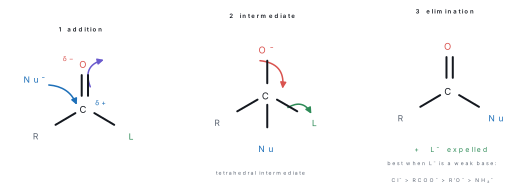
Hydrolysis
| Derivative | Reagent | Equation |
|---|---|---|
| Acid chloride | cold water, violent | CH₃COCl + H₂O → CH₃COOH + HCl |
| Anhydride | warm water | (CH₃CO)₂O + H₂O → 2CH₃COOH |
| Ester | dilute acid (reversible) | CH₃COOC₂H₅ + H₂O ⇌ CH₃COOH + C₂H₅OH |
| Ester | alkali (irreversible) | CH₃COOC₂H₅ + NaOH → CH₃COONa + C₂H₅OH |
| Amide | boiling dilute acid | CH₃CONH₂ + H₂O + HCl → CH₃COOH + NH₄Cl |
| Amide | boiling alkali | CH₃CONH₂ + NaOH → CH₃COONa + NH₃↑ |
Alkaline hydrolysis of an ester is called saponification — it is the reaction that makes soap from a triglyceride.
Ammonolysis and reaction with amines
CH₃COCl + 2NH₃ → CH₃CONH₂ + NH₄Cl
(CH₃CO)₂O + 2NH₃ → CH₃CONH₂ + CH₃COONH₄
CH₃COOC₂H₅ + NH₃ → CH₃CONH₂ + C₂H₅OH
With a primary amine the product is an N-substituted amide:
CH₃COCl + C₂H₅NH₂ → CH₃CONHC₂H₅ + HCl
C₆H₅NH₂ + (CH₃CO)₂O → C₆H₅NHCOCH₃ + CH₃COOH (acetanilide)
Acylation of an amine or a phenol with an acid chloride in the presence of aqueous NaOH is the Schotten–Baumann reaction; the alkali mops up the HCl.
Alcoholysis
CH₃COCl + C₂H₅OH → CH₃COOC₂H₅ + HCl
(CH₃CO)₂O + C₂H₅OH → CH₃COOC₂H₅ + CH₃COOH
Both give esters in one step and, unlike direct esterification, neither is an equilibrium — which is why acid chlorides are used when a high yield matters.
Reduction
| Derivative | Reagent | Product |
|---|---|---|
| CH₃COCl | LiAlH₄ (4[H]) | CH₃CH₂OH + HCl |
| CH₃COCl | H₂, Pd/BaSO₄ poisoned (Rosenmund) | CH₃CHO + HCl |
| (CH₃CO)₂O | LiAlH₄ (8[H]) | 2CH₃CH₂OH + H₂O |
| CH₃COOC₂H₅ | LiAlH₄ (4[H]) | CH₃CH₂OH + C₂H₅OH |
| CH₃CONH₂ | LiAlH₄ (4[H]) | CH₃CH₂NH₂ + H₂O |
Note the odd one out: an amide is reduced to an amine, not to an alcohol, because nitrogen is a much poorer leaving group than oxygen.
14.11 Claisen condensation, Hofmann bromamide, amides and reactivity
Claisen condensation
An ester with an α-hydrogen, treated with its own sodium alkoxide, condenses with a second molecule of ester to give a β-keto ester:
2CH₃COOC₂H₅ --C₂H₅ONa, then H⁺--> CH₃COCH₂COOC₂H₅ + C₂H₅OH
The product, ethyl 3-oxobutanoate (ethyl acetoacetate), is a key synthetic intermediate. The mechanism parallels the aldol condensation of Unit 13 — the alkoxide removes an α-hydrogen to give an ester enolate, which attacks the carbonyl carbon of the second ester — but here the tetrahedral intermediate expels ethoxide, so the result is substitution, not addition. Esters with no α-hydrogen, such as ethyl benzoate, cannot undergo it.
Hofmann bromamide reaction
An amide treated with bromine in excess alkali loses its carbonyl carbon as carbonate and gives a primary amine with one carbon fewer:
CH₃CONH₂ + Br₂ + 4NaOH → CH₃NH₂ + Na₂CO₃ + 2NaBr + 2H₂O
C₆H₅CONH₂ + Br₂ + 4NaOH → C₆H₅NH₂ + Na₂CO₃ + 2NaBr + 2H₂O
Check the first: C 1 + 1 = 2 ✓, H 5 + 4 = 5 + 4 ✓, N 1 ✓, O 1 + 4 = 3 + 2 ✓, Na 4 = 2 + 2 ✓, Br 2 ✓. It is a descending reaction, the counterpart of the ascending nitrile route of Section 14.2.
Amphoteric nature of amides
An amide is almost neutral to litmus, yet it reacts with both acids and bases:
As a base — the nitrogen lone pair accepts a proton from a strong acid:
CH₃CONH₂ + HCl → CH₃CONH₂·HCl
As an acid — the N—H hydrogen can be removed by sodium or mercury(II) oxide:
2CH₃CONH₂ + 2Na → 2CH₃CONHNa + H₂↑
2CH₃CONH₂ + HgO → (CH₃CONH)₂Hg + H₂O
The reason for both is the same delocalisation: the nitrogen lone pair is pulled into the carbonyl group, which makes the nitrogen a much weaker base than an amine, and at the same time makes the N—H bond polar enough to be attacked by a strong base.
Relative reactivity of the derivatives
RCOCl > (RCO)₂O > RCOOR′ > RCOOH > RCONH₂
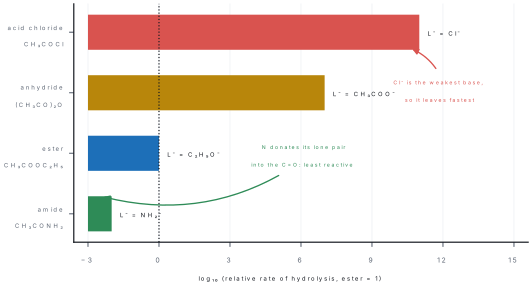
Two effects explain the order, and they reinforce each other:
- Leaving-group ability. Cl⁻ is the conjugate base of a strong acid and so a very weak base — it leaves easily. NH₂⁻ is the conjugate base of ammonia, a very strong base — it will not leave.
- Resonance donation into the carbonyl group. The lone pair on the attached atom feeds into the C=O and reduces the δ+ charge. Nitrogen (2p–2p overlap, low electronegativity) donates best, oxygen less, chlorine (3p–2p, poor overlap, high electronegativity) hardly at all.
This order also means a more reactive derivative can be converted into a less reactive one, but not the reverse: an acid chloride gives an anhydride, an ester or an amide directly, but an amide cannot be turned into an acid chloride in one step.
| Reaction | Reagent and conditions | Substrate needs | Product |
|---|---|---|---|
| Hell–Volhard–Zelinsky | Cl₂ or Br₂ with red P | acid with α-H | α-halo acid |
| Claisen condensation | RONa (same alkyl as the ester) | ester with α-H | β-keto ester |
| Hofmann bromamide | Br₂ + 4NaOH | amide | 1° amine, one C fewer |
| Schotten–Baumann | RCOCl + aq. NaOH | amine or phenol | amide or ester |
Problem. 6.00 g of ethanoic acid is added to excess sodium hydrogencarbonate solution. What volume of carbon dioxide, measured at STP, is evolved? (C = 12, H = 1, O = 16; molar volume at STP = 22.4 dm³ mol⁻¹.)
Solution. M(CH₃COOH) = 2(12) + 4(1) + 2(16) = 60 g mol⁻¹.
From CH₃COOH + NaHCO₃ → CH₃COONa + H₂O + CO₂ the ratio is 1 : 1, so n(\text{CO}_2) = 0.100 mol.
Answer: 2.24 dm³ (2240 cm³) of CO₂ at STP.
Problem. 0.150 g of a pure monocarboxylic acid needs exactly 25.0 cm³ of 0.100 M sodium hydroxide for complete neutralisation. Find its molar mass and name the acid.
Solution. Moles of NaOH used:
A monocarboxylic acid is monobasic, so RCOOH + NaOH → RCOONa + H₂O reacts 1 : 1 and n(\text{acid}) = 2.50\times10^{-3} mol.
CₙH₂ₙO₂ with M = 60 gives 14n + 32 = 60, so n = 2. The acid is ethanoic acid, CH₃COOH.
Problem. 12.0 g of ethanoic acid is refluxed with excess ethanol and a little concentrated sulphuric acid. 12.3 g of ethyl ethanoate is obtained. Calculate the percentage yield.
Solution. n(\text{CH}_3\text{COOH}) = 12.0/60 = 0.200 mol. The acid is the limiting reagent because the alcohol is in excess, and
CH₃COOH + C₂H₅OH ⇌ CH₃COOC₂H₅ + H₂O
is 1 : 1, so the theoretical yield is 0.200 mol of ester. M(CH₃COOC₂H₅) = 4(12) + 8(1) + 2(16) = 88 g mol⁻¹.
Answer: about 70 %. The yield is limited because esterification is an equilibrium; removing the ester by distillation as it forms pushes it higher.
Problem. At 298 K, K_a(CH₃COOH) = 1.75\times10^{-5} and K_a(ClCH₂COOH) = 1.36\times10^{-3}. Calculate both pK_a values, state how many times stronger chloroethanoic acid is, and explain the difference.
Solution.
For ethanoic acid: pK_a = -\log(1.75\times10^{-5}) = 5 - 0.243 = 4.76.
For chloroethanoic acid: pK_a = -\log(1.36\times10^{-3}) = 3 - 0.134 = 2.87.
So chloroethanoic acid is about 78 times stronger.
Reason. Chlorine is strongly electronegative and exerts a −I effect. It withdraws electron density along the C—C bond, spreading the negative charge of ClCH₂COO⁻ over a larger volume and stabilising it. The more stable the anion, the further the ionisation equilibrium lies to the right, so the acid is stronger. In CH₃COO⁻ the methyl group does the opposite (+I).
Problem. A compound P, C₃H₆O₂, gives brisk effervescence with NaHCO₃. With SOCl₂ it gives Q, and Q with excess ammonia gives R, C₃H₇NO. R with bromine and excess NaOH gives S, a basic compound of formula C₂H₇N. Identify P, Q, R and S and write the equations.
Solution. Effervescence with NaHCO₃ proves a —COOH group, and C₃H₆O₂ with one —COOH is propanoic acid, CH₃CH₂COOH = P.
CH₃CH₂COOH + SOCl₂ → CH₃CH₂COCl + SO₂ + HCl, so Q = propanoyl chloride.
CH₃CH₂COCl + 2NH₃ → CH₃CH₂CONH₂ + NH₄Cl. Ethanamide would be C₂H₅NO; here C₃H₇NO fits propanamide, CH₃CH₂CONH₂ = R ✓.
The last step is the Hofmann bromamide reaction, which removes one carbon:
CH₃CH₂CONH₂ + Br₂ + 4NaOH → CH₃CH₂NH₂ + Na₂CO₃ + 2NaBr + 2H₂O
so S = ethylamine, C₂H₅NH₂ = C₂H₇N ✓, which is basic as required.
Chapter summary
- Carboxylic acids are R—COOH, CₙH₂ₙO₂; the carboxyl carbon is always C-1. They are functional isomers of esters (C₃H₆O₂ = propanoic acid, methyl ethanoate, ethyl methanoate).
- Preparations: oxidation of a 1° alcohol or aldehyde, hydrolysis of a nitrile (+1 C), decarboxylation of a diacid (−1 C), carbonylation of a sodium alkoxide, hydrolysis of a trihaloalkane; benzoic acid from any alkylbenzene with a benzylic H by hot alkaline KMnO₄.
- They form hydrogen-bonded dimers, so they boil above alcohols of the same molar mass (ethanoic acid 118 °C against propan-1-ol 97 °C).
- Acidity: RCOOH > H₂CO₃ > C₆H₅OH > H₂O > ROH, because RCOO⁻ is resonance stabilised with both C—O bonds 127 pm. Effervescence with NaHCO₃ distinguishes an acid from a phenol.
- −I substituents strengthen the acid (pK_a: CH₃COOH 4.76, ClCH₂COOH 2.87, Cl₂CHCOOH 1.29, Cl₃CCOOH 0.66); +I groups weaken it; the effect falls off sharply with distance.
- Methanoic acid is abnormal: strongest simple acid, reduces Tollens' and Fehling's, gives CO with conc. H₂SO₄, gives no anhydride and no HVZ reaction.
- HVZ (Cl₂/red P) halogenates the α-carbon; —COOH is meta-directing and deactivating on a benzene ring.
- Derivatives RCOCl, (RCO)₂O, RCOOR′, RCONH₂ all react by nucleophilic acyl substitution (addition then elimination) and all hydrolyse back to the acid. Reactivity RCOCl > (RCO)₂O > RCOOR′ > RCOOH > RCONH₂.
- Named reactions: Claisen (2 esters → β-keto ester), Hofmann bromamide (amide → 1° amine, one C fewer), Schotten–Baumann (acylation in aq. NaOH). Amides are amphoteric and are reduced by LiAlH₄ to amines.
Practice questions
Group A — Multiple choice (1 mark each)
- Which reagent distinguishes ethanoic acid from phenol? [1]aNaOHbNaHCO₃cNa metaldneutral FeCl₃
- The strongest acid among the following is [1]aCH₃COOHbClCH₂COOHcCl₂CHCOOHdCl₃CCOOH
- Which carboxylic acid gives a silver mirror with Tollens' reagent? [1]aCH₃COOHbHCOOHcC₆H₅COOHdCH₃CH₂COOH
- Reduction of ethanamide with LiAlH₄ gives [1]aethanolbethanalcethylaminedethanoic acid
- The correct order of reactivity towards hydrolysis is [1]aRCONH₂ > RCOOR′ > (RCO)₂O > RCOClbRCOCl > (RCO)₂O > RCOOR′ > RCONH₂cRCOOR′ > RCOCl > RCONH₂ > (RCO)₂Od(RCO)₂O > RCOCl > RCONH₂ > RCOOR′
- In the Hofmann bromamide reaction, the amine formed contains [1]athe same number of carbons as the amidebone carbon morecone carbon lessdtwo carbons less
Answers to Group A
1. (b) — only the acid is strong enough to liberate CO₂ from NaHCO₃; phenol is not.
2. (d) — three chlorine atoms give the largest total −I effect, pK_a 0.66.
3. (b) — methanoic acid contains a —CHO grouping and so acts as a reducing agent.
4. (c) — an amide is reduced to an amine, since N is a poor leaving group.
5. (b) — Cl⁻ is the weakest base and therefore the best leaving group.
6. (c) — the carbonyl carbon is lost as Na₂CO₃.
Group B — Short answer (5 marks each)
- Explain, with resonance structures, why a carboxylic acid is more acidic than both phenol and ethanol. [5]
- Arrange the following in increasing order of acid strength and justify: CH₃COOH, HCOOH, ClCH₂COOH, (CH₃)₃CCOOH, Cl₃CCOOH. [5]
- What is the Hell–Volhard–Zelinsky reaction? Write the equations for the conversion of ethanoic acid into chloroethanoic acid and then into glycine, and state why methanoic acid does not undergo it. [5]
- 3.00 g of ethanoic acid is treated with excess sodium carbonate solution. Calculate the volume of CO₂ evolved at STP and the mass of sodium ethanoate formed. [5]
- Write the reactions of ethanoyl chloride with(a) water,(b) ethanol,(c) ammonia,(d) aniline and(e) H₂ over poisoned Pd, naming each product. [5]
- Describe the abnormal behaviour of methanoic acid under four headings with equations. [5]
Answers to Group B
2. (CH₃)₃CCOOH (5.05) < CH₃COOH (4.76) < HCOOH (3.75) < ClCH₂COOH (2.87) < Cl₃CCOOH (0.66) in order of increasing strength. Alkyl groups are +I and destabilise the anion; H has no inductive effect; chlorine is −I and stabilises it, and three chlorines do so three times over.
3. CH₃COOH + Cl₂ --red P--> ClCH₂COOH + HCl; then ClCH₂COOH + 2NH₃ → H₂NCH₂COOH + NH₄Cl (glycine). Methanoic acid has no α-carbon, so there is no α-hydrogen to replace.
4. n(CH₃COOH) = 3.00/60 = 0.0500 mol. From 2CH₃COOH + Na₂CO₃ → 2CH₃COONa + H₂O + CO₂, the acid : CO₂ ratio is 2 : 1, so n(CO₂) = 0.0250 mol and V = 0.0250 × 22.4 = 0.560 dm³. The acid : salt ratio is 1 : 1, so n(CH₃COONa) = 0.0500 mol; M(CH₃COONa) = 82 g mol⁻¹, giving m = 0.0500 × 82 = 4.10 g.
5. (a) CH₃COCl + H₂O → CH₃COOH + HCl (ethanoic acid). (b) CH₃COCl + C₂H₅OH → CH₃COOC₂H₅ + HCl (ethyl ethanoate). (c) CH₃COCl + 2NH₃ → CH₃CONH₂ + NH₄Cl (ethanamide). (d) CH₃COCl + C₆H₅NH₂ → C₆H₅NHCOCH₃ + HCl (acetanilide). (e) CH₃COCl + H₂ --Pd/BaSO₄, S--> CH₃CHO + HCl (ethanal, Rosenmund reduction).
Group C — Long answer (8 marks each)
- (a) Define a carboxylic acid and explain its acidic character using the resonance of the carboxylate ion. [3](b) Discuss the effect of electron-withdrawing and electron-releasing substituents on acid strength, using pK_a data. [3](c) Why is benzoic acid a stronger acid than ethanoic acid? [2]
- (a) Name the four derivatives of ethanoic acid and give one equation for the preparation of each from ethanoic acid. [4](b) Compare their reactivity towards hydrolysis, explain the order, and write the equation for the alkaline hydrolysis of ethyl ethanoate and of ethanamide. [4]
- An organic compound A of formula C₇H₈ is oxidised by hot alkaline KMnO₄ and then acidified to give B, C₇H₆O₂, which dissolves in NaHCO₃ with effervescence. B with SOCl₂ gives C; C with ammonia gives D, C₇H₇NO; D with Br₂ and excess NaOH gives E, C₆H₇N, which gives an orange dye when coupled after diazotisation. Identify A to E and write all the equations. [8]
Answers to Group C
1. (c) The carbon of the benzene ring is sp² hybridised and therefore more electronegative than the sp³ carbon of a methyl group. It withdraws electron density from the carboxyl group (−I) instead of releasing it, so benzoate is better stabilised than ethanoate: pK_a 4.20 against 4.76.
2. (b) RCOCl > (RCO)₂O > RCOOR′ > RCONH₂, because the weaker the base L⁻ the faster it leaves, and the less the atom L donates its lone pair into the C=O. CH₃COOC₂H₅ + NaOH → CH₃COONa + C₂H₅OH (saponification); CH₃CONH₂ + NaOH → CH₃COONa + NH₃.
3. C₇H₈ with a benzene ring and a side chain is toluene, C₆H₅CH₃ = A.
C₆H₅CH₃ + 2KMnO₄ → C₆H₅COOK + 2MnO₂ + KOH + H₂O; then C₆H₅COOK + HCl → C₆H₅COOH + KCl, so B = benzoic acid, C₇H₆O₂ ✓ (it effervesces with NaHCO₃, confirming —COOH).
C₆H₅COOH + SOCl₂ → C₆H₅COCl + SO₂ + HCl, so C = benzoyl chloride.
C₆H₅COCl + 2NH₃ → C₆H₅CONH₂ + NH₄Cl, so D = benzamide, C₇H₇NO ✓.
C₆H₅CONH₂ + Br₂ + 4NaOH → C₆H₅NH₂ + Na₂CO₃ + 2NaBr + 2H₂O, so E = aniline, C₆H₇N ✓ — and aniline is diazotised and coupled to give azo dyes, as required.
Practise more: Chemistry question bank