Unit 13 · Organic Chemistry · 10 teaching hours · 28 min read
Aldehydes and Ketones
What the syllabus asks for 12
- Aliphatic aldehydes and ketones: introduction, nomenclature, isomerism
- Preparation: dehydrogenation and oxidation of alcohol, ozonolysis of alkenes, acid chloride, gem dihaloalkane, catalytic hydration of alkynes
- Physical properties; structure and nature of carbonyl group
- Distinction by 2,4-DNP, Tollen's reagent, Fehling's solution
- Addition of H2, HCN, NaHSO3
- Action with ammonia derivatives: NH2OH, NH2-NH2, phenyl hydrazine, semicarbazide
- Aldol condensation; Cannizzaro's reaction
- Clemmensen's reduction; Wolf-Kishner reduction
- Action with PCl5 and LiAlH4; action of methanal with ammonia and phenol
- Formalin and its uses
- Aromatic: preparation of benzaldehyde from toluene and acetophenone from benzene
- Properties of benzaldehyde: Perkin condensation, Benzoin condensation, Cannizzaro's reaction, electrophilic substitution
Aldehydes and ketones both contain the carbonyl group, >C=O. In an aldehyde the carbonyl carbon carries at least one hydrogen; in a ketone it carries two carbon groups. That single difference in substitution controls everything in this unit — which reagent oxidises which, which compound gives a silver mirror, and which one condenses with itself. At ten hours this is the longest organic unit in the course and the most heavily examined.
Four things come back every year: (1) distinguish an aldehyde from a ketone and one aldehyde from another, with reagent, observation and equation; (2) the nucleophilic addition mechanism and the reactivity order HCHO > RCHO > RCOR′; (3) the named reactions — aldol, Cannizzaro, Clemmensen, Wolff–Kishner, Perkin, benzoin — with reagent, condition and product; (4) conversions, i.e. "how would you convert ethanal into butan-1-ol".
13.1 Aliphatic aldehydes and ketones: introduction, nomenclature, isomerism
Both families have the general formula CₙH₂ₙO for the saturated open-chain case. An aldehyde is R—CHO (the carbonyl carbon is bonded to H); a ketone is R—CO—R′. The group —CHO is called the formyl or aldehydic group; —CO— is the keto group. Ketones are simple (symmetrical) when R = R′ and mixed (unsymmetrical) when R ≠ R′.
An aldehyde is a compound in which a carbonyl group is attached to one hydrogen atom and one alkyl or aryl group (or to two hydrogen atoms, as in methanal). A ketone is a compound in which the carbonyl group is attached to two alkyl or aryl groups.
IUPAC rules. For aldehydes, replace the -e of the parent alkane by -al; the —CHO carbon is always C-1 and needs no locant. For ketones, replace -e by -one and number the chain to give the carbonyl carbon the lowest possible number. When —CHO is attached to a ring, the suffix is -carbaldehyde.
| Formula | IUPAC name | Common name | Derived name |
|---|---|---|---|
| HCHO | methanal | formaldehyde | — |
| CH₃CHO | ethanal | acetaldehyde | — |
| CH₃CH₂CHO | propanal | propionaldehyde | — |
| (CH₃)₂CHCHO | 2-methylpropanal | isobutyraldehyde | — |
| CH₃COCH₃ | propanone | acetone | dimethyl ketone |
| CH₃COCH₂CH₃ | butanone | methyl ethyl ketone | ethyl methyl ketone |
| CH₃COCH₂CH₂CH₃ | pentan-2-one | — | methyl propyl ketone |
| CH₃CH₂COCH₂CH₃ | pentan-3-one | — | diethyl ketone |
| C₆H₅CHO | benzenecarbaldehyde | benzaldehyde | — |
| C₆H₅COCH₃ | 1-phenylethanone | acetophenone | methyl phenyl ketone |
Isomerism. Carbonyl compounds show four kinds:
- Chain isomerism — pentanal, 2-methylbutanal, 3-methylbutanal and 2,2-dimethylpropanal are all C₅H₁₀O aldehydes differing only in the skeleton.
- Position isomerism — in ketones the carbonyl group can sit at different positions: pentan-2-one and pentan-3-one.
- Metamerism — the same carbonyl group flanked by different pairs of alkyl groups: pentan-2-one (methyl propyl ketone) and pentan-3-one (diethyl ketone).
- Functional isomerism — an aldehyde and a ketone of the same formula are functional isomers (propanal and propanone, C₃H₆O). Alkenols and cyclic ethers of the same formula are also functional isomers.
C₄H₈O has exactly three carbonyl isomers: butanal, 2-methylpropanal and butanone. Learning to count these quickly is worth a Group A mark.
Carbonyl compounds with an α-hydrogen also show tautomerism, a dynamic equilibrium between the keto and the enol form:
CH₃CHO ⇌ CH₂=CH—OH (keto ⇌ enol; for ethanal the enol is under 0.01 %)
13.2 Preparation
Dehydrogenation and oxidation of alcohols
A primary alcohol gives an aldehyde, a secondary alcohol gives a ketone, and a tertiary alcohol gives neither. Catalytic dehydrogenation passes the alcohol vapour over hot copper:
CH₃CH₂OH --Cu, 573 K--> CH₃CHO + H₂
(CH₃)₂CHOH --Cu, 573 K--> CH₃COCH₃ + H₂
Oxidation uses acidified potassium dichromate, acidified KMnO₄, or — better for aldehydes — a mild reagent that stops at the aldehyde:
3CH₃CH₂OH + K₂Cr₂O₇ + 4H₂SO₄ → 3CH₃CHO + K₂SO₄ + Cr₂(SO₄)₃ + 7H₂O
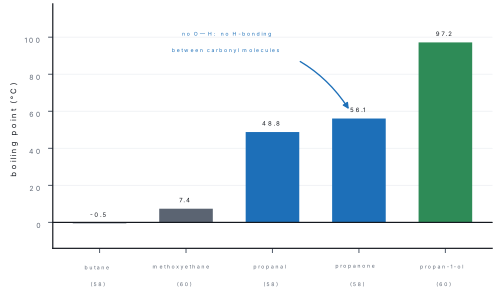
Ethanal (b.p. 21 °C) boils far below ethanol (78 °C), so it is distilled out as it forms. If it stays in the flask the dichromate oxidises it further to ethanoic acid. In the laboratory the controlled reagents are PCC (pyridinium chlorochromate) in dichloromethane, or Cu at 573 K.
Ozonolysis of alkenes
Ozone adds across the double bond to give an ozonide, which is cleaved by zinc dust and water. The zinc destroys the hydrogen peroxide formed, so the aldehyde is not oxidised further (reductive ozonolysis):
CH₃CH=CHCH₃ --O₃--> ozonide --Zn / H₂O--> 2CH₃CHO
(CH₃)₂C=CHCH₃ --O₃, then Zn / H₂O--> CH₃COCH₃ + CH₃CHO
Each doubly bonded carbon keeps its own substituents, so ozonolysis run backwards locates a double bond — a standard structure-determination question.
From acid chlorides: Rosenmund reduction
Hydrogen over palladium supported on barium sulphate, poisoned with sulphur or quinoline, reduces an acid chloride only as far as the aldehyde:
CH₃COCl + H₂ --Pd / BaSO₄, S poison--> CH₃CHO + HCl
Without the poison the catalyst is too active and the product is the alcohol. Ketones are made from acid chlorides with dialkyl cadmium or a Grignard reagent at low temperature.
From gem-dihaloalkanes
Two halogens on the same carbon hydrolyse to an unstable gem-diol, which loses water:
CH₃CHCl₂ + 2NaOH(aq) → CH₃CHO + 2NaCl + H₂O
CH₃CCl₂CH₃ + 2NaOH(aq) → CH₃COCH₃ + 2NaCl + H₂O
A 1,1-dihalide gives a carbonyl compound; a 1,2-dihalide would give a diol.
Catalytic hydration of alkynes
Water adds across the triple bond in dilute sulphuric acid with mercury(II) sulphate as catalyst (Markovnikov addition). The enol formed tautomerises:
C₂H₂ + H₂O --HgSO₄ / dil. H₂SO₄, 333 K--> CH₂=CHOH → CH₃CHO
CH₃C≡CH + H₂O --HgSO₄ / dil. H₂SO₄--> CH₃COCH₃
Ethyne is the only alkyne that gives an aldehyde; every higher alkyne gives a ketone.
13.3 Physical properties; structure and nature of the carbonyl group
Methanal is a gas, ethanal a volatile liquid (b.p. 21 °C), and the rest up to about C₁₁ are liquids with characteristic smells. Because there is no O—H bond, carbonyl compounds cannot hydrogen bond to each other, only dipole–dipole attraction operates between molecules. But the carbonyl oxygen can accept a hydrogen bond from water, so the lower members are freely water-soluble.
Structure of the carbonyl group. The carbonyl carbon is sp² hybridised. Three sp² orbitals form σ bonds to oxygen and to the two other groups, all in one plane at about 120°; the left-over p orbital on carbon overlaps sideways with a p orbital on oxygen to give the π bond. The C=O bond length is 122 pm — shorter than the 143 pm of a C—O single bond — and its bond enthalpy is about 740 kJ mol⁻¹.
Oxygen is much more electronegative than carbon, so the π cloud is pulled towards oxygen. The group is strongly polar (dipole moment of ethanal 2.7 D, of propanone 2.9 D) and is best described by two contributing structures:
C=O ⇌ >C⁺—O⁻
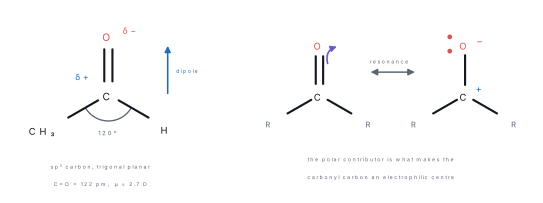
Three consequences follow, and they organise the whole of the rest of the unit:
- the δ+ carbon is attacked by nucleophiles — hence addition of HCN, NaHSO₃, Grignard reagents, and reaction with ammonia derivatives;
- the δ− oxygen is protonated by acids, which makes the carbon still more electrophilic — acid catalysis;
- the α-hydrogen becomes weakly acidic because the resulting carbanion is stabilised by the carbonyl group — hence aldol condensation, iodoform formation and halogenation.
13.4 Distinction by 2,4-DNP, Tollen's reagent and Fehling's solution
The logic is two-step. First prove a carbonyl group is present (2,4-DNP or Schiff's reagent, or the formation of a crystalline derivative). Then find out whether it is an aldehyde, which is easily oxidised, or a ketone, which is not. Mild oxidising agents such as Tollens' reagent and Fehling's solution oxidise aldehydes only.
| Test | Reagent | Aldehyde | Ketone | What you see |
|---|---|---|---|---|
| 2,4-DNP (Brady's) | 2,4-dinitrophenylhydrazine in acid | ✓ | ✓ | orange to red crystalline precipitate |
| Schiff's | dilute magenta decolourised by SO₂ | ✓ | ✗ | pink/magenta colour restored |
| Tollens' | ammoniacal AgNO₃, warm | ✓ | ✗ | shining silver mirror on the tube |
| Fehling's | CuSO₄ + alkaline sodium tartrate | ✓ | ✗ | deep blue → red-brown Cu₂O precipitate |
| Benedict's | CuSO₄ + sodium citrate + Na₂CO₃ | ✓ | ✗ | green → yellow → brick-red Cu₂O |
| Iodoform | I₂ + NaOH, warm | only CH₃CHO | only methyl ketones | yellow crystals, antiseptic smell |
| NaHSO₃ | saturated sodium bisulphite | ✓ | ✓ (small ketones) | white crystalline adduct |
The equations, with charges and atoms balanced:
RCHO + 2,4-(NO₂)₂C₆H₃NHNH₂ → RCH=N—NHC₆H₃(NO₂)₂ + H₂O
RCHO + 2[Ag(NH₃)₂]⁺ + 3OH⁻ → RCOO⁻ + 2Ag↓ + 4NH₃ + 2H₂O
RCHO + 2Cu²⁺ + 5OH⁻ → RCOO⁻ + Cu₂O↓ + 3H₂O
CH₃CHO + 3I₂ + 4NaOH → CHI₃↓ + HCOONa + 3NaI + 3H₂O
CH₃COCH₃ + 3I₂ + 4NaOH → CHI₃↓ + CH₃COONa + 3NaI + 3H₂O
The iodoform test does not separate aldehydes from ketones. It detects the CH₃—CO— grouping (or CH₃—CH(OH)—, which the iodine oxidises to it). So ethanal, propanone, butanone, acetophenone, ethanol and propan-2-ol all give iodoform, while propanal, benzaldehyde and pentan-3-one do not.
Benzaldehyde reduces Tollens' reagent but does not reduce Fehling's solution. Fehling's is only mildly oxidising and the resonance-stabilised aromatic aldehyde resists it. And methanoic acid, HCOOH, reduces both even though it is an acid, because it still contains a —CHO grouping (Unit 14). Never write "Fehling's is positive" for benzaldehyde.
13.5 Addition of H₂, HCN and NaHSO₃
All three are nucleophilic addition reactions. The nucleophile attacks the δ+ carbon, the π electrons fold back onto oxygen to give an alkoxide, and the alkoxide picks up a proton. The carbon changes from sp² (planar) to sp³ (tetrahedral).
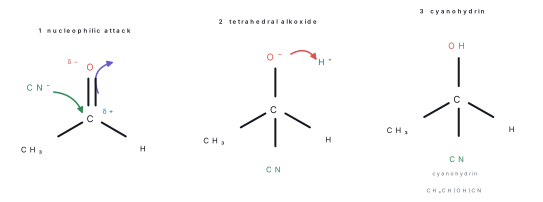
Addition of hydrogen (reduction) uses H₂ with Ni, Pt or Pd:
CH₃CHO + H₂ --Ni, 413 K--> CH₃CH₂OH (a primary alcohol)
CH₃COCH₃ + H₂ --Ni--> (CH₃)₂CHOH (a secondary alcohol)
Addition of HCN gives a cyanohydrin. The reaction is base-catalysed, because it is CN⁻ and not HCN that is the nucleophile — a trace of KCN speeds it up enormously:
CH₃CHO + HCN → CH₃CH(OH)CN (2-hydroxypropanenitrile)
CH₃COCH₃ + HCN → (CH₃)₂C(OH)CN (2-hydroxy-2-methylpropanenitrile)
Cyanohydrins are useful because the nitrile can then be hydrolysed to an α-hydroxy acid — this is how lactic acid is made from ethanal.
Addition of NaHSO₃ gives a crystalline bisulphite adduct. It is reversible on warming with dilute acid or alkali, so it is used to purify and to store aldehydes:
CH₃CHO + NaHSO₃ → CH₃CH(OH)SO₃Na
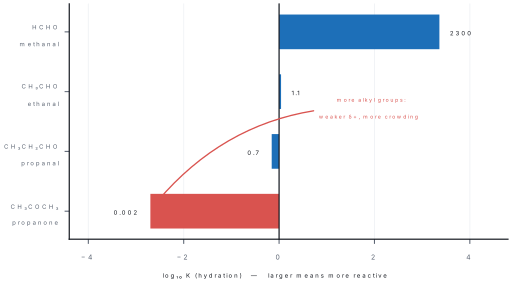
Relative reactivity towards nucleophilic addition
HCHO > CH₃CHO > CH₃CH₂CHO > CH₃COCH₃ > CH₃COC₂H₅ > C₆H₅CHO > C₆H₅COCH₃
Two effects act in the same direction:
- Electronic. Alkyl groups release electrons (+I), so each one reduces the δ+ charge on the carbonyl carbon. Methanal has none, ethanal one, propanone two. In benzaldehyde the ring donates electron density by resonance, which is why an aromatic aldehyde is less reactive than an aliphatic one.
- Steric. The nucleophile has to reach a carbon that becomes crowded as it turns tetrahedral. Two bulky groups hinder the approach far more than one.
13.6 Action with ammonia derivatives
Ammonia derivatives of the type H₂N—Z condense with the carbonyl group, eliminating water and forming a C=N bond. The products are sharp-melting crystalline solids, so they are used to identify an unknown carbonyl compound. All these reactions are fastest at about pH 4–5: enough acid to activate the carbonyl, not so much that the weakly basic nitrogen is all protonated.
| Reagent | Formula | Product name | Product from CH₃CHO |
|---|---|---|---|
| Hydroxylamine | NH₂OH | oxime | CH₃CH=NOH + H₂O |
| Hydrazine | NH₂—NH₂ | hydrazone | CH₃CH=N—NH₂ + H₂O |
| Phenylhydrazine | C₆H₅NHNH₂ | phenylhydrazone | CH₃CH=N—NHC₆H₅ + H₂O |
| 2,4-Dinitrophenylhydrazine | (NO₂)₂C₆H₃NHNH₂ | 2,4-dinitrophenylhydrazone | orange solid + H₂O |
| Semicarbazide | H₂N—NH—CO—NH₂ | semicarbazone | CH₃CH=N—NHCONH₂ + H₂O |
The general equation is
C=O + H₂N—Z → >C=N—Z + H₂O
and the mechanism is nucleophilic addition of the nitrogen followed by dehydration of the resulting carbinolamine.
H-H-P-S: Hydroxylamine gives an oxime; Hydrazine gives a hydrazone; Phenylhydrazine gives a phenylhydrazone; Semicarbazide gives a semicarbazone. Every one of them loses one molecule of water.
13.7 Aldol condensation and Cannizzaro's reaction
These two reactions are complementary, and which one a compound gives depends on a single structural feature — the α-hydrogen.
Aldol condensation (needs α-hydrogen)
Dilute alkali removes an α-hydrogen to give a resonance-stabilised enolate, which attacks the carbonyl carbon of a second molecule. The product is a β-hydroxy carbonyl compound — an "aldehyde-alcohol", hence aldol. On warming it loses water to give an α,β-unsaturated carbonyl compound:
2CH₃CHO --dil. NaOH, 280 K--> CH₃CH(OH)CH₂CHO --Δ, −H₂O--> CH₃CH=CHCHO
(3-hydroxybutanal, the aldol → but-2-enal, crotonaldehyde)
2CH₃COCH₃ --dil. Ba(OH)₂--> (CH₃)₂C(OH)CH₂COCH₃ --Δ, −H₂O--> (CH₃)₂C=CHCOCH₃
(4-hydroxy-4-methylpentan-2-one → 4-methylpent-3-en-2-one, mesityl oxide)
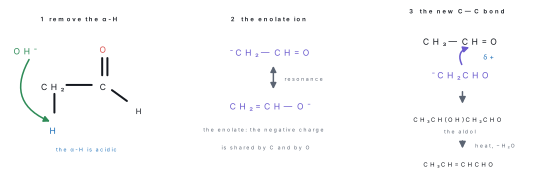
A cross aldol between two different carbonyl compounds can give up to four products, so in practice one partner is chosen to have no α-hydrogen.
Cannizzaro's reaction (no α-hydrogen)
An aldehyde with no α-hydrogen cannot form an enolate. With concentrated alkali it instead disproportionates: one molecule is reduced to the alcohol and the other is oxidised to the salt of the acid.
2HCHO + NaOH(conc.) → CH₃OH + HCOONa
2C₆H₅CHO + NaOH(conc.) → C₆H₅CH₂OH + C₆H₅COONa
The hydride ion is transferred from the first molecule to the carbonyl carbon of the second — an intermolecular hydride shift. Methanal, benzaldehyde, 2,2-dimethylpropanal (trimethylacetaldehyde) and furfural all give Cannizzaro; ethanal, propanal and propanone give aldol.
Problem. Predict the product when (a) propanal and (b) 2,2-dimethylpropanal, (CH₃)₃CCHO, are warmed with sodium hydroxide. Name the products.
Solution.
(a) Propanal, CH₃CH₂CHO, has two α-hydrogens on the CH₂ next to the —CHO, so it undergoes aldol condensation:
2CH₃CH₂CHO → CH₃CH₂CH(OH)CH(CH₃)CHO --Δ, −H₂O--> CH₃CH₂CH=C(CH₃)CHO
The aldol is 3-hydroxy-2-methylpentanal and the final product is 2-methylpent-2-enal.
(b) In (CH₃)₃CCHO the carbon next to —CHO carries three methyl groups and no hydrogen. No enolate is possible, so with concentrated alkali it gives Cannizzaro's reaction:
2(CH₃)₃CCHO + NaOH → (CH₃)₃CCH₂OH + (CH₃)₃CCOONa
i.e. 2,2-dimethylpropan-1-ol and sodium 2,2-dimethylpropanoate.
13.8 Clemmensen's reduction and Wolff–Kishner reduction
Both convert >C=O all the way to >CH₂ — a complete removal of oxygen, not just reduction to an alcohol. They differ only in the medium, and that is the whole point of the pair: one is acidic, the other is basic, so you choose the one that the rest of the molecule can survive.
Clemmensen's reduction — zinc amalgam and concentrated hydrochloric acid:
CH₃COCH₃ + 4[H] --Zn-Hg / conc. HCl--> CH₃CH₂CH₃ + H₂O
Wolff–Kishner reduction — hydrazine first, then a strong base at high temperature. It is a two-step process:
CH₃COCH₃ + NH₂NH₂ → (CH₃)₂C=N—NH₂ + H₂O
(CH₃)₂C=N—NH₂ --KOH / ethylene glycol, 453 K--> CH₃CH₂CH₃ + N₂↑
| Feature | Clemmensen | Wolff–Kishner |
|---|---|---|
| Reagent | Zn-Hg, conc. HCl | NH₂NH₂, then KOH or NaOC₂H₅ |
| Medium | strongly acidic | strongly basic |
| Temperature | reflux, ~373 K | 453–473 K in ethylene glycol |
| Product | alkane (>CH₂) | alkane (>CH₂) |
| By-product | H₂O | N₂ gas |
| Use it when | the molecule is base-sensitive (e.g. contains an ester) | the molecule is acid-sensitive (e.g. contains an alcohol that would dehydrate) |
Three different reducing systems give three different products from the same ketone. H₂/Ni or LiAlH₄ or NaBH₄ stop at the alcohol. Zn-Hg/HCl or NH₂NH₂/KOH go on to the alkane. Mg-Hg/H₂O gives a diol (pinacol). Read the reagent before writing the product.
13.9 Action with PCl₅ and LiAlH₄; methanal with ammonia and with phenol
With PCl₅ the carbonyl oxygen is replaced by two chlorine atoms, giving a gem-dihaloalkane — the reverse of the preparation in Section 13.2:
CH₃CHO + PCl₅ → CH₃CHCl₂ + POCl₃
CH₃COCH₃ + PCl₅ → CH₃CCl₂CH₃ + POCl₃
With LiAlH₄ (or NaBH₄, or H₂/Ni) the carbonyl group is reduced to an alcohol. Lithium aluminium hydride delivers a hydride ion, H⁻, to the δ+ carbon; the reaction is carried out in dry ether and then worked up with water:
CH₃CHO + 2[H] --LiAlH₄, dry ether, then H₂O--> CH₃CH₂OH
CH₃COCH₃ + 2[H] --LiAlH₄--> (CH₃)₂CHOH
Aldehydes give primary alcohols; ketones give secondary alcohols.
Methanal with ammonia. Six molecules of methanal and four of ammonia condense to a cage-shaped molecule, hexamethylenetetramine, known as urotropine:
6HCHO + 4NH₃ → (CH₂)₆N₄ + 6H₂O
Urotropine is a urinary antiseptic, and on nitration it gives the explosive RDX. Higher aldehydes and ketones give simple aldimines, RCH=NH, with ammonia instead.
Methanal with phenol. In the presence of acid or alkali, phenol attacks methanal at the ortho and para positions to give hydroxymethylphenols, which then condense repeatedly:
C₆H₅OH + HCHO → o-HOC₆H₄CH₂OH --further HCHO, Δ--> bakelite
Bakelite is a hard, three-dimensional cross-linked thermosetting plastic used for electrical switches and handles (Unit 18).
13.10 Formalin and its uses
Formalin is a 37–40 % (w/v) aqueous solution of methanal, usually containing about 10 % methanol to stop it polymerising to paraformaldehyde, (HCHO)ₙ.
Methanal itself is a pungent gas (b.p. −19 °C) and very soluble in water. On standing, its aqueous solution slowly deposits a white solid, paraformaldehyde; warming the solid regenerates the gas. Dry methanal with a trace of acid gives the cyclic trimer trioxane.
Uses of formalin:
- Preserving biological specimens and embalming, because it hardens protein by cross-linking it;
- as a disinfectant and germicide for surgical instruments and animal sheds;
- manufacture of bakelite and of urotropine;
- hardening gelatin films in photography, and tanning leather;
- seed dressing against fungal disease, widely used in Nepali agriculture;
- silvering of mirrors, as a reducing agent.
Formalin is toxic and a suspected carcinogen; adulterating fish or milk with it is illegal in Nepal. "Preservative" here means preserving dead tissue for study, not preserving food.
13.11 Aromatic carbonyl compounds: benzaldehyde and acetophenone
Benzaldehyde from toluene
Three routes, all attacking the methyl side chain:
(a) Side-chain chlorination then hydrolysis. Chlorine in bright light or at high temperature substitutes in the side chain, not the ring:
C₆H₅CH₃ + 2Cl₂ --hν, 673 K--> C₆H₅CHCl₂ + 2HCl
C₆H₅CHCl₂ + H₂O --Ca(OH)₂, 373 K--> C₆H₅CHO + 2HCl
(b) Étard reaction. Chromyl chloride in carbon disulphide gives a brown solid complex, which is then hydrolysed:
C₆H₅CH₃ + 2CrO₂Cl₂ --CS₂--> C₆H₅CH(OCrOHCl₂)₂ --H₃O⁺--> C₆H₅CHO
(c) Controlled oxidation with manganese dioxide in 60 % sulphuric acid at about 313 K:
C₆H₅CH₃ + 2[O] --MnO₂ / 60 % H₂SO₄--> C₆H₅CHO + H₂O
Acetophenone from benzene
Friedel–Crafts acylation with ethanoyl chloride or ethanoic anhydride and anhydrous aluminium chloride:
C₆H₆ + CH₃COCl --anhyd. AlCl₃--> C₆H₅COCH₃ + HCl
C₆H₆ + (CH₃CO)₂O --anhyd. AlCl₃--> C₆H₅COCH₃ + CH₃COOH
Acylation, unlike alkylation, does not rearrange and does not go twice over, because the —COCH₃ group deactivates the ring.
13.12 Properties of benzaldehyde
Benzaldehyde, C₆H₅CHO, is a colourless oily liquid (b.p. 178 °C) that smells of bitter almonds — it occurs in almond and peach kernels as the glycoside amygdalin. It oxidises in air to benzoic acid, and the white crystals in an old bottle of benzaldehyde are benzoic acid.
Perkin condensation
Benzaldehyde condenses with an aliphatic anhydride in the presence of the corresponding sodium salt to give an α,β-unsaturated aromatic acid:
C₆H₅CHO + (CH₃CO)₂O --CH₃COONa, 453 K--> C₆H₅CH=CHCOOH + CH₃COOH
The product is cinnamic acid (3-phenylpropenoic acid). The mechanism is an aldol-type attack by the anhydride's enolate followed by dehydration.
Benzoin condensation
With alcoholic potassium cyanide, two molecules of benzaldehyde join head to tail to give an α-hydroxy ketone:
2C₆H₅CHO --alc. KCN--> C₆H₅CH(OH)COC₆H₅
The product is benzoin. Here CN⁻ acts as a catalyst, not a reagent: it adds, makes the aldehydic hydrogen acidic, and is expelled again.
Cannizzaro's reaction
Because there is no α-hydrogen, concentrated alkali makes benzaldehyde disproportionate (Section 13.7):
2C₆H₅CHO + NaOH(conc.) → C₆H₅CH₂OH + C₆H₅COONa
Electrophilic substitution
The —CHO group is electron-withdrawing (−I and −R), so it deactivates the ring and directs incoming groups to the meta position:
C₆H₅CHO + HNO₃ --conc. H₂SO₄, 328 K--> m-O₂NC₆H₄CHO + H₂O
C₆H₅CHO + H₂SO₄ (fuming) → m-HO₃SC₆H₄CHO + H₂O
C₆H₅CHO + Cl₂ --anhyd. AlCl₃--> m-ClC₆H₄CHO + HCl
| Reaction | Reagent and conditions | Substrate needs | Product |
|---|---|---|---|
| Aldol condensation | dil. NaOH or Ba(OH)₂, 280–290 K | α-hydrogen | β-hydroxy carbonyl, then α,β-unsaturated carbonyl |
| Cannizzaro | conc. NaOH or KOH (50 %) | no α-hydrogen | alcohol + salt of the acid |
| Clemmensen | Zn-Hg / conc. HCl, reflux | any >C=O | alkane + H₂O |
| Wolff–Kishner | NH₂NH₂, then KOH / glycol, 453 K | any >C=O | alkane + N₂ |
| Rosenmund | H₂, Pd/BaSO₄ poisoned with S | acid chloride | aldehyde + HCl |
| Perkin | (RCO)₂O + RCOONa, 453 K | aromatic aldehyde | α,β-unsaturated acid |
| Benzoin | alcoholic KCN | aromatic aldehyde | α-hydroxy ketone |
| Hell–Volhard–Zelinsky | Cl₂ or Br₂ / red P (Unit 14) | carboxylic acid with α-H | α-halo acid |
Problem. A neutral liquid A of molecular formula C₃H₆O gives an orange precipitate with 2,4-dinitrophenylhydrazine and yellow crystals with iodine and sodium hydroxide, but gives no silver mirror with Tollens' reagent. Identify A and write the equations for the two positive tests.
Solution. C₃H₆O fits both propanal and propanone.
- The 2,4-DNP precipitate proves a carbonyl group is present.
- No silver mirror means A is not an aldehyde, so it is not propanal.
- The positive iodoform test proves a CH₃—CO— group.
Therefore A is propanone, CH₃COCH₃.
CH₃COCH₃ + (NO₂)₂C₆H₃NHNH₂ → (CH₃)₂C=N—NHC₆H₃(NO₂)₂ + H₂O
CH₃COCH₃ + 3I₂ + 4NaOH → CHI₃↓ + CH₃COONa + 3NaI + 3H₂O
Check the second equation: C 3 = 1 + 2 ✓, H 6 + 4 = 1 + 3 + 6 ✓, I 6 = 3 + 3 ✓, Na 4 = 1 + 3 ✓, O 1 + 4 = 2 + 3 ✓.
Problem. 2.20 g of ethanal is warmed with excess Tollens' reagent until the reaction is complete. Calculate the mass of silver deposited. (Ar: C = 12, H = 1, O = 16, Ag = 108.)
Solution. Molar mass of CH₃CHO = 2(12) + 4(1) + 16 = 44 g mol⁻¹.
From the equation
CH₃CHO + 2[Ag(NH₃)₂]⁺ + 3OH⁻ → CH₃COO⁻ + 2Ag + 4NH₃ + 2H₂O
one mole of ethanal gives two moles of silver, so n(\text{Ag}) = 2 \times 0.0500 = 0.100 mol.
Answer: 10.8 g of silver.
Problem. 5.80 g of propanone is treated with excess iodine and sodium hydroxide. Calculate the maximum mass of iodoform obtainable. (Ar: I = 127.)
Solution. M(CH₃COCH₃) = 3(12) + 6(1) + 16 = 58 g mol⁻¹, so
The equation CH₃COCH₃ + 3I₂ + 4NaOH → CHI₃ + CH₃COONa + 3NaI + 3H₂O shows a 1 : 1 ratio, so n(\text{CHI}_3) = 0.100 mol.
M(CHI₃) = 12 + 1 + 3(127) = 394 g mol⁻¹.
Answer: 39.4 g of iodoform. Note that 0.300 mol of I₂ (76.2 g) is consumed, which is why the test is only a test and not a synthesis.
Problem. How would you convert ethanal into butan-1-ol? Give the reagents and equations for each step.
Solution. Butan-1-ol has four carbons; ethanal has two. Aldol condensation is the carbon–carbon bond-forming step.
Step 1 — aldol condensation. Warm ethanal with dilute sodium hydroxide:
2CH₃CHO --dil. NaOH--> CH₃CH(OH)CH₂CHO
Step 2 — dehydration. Heat the aldol; it loses water:
CH₃CH(OH)CH₂CHO --Δ--> CH₃CH=CHCHO + H₂O (but-2-enal)
Step 3 — complete reduction. Hydrogen over nickel reduces both the C=C and the C=O:
CH₃CH=CHCHO + 2H₂ --Ni, 423 K--> CH₃CH₂CH₂CH₂OH
Atom check on step 3: C₄H₆O + 2H₂ = C₄H₁₀O ✓ — butan-1-ol.
(LiAlH₄ would reduce only the C=O and leave but-2-en-1-ol, so H₂/Ni is the right choice here.)
Chapter summary
- Aldehydes are R—CHO, ketones R—CO—R′; both are CₙH₂ₙO and are functional isomers of each other. Ketones also show position isomerism and metamerism.
- The carbonyl carbon is sp², planar, 120°, C=O = 122 pm, strongly polarised Cδ+=Oδ−. This makes the carbon electrophilic, the oxygen basic and the α-hydrogen acidic.
- Preparations: oxidation or Cu-dehydrogenation of alcohols (1° → aldehyde, 2° → ketone), reductive ozonolysis of alkenes, Rosenmund reduction of acid chlorides, hydrolysis of gem-dihalides, HgSO₄/H₂SO₄ hydration of alkynes (ethyne → ethanal, all others → ketone).
- Both give 2,4-DNP; only aldehydes give Tollens' silver mirror, Fehling's Cu₂O and Schiff's pink. Benzaldehyde gives Tollens but not Fehling. Iodoform tests for CH₃CO—, not for the aldehyde group.
- Nucleophilic addition: HCN → cyanohydrin, NaHSO₃ → bisulphite adduct, H₂/LiAlH₄ → alcohol. Reactivity HCHO > RCHO > RCOR′ > ArCHO, from +I and steric effects.
- Ammonia derivatives H₂N—Z give >C=N—Z + H₂O: oxime, hydrazone, phenylhydrazone, semicarbazone.
- α-hydrogen present → aldol; α-hydrogen absent → Cannizzaro. Clemmensen (Zn-Hg/HCl) and Wolff–Kishner (NH₂NH₂/KOH) both give the alkane.
- Benzaldehyde: Perkin → cinnamic acid; benzoin condensation → benzoin; Cannizzaro → benzyl alcohol + sodium benzoate; electrophilic substitution is meta.
- Formalin is 37–40 % aqueous methanal; 6HCHO + 4NH₃ → (CH₂)₆N₄ + 6H₂O (urotropine); HCHO + phenol → bakelite.
Practice questions
Group A — Multiple choice (1 mark each)
- Which compound gives a positive Fehling's test? [1]apropanonebbenzaldehydecpropanaldbenzophenone
- The reagent that distinguishes ethanal from propanone is [1]a2,4-DNPbI₂ / NaOHcTollens' reagentdNaHSO₃
- Which of the following gives Cannizzaro's reaction? [1]aCH₃CHObCH₃CH₂CHOcHCHOdCH₃COCH₃
- On ozonolysis followed by Zn/H₂O, 2-methylbut-2-ene gives [1]apropanone and ethanalbtwo molecules of ethanalcpropanal and methanaldbutanone and methanal
- The correct order of reactivity towards HCN addition is [1]aCH₃COCH₃ > CH₃CHO > HCHObHCHO > CH₃CHO > CH₃COCH₃cCH₃CHO > HCHO > CH₃COCH₃dall react equally fast
- Clemmensen's reduction of propanone gives [1]apropan-2-olbpropanecpropenedpropan-1-ol
Answers to Group A
1. (c) — only an aliphatic aldehyde reduces Fehling's; benzaldehyde does not.
2. (c) — Tollens' gives a silver mirror with ethanal only. Both give 2,4-DNP and both give iodoform.
3. (c) — methanal has no α-hydrogen, so it disproportionates.
4. (a) — (CH₃)₂C= gives propanone and =CHCH₃ gives ethanal.
5. (b) — each extra alkyl group weakens the δ+ charge and crowds the carbon.
6. (b) — Zn-Hg/HCl removes the oxygen completely, giving the alkane.
Group B — Short answer (5 marks each)
- Describe the structure of the carbonyl group and explain, with the help of the polarity, why aldehydes and ketones undergo nucleophilic addition rather than electrophilic addition. [5]
- How do you distinguish between(a) ethanal and propanone,(b) propanal and propanone,(c) ethanal and benzaldehyde? Give reagent, observation and equation in each case. [5]
- What is aldol condensation? Write the mechanism for the aldol condensation of ethanal and state why benzaldehyde does not undergo it. [5]
- 4.40 g of ethanal is treated with excess Fehling's solution. Calculate the mass of copper(I) oxide precipitated. (Cu = 63.5) [5]
- Starting from ethyne, how would you prepare(a) ethanal,(b) ethanoic acid and(c) 2-hydroxypropanenitrile? Write balanced equations. [5]
- Compare Clemmensen's reduction with Wolff–Kishner reduction under four headings, and state which you would use to reduce 4-hydroxybutan-2-one to 4-hydroxybutane. [5]
Answers to Group B
2. (a) Tollens' reagent: ethanal gives a silver mirror, propanone gives no change — CH₃CHO + 2[Ag(NH₃)₂]⁺ + 3OH⁻ → CH₃COO⁻ + 2Ag + 4NH₃ + 2H₂O. (b) Iodoform test with I₂/NaOH: propanone gives yellow CHI₃, propanal does not, because propanal has no CH₃—CO— group. (c) Fehling's solution: ethanal gives a red-brown Cu₂O precipitate, benzaldehyde gives none (both give Tollens').
4. M(CH₃CHO) = 44, so n = 4.40/44 = 0.100 mol. From RCHO + 2Cu²⁺ + 5OH⁻ → RCOO⁻ + Cu₂O + 3H₂O the ratio is 1 : 1, so n(Cu₂O) = 0.100 mol. M(Cu₂O) = 2(63.5) + 16 = 143 g mol⁻¹, so m = 0.100 × 143 = 14.3 g.
5. (a) C₂H₂ + H₂O --HgSO₄/dil. H₂SO₄, 333 K--> CH₃CHO. (b) CH₃CHO + [O] --K₂Cr₂O₇/H₂SO₄--> CH₃COOH. (c) CH₃CHO + HCN → CH₃CH(OH)CN.
6. Headings: reagent, medium, by-product, when used (see the table in Section 13.8). The substrate contains an —OH group, which concentrated HCl would dehydrate or substitute, so use Wolff–Kishner (basic conditions).
Group C — Long answer (8 marks each)
- (a) Explain the structure and polar nature of the carbonyl group and give the general mechanism of nucleophilic addition. [4](b) Arrange HCHO, CH₃CHO, CH₃COCH₃ and C₆H₅CHO in order of decreasing reactivity towards nucleophilic addition and justify the order. [4]
- (a) How is benzaldehyde prepared from toluene? Give two methods with equations. [3](b) Write the reactions of benzaldehyde with (i) ethanoic anhydride and sodium ethanoate, (ii) alcoholic KCN, (iii) concentrated NaOH, naming each product. [3](c) Why does benzaldehyde undergo meta substitution on nitration? [2]
- An organic compound X of formula C₄H₈O decolourises neither bromine water nor KMnO₄, gives an orange solid with 2,4-DNP, gives yellow crystals with I₂/NaOH, but does not reduce Tollens' reagent. On reduction with LiAlH₄ it gives Y, which on heating with concentrated H₂SO₄ gives Z, C₄H₈. Identify X, Y and Z with reasoning and write all the equations. [8]
Answers to Group C
1. (b) HCHO > CH₃CHO > CH₃COCH₃ > C₆H₅CHO. HCHO has no electron-releasing alkyl group, so its carbonyl carbon carries the largest δ+ and is the least hindered. Each alkyl group added donates electron density (+I), lowering δ+, and adds steric bulk. In benzaldehyde the benzene ring donates electron density into the carbonyl group by resonance, which lowers δ+ further; propanone is therefore more reactive than benzaldehyde in practice. (Figure of hydration constants: K = 2.3 × 10³, 1.1 and 2 × 10⁻³ for the first three.)
2. (c) —CHO is a −I and −R group. It withdraws electron density from the ring, and the resonance structures put the positive charge at the ortho and para positions. The electrophile therefore attacks the least deactivated position, the meta position.
3. No decolourisation of Br₂ water or KMnO₄ ⇒ no C=C. 2,4-DNP positive ⇒ carbonyl group. Tollens' negative ⇒ not an aldehyde ⇒ a ketone. Iodoform positive ⇒ contains CH₃CO—. The only C₄H₈O ketone is butanone, CH₃COCH₂CH₃ = X.
CH₃COCH₂CH₃ + 2[H] --LiAlH₄--> CH₃CH(OH)CH₂CH₃, so Y = butan-2-ol.
CH₃CH(OH)CH₂CH₃ --conc. H₂SO₄, 443 K--> CH₃CH=CHCH₃ + H₂O, so Z = but-2-ene (the Saytzeff product, C₄H₈).
Also acceptable as supporting evidence: X + 3I₂ + 4NaOH → CHI₃ + CH₃CH₂COONa + 3NaI + 3H₂O.
Practise more: Chemistry question bank