Unit 11 · Organic Chemistry · 4 teaching hours · 21 min read
Phenols
What the syllabus asks for 8
- Introduction and nomenclature
- Preparation from chlorobenzene, diazonium salt, benzene sulphonic acid
- Physical properties
- Acidic nature: comparison with alcohol and water
- Action with NH3, Zn, Na, benzene diazonium chloride, phthalic anhydride
- Acylation, Kolbe's reaction, Reimer-Tiemann reaction
- Electrophilic substitution: nitration, sulphonation, bromination, Friedel-Crafts alkylation
- Test of phenol (FeCl3 test, aqueous bromine test, Libermann test); uses
A phenol has its –OH group attached directly to the benzene ring. That single difference from an alcohol changes everything. The oxygen lone pair is drawn into the ring, so the O–H bond becomes markedly more polar and phenol behaves as a genuine, if weak, acid — it dissolves in sodium hydroxide, which no alcohol does. The same lone-pair donation floods the ring with electron density, so phenol undergoes electrophilic substitution far faster than benzene and always at the ortho and para positions.
The two questions to keep answering
Almost everything in this unit is one of two questions: "why is phenol acidic when ethanol is not?" (answer: resonance stabilisation of the phenoxide ion) and "why does the ring react so fast, and where?" (answer: the same lone pair, delivered to positions 2, 4 and 6). Learn to draw the resonance structures — examiners award marks for the diagrams, not the words.
11.1 Introduction and nomenclature
Phenols are compounds of general formula Ar–OH. A monohydric phenol has one –OH on the ring, a dihydric phenol two, and so on. Phenol itself, C₆H₅OH, was called carbolic acid by Lister, who used it as the first surgical antiseptic.
Do not confuse a phenol with an aromatic alcohol: in benzyl alcohol, C₆H₅CH₂OH, the –OH sits on a side-chain carbon, not on the ring, so it behaves like an ordinary primary alcohol and gives no colour with FeCl₃.
| Structure | IUPAC name | Common name |
|---|---|---|
| C₆H₅OH | phenol | carbolic acid |
| 2-CH₃C₆H₄OH | 2-methylphenol | o-cresol |
| 4-CH₃C₆H₄OH | 4-methylphenol | p-cresol |
| 1,2-C₆H₄(OH)₂ | benzene-1,2-diol | catechol |
| 1,3-C₆H₄(OH)₂ | benzene-1,3-diol | resorcinol |
| 1,4-C₆H₄(OH)₂ | benzene-1,4-diol | quinol (hydroquinone) |
| 1,2,3-C₆H₃(OH)₃ | benzene-1,2,3-triol | pyrogallol |
| 2,4,6-(O₂N)₃C₆H₂OH | 2,4,6-trinitrophenol | picric acid |
| C₁₀H₇OH | naphthalen-1-ol | α-naphthol |
11.2 Preparation from chlorobenzene, diazonium salt, benzene sulphonic acid
(a) From chlorobenzene — Dow's process. Chlorobenzene is very unreactive, so forcing conditions are needed: 10 % aqueous NaOH at 300 °C and about 150 atm.
C₆H₅Cl + 2NaOH --300 °C, 150 atm--> C₆H₅ONa + NaCl + H₂O
C₆H₅ONa + HCl → C₆H₅OH + NaCl
(b) From benzene diazonium chloride. Aniline is diazotised at 0–5 °C and the diazonium salt solution is then simply warmed above 5 °C with dilute acid:
C₆H₅NH₂ + HNO₂ + HCl --0–5 °C--> C₆H₅N₂Cl + 2H₂O
C₆H₅N₂Cl + H₂O --warm, >5 °C--> C₆H₅OH + N₂↑ + HCl
This is the laboratory method: mild, and the nitrogen simply bubbles away.
(c) From benzene sulphonic acid — alkali fusion. The sodium salt is fused with solid sodium hydroxide at 300–350 °C:
C₆H₅SO₃H + NaOH → C₆H₅SO₃Na + H₂O
C₆H₅SO₃Na + 2NaOH --fuse, 300–350 °C--> C₆H₅ONa + Na₂SO₃ + H₂O
C₆H₅ONa + HCl → C₆H₅OH + NaCl
All three routes stop at sodium phenoxide, which is a water-soluble salt, not phenol. The final acidification step — with HCl, dilute H₂SO₄ or even by passing CO₂ — is worth a mark and is regularly forgotten.
11.3 Physical properties
- Colourless, needle-shaped crystalline solid, m.p. 40.9 °C, b.p. 181.8 °C. On standing in air and light it slowly oxidises and turns pink to red.
- Characteristic sharp "carbolic" smell; corrosive and poisonous — it raises painful blisters on skin, so it is handled with gloves.
- Sparingly soluble in cold water (about 8.3 g per 100 g at 20 °C) because the large hydrocarbon ring is water-repelling, but freely soluble in ethanol, ether and benzene. Above 66 °C phenol and water mix in all proportions.
- Its boiling point is very high for its molar mass (94 g mol⁻¹) because the molecules are linked by intermolecular hydrogen bonds, just as in alcohols.
- Phenol dissolves readily in aqueous NaOH (forming sodium phenoxide) — a physical observation that is really a chemical test.
11.4 Acidic nature: comparison with alcohol and water
Phenol ionises slightly in water:
C₆H₅OH + H₂O ⇌ C₆H₅O⁻ + H₃O⁺, K_a = 1.0\times10^{-10}, \mathrm{p}K_a = 10.0
Two effects work together.
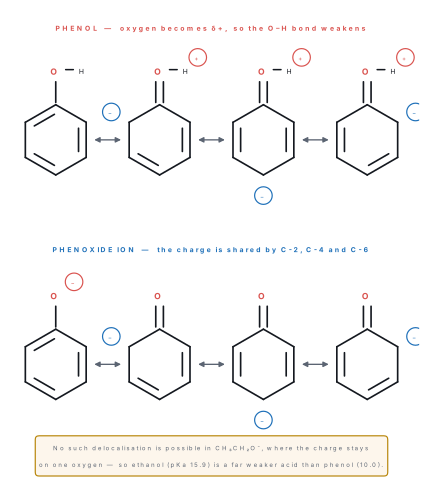
(i) The phenoxide ion is resonance-stabilised. Its negative charge is not stuck on oxygen; it is delocalised over the two ortho and one para carbon atoms. Spreading charge lowers energy, so the conjugate base is unusually stable and the equilibrium above lies further right than for an alcohol. In an alkoxide ion, CH₃CH₂O⁻, no such delocalisation is possible — and the electron-releasing (+I) ethyl group actually pushes more charge onto the oxygen, making the ion less stable still.
(ii) The O–H bond in phenol is already polarised. In phenol itself the oxygen lone pair is fed into the ring, giving oxygen a partial positive charge. Oxygen therefore pulls harder on the shared pair of the O–H bond, and the proton leaves more easily.
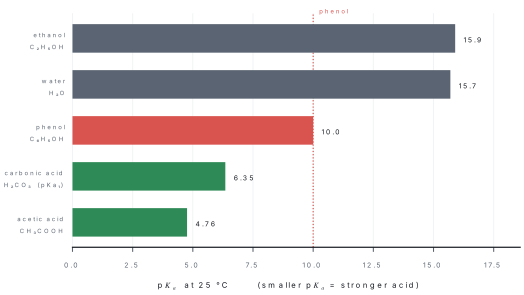
How strong is "acidic"? Phenol is a much stronger acid than water or ethanol, but much weaker than a carboxylic acid — and, decisively, weaker than carbonic acid.
The consequences are examined every year:
| Reagent | Phenol | Ethanol | Carboxylic acid |
|---|---|---|---|
| Na metal | H₂ evolved | H₂ evolved | H₂ evolved |
| NaOH(aq) | dissolves, gives C₆H₅ONa | no reaction | dissolves |
| NaHCO₃(aq) | no CO₂ | no reaction | CO₂ effervescence |
| Litmus | very faintly red | neutral | red |
So NaOH separates phenol from an alcohol, and NaHCO₃ separates a carboxylic acid from phenol.
C₆H₅OH + NaOH → C₆H₅ONa + H₂O
Effect of substituents. Electron-withdrawing groups drain charge from the phenoxide ion and strengthen the acid; electron-releasing groups weaken it:
picric acid (0.38) > p-nitrophenol (7.15) > phenol (10.0) > p-cresol (10.26)
Problem. The dissociation constant of phenol is K_a = 1.0\times10^{-10} at 25 °C. Calculate the pH and the degree of ionisation of a 0.01 M aqueous solution of phenol.
Solution. For a weak monobasic acid of concentration C,
Degree of ionisation, by Ostwald's dilution law,
Only one molecule in ten thousand is ionised — phenol is acidic, but only just.
Problem. Phenol dissolves completely in aqueous NaOH but gives no effervescence with NaHCO₃. Justify this using K_a(\text{C}_6\text{H}_5\text{OH}) = 1.0\times10^{-10}, K_{a1}(\text{H}_2\text{CO}_3) = 4.5\times10^{-7} and K_w = 1.0\times10^{-14}.
Solution.
With NaOH. C₆H₅OH + OH⁻ ⇌ C₆H₅O⁻ + H₂O, for which
K \gg 1, so the reaction goes essentially to completion and the phenol dissolves as sodium phenoxide.
With NaHCO₃. C₆H₅OH + HCO₃⁻ ⇌ C₆H₅O⁻ + H₂CO₃, for which
K \ll 1, so almost no reaction occurs: no H₂CO₃ is formed and therefore no CO₂ is released. Phenol is a weaker acid than carbonic acid, so it cannot displace CO₂ from a bicarbonate — which is the standard way of telling phenol from benzoic acid.
11.5 Action with NH₃, Zn, Na, benzene diazonium chloride, phthalic anhydride
(a) With ammonia (replacement of –OH by –NH₂, over anhydrous ZnCl₂ at 300 °C):
C₆H₅OH + NH₃ --anhyd. ZnCl₂, 300 °C--> C₆H₅NH₂ + H₂O (aniline)
(b) With zinc dust (reduction; removal of the oxygen):
C₆H₅OH + Zn --distil--> C₆H₆ + ZnO
(c) With sodium metal (the acidic O–H hydrogen is displaced):
2C₆H₅OH + 2Na → 2C₆H₅ONa + H₂↑
(d) With benzene diazonium chloride — a coupling reaction in cold alkaline solution at 0–5 °C. The diazonium ion is a weak electrophile, so it can attack only a strongly activated ring, and it goes to the para position:
C₆H₅N₂Cl + C₆H₅OH --NaOH(aq), 0–5 °C--> C₆H₅–N=N–C₆H₄–OH + HCl
The product, p-hydroxyazobenzene, is an orange dye; this is the basis of the whole azo-dye industry.
(e) With phthalic anhydride (two molecules of phenol, conc. H₂SO₄, heat):
C₆H₄(CO)₂O + 2C₆H₅OH --conc. H₂SO₄--> phenolphthalein + H₂O
Phenolphthalein, C₂₀H₁₄O₄, is the familiar titration indicator: colourless in acid, pink in alkali.
11.6 Acylation, Kolbe's reaction, Reimer-Tiemann reaction
Acylation. Phenol is a poor nucleophile, so an acid chloride or anhydride is used, usually with a base (pyridine or NaOH) to mop up the acid formed:
C₆H₅OH + CH₃COCl → CH₃COOC₆H₅ + HCl (phenyl ethanoate)
C₆H₅OH + (CH₃CO)₂O → CH₃COOC₆H₅ + CH₃COOH
Heating phenyl ethanoate with anhydrous AlCl₃ shifts the acetyl group onto the ring itself, giving o- and p-hydroxyacetophenone — the Fries rearrangement.
Kolbe's reaction (Kolbe–Schmitt). Dry sodium phenoxide absorbs carbon dioxide under pressure. CO₂ is the electrophile and attacks the ortho position:
C₆H₅ONa + CO₂ --125 °C, 4–7 atm--> 2-(HO)C₆H₄COONa
2-(HO)C₆H₄COONa + HCl → 2-(HO)C₆H₄COOH + NaCl (salicylic acid)
Salicylic acid is then acetylated to give aspirin:
2-(HO)C₆H₄COOH + (CH₃CO)₂O → 2-(CH₃COO)C₆H₄COOH + CH₃COOH
Reimer–Tiemann reaction. Phenol warmed with chloroform and aqueous NaOH at 60–70 °C, followed by acidification, gives salicylaldehyde (2-hydroxybenzaldehyde). The true electrophile is dichlorocarbene, :CCl₂, generated from chloroform by the alkali:
CHCl₃ + NaOH → :CCl₂ + NaCl + H₂O
C₆H₅OH + CHCl₃ + 3NaOH --60–70 °C--> 2-(HO)C₆H₄CHO + 3NaCl + 2H₂O
If carbon tetrachloride is used in place of chloroform the product is salicylic acid instead:
C₆H₅OH + CCl₄ + 5NaOH → 2-(HO)C₆H₄COONa + 4NaCl + 3H₂O
The attacking species (CO₂ or :CCl₂) is a weak electrophile. Only the phenoxide ion, C₆H₅O⁻, is activated enough to react with it. That is why both reactions are carried out in alkali — leave out the NaOH and nothing happens.
11.7 Electrophilic substitution: nitration, sulphonation, bromination, Friedel-Crafts alkylation
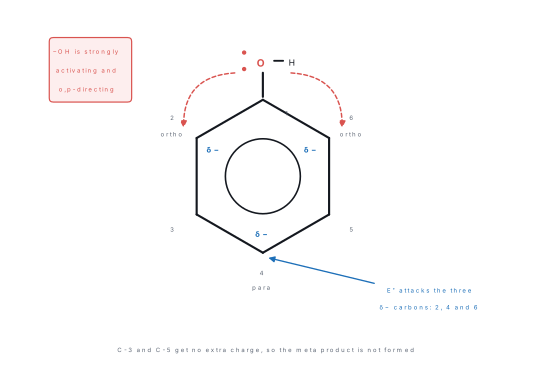
Because the –OH group donates its lone pair into the ring, phenol is far more reactive than benzene and substitution occurs at C-2, C-4 and C-6.
| Reaction | Reagent and conditions | Product |
|---|---|---|
| Nitration | 20 % dilute HNO₃, 25 °C | o-nitrophenol + p-nitrophenol |
| conc. HNO₃ + conc. H₂SO₄ | 2,4,6-trinitrophenol (picric acid) | |
| Sulphonation | conc. H₂SO₄, 25 °C | o-phenolsulphonic acid (mainly) |
| conc. H₂SO₄, 100 °C | p-phenolsulphonic acid (mainly) | |
| Bromination | Br₂ in CS₂ or CHCl₃, 0 °C | p-bromophenol (mainly) |
| bromine water, excess | 2,4,6-tribromophenol, white precipitate | |
| Friedel–Crafts alkylation | CH₃Cl, anhydrous AlCl₃ | o- and p-cresol |
The important equations are
C₆H₅OH + 3HNO₃ --conc. H₂SO₄--> C₆H₂(NO₂)₃OH + 3H₂O
C₆H₅OH + H₂SO₄ ⇌ HO–C₆H₄–SO₃H + H₂O
C₆H₅OH + 3Br₂ --water--> C₆H₂Br₃OH↓ + 3HBr
C₆H₅OH + CH₃Cl --anhyd. AlCl₃--> CH₃–C₆H₄–OH + HCl
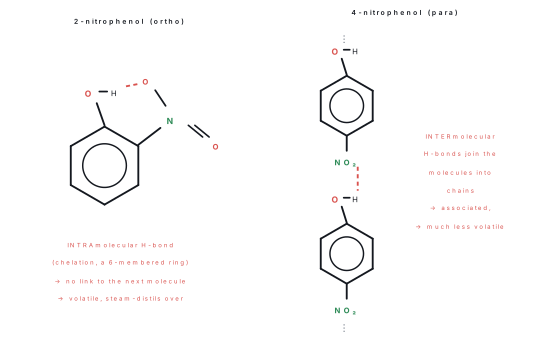
The two nitrophenols are separated by steam distillation: only the ortho isomer distils over, because its –OH and –NO₂ groups are close enough to form an intramolecular hydrogen bond (chelation), leaving no O–H free to bond to neighbouring molecules. The para isomer, whose groups are too far apart, forms intermolecular hydrogen bonds instead, associates into larger units and stays behind.
11.8 Test of phenol (FeCl₃ test, aqueous bromine test, Libermann test); uses
| Test | Reagent and conditions | Observation with phenol | With ethanol |
|---|---|---|---|
| Ferric chloride test | a few drops of neutral FeCl₃ | violet / blue-violet colour | no colour |
| Aqueous bromine test | excess bromine water | white precipitate of 2,4,6-tribromophenol; bromine decolourised | no reaction |
| Libermann's nitroso test | solid NaNO₂ + conc. H₂SO₄, warm; dilute with water; then excess NaOH | deep blue-green solution → red on dilution → blue-green again with excess alkali | negative |
| NaOH solubility | 10 % NaOH(aq) | dissolves as sodium phenoxide | does not react |
| Phthalein test | phthalic anhydride + conc. H₂SO₄, then NaOH | pink colour (phenolphthalein) | negative |
The ferric chloride colour comes from a violet complex ion:
6C₆H₅OH + FeCl₃ → [Fe(OC₆H₅)₆]³⁻ + 3Cl⁻ + 6H⁺
Ferric chloride solution is normally acidic through hydrolysis, and an acidic solution suppresses the ionisation of phenol so the colour fails to develop. The reagent is neutralised first. Also note that some phenols (for example p-nitrophenol) give a weak or no colour, so a negative FeCl₃ test alone is not proof that phenol is absent.
Uses of phenol
- Manufacture of bakelite (phenol + methanal), the first synthetic plastic.
- Antiseptics and disinfectants — carbolic soap, and the cresols in Lysol and creosote used to preserve railway sleepers and electric poles.
- Drugs: salicylic acid → aspirin; also paracetamol and phenacetin; methyl salicylate is oil of wintergreen, used in pain balms.
- Picric acid, a yellow dye and a powerful explosive.
- Azo dyes, by coupling with diazonium salts.
- Phenolphthalein, the acid–base indicator used in NaOH titrations.
- Starting material for nylon-6,6 (via cyclohexanol) and for epoxy resins.
Problem. 0.94 g of phenol is shaken with excess bromine water until precipitation is complete. Calculate (a) the mass of 2,4,6-tribromophenol formed and (b) the mass of bromine consumed. (C = 12, H = 1, O = 16, Br = 79.9)
Solution. C₆H₅OH + 3Br₂ → C₆H₂Br₃OH↓ + 3HBr
Molar mass of phenol = 6(12) + 6(1) + 16 = 94\ \text{g mol}^{-1}, so
(a) 1 mol phenol gives 1 mol of tribromophenol, whose molar mass is
(b) 3 mol of Br₂ are needed per mol of phenol:
Problem. An organic compound P, C₇H₈O, is insoluble in water and in NaHCO₃ but dissolves in NaOH. It gives a violet colour with neutral FeCl₃ and a white precipitate with bromine water. On treatment with CHCl₃ and NaOH followed by acidification it gives an aldehyde Q. Identify P and Q.
Solution.
Step 1. Soluble in NaOH but not NaHCO₃ ⇒ P is a phenol, not a carboxylic acid (a carboxylic acid would give CO₂ with NaHCO₃). Step 2. Violet with FeCl₃ and a white precipitate with Br₂ water confirm a phenolic –OH on the ring. Step 3. C₇H₈O = C₆H₄(CH₃)(OH), a cresol. Since the Reimer–Tiemann reaction works, a free ortho position is needed; the standard NEB answer is 4-methylphenol (p-cresol), which has both ortho positions free. Step 4. Reimer–Tiemann puts a –CHO group ortho to the –OH:
CH₃C₆H₄OH + CHCl₃ + 3NaOH → 2-hydroxy-5-methylbenzaldehyde + 3NaCl + 2H₂O
So P is p-cresol and Q is 2-hydroxy-5-methylbenzaldehyde, C₈H₈O₂ (molar mass 136).
Chapter summary
- A phenol has –OH bonded directly to the ring; benzyl alcohol has it on a side chain and behaves as a 1° alcohol.
- Preparations: chlorobenzene + NaOH at 300 °C/150 atm (Dow); warming C₆H₅N₂Cl with water; fusion of C₆H₅SO₃Na with NaOH. Every route ends in sodium phenoxide and must be acidified.
- Phenol is a colourless solid, m.p. 41 °C, sparingly soluble in water, corrosive, and turns pink in air.
- Acidity: K_a = 1.0\times10^{-10}, \mathrm{p}K_a = 10.0 — stronger than water (15.7) and ethanol (15.9) but weaker than carbonic acid (6.35). Hence it dissolves in NaOH but gives no CO₂ with NaHCO₃. The cause is resonance stabilisation of the phenoxide ion over C-2, C-4 and C-6.
- With NH₃ over ZnCl₂ at 300 °C → aniline; with Zn dust → benzene; with Na → sodium phenoxide + H₂; with C₆H₅N₂Cl in cold alkali → p-hydroxyazobenzene (orange dye); with phthalic anhydride → phenolphthalein.
- Kolbe: C₆H₅ONa + CO₂ at 125 °C/4–7 atm → sodium salicylate → salicylic acid → aspirin. Reimer–Tiemann: CHCl₃ + NaOH (via :CCl₂) → salicylaldehyde; CCl₄ gives salicylic acid.
- Electrophilic substitution is fast and o,p-directed: dilute HNO₃ → o- and p-nitrophenol (separated by steam distillation, ortho is chelated); conc. HNO₃/H₂SO₄ → picric acid; bromine water → white 2,4,6-tribromophenol.
- Tests: violet with neutral FeCl₃; white precipitate with bromine water; Libermann's test gives blue-green → red on dilution → blue-green with alkali.
Practice questions
Group A — Multiple choice (1 mark each)
- Phenol dissolves in aqueous NaOH but not in aqueous NaHCO₃ because [1]ait is a stronger acid than carbonic acidbit is a weaker acid than carbonic acidcit is not acidic at alldit is insoluble in water
- The white precipitate formed when phenol is shaken with excess bromine water is [1]ap-bromophenolbo-bromophenolc2,4,6-tribromophenoldbromobenzene
- Sodium phenoxide heated with CO₂ at 125 °C and 4–7 atm gives, after acidification, [1]abenzoic acidbsalicylic acidcsalicylaldehydedpicric acid
- The electrophile in the Reimer–Tiemann reaction is [1]aCHCl₃bCCl₃⁻c:CCl₂dCl⁺
- Which one gives a violet colour with neutral ferric chloride? [1]aethanolbbenzyl alcoholcphenoldchlorobenzene
- Phenol is more acidic than ethanol mainly because [1]ait is a solidbthe phenoxide ion is resonance stabilisedcit contains a benzene ringdit has a higher molar mass
Answers to Group A
1. (b) — with \mathrm{p}K_a 10.0 against 6.35, phenol cannot displace CO₂ from a bicarbonate.
2. (c) — in water all three activated positions (2, 4 and 6) are brominated.
3. (b) — Kolbe–Schmitt reaction; CO₂ attacks the ortho position.
4. (c) — dichlorocarbene, generated from CHCl₃ by the alkali.
5. (c) — only a phenolic –OH forms the violet iron(III) complex.
6. (b) — the negative charge is delocalised over C-2, C-4 and C-6, which is impossible in an alkoxide ion.
Group B — Short answer (5 marks each)
- Explain, with resonance structures, why phenol is a stronger acid than ethanol but a weaker acid than acetic acid. [5]
- How is phenol prepared from(a) chlorobenzene,(b) benzene diazonium chloride and(c) benzene sulphonic acid? Give equations and conditions. [5]
- What is the Reimer–Tiemann reaction? Give the mechanism outline, the equation and the product obtained when CCl₄ is used in place of CHCl₃. [5]
- How would you distinguish between phenol, ethanol and benzoic acid using simple chemical tests? [5]
- Calculate the pH of a 0.001 M solution of phenol, K_a = 1.0\times10^{-10}, and state whether the solution would turn blue litmus red. [5]
Answers to Group B
1. In the phenoxide ion the negative charge is delocalised over the oxygen and the two ortho and one para carbons (four contributing structures), so the conjugate base is stabilised and the proton is lost more easily. In an ethoxide ion the charge stays on one oxygen and the +I effect of the ethyl group intensifies it, so ethanol (\mathrm{p}K_a 15.9) is a much weaker acid. In the acetate ion, however, the charge is shared equally by two electronegative oxygen atoms, which is far more effective than spreading it onto carbon atoms — so acetic acid (\mathrm{p}K_a 4.76) is stronger than phenol (10.0).
2. (a) C₆H₅Cl + 2NaOH --300 °C, 150 atm--> C₆H₅ONa + NaCl + H₂O, then C₆H₅ONa + HCl → C₆H₅OH + NaCl (Dow's process). (b) C₆H₅N₂Cl + H₂O --warm above 5 °C--> C₆H₅OH + N₂↑ + HCl. (c) C₆H₅SO₃Na + 2NaOH --fuse 300–350 °C--> C₆H₅ONa + Na₂SO₃ + H₂O, then acidify.
3. Phenol + CHCl₃ + aqueous NaOH at 60–70 °C, then acidification, gives salicylaldehyde. The alkali removes a proton from chloroform to give CCl₃⁻ which loses Cl⁻ to form dichlorocarbene :CCl₂, the electrophile. It attacks the ortho position of the phenoxide ion; hydrolysis of the resulting –CHCl₂ group gives –CHO. Overall: C₆H₅OH + CHCl₃ + 3NaOH → 2-(HO)C₆H₄CHO + 3NaCl + 2H₂O. With CCl₄ the product is salicylic acid: C₆H₅OH + CCl₄ + 5NaOH → 2-(HO)C₆H₄COONa + 4NaCl + 3H₂O.
4. Add NaHCO₃ solution: only benzoic acid gives CO₂ effervescence. To the remaining two add neutral FeCl₃: phenol gives a violet colour, ethanol none. Confirm with bromine water (phenol → white precipitate) and with the iodoform test (ethanol → yellow CHI₃).
5. [\text{H}^{+}] = \sqrt{K_aC} = \sqrt{(1.0\times10^{-10})(1.0\times10^{-3})} = \sqrt{1.0\times10^{-13}} = 3.16\times10^{-7}\ \text{mol dm}^{-3}. \mathrm{pH} = -\log(3.16\times10^{-7}) = 6.5. The solution is only very slightly acidic — litmus (which changes around pH 5–8) would show at most a very faint pink, so in practice phenol does not turn blue litmus properly red.
Group C — Long answer (8 marks each)
- (a) Account for the acidic character of phenol and compare it with that of water and ethanol, using resonance structures. [4](b) Give equations for the action of phenol with ammonia, zinc dust, sodium metal, benzene diazonium chloride and phthalic anhydride. [4]
- (a) Why is phenol more reactive than benzene towards electrophilic substitution, and why does substitution occur at the ortho and para positions? [3](b) Write equations for the nitration, sulphonation, bromination and Friedel–Crafts alkylation of phenol, stating the conditions. [3](c) 9.4 g of phenol is nitrated completely with excess conc. HNO₃/H₂SO₄. Calculate the mass of picric acid obtained if the yield is 70 %. [2]
Answers to Group C
1. (a) Phenol ionises as C₆H₅OH ⇌ C₆H₅O⁻ + H⁺. The phenoxide ion has four resonance structures spreading the negative charge onto C-2, C-4 and C-6, so it is far more stable than the hydroxide or ethoxide ion in which the charge is localised on one oxygen. In phenol itself the oxygen lone pair is delocalised into the ring, leaving oxygen δ+ and weakening the O–H bond. Hence acidity runs phenol (10.0) > water (15.7) > ethanol (15.9); the +I effect of the alkyl group makes ethanol the weakest of the three. (b) C₆H₅OH + NH₃ --ZnCl₂, 300 °C--> C₆H₅NH₂ + H₂O; C₆H₅OH + Zn --distil--> C₆H₆ + ZnO; 2C₆H₅OH + 2Na → 2C₆H₅ONa + H₂↑; C₆H₅N₂Cl + C₆H₅OH --NaOH, 0–5 °C--> C₆H₅N=N–C₆H₄–OH + HCl; C₆H₄(CO)₂O + 2C₆H₅OH --conc. H₂SO₄--> phenolphthalein + H₂O.
2. (a) The oxygen lone pair is delocalised into the ring, so the ring carries more electron density than benzene and attracts electrophiles more strongly (–OH is strongly activating). The delocalisation places the extra negative charge specifically on C-2, C-4 and C-6, so the electrophile attacks there; the intermediate carbocation formed at those positions is also the only one that can be stabilised by a structure in which every atom has a complete octet. (b) C₆H₅OH + HNO₃(dil., 25 °C) → o- and p-O₂NC₆H₄OH + H₂O; C₆H₅OH + 3HNO₃ --conc. H₂SO₄--> C₆H₂(NO₂)₃OH + 3H₂O; C₆H₅OH + H₂SO₄ ⇌ HOC₆H₄SO₃H + H₂O (ortho at 25 °C, para at 100 °C); C₆H₅OH + 3Br₂ (water) → C₆H₂Br₃OH↓ + 3HBr; C₆H₅OH + CH₃Cl --anhyd. AlCl₃--> CH₃C₆H₄OH + HCl. (c) n(\text{phenol}) = 9.4/94 = 0.10\ \text{mol}. One mole of phenol gives one mole of picric acid, C₆H₂(NO₂)₃OH, of molar mass 72 + 3 + 3(46) + 16 = 229\ \text{g mol}^{-1}. Theoretical mass = 0.10 \times 229 = 22.9\ \text{g}; at 70 % yield, m = 0.70 \times 22.9 = 16.0\ \text{g}.
Practise more: Chemistry question bank