Unit 12 · Organic Chemistry · 2 teaching hours · 18 min read
Ethers
What the syllabus asks for 5
- Introduction; nomenclature, classification and isomerism
- Preparation of aliphatic and aromatic ethers by Williamson's synthesis
- Physical properties
- Chemical properties of ethoxyethane: action with HI, conc. HCl, conc. H2SO4, air and Cl2
- Uses
An ether is an oxygen atom with an alkyl or aryl group on each side, R–O–R′. The same formula CₙH₂ₙ₊₂O also belongs to the alcohols, so every ether is a functional isomer of an alcohol — yet the two behave nothing alike. An ether has no O–H bond, so it cannot hydrogen-bond to itself, cannot react with sodium and is chemically very unreactive. That inertness is exactly why ethoxyethane became the chemist's favourite solvent and the first surgical anaesthetic.
Expect (i) Williamson's synthesis, including why it must be planned the right way round; (ii) why an ether boils about 80 °C below its isomeric alcohol; and (iii) the action of HI on ethoxyethane and on anisole. Everything else in this unit is supporting detail.
12.1 Introduction; nomenclature, classification and isomerism
The general formula of a saturated ether is CₙH₂ₙ₊₂O, the same as that of a saturated monohydric alcohol. Ethers fall into two classes:
- Simple (symmetrical) ethers, R–O–R, with the same group on both sides — ethoxyethane, C₂H₅OC₂H₅.
- Mixed (unsymmetrical) ethers, R–O–R′ — methoxyethane, CH₃OC₂H₅; and methoxybenzene, C₆H₅OCH₃, which is an aromatic mixed ether.
Nomenclature. In the IUPAC system the smaller group plus the oxygen is named as an alkoxy substituent on the larger parent chain: alkoxyalkane. The common system simply names both groups followed by the word ether.
| Structure | IUPAC name | Common name |
|---|---|---|
| CH₃OCH₃ | methoxymethane | dimethyl ether |
| CH₃OC₂H₅ | methoxyethane | ethyl methyl ether |
| C₂H₅OC₂H₅ | ethoxyethane | diethyl ether ("ether") |
| CH₃OCH₂CH₂CH₃ | 1-methoxypropane | methyl n-propyl ether |
| CH₃OCH(CH₃)₂ | 2-methoxypropane | methyl isopropyl ether |
| (CH₃)₃COCH₃ | 2-methoxy-2-methylpropane | MTBE, tert-butyl methyl ether |
| C₆H₅OCH₃ | methoxybenzene | anisole |
| C₆H₅OC₆H₅ | phenoxybenzene | diphenyl ether |
Isomerism. Ethers show three kinds:
- Metamerism — the same formula, the same functional group, but a different distribution of carbon atoms on the two sides of the oxygen. C₄H₁₀O gives CH₃–O–C₃H₇ and C₂H₅–O–C₂H₅; these are metamers.
- Chain isomerism — within one alkyl group: 1-methoxypropane and 2-methoxypropane.
- Functional isomerism — with the alcohols. C₂H₆O is either ethanol or methoxymethane; C₄H₁₀O has four alcohols and three ethers, seven isomers in all.
12.2 Preparation of aliphatic and aromatic ethers by Williamson's synthesis
Williamson's synthesis is the general method: a sodium alkoxide or phenoxide (the nucleophile) is warmed with a haloalkane in dry conditions.
C₂H₅ONa + C₂H₅I → C₂H₅OC₂H₅ + NaI
C₆H₅ONa + CH₃I → C₆H₅OCH₃ + NaI (anisole)
The mechanism is SN₂: the alkoxide oxygen attacks the carbon carrying the halogen from the side opposite to it, and the halide leaves at the same moment. That single fact decides how the reaction must be planned.
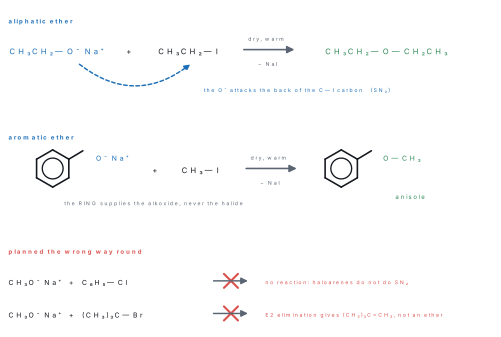
For a mixed ether there are always two ways of splitting it, and only one of them works. Always make the bulky group the alkoxide and the methyl or primary group the halide. To prepare 2-methoxy-2-methylpropane, use (CH₃)₃CONa + CH₃I — not CH₃ONa + (CH₃)₃CBr, which would give 2-methylpropene by elimination. For anisole, use C₆H₅ONa + CH₃I — not CH₃ONa + C₆H₅Cl, because the C–Cl bond of a haloarene has partial double-bond character and is inert to SN₂.
Ethers can also be made by the dehydration of alcohols, as in Unit 10:
2C₂H₅OH --conc. H₂SO₄, 140 °C--> C₂H₅OC₂H₅ + H₂O
This is cheap and is used industrially, but it works only for simple ethers — a mixture of two alcohols would give all three possible products.
12.3 Physical properties
- Methoxymethane and methoxyethane are gases at room temperature; the rest of the lower ethers are colourless, volatile, very inflammable liquids with a sweet smell.
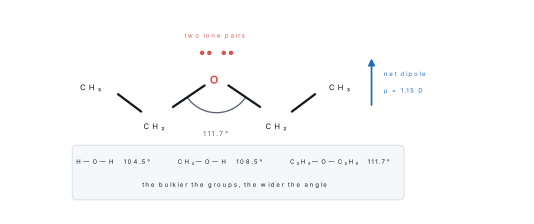
- Ethoxyethane boils at 34.6 °C and has density 0.713 g cm⁻³ and dipole moment 1.15 D. The C–O–C angle is 111.7° — wider than the 104.5° of water, because the two bulky ethyl groups repel each other.
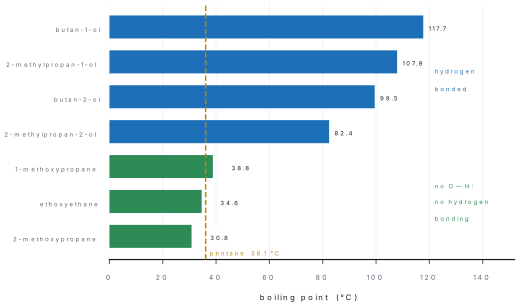
- The boiling point is far below that of the isomeric alcohol (ethoxyethane 34.6 °C against butan-1-ol 117.7 °C) because an ether has no O–H hydrogen and so cannot hydrogen-bond to another ether molecule. It boils at almost exactly the temperature of pentane (36.1 °C), the alkane of similar mass.
- Yet ethers are as soluble in water as the alcohols (6.5 g per 100 cm³, against 7.9 g for butan-1-ol), because the oxygen still has lone pairs and can accept a hydrogen bond from a water molecule even though it cannot donate one.
- The vapour is much denser than air, spreads along the bench and forms explosive mixtures — never use a naked flame near ether.
12.4 Chemical properties of ethoxyethane: action with HI, conc. HCl, conc. H₂SO₄, air and Cl₂
Ethers are remarkably unreactive: they are not attacked by alkalis, by sodium metal or by ordinary oxidising and reducing agents. The oxygen lone pairs do, however, make an ether a weak Lewis base, and that is where most of its chemistry starts. The oxygen is first protonated (or coordinated), and the C–O bond is then broken by the nucleophile.
(a) With hydrogen iodide. The amount and temperature decide the product:
C₂H₅OC₂H₅ + HI (cold) → C₂H₅OH + C₂H₅I
C₂H₅OC₂H₅ + 2HI (hot, excess) → 2C₂H₅I + H₂O
Reactivity of the halogen acids is HI > HBr > HCl, following the nucleophilic strength of the halide ion. With an aromatic ether the iodide can attack only the sp³ carbon of the alkyl group, so the aryl–oxygen bond survives:
C₆H₅OCH₃ + HI → C₆H₅OH + CH₃I
(b) With concentrated HCl. In the cold the ether merely dissolves, forming an oxonium salt — the clearest demonstration of its basic character:
C₂H₅OC₂H₅ + HCl (cold, conc.) → [(C₂H₅)₂OH]⁺Cl⁻
Heated under pressure the C–O bonds are broken:
C₂H₅OC₂H₅ + 2HCl --heat, pressure--> 2C₂H₅Cl + H₂O
(c) With concentrated H₂SO₄. Again, cold gives the oxonium salt; hot gives cleavage to ethyl hydrogen sulphate:
C₂H₅OC₂H₅ + H₂SO₄ (cold) → [(C₂H₅)₂OH]⁺HSO₄⁻
C₂H₅OC₂H₅ + 2H₂SO₄ --heat--> 2C₂H₅HSO₄ + H₂O
(d) With air — peroxide formation. On long standing in air and light, ether slowly takes up oxygen at the carbon next to the oxygen:
C₂H₅OC₂H₅ + O₂ --air, light, slow--> CH₃CH(OOH)OC₂H₅
The peroxide is non-volatile, so it concentrates in the flask when ether is distilled and explodes near dryness. Peroxides are detected by shaking with acidified KI solution (iodine is liberated, giving a blue colour with starch) or with FeSO₄ and KSCN (blood-red). They are prevented by storing ether in dark bottles over a piece of sodium wire or reduced iron, and by never distilling ether to dryness.
(e) With chlorine. Substitution of the α-hydrogens, and the extent depends on the light:
C₂H₅OC₂H₅ + 2Cl₂ --in the dark--> CH₃CHCl–O–CHClCH₃ + 2HCl
C₂H₅OC₂H₅ + 10Cl₂ --bright sunlight--> C₂Cl₅OC₂Cl₅ + 10HCl
Cleavage of an ether by HI always breaks the bond to the carbon that can accept a backside SN₂ attack. In anisole only the methyl carbon is sp³ hybridised, so the products are phenol and iodomethane. Writing "iodobenzene and methanol" is the standard error here.
12.5 Uses
- Solvent. Ethoxyethane dissolves fats, oils, waxes, resins, gums, nitrocellulose and alkaloids, and is used for extracting organic compounds from aqueous solutions ("ether extraction") because it is inert and boils off easily.
- Grignard reagents are prepared and used in dry ether; the ether oxygen donates its lone pairs to the magnesium and keeps R–Mg–X in solution.
- Anaesthetic. Ethoxyethane was the first general anaesthetic (1846) and is still listed as an essential medicine, though its flammability means safer agents are now preferred.
- Refrigerant and as a starting fluid for diesel engines in cold weather.
- Smokeless powder (cordite) is made using an ether–alcohol mixture.
- MTBE, 2-methoxy-2-methylpropane, is blended into petrol as a lead-free anti-knock agent in place of tetraethyl lead.
Problem. Write the structures and IUPAC names of all the isomeric ethers of molecular formula C₅H₁₂O, and state which pairs are metamers.
Solution. The oxygen must carry five carbons in total, split between the two sides as 1 + 4 or 2 + 3.
Split 1 + 4 — methoxybutanes (CH₃–O–C₄H₉); the butyl group has four arrangements:
- CH₃OCH₂CH₂CH₂CH₃ — 1-methoxybutane
- CH₃OCH(CH₃)CH₂CH₃ — 2-methoxybutane
- CH₃OCH₂CH(CH₃)₂ — 1-methoxy-2-methylpropane
- CH₃OC(CH₃)₃ — 2-methoxy-2-methylpropane
Split 2 + 3 — ethoxypropanes (C₂H₅–O–C₃H₇):
- C₂H₅OCH₂CH₂CH₃ — 1-ethoxypropane
- C₂H₅OCH(CH₃)₂ — 2-ethoxypropane
There are therefore six isomeric ethers. Any methoxybutane paired with any ethoxypropane is a pair of metamers, because the carbon atoms are distributed differently about the oxygen (1 + 4 against 2 + 3). Within each group — for example 1-methoxybutane and 2-methoxybutane — the isomerism is chain or position isomerism, not metamerism.
Problem. 6.8 g of sodium ethoxide is warmed with excess iodoethane. Calculate the mass and the volume of ethoxyethane obtained if the yield is 75 %. (Density of ethoxyethane = 0.713 g cm⁻³; Na = 23, C = 12, H = 1, O = 16)
Solution. C₂H₅ONa + C₂H₅I → C₂H₅OC₂H₅ + NaI
Molar mass of C₂H₅ONa = 24 + 5 + 16 + 23 = 68\ \text{g mol}^{-1}, so
The iodoethane is in excess, so the alkoxide is the limiting reagent and the theoretical yield of ether is 0.10 mol. Molar mass of C₄H₁₀O = 48 + 10 + 16 = 74\ \text{g mol}^{-1}, so the theoretical mass is 0.10 \times 74 = 7.4\ \text{g}.
At 75 % yield,
Problem. 7.4 g of ethoxyethane is heated with an excess of hydroiodic acid. Calculate the mass of iodoethane and of water formed. What would the products be, and in what masses, if only 0.10 mol of cold HI were used? (I = 126.9)
Solution.
Hot, excess HI. C₂H₅OC₂H₅ + 2HI → 2C₂H₅I + H₂O
n(\text{C}_2\text{H}_5\text{I}) = 2 \times 0.10 = 0.20\ \text{mol} and its molar mass is 24 + 5 + 126.9 = 155.9\ \text{g mol}^{-1}, so
n(\text{H}_2\text{O}) = 0.10\ \text{mol}, so m = 0.10 \times 18 = 1.8\ \text{g}.
Cold, 1 mol of HI per mol of ether. C₂H₅OC₂H₅ + HI → C₂H₅OH + C₂H₅I
Now one mole of each product is formed per mole of ether: m(\text{C}_2\text{H}_5\text{OH}) = 0.10 \times 46 = 4.6\ \text{g} and m(\text{C}_2\text{H}_5\text{I}) = 0.10 \times 155.9 = 15.6\ \text{g}.
Problem. 10.8 g of anisole is refluxed with excess hydroiodic acid. Name and calculate the mass of each organic product, and explain why iodobenzene is not formed.
Solution. C₆H₅OCH₃ + HI → C₆H₅OH + CH₃I
Molar mass of anisole, C₇H₈O = 84 + 8 + 16 = 108\ \text{g mol}^{-1}, so
One mole of anisole gives one mole of each product.
Phenol, C₆H₅OH, M = 94\ \text{g mol}^{-1}: m = 0.10 \times 94 = 9.4\ \text{g}.
Iodomethane, CH₃I, M = 12 + 3 + 126.9 = 141.9\ \text{g mol}^{-1}: m = 0.10 \times 141.9 = 14.2\ \text{g}.
Why not iodobenzene? The iodide ion must attack the carbon from the side opposite the leaving oxygen (SN₂). The methyl carbon is sp³ and open to such an attack, but the ring carbon is sp² and its bond to oxygen has partial double-bond character from delocalisation; a benzene ring also blocks backside approach. So the CH₃–O bond breaks and the C₆H₅–O bond does not.
Chapter summary
- An ether is R–O–R′, formula CₙH₂ₙ₊₂O — a functional isomer of an alcohol. Simple ethers have identical groups, mixed ethers different ones.
- IUPAC names are alkoxyalkanes, the smaller group becoming the alkoxy substituent: C₂H₅OC₂H₅ is ethoxyethane, C₆H₅OCH₃ is methoxybenzene (anisole).
- Ethers show metamerism (different sharing of carbons about the oxygen), chain isomerism and functional isomerism with alcohols. C₄H₁₀O has 3 ethers and 4 alcohols.
- Williamson's synthesis: R–ONa + R′–X → R–O–R′ + NaX, an SN₂ reaction. The halide must be methyl or primary; a 3° halide gives an alkene and a haloarene gives nothing. For anisole use C₆H₅ONa + CH₃I.
- No O–H means no self-hydrogen-bonding, so ethoxyethane boils at 34.6 °C, about 83 °C below butan-1-ol and close to pentane. It is still water-soluble, because oxygen can accept a hydrogen bond from water.
- The oxygen lone pairs make ethers weak Lewis bases: cold conc. HCl or H₂SO₄ gives oxonium salts; hot acid cleaves both C–O bonds.
- HI cold gives alcohol + iodoalkane; hot excess HI gives 2 iodoalkane + water; anisole gives phenol + iodomethane.
- Ether left in air forms an explosive peroxide, CH₃CH(OOH)OC₂H₅ — store over sodium wire in dark bottles and never distil to dryness. Chlorine substitutes the α-hydrogens in the dark and every hydrogen in sunlight.
Practice questions
Group A — Multiple choice (1 mark each)
- The IUPAC name of C₂H₅OCH₃ is [1]aethoxymethanebmethoxyethanecethyl methyl etherdmethoxymethane
- CH₃OC₃H₇ and C₂H₅OC₂H₅ are [1]achain isomersbposition isomerscmetamersdfunctional isomers
- Anisole on refluxing with excess HI gives [1]aiodobenzene + methanolbphenol + iodomethanecbenzene + iodomethanedphenol + methanol
- Ethoxyethane boils at 34.6 °C while butan-1-ol boils at 117.7 °C because [1]athe ether has a smaller molar massbthe ether cannot form intermolecular hydrogen bondscthe ether is non-polardthe alcohol is ionic
- The best pair of reagents for preparing 2-methoxy-2-methylpropane is [1]aCH₃ONa + (CH₃)₃CBrb(CH₃)₃CONa + CH₃IcCH₃OH + (CH₃)₃COHdCH₃Br + (CH₃)₃CBr
- Diethyl ether stored for a long time in a half-empty bottle becomes dangerous because it forms [1]aethanolbethanalca peroxidedan oxonium salt
Answers to Group A
1. (b) — the smaller group (CH₃) becomes the methoxy substituent on the larger (ethane) chain.
2. (c) — same functional group, same formula, but the carbons are shared 1 + 3 against 2 + 2 about the oxygen.
3. (b) — only the sp³ methyl carbon can undergo SN₂, so the aryl–O bond survives.
4. (b) — an ether has no O–H hydrogen to donate, so its molecules are held together only by weak dipole and van der Waals forces.
5. (b) — the bulky group must be the alkoxide; (a) would give 2-methylpropene by elimination.
6. (c) — slow autoxidation gives CH₃CH(OOH)OC₂H₅, which explodes when the ether is distilled to dryness.
Group B — Short answer (5 marks each)
- What is Williamson's synthesis? Show how it is used to prepare ethoxyethane and anisole, and explain why CH₃ONa + C₆H₅Cl cannot be used. [5]
- Explain why ethoxyethane (b.p. 34.6 °C) boils far below butan-1-ol (b.p. 117.7 °C) although both are C₄H₁₀O, yet the two are about equally soluble in water. [5]
- What happens when ethoxyethane is treated with(a) cold HI,(b) hot excess HI,(c) cold conc. H₂SO₄,(d) chlorine in the dark,(e) air over a long period? Give equations. [5]
- Write all the isomers of C₄H₁₀O with their IUPAC names, and state the type of isomerism shown by (i) ethoxyethane and butan-1-ol, (ii) ethoxyethane and 1-methoxypropane. [5]
- 14.8 g of ethoxyethane is heated with excess HI. Calculate the mass of iodoethane formed and the volume of HI required at STP. (I = 126.9) [5]
Answers to Group B
1. Williamson's synthesis is the SN₂ reaction of a sodium alkoxide or phenoxide with a methyl or primary haloalkane: C₂H₅ONa + C₂H₅I → C₂H₅OC₂H₅ + NaI, and C₆H₅ONa + CH₃I → C₆H₅OCH₃ + NaI. CH₃ONa + C₆H₅Cl fails because the C–Cl bond in a haloarene has partial double-bond character (the chlorine lone pair is delocalised into the ring), the ring carbon is sp², and the benzene ring blocks the backside approach that SN₂ requires.
2. Butan-1-ol has an O–H hydrogen, so its molecules are joined by intermolecular hydrogen bonds that must be broken before it boils; ethoxyethane has no O–H and is held only by dipole and van der Waals forces, so it boils about 83 °C lower — close to pentane (36.1 °C). Solubility is a different question: water supplies the hydrogen, and the ether oxygen accepts the hydrogen bond, so both compounds hydrogen-bond to water about equally well (6.5 g and 7.9 g per 100 cm³).
3. (a) C₂H₅OC₂H₅ + HI → C₂H₅OH + C₂H₅I. (b) C₂H₅OC₂H₅ + 2HI → 2C₂H₅I + H₂O. (c) It dissolves, forming the oxonium salt [(C₂H₅)₂OH]⁺HSO₄⁻ — the ether is acting as a Lewis base. (d) C₂H₅OC₂H₅ + 2Cl₂ → CH₃CHCl–O–CHClCH₃ + 2HCl (the two α-hydrogens are replaced). (e) Slow autoxidation: C₂H₅OC₂H₅ + O₂ → CH₃CH(OOH)OC₂H₅, an explosive peroxide.
4. Alcohols: butan-1-ol, butan-2-ol, 2-methylpropan-1-ol, 2-methylpropan-2-ol. Ethers: ethoxyethane, 1-methoxypropane, 2-methoxypropane — seven isomers in all. (i) Functional isomerism (alcohol against ether). (ii) Metamerism (2 + 2 against 1 + 3 carbons about the oxygen).
5. n(\text{C}_4\text{H}_{10}\text{O}) = 14.8/74 = 0.20\ \text{mol}. C₂H₅OC₂H₅ + 2HI → 2C₂H₅I + H₂O, so n(\text{C}_2\text{H}_5\text{I}) = 0.40\ \text{mol} and m = 0.40 \times 155.9 = 62.4\ \text{g}. n(\text{HI}) = 0.40\ \text{mol}, so V = 0.40 \times 22.4 = 8.96\ \text{dm}^{3} at STP.
Group C — Long answer (8 marks each)
- (a) Define an ether and classify ethers with one example of each type. Explain metamerism using C₄H₁₀O. [3](b) Describe Williamson's synthesis of an aliphatic and of an aromatic ether, give the mechanism in outline, and explain why the halide must be primary. [3](c) How is ethoxyethane also obtained from ethanol? Why does this method fail for mixed ethers? [2]
- (a) Give equations for the action of ethoxyethane with HI, conc. HCl, conc. H₂SO₄, air and Cl₂, stating the conditions in each case. [5](b) 3.7 g of ethoxyethane is treated with just 0.050 mol of cold HI. Name the organic products and calculate the mass of each. [3]
Answers to Group C
1. (a) An ether has an oxygen atom bonded to two carbon atoms, R–O–R′. Simple (symmetrical): C₂H₅OC₂H₅. Mixed (unsymmetrical): CH₃OC₂H₅; aromatic mixed: C₆H₅OCH₃. Metamerism is isomerism arising from a different distribution of carbon atoms about the same functional group: for C₄H₁₀O, C₂H₅–O–C₂H₅ (2 + 2) and CH₃–O–C₃H₇ (1 + 3) are metamers. (b) C₂H₅ONa + C₂H₅I → C₂H₅OC₂H₅ + NaI; C₆H₅ONa + CH₃I → C₆H₅OCH₃ + NaI. Mechanism: the alkoxide oxygen, a strong nucleophile, attacks the carbon carrying the halogen from the side opposite the C–X bond; the transition state has the oxygen and the halogen partially bonded on opposite sides, and the halide leaves as the new C–O bond forms (SN₂). Because the attack must come from behind the carbon, bulky groups block it: a 3° halide reacts by elimination (E2) to give an alkene instead, so only methyl and primary halides give good yields. (c) 2C₂H₅OH --conc. H₂SO₄, 140 °C--> C₂H₅OC₂H₅ + H₂O. With a mixture of two different alcohols, R–OH and R′–OH, all three ethers R–O–R, R–O–R′ and R′–O–R′ are formed together and are difficult to separate, so the method is useless for mixed ethers.
2. (a) C₂H₅OC₂H₅ + HI (cold) → C₂H₅OH + C₂H₅I; C₂H₅OC₂H₅ + 2HI (hot, excess) → 2C₂H₅I + H₂O; C₂H₅OC₂H₅ + HCl (cold conc.) → [(C₂H₅)₂OH]⁺Cl⁻, and on heating under pressure C₂H₅OC₂H₅ + 2HCl → 2C₂H₅Cl + H₂O; C₂H₅OC₂H₅ + H₂SO₄ (cold) → [(C₂H₅)₂OH]⁺HSO₄⁻, and on heating C₂H₅OC₂H₅ + 2H₂SO₄ → 2C₂H₅HSO₄ + H₂O; C₂H₅OC₂H₅ + O₂ (air, light, slow) → CH₃CH(OOH)OC₂H₅; C₂H₅OC₂H₅ + 2Cl₂ (dark) → CH₃CHCl–O–CHClCH₃ + 2HCl, and C₂H₅OC₂H₅ + 10Cl₂ (sunlight) → C₂Cl₅OC₂Cl₅ + 10HCl. (b) n(\text{ether}) = 3.7/74 = 0.050\ \text{mol}, and 0.050 mol of HI is supplied, so the mole ratio is 1 : 1 and only one C–O bond is broken: C₂H₅OC₂H₅ + HI → C₂H₅OH + C₂H₅I. The products are ethanol, m = 0.050 \times 46 = 2.3\ \text{g}, and iodoethane, m = 0.050 \times 155.9 = 7.8\ \text{g}.
Practise more: Chemistry question bank