Unit 6 · Inorganic Chemistry · 5 teaching hours · 21 min read
Transition Metals
What the syllabus asks for 7
- Characteristics of transition metals
- Oxidation states
- Complex ions and metal complexes
- Shapes of complex ions
- d-orbitals in complex ions (crystal field theory, octahedral complex)
- Reasons for the colour of transition metal compounds
- Catalytic properties of transition metals
The ten elements from scandium to zinc fill the 3d orbitals, and in doing so behave quite unlike the s-block metals of Grade 11. They are hard and high-melting, they show several oxidation states, their compounds are coloured and magnetic, they form complex ions, and they catalyse a large share of the world's industrial chemistry. All of this comes from one structural fact: the 3d and 4s orbitals are very close in energy.
Four recurring questions: list and explain the characteristic properties; explain variable oxidation states from the electronic configuration; define ligand, coordination number and EAN and calculate them; and draw the crystal field splitting in an octahedral complex and use it to explain colour and magnetism.
6.1 Characteristics of transition metals
A transition element is one whose atom, or one of whose common ions, contains a partially filled d subshell. On this definition the 3d series runs from Sc to Zn, but zinc (3d¹⁰4s², Zn²⁺ = 3d¹⁰) is not a typical transition metal because neither its atom nor its ion has an incomplete d subshell.
| Element | Sc | Ti | V | Cr | Mn | Fe | Co | Ni | Cu | Zn |
|---|---|---|---|---|---|---|---|---|---|---|
| Z | 21 | 22 | 23 | 24 | 25 | 26 | 27 | 28 | 29 | 30 |
| Configuration ([Ar]) | 3d¹4s² | 3d²4s² | 3d³4s² | 3d⁵4s¹ | 3d⁵4s² | 3d⁶4s² | 3d⁷4s² | 3d⁸4s² | 3d¹⁰4s¹ | 3d¹⁰4s² |
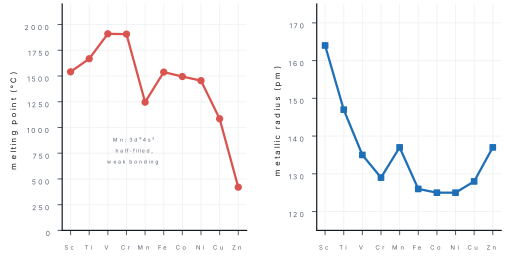
Chromium and copper break the expected pattern because a half-filled (3d⁵) or completely filled (3d¹⁰) d subshell is extra stable, so one 4s electron is promoted.
The characteristic properties, with the reason for each:
- Metallic character, hardness and high melting point. Besides the 4s electrons, unpaired 3d electrons also take part in metallic bonding, giving strong interatomic bonds. Chromium is the hardest metal; tungsten in the 5d series melts at 3410 °C, which is why it is used for lamp filaments. Zinc, with no unpaired d electrons, melts at only 420 °C.
- High density. Small atomic volume plus high atomic mass.
- Variable oxidation states (Section 6.2).
- Coloured ions (Section 6.6).
- Paramagnetism. Unpaired d electrons give a magnetic moment; \mu = \sqrt{n(n+2)} Bohr magnetons, where n is the number of unpaired electrons. Fe, Co and Ni are ferromagnetic.
- Complex formation (Section 6.3) — small, highly charged ions with vacant d orbitals attract lone pairs strongly.
- Catalytic activity (Section 6.7).
- Alloy formation. The atomic radii are similar, so atoms replace one another freely in the lattice: stainless steel, bronze, brass.
- Interstitial compounds. Small atoms (H, C, N, B) occupy the holes in the metal lattice, giving hard, non-stoichiometric solids such as steel and TiC.
6.2 Oxidation states
The 4s and 3d orbitals differ so little in energy that after the 4s electrons are removed, 3d electrons can be removed one at a time with comparable effort. Every intermediate configuration is therefore accessible, and the elements show a range of oxidation states differing by one, unlike the s-block where only one state exists.
Points the examiner looks for:
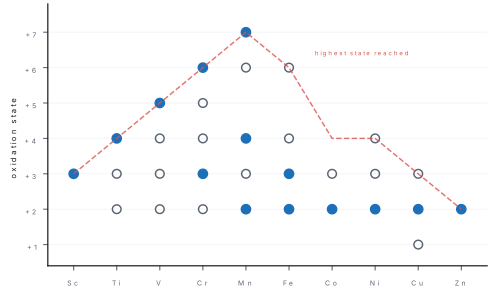
- The minimum common state is +2 (loss of the two 4s electrons) for every element from Ti onwards. Scandium has only one d electron and forms Sc³⁺, giving the noble-gas core.
- The maximum state equals the total of 3d and 4s electrons up to manganese (Mn: 5 + 2 = +7 in MnO₄⁻; Cr: +6 in Cr₂O₇²⁻; V: +5 in VO₃⁻).
- After Mn, the effective nuclear charge has grown so much that the remaining d electrons are held too tightly; Fe rarely goes beyond +3 and Ni, Cu, Zn stop at +2 (copper also has a +1 state, 3d¹⁰).
- High oxidation states occur with the most electronegative partners, oxygen and fluorine (MnO₄⁻, CrO₄²⁻, VF₅).
- Oxides in a low oxidation state are basic (MnO), in an intermediate state amphoteric (Mn₂O₃, Cr₂O₃), and in a high state acidic (Mn₂O₇, CrO₃).
Problem. Determine the oxidation state of the metal in (a) KMnO₄, (b) K₂Cr₂O₇, (c) K₄[Fe(CN)₆] and (d) [Ni(CO)₄].
Solution. Take O = −2, K = +1, CN = −1 and CO = 0 (a neutral ligand).
(a) (+1) + x + 4(-2) = 0 \Rightarrow x - 7 = 0 \Rightarrow x = +7.
(b) 2(+1) + 2x + 7(-2) = 0 \Rightarrow 2x - 12 = 0 \Rightarrow x = +6.
(c) The complex ion is [Fe(CN)₆]⁴⁻, so x + 6(-1) = -4 \Rightarrow x = +2.
(d) Carbon monoxide is neutral, so x + 4(0) = 0 \Rightarrow x = 0. Nickel is in the zero oxidation state — only transition metals do this, and only with ligands like CO that can accept electron density back from the metal.
Problem. 25.0 cm³ of 0.020 M KMnO₄ solution exactly oxidises an acidified solution of iron(II) sulphate. Write the balanced ionic equation and calculate the mass of FeSO₄ present. (FeSO₄ = 152 g mol⁻¹.)
Solution. Manganese falls from +7 to +2 (5 electrons gained) while iron goes from +2 to +3 (1 electron lost), so five Fe²⁺ are needed per MnO₄⁻:
MnO₄⁻ + 5Fe²⁺ + 8H⁺ → Mn²⁺ + 5Fe³⁺ + 4H₂O
Check: 1 Mn, 5 Fe, 4 O and 8 H on each side; charge -1 + 10 + 8 = +17 on the left and +2 + 15 = +17 on the right. Balanced.
No indicator is needed: the first drop of excess MnO₄⁻ turns the solution pink.
6.3 Complex ions and metal complexes
When ammonia is added to copper(II) sulphate solution the pale blue colour deepens to an intense royal blue:
[Cu(H₂O)₄]²⁺ + 4NH₃ → [Cu(NH₃)₄]²⁺ + 4H₂O
The species in square brackets is a complex ion — a central metal ion joined to a fixed number of surrounding molecules or ions by coordinate (dative) bonds, in which the surrounding species supplies both electrons.
| Term | Meaning | Example in [Cu(NH₃)₄]SO₄ |
|---|---|---|
| Central metal ion | The electron-pair acceptor (a Lewis acid) | Cu²⁺ |
| Ligand | The electron-pair donor (a Lewis base) | NH₃ |
| Coordination number | Number of coordinate bonds to the central ion | 4 |
| Coordination sphere | The part written inside the square brackets | [Cu(NH₃)₄]²⁺ |
| Counter ion | The ion outside the brackets, free in solution | SO₄²⁻ |
Ligands are classified by how many donor atoms each one uses:
| Type | Donor sites | Examples |
|---|---|---|
| Monodentate | 1 | NH₃, H₂O, CN⁻, Cl⁻, OH⁻, CO, NO₂⁻ |
| Bidentate | 2 | ethane-1,2-diamine (en), oxalate C₂O₄²⁻ |
| Hexadentate | 6 | EDTA⁴⁻ |
A ring formed by a poly-dentate ligand is called a chelate, and chelates are unusually stable — this is why EDTA is used to soften water and to treat lead poisoning.
Sidgwick's rule says that a complex is especially stable if its EAN equals the atomic number of the next noble gas (36 for Kr, 54 for Xe, 86 for Rn).
Problem. Calculate the EAN of the metal in (a) [Fe(CN)₆]⁴⁻, (b) [Co(NH₃)₆]³⁺, (c) [Ni(CO)₄] and (d) [Cu(NH₃)₄]²⁺. State which obey Sidgwick's rule. (Z: Fe = 26, Co = 27, Ni = 28, Cu = 29.)
Solution.
(a) Fe is +2 with coordination number 6: \text{EAN} = 26 - 2 + 2(6) = 24 + 12 = 36 — krypton. Stable.
(b) Co is +3 with coordination number 6: \text{EAN} = 27 - 3 + 2(6) = 24 + 12 = 36 — krypton. Stable.
(c) Ni is 0 with coordination number 4: \text{EAN} = 28 - 0 + 2(4) = 28 + 8 = 36 — krypton. Stable.
(d) Cu is +2 with coordination number 4: \text{EAN} = 29 - 2 + 2(4) = 27 + 8 = 35 — not a noble-gas number, yet [Cu(NH₃)₄]²⁺ is perfectly stable. The EAN rule is a useful guide, not a law.
Double salts versus complex salts. Both are made by crystallising two salts together, but they behave quite differently in water.
| Double salt | Complex salt | |
|---|---|---|
| Example | Mohr's salt, FeSO₄·(NH₄)₂SO₄·6H₂O | Potassium ferrocyanide, K₄[Fe(CN)₆] |
| In solution | Splits completely into all its simple ions | Gives the complex ion, which stays intact |
| Ions given | Fe²⁺, NH₄⁺, SO₄²⁻ | K⁺ and [Fe(CN)₆]⁴⁻ |
| Test | Gives the normal tests for Fe²⁺ | Gives no test for Fe²⁺ |
| Exists | Only in the solid state | In the solid and in solution |
6.4 Shapes of complex ions
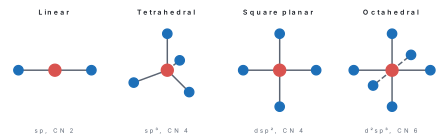
The shape follows from the coordination number and from the hybridisation the metal ion adopts.
| CN | Hybridisation | Shape | Example |
|---|---|---|---|
| 2 | sp | Linear | [Ag(NH₃)₂]⁺, [CuCl₂]⁻ |
| 4 | sp³ | Tetrahedral | [NiCl₄]²⁻, [CoCl₄]²⁻, [Zn(NH₃)₄]²⁺ |
| 4 | dsp² | Square planar | [Ni(CN)₄]²⁻, [PtCl₄]²⁻, [Cu(NH₃)₄]²⁺ |
| 6 | d²sp³ or sp³d² | Octahedral | [Fe(CN)₆]³⁻, [Co(NH₃)₆]³⁺, [Cr(H₂O)₆]³⁺ |
6.5 d-orbitals in complex ions (crystal field theory, octahedral complex)
Valence-bond theory gives the shapes but says nothing about colour or about why some complexes are strongly magnetic and others are not. Crystal field theory (CFT) does both. Its postulates:
- The metal–ligand bond is purely electrostatic — the ligands are treated as point negative charges (or as the negative end of dipoles).
- In a free gaseous metal ion the five d orbitals are degenerate (equal in energy).
- When ligands approach, they repel the d electrons. Orbitals that point directly at the ligands are raised in energy more than those that point between them, so the degeneracy is lifted.
In an octahedral field the six ligands approach along the x, y and z axes. The d_{z^{2}} and d_{x^{2}-y^{2}} orbitals point straight at them and are raised; the d_{xy}, d_{yz} and d_{zx} orbitals point between the axes and are lowered.
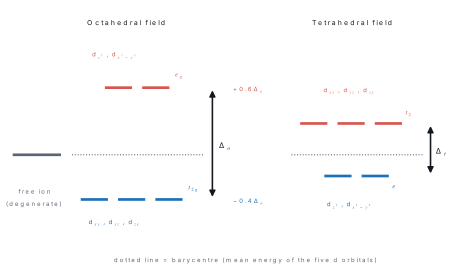
The energy gap \Delta_{o} is the crystal field splitting energy. The three t_{2g} orbitals fall by 0.4\Delta_{o} and the two e_{g} orbitals rise by 0.6\Delta_{o}, so the average energy (the barycentre) is unchanged.
Crystal field stabilisation energy (CFSE) is the net energy gained by placing the d electrons in the split set:
High spin or low spin? For d⁴ to d⁷ there are two ways to fill the orbitals, and the winner depends on how \Delta_{o} compares with the pairing energy P needed to force two electrons into one orbital:
- If \Delta_{o} < P (weak field ligand), electrons spread out to give the maximum number of unpaired spins — high spin.
- If \Delta_{o} > P (strong field ligand), the t_{2g} set fills first — low spin.
I⁻ < Br⁻ < Cl⁻ < F⁻ < OH⁻ < H₂O < NH₃ < en < NO₂⁻ < CN⁻ < CO
Halides are weak (small \Delta, high spin, pale colours); cyanide and carbonyl are strong (large \Delta, low spin, deep colours).
Problem. Both [Fe(H₂O)₆]²⁺ and [Fe(CN)₆]⁴⁻ contain Fe(II). Explain why the first is strongly paramagnetic and the second is diamagnetic, and calculate the CFSE and the spin-only magnetic moment of each.
Solution. Fe²⁺ is 3d⁶ in both complexes.
[Fe(H₂O)₆]²⁺. Water is a weak-field ligand, so \Delta_{o} < P and the configuration is high spin, t_{2g}^{4}e_{g}^{2}, with 4 unpaired electrons.
[Fe(CN)₆]⁴⁻. Cyanide is a strong-field ligand, so \Delta_{o} > P and all six electrons pair up in the lower set, t_{2g}^{6}e_{g}^{0}, with no unpaired electrons.
The far larger CFSE is what pays for the pairing energy.
In a tetrahedral field only four ligands approach, and they come between the axes, so the pattern is inverted: the e pair (d_{z^2}, d_{x^2-y^2}) lies lower and the t_2 trio higher. The splitting is much smaller, \Delta_{t} = \frac{4}{9}\Delta_{o}, because there are fewer ligands and none of them points at an orbital. Consequently tetrahedral complexes are almost always high spin.
6.6 Reasons for the colour of transition metal compounds
The splitting \Delta_{o} happens to be about 150–400 kJ mol⁻¹, which matches the energy of visible light. A d electron absorbs a photon and jumps from the t_{2g} level to the e_g level — a d–d transition. The colour we see is the complementary colour of the light absorbed.
| Light absorbed | Wavelength / nm | Colour seen |
|---|---|---|
| Violet | 400–430 | Yellow-green |
| Blue | 450–490 | Orange-yellow |
| Green | 490–560 | Purple / red |
| Yellow | 570–590 | Blue |
| Red | 620–750 | Blue-green |
Three consequences:
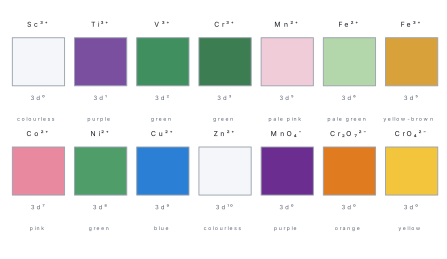
- d⁰ and d¹⁰ ions are colourless — Sc³⁺, Ti⁴⁺, Zn²⁺, Cu⁺, Ag⁺ — because there is either no d electron to promote or no vacancy to promote it into.
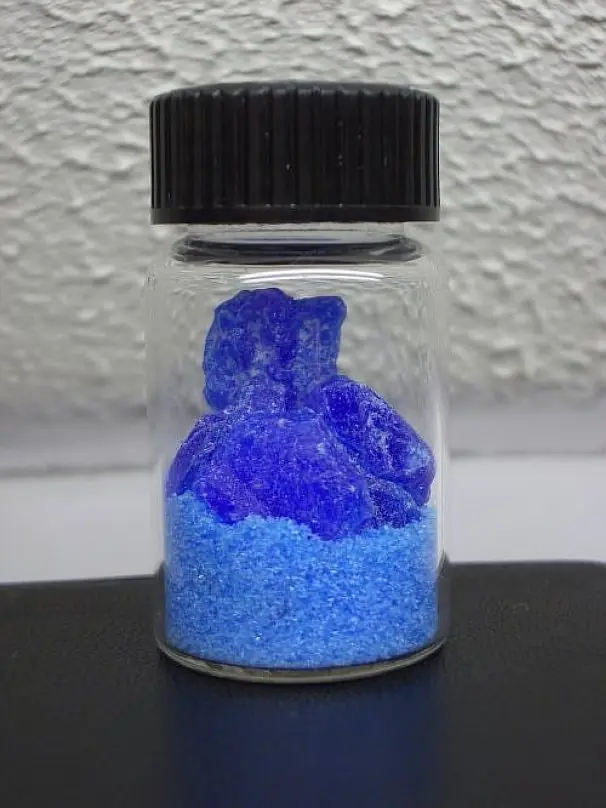
- The ligand changes the colour, because it changes \Delta_{o}. [Cu(H₂O)₄]²⁺ is pale blue while [Cu(NH₃)₄]²⁺ is deep royal blue; ammonia is higher in the spectrochemical series, so it absorbs at shorter wavelength.
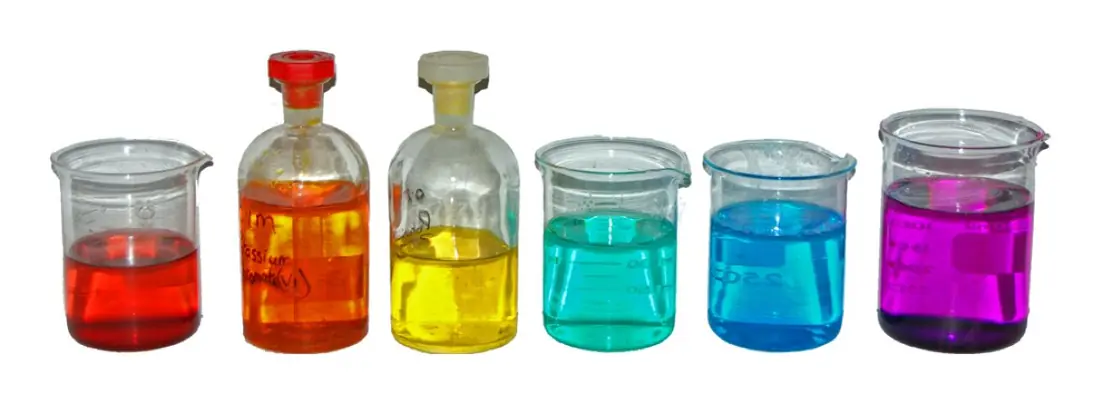
- The oxidation state changes the colour — Fe²⁺ is pale green, Fe³⁺ yellow-brown; Cr³⁺ green, Cr₂O₇²⁻ orange.
In permanganate the manganese is Mn(VII), which is 3d⁰ — there are no d electrons at all, so a d–d jump is impossible. The intense purple comes from charge transfer: a photon shifts an electron from an oxygen lone pair on to the metal. That is why the colour is so much more intense than a normal d–d colour.
Problem. The complex [Ti(H₂O)₆]³⁺ absorbs most strongly at 500 nm. Calculate \Delta_{o} in kJ mol⁻¹ and explain the observed violet colour. (h = 6.626\times10^{-34} J s, c = 3.0\times10^{8} m s⁻¹, N_A = 6.022\times10^{23} mol⁻¹.)
Solution. The energy of one absorbed photon is
Per mole,
Ti³⁺ is 3d¹, so the single electron is promoted t_{2g}^{1} \rightarrow e_{g}^{1} by absorbing green light at 500 nm. The transmitted light is the complement of green, so the solution looks violet-purple.
6.7 Catalytic properties of transition metals
Transition metals and their compounds catalyse an enormous number of reactions. Two mechanisms account for this:
- Variable oxidation state. The metal can hand electrons to one reactant and take them from another, forming an unstable intermediate that provides a lower-energy path. Fe³⁺ catalysing the reaction of iodide with persulphate is the classic example: Fe³⁺ oxidises I⁻ and is then re-oxidised by S₂O₈²⁻.
- Surface adsorption. A metal surface has partly filled d orbitals and unsatisfied valencies, so it adsorbs gaseous reactants, holds them close together in the right orientation, and weakens their bonds. This is heterogeneous catalysis; iron in the Haber process works this way.
| Catalyst | Process | Reaction |
|---|---|---|
| Fe with Mo promoter | Haber process | N₂ + 3H₂ ⇌ 2NH₃ |
| V₂O₅ | Contact process | 2SO₂ + O₂ ⇌ 2SO₃ |
| Pt / Rh gauze | Ostwald process | 4NH₃ + 5O₂ → 4NO + 6H₂O |
| Ni (finely divided) | Hydrogenation of oils to vanaspati ghee | vegetable oil + H₂ → fat |
| MnO₂ | Decomposition of potassium chlorate | 2KClO₃ → 2KCl + 3O₂ |
| TiCl₄ + Al(C₂H₅)₃ | Ziegler–Natta polymerisation | n CH₂=CH₂ → polythene |
| Cu | Dehydrogenation of ethanol | C₂H₅OH → CH₃CHO + H₂ |
Living systems use the same chemistry: the iron in haemoglobin carries oxygen, cobalt sits at the centre of vitamin B₁₂, and zinc is the active site of carbonic anhydrase.
Chapter summary
- A transition element has a partially filled d subshell in the atom or in a common ion. Zn (3d¹⁰4s², Zn²⁺ = 3d¹⁰) is therefore not typical. Cr and Cu have 4s¹ configurations because half-filled and full d subshells are stable.
- Characteristic properties: hardness, high melting point and density, variable oxidation states, coloured and paramagnetic ions, complex formation, catalysis, alloys and interstitial compounds.
- Variable oxidation states arise because 3d and 4s are close in energy. The maximum state rises to +7 at Mn, then falls; the +2 state dominates on the right.
- A complex ion is a central metal ion bonded to ligands by coordinate bonds. \text{EAN} = Z - (\text{oxidation state}) + 2(\text{CN}).
- Shapes: CN 2 linear (sp); CN 4 tetrahedral (sp³) or square planar (dsp²); CN 6 octahedral (d²sp³).
- CFT: in an octahedral field e_g rises by 0.6\Delta_{o} and t_{2g} falls by 0.4\Delta_{o}; \text{CFSE} = (-0.4n_{t_{2g}} + 0.6n_{e_{g}})\Delta_{o}. Weak field (\Delta_{o} < P) gives high spin, strong field gives low spin. In a tetrahedral field the order inverts and \Delta_{t} = \frac{4}{9}\Delta_{o}.
- Colour comes from d–d transitions whose energy matches visible light; d⁰ and d¹⁰ ions are colourless. MnO₄⁻ and Cr₂O₇²⁻ are coloured by charge transfer.
- Spin-only magnetic moment \mu = \sqrt{n(n+2)} BM.
- Catalysis works through variable oxidation states (homogeneous) or surface adsorption (heterogeneous).
Practice questions
Group A — Multiple choice (1 mark each)
- Which of the following is not regarded as a typical transition element? [1]aScbZncFedCr
- The highest oxidation state shown by manganese is [1]a+2b+4c+6d+7
- Which aqueous ion is colourless? [1]aCu²⁺bNi²⁺cZn²⁺dCo²⁺
- The crystal field stabilisation energy of an octahedral d¹ complex is [1]a-0.4\Delta_{o}b-0.6\Delta_{o}c+0.4\Delta_{o}d-1.2\Delta_{o}
- The oxidation state of iron in K₃[Fe(CN)₆] is [1]a+2b+3c+4d0
- The coordination number and shape of [Ni(CN)₄]²⁻ are [1]a4, tetrahedralb4, square planarc6, octahedrald2, linear
Answers to Group A
1. (b) — zinc has a complete 3d¹⁰ subshell in both the atom and the Zn²⁺ ion.
2. (d) — all five 3d and both 4s electrons are used, as in MnO₄⁻.
3. (c) — Zn²⁺ is 3d¹⁰, so no d–d transition is possible.
4. (a) — the single electron occupies a t_{2g} orbital, which lies 0.4\Delta_{o} below the barycentre.
5. (b) — x + 6(-1) = -3, so x = +3.
6. (b) — CN⁻ is a strong-field ligand, forcing dsp² hybridisation.
Group B — Short answer (5 marks each)
- Define a transition element. State any five characteristic properties of transition metals and explain why they show variable oxidation states. [5]
- Why are most transition metal compounds coloured? Explain why Sc³⁺ and Zn²⁺ are colourless, and why the colour of MnO₄⁻ has a different origin. [5]
- Define ligand, coordination number and effective atomic number. Calculate the EAN of the metal in [Cu(NH₃)₄]²⁺ and [Fe(CN)₆]³⁻. (Z: Cu = 29, Fe = 26) [5]
- Distinguish between a double salt and a complex salt, using Mohr's salt and potassium ferrocyanide as examples. [5]
- State the postulates of crystal field theory. Draw the splitting of the d orbitals in an octahedral field and calculate the spin-only magnetic moment of [Mn(H₂O)₆]²⁺. [5]
- Why do transition metals and their compounds act as good catalysts? Give any four industrial catalysts with the process in which each is used. [5]
Answers to Group B
3. A ligand is a molecule or ion with at least one lone pair that it donates to a central metal ion to form a coordinate bond. The coordination number is the number of such bonds. The EAN is Z - (\text{oxidation state}) + 2(\text{CN}).
For [Cu(NH₃)₄]²⁺: \text{EAN} = 29 - 2 + 2(4) = 35.
For [Fe(CN)₆]³⁻: \text{EAN} = 26 - 3 + 2(6) = 35.
5. Mn²⁺ is 3d⁵. Water is a weak-field ligand, so the complex is high spin, t_{2g}^{3}e_{g}^{2}, with n = 5 unpaired electrons:
(The CFSE is [-0.4(3) + 0.6(2)]\Delta_{o} = 0, which is why high-spin d⁵ ions are so pale.)
Group C — Long answer (8 marks each)
- (a) Discuss the variation of oxidation states across the 3d series and explain why the +2 state becomes increasingly stable towards the right-hand end. [4](b) Give the hybridisation, shape and coordination number of [Ag(NH₃)₂]⁺, [NiCl₄]²⁻, [Ni(CN)₄]²⁻ and [Co(NH₃)₆]³⁺. [4]
- (a) State the postulates of crystal field theory. Explain the splitting of the d orbitals in octahedral and in tetrahedral fields, and state the relation between \Delta_{t} and \Delta_{o}. [5](b) [Fe(H₂O)₆]²⁺ has four unpaired electrons whereas [Fe(CN)₆]⁴⁻ has none, although both contain Fe(II). Explain, and calculate the CFSE of each. [3]
Answers to Group C
1.(a) The lowest common state is +2 (loss of the two 4s electrons) and the highest rises steadily from +3 at Sc to +7 at Mn, where all five 3d electrons plus both 4s electrons can be used. Beyond Mn the nuclear charge keeps growing while the d electrons are added to the same shell, so the effective nuclear charge rises and the ionisation energies climb steeply. The 3d electrons are then held too tightly to be removed, and only the 4s pair is easily lost — hence Fe (+2, +3), Co (+2), Ni (+2), Cu (+1, +2), Zn (+2 only).
1.(b)
| Complex | CN | Hybridisation | Shape |
|---|---|---|---|
| [Ag(NH₃)₂]⁺ | 2 | sp | Linear |
| [NiCl₄]²⁻ | 4 | sp³ | Tetrahedral |
| [Ni(CN)₄]²⁻ | 4 | dsp² | Square planar |
| [Co(NH₃)₆]³⁺ | 6 | d²sp³ | Octahedral |
2.(b) Fe²⁺ is 3d⁶ in both. H₂O is a weak-field ligand, so \Delta_{o} < P and the electrons spread out over all five orbitals, t_{2g}^{4}e_{g}^{2}, leaving four unpaired: high spin, and \text{CFSE} = [-0.4(4) + 0.6(2)]\Delta_{o} = -0.4\Delta_{o}.
CN⁻ is a strong-field ligand, so \Delta_{o} > P; it costs less energy to pair the electrons than to promote them, giving t_{2g}^{6}e_{g}^{0} with no unpaired electrons: low spin, diamagnetic, and \text{CFSE} = -0.4(6)\Delta_{o} = -2.4\Delta_{o}.
Practise more: Chemistry question bank