Unit 16 · Organic Chemistry · 7 teaching hours · 22 min read
Amines
What the syllabus asks for 10
- Aliphatic amines: introduction, nomenclature, classification, isomerism
- Separation of 1, 2, 3 amines by Hoffmann's method
- Preparation of primary amines from haloalkane, nitriles, nitroalkanes and amides
- Physical properties; basicity and comparative basic nature of 1, 2, 3 amines
- Reaction of primary amines with chloroform, conc. HCl, R-X, RCOX and nitrous acid
- Test of 1, 2, 3 amines (nitrous acid test)
- Aniline: preparation from nitrobenzene and phenol; physical properties
- Basicity of aniline compared with aliphatic amines and ammonia
- Alkylation, acylation, diazotization, carbylamine and coupling reaction
- Electrophilic substitution: nitration, sulphonation, bromination; uses
Amines are the organic descendants of ammonia: replace one, two or three of the hydrogens of NH₃ by alkyl or aryl groups and you get a primary, secondary or tertiary amine. The nitrogen keeps its lone pair throughout, and almost the whole chapter — basicity, salt formation, alkylation, acylation, diazotisation — is that one lone pair doing chemistry. Amines are also the largest single family of biologically active molecules: adrenaline, nicotine, quinine and most of the drugs in a Nepali pharmacy are amines.
Four high-value items: the comparative basicity of 1°, 2°, 3° amines and of aniline (with reasons); distinguishing 1°, 2° and 3° amines by the nitrous acid and carbylamine tests; Hoffmann's separation of an amine mixture; and the reactions of aniline — diazotisation, coupling, and why nitration needs the amino group protected first.
16.1 Aliphatic amines: introduction, nomenclature, classification, isomerism
An amine is a compound derived from ammonia by replacing one or more hydrogen atoms by alkyl or aryl groups. It is primary (1°), secondary (2°) or tertiary (3°) according to whether one, two or three hydrogens have been replaced — that is, by the number of carbon atoms attached to nitrogen.
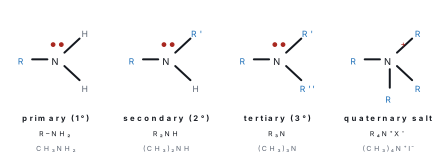
In the IUPAC system an amine is named as an alkanamine: drop the -e of the alkane and add -amine. Groups on the nitrogen itself are prefixed with N-.
| Formula | IUPAC name | Common name | Class |
|---|---|---|---|
| CH₃NH₂ | methanamine | methylamine | 1° |
| CH₃CH₂CH₂NH₂ | propan-1-amine | n-propylamine | 1° |
| (CH₃)₂CHNH₂ | propan-2-amine | isopropylamine | 1° |
| CH₃NHCH₂CH₃ | N-methylethanamine | ethylmethylamine | 2° |
| (CH₃)₃N | N,N-dimethylmethanamine | trimethylamine | 3° |
| C₆H₅NH₂ | benzenamine | aniline | 1° (aromatic) |
| (CH₃)₄N⁺I⁻ | tetramethylammonium iodide | — | quaternary |
Amines show chain, position and functional (metameric) isomerism, and those with a chiral carbon also show optical isomerism. C₃H₉N has exactly four isomers, spread over all three classes:
| Isomer | Name | Class |
|---|---|---|
| CH₃CH₂CH₂NH₂ | propan-1-amine | 1° |
| (CH₃)₂CHNH₂ | propan-2-amine | 1° |
| CH₃CH₂NHCH₃ | N-methylethanamine | 2° |
| (CH₃)₃N | N,N-dimethylmethanamine | 3° |
16.2 Separation of 1°, 2° and 3° amines by Hoffmann's method
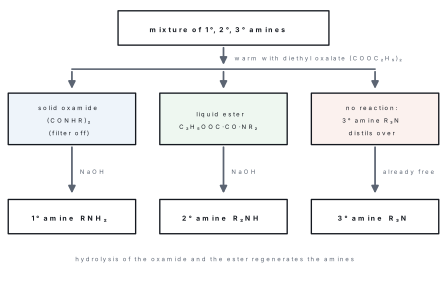
Ammonolysis of a haloalkane gives all three amines at once, so a method of separating them is needed. Hoffmann's method uses diethyl oxalate, (COOC₂H₅)₂, which reacts differently with each class.
(COOC₂H₅)₂ + 2RNH₂ → (CONHR)₂ + 2C₂H₅OH (a solid dialkyl oxamide)
(COOC₂H₅)₂ + R₂NH → C₂H₅OOC–CO–NR₂ + C₂H₅OH (a liquid oxamic ester)
R₃N + (COOC₂H₅)₂ → no reaction (no hydrogen on nitrogen)
The three are then separated physically and the original amines recovered by hydrolysis with alkali:
(CONHR)₂ + 2NaOH → 2RNH₂ + (COONa)₂
16.3 Preparation of primary amines
| Route | Reagents | Equation | Carbon change |
|---|---|---|---|
| From haloalkane (ammonolysis) | excess NH₃(alc.), 373 K, sealed tube | C₂H₅Br + 2NH₃ → C₂H₅NH₂ + NH₄Br | same |
| From nitrile (reduction) | Na + C₂H₅OH (Mendius), or LiAlH₄, or H₂/Ni | CH₃CN + 4[H] → CH₃CH₂NH₂ | one more C |
| From nitroalkane (reduction) | Sn/HCl or H₂/Ni | CH₃NO₂ + 6[H] → CH₃NH₂ + 2H₂O | same |
| From amide (reduction) | LiAlH₄ | CH₃CONH₂ + 4[H] → CH₃CH₂NH₂ + H₂O | same |
| From amide (Hofmann bromamide) | Br₂ + 4NaOH | CH₃CONH₂ + Br₂ + 4NaOH → CH₃NH₂ + Na₂CO₃ + 2NaBr + 2H₂O | one fewer C |
The amine formed in C₂H₅Br + NH₃ is itself a nucleophile, so it attacks more haloalkane: the product is a mixture of 1°, 2°, 3° amine and the quaternary salt. A large excess of ammonia is used to push the first step and suppress the rest. If a question asks for a pure primary amine, choose the Hofmann bromamide reaction or reduction of a nitrile or nitro compound instead.
The two amide routes are worth contrasting because they change the carbon skeleton in opposite directions: LiAlH₄ reduction of ethanamide keeps both carbons and gives ethylamine, whereas Hofmann bromamide degradation of the same ethanamide loses a carbon as carbonate and gives methylamine.
16.4 Physical properties, basicity and comparative basic nature
Physical properties. Methylamine, dimethylamine and trimethylamine are gases; the next members are liquids with a strong fishy, ammoniacal smell (the smell of stale fish is largely trimethylamine). 1° and 2° amines have N–H bonds and associate by hydrogen bonding, but 3° amines have none — so for the same molecular mass the boiling point falls in the order 1° > 2° > 3°.
| Compound (C₃H₉N, M = 59) | Class | N–H bonds | b.p. (°C) |
|---|---|---|---|
| Propan-1-amine | 1° | 2 | 48 |
| N-Methylethanamine | 2° | 1 | 37 |
| Trimethylamine | 3° | 0 | 3 |
| Propan-1-ol (for comparison, M = 60) | — | — | 97 |
All amines can accept hydrogen bonds from water, so the lower members are freely water-soluble; solubility falls as the hydrocarbon chain grows. Amines boil lower than alcohols of similar mass because N is less electronegative than O, so the N···H–N hydrogen bond is weaker than O···H–O.
Basicity. The lone pair accepts a proton, so an amine is both a Brønsted and a Lewis base:
RNH₂ + H₂O ⇌ RNH₃⁺ + OH⁻
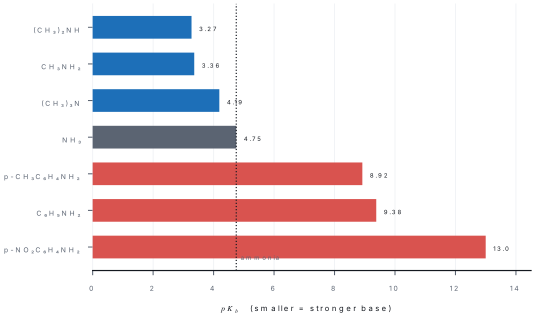
A larger K_b — and therefore a smaller pK_b — means a stronger base. For a conjugate pair, pK_a + pK_b = 14 at 25 °C.
Three effects compete:
- +I effect of alkyl groups pushes electron density onto nitrogen, making the lone pair more available. On this count alone, 3° > 2° > 1° > NH₃.
- Solvation of the cation. The more N–H bonds the cation has, the more hydrogen bonds it makes with water, and the more stable it is. Here 1° > 2° > 3°.
- Steric hindrance. Three bulky groups crowd the nitrogen in a 3° amine and block both the incoming proton and the solvating water molecules.
In water the compromise gives, for the methyl series,
(CH₃)₂NH > CH₃NH₂ > (CH₃)₃N > NH₃
and for the ethyl series (C₂H₅ is a better electron donor than CH₃),
(C₂H₅)₂NH > (C₂H₅)₃N > C₂H₅NH₂ > NH₃
In the gas phase there is no water, so solvation cannot interfere and the order is the pure inductive one: 3° > 2° > 1° > NH₃. Quoting this shows the examiner you know why trimethylamine is out of place in water — it is a solvation effect, not an electronic one.
Worked example 16.1 — pH of an amine solution
Problem. Calculate the pH of a 0.10 mol dm⁻³ solution of methylamine. K_b = 4.4\times 10^{-4}.
Solution. For a weak base, CH₃NH₂ + H₂O ⇌ CH₃NH₃⁺ + OH⁻, with c \gg K_b:
The solution is strongly basic, as expected for a base about 25 times stronger than ammonia.
16.5 Reactions of primary amines
| Reagent | Product | Remark |
|---|---|---|
| CHCl₃ + alcoholic KOH, warm | alkyl isocyanide (carbylamine), R–NC | RNH₂ + CHCl₃ + 3KOH → RNC + 3KCl + 3H₂O — only 1° amines, foul smell |
| conc. HCl | alkylammonium chloride, RNH₃⁺Cl⁻ | shows basic character; NaOH regenerates the amine |
| R'–X (alkylation) | 2° → 3° amine → quaternary salt | exhaustive alkylation; the amine is the nucleophile |
| R'COCl or (R'CO)₂O (acylation) | N-substituted amide, R–NHCOR' | CH₃NH₂ + CH₃COCl → CH₃NHCOCH₃ + HCl; pyridine removes the HCl |
| HNO₂ (NaNO₂ + HCl, 0–5 °C) | alcohol + N₂↑ | RNH₂ + HNO₂ → ROH + N₂↑ + H₂O — brisk effervescence |
The carbylamine (Hofmann isocyanide) reaction is the quickest test for a primary amine — the isocyanide has an extremely unpleasant smell and neither 2° nor 3° amines give it:
CH₃NH₂ + CHCl₃ + 3KOH → CH₃NC + 3KCl + 3H₂O
Acylation converts a strongly basic, easily oxidised –NH₂ into a mild, stable amide. That is why acylation is used as a protecting group (see §16.10).
16.6 Test of 1°, 2° and 3° amines
Nitrous acid, made in situ from NaNO₂ and dilute HCl at 0–5 °C, gives a different result with each class.
| Amine | Reaction with HNO₂ | Observation |
|---|---|---|
| 1° aliphatic | RNH₂ + HNO₂ → ROH + N₂↑ + H₂O | brisk effervescence of N₂, no gas left in the tube |
| 2° | R₂NH + HNO₂ → R₂N–NO + H₂O | yellow oily N-nitrosoamine separates |
| 3° aliphatic | R₃N + HNO₂ → [R₃NH]⁺NO₂⁻ | clear solution only — a salt, no gas, no oil |
| 1° aromatic (aniline), 0–5 °C | C₆H₅NH₂ + NaNO₂ + 2HCl → C₆H₅N₂⁺Cl⁻ + NaCl + 2H₂O | clear solution; adding alkaline 2-naphthol gives an orange-red dye |
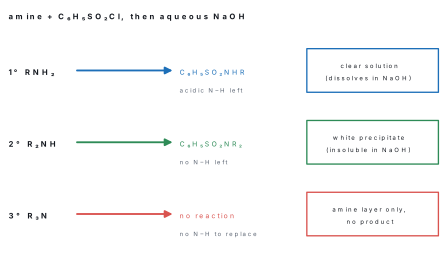
A second, cleaner test is Hinsberg's test with benzenesulphonyl chloride, C₆H₅SO₂Cl, followed by aqueous NaOH.
Problem. Bottles P, Q and R contain propan-1-amine, N-methylethanamine and trimethylamine in some order. On treatment with NaNO₂ + dilute HCl at 5 °C, P gives a yellow oil, Q effervesces briskly and R gives only a clear solution. Identify P, Q and R and confirm Q by a second test.
Solution.
- Brisk effervescence of N₂ means a 1° aliphatic amine, so Q = propan-1-amine, CH₃CH₂CH₂NH₂ (CH₃CH₂CH₂NH₂ + HNO₂ → CH₃CH₂CH₂OH + N₂↑ + H₂O).
- A yellow oily layer is an N-nitrosoamine, so P = N-methylethanamine (CH₃NHC₂H₅ + HNO₂ → CH₃N(NO)C₂H₅ + H₂O).
- Only a salt is formed with the 3° amine, so R = trimethylamine ((CH₃)₃N + HNO₂ → [(CH₃)₃NH]⁺NO₂⁻).
Confirmation of Q: warm with chloroform and alcoholic KOH. Only the primary amine gives the vile-smelling carbylamine, CH₃CH₂CH₂NH₂ + CHCl₃ + 3KOH → CH₃CH₂CH₂NC + 3KCl + 3H₂O. Alternatively, Hinsberg's test on Q gives a sulphonamide that dissolves in NaOH, while P's does not.
16.7 Aniline: preparation from nitrobenzene and phenol; physical properties
From nitrobenzene (the industrial and laboratory route) — reduce in an acidic medium:
C₆H₅NO₂ + 6[H] --Sn/conc. HCl--> C₆H₅NH₂ + 2H₂O
Using cheaper iron filings with a little HCl (the Béchamp reduction):
4C₆H₅NO₂ + 9Fe + 4H₂O → 4C₆H₅NH₂ + 3Fe₃O₄
From phenol — heat with ammonia over a zinc chloride (or alumina) catalyst at about 300–350 °C under pressure:
C₆H₅OH + NH₃ --ZnCl₂, 300 °C--> C₆H₅NH₂ + H₂O
Physical properties. Pure aniline is a colourless oily liquid, but it darkens to reddish-brown on standing because air oxidises it. It has a characteristic unpleasant smell, b.p. 184 °C, m.p. −6 °C, density 1.02 g cm⁻³. It is only slightly soluble in water (about 3.6 g per 100 g at 25 °C) but miscible with ethanol, ether and benzene, is steam-volatile, and is poisonous — it is absorbed through the skin and causes methaemoglobinaemia.
16.8 Basicity of aniline compared with aliphatic amines and ammonia
Aniline (pK_b = 9.38) is about a million times weaker a base than methylamine (pK_b = 3.36) and much weaker than ammonia (pK_b = 4.75). Two reasons, both about availability of the lone pair:
- Resonance. The nitrogen lone pair is conjugated with the benzene ring and is delocalised over the ortho and para carbons. A delocalised pair is not free to bond a proton. In an aliphatic amine there is no such delocalisation.
- Loss of resonance energy on protonation. In the anilinium ion C₆H₅NH₃⁺ the lone pair is tied up in the N–H bond, so the delocalisation is destroyed and the ion is less stabilised relative to the free base. The equilibrium therefore lies to the left.
A third, smaller contribution: the nitrogen of aniline is close to sp², and the greater s-character holds the lone pair nearer the nucleus.
Substituents on the ring shift the value predictably — electron-releasing groups raise basicity, electron-withdrawing groups lower it:
| Base | pK_b | Comment |
|---|---|---|
| (CH₃)₂NH | 3.27 | strongest here; two +I groups |
| CH₃NH₂ | 3.36 | +I effect, no resonance |
| NH₃ | 4.75 | reference |
| p-Toluidine, p-CH₃C₆H₄NH₂ | 8.92 | –CH₃ releases electrons |
| Aniline | 9.38 | lone pair delocalised into ring |
| p-Nitroaniline | 13.0 | –NO₂ withdraws strongly; almost neutral |
Overall: aliphatic amine > ammonia > aniline > diphenylamine > triphenylamine.
16.9 Alkylation, acylation, diazotisation, carbylamine and coupling
| Reaction | Reagents and conditions | Product |
|---|---|---|
| Alkylation | CH₃I, then more CH₃I | C₆H₅NHCH₃ (N-methylaniline) → C₆H₅N(CH₃)₂ → quaternary salt |
| Acylation | (CH₃CO)₂O or CH₃COCl / pyridine | C₆H₅NHCOCH₃, acetanilide (m.p. 114 °C) + CH₃COOH |
| Benzoylation | C₆H₅COCl + NaOH (Schotten–Baumann) | C₆H₅NHCOC₆H₅, benzanilide |
| Diazotisation | NaNO₂ + 2HCl, 0–5 °C | C₆H₅N₂⁺Cl⁻, benzenediazonium chloride |
| Carbylamine | CHCl₃ + alcoholic KOH | C₆H₅NC, phenyl isocyanide (foul smell) |
| Coupling | C₆H₅N₂⁺Cl⁻ + phenol, NaOH, pH 9–10 | p-HO–C₆H₄–N=N–C₆H₅, an orange azo dye |
| Coupling | C₆H₅N₂⁺Cl⁻ + aniline, weakly acidic | p-H₂N–C₆H₄–N=N–C₆H₅, aniline yellow |
Written out, the two reactions that carry the most marks are:
C₆H₅NH₂ + NaNO₂ + 2HCl --0–5 °C--> C₆H₅N₂⁺Cl⁻ + NaCl + 2H₂O
C₆H₅N₂⁺Cl⁻ + C₆H₅OH --NaOH, 0–5 °C--> p-HO–C₆H₄–N=N–C₆H₅ + HCl
Benzenediazonium chloride decomposes above about 5 °C: C₆H₅N₂⁺Cl⁻ + H₂O → C₆H₅OH + N₂↑ + HCl. Every diazotisation and every coupling must be written at 0–5 °C; omitting the temperature is the commonest lost mark in this unit. Coupling with a phenol needs weak alkali, coupling with an amine needs weak acid — the diazonium ion is a feeble electrophile and needs an activated ring.
Azo coupling is the chemistry behind most synthetic textile dyes, and the –N=N– chromophore is why they are coloured at all.
16.10 Electrophilic substitution in aniline; uses
The –NH₂ group is strongly activating and ortho/para-directing, so aniline reacts far faster than benzene. Two complications follow:
- In the strongly acidic nitrating mixture, aniline is protonated to the anilinium ion, –NH₃⁺, which is meta-directing. Direct nitration therefore gives a poor mixture containing roughly half m-nitroaniline.
- Nitric acid also oxidises aniline to tarry products.
The answer is to protect the nitrogen by acetylation first.
| Reaction | Conditions | Product |
|---|---|---|
| Nitration (direct) | conc. HNO₃ + H₂SO₄ | mixture: o-, p- and about 47 % m-nitroaniline |
| Nitration (correct route) | acetylate → HNO₃/H₂SO₄ at 288 K → hydrolyse | p-nitroaniline |
| Sulphonation | conc. H₂SO₄, then bake at 180–200 °C | sulphanilic acid, p-H₂N–C₆H₄–SO₃H (a zwitterion) |
| Bromination | Br₂ in water, room temperature | 2,4,6-tribromoaniline, white precipitate, at once |
| Bromination (monosubstitution) | acetylate → Br₂/CH₃COOH → hydrolyse | p-bromoaniline |
C₆H₅NH₂ + 3Br₂ → 2,4,6-C₆H₂Br₃(NH₂) + 3HBr
Uses of aniline and amines. Aniline is the feedstock for azo dyes (aniline yellow, methyl orange, indigo), for sulpha drugs via sulphanilic acid, for paracetamol, for rubber vulcanisation accelerators and antioxidants, for polyurethane precursors, and in black printing ink and shoe polish. Aliphatic amines are used as solvents, as corrosion inhibitors in boiler water, in making nylon-6,6 (hexamethylenediamine), quaternary ammonium salts as cationic detergents and disinfectants, and as intermediates for almost every synthetic drug.
Problem. 11.8 g of ethanamide (acetamide) is treated with bromine and sodium hydroxide. Calculate the mass of amine obtained if the yield is 80 %. Name the amine. (C = 12, H = 1, N = 14, O = 16, Br = 80)
Solution. The reaction removes one carbon:
CH₃CONH₂ + Br₂ + 4NaOH → CH₃NH₂ + Na₂CO₃ + 2NaBr + 2H₂O
Molar mass of CH₃CONH₂ = 2(12) + 5(1) + 14 + 16 = 59 g mol⁻¹.
Moles of ethanamide = 11.8 / 59 = 0.200 mol.
Stoichiometry is 1 : 1, so theoretical methylamine = 0.200 mol. Molar mass of CH₃NH₂ = 12 + 5 + 14 = 31 g mol⁻¹, so theoretical mass = 0.200 × 31 = 6.20 g.
Actual mass = 6.20 × 0.80 = 4.96 g of methylamine (a primary amine with one carbon fewer than the amide).
Problem. Explain, with equations, why p-nitroaniline cannot be made by nitrating aniline directly, and give a workable four-step synthesis from nitrobenzene.
Solution. In the nitrating mixture, aniline is first protonated:
C₆H₅NH₂ + H₂SO₄ → C₆H₅NH₃⁺ + HSO₄⁻
The anilinium ion has no lone pair on nitrogen; –NH₃⁺ is electron-withdrawing and meta-directing, so a large fraction of m-nitroaniline is formed, and HNO₃ also oxidises part of the aniline to tar.
Workable route:
- C₆H₅NO₂ + 6[H] --Sn/HCl--> C₆H₅NH₂ + 2H₂O
- C₆H₅NH₂ + (CH₃CO)₂O → C₆H₅NHCOCH₃ + CH₃COOH (protect the nitrogen)
- C₆H₅NHCOCH₃ + HNO₃ --H₂SO₄, 288 K--> p-NO₂–C₆H₄–NHCOCH₃ + H₂O
- p-NO₂–C₆H₄–NHCOCH₃ + H₂O --H⁺, heat--> p-NO₂–C₆H₄–NH₂ + CH₃COOH
The acetyl group is only weakly basic, so it is not protonated; it keeps the directing effect ortho/para while reducing the activation enough to stop polysubstitution and oxidation.
Chapter summary
- Amines are 1° (RNH₂), 2° (R₂NH) or 3° (R₃N) by the number of carbons on nitrogen; IUPAC names them alkanamines, with N- prefixes for groups on nitrogen. C₃H₉N has four isomers covering all three classes.
- Hoffmann's method separates a mixture with diethyl oxalate: 1° → solid oxamide, 2° → liquid oxamic ester, 3° → no reaction; alkaline hydrolysis returns each amine.
- Primary amines: C₂H₅Br + 2NH₃ → C₂H₅NH₂ + NH₄Br; CH₃CN + 4[H] → CH₃CH₂NH₂ (one more C); CH₃NO₂ + 6[H] → CH₃NH₂ + 2H₂O; CH₃CONH₂ + Br₂ + 4NaOH → CH₃NH₂ + Na₂CO₃ + 2NaBr + 2H₂O (one fewer C).
- Boiling point 1° > 2° > 3° at equal mass (hydrogen bonding); amines boil below alcohols of similar mass.
- K_b = [\mathrm{RNH_3^+}][\mathrm{OH^-}]/[\mathrm{RNH_2}], and smaller pK_b means stronger base. In water: (CH₃)₂NH > CH₃NH₂ > (CH₃)₃N > NH₃; in the gas phase 3° > 2° > 1° > NH₃.
- Aniline (pK_b = 9.38) is a far weaker base than ammonia because its lone pair is delocalised into the ring and that stabilisation is lost on protonation.
- Distinguishing tests: HNO₂ gives N₂ effervescence (1°), a yellow nitrosoamine oil (2°) or just a salt (3°); CHCl₃ + alcoholic KOH gives the foul carbylamine only with 1°; Hinsberg's sulphonamide dissolves in NaOH only for 1°.
- Diazotisation at 0–5 °C: C₆H₅NH₂ + NaNO₂ + 2HCl → C₆H₅N₂⁺Cl⁻ + NaCl + 2H₂O; the diazonium salt couples with phenol (weak alkali) or aniline (weak acid) to give azo dyes.
- Aniline gives 2,4,6-tribromoaniline at once with bromine water, sulphanilic acid on baking with H₂SO₄, and needs acetyl protection before nitration to give p-nitroaniline.
Practice questions
Group A — Multiple choice (1 mark each)
- The number of structural isomers of C₃H₉N is [1]a2b3c4d5
- Which one gives brisk effervescence of nitrogen with nitrous acid at 5 °C? [1]a(CH₃)₃NbCH₃NHCH₃cCH₃CH₂NH₂dC₆H₅N(CH₃)₂
- The correct order of basic strength in aqueous solution is [1]a(CH₃)₃N > (CH₃)₂NH > CH₃NH₂ > NH₃b(CH₃)₂NH > CH₃NH₂ > (CH₃)₃N > NH₃cNH₃ > CH₃NH₂ > (CH₃)₂NH > (CH₃)₃NdCH₃NH₂ > (CH₃)₂NH > NH₃ > (CH₃)₃N
- Aniline is a weaker base than ammonia because [1]ait is a liquidbits lone pair is delocalised into the ringcit is aromaticdnitrogen is sp³ hybridised
- Benzenediazonium chloride is prepared at 0–5 °C because [1]athe reaction is exothermicbit decomposes to phenol and N₂ above 5 °Ccaniline freezesdHCl evaporates
- The Hinsberg product of a secondary amine is [1]asoluble in NaOHbinsoluble in NaOHca gasdnot formed
Answers to Group A
1. (c) — two 1° amines, one 2° and one 3°.
2. (c) — only a 1° aliphatic amine gives an unstable diazonium salt that releases N₂.
3. (b) — the compromise between +I effect, cation solvation and steric hindrance.
4. (b) — delocalisation removes the lone pair from service, and the anilinium ion loses that resonance energy.
5. (b) — C₆H₅N₂⁺Cl⁻ + H₂O → C₆H₅OH + N₂↑ + HCl.
6. (b) — C₆H₅SO₂NR₂ has no acidic N–H, so it cannot form a sodium salt.
Group B — Short answer (5 marks each)
- Classify amines with one example each, and write the four structural isomers of C₃H₉N with their IUPAC names. [5]
- Describe Hoffmann's method for separating a mixture of 1°, 2° and 3° amines, with equations. [5]
- Arrange CH₃NH₂, (CH₃)₂NH, (CH₃)₃N and NH₃ in order of basic strength in water and justify the order. Why does the order change in the gas phase? [5]
- How will you distinguish between propan-1-amine, N-methylethanamine and trimethylamine? Give reagents, equations and observations. [5]
- Calculate the pH of a 0.050 mol dm⁻³ solution of ethylamine (K_b = 5.0\times10^{-4}). [5]
- What is diazotisation? Give the equation and explain the coupling reaction of benzenediazonium chloride with phenol. [5]
Answers to Group B
1. See §16.1: 1° R–NH₂ (CH₃NH₂), 2° R₂NH ((CH₃)₂NH), 3° R₃N ((CH₃)₃N). Isomers of C₃H₉N: propan-1-amine, propan-2-amine (both 1°), N-methylethanamine (2°), N,N-dimethylmethanamine (3°).
2. Warm the mixture with diethyl oxalate. 1° → solid oxamide, (COOC₂H₅)₂ + 2RNH₂ → (CONHR)₂ + 2C₂H₅OH; 2° → liquid oxamic ester, (COOC₂H₅)₂ + R₂NH → C₂H₅OOC·CO·NR₂ + C₂H₅OH; 3° does not react and distils over unchanged. Filter the solid from the liquid, then hydrolyse each with NaOH: (CONHR)₂ + 2NaOH → 2RNH₂ + (COONa)₂.
3. In water: (CH₃)₂NH > CH₃NH₂ > (CH₃)₃N > NH₃. Alkyl groups release electrons (+I), so replacing H by CH₃ increases the electron density on nitrogen; but each replacement also removes one N–H from the cation, reducing hydrogen-bonded solvation, and three methyl groups sterically crowd the nitrogen. Two methyls give the best balance. In the gas phase there is no solvent, so only the +I effect operates and the order becomes (CH₃)₃N > (CH₃)₂NH > CH₃NH₂ > NH₃.
4. Use NaNO₂ + dilute HCl at 0–5 °C. Propan-1-amine: brisk N₂, C₃H₇NH₂ + HNO₂ → C₃H₇OH + N₂↑ + H₂O. N-Methylethanamine: yellow oil, CH₃NHC₂H₅ + HNO₂ → CH₃N(NO)C₂H₅ + H₂O. Trimethylamine: clear solution of [(CH₃)₃NH]⁺NO₂⁻ only. Confirm the first with the carbylamine test, C₃H₇NH₂ + CHCl₃ + 3KOH → C₃H₇NC + 3KCl + 3H₂O.
5. [\mathrm{OH^-}] = \sqrt{K_bc} = \sqrt{5.0\times10^{-4}\times0.050} = \sqrt{2.5\times10^{-5}} = 5.0\times10^{-3} mol dm⁻³. So pOH = 2.30 and pH = 11.70.
6. Diazotisation is the conversion of a primary aromatic amine into a diazonium salt with nitrous acid at 0–5 °C: C₆H₅NH₂ + NaNO₂ + 2HCl → C₆H₅N₂⁺Cl⁻ + NaCl + 2H₂O. The diazonium ion is a weak electrophile, so it attacks only a strongly activated ring. With phenol in weak alkali (pH 9–10, which generates the more reactive phenoxide) it substitutes at the para position: C₆H₅N₂⁺Cl⁻ + C₆H₅OH → p-HO–C₆H₄–N=N–C₆H₅ + HCl, an orange azo dye.
Group C — Long answer (8 marks each)
- (a) How is aniline prepared from nitrobenzene and from phenol? Give equations and conditions. [3](b) Compare the basicity of aniline with that of methylamine and ammonia, with reasons. [3](c) Why does bromine water give 2,4,6-tribromoaniline immediately, whereas p-bromoaniline needs a three-step route? [2]
- (a) Give the reactions of a primary amine with chloroform and alcoholic KOH, with an acid chloride, with an alkyl halide and with nitrous acid. [4](b) 8.85 g of ethanamide is subjected to the Hofmann bromamide reaction with a 70 % yield. Name the product and calculate its mass. [4]
Answers to Group C
1. (a) C₆H₅NO₂ + 6[H] --Sn/conc. HCl--> C₆H₅NH₂ + 2H₂O (industrially 4C₆H₅NO₂ + 9Fe + 4H₂O → 4C₆H₅NH₂ + 3Fe₃O₄); and C₆H₅OH + NH₃ --ZnCl₂, 300 °C, pressure--> C₆H₅NH₂ + H₂O. (b) Basicity CH₃NH₂ (pK_b 3.36) > NH₃ (4.75) > C₆H₅NH₂ (9.38). Methylamine is strengthened by the +I effect of CH₃; aniline is weakened because the lone pair is delocalised into the ring and because the anilinium ion loses that resonance stabilisation on protonation. (c) –NH₂ is so strongly activating that all three free ortho/para positions react at once with bromine water, giving the tribromo compound. Acetylation moderates the activation (and the bulky group blocks the ortho positions), so bromination then stops at the para position; hydrolysis afterwards frees the amine.
2. (a) Carbylamine: RNH₂ + CHCl₃ + 3KOH → RNC + 3KCl + 3H₂O. Acylation: CH₃NH₂ + CH₃COCl → CH₃NHCOCH₃ + HCl. Alkylation: CH₃NH₂ + CH₃I → (CH₃)₂NH·HI, continuing to (CH₃)₃N and (CH₃)₄N⁺I⁻. Nitrous acid: RNH₂ + HNO₂ → ROH + N₂↑ + H₂O. (b) Moles of CH₃CONH₂ = 8.85 / 59 = 0.150 mol. The product is methylamine, CH₃NH₂ (M = 31). Theoretical mass = 0.150 × 31 = 4.65 g; at 70 % yield, mass = 4.65 × 0.70 = 3.26 g.
Practise more: Chemistry question bank