Unit 4 · General and Physical Chemistry · 8 teaching hours · 26 min read
Thermodynamics
What the syllabus asks for 10
- Introduction; energy in chemical reactions
- Internal energy
- First law of thermodynamics
- Enthalpy and enthalpy changes (endothermic and exothermic)
- Enthalpy of reaction, solution, formation, combustion
- Laws of thermochemistry: Laplace law and Hess's law
- Entropy and spontaneity
- Second law of thermodynamics
- Gibbs free energy and prediction of spontaneity
- Relationship between dG and equilibrium constant
Every chemical change moves energy about. Burning a cylinder of LPG in a Kathmandu kitchen releases heat; dissolving ammonium nitrate in water makes the beaker go cold. Thermodynamics is the book-keeping that tells us how much energy moves, in which direction, and — most usefully — whether a reaction will happen at all without being pushed. Three quantities do all the work: enthalpy H, entropy S and Gibbs free energy G.
Four things, nearly every year: the first law with a sign-convention numerical, a Hess's law calculation (often a Born–Haber cycle), the criterion \Delta G = \Delta H - T\Delta S applied to decide spontaneity, and \Delta G^{\circ} = -RT\ln K. Learn the signs and you have the marks.
4.1 Introduction; energy in chemical reactions
Thermodynamics is the study of energy changes accompanying physical and chemical processes. It deals only with bulk, measurable properties — pressure, volume, temperature, heat — and it says nothing about how fast a change occurs (that is kinetics, Unit 3) or about individual molecules.
The part of the universe under study is the system; everything else is the surroundings. The imaginary boundary between them decides what can cross it.
| Type of system | Exchanges matter? | Exchanges energy? | Example |
|---|---|---|---|
| Open | yes | yes | tea cooling in an open cup |
| Closed | no | yes | reaction in a sealed glass bulb |
| Isolated | no | no | hot water in a perfect thermos flask |
Any property that depends only on the present state of the system, and not on the route taken to reach it, is a state function: p, V, T, U, H, S, G. Heat q and work w are path functions — their values depend on how the change was carried out.
| Process | Held constant | Condition |
|---|---|---|
| Isothermal | temperature | \Delta T = 0 |
| Isobaric | pressure | \Delta p = 0 |
| Isochoric | volume | \Delta V = 0, so w = 0 |
| Adiabatic | no heat exchange | q = 0 |
| Cyclic | system returns to start | \Delta U = 0, \Delta H = 0 |
Where the energy comes from. A reaction is bond-breaking followed by bond-making. Breaking a bond always costs energy; making a bond always releases it. The net enthalpy change is the difference:
For H₂ + Cl₂ → 2HCl, the bonds broken are one H–H (436 kJ mol⁻¹) and one Cl–Cl (242 kJ mol⁻¹); two H–Cl bonds are formed (431 kJ mol⁻¹ each):
The negative sign means the products hold less energy than the reactants, so 184 kJ escapes into the surroundings for every mole of H₂ consumed. The measured value is −184.6 kJ mol⁻¹.
4.2 Internal energy
The internal energy U of a system is the total of all forms of energy stored inside it — translational, rotational and vibrational energy of its molecules, plus electronic and nuclear energy and the energy of intermolecular attraction. It is a state function and an extensive property.
Absolute values of U cannot be measured, but changes can:
If the volume is kept constant no mechanical work is possible, so all the heat supplied goes into raising the internal energy:
This is why \Delta U of combustion is measured in a bomb calorimeter, a sealed steel vessel of fixed volume.
A system contains internal energy; it does not contain heat. Heat is energy in transit across the boundary. Saying "the heat of the system is 200 J" is wrong; "the system absorbed 200 J of heat" is right.
4.3 First law of thermodynamics
Energy can neither be created nor destroyed, although it may be converted from one form to another. Equivalently: the energy of an isolated system is constant. For any process,
Everything depends on getting the signs right. The modern (IUPAC) convention is written from the system's point of view:
| Quantity | Positive when | Negative when |
|---|---|---|
| q | heat is absorbed by the system | heat is released by the system |
| w | work is done on the system (compression) | work is done by the system (expansion) |
The only work a chemist normally meets is pressure–volume work. If a gas expands by \Delta V against a constant external pressure p_{ext}, the system pushes the surroundings back, so it loses energy:
Let the gas be in a cylinder of cross-sectional area A fitted with a frictionless piston, with a constant external pressure p_{ext} pressing down. The force on the piston is F = p_{ext}A. If the piston moves out a distance \Delta l, the work done by the system is F\Delta l = p_{ext}A\Delta l. But A\Delta l = \Delta V, the increase in volume. Since work done by the system is negative in our convention,
Substituting in the first law gives the working form
For a constant-volume change \Delta V = 0, so w=0 and \Delta U = q_{v}.
Problem. Two moles of an ideal gas expand from 10.0 L to 25.0 L against a constant external pressure of 1.50 atm. During the expansion the gas absorbs 3.50 kJ of heat. Calculate the work done and the change in internal energy. (1 L atm = 101.3 J.)
Solution. The volume change is \Delta V = 25.0 - 10.0 = 15.0 L, and the expansion is against a constant pressure, so
Converting, w = -22.5 \times 101.3 = -2279\ \text{J} = -2.28\ \text{kJ}. The sign is negative because the gas did work on the surroundings.
Heat is absorbed, so q = +3.50 kJ. By the first law,
The internal energy rises by 1.22 kJ: of the 3.50 kJ taken in, 2.28 kJ was spent pushing back the atmosphere and only 1.22 kJ was stored.
4.4 Enthalpy and enthalpy changes (endothermic and exothermic)
Most reactions in a laboratory are run in open vessels, at the constant pressure of the atmosphere, not at constant volume. The state function suited to constant pressure is enthalpy:
At constant pressure, \Delta H = \Delta U + p\Delta V. From the first law with only p–V work, \Delta U = q_{p} - p\Delta V. Adding,
So the enthalpy change of a reaction is simply the heat exchanged at constant pressure — which is exactly what a calorimeter open to the air measures.
For reactions involving gases, p\Delta V = \Delta n_{g}RT where \Delta n_{g} is the change in the number of moles of gas, so
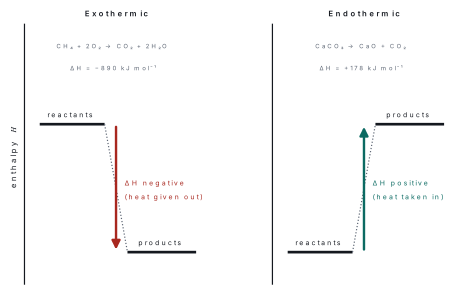
A reaction is exothermic if it gives heat out (\Delta H negative, products below reactants on an enthalpy diagram) and endothermic if it takes heat in (\Delta H positive, products above reactants).
The sign is part of the answer
"ΔH = 890 kJ for the combustion of methane" is wrong and loses the mark. Heat is released, so \Delta H = -890\ \text{kJ mol}^{-1}. Equally, an exothermic reaction has a negative \Delta H but makes the thermometer reading rise — the two signs are opposite because the thermometer is in the surroundings.
Problem. For the combustion of methane, CH₄(g) + 2O₂(g) → CO₂(g) + 2H₂O(l), \Delta H^{\circ} = -890.3 kJ mol⁻¹ at 298 K. Calculate \Delta U^{\circ}. (R = 8.314 J K⁻¹ mol⁻¹.)
Solution. Count gas moles only — liquid water does not count.
Gaseous reactants: 1 (CH₄) + 2 (O₂) = 3 mol. Gaseous products: 1 (CO₂) = 1 mol.
From \Delta H = \Delta U + \Delta n_{g}RT,
Because the gas volume shrinks, the atmosphere does work on the system, so less energy escapes as heat than the internal energy drop would suggest.
4.5 Enthalpy of reaction, solution, formation, combustion
The standard state of a substance is its most stable form at 1 bar pressure and the stated temperature (usually 298 K). A standard enthalpy change carries the superscript circle, \Delta H^{\circ}.
| Name | Definition | Example |
|---|---|---|
| Enthalpy of reaction \Delta H_{r} | Heat change when the molar amounts in the balanced equation react completely | N₂ + 3H₂ → 2NH₃, \Delta H^{\circ} = -92.2 kJ |
| Enthalpy of formation \Delta H_{f} | Heat change when one mole of a compound is formed from its elements in their standard states | C(s) + 2H₂(g) → CH₄(g), \Delta H_{f}^{\circ} = -74.8 kJ mol⁻¹ |
| Enthalpy of combustion \Delta H_{c} | Heat change when one mole of a substance burns completely in excess oxygen | C₂H₅OH(l) + 3O₂ → 2CO₂ + 3H₂O(l), \Delta H_{c}^{\circ} = -1367 kJ mol⁻¹ |
| Enthalpy of solution \Delta H_{sol} | Heat change when one mole of a solute dissolves in so much solvent that further dilution causes no further heat change | NH₄Cl(s) + water → NH₄⁺(aq) + Cl⁻(aq), \Delta H_{sol} = +15.1 kJ mol⁻¹ |
| Enthalpy of neutralisation | Heat change when one gram-equivalent of acid is neutralised by a base in dilute solution | H⁺(aq) + OH⁻(aq) → H₂O(l), \Delta H = -57.1 kJ |
Two consequences worth remembering. First, \Delta H_{f}^{\circ} of any element in its standard state is zero — O₂(g), C(graphite), Br₂(l) all have \Delta H_{f}^{\circ} = 0. Second, once a table of formation enthalpies exists, any reaction enthalpy follows from
Enthalpy of solution is itself the sum of two opposing terms: the lattice enthalpy (energy needed to pull the ionic lattice apart, always positive) and the hydration enthalpy of the separated ions (always negative). NH₄Cl dissolves endothermically because its lattice enthalpy slightly outweighs hydration — which is why an instant cold pack works.
4.6 Laws of thermochemistry: Laplace law and Hess's law
The enthalpy change of a reaction is equal in magnitude but opposite in sign to the enthalpy change of the reverse reaction.
For example, if C(s) + O₂(g) → CO₂(g) has \Delta H = -393.5 kJ mol⁻¹, then CO₂(g) → C(s) + O₂(g) has \Delta H = +393.5 kJ mol⁻¹. The law is just a restatement of the first law: if it were not true you could run the forward and backward reactions in a loop and manufacture energy from nothing.
The total enthalpy change of a reaction is the same whether the reaction takes place in one step or in several steps, provided the initial and final states are the same.
Hess's law follows because H is a state function: \Delta H depends only on the endpoints, never the route. So around any closed cycle the enthalpy changes sum to zero, and an unmeasurable \Delta H can be found from measurable ones.
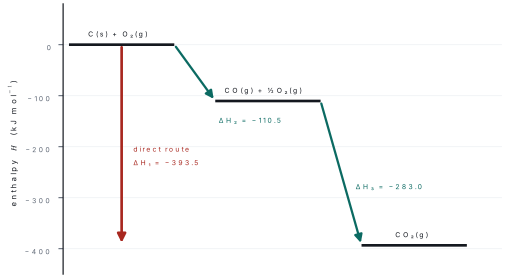
Problem. Calculate the standard enthalpy of formation of methane from:
(i) C(s) + O₂(g) → CO₂(g), \Delta H^{\circ} = -393.5 kJ mol⁻¹ (ii) H₂(g) + ½O₂(g) → H₂O(l), \Delta H^{\circ} = -285.8 kJ mol⁻¹ (iii) CH₄(g) + 2O₂(g) → CO₂(g) + 2H₂O(l), \Delta H^{\circ} = -890.3 kJ mol⁻¹
Solution. The target equation is C(s) + 2H₂(g) → CH₄(g).
Take (i) as written, add 2 × (ii), and subtract (iii) — which means reversing it and changing its sign, by the Lavoisier–Laplace law:
C(s) + O₂ → CO₂ ............... -393.5 2H₂ + O₂ → 2H₂O(l) ........... 2(-285.8) = -571.6 CO₂ + 2H₂O(l) → CH₄ + 2O₂ ..... +890.3
Adding the three equations, CO₂ cancels, 2H₂O cancels, and of the oxygen 1 + 1 - 2 = 0 mol remain. What is left is exactly C(s) + 2H₂ → CH₄. Hence
The accepted value is −74.8 kJ mol⁻¹, a quantity that cannot be measured directly because carbon and hydrogen do not combine cleanly to give methane.
The Born–Haber cycle
The most important application of Hess's law in inorganic chemistry is the Born–Haber cycle, which finds the lattice enthalpy of an ionic solid — the enthalpy change when one mole of the crystal is formed from its gaseous ions. Lattice enthalpy cannot be measured directly; every other step in the cycle can.
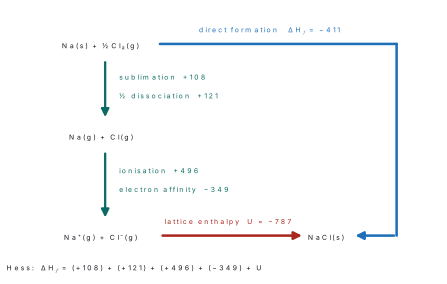
Problem. Use the Born–Haber cycle to calculate the lattice enthalpy of NaCl from: enthalpy of formation of NaCl(s) = −411 kJ mol⁻¹; enthalpy of sublimation of Na = +108 kJ mol⁻¹; first ionisation energy of Na = +496 kJ mol⁻¹; bond dissociation enthalpy of Cl₂ = +242 kJ mol⁻¹; electron affinity of Cl = −349 kJ mol⁻¹.
Solution. Break the formation of NaCl(s) into five steps that add up to it:
| Step | Process | \Delta H / kJ mol⁻¹ |
|---|---|---|
| 1 | Na(s) → Na(g) | +108 |
| 2 | ½Cl₂(g) → Cl(g) | \tfrac{1}{2}(242) = +121 |
| 3 | Na(g) → Na⁺(g) + e⁻ | +496 |
| 4 | Cl(g) + e⁻ → Cl⁻(g) | −349 |
| 5 | Na⁺(g) + Cl⁻(g) → NaCl(s) | U = ? |
By Hess's law the five steps must total \Delta H_{f}^{\circ}:
So 787 kJ is released when one mole of gaseous Na⁺ and Cl⁻ ions collapses into the crystal — a very large number, which is why NaCl melts at 801 °C.
The formation equation is Na(s) + ½Cl₂(g) → NaCl(s), so only half the Cl–Cl bond is broken. Forgetting the factor of ½ is the single commonest Born–Haber error and shifts the answer by 121 kJ.
4.7 Entropy and spontaneity
A spontaneous process is one that occurs on its own, without continuous outside help: ice melting in a glass at room temperature, iron rusting, a gas filling a vacuum. Exothermicity alone does not explain spontaneity — ice melts spontaneously above 0 °C even though melting is endothermic. A second driving force is at work: the tendency towards disorder.
Entropy S is a measure of the randomness or disorder of a system. It is a state function. For a change carried out reversibly at constant temperature T,
Its SI unit is J K⁻¹ mol⁻¹.
Entropy increases when disorder increases:
- Phase changes: S_{\text{solid}} < S_{\text{liquid}} \ll S_{\text{gas}}.
- Number of gas molecules: CaCO₃(s) → CaO(s) + CO₂(g) creates a gas, so \Delta S > 0. N₂ + 3H₂ → 2NH₃ destroys two moles of gas, so \Delta S < 0.
- Dissolving an ionic solid and mixing are entropy-increasing.
- Heating anything raises its entropy.
For a phase change at its transition temperature the process is reversible, so \Delta S = \Delta H / T. For the melting of ice, \Delta S_{fus} = 6010 / 273 = 22.0 J K⁻¹ mol⁻¹; for the boiling of water, \Delta S_{vap} = 40700 / 373 = 109.1 J K⁻¹ mol⁻¹. Boiling disorders far more, as expected.
The third law of thermodynamics completes the picture: the entropy of a perfectly crystalline substance at absolute zero is zero. That gives entropy an absolute scale, which is why tables list S^{\circ} itself, not just \Delta S^{\circ}.
4.8 Second law of thermodynamics
The first law says energy is conserved; it does not say which direction a change will go. The second law supplies the direction.
- Entropy statement. In any spontaneous (irreversible) process the total entropy of the universe increases: \Delta S_{total} > 0. For a reversible process \Delta S_{total} = 0. It never decreases.
- Clausius statement. Heat cannot flow of its own accord from a colder body to a hotter body.
- Kelvin–Planck statement. It is impossible to construct a machine that, working in a cycle, converts heat completely into work without rejecting some heat to a colder reservoir.
Writing the universe as system plus surroundings,
Note that \Delta S_{system} alone may be negative — water freezing in a Mustang winter becomes more ordered — provided the surroundings gain more entropy than the system loses.
4.9 Gibbs free energy and prediction of spontaneity
Testing \Delta S_{total} means measuring the surroundings, which is awkward. J. W. Gibbs removed the need by defining a function of the system only:
At constant temperature and pressure the heat a reaction gives to its surroundings is -\Delta H_{sys}, delivered reversibly at T, so
The second law requires \Delta S_{total} > 0 for a spontaneous change:
Multiplying through by -T (which reverses the inequality),
The left-hand side is defined as \Delta G. Hence a process at constant T and p is spontaneous if and only if \Delta G < 0.
| \Delta H | \Delta S | \Delta G = \Delta H - T\Delta S | Spontaneous? |
|---|---|---|---|
| − | + | always negative | Yes, at all temperatures |
| − | − | negative at low T | Only below T = \Delta H/\Delta S |
| + | + | negative at high T | Only above T = \Delta H/\Delta S |
| + | − | always positive | Never |
\Delta G also has a mechanical meaning: -\Delta G is the maximum useful (non-expansion) work obtainable from the change. At equilibrium \Delta G = 0 and no further work can be extracted.
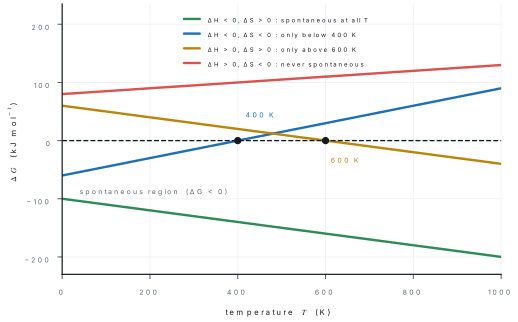
Problem. For the decomposition of limestone, CaCO₃(s) → CaO(s) + CO₂(g), \Delta H^{\circ} = +178.3 kJ mol⁻¹ and \Delta S^{\circ} = +160.6 J K⁻¹ mol⁻¹. (a) Is the reaction spontaneous at 298 K? (b) Above what temperature does it become spontaneous?
Solution.
(a) Convert the entropy to kJ: \Delta S^{\circ} = 0.1606 kJ K⁻¹ mol⁻¹.
\Delta G^{\circ} is positive, so limestone does not decompose at room temperature — fortunate, since Nepal's buildings are full of it.
(b) The changeover is where \Delta G^{\circ} = 0:
Above about 1110 K the T\Delta S term wins and decomposition becomes spontaneous. This is exactly why a cement kiln is run near 1400 °C.
Thermodynamics predicts only possibility, not speed. The conversion of diamond to graphite has \Delta G^{\circ} = -2.9 kJ mol⁻¹ and so is spontaneous, yet a diamond lasts millions of years because the activation energy is enormous. Spontaneous means "needs no help", not "happens quickly".
4.10 Relationship between \Delta G and equilibrium constant
For a reaction not at standard concentrations, the free energy change is
where Q is the reaction quotient — the same expression as the equilibrium constant but with the actual, not equilibrium, concentrations. As the reaction proceeds, Q changes and \Delta G rises towards zero.
At equilibrium two things are true at once: the reaction has no further tendency to move, so \Delta G = 0; and the quotient has reached its equilibrium value, Q = K. Substituting both into the relation above,
| \Delta G^{\circ} | K | Position of equilibrium |
|---|---|---|
| negative | K > 1 | products favoured |
| zero | K = 1 | neither favoured |
| positive | K < 1 | reactants favoured |
Problem. At 298 K the equilibrium constant for N₂O₄(g) ⇌ 2NO₂(g) is K_{p} = 0.145. Calculate \Delta G^{\circ} for the dissociation. (R = 8.314 J K⁻¹ mol⁻¹.)
Solution. Use \Delta G^{\circ} = -2.303\,RT\log K.
\Delta G^{\circ} is positive and K < 1, so at 298 K and standard pressures the dinitrogen tetroxide side is favoured — consistent with the fact that N₂O₄ dissociation needs warming to go appreciably to the right.
Chapter summary
- A system exchanges matter and/or energy with its surroundings. U, H, S, G, p, V, T are state functions; q and w are not.
- First law: \Delta U = q + w with w = -p_{ext}\Delta V. At constant volume q_{v} = \Delta U; at constant pressure q_{p} = \Delta H.
- H = U + pV, so \Delta H = \Delta U + \Delta n_{g}RT for gas reactions. \Delta H < 0 exothermic, \Delta H > 0 endothermic.
- \Delta H_{r}^{\circ} = \sum\Delta H_{f}^{\circ}(\text{products}) - \sum\Delta H_{f}^{\circ}(\text{reactants}), and \Delta H_{f}^{\circ} of an element in its standard state is zero.
- Lavoisier–Laplace: reversing a reaction reverses the sign of \Delta H. Hess's law: \Delta H is route-independent — the basis of the Born–Haber cycle, which gives lattice enthalpy (−787 kJ mol⁻¹ for NaCl).
- Entropy S measures disorder, \Delta S = q_{rev}/T in J K⁻¹ mol⁻¹; S rises solid → liquid → gas.
- Second law: \Delta S_{total} = \Delta S_{sys} + \Delta S_{surr} > 0 for every spontaneous change.
- Gibbs: \Delta G = \Delta H - T\Delta S; spontaneous if \Delta G < 0, at equilibrium if \Delta G = 0; crossover at T = \Delta H/\Delta S.
- \Delta G = \Delta G^{\circ} + RT\ln Q and \Delta G^{\circ} = -RT\ln K = -2.303\,RT\log K.
Practice questions
Group A — Multiple choice (1 mark each)
- Which of the following is not a state function? [1]ainternal energybenthalpycworkdentropy
- For the isothermal expansion of an ideal gas, \Delta U is [1]apositivebnegativeczerodequal to w
- For N₂(g) + 3H₂(g) → 2NH₃(g), the value of \Delta H - \Delta U is [1]a+2RTb-2RTc+RTdzero
- A reaction is spontaneous at all temperatures when [1]a\Delta H < 0, \Delta S < 0b\Delta H > 0, \Delta S > 0c\Delta H < 0, \Delta S > 0d\Delta H > 0, \Delta S < 0
- If \Delta G^{\circ} = 0 for a reaction at temperature T, then K equals [1]a0b1cinfinityde
- The entropy of a perfectly crystalline solid at 0 K is [1]azerobpositivecnegativedinfinite
Answers to Group A
1. (c) — work depends on the path taken, not just on the endpoints.
2. (c) — U of an ideal gas depends only on T, and T is constant.
3. (b) — \Delta n_{g} = 2 - 4 = -2, and \Delta H - \Delta U = \Delta n_{g}RT.
4. (c) — then -T\Delta S is negative too, so \Delta G is negative at every T.
5. (b) — \Delta G^{\circ} = -RT\ln K, so \ln K = 0 and K = 1.
6. (a) — third law of thermodynamics: perfect order means zero disorder.
Group B — Short answer (5 marks each)
- Define internal energy. State the first law of thermodynamics and derive the expression w = -p_{ext}\Delta V for the work done in an isobaric expansion. [5]
- Define enthalpy of formation, enthalpy of combustion, enthalpy of solution and enthalpy of neutralisation, giving one thermochemical equation for each. [5]
- State Hess's law. Given C(s) + O₂(g) → CO₂(g), \Delta H = -393.5 kJ mol⁻¹ and CO(g) + ½O₂(g) → CO₂(g), \Delta H = -283.0 kJ mol⁻¹, calculate the enthalpy of formation of carbon monoxide. [5]
- For a certain reaction \Delta H = 30.56 kJ mol⁻¹ and \Delta S = 66.0 J K⁻¹ mol⁻¹. Calculate \Delta G at 300 K and find the temperature at which the reaction becomes spontaneous. [5]
- Derive \Delta G = \Delta H - T\Delta S from the second law, and use it to discuss the four possible sign combinations of \Delta H and \Delta S. [5]
- The equilibrium constant of a reaction at 298 K is 1.0\times10^{5}. Calculate \Delta G^{\circ} and comment on the position of equilibrium. [5]
Answers to Group B
3. Hess's law: the enthalpy change is the same by whatever route the reaction is carried out. The target is C(s) + ½O₂(g) → CO(g). Subtract the second equation from the first (i.e. reverse the second and add):
C(s) + O₂ → CO₂ ..... -393.5; CO₂ → CO + ½O₂ ..... +283.0
4. With \Delta S = 0.0660 kJ K⁻¹ mol⁻¹,
so it is non-spontaneous at 300 K. Setting \Delta G = 0, T = 30.56/0.0660 = 463\ \text{K}; above 463 K the reaction is spontaneous.
6. \Delta G^{\circ} = -2.303RT\log K = -(2.303)(8.314)(298)\log(10^{5}) = -(5706)(5) = -28530\ \text{J mol}^{-1} = -28.53\ \text{kJ mol}^{-1}. Since \Delta G^{\circ} is large and negative and K \gg 1, the equilibrium lies far to the product side.
Group C — Long answer (8 marks each)
- (a) State Hess's law of constant heat summation and explain why it follows from enthalpy being a state function. [3](b) Construct a Born–Haber cycle for potassium chloride and calculate its lattice enthalpy from: \Delta H_{f}^{\circ}(\text{KCl}) = -437 kJ mol⁻¹, enthalpy of sublimation of K = +89 kJ mol⁻¹, ionisation energy of K = +419 kJ mol⁻¹, bond dissociation enthalpy of Cl₂ = +242 kJ mol⁻¹, electron affinity of Cl = −349 kJ mol⁻¹. Explain why the lattice enthalpy of NaCl is more negative than that of KCl. [5]
- (a) State the second law of thermodynamics in two different ways and define entropy. Explain, using \Delta S_{total}, how water can freeze spontaneously in winter although freezing decreases the entropy of the water. [4](b) The enthalpy of vaporisation of water at 373 K is 40.7 kJ mol⁻¹. Calculate \Delta S_{vap}, and hence \Delta G for the vaporisation at 373 K and at 383 K. Interpret both answers. [4]
Answers to Group C
1.(b) The steps are: K(s) → K(g), +89; ½Cl₂(g) → Cl(g), \tfrac{1}{2}(242) = +121; K(g) → K⁺(g) + e⁻, +419; Cl(g) + e⁻ → Cl⁻(g), −349; K⁺(g) + Cl⁻(g) → KCl(s), U. By Hess's law
Lattice enthalpy varies as 1/(r_{+} + r_{-}). Na⁺ (102 pm) is smaller than K⁺ (138 pm), so the ions in NaCl sit closer together, the electrostatic attraction is stronger and the lattice enthalpy is more negative (−787 against −717 kJ mol⁻¹).
2.(b) Vaporisation at the normal boiling point is a reversible change, so
At 373 K: \Delta G = 40700 - (373)(109.1) = 0. Liquid and vapour are in equilibrium — which is what "boiling point" means.
At 383 K: \Delta G = 40700 - (383)(109.1) = 40700 - 41785 = -1085\ \text{J mol}^{-1} = -1.09\ \text{kJ mol}^{-1}, negative, so above 373 K vaporisation is spontaneous and the liquid boils away.
Practise more: Chemistry question bank