Unit 2 · General and Physical Chemistry · 10 teaching hours · 36 min read
Ionic Equilibrium
What the syllabus asks for 15
- Limitation of Arrhenius concept
- Bronsted-Lowry definition; Conjugate acid-base pairs
- Relative strength of acids and bases
- Lewis definition
- Ionization of weak electrolyte (Ostwald's dilution law)
- Ionic product of water (Kw)
- Dissociation constant of acid and base (Ka and Kb); concept of pKa and pKb
- pH value: pH of strong and weak acids; pH of strong and weak bases
- Solubility and solubility product principle
- Common ion effect
- Application of solubility product principle and common ion effect in precipitation reactions
- Buffer solution and its application
- Indicators and selection of indicators in acid-base titration
- Types of salts: acidic, basic, simple, complex
- Hydrolysis of salts: strong acid + strong base; weak acid + strong base; weak base + strong acid
Water is never just water. In every aqueous solution a set of reversible ionic reactions sits at equilibrium — the water splitting into H⁺ and OH⁻, a weak acid half-ionised, a sparingly soluble salt dissolving as fast as it re-precipitates. This unit gives you the equilibrium constants that describe those processes (K_w, K_a, K_b, K_{sp}, K_h) and the arithmetic — almost all of it logarithms — that turns them into a pH or a solubility. It is the longest unit in the physical-chemistry area and the most heavily examined.
Expect one definition question (Bronsted or Lewis, conjugate pairs), one numerical on pH / K_a / buffers / K_{sp}, and very often a question on choosing an indicator or on salt hydrolysis. Learn the five master formulas in §2.8, §2.12 and §2.15 and most of the marks are already yours.
2.1 Limitation of Arrhenius concept
Svante Arrhenius (1887) defined an acid as a substance that gives H⁺ ions in aqueous solution and a base as one that gives OH⁻ ions. The definition works — HCl → H⁺ + Cl⁻ and NaOH → Na⁺ + OH⁻ — but it fails in five ways that the board asks about directly.
- It is restricted to water. Acid-base behaviour in liquid ammonia, in benzene or in the gas phase is outside it. NH₃(g) + HCl(g) → NH₄Cl(s) is clearly a neutralisation, yet no water and no OH⁻ are involved.
- Free H⁺ does not exist in solution. A bare proton is only about 10⁻¹⁵ m across and would have an enormous charge density; in water it is always hydrated as the hydronium ion, H₃O⁺.
- It cannot explain acids without hydrogen. CO₂, SO₂, AlCl₃ and BF₃ all behave as acids, yet none of them contains an ionisable H.
- It cannot explain bases without OH. NH₃, Na₂CO₃, CH₃NH₂ and NaHCO₃ all turn red litmus blue although no OH group is present in the formula.
- It ignores the role of the solvent. Dry HCl gas does not turn dry blue litmus red, and HCl in benzene is not acidic at all. The solvent is an active partner, not a spectator.
2.2 Bronsted-Lowry definition; conjugate acid-base pairs
An acid is a substance that can donate a proton (H⁺); a base is a substance that can accept a proton. An acid-base reaction is simply the transfer of a proton from the acid to the base.
Because a proton must be given to something, every Bronsted acid-base reaction has two acids and two bases:
CH₃COOH + H₂O ⇌ H₃O⁺ + CH₃COO⁻
Here CH₃COOH gives a proton to H₂O in the forward direction, and H₃O⁺ gives a proton back to CH₃COO⁻ in the reverse direction.
A conjugate acid-base pair is a pair of species that differ by one proton. The species left after an acid has lost its proton is its conjugate base; the species formed when a base gains a proton is its conjugate acid.
| Acid | Its conjugate base | Base | Its conjugate acid |
|---|---|---|---|
| HCl | Cl⁻ | H₂O | H₃O⁺ |
| CH₃COOH | CH₃COO⁻ | NH₃ | NH₄⁺ |
| H₂SO₄ | HSO₄⁻ | OH⁻ | H₂O |
| HSO₄⁻ | SO₄²⁻ | CO₃²⁻ | HCO₃⁻ |
| H₂CO₃ | HCO₃⁻ | HCO₃⁻ | H₂CO₃ |
| NH₄⁺ | NH₃ | CH₃COO⁻ | CH₃COOH |
| H₃O⁺ | H₂O | H₂PO₄⁻ | H₃PO₄ |
Species such as H₂O, HCO₃⁻, HSO₄⁻ and H₂PO₄⁻ appear in both columns: they can donate a proton to a stronger base and accept one from a stronger acid. They are called amphiprotic (or amphoteric) species.
H₂O + H₂O ⇌ H₃O⁺ + OH⁻
Cl⁻ is the conjugate base of HCl, but a solution of NaCl is neutral. The reason is that HCl is a very strong acid, so its conjugate base Cl⁻ is extremely weak — so weak that it takes no measurable proportion of protons back from water. "Conjugate base" describes a relationship, not a strength.
The Bronsted definition still has a limitation of its own: it needs a proton. Reactions such as BF₃ + NH₃ → F₃B←NH₃, which show every chemical feature of neutralisation, lie outside it.
2.3 Relative strength of acids and bases
The strength of a Bronsted acid is the extent to which it transfers its proton to water. For a weak acid HA,
HA + H₂O ⇌ H₃O⁺ + A⁻
A larger K_a (smaller pK_a) means a stronger acid. The same logic with K_b measures base strength.
The stronger an acid, the weaker its conjugate base, and vice versa. Quantitatively K_a \times K_b = K_w for any conjugate pair, so pK_a + pK_b = 14 at 25 °C.
| Acid | K_a (25 °C) | pK_a | Conjugate base | K_b of that base |
|---|---|---|---|---|
| HCl | very large | < 0 | Cl⁻ | negligible |
| HSO₄⁻ | 1.2\times10^{-2} | 1.92 | SO₄²⁻ | 8.3\times10^{-13} |
| HF | 6.8\times10^{-4} | 3.17 | F⁻ | 1.5\times10^{-11} |
| HCOOH | 1.8\times10^{-4} | 3.75 | HCOO⁻ | 5.6\times10^{-11} |
| CH₃COOH | 1.8\times10^{-5} | 4.74 | CH₃COO⁻ | 5.6\times10^{-10} |
| H₂CO₃ | 4.5\times10^{-7} | 6.35 | HCO₃⁻ | 2.2\times10^{-8} |
| NH₄⁺ | 5.6\times10^{-10} | 9.25 | NH₃ | 1.8\times10^{-5} |
| HCN | 4.9\times10^{-10} | 9.31 | CN⁻ | 2.0\times10^{-5} |
If two weak acids of the same concentration C are compared, then since \alpha = \sqrt{K_a/C} (next section),
So acetic acid (1.8\times10^{-5}) is about 192 times stronger than hydrocyanic acid at the same concentration, because \sqrt{1.8\times10^{-5}/4.9\times10^{-10}} = \sqrt{3.67\times10^{4}} = 192.
Levelling effect. HCl, HBr, HI, HNO₃ and HClO₄ all appear equally strong in water, because each of them transfers its proton to water completely; the strongest acid that can exist in water is H₃O⁺ itself. Water is said to level them. To rank them you must use a weaker base as solvent, such as glacial acetic acid, which shows the true order HClO₄ > HI > HBr > HCl > HNO₃.
2.4 Lewis definition
A Lewis acid is any species that can accept a lone pair of electrons; a Lewis base is any species that can donate a lone pair. Neutralisation is the formation of a coordinate (dative) bond between them.
BF₃ + :NH₃ → F₃B←NH₃
| Lewis acids (electron-pair acceptors) | Lewis bases (electron-pair donors) |
|---|---|
| Molecules with an incomplete octet: BF₃, AlCl₃, BeCl₂ | Molecules with a lone pair: NH₃, H₂O, R–OH, R–NH₂, R₂S |
| Simple cations: H⁺, Ag⁺, Cu²⁺, Fe³⁺ | Anions: OH⁻, Cl⁻, CN⁻, F⁻ |
| Molecules with expandable octets: SiF₄, PF₅, SF₄ | Molecules with π electrons: C₂H₄, C₆H₆ |
| Molecules with a multiple bond to an electronegative atom: CO₂, SO₃, SO₂ | Carbanions and alkoxides |
Ag⁺ + 2NH₃ → [Ag(NH₃)₂]⁺ and Cu²⁺ + 4NH₃ → [Cu(NH₃)₄]²⁺ are Lewis neutralisations; this is why complex formation belongs in the same chapter of ideas as acidity.
| Arrhenius | Bronsted-Lowry | Lewis | |
|---|---|---|---|
| Acid | gives H⁺ in water | proton donor | electron-pair acceptor |
| Base | gives OH⁻ in water | proton acceptor | electron-pair donor |
| Solvent | must be water | any solvent, or none | any solvent, or none |
| Scope | narrowest | wider | widest |
| Weakness | no non-aqueous acids/bases | cannot handle BF₃, AlCl₃ | too wide; says nothing about relative strength; protonic acids such as HCl are not strictly Lewis acids |
2.5 Ionization of weak electrolyte (Ostwald's dilution law)
A weak electrolyte is only partly ionised, and the un-ionised molecules are in equilibrium with the ions.
Let one mole of a weak binary electrolyte AB be dissolved in V litres, so its concentration is C = 1/V, and let \alpha be its degree of ionisation at equilibrium.
| AB | ⇌ | A⁺ | + | B⁻ | |
|---|---|---|---|---|---|
| initial | C | 0 | 0 | ||
| at equilibrium | C(1-\alpha) | C\alpha | C\alpha |
Applying the law of mass action,
For a weak electrolyte \alpha \ll 1, so 1 - \alpha \approx 1 and
The degree of ionisation of a weak electrolyte is inversely proportional to the square root of its concentration, i.e. directly proportional to the square root of the dilution. Diluting a weak acid one hundred times increases its degree of ionisation ten times.
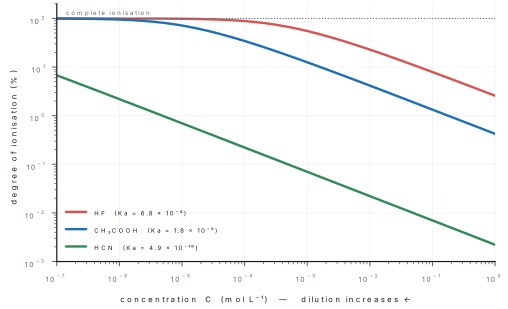
The law works well for weak electrolytes but fails completely for strong electrolytes such as NaCl or HCl, which are fully ionised in the solid state already; for them the observed "degree of ionisation" changes with concentration only because of interionic attraction, not because of any equilibrium.
2.6 Ionic product of water (Kw)
Pure water conducts electricity very slightly, so it must ionise to a small extent:
H₂O + H₂O ⇌ H₃O⁺ + OH⁻, usually written H₂O ⇌ H⁺ + OH⁻
Because only about two water molecules in 10⁹ are ionised, [\text{H}_2\text{O}] is effectively constant (55.5 mol L⁻¹), and it is absorbed into the constant:
The ionic product of water, K_w, is the product of the molar concentrations of hydrogen ions and hydroxide ions in water or in any aqueous solution at a given temperature. At 25 °C, K_w = 1.0\times10^{-14}\ \text{mol}^{2}\ \text{L}^{-2}, and in pure water [\text{H}^{+}] = [\text{OH}^{-}] = 1.0\times10^{-7} mol L⁻¹.
Taking negative logarithms of K_w = [\text{H}^{+}][\text{OH}^{-}],
Ionisation of water is endothermic, so by Le Chatelier's principle K_w rises with temperature:
| Temperature | K_w | pK_w | pH of pure water |
|---|---|---|---|
| 0 °C | 0.11\times10^{-14} | 14.94 | 7.47 |
| 25 °C | 1.00\times10^{-14} | 14.00 | 7.00 |
| 50 °C | 5.48\times10^{-14} | 13.26 | 6.63 |
| 100 °C | 51.3\times10^{-14} | 12.29 | 6.14 |
Water at 100 °C has pH 6.14 and is still neutral, because [\text{H}^{+}] = [\text{OH}^{-}] there. Neutrality means the two concentrations are equal, not that the pH is 7.
2.7 Dissociation constant of acid and base (Ka and Kb); concept of pKa and pKb
For the weak acid HA and the weak base BOH:
K_a and K_b are true equilibrium constants: they depend on temperature but not on concentration. Combining with Ostwald's law, K_a = C\alpha^{2}.
Because these constants span many powers of ten, they are quoted logarithmically:
A small pK_a means a strong acid. Acetic acid, K_a = 1.8\times10^{-5}, has pK_a = 4.74.
Take the pair CH₃COOH / CH₃COO⁻:
CH₃COOH ⇌ H⁺ + CH₃COO⁻ with K_a = \dfrac{[\text{H}^{+}][\text{CH}_3\text{COO}^{-}]}{[\text{CH}_3\text{COOH}]}
CH₃COO⁻ + H₂O ⇌ CH₃COOH + OH⁻ with K_b = \dfrac{[\text{CH}_3\text{COOH}][\text{OH}^{-}]}{[\text{CH}_3\text{COO}^{-}]}
Multiplying the two expressions, every concentration except those of H⁺ and OH⁻ cancels:
and taking logarithms, pK_a + pK_b = pK_w = 14 at 25 °C.
2.8 pH value: pH of strong and weak acids; pH of strong and weak bases
Hydrogen-ion concentrations run from about 10 to 10⁻¹⁵ mol L⁻¹. Sørensen (1909) replaced them by a logarithmic scale.
The pH of a solution is the negative logarithm to base 10 of its hydrogen-ion concentration in mol L⁻¹:
Similarly pOH = -\log_{10}[\text{OH}^{-}], and pH + pOH = 14 at 25 °C.
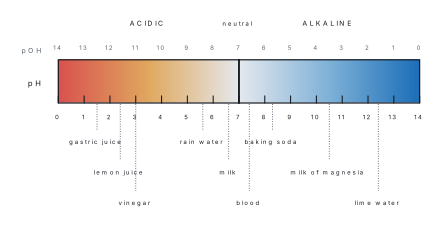
Strong acid. A strong monobasic acid is completely ionised, so [\text{H}^{+}] = C and
For a dibasic strong acid such as H₂SO₄, [\text{H}^{+}] = 2C.
Weak acid. Only a fraction \alpha ionises, and [\text{H}^{+}] = C\alpha. Substituting \alpha = \sqrt{K_a/C},
Strong base. [\text{OH}^{-}] = C \times (acidity), pOH = -\log[\text{OH}^{-}] and pH = 14 - pOH.
Weak base. [\text{OH}^{-}] = \sqrt{K_bC}, so
A 2 M solution of HCl has [\text{H}^{+}] = 2, so pH = -\log 2 = -0.30; a 5 M NaOH solution has pH 14.7. The 0–14 range is only the region in which both ion concentrations are below 1 mol L⁻¹. Also remember that [\text{H}^{+}] must be in mol L⁻¹ — a favourite trap is to give the data in g L⁻¹.
Problem. Calculate the pH of (a) 0.005 M Ca(OH)₂, and (b) the solution formed when 100 cm³ of 0.10 M HCl is mixed with 100 cm³ of 0.05 M NaOH.
Solution.
(a) Ca(OH)₂ → Ca²⁺ + 2OH⁻ is fully ionised, so [\text{OH}^{-}] = 2 \times 0.005 = 0.01\ \text{mol L}^{-1}.
(b) Millimoles of H⁺ = 0.10 \times 100 = 10.0; millimoles of OH⁻ = 0.05 \times 100 = 5.0. The acid is in excess by 5.0 mmol, in a total volume of 200 cm³:
Problem. Calculate the pH, the degree of ionisation and the concentration of CH₃COO⁻ in 0.10 M acetic acid. K_a = 1.8\times10^{-5}.
Solution.
Since each ionised molecule gives one acetate ion, [\text{CH}_3\text{COO}^{-}] = [\text{H}^{+}] = 1.34\times10^{-3} mol L⁻¹, and the assumption \alpha \ll 1 is justified.
Problem. Calculate the degree of ionisation, the hydroxide-ion concentration and the pH of 0.020 M ammonium hydroxide. K_b = 1.8\times10^{-5}.
Solution.
2.9 Solubility and solubility product principle
The solubility (S) of a salt is the number of moles of it that dissolve in one litre of solvent to give a saturated solution at a stated temperature.
The solubility product (K_{sp}) of a sparingly soluble salt is the product of the molar concentrations of its ions in a saturated solution, each raised to the power of its coefficient in the dissociation equation.
In a saturated solution of AgCl an equilibrium exists between the undissolved solid and its ions:
AgCl(s) ⇌ Ag⁺(aq) + Cl⁻(aq)
The concentration of a pure solid is constant, so it is absorbed into the constant, giving K_{sp} = [\text{Ag}^{+}][\text{Cl}^{-}].
For a salt \text{A}_x\text{B}_y of solubility S mol L⁻¹,
A_xB_y(s) ⇌ xA^{y+} + yB^{x-}
At saturation [\text{A}^{y+}] = xS and [\text{B}^{x-}] = yS, so
| Salt type | Example | K_{sp} in terms of S | S in terms of K_{sp} |
|---|---|---|---|
| AB | AgCl, BaSO₄ | S^{2} | \sqrt{K_{sp}} |
| AB₂ or A₂B | PbI₂, Ag₂CrO₄ | 4S^{3} | \left(K_{sp}/4\right)^{1/3} |
| AB₃ | Fe(OH)₃ | 27S^{4} | \left(K_{sp}/27\right)^{1/4} |
| A₃B₂ | Ca₃(PO₄)₂ | 108S^{5} | \left(K_{sp}/108\right)^{1/5} |
K_{sp} depends only on temperature. Solubility, by contrast, depends on what else is in the solution — which is the subject of the next two sections.
Problem. (a) The solubility of silver chloride in water at 25 °C is 1.93\times10^{-3} g L⁻¹. Calculate its solubility product (molar mass of AgCl = 143.5). (b) The solubility of silver chromate, Ag₂CrO₄, is 6.5\times10^{-5} mol L⁻¹. Calculate its K_{sp}.
Solution.
(a) Molar solubility:
AgCl(s) ⇌ Ag⁺ + Cl⁻, so [\text{Ag}^{+}] = [\text{Cl}^{-}] = S and
(b) Ag₂CrO₄(s) ⇌ 2Ag⁺ + CrO₄²⁻, so [\text{Ag}^{+}] = 2S and [\text{CrO}_4^{2-}] = S:
2.10 Common ion effect
The common ion effect is the suppression of the ionisation of a weak electrolyte (or of the solubility of a sparingly soluble salt) caused by the addition of a strong electrolyte that supplies an ion common to the equilibrium.
It is Le Chatelier's principle applied to an ionic equilibrium. Add acetate ions to acetic acid and the equilibrium
CH₃COOH ⇌ CH₃COO⁻ + H⁺
shifts to the left, so [\text{H}^{+}] falls and the pH rises — even though more "acid material" has been added. In the same way NH₄Cl suppresses the ionisation of NH₄OH, and HCl suppresses that of H₂S.
| System | Added common ion | Effect |
|---|---|---|
| CH₃COOH + CH₃COONa | CH₃COO⁻ | ionisation of the acid suppressed; pH rises |
| NH₄OH + NH₄Cl | NH₄⁺ | ionisation of the base suppressed; [OH⁻] falls |
| H₂S + HCl | H⁺ | [S²⁻] falls sharply — basis of Group II analysis |
| AgCl + NaCl | Cl⁻ | solubility of AgCl falls |
| Saturated NaCl + HCl gas | Cl⁻ | pure NaCl crystallises out (salt purification) |
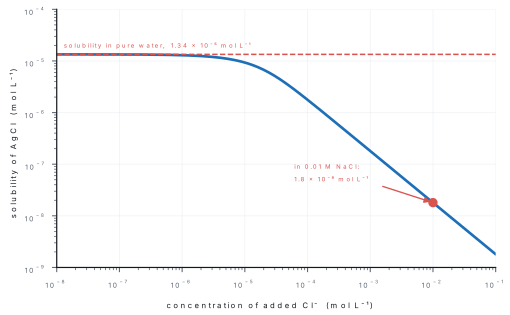
Problem. K_{sp} of AgCl is 1.8\times10^{-10}. Calculate its solubility (a) in pure water and (b) in 0.010 M sodium chloride solution.
Solution.
(a) S = \sqrt{K_{sp}} = \sqrt{1.8\times10^{-10}} = 1.34\times10^{-5} mol L⁻¹.
(b) Let the solubility now be S'. Then [\text{Ag}^{+}] = S', while the chloride comes almost entirely from the NaCl: [\text{Cl}^{-}] = 0.010 + S' \approx 0.010 (because S' will be tiny).
The solubility has fallen by a factor of about 745, since 1.34\times10^{-5}/1.8\times10^{-8} = 745. This is why a precipitate is always washed with a dilute solution of a common ion rather than with pure water.
2.11 Application of solubility product principle and common ion effect in precipitation reactions
Write Q (the ionic product) for the product of the ion concentrations at any moment, calculated exactly like K_{sp} but for a solution that need not be saturated. Then:
| Condition | Meaning |
|---|---|
| Q < K_{sp} | unsaturated — no precipitate; more solid will dissolve |
| Q = K_{sp} | exactly saturated — solid and solution in equilibrium |
| Q > K_{sp} | supersaturated — precipitation occurs until Q falls to K_{sp} |
Qualitative analysis. The whole group separation scheme rests on these two ideas.
- Group II (Cu²⁺, Pb²⁺, Cd²⁺, Bi³⁺, …) is precipitated as sulphides by passing H₂S in the presence of dilute HCl. The H⁺ from HCl is a common ion for H₂S ⇌ 2H⁺ + S²⁻, so it pushes that equilibrium far to the left and keeps [\text{S}^{2-}] extremely low. Only the sulphides with the very smallest K_{sp} (CuS, PbS, CdS) then satisfy Q > K_{sp}; ZnS, MnS and NiS do not precipitate.
- Group III A (Fe³⁺, Al³⁺, Cr³⁺) is precipitated as hydroxides by NH₄OH in the presence of NH₄Cl. The NH₄⁺ common ion suppresses the ionisation of NH₄OH, keeping [\text{OH}^{-}] low, so only the hydroxides of very low K_{sp} come down and Mg(OH)₂ stays in solution.
- Group IV sulphides (ZnS, MnS, CoS, NiS) are then precipitated by H₂S in alkaline medium, where [\text{S}^{2-}] is much higher.
Purification of common salt. Saturated brine made from crude salt is treated with HCl gas. The large excess of the common ion Cl⁻ makes Q = [\text{Na}^{+}][\text{Cl}^{-}] exceed K_{sp} for NaCl, and pure sodium chloride crystallises out while the more soluble impurities (MgCl₂, CaCl₂) stay in solution.
Salting out of soap. Adding solid NaCl to the soap solution after saponification raises [\text{Na}^{+}], exceeds the solubility product of sodium stearate, and the soap separates as a curd.
Problem. Equal volumes of 0.0020 M BaCl₂ and 0.0020 M Na₂SO₄ are mixed. Will barium sulphate precipitate? K_{sp}(\text{BaSO}_4) = 1.1\times10^{-10}.
Solution. On mixing equal volumes each concentration is halved:
Since Q = 1.0\times10^{-6} is very much greater than K_{sp} = 1.1\times10^{-10}, the solution is supersaturated and BaSO₄ will precipitate. Precipitation continues until the ion product falls to 1.1\times10^{-10}.
2.12 Buffer solution and its application
Buffer solution
A buffer solution is one that resists a change in its pH when a small amount of a strong acid or a strong base is added to it, or when it is diluted.
| Type | Made from | Example | pH |
|---|---|---|---|
| Acidic buffer | weak acid + its salt with a strong base | CH₃COOH + CH₃COONa | < 7 |
| Basic buffer | weak base + its salt with a strong acid | NH₄OH + NH₄Cl | > 7 |
| Salt-only buffer | salt of a weak acid and a weak base | CH₃COONH₄ | ≈ 7 |
For an acidic buffer, the weak acid is only slightly ionised and the salt is completely ionised:
HA ⇌ H⁺ + A⁻ and NaA → Na⁺ + A⁻
The common ion A⁻ from the salt pushes the acid equilibrium far to the left, so [\text{HA}] \approx the concentration of acid taken, and [\text{A}^{-}] \approx the concentration of salt taken. Hence
Taking negative logarithms,
For a basic buffer the same argument gives
How a buffer works. Take CH₃COOH + CH₃COONa. The mixture contains a large reserve of un-ionised acid and a large reserve of acetate ions.
- Add H⁺: it is mopped up by the acetate reserve, CH₃COO⁻ + H⁺ → CH₃COOH. A weak, barely ionised acid replaces the strong acid, so the pH hardly moves.
- Add OH⁻: it is neutralised by the acid reserve, CH₃COOH + OH⁻ → CH₃COO⁻ + H₂O.
Only the ratio [salt]/[acid] changes, and pH depends on its logarithm, so a large change in the ratio gives a small change in pH.
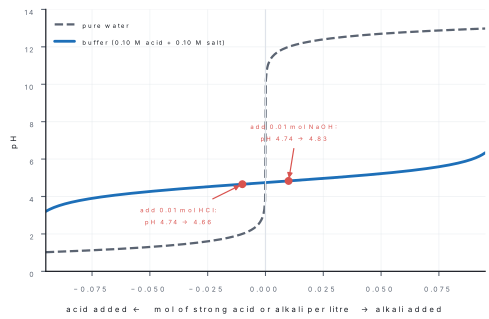
A buffer works best when [\text{salt}] = [\text{acid}], because then pH = pK_a and the ratio can move furthest in either direction. In practice a buffer is useful only over the range pH = pK_a \pm 1. Choose the weak acid whose pK_a is closest to the pH you want.
Applications of buffers.
- Blood is buffered at pH 7.4 by H₂CO₃/HCO₃⁻ (with phosphate and protein buffers). A drift of 0.4 pH unit either way is fatal.
- Intracellular fluid is buffered by H₂PO₄⁻/HPO₄²⁻ at about pH 7.2.
- Agriculture: soil must be buffered near pH 6–7; acidic hill soils in Nepal are limed to raise and hold the pH.
- Industry: electroplating baths, fermentation of beer and curd, dyeing of textiles, sugar refining and paper manufacture all need fixed pH.
- Pharmacy: eye drops and injections are buffered to the pH of body fluid to avoid irritation.
- Analysis: complexometric EDTA titrations are run in an NH₄Cl/NH₄OH buffer at pH 10.
Problem. (a) What mass of sodium acetate (molar mass 82) must be dissolved in 1.00 L of 0.10 M acetic acid to give a buffer of pH 5.00? (K_a = 1.8\times10^{-5}.) (b) Show that adding 0.010 mol of HCl to 1.00 L of a buffer that is 0.10 M in acetic acid and 0.10 M in sodium acetate changes the pH by less than 0.1 unit.
Solution.
(a) pK_a = -\log(1.8\times10^{-5}) = 5 - \log 1.8 = 5 - 0.255 = 4.74.
(b) Before addition, [salt] = [acid] = 0.10, so pH = pK_a = 4.74.
The added H⁺ converts 0.010 mol of acetate into acetic acid, so [salt] = 0.090 and [acid] = 0.110:
The change is 0.08 pH unit. The same 0.010 mol of HCl added to a litre of pure water would take the pH from 7 to -\log(0.010) = 2 — a change of five units.
2.13 Indicators and selection of indicators in acid-base titration
An acid-base indicator is a weak organic acid or base whose un-ionised form has a different colour from its ionised form, so that the colour of the solution signals its pH.
Ostwald's theory. Let the indicator be a weak acid HIn:
HIn ⇌ H⁺ + In⁻ (colour A) → (colour B)
The eye sees colour A alone when [HIn] is about ten times [In⁻], and colour B alone when the ratio is reversed. Putting the ratio equal to 1/10 and 10/1 gives the working range of the indicator:
In an acidic solution the high [\text{H}^{+}] pushes the equilibrium left, so phenolphthalein (whose ionised form is pink) is colourless in acid; in alkali the H⁺ is removed and the pink In⁻ appears.
| Indicator | Range (pH) | Colour in acid | Colour in alkali |
|---|---|---|---|
| Methyl orange | 3.1 – 4.4 | red | yellow |
| Methyl red | 4.2 – 6.3 | red | yellow |
| Litmus | 5.0 – 8.0 | red | blue |
| Bromothymol blue | 6.0 – 7.6 | yellow | blue |
| Phenol red | 6.8 – 8.4 | yellow | red |
| Phenolphthalein | 8.3 – 10.0 | colourless | pink |
| Thymolphthalein | 9.3 – 10.5 | colourless | blue |
Choose an indicator whose working range lies wholly within the steep, nearly vertical portion of the titration curve — the part where one drop of titrant changes the pH by several units. If the range lies outside that jump, the colour changes too early or too late and the titration is worthless.
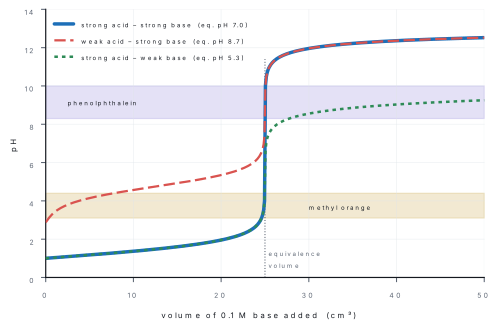
| Titration | pH at equivalence | Why | Indicator |
|---|---|---|---|
| Strong acid vs strong base | 7 | salt not hydrolysed | methyl orange or phenolphthalein |
| Weak acid vs strong base | > 7 (≈ 8.7) | anionic hydrolysis | phenolphthalein |
| Strong acid vs weak base | < 7 (≈ 5.3) | cationic hydrolysis | methyl orange |
| Weak acid vs weak base | ≈ 7 | both ions hydrolysed | no sharp jump — no indicator works; use a pH meter |
2.14 Types of salts: acidic, basic, simple, complex
A salt is the product of the reaction of an acid with a base. Salts are classified in two independent ways.
By composition:
| Class | Formed by | Examples |
|---|---|---|
| Normal (neutral) salt | complete replacement of all H⁺ of the acid | NaCl, Na₂SO₄, K₃PO₄ |
| Acid salt | partial replacement of the replaceable H⁺ | NaHSO₄, NaHCO₃, NaH₂PO₄ |
| Basic salt | partial replacement of the OH⁻ of a polyacidic base | Pb(OH)Cl, Zn(OH)Cl, Mg(OH)Cl |
| Double salt | two simple salts crystallised together | Mohr's salt FeSO₄·(NH₄)₂SO₄·6H₂O; potash alum K₂SO₄·Al₂(SO₄)₃·24H₂O |
| Mixed salt | one acid with two different bases, or one base with two acids | CaOCl₂ (bleaching powder), NaKSO₄ |
| Complex salt | contains a complex ion that survives in solution | K₄[Fe(CN)₆], [Cu(NH₃)₄]SO₄, K₃[Fe(CN)₆] |
A double salt exists only in the solid state: dissolve Mohr's salt and the solution gives all the tests of Fe²⁺, NH₄⁺ and SO₄²⁻. A complex salt keeps its complex ion in solution: dissolve K₄[Fe(CN)₆] and you get K⁺ and [Fe(CN)₆]⁴⁻ — the solution gives no test for Fe²⁺ or CN⁻.
By the pH of their solution (the result of hydrolysis, §2.15):
| Salt of | Nature of solution | Example |
|---|---|---|
| Strong acid + strong base | neutral, pH = 7 | NaCl, KNO₃, Na₂SO₄ |
| Weak acid + strong base | basic, pH > 7 | CH₃COONa, Na₂CO₃, KCN |
| Strong acid + weak base | acidic, pH < 7 | NH₄Cl, CuSO₄, FeCl₃ |
| Weak acid + weak base | depends on K_a vs K_b | CH₃COONH₄ (≈ 7) |
Note that an acid salt is not the same thing as an acidic salt: NaHCO₃ is an acid salt by composition but its solution is alkaline, because the carbonic acid it comes from is much weaker than the base NaOH.
2.15 Hydrolysis of salts
Hydrolysis is the reaction of the cation or the anion of a dissolved salt with water to produce the parent acid or base, making the solution acidic or alkaline. It is the reverse of neutralisation.
Case 1 — salt of a strong acid and a strong base (NaCl).
NaCl → Na⁺ + Cl⁻. Neither ion reacts with water: Na⁺ would give NaOH, a strong base which is completely ionised again, and Cl⁻ would give HCl, likewise. There is no hydrolysis; the solution is neutral, pH 7.
Case 2 — salt of a weak acid and a strong base (CH₃COONa): anionic hydrolysis.
CH₃COO⁻ + H₂O ⇌ CH₃COOH + OH⁻
The acetate ion takes a proton from water, leaving OH⁻ behind; the solution is alkaline.
Let C be the concentration of the salt and h its degree of hydrolysis.
| CH₃COO⁻ | + H₂O ⇌ | CH₃COOH | + | OH⁻ | |
|---|---|---|---|---|---|
| initial | C | 0 | 0 | ||
| equilibrium | C(1-h) | Ch | Ch |
Multiplying numerator and denominator of K_h by [\text{H}^{+}] and recognising K_a and K_w,
Since [\text{OH}^{-}] = Ch = \sqrt{K_hC} = \sqrt{K_wC/K_a}, taking logarithms gives
Case 3 — salt of a strong acid and a weak base (NH₄Cl): cationic hydrolysis.
NH₄⁺ + H₂O ⇌ NH₄OH + H⁺
The solution is acidic. By exactly the same argument,
Case 4 — salt of a weak acid and a weak base (CH₃COONH₄). Both ions hydrolyse and
Notice that here the degree of hydrolysis and the pH are independent of concentration — a favourite one-mark point. Dilution does not change the pH of an ammonium acetate solution.
| Salt of | Ion hydrolysed | K_h | Nature |
|---|---|---|---|
| SA + SB | none | — | neutral |
| WA + SB | anion | K_w/K_a | alkaline |
| SA + WB | cation | K_w/K_b | acidic |
| WA + WB | both | K_w/(K_aK_b) | depends on K_a vs K_b |
Problem. Calculate the hydrolysis constant, the degree of hydrolysis and the pH of a 0.10 M solution of sodium acetate at 25 °C. K_a(\text{CH}_3\text{COOH}) = 1.8\times10^{-5}, K_w = 1.0\times10^{-14}.
Solution.
so only about 0.0075 % of the acetate is hydrolysed.
The standard formula gives the same result: pH = 7 + \frac{1}{2}(4.74) + \frac{1}{2}(-1) = 7 + 2.37 - 0.50 = 8.87.
Chapter summary
- Arrhenius acids/bases work only in water; Bronsted-Lowry defines acid = proton donor, base = proton acceptor, giving conjugate pairs that differ by one H⁺; Lewis defines acid = electron-pair acceptor, base = electron-pair donor.
- For a conjugate pair K_a \times K_b = K_w and pK_a + pK_b = 14; the stronger the acid, the weaker its conjugate base.
- Ostwald's dilution law: K = C\alpha^{2}/(1-\alpha) \approx C\alpha^{2}, so \alpha = \sqrt{K/C} = \sqrt{KV}. It fails for strong electrolytes.
- K_w = [\text{H}^{+}][\text{OH}^{-}] = 1.0\times10^{-14} at 25 °C; pH + pOH = 14. K_w rises with temperature, so neutral pH falls below 7 on heating.
- pH master formulas: strong acid pH = -\log C; weak acid pH = \frac{1}{2}(pK_a - \log C); strong base pH = 14 + \log C; weak base pOH = \frac{1}{2}(pK_b - \log C).
- K_{sp} = x^{x}y^{y}S^{(x+y)} for A_xB_y. Precipitation occurs when the ionic product Q > K_{sp}; the common ion effect lowers solubility and suppresses the ionisation of weak electrolytes.
- Buffers: pH = pK_a + \log([\text{salt}]/[\text{acid}]) and pOH = pK_b + \log([\text{salt}]/[\text{base}]); capacity is greatest at pH = pK_a and useful over pK_a \pm 1.
- Choose an indicator whose range lies inside the vertical part of the titration curve: phenolphthalein (8.3–10.0) for weak acid vs strong base, methyl orange (3.1–4.4) for strong acid vs weak base, either for strong vs strong.
- Hydrolysis: WA+SB gives pH = 7 + \frac{1}{2}pK_a + \frac{1}{2}\log C (alkaline); SA+WB gives pH = 7 - \frac{1}{2}pK_b - \frac{1}{2}\log C (acidic); WA+WB gives pH = 7 + \frac{1}{2}pK_a - \frac{1}{2}pK_b, independent of concentration.
Practice questions
Group A — Multiple choice (1 mark each)
- The conjugate base of HSO₄⁻ is [1]aH₂SO₄bSO₄²⁻cH₂OdOH⁻
- Which of the following is a Lewis acid but not a Bronsted acid? [1]aHClbNH₄⁺cBF₃dCH₃COOH
- The pH of a 0.001 M solution of NaOH at 25 °C is [1]a3b7c11d14
- On dilution, the degree of ionisation of a weak electrolyte [1]adecreasesbincreasescremains the samedbecomes zero
- An aqueous solution of ammonium chloride is [1]aneutralbacidiccalkalinedamphoteric
- The indicator most suitable for the titration of acetic acid against sodium hydroxide is [1]amethyl orangebmethyl redcphenolphthaleindany of them
- If the solubility of a salt AB₂ is S mol L⁻¹, its solubility product is [1]aS^{2}b2S^{3}c4S^{3}dS^{3}
Answers to Group A
1. (b) — removing one proton from HSO₄⁻ leaves SO₄²⁻.
2. (c) — BF₃ has no proton to donate but an empty p orbital to accept a lone pair.
3. (c) — pOH = -\log 10^{-3} = 3, so pH = 14 - 3 = 11.
4. (b) — Ostwald's law, \alpha = \sqrt{K/C}, and C falls on dilution.
5. (b) — NH₄⁺ hydrolyses to give H⁺ (salt of strong acid + weak base).
6. (c) — the equivalence pH is about 8.7, inside the phenolphthalein range 8.3–10.0.
7. (c) — AB₂ ⇌ A²⁺ + 2B⁻, so K_{sp} = (S)(2S)^{2} = 4S^{3}.
Group B — Short answer (5 marks each)
- State the limitations of the Arrhenius concept of acids and bases, and show how the Bronsted-Lowry concept removes them. Identify the conjugate acid-base pairs in HCO₃⁻ + H₂O ⇌ H₂CO₃ + OH⁻. [5]
- State and derive Ostwald's dilution law. Why does it fail for strong electrolytes? [5]
- Calculate the pH and the degree of ionisation of a 0.020 M solution of a weak monobasic acid whose K_a is 2.0\times10^{-5}. [5]
- What is a buffer solution? Derive the Henderson equation for an acidic buffer and calculate the pH of a solution that is 0.20 M in CH₃COOH and 0.10 M in CH₃COONa. (pK_a = 4.74) [5]
- Define solubility product. The solubility of Mg(OH)₂ in water is 1.65\times10^{-4} mol L⁻¹. Calculate its solubility product. [5]
- What is meant by hydrolysis of a salt? Explain, with equations, why an aqueous solution of sodium carbonate is alkaline while that of ferric chloride is acidic. [5]
Answers to Group B
1. Limitations: restricted to water; free H⁺ cannot exist; cannot explain acids without H (CO₂, BF₃) or bases without OH (NH₃); ignores the solvent. The Bronsted definition needs only a proton transfer, so it works in any solvent and classifies NH₃ as a base and NH₄⁺ as an acid. In the given equation the pairs are HCO₃⁻ / H₂CO₃ (base / its conjugate acid) and H₂O / OH⁻ (acid / its conjugate base).
3. Using [\text{H}^{+}] = \sqrt{K_aC},
so pH = 4 - \log 6.32 = 4 - 0.801 = 3.20. And \alpha = \sqrt{K_a/C} = \sqrt{1.0\times10^{-3}} = 3.16\times10^{-2}, i.e. 3.16 per cent.
4. pH = pK_a + \log([\text{salt}]/[\text{acid}]), so pH = 4.74 + \log(0.10/0.20) = 4.74 - 0.301 = 4.44.
5. Mg(OH)₂ ⇌ Mg²⁺ + 2OH⁻, so K_{sp} = (S)(2S)^{2} = 4S^{3} and K_{sp} = 4(1.65\times10^{-4})^{3} = 4 \times 4.49\times10^{-12} = 1.80\times10^{-11}.
6. Hydrolysis is the reaction of the ions of a salt with water to regenerate the parent acid or base. Na₂CO₃ is the salt of the weak acid H₂CO₃ and the strong base NaOH, so the anion hydrolyses: CO₃²⁻ + H₂O ⇌ HCO₃⁻ + OH⁻, releasing OH⁻ and making the solution alkaline. FeCl₃ is the salt of the strong acid HCl and the weak base Fe(OH)₃, so the cation hydrolyses: Fe³⁺ + 3H₂O ⇌ Fe(OH)₃ + 3H⁺, releasing H⁺ and making the solution acidic.
Group C — Long answer (8 marks each)
- (a) Define pH and derive the expression for the pH of a weak monobasic acid. [3](b) Calculate the pH of 0.10 M ammonium hydroxide (K_b = 1.8\times10^{-5}), and the pH of the solution obtained when 0.10 mol of NH₄Cl is dissolved in 1.00 L of that ammonia solution. [5]
- (a) What is the common ion effect? Explain how it and the solubility product principle are used to separate Group II from Group IV cations in qualitative analysis. [4](b) The solubility product of AgCl is 1.8\times10^{-10}. Calculate its solubility in pure water and in 0.10 M AgNO₃ solution. [4]
- (a) State Ostwald's theory of indicators and derive the working range of an indicator. [4](b) Sketch the titration curve for a weak acid against a strong base, mark the equivalence point, and justify the choice of phenolphthalein rather than methyl orange. [4]
Answers to Group C
1.(b) For the ammonia alone, [\text{OH}^{-}] = \sqrt{K_bC} = \sqrt{1.8\times10^{-6}} = 1.34\times10^{-3} mol L⁻¹, so pOH = 2.87 and pH = 11.13.
Adding NH₄Cl creates a basic buffer with [base] = [salt] = 0.10 M:
so pH = 14 - 4.74 = 9.26. The common ion NH₄⁺ has suppressed the ionisation of the base and lowered the pH by nearly two units.
2.(a) The common ion effect is the suppression of the ionisation of a weak electrolyte by adding a strong electrolyte with an ion in common. H₂S is a weak acid; in the presence of dilute HCl the common ion H⁺ drives H₂S ⇌ 2H⁺ + S²⁻ to the left, so [\text{S}^{2-}] is very small. Only the Group II sulphides, whose K_{sp} values are extremely small, then reach Q > K_{sp} and precipitate. In Group IV the solution is made alkaline with NH₄OH; the OH⁻ removes H⁺, [\text{S}^{2-}] rises by many powers of ten, and the more soluble sulphides ZnS, MnS, CoS and NiS now satisfy Q > K_{sp}.
2.(b) In pure water S = \sqrt{K_{sp}} = 1.34\times10^{-5} mol L⁻¹.
In 0.10 M AgNO₃, [\text{Ag}^{+}] \approx 0.10, so
about 7450 times smaller.
3.(b) The curve starts near pH 2.9, rises quickly, flattens into a buffer region around pH = pK_a = 4.74 at half-neutralisation, then jumps steeply to the equivalence point at pH ≈ 8.7 (alkaline because of anionic hydrolysis of the acetate formed) and levels off near pH 12–13. The vertical portion runs only from about pH 7 to pH 11. Phenolphthalein (8.3–10.0) lies inside that jump, so its colour changes within one drop of the equivalence point. Methyl orange (3.1–4.4) lies far below it, in the buffer region, and would change colour long before the acid was neutralised.
Practise more: Chemistry question bank