Unit 7 · Inorganic Chemistry · 15 teaching hours · 48 min read
Studies of Heavy Metals
What the syllabus asks for 5
- Copper: occurrence and extraction from copper pyrite; properties with air, acids, aqueous ammonia, metal ions; uses; chemistry of blue vitriol; red oxide and black oxide (formula and uses)
- Zinc: occurrence and extraction from zinc blende; properties with air, acid, alkali, displacement; uses; chemistry of white vitriol
- Mercury: occurrence and extraction from cinnabar; properties; chemistry of calomel and corrosive sublimate
- Iron: occurrence and extraction; properties and uses; manufacture of steel by Basic Oxygen Method and Open Hearth Process; corrosion of iron and its prevention
- Silver: occurrence and extraction by cyanide process; preparation and uses of silver chloride and silver nitrate
Copper, zinc, mercury, iron and silver are the five metals the NEB course calls heavy metals — dense metals whose chemistry has been worked out over centuries of smelting. This is the longest unit in the book, but it is also the most repetitive: every metal is handled in the same four moves. Where is it found and how is it won from its ore? How does it behave with air, acids, alkalis and other metal ions? What are its two or three examinable compounds? What is it used for? Learn the pattern once and the five metals become five copies of one template.
Extraction questions carry the most marks: the ore and its formula, the furnace or process name, and the balanced equation for the key reduction step. Then come the "action of X on Y" one-liners, and finally the named compounds — blue vitriol, white vitriol, calomel, corrosive sublimate, silver nitrate. Every one of these is a table in this chapter. Memorise the tables.
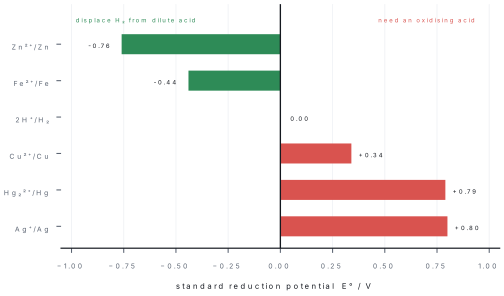
The whole unit is governed by one number per metal: its standard reduction potential. A metal above hydrogen displaces hydrogen from dilute acid; a metal below it does not, and must instead be dissolved by an oxidising acid such as nitric acid. That single rule explains why zinc and iron fizz in dilute hydrochloric acid while copper, mercury and silver sit there unchanged.
7.1 Copper
Copper is the oldest worked metal: the Kathmandu Valley's repoussé work, the gilded roofs of Pashupatinath and the water vessels of every Newari household are copper or its alloys. Nepal has small copper showings at Wapsa in Solukhumbu and in the Bhotkhola area, but none is mined industrially, so the metal is imported.
Occurrence and extraction from copper pyrite
| Ore | Formula | Type | Remark |
|---|---|---|---|
| Copper pyrite (chalcopyrite) | CuFeS₂ | sulphide | the chief ore, ~76% of world supply |
| Copper glance | Cu₂S | sulphide | rich but scarce |
| Cuprite (ruby copper) | Cu₂O | oxide | red |
| Malachite | CuCO₃·Cu(OH)₂ | carbonate | green |
| Azurite | 2CuCO₃·Cu(OH)₂ | carbonate | blue |
Copper pyrite carries only 2–3% copper, so the ore must be enriched before any chemistry is done. The full route has five stages.
1. Crushing and concentration by froth flotation. The powdered ore is stirred in water containing pine oil and a little sodium ethyl xanthate, and air is blown through. The sulphide particles are wetted by the oil, stick to the air bubbles and rise as a froth; the earthy gangue (silica, clay) is wetted by water and sinks. Froth flotation is used because the ore is a sulphide — sulphides are preferentially wetted by oil.
2. Roasting. The concentrate is heated in a current of air in a reverberatory furnace at about 1070 K, below the melting point of the charge. Moisture is driven off, volatile arsenic and antimony oxides escape, and the sulphur burns:
- S + O₂ → SO₂
- 2CuFeS₂ + O₂ → Cu₂S + 2FeS + SO₂
- 2FeS + 3O₂ → 2FeO + 2SO₂
- 2Cu₂S + 3O₂ → 2Cu₂O + 2SO₂
Roasting is deliberately incomplete: enough Cu₂S must survive to reduce the Cu₂O later.
3. Smelting. The roasted mass, mixed with coke and silica (sand), is smelted in a small water-jacketed blast furnace. Silica is the flux; it removes iron as a fusible slag:
- FeO + SiO₂ → FeSiO₃ (fusible slag, tapped off)
- Cu₂O + FeS → Cu₂S + FeO
The molten product that collects below the slag is copper matte, a mixture of Cu₂S and FeS containing about 45% copper.
4. Bessemerisation. The matte is transferred to a Bessemer converter lined with silica (an acidic lining, because the impurity FeO is basic). A hot air blast is forced through the tuyères:
- 2FeS + 3O₂ → 2FeO + 2SO₂ , then FeO + SiO₂ → FeSiO₃ (slag)
- 2Cu₂S + 3O₂ → 2Cu₂O + 2SO₂
- 2Cu₂O + Cu₂S → 6Cu + SO₂↑
The last equation is the heart of the process and is called auto-reduction or self-reduction: the ore reduces itself, with no external reducing agent. The copper obtained is 98% pure and is called blister copper, because the escaping SO₂ leaves blisters on its solidified surface.
5. Refining. Two methods are used in succession.
Poling. Molten blister copper is stirred with poles of green (unseasoned) wood. The hydrocarbons released reduce any dissolved Cu₂O back to copper, and the layer of charcoal on top stops re-oxidation.
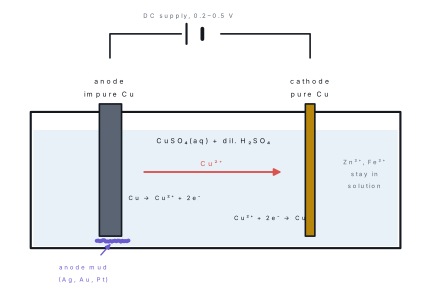
Electrolytic refining. This gives 99.95% copper — the purity needed for electrical wiring.
| Part of the cell | What it is |
|---|---|
| Anode | thick plate of impure blister copper |
| Cathode | thin sheet of pure copper |
| Electrolyte | 15% CuSO₄ solution acidified with dilute H₂SO₄ |
| At the anode | Cu → Cu²⁺ + 2e⁻ (the anode dissolves) |
| At the cathode | Cu²⁺ + 2e⁻ → Cu (pure copper deposits) |
| Anode mud | Ag, Au, Pt — too noble to dissolve; falls below the anode |
| Left in solution | Zn²⁺, Fe²⁺ — too active to be deposited |
Properties of copper
Copper is a soft, reddish-brown, ductile metal of density 8.95 g cm⁻³ and melting point 1083 °C. It is the second best conductor of electricity after silver.
| Reagent | Conditions | Reaction |
|---|---|---|
| Dry air | room temperature | no action |
| Moist air + CO₂ | long exposure | 2Cu + O₂ + CO₂ + H₂O → CuCO₃·Cu(OH)₂ (green patina) |
| Air | red heat, below 1370 K | 2Cu + O₂ → 2CuO (black) |
| Air | above 1370 K | 4Cu + O₂ → 2Cu₂O (red) |
| Dilute HCl / dilute H₂SO₄ | — | no reaction (Cu is below H in the series) |
| Hot conc. H₂SO₄ | — | Cu + 2H₂SO₄ → CuSO₄ + SO₂↑ + 2H₂O |
| Dilute HNO₃ | cold | 3Cu + 8HNO₃ → 3Cu(NO₃)₂ + 2NO↑ + 4H₂O |
| Conc. HNO₃ | — | Cu + 4HNO₃ → Cu(NO₃)₂ + 2NO₂↑ + 2H₂O |
| Conc. HCl | hot, air present | 2Cu + 4HCl + O₂ → 2CuCl₂ + 2H₂O |
| Cl₂ | heated | Cu + Cl₂ → CuCl₂ |
Action with aqueous ammonia. Copper is slowly dissolved by ammonia solution in the presence of air, giving the deep blue tetraamminecopper(II) ion:
2Cu + 8NH₃ + O₂ + 2H₂O → 2Cu(NH₃)₄₂
This deep blue solution is Schweitzer's reagent. It dissolves cellulose, and squirting that solution into dilute acid regenerates the cellulose as a fibre — this is how rayon (artificial silk) was first made.
Action with metal ions (displacement). Copper displaces from solution any metal that lies below it in the electrochemical series, and is itself displaced by any metal above it:
- Cu + 2AgNO₃ → Cu(NO₃)₂ + 2Ag (silver tree; the solution turns blue)
- Cu + Hg(NO₃)₂ → Cu(NO₃)₂ + Hg
- Cu + 2FeCl₃ → CuCl₂ + 2FeCl₂
The last reaction looks like an exception — iron is above copper, yet Fe³⁺ oxidises copper. It is not an exception: the relevant couple is Fe³⁺/Fe²⁺ (E° = +0.77 V), not Fe²⁺/Fe. It is used industrially to etch copper printed circuit boards.
"Iron is more reactive than copper, so copper cannot react with an iron salt" is a trap. Copper does react with Fe³⁺ because the Fe³⁺/Fe²⁺ couple sits above Cu²⁺/Cu. Always name the couple, never just the element.
Uses of copper
- Electrical wiring, cables, busbars and motor windings — second only to silver in conductivity but far cheaper.
- Utensils, boilers, calorimeters and distillation vessels (high thermal conductivity, not attacked by water).
- Alloys: brass (Cu + Zn), bronze (Cu + Sn), gun metal (Cu + Sn + Zn), German silver (Cu + Zn + Ni), coinage alloys.
- Electroplating and electrotyping; roofing sheets, temple ornament and repoussé work.
- Copper salts as fungicides (Bordeaux mixture) and in electroplating baths.
Chemistry of blue vitriol, CuSO₄·5H₂O
Blue vitriol, nilathotha in Nepali, is copper(II) sulphate pentahydrate.
Preparation. On the laboratory scale, dissolve copper(II) oxide or carbonate in warm dilute sulphuric acid and crystallise:
CuO + H₂SO₄ → CuSO₄ + H₂O
Industrially, scrap copper is heated with dilute sulphuric acid while air is blown through:
2Cu + 2H₂SO₄ + O₂ → 2CuSO₄ + 2H₂O
Structure. The crystal is not "copper sulphate with five loose waters". Four water molecules are bonded to the copper ion in a square plane and the fifth is held by hydrogen bonds to the sulphate, so the formula is better written [Cu(H₂O)₄]SO₄·H₂O.
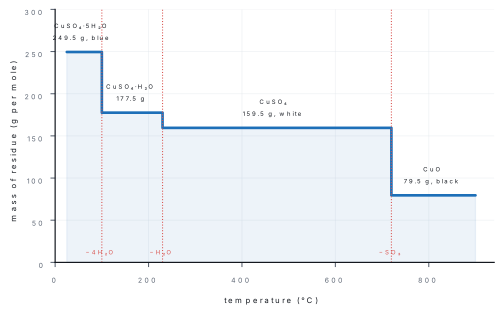
Action of heat. The water is lost in three well-separated stages:
| Temperature | Change | Colour |
|---|---|---|
| 100 °C | CuSO₄·5H₂O → CuSO₄·H₂O + 4H₂O | blue → pale blue |
| 230 °C | CuSO₄·H₂O → CuSO₄ + H₂O | pale blue → white |
| 720 °C | CuSO₄ → CuO + SO₃ | white → black |
Anhydrous copper sulphate is white and turns blue with water, which is the standard laboratory test for water.
Reactions of the solution. These are the reactions of the hydrated Cu²⁺ ion and are examined every year.
| Reagent | Observation | Equation |
|---|---|---|
| NaOH(aq) | blue gelatinous precipitate | CuSO₄ + 2NaOH → Cu(OH)₂↓ + Na₂SO₄ |
| NH₃(aq), a little | pale blue precipitate | CuSO₄ + 2NH₄OH → Cu(OH)₂↓ + (NH₄)₂SO₄ |
| NH₃(aq), excess | precipitate dissolves, deep blue | Cu(OH)₂ + 4NH₃ → Cu(NH₃)₄₂ |
| H₂S | black precipitate | CuSO₄ + H₂S → CuS↓ + H₂SO₄ |
| KI | white precipitate + brown iodine | 2CuSO₄ + 4KI → Cu₂I₂↓ + 2K₂SO₄ + I₂ |
| KCN, excess | cyanogen gas evolved | 2CuSO₄ + 4KCN → Cu₂(CN)₂↓ + 2K₂SO₄ + C₂N₂↑ |
| Fe or Zn | red-brown copper deposits | Fe + CuSO₄ → FeSO₄ + Cu |
Note the last two rows carefully: iodide and cyanide both reduce copper(II) to copper(I). Cu²⁺ does not give CuI₂ or Cu(CN)₂; those compounds decompose at once.
Uses of blue vitriol. Bordeaux mixture (CuSO₄ + slaked lime) sprayed against blight and mildew on potato, tomato and grape; electroplating and electrolytic refining baths; Fehling's solution and Benedict's solution for reducing sugars; a mordant in calico printing; an algicide in drinking-water tanks; a laboratory test for water.
Red oxide and black oxide of copper
| Red oxide | Black oxide | |
|---|---|---|
| Name | copper(I) oxide, cuprous oxide | copper(II) oxide, cupric oxide |
| Formula | Cu₂O | CuO |
| Colour | red | black |
| Nature | basic, covalent character | basic |
| Made by | reduction of Fehling's solution by a reducing sugar; or 4Cu + O₂ → 2Cu₂O above 1370 K | 2Cu + O₂ → 2CuO at red heat; or Cu(NO₃)₂ heated |
| Uses | red ("ruby") glass and glazes; antifouling paint for ships' hulls; copper oxide rectifiers; as a fungicide for seed dressing | pigment for blue and green glass and ceramics; oxidising agent in the combustion analysis of organic compounds; making rayon and other copper salts; desulphurising petroleum |
Problem. A sample of ore contains 20.0% copper pyrite, CuFeS₂, by mass. Calculate the mass of copper that can be recovered from 1.00 tonne of this ore if the overall recovery of the plant is 90%. (Cu = 63.5, Fe = 56, S = 32)
Solution. First the percentage of copper in the pure mineral:
Copper as a fraction of the ore is 0.200 \times 34.60\% = 6.92\%.
Mass of copper in 1.00 tonne = 1000 kg:
At 90% recovery, m = 0.90 \times 69.2 = 62.3\ \text{kg} of copper.
Problem. 24.95 g of blue vitriol is heated first to 100 °C, then to 230 °C. Calculate the mass of the residue at each stage and the total mass of water lost. (Cu = 63.5, S = 32, O = 16, H = 1)
Solution. M(\text{CuSO}_4\cdot 5\text{H}_2\text{O}) = 63.5+32+64+90 = 249.5\ \text{g mol}^{-1}, so
At 100 °C four moles of water leave per mole of salt:
so the residue CuSO₄·H₂O weighs 24.95 - 7.2 = 17.75\ \text{g}.
At 230 °C the fifth water leaves: a further 0.100 \times 18 = 1.8\ \text{g}, giving white anhydrous CuSO₄ of mass 17.75 - 1.8 = 15.95\ \text{g} (check: 0.100 \times 159.5 = 15.95\ \text{g} ✔).
Total water lost = 7.2 + 1.8 = 9.0\ \text{g}.
7.2 Zinc
Zinc is the metal that protects other metals. In Nepal it matters twice over: the Ganesh Himal lead–zinc deposit in Dhading is the country's best-known metal prospect, and galvanised (jasta) roofing sheet is the standard roof of the hills.
Occurrence and extraction from zinc blende
| Ore | Formula | Remark |
|---|---|---|
| Zinc blende (sphalerite) | ZnS | chief ore |
| Calamine (smithsonite) | ZnCO₃ | carbonate ore |
| Zincite | ZnO | red, rare |
| Willemite | Zn₂SiO₄ | silicate |
1. Concentration by froth flotation — again a sulphide ore, again pine oil and air. Blende often carries galena (PbS), so a depressant is used to float the two sulphides separately.
2. Roasting. The concentrate is roasted at about 1200 K in a free supply of air in a fluidised-bed roaster:
2ZnS + 3O₂ → 2ZnO + 2SO₂↑
(A carbonate ore is calcined instead: ZnCO₃ → ZnO + CO₂.) The SO₂ is not wasted — it is fed to a contact-process plant to make sulphuric acid.
3. Reduction (smelting). The zinc oxide is mixed with powdered coke and heated to 1673 K in fireclay retorts:
ZnO + C → Zn + CO↑
At this temperature zinc is a vapour (b.p. 907 °C), so it distils over and is condensed. This is the crucial difference from iron smelting, and the reason zinc was isolated so late in history: cool the vapour in air and it simply burns back to ZnO. The condensed metal, 97–98% pure, is called spelter, and the fine powder that condenses first is zinc dust.
4. Refining. Three options: liquation (melting on a sloping hearth so that zinc runs off and less fusible iron stays behind), fractional distillation, and electrolytic refining using ZnSO₄ + H₂SO₄ as electrolyte with aluminium cathodes, which gives 99.95% zinc.
Carbon will not reduce ZnS. Every sulphide ore in this chapter is first converted to the oxide by roasting, because carbon reduces oxides but has no affinity for sulphur. Copper is the one apparent exception, and there the reducing agent is not carbon but the ore's own sulphide (auto-reduction).
Properties of zinc
Zinc is a bluish-white metal, brittle at room temperature, malleable between 100 °C and 150 °C, and brittle again above 200 °C — so zinc sheet is always rolled hot.
| Reagent | Reaction |
|---|---|
| Moist air | 2Zn + O₂ + CO₂ + H₂O → ZnCO₃·Zn(OH)₂ (protective film) |
| Air, strong heating | 2Zn + O₂ → 2ZnO (burns with a bluish-white flame; the white ZnO smoke is philosopher's wool) |
| Dilute HCl | Zn + 2HCl → ZnCl₂ + H₂↑ |
| Dilute H₂SO₄ | Zn + H₂SO₄ → ZnSO₄ + H₂↑ |
| Hot conc. H₂SO₄ | Zn + 2H₂SO₄ → ZnSO₄ + SO₂↑ + 2H₂O |
| Very dilute HNO₃, cold | 4Zn + 10HNO₃ → 4Zn(NO₃)₂ + NH₄NO₃ + 3H₂O |
| Dilute HNO₃ | 3Zn + 8HNO₃ → 3Zn(NO₃)₂ + 2NO↑ + 4H₂O |
| Conc. HNO₃ | Zn + 4HNO₃ → Zn(NO₃)₂ + 2NO₂↑ + 2H₂O |
| Hot NaOH(aq) | Zn + 2NaOH → Na₂ZnO₂ + H₂↑ (sodium zincate) |
| Steam, red heat | Zn + H₂O → ZnO + H₂↑ |
The reaction with alkali is written more accurately as
Zn + 2NaOH + 2H₂O → Na₂[Zn(OH)₄] + H₂↑
Because zinc dissolves in both acid and alkali with evolution of hydrogen, it is amphoteric — the single most-asked fact about the metal.
Displacement. Zinc lies well below hydrogen (E° = −0.76 V), so it displaces almost every common metal from solution:
- Zn + CuSO₄ → ZnSO₄ + Cu
- Zn + FeSO₄ → ZnSO₄ + Fe
- Zn + 2AgNO₃ → Zn(NO₃)₂ + 2Ag
- 2Na[Ag(CN)₂] + Zn → Na₂[Zn(CN)₄] + 2Ag (used in the silver cyanide process)
In alkaline solution zinc is such a strong reducing agent that it reduces nitrates all the way to ammonia — the basis of a test for the nitrate ion:
4Zn + 7NaOH + NaNO₃ → 4Na₂ZnO₂ + NH₃↑ + 2H₂O
Uses of zinc
- Galvanising iron sheet, pipe, nails and wire — the largest single use.
- Alloys: brass, German silver, bronze solders and die-casting alloys.
- The negative electrode (the can) of the dry Leclanché cell.
- Zinc dust as a reducing agent in the laboratory and in industry; zinc amalgam in Clemmensen reduction.
- Sacrificial anodes on ships' hulls, buried pipelines and water heaters.
- Zinc oxide in white paint, rubber compounding, cosmetics and calamine lotion; zinc sulphate as a micronutrient fertiliser on zinc-deficient paddy soils.
Chemistry of white vitriol, ZnSO₄·7H₂O
Preparation. Dissolve zinc, zinc oxide or zinc carbonate in dilute sulphuric acid and crystallise the solution below 30 °C:
- Zn + H₂SO₄ → ZnSO₄ + H₂↑
- ZnO + H₂SO₄ → ZnSO₄ + H₂O
Above 30 °C the hexahydrate crystallises instead, and above 70 °C the monohydrate, so temperature control matters.
Action of heat.
| Temperature | Change |
|---|---|
| 100 °C | ZnSO₄·7H₂O → ZnSO₄·H₂O + 6H₂O |
| 450 °C | ZnSO₄·H₂O → ZnSO₄ + H₂O |
| red heat | 2ZnSO₄ → 2ZnO + 2SO₂↑ + O₂↑ |
Reactions in solution.
| Reagent | Observation | Equation |
|---|---|---|
| NaOH, a little | white precipitate | ZnSO₄ + 2NaOH → Zn(OH)₂↓ + Na₂SO₄ |
| NaOH, excess | precipitate dissolves | Zn(OH)₂ + 2NaOH → Na₂[Zn(OH)₄] |
| NH₃, a little | white precipitate | ZnSO₄ + 2NH₄OH → Zn(OH)₂↓ + (NH₄)₂SO₄ |
| NH₃, excess | dissolves, colourless | Zn(OH)₂ + 4NH₃ → Zn(NH₃)₄₂ |
| H₂S in alkaline medium | white precipitate | ZnSO₄ + H₂S → ZnS↓ + H₂SO₄ |
| BaCl₂ | white precipitate, acid-insoluble | ZnSO₄ + BaCl₂ → BaSO₄↓ + ZnCl₂ |
| K₄[Fe(CN)₆] | white precipitate | 2ZnSO₄ + K₄[Fe(CN)₆] → Zn₂[Fe(CN)₆]↓ + 2K₂SO₄ |
The white Zn(OH)₂ that dissolves in excess alkali is the standard way of telling zinc from other white-precipitate cations: aluminium behaves similarly with NaOH but not with excess ammonia, while magnesium dissolves in neither.
Uses of white vitriol. Making lithopone (ZnS + BaSO₄), a brilliant white pigment that does not blacken in polluted air as white lead does; as an eye lotion and mild astringent antiseptic; a mordant in dyeing and calico printing; electrolyte in zinc electroplating; a wood preservative; and a zinc fertiliser.
Problem. 194.8 g of pure zinc blende is roasted completely, and the zinc oxide formed is then reduced by coke. Calculate (a) the volume of SO₂ produced at STP and (b) the mass of zinc obtained, assuming both steps go to completion. (Zn = 65.4, S = 32, molar volume at STP = 22.4 L mol⁻¹)
Solution. M(\text{ZnS}) = 65.4 + 32 = 97.4\ \text{g mol}^{-1}, so
(a) From 2ZnS + 3O₂ → 2ZnO + 2SO₂, the mole ratio ZnS : SO₂ is 1 : 1, so n(\text{SO}_2) = 2.00\ \text{mol} and
(b) From ZnO + C → Zn + CO, the ratio ZnO : Zn is also 1 : 1, so n(\text{Zn}) = 2.00\ \text{mol} and
7.3 Mercury
Mercury is the only metal that is liquid at room temperature, and the only one on this list that is a cumulative poison. Its vapour damages the nervous system, which is why mercury thermometers and sphygmomanometers are being withdrawn from Nepali hospitals under the Minamata Convention.
Occurrence and extraction from cinnabar
| Ore | Formula | Colour |
|---|---|---|
| Cinnabar | HgS | bright red — the chief ore |
| Calomel (horn quicksilver) | Hg₂Cl₂ | white |
| Livingstonite | HgSb₄S₈ | grey |
1. Concentration. The crushed ore is concentrated by froth flotation.
2. Roasting — and that is the whole extraction. Cinnabar is roasted in a current of air at 700–800 K in a shaft or rotary furnace:
HgS + O₂ → Hg + SO₂↑
No reducing agent is needed. Mercury(II) oxide is so unstable that even if it forms first it decomposes at once:
2HgS + 3O₂ → 2HgO + 2SO₂ , then 2HgO → 2Hg + O₂
This makes mercury the easiest metal in the syllabus to extract: it is the only one whose oxide falls apart on heating, which is precisely how Priestley and Lavoisier discovered oxygen.
3. Condensation. The mercury vapour (b.p. 357 °C) is led through a long series of water-cooled earthenware condensers and collects as liquid metal.
4. Purification. Two steps:
- The crude metal is allowed to fall as a fine spray down a tall column of dilute nitric acid. Base metals (Zn, Pb, Sn, Cu) dissolve; mercury, being noble, does not. Any mercury that does dissolve is recovered by shaking with more mercury.
- The washed metal is distilled under reduced pressure. Laboratory-grade mercury is "triple-distilled", 99.999% pure.
Properties of mercury
| Property | Value |
|---|---|
| Melting point | −38.9 °C |
| Boiling point | 356.6 °C |
| Density | 13.6 g cm⁻³ |
| Electrical conductivity | moderate |
| Thermal conductivity | poor |
Mercury has a high surface tension, so it does not wet glass and forms convex menisci; it expands almost uniformly between 0 °C and 100 °C, which is why it was the standard thermometric liquid.
| Reagent | Reaction |
|---|---|
| Dry or moist air, cold | no action (it keeps its mirror surface) |
| Air at about 350 °C | 2Hg + O₂ → 2HgO (red) |
| The same oxide above 400 °C | 2HgO → 2Hg + O₂↑ |
| Dilute HCl, dilute H₂SO₄ | no reaction |
| Hot conc. H₂SO₄, excess acid | Hg + 2H₂SO₄ → HgSO₄ + SO₂↑ + 2H₂O |
| Hot conc. H₂SO₄, excess mercury | 2Hg + 2H₂SO₄ → Hg₂SO₄ + SO₂↑ + 2H₂O |
| Cold dilute HNO₃, excess mercury | 6Hg + 8HNO₃ → 3Hg₂(NO₃)₂ + 2NO↑ + 4H₂O |
| Hot conc. HNO₃, excess acid | Hg + 4HNO₃ → Hg(NO₃)₂ + 2NO₂↑ + 2H₂O |
| Cl₂, excess | Hg + Cl₂ → HgCl₂ |
| Cl₂, limited | 2Hg + Cl₂ → Hg₂Cl₂ |
| Sulphur, rubbed together | Hg + S → HgS (black) |
With mercury, excess metal gives the mercurous (Hg₂²⁺) salt and excess acid or halogen gives the mercuric (Hg²⁺) salt. Two answers to the same question are both right; the condition in the question tells you which. The Hg₂²⁺ ion always contains an Hg–Hg bond, so it is never written as Hg⁺.
Mercury dissolves most metals to give amalgams — sodium amalgam and zinc amalgam are common reducing agents, and dental amalgam is Ag–Sn–Hg. Iron and platinum do not amalgamate, which is why mercury is stored and transported in iron bottles. Powdered sulphur is sprinkled on a spilt mercury bead because the solid black sulphide formed is not volatile and can be swept up safely.
Chemistry of calomel, Hg₂Cl₂
Calomel is mercury(I) chloride, a white insoluble powder.
Preparation.
- By precipitation: Hg₂(NO₃)₂ + 2NaCl → Hg₂Cl₂↓ + 2NaNO₃
- By grinding corrosive sublimate with mercury: HgCl₂ + Hg → Hg₂Cl₂
- By reduction with tin(II) chloride: 2HgCl₂ + SnCl₂ → Hg₂Cl₂↓ + SnCl₄
Properties. It is a white solid, insoluble in water, tasteless and non-poisonous (unlike the mercuric compound), and it sublimes at about 400 °C.
Action of ammonia — the identifying test:
Hg₂Cl₂ + 2NH₃ → Hg(NH₂)Cl↓ + Hg↓ + NH₄Cl
The finely divided free mercury turns the white solid black. The name calomel comes from the Greek kalos melas, "beautiful black", for exactly this reaction.
Action of excess potassium iodide — disproportionation again:
Hg₂Cl₂ + 2KI → HgI₂ + Hg↓ + 2KCl
Uses. The calomel electrode — a standard secondary reference electrode in every pH meter (E° = +0.28 V for the saturated form); formerly a purgative in medicine; in fungicides and in sweet-mercury preparations.
Chemistry of corrosive sublimate, HgCl₂
Corrosive sublimate is mercury(II) chloride — a violent poison, as the name warns.
Preparation.
- Direct: Hg + Cl₂ → HgCl₂ (excess chlorine, about 300 °C)
- Industrial: mercury(II) sulphate is heated with sodium chloride, and the product sublimes off:
HgSO₄ + 2NaCl → HgCl₂↑ + Na₂SO₄
A little manganese dioxide is added to oxidise any mercurous salt to the mercuric state.
Properties. A white crystalline solid, sparingly soluble in water, very soluble in alcohol and ether. In solution it is largely un-ionised — it is essentially a covalent molecule, Cl–Hg–Cl — so a fresh solution gives only a faint test for chloride ion with silver nitrate. It sublimes readily on heating.
| Reagent | Observation | Equation |
|---|---|---|
| NaOH | yellow precipitate | HgCl₂ + 2NaOH → HgO↓ + 2NaCl + H₂O |
| NH₃ | white precipitate (the 'infusible white precipitate') | HgCl₂ + 2NH₃ → Hg(NH₂)Cl↓ + NH₄Cl |
| SnCl₂, limited | white precipitate of calomel | 2HgCl₂ + SnCl₂ → Hg₂Cl₂↓ + SnCl₄ |
| SnCl₂, excess | grey-black free mercury | Hg₂Cl₂ + SnCl₂ → 2Hg↓ + SnCl₄ |
| KI, limited | scarlet precipitate | HgCl₂ + 2KI → HgI₂↓ + 2KCl |
| KI, excess | precipitate dissolves | HgI₂ + 2KI → K₂[HgI₄] |
The last row makes Nessler's reagent (alkaline K₂[HgI₄]), the standard test for ammonia and ammonium salts — it gives a brown precipitate with NH₄⁺, and is used to check drinking water and effluent in Nepali laboratories.
The two-stage reaction with tin(II) chloride is the classic distinction: a white precipitate turning grey on adding more SnCl₂ proves a mercuric salt.
Uses. Antiseptic and disinfectant in 1 : 1000 solution; preserving timber and anatomical specimens; making Nessler's reagent and calomel; catalyst (with HgSO₄) for the hydration of ethyne to ethanal; seed dressing; and as a laboratory reagent.
Calomel Hg₂Cl₂ is insoluble, tasteless and non-poisonous; corrosive sublimate HgCl₂ is soluble, sharply metallic-tasting and lethal. Ammonia blackens the first and gives a persistent white precipitate with the second. Do not swap their formulae — Hg₂Cl₂ has the Hg–Hg bond.
7.4 Iron
Iron is the working metal of the modern world and the central atom of haemoglobin. Nepal's Dhaubadi deposit in Nawalparasi, together with older showings at Phulchoki (Lalitpur) and Thoshe (Ramechhap), is the basis of the country's first planned iron and steel plant.
Occurrence and extraction
| Ore | Formula | % Fe | Remark |
|---|---|---|---|
| Haematite | Fe₂O₃ | 70 | red, chief ore |
| Magnetite | Fe₃O₄ | 72 | magnetic, richest |
| Siderite (spathic ore) | FeCO₃ | 48 | carbonate |
| Limonite | Fe₂O₃·3H₂O | 60 | hydrated, brown |
| Iron pyrite | FeS₂ | 47 | "fool's gold"; used for H₂SO₄, not for iron |
Iron pyrite is never used to make iron: the sulphur it leaves behind makes the metal red-short, i.e. brittle when hot.
1. Concentration. Gravity separation (washing) for haematite; magnetic separation for magnetite.
2. Calcination and roasting. Heating in a reverberatory furnace drives off moisture and CO₂, burns away sulphur and arsenic as their oxides, and oxidises FeO to Fe₂O₃, leaving the ore porous.
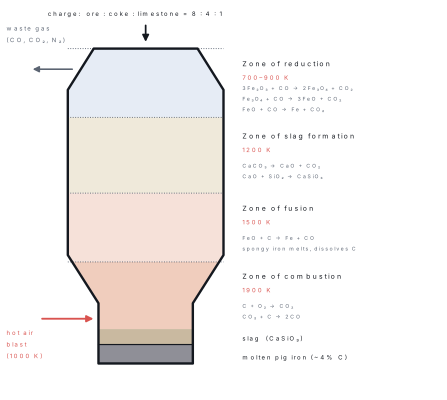
3. Smelting in the blast furnace. The charge is roasted ore, coke and limestone in roughly the mass ratio 8 : 4 : 1, fed in at the top through a cup-and-cone arrangement. A blast of air preheated to about 1000 K enters near the bottom through tuyères. Four zones do four different jobs.
| Zone | Temperature | Chemistry |
|---|---|---|
| Combustion (bottom) | 1900 K | C + O₂ → CO₂ (exothermic); CO₂ + C → 2CO (endothermic) |
| Fusion | 1500 K | FeO + C → Fe + CO; spongy iron melts and dissolves carbon |
| Slag formation | 1200 K | CaCO₃ → CaO + CO₂; CaO + SiO₂ → CaSiO₃ (slag) |
| Reduction (top) | 700–900 K | 3Fe₂O₃ + CO → 2Fe₃O₄ + CO₂; Fe₃O₄ + CO → 3FeO + CO₂; FeO + CO → Fe + CO₂ |
Molten iron collects at the hearth and the lighter slag floats on it; both are tapped separately. The product is pig iron, about 4% carbon, plus Si, Mn, P and S. Remelting pig iron with scrap and coke in a cupola furnace gives cast iron.
Properties and uses of iron
Pure iron is a lustrous, silvery-white, soft metal of density 7.86 g cm⁻³ and melting point 1535 °C. It is strongly ferromagnetic.
| Reagent | Reaction |
|---|---|
| Dry air | no action |
| Moist air | rusting: hydrated Fe₂O₃·xH₂O |
| Air, strongly heated | 3Fe + 2O₂ → Fe₃O₄ |
| Steam, red heat (reversible) | 3Fe + 4H₂O ⇌ Fe₃O₄ + 4H₂ |
| Dilute HCl | Fe + 2HCl → FeCl₂ + H₂↑ |
| Dilute H₂SO₄ | Fe + H₂SO₄ → FeSO₄ + H₂↑ |
| Hot conc. H₂SO₄ | 2Fe + 6H₂SO₄ → Fe₂(SO₄)₃ + 3SO₂↑ + 6H₂O |
| Very dilute cold HNO₃ | 4Fe + 10HNO₃ → 4Fe(NO₃)₂ + NH₄NO₃ + 3H₂O |
| Conc. HNO₃ | passivity — a thin film of Fe₃O₄ stops all further attack |
| Cl₂, heated | 2Fe + 3Cl₂ → 2FeCl₃ |
| NaOH(aq) | no action — iron is not amphoteric |
| CuSO₄(aq) | Fe + CuSO₄ → FeSO₄ + Cu |
Note that dilute acids give iron(II), while chlorine and hot concentrated sulphuric acid give iron(III): the halogen and the hot acid are the stronger oxidising agents.
| Variety | Carbon | Properties and uses |
|---|---|---|
| Pig iron / cast iron | 2.5–4.5% | hard, brittle, cannot be forged; drain pipes, manhole covers, engine blocks, stoves |
| Wrought iron | below 0.25% | softest and purest, malleable, weldable; chains, hooks, ornamental gates, electromagnet cores |
| Steel | 0.25–1.5% | hard and tough, can be tempered; rods, girders, rails, tools, vehicles |
Iron is also essential biologically: an adult carries about 4 g, most of it in the haem groups of haemoglobin, and iron-deficiency anaemia is Nepal's commonest nutritional disorder.
Manufacture of steel by the Basic Oxygen Method
Steel is iron with its carbon content cut to between 0.25% and 1.5%, and with silicon, manganese, phosphorus and sulphur removed. The Basic Oxygen Process (the LD or Linz–Donawitz process) now makes most of the world's steel.
- Vessel. A pear-shaped converter lined with a basic refractory (calcined dolomite, CaO·MgO) — basic because the impurity oxides SiO₂ and P₂O₅ that must be absorbed are acidic.
- Charge. Molten pig iron from the blast furnace, up to 30% scrap steel, and a measured amount of quicklime (CaO) as flux.
- Blow. A water-cooled lance is lowered to within a metre of the melt and 99.5% pure oxygen is blown at about 10 atm for 20 minutes. No fuel is needed: the oxidation of the impurities supplies all the heat.
| Impurity | Oxidation | Fate of the oxide |
|---|---|---|
| Carbon | 2C + O₂ → 2CO↑ | burns off at the mouth as a flame |
| Silicon | Si + O₂ → SiO₂ | SiO₂ + CaO → CaSiO₃ (slag) |
| Manganese | 2Mn + O₂ → 2MnO | MnO + SiO₂ → MnSiO₃ (slag) |
| Phosphorus | 4P + 5O₂ → 2P₂O₅ | P₂O₅ + 3CaO → Ca₃(PO₄)₂ (slag, sold as fertiliser) |
| Sulphur | S + O₂ → SO₂↑ | escapes as gas |
When the carbon has fallen to the required level the blow is stopped and calculated amounts of ferro-manganese or other alloying metals are added. One charge of 300 tonnes takes about 40 minutes.
Manufacture of steel by the Open Hearth Process
The Open Hearth or Siemens–Martin process is older and slower but gives far better control of composition.
- Vessel. A shallow, saucer-shaped hearth of large surface area, lined with dolomite (basic hearth, for high-phosphorus pig iron) or silica (acid hearth, for low-phosphorus pig iron).
- Heating. Producer gas and preheated air are burnt over the surface of the charge. The hot waste gases pass through brick regenerators, which store the heat and give it back to the incoming air — the Siemens regenerative principle, which is what makes 1600 °C possible on an open hearth.
- Oxidising agent. Not an oxygen blast but haematite added to the charge. The iron(III) oxide burns out the impurities:
| Impurity | Reaction |
|---|---|
| Carbon | Fe₂O₃ + 3C → 2Fe + 3CO↑ |
| Silicon | 2Fe₂O₃ + 3Si → 4Fe + 3SiO₂ |
| Manganese | Fe₂O₃ + 3Mn → 2Fe + 3MnO |
| Phosphorus | 5Fe₂O₃ + 6P → 10Fe + 3P₂O₅ |
Lime is added as flux, and the SiO₂ and P₂O₅ pass into the slag as before. A charge takes 8–10 hours, and because it is slow the operator can draw samples, analyse them and adjust the melt — which is why alloy and tool steels are still made this way.
| Basic Oxygen Process | Open Hearth Process | |
|---|---|---|
| Oxidant | pure O₂ blown through a lance | Fe₂O₃ (haematite) in the charge |
| Fuel | none needed | producer gas + regenerators |
| Time per charge | 20–40 min | 8–10 h |
| Control of composition | limited | excellent — samples can be taken |
| Nitrogen pick-up | very low (no air blown) | low |
| Typical product | plain carbon steel in bulk | alloy, tool and special steels |
Heat treatment finishes the job: annealing (heat, then cool very slowly) softens steel and removes internal stress; quenching (heat, then plunge into oil or water) makes it glass-hard but brittle; tempering (reheat the quenched steel gently) restores toughness; case hardening gives a hard skin on a tough core.
Corrosion of iron and its prevention
Rusting is an electrochemical process, not simple oxidation. It needs both water and oxygen — iron does not rust in dry air, nor under air-free boiled water.
A single drop of water on an iron surface sets up a miniature galvanic cell. The centre of the drop, starved of oxygen, becomes the anode; the rim, where oxygen dissolves freely, becomes the cathode.
At the anode (oxidation): 2Fe → 2Fe²⁺ + 4e⁻
At the cathode (reduction): O₂ + 4H⁺ + 4e⁻ → 2H₂O
Overall: 2Fe + O₂ + 4H⁺ → 2Fe²⁺ + 2H₂O
The H⁺ comes from carbonic acid, since rainwater always carries dissolved CO₂. The Fe²⁺ then diffuses out to the oxygen-rich rim and is oxidised further:
4Fe²⁺ + O₂ + 4H₂O → 2Fe₂O₃ + 8H⁺ , then Fe₂O₃ + xH₂O → Fe₂O₃·xH₂O (rust)
Rust is flaky and porous, so it does not protect the metal underneath — unlike the oxide film on aluminium — and corrosion continues right through the object.
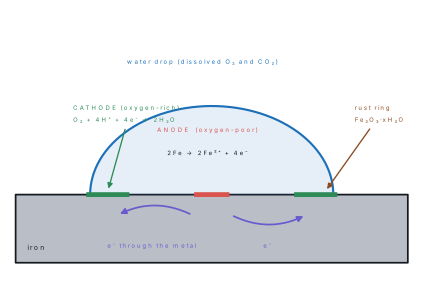
Factors that speed up rusting: presence of moisture and oxygen; dissolved CO₂, acids and especially salts (sea air, road salt) because they raise the conductivity of the electrolyte; contact with a less reactive metal; impurities and strains in the metal; and rough or scratched surfaces.
Prevention.
| Method | How it works | Example |
|---|---|---|
| Barrier coating | keeps out air and water | paint, grease, oil, enamel, plastic |
| Galvanising | zinc coat; zinc is more electropositive, so it corrodes first even if the coat is scratched | roofing sheet, buckets, nails |
| Tinning | tin coat, purely a barrier | food cans |
| Electroplating | Cr, Ni or Cu deposited electrolytically | taps, cycle parts |
| Cathodic (sacrificial) protection | blocks of Mg or Zn wired to the iron corrode instead | ship hulls, buried pipelines, water tanks |
| Alloying | the alloy carries its own passive film | stainless steel: Fe + 18% Cr + 8% Ni |
| Passivation | a chemically grown oxide or phosphate film | phosphating of car bodies before painting |
Both coatings work while they are unbroken. Scratch a galvanised sheet and the zinc, being more electropositive than iron, still corrodes first and the iron is safe. Scratch a tinned can and the iron, being more electropositive than tin, becomes the anode — so a scratched tin can rusts faster than plain iron. This comparison is a standard 2-mark question.
Problem. A basic oxygen converter is charged with 100 tonnes of pig iron containing 4.0% carbon, which must be brought down to 0.4% carbon. Calculate the volume of oxygen at STP needed to remove this carbon, assuming it is all oxidised to carbon monoxide. (C = 12, molar volume at STP = 22.4 L mol⁻¹)
Solution. Carbon to be removed:
From 2C + O₂ → 2CO, one mole of O₂ is needed for every two moles of carbon:
7.5 Silver
Silver is the best conductor of heat and electricity of all metals, and the metal of Nepali jewellery, ritual vessels and the old mohar coinage. Almost all of it today comes as a by-product of lead, zinc and copper refining rather than from a silver mine.
Occurrence and extraction by the cyanide process
| Ore | Formula |
|---|---|
| Native silver | Ag |
| Argentite (silver glance) | Ag₂S |
| Horn silver | AgCl |
| Ruby silver (pyrargyrite) | Ag₃SbS₃ |
| Anode mud of copper refining | mixed Ag, Au, Pt |
The cyanide process (the MacArthur–Forrest process) extracts silver from argentite in three steps.
1. Concentration of the crushed ore by froth flotation.
2. Leaching with sodium cyanide. The concentrate is stirred with a dilute (0.1–0.5%) solution of sodium cyanide while air is blown through:
Ag₂S + 4NaCN ⇌ 2Na[Ag(CN)₂] + Na₂S
The reaction is reversible and would stop early, so the sodium sulphide is continuously destroyed by the air blast:
2Na₂S + 2O₂ + H₂O → Na₂S₂O₃ + 2NaOH
Removing a product pulls the equilibrium to the right — Le Chatelier's principle doing real industrial work. The silver is now in solution as the soluble complex sodium dicyanoargentate(I).
3. Precipitation with zinc. Scrap zinc dust is added to the filtered solution. Zinc is more electropositive than silver, so it displaces it:
2Na[Ag(CN)₂] + Zn → Na₂[Zn(CN)₄] + 2Ag↓
4. Refining. The spongy silver is purified electrolytically by the Moebius process: a plate of impure silver is the anode, a sheet of pure silver the cathode, and the electrolyte is silver nitrate acidified with 1% nitric acid. Pure silver falls as crystals into a canvas bag hung beneath the anode; gold and platinum stay in the anode mud. The product is 99.9% pure.
Cyanide is used because Ag⁺ forms an exceptionally stable complex with CN⁻. Complex formation lowers the concentration of free Ag⁺ so far that even an insoluble sulphide is forced into solution. The same trick is used for gold. The price is a lethally toxic effluent, which is why cyanide leaching is tightly regulated.
Silver is a white, lustrous, very malleable and ductile metal (m.p. 961 °C, density 10.5 g cm⁻³). It is unaffected by air and water, but is tarnished black by hydrogen sulphide in polluted air:
4Ag + 2H₂S + O₂ → 2Ag₂S + 2H₂O
It does not react with dilute hydrochloric or sulphuric acid, but dissolves in nitric acid and in hot concentrated sulphuric acid.
Preparation and uses of silver nitrate
Silver nitrate, AgNO₃, is called lunar caustic — luna was the alchemists' name for silver, and the solid cauterises skin.
Preparation. Dissolve pure silver in nitric acid and evaporate:
3Ag + 4HNO₃(dilute) → 3AgNO₃ + NO↑ + 2H₂O
Ag + 2HNO₃(conc.) → AgNO₃ + NO₂↑ + H₂O
If the silver contained copper, the crystals are heated to about 450 °C: the copper nitrate decomposes to black insoluble CuO while silver nitrate is unaffected, and the salt is then extracted with water.
Properties.
| Reagent | Observation | Equation |
|---|---|---|
| Heat, 450 °C then higher | melts, then decomposes | 2AgNO₃ → 2Ag + 2NO₂↑ + O₂↑ |
| NaOH | brown precipitate (not the hydroxide) | 2AgNO₃ + 2NaOH → Ag₂O↓ + 2NaNO₃ + H₂O |
| NH₃, excess | colourless solution — Tollens' reagent | Ag₂O + 4NH₃ + H₂O → 2[Ag(NH₃)₂]OH |
| NaCl | white curdy precipitate | AgNO₃ + NaCl → AgCl↓ + NaNO₃ |
| KBr | pale yellow precipitate | AgNO₃ + KBr → AgBr↓ + KNO₃ |
| KI | yellow precipitate | AgNO₃ + KI → AgI↓ + KNO₃ |
| K₂CrO₄ | brick-red precipitate | 2AgNO₃ + K₂CrO₄ → Ag₂CrO₄↓ + 2KNO₃ |
| Organic matter / skin | black stain of finely divided silver | reduction of Ag⁺ to Ag |
Uses. Making the silver halides for photographic film and paper; indelible marking ink and hair dye; Tollens' reagent for the silver-mirror test on aldehydes; the standard reagent for detecting halide ions; argentometric titration (Mohr's and Volhard's methods); silver plating; and as a caustic and antiseptic in medicine.
Preparation and uses of silver chloride
Silver chloride, AgCl, occurs naturally as horn silver.
Preparation. By adding any soluble chloride to a silver nitrate solution:
AgNO₃ + NaCl → AgCl↓ + NaNO₃
or by dissolving silver oxide in hydrochloric acid: Ag₂O + 2HCl → 2AgCl + H₂O.
Properties. A white curdy precipitate, insoluble in water and in dilute nitric acid, which fuses at 455 °C to a horn-like mass. Its three examinable reactions are all dissolutions, and all three are complex formation:
| Reagent | Result |
|---|---|
| NH₃(aq) | AgCl + 2NH₃ → [Ag(NH₃)₂]Cl (dissolves; AgBr dissolves only partly, AgI not at all) |
| Na₂S₂O₃ ("hypo") | AgCl + 2Na₂S₂O₃ → Na₃[Ag(S₂O₃)₂] + NaCl — this is photographic fixing |
| KCN | AgCl + 2KCN → K[Ag(CN)₂] + KCl |
Exposed to light it slowly turns violet then grey as it decomposes:
2AgCl --light--> 2Ag + Cl₂↑
This photosensitivity is the whole basis of film photography, and of photochromic (self-darkening) spectacle lenses.
Uses. Photography and photochromic glass; the Ag/AgCl reference electrode, the electrode inside most pH probes and ECG pads; preparing pure silver; and as an antiseptic in some dressings.
Problem. In the cyanide process, a leach solution contains 0.500 mol of sodium dicyanoargentate(I), Na[Ag(CN)₂]. Calculate (a) the minimum mass of zinc dust required to precipitate all the silver, and (b) the mass of silver obtained. (Zn = 65.4, Ag = 108)
Solution. The equation is
2Na[Ag(CN)₂] + Zn → Na₂[Zn(CN)₄] + 2Ag
(a) The ratio of complex to zinc is 2 : 1, so
(b) The ratio of complex to silver is 1 : 1, so n(\text{Ag}) = 0.500\ \text{mol} and
Tests for the five metal ions at a glance
| Ion | With NaOH | With excess NaOH | With NH₃(aq), excess | Other test |
|---|---|---|---|---|
| Cu²⁺ | blue precipitate | insoluble | deep blue solution | black CuS with H₂S |
| Zn²⁺ | white precipitate | dissolves (zincate) | dissolves, colourless | white ZnS in alkaline medium |
| Hg²⁺ | yellow HgO | insoluble | white Hg(NH₂)Cl | SnCl₂: white → grey |
| Fe²⁺ | dirty green precipitate | insoluble | dirty green | K₃[Fe(CN)₆] gives deep blue |
| Fe³⁺ | reddish-brown precipitate | insoluble | reddish-brown | KSCN gives blood-red |
| Ag⁺ | brown Ag₂O | insoluble | dissolves (Tollens') | white AgCl, soluble in NH₃ |
Chapter summary
- Copper comes from copper pyrite, CuFeS₂: froth flotation → roasting → smelting with silica (FeSiO₃ slag, Cu₂S + FeS matte) → bessemerisation, where 2Cu₂O + Cu₂S → 6Cu + SO₂ gives blister copper by auto-reduction → poling and electrolytic refining (anode mud holds Ag, Au, Pt).
- Copper is unattacked by dilute HCl or H₂SO₄ but dissolves in HNO₃ and in hot conc. H₂SO₄; with aqueous ammonia and air it gives deep blue Cu(NH₃)₄₂, Schweitzer's reagent. Blue vitriol is [Cu(H₂O)₄]SO₄·H₂O, white when anhydrous. Cu₂O is the red oxide, CuO the black.
- Zinc comes from zinc blende, ZnS: flotation → roasting (2ZnS + 3O₂ → 2ZnO + 2SO₂) → reduction with coke (ZnO + C → Zn + CO), the zinc distilling off as vapour. Zinc is amphoteric: it gives H₂ with both dilute acid and hot alkali. White vitriol is ZnSO₄·7H₂O.
- Mercury comes from cinnabar, HgS, by roasting alone: HgS + O₂ → Hg + SO₂, because HgO decomposes on heating. Excess mercury gives mercurous (Hg₂²⁺) salts, excess acid or halogen gives mercuric (Hg²⁺) salts. Calomel Hg₂Cl₂ is white, insoluble, harmless and blackened by ammonia; corrosive sublimate HgCl₂ is soluble, covalent and poisonous, and gives a white precipitate with ammonia and a scarlet one with KI that dissolves in excess KI to Nessler's reagent.
- Iron comes from haematite Fe₂O₃ in the blast furnace, the key step being FeO + CO → Fe + CO₂, with limestone as flux giving CaSiO₃ slag; the product is pig iron with ~4% C. Conc. HNO₃ makes iron passive.
- Steel: the Basic Oxygen Process burns the impurities out with a lance of pure O₂ in 20 minutes, no fuel; the Open Hearth Process uses haematite as the oxidant and regenerative heating over 8–10 hours, with much better control of composition.
- Rusting is electrochemical and needs water and oxygen: anode 2Fe → 2Fe²⁺ + 4e⁻, cathode O₂ + 4H⁺ + 4e⁻ → 2H₂O, product Fe₂O₃·xH₂O. Galvanising protects even when scratched; tinning does not.
- Silver is extracted by the cyanide process: Ag₂S + 4NaCN ⇌ 2Na[Ag(CN)₂] + Na₂S, then 2Na[Ag(CN)₂] + Zn → Na₂[Zn(CN)₄] + 2Ag, then Moebius electrolytic refining. AgNO₃ is lunar caustic; AgCl is a white curdy precipitate soluble in ammonia and in hypo, and darkens in light.
Practice questions
Group A — Multiple choice (1 mark each)
- The chief ore of copper is [1]acupritebmalachiteccopper pyritedcopper glance
- In the bessemerisation of copper matte, copper is finally obtained by [1]areduction with cokebreduction with carbon monoxidecauto-reductiondelectrolysis
- The metal extracted by roasting its ore alone, with no reducing agent, is [1]azincbmercurycirondcopper
- Which of the following dissolves in both dilute hydrochloric acid and hot sodium hydroxide solution? [1]aCubAgcZndHg
- Concentrated nitric acid has no visible action on iron because [1]airon is a noble metalba protective film of Fe₃O₄ is formedciron is amphotericdthe acid is too concentrated to ionise
- Ammonia solution turns calomel black because it forms [1]aHgObHgScfinely divided mercurydHg(NH₃)₂Cl₂
- In the cyanide process the silver is finally precipitated by [1]acopperbzinccirondsodium
- Anhydrous copper sulphate is [1]abluebgreencwhitedblack
- The flux used in the blast furnace extraction of iron is [1]asilicablimestoneccokeddolomite
Answers to Group A
1. (c) — copper pyrite, CuFeS₂, supplies about three-quarters of the world's copper.
2. (c) — 2Cu₂O + Cu₂S → 6Cu + SO₂; the ore reduces itself.
3. (b) — HgS + O₂ → Hg + SO₂, because HgO decomposes on heating.
4. (c) — zinc is amphoteric and gives H₂ with acid and with alkali.
5. (b) — passivity; the film is coherent and stops further attack.
6. (c) — Hg₂Cl₂ + 2NH₃ → Hg(NH₂)Cl + Hg + NH₄Cl.
7. (b) — zinc is more electropositive: 2Na[Ag(CN)₂] + Zn → Na₂[Zn(CN)₄] + 2Ag.
8. (c) — white, and it turns blue with water; this is the test for water.
9. (b) — limestone gives CaO, which removes the silica gangue as CaSiO₃.
Group B — Short answer (5 marks each)
- Describe the extraction of copper from copper pyrite up to the stage of blister copper. Give balanced equations for roasting, smelting and bessemerisation, and state the role of silica. [5]
- How is zinc extracted from zinc blende? Why must the ore be roasted before reduction, and why is the zinc obtained as a vapour? [5]
- What happens when(a) copper is left in moist air containing CO₂,(b) copper is warmed with aqueous ammonia in the presence of air,(c) copper is added to iron(III) chloride solution? Give equations. [5]
- Explain, with equations, the action of heat on blue vitriol. Why is the formula of the pentahydrate better written [Cu(H₂O)₄]SO₄·H₂O? [5]
- Distinguish between calomel and corrosive sublimate under four headings, and give one chemical test that separates them. [5]
- 24.95 g of blue vitriol is heated to 230 °C. Calculate the mass of the residue and the volume of water vapour released at STP. (Cu = 63.5, S = 32, O = 16, H = 1) [5]
- Explain the electrochemical theory of rusting. Why does a scratched galvanised sheet still resist rust while a scratched tinned can does not? [5]
Answers to Group B
2. Concentration by froth flotation; roasting 2ZnS + 3O₂ → 2ZnO + 2SO₂; reduction ZnO + C → Zn + CO at 1673 K in fireclay retorts; refining by liquation, distillation or electrolysis. Carbon has no affinity for sulphur and cannot reduce ZnS, so the sulphide must first become the oxide. Zinc boils at 907 °C, well below the 1400 °C of the retort, so it leaves as vapour and is condensed out of contact with air — otherwise it would re-oxidise to ZnO.
5.
| Calomel Hg₂Cl₂ | Corrosive sublimate HgCl₂ | |
|---|---|---|
| Oxidation state | Hg(I), with an Hg–Hg bond | Hg(II) |
| Solubility in water | insoluble | soluble |
| Toxicity | non-poisonous | violent poison |
| With NH₃ | turns black (free Hg) | white precipitate Hg(NH₂)Cl |
Test: add ammonia solution. Blackening proves calomel.
6. n = 24.95/249.5 = 0.100\ \text{mol}. Heating to 230 °C removes all five waters, so the residue is anhydrous CuSO₄:
Water released = 0.100\times5 = 0.500\ \text{mol}, so at STP
7. A water film containing dissolved O₂ and CO₂ makes the iron surface a galvanic cell. Oxygen-poor areas are anodic, 2Fe → 2Fe²⁺ + 4e⁻; oxygen-rich areas are cathodic, O₂ + 4H⁺ + 4e⁻ → 2H₂O. The Fe²⁺ is oxidised further, 4Fe²⁺ + O₂ + 4H₂O → 2Fe₂O₃ + 8H⁺, and the oxide hydrates to rust Fe₂O₃·xH₂O. Zinc (E° = −0.76 V) is more electropositive than iron (−0.44 V), so at a scratch the zinc becomes the anode and corrodes instead of the iron — sacrificial protection. Tin (−0.14 V) is less electropositive than iron, so at a scratch the iron becomes the anode of a small cell and corrodes faster than it would on its own.
Group C — Long answer (8 marks each)
- (a) Describe the manufacture of steel by the Basic Oxygen Process, with the equations for the removal of carbon, silicon and phosphorus, and state the function of the lime. [5](b) Compare the Basic Oxygen Process with the Open Hearth Process under three headings. [3]
- (a) Describe the extraction of silver from argentite by the cyanide process, with equations, and explain why air is blown through the leach solution. [5](b) How is silver chloride prepared? Give its action with aqueous ammonia, with sodium thiosulphate and with light. [3]
- An ore contains 25.0% copper pyrite by mass. Calculate(a) the percentage of copper in pure CuFeS₂,(b) the mass of copper in 2.00 tonnes of the ore, and(c) the mass of blister copper (98% pure) that this would give at 85% recovery. (Cu = 63.5, Fe = 56, S = 32) [8]
Answers to Group C
1.(a) A pear-shaped converter lined with basic dolomite is charged with molten pig iron, up to 30% scrap and quicklime. A water-cooled lance blows 99.5% oxygen at ~10 atm for about 20 minutes; the heat of oxidation of the impurities keeps the charge molten, so no fuel is burnt. 2C + O₂ → 2CO↑ (burns off at the mouth); Si + O₂ → SiO₂; 4P + 5O₂ → 2P₂O₅. The lime is a basic flux that absorbs these acidic oxides: SiO₂ + CaO → CaSiO₃ and P₂O₅ + 3CaO → Ca₃(PO₄)₂, both of which float off as slag. Alloying metals such as ferro-manganese are added at the end.
1.(b) Oxidant: pure O₂ blown in, versus haematite added to the charge. Time: 20–40 minutes, versus 8–10 hours. Control: limited, versus excellent — the open hearth can be sampled and corrected, so it is preferred for alloy and tool steels.
2.(a) Flotation concentrates the argentite. Leaching with 0.1–0.5% NaCN in a current of air gives the soluble complex, Ag₂S + 4NaCN ⇌ 2Na[Ag(CN)₂] + Na₂S. The reaction is reversible; the air oxidises the sodium sulphide away, 2Na₂S + 2O₂ + H₂O → Na₂S₂O₃ + 2NaOH, so by Le Chatelier's principle the equilibrium is driven to the right. The filtered solution is treated with zinc dust, 2Na[Ag(CN)₂] + Zn → Na₂[Zn(CN)₄] + 2Ag↓, and the spongy silver is refined electrolytically (Moebius process) with an impure silver anode, a pure silver cathode and AgNO₃ + 1% HNO₃ as electrolyte.
2.(b) AgNO₃ + NaCl → AgCl↓ + NaNO₃, a white curdy precipitate. With ammonia it dissolves: AgCl + 2NH₃ → [Ag(NH₃)₂]Cl. With hypo it dissolves: AgCl + 2Na₂S₂O₃ → Na₃[Ag(S₂O₃)₂] + NaCl (photographic fixing). In light it darkens: 2AgCl → 2Ag + Cl₂.
3. (a) M(\text{CuFeS}_2) = 63.5+56+64 = 183.5, so
(b) Copper in the ore = 0.250\times34.60\% = 8.65\%, so in 2000 kg
(c) Copper actually recovered = 0.85\times173 = 147.1\ \text{kg}. Since blister copper is only 98% copper, the mass of blister copper is
Practise more: Chemistry question bank