Unit 1 · Mechanics · 7 teaching hours · 18 min read
Rotational dynamics
What the syllabus asks for 7
- Equation of angular motion; Relation between linear and angular kinematics
- Kinetic energy of rotation of rigid body
- Moment of inertia; Radius of gyration
- Moment of inertia of a uniform rod
- Torque and angular acceleration for a rigid body
- Work and power in rotational motion
- Angular momentum; conservation of angular momentum
A spinning flywheel, a turning grinding stone at a mill in Bhaktapur, the rotor of a Kulekhani turbine — none of these move from place to place, yet they clearly have motion and energy. To describe them we need a second set of mechanics, built on angle instead of distance. Every idea you learned in Grade 11 has a rotational twin: displacement becomes angle, mass becomes moment of inertia, force becomes torque. Learn the dictionary and most of this unit writes itself.
Every rotational formula in this chapter is a linear formula with the symbols swapped: s \to \theta, v \to \omega, a \to \alpha, m \to I, F \to \tau, p \to L. If you can recall the linear result, you can rebuild the rotational one.
1.1 Equation of angular motion; Relation between linear and angular kinematics
When a rigid body rotates about a fixed axis, every particle of it moves in a circle centred on that axis. Different particles travel different distances in the same time, but all of them sweep the same angle. That is why angle, not distance, is the natural variable.
The angular displacement \theta is measured in radians, defined by
where s is the arc length and r the radius. The angular velocity and angular acceleration are then
with units rad s⁻¹ and rad s⁻².
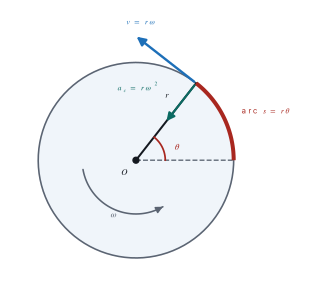
If \alpha is constant, integrating twice gives the equations of angular motion, exactly parallel to the linear ones:
and the angle turned in the n^{\text{th}} second is \theta_n = \omega_0 + \frac{\alpha}{2}(2n-1).
Because s = r\theta and r is fixed for a given particle, differentiating gives the link between the linear and angular pictures:
Here a_t is the tangential acceleration (it changes the speed) and a_c is the centripetal acceleration (it changes the direction). The resultant linear acceleration has magnitude a = \sqrt{a_t^{2} + a_c^{2}}.
| Linear quantity | Rotational quantity | Connection |
|---|---|---|
| Displacement s (m) | Angular displacement \theta (rad) | s = r\theta |
| Velocity v (m s⁻¹) | Angular velocity \omega (rad s⁻¹) | v = r\omega |
| Acceleration a (m s⁻²) | Angular acceleration \alpha (rad s⁻²) | a_t = r\alpha |
| Mass m (kg) | Moment of inertia I (kg m²) | I = \sum m r^{2} |
| Force F (N) | Torque \tau (N m) | \tau = rF\sin\phi |
| Momentum p = mv | Angular momentum L = I\omega | L = rp\sin\phi |
v = r\omega, s = r\theta and \tau = I\alpha are true only when angles are in radians. Convert first: 1\ \text{rev} = 2\pi\ \text{rad}, and N rev min⁻¹ means \omega = 2\pi N/60 rad s⁻¹.
Problem. A grinding wheel starts from rest and reaches 300 rev min⁻¹ in 10\ \text{s} with uniform angular acceleration. Find (a) the angular acceleration, (b) the number of revolutions made, and (c) the linear speed of a point 0.40\ \text{m} from the axis at the end.
Solution. (a) \omega = \dfrac{2\pi \times 300}{60} = 10\pi = 31.4\ \text{rad s}^{-1}, so
(b) \theta = \tfrac{1}{2}\alpha t^{2} = \tfrac{1}{2}(\pi)(10)^{2} = 50\pi\ \text{rad}. Number of revolutions = 50\pi / 2\pi = 25 revolutions.
(c) v = r\omega = 0.40 \times 31.4 = 12.6\ \text{m s}^{-1}.
1.2 Kinetic energy of rotation of rigid body
Think of the rigid body as a collection of particles of masses m_1, m_2, \ldots at perpendicular distances r_1, r_2, \ldots from the axis. All share the same \omega, so particle i has speed v_i = r_i\omega.
The total kinetic energy is the sum of the kinetic energies of the particles:
The bracket contains only the masses and their distances from the axis — it is a property of the body and the axis, not of the motion. Calling it the moment of inertia I,
Compare \frac{1}{2}mv^{2}: the moment of inertia plays exactly the role that mass plays in translation. A body that is also moving forward (a rolling wheel) has total kinetic energy \frac{1}{2}mv^{2} + \frac{1}{2}I\omega^{2}.
1.3 Moment of inertia; Radius of gyration
The moment of inertia of a body about a given axis is the sum of the products of the mass of each particle and the square of its perpendicular distance from that axis: I = \sum m_i r_i^{2}, or I = \int r^{2}\,dm for a continuous body. Its SI unit is kg m² and its dimensional formula is [ML^{2}].
Moment of inertia measures rotational inertia — the opposition a body offers to a change in its angular velocity. Unlike mass it is not a single number for a body: it depends on (i) the total mass, (ii) how that mass is distributed, and (iii) which axis is chosen. Mass placed far from the axis counts much more, because the distance is squared.
Two theorems shorten most calculations:
- Parallel axis theorem. I = I_{cm} + Md^{2}, where I_{cm} is about a parallel axis through the centre of mass and d is the separation.
- Perpendicular axis theorem (plane laminae only). I_z = I_x + I_y, the z-axis being perpendicular to the lamina.
| Body (mass M) | Axis | Moment of inertia | Radius of gyration k |
|---|---|---|---|
| Thin rod, length L | ⊥ through centre | ML^{2}/12 | L/\sqrt{12} |
| Thin rod, length L | ⊥ through one end | ML^{2}/3 | L/\sqrt{3} |
| Ring, radius R | central, ⊥ to plane | MR^{2} | R |
| Disc, radius R | central, ⊥ to plane | MR^{2}/2 | R/\sqrt{2} |
| Solid cylinder, radius R | own axis | MR^{2}/2 | R/\sqrt{2} |
| Solid sphere, radius R | diameter | 2MR^{2}/5 | R\sqrt{2/5} |
| Hollow sphere, radius R | diameter | 2MR^{2}/3 | R\sqrt{2/3} |
The radius of gyration k is the distance from the axis at which the whole mass could be concentrated as a single point without changing the moment of inertia:
Problem. A solid disc flywheel of mass 20\ \text{kg} and radius 0.50\ \text{m} spins at 120 rev min⁻¹. Find its moment of inertia, radius of gyration and rotational kinetic energy.
Solution.
which is indeed R/\sqrt{2}. With \omega = 2\pi(120)/60 = 4\pi = 12.57\ \text{rad s}^{-1},
1.4 Moment of inertia of a uniform rod
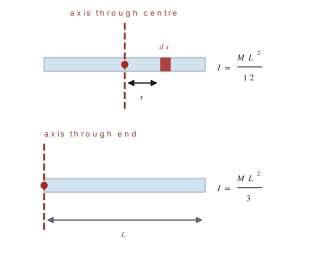
Take a rod of mass M and length L, of uniform linear mass density \lambda = M/L. Let the axis pass through the centre C, perpendicular to the rod. Consider a small element of length dx at a distance x from C; its mass is dm = \lambda\,dx = (M/L)\,dx and its moment of inertia is x^{2}\,dm.
Summing over the whole rod, x runs from -L/2 to +L/2:
Now put the axis at the end A, so x runs from 0 to L:
Check with the parallel axis theorem: the end is a distance d = L/2 from the centre of mass, so
1.5 Torque and angular acceleration for a rigid body
A force applied to a body that is free to rotate produces a turning effect called torque (or moment of force). If the force \vec{F} acts at a point whose position vector from the axis is \vec{r}, and \phi is the angle between them,
The quantity d = r\sin\phi is the moment arm. Torque is largest when the force is applied perpendicular to \vec{r} and as far from the axis as possible — which is why a door handle is fitted at the edge, not next to the hinge. The SI unit is N m; torque is a vector, \vec{\tau} = \vec{r}\times\vec{F}.
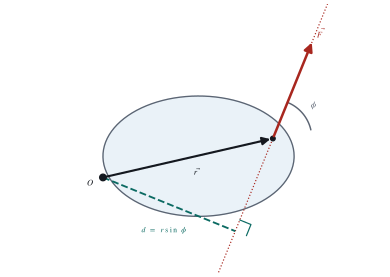
Take one particle of mass m_i at distance r_i. The tangential force on it is, by Newton's second law, F_i = m_i a_{ti} = m_i r_i\alpha, because every particle of a rigid body shares the same \alpha. The torque of this force about the axis is
Adding over all particles, the internal forces cancel in pairs (Newton's third law), so the resultant external torque is
This is the rotational form of F = ma.
Problem. A uniform rod of mass 2\ \text{kg} and length 1\ \text{m} is hinged at one end and held horizontal. It is released from rest. Find its initial angular acceleration and the initial linear acceleration of the free end. Take g = 9.8\ \text{m s}^{-2}.
Solution. The weight acts at the centre of mass, 0.5\ \text{m} from the hinge, so the torque about the hinge is
About the end, I = ML^{2}/3 = 2(1)^{2}/3 = 0.667\ \text{kg m}^{2}. Hence
The free end has a_t = L\alpha = 1 \times 14.7 = 14.7\ \text{m s}^{-2}, which is greater than g. A coin resting on the far end of the rod is therefore left behind when the rod is released.
1.6 Work and power in rotational motion
When a torque \tau turns a body through a small angle d\theta, the force F = \tau/r acts through an arc ds = r\,d\theta, so the work done is
For a constant torque, W = \tau\theta. The power is the rate of doing this work:
the exact analogue of P = Fv. And since \tau = I\alpha = I\,\omega\,d\omega/d\theta,
which is the work–energy theorem for rotation: the work done by the resultant torque equals the change in rotational kinetic energy.
Problem. An electric motor at a rice mill in Jhapa delivers a constant torque of 25\ \text{N m} while running at 1500 rev min⁻¹. Find the power output, and the work done in one minute.
Solution. \omega = \dfrac{2\pi \times 1500}{60} = 50\pi = 157.1\ \text{rad s}^{-1}.
In 60\ \text{s}, W = Pt = 3927 \times 60 = 2.36 \times 10^{5}\ \text{J}.
1.7 Angular momentum; conservation of angular momentum
The angular momentum of a particle about a point is the moment of its linear momentum: L = rp\sin\phi = mvr\sin\phi. For a rigid body rotating about a fixed axis, L = I\omega. Its SI unit is kg m² s⁻¹ (or J s).
Differentiating L = I\omega for a rigid body (I constant about a fixed axis),
So torque is the rate of change of angular momentum, just as force is the rate of change of linear momentum. Written this way the result is more general: it holds even when I changes.
If the resultant external torque on a system is zero, then dL/dt = 0, so L = I\omega is constant:
A body that reduces its moment of inertia must spin faster, and vice versa.
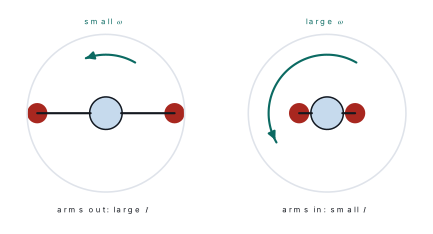
Everyday consequences, all examined regularly:
- An ice skater or a dancer spins faster on folding the arms in.
- A diver tucks to somersault quickly, then stretches out to slow the spin before entering the water.
- A planet moves faster when nearer the Sun; since gravity is a central force its torque about the Sun is zero. This is Kepler's second law.
- A spinning top or a bicycle wheel resists being tipped over, because tipping it would change the direction of \vec{L}.
When a skater pulls the arms in, L stays the same but E_k = L^{2}/2I increases because I falls. The extra energy comes from the muscular work done in pulling the arms inwards against the outward (centrifugal) effect. Conversely, when two rotating discs are coupled together, energy is lost to friction while L is conserved.
Problem. A student sits on a frictionless rotating stool with arms outstretched, holding weights. The moment of inertia of the system is 6\ \text{kg m}^{2} and it rotates at 2\ \text{rad s}^{-1}. He pulls his arms in, reducing the moment of inertia to 2\ \text{kg m}^{2}. Find the new angular velocity and the change in kinetic energy.
Solution. No external torque acts about the vertical axis, so angular momentum is conserved:
The kinetic energy increases by 24\ \text{J}, supplied by the work the student does in pulling the weights inwards.
Chapter summary
- For constant \alpha: \omega = \omega_0 + \alpha t, \theta = \omega_0 t + \frac{1}{2}\alpha t^{2}, \omega^{2} = \omega_0^{2} + 2\alpha\theta; and s = r\theta, v = r\omega, a_t = r\alpha, a_c = r\omega^{2}.
- Rotational kinetic energy E_k = \frac{1}{2}I\omega^{2}, where I = \sum m_i r_i^{2} = \int r^{2}dm is the moment of inertia.
- Radius of gyration: I = Mk^{2}, so k = \sqrt{I/M}. Parallel axis: I = I_{cm} + Md^{2}; perpendicular axis (laminae): I_z = I_x + I_y.
- Uniform rod of mass M, length L: I = ML^{2}/12 about the centre and ML^{2}/3 about one end.
- Torque \tau = rF\sin\phi and \tau = I\alpha, the rotational form of F = ma.
- Work W = \tau\theta, power P = \tau\omega, and W = \frac{1}{2}I\omega_2^{2} - \frac{1}{2}I\omega_1^{2}.
- Angular momentum L = I\omega with \tau = dL/dt. If \tau = 0 then I_1\omega_1 = I_2\omega_2: angular momentum is conserved, but kinetic energy need not be.
Practice questions
Group A — Multiple choice (1 mark each)
- The moment of inertia of a uniform rod of mass M and length L about an axis through one end and perpendicular to it is [1]aML^{2}/12bML^{2}/3cML^{2}/2dML^{2}
- The rotational analogue of mass is [1]atorquebangular velocitycmoment of inertiadangular momentum
- A body of moment of inertia 2\ \text{kg m}^{2} rotates at 3\ \text{rad s}^{-1}. Its rotational kinetic energy is [1]a3\ \text{J}b6\ \text{J}c9\ \text{J}d18\ \text{J}
- A skater spinning with arms outstretched folds her arms in. Her angular velocity increases because [1]aher angular momentum increasesban external torque acts on hercher moment of inertia decreases while L is constantdher kinetic energy is conserved
- The power delivered by a torque \tau at angular velocity \omega is [1]a\tau\thetab\tau\omegacI\omegad\tau/\omega
Answers to Group A
1. (b) — integrating x^{2}dm from 0 to L gives ML^{2}/3.
2. (c) — I appears in \tau = I\alpha exactly where m appears in F = ma.
3. (c) — E_k = \frac{1}{2}(2)(3)^{2} = 9\ \text{J}.
4. (c) — no external torque, so I\omega is fixed and \omega must rise.
5. (b) — P = dW/dt = \tau\,d\theta/dt = \tau\omega.
Group B — Short answer (5 marks each)
- Define moment of inertia and radius of gyration. On what factors does the moment of inertia of a body depend? [5]
- Derive the relation \tau = I\alpha for a rigid body rotating about a fixed axis. [5]
- A flywheel of mass 50\ \text{kg} in the form of a uniform disc of radius 0.40\ \text{m} rotates at 300 rev min⁻¹. Calculate its kinetic energy and the constant torque needed to stop it in 10\ \text{s}. [5]
- A disc of moment of inertia 2\ \text{kg m}^{2} rotating at 10\ \text{rad s}^{-1} is suddenly coupled to a stationary coaxial disc of moment of inertia 3\ \text{kg m}^{2}. Find the common angular velocity and the loss of kinetic energy. [5]
Answers to Group B
1. Outline: state I = \sum m_i r_i^{2} (unit kg m², dimensions [ML^{2}]) and k = \sqrt{I/M}. I depends on the total mass, on the distribution of that mass about the axis, and on the position and direction of the axis itself.
2. Outline: for particle i, F_i = m_i r_i\alpha, so \tau_i = m_i r_i^{2}\alpha; sum over all particles (internal torques cancel in pairs) to get \tau = (\sum m_i r_i^{2})\alpha = I\alpha.
3. I = \frac{1}{2}MR^{2} = \frac{1}{2}(50)(0.40)^{2} = 4\ \text{kg m}^{2}; \omega = 2\pi(300)/60 = 31.42\ \text{rad s}^{-1}. E_k = \frac{1}{2}(4)(31.42)^{2} = 1974\ \text{J}. Retardation \alpha = 31.42/10 = 3.142\ \text{rad s}^{-2}, so \tau = I\alpha = 4 \times 3.142 = 12.6\ \text{N m}.
4. Angular momentum is conserved: 2 \times 10 = (2+3)\omega, so \omega = 4\ \text{rad s}^{-1}. E_1 = \frac{1}{2}(2)(10)^{2} = 100\ \text{J}, E_2 = \frac{1}{2}(5)(4)^{2} = 40\ \text{J}; loss = 60\ \text{J}, dissipated as heat by friction between the coupled discs.
Group C — Long answer (8 marks each)
- (a) Define moment of inertia and radius of gyration. [3](b) Derive an expression for the moment of inertia of a uniform rod of mass M and length L about an axis through its centre and perpendicular to its length, and hence, using the parallel axis theorem, about an axis through one end. [5]
- (a) Show that the kinetic energy of a rigid body rotating about a fixed axis is \frac{1}{2}I\omega^{2}. [3](b) A flywheel of mass 100\ \text{kg} and radius of gyration 0.50\ \text{m} rotates at 600 rev min⁻¹. A constant retarding torque brings it to rest in 40\ \text{s}. Find its moment of inertia, its initial kinetic energy, the retarding torque, and the number of revolutions it makes before stopping. [5]
Answer to Group C question 2(b)
I = Mk^{2} = 100 \times (0.50)^{2} = 25\ \text{kg m}^{2}.
\omega_0 = 2\pi(600)/60 = 20\pi = 62.83\ \text{rad s}^{-1}, so E_k = \frac{1}{2}(25)(62.83)^{2} = 4.93 \times 10^{4}\ \text{J}.
\alpha = (0 - 62.83)/40 = -1.571\ \text{rad s}^{-2}, so the retarding torque is |\tau| = I|\alpha| = 25 \times 1.571 = 39.3\ \text{N m}.
\theta = \frac{1}{2}(\omega_0 + 0)t = \frac{1}{2}(62.83)(40) = 1257\ \text{rad}, so the number of revolutions = 1257/2\pi = 200.
Practise more: Physics question bank