Unit 3 · Mechanics · 9 teaching hours · 18 min read
Fluid statics
What the syllabus asks for 8
- Fluid statics: Pressure in a fluid; Buoyancy
- Surface tension: Theory of surface tension; Surface energy
- Angle of contact, capillarity and its applications
- Fluid Dynamics: Newton's formula for viscosity in a liquid; Coefficient of viscosity
- Poiseuille's formula and its application
- Stokes law and its applications
- Equation of continuity and its applications
- Bernoulli's equation and its applications
A fluid is anything that flows. Because a fluid at rest cannot support a shearing force, its mechanics is written in terms of pressure rather than force. This unit runs from fluids at rest (pressure, upthrust), through the forces in a liquid surface (surface tension, capillarity), to fluids in motion (viscosity, Poiseuille, Stokes, continuity, Bernoulli).
Four derivations recur in almost every paper: P = h\rho g, the capillary rise h = 2T\cos\theta/r\rho g, terminal velocity from Stokes' law, and Bernoulli's equation. Learn these four and the numericals become routine.
3.1 Fluid statics: Pressure in a fluid; Buoyancy
Pressure is the normal force per unit area, P = F/A, in pascals (1\ \text{Pa} = 1\ \text{N m}^{-2}). It is a scalar: at a point in a fluid at rest it is the same in every direction.
Take a horizontal area A at depth h below the free surface of a liquid of density \rho. The column standing on it has volume Ah, mass \rho Ah and weight \rho Ahg, all carried by that area:
Pressure therefore depends only on depth, density and g — never on the shape of the vessel. The absolute pressure is P = P_0 + h\rho g; h\rho g alone is the gauge pressure. By Pascal's law pressure applied to an enclosed fluid is transmitted undiminished, so a small force on a narrow piston balances a large load on a wide one — the hydraulic press and brake.
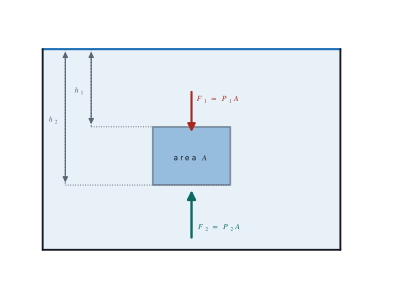
A cylinder of cross-section A is immersed with its top face at depth h_1 and its bottom face at h_2. Sideways forces cancel in pairs; vertically F_1 = h_1\rho gA acts down and F_2 = h_2\rho gA up. As h_2 > h_1 the resultant — the upthrust — acts upwards:
Since V\rho is the mass of liquid displaced, the upthrust equals the weight of fluid displaced.
A body floats when the upthrust equals its weight, so a body of density \rho_b and volume V floating with volume V_s submerged in liquid of density \rho_l has V\rho_b g = V_s\rho_l g, giving
Ice (917\ \text{kg m}^{-3}) in sea water (1025\ \text{kg m}^{-3}) therefore shows only about 11\% of itself above the surface.
Problem. (a) Find the absolute pressure 10\ \text{m} below the surface of Phewa Lake. (b) A block weighs 4.9\ \text{N} in air and 3.92\ \text{N} in water. Find its volume, density and relative density. (P_0 = 1.013\times10^{5}\ \text{Pa}, \rho_w = 1000\ \text{kg m}^{-3}, g = 9.8\ \text{m s}^{-2})
Solution. (a) P = P_0 + h\rho g = 1.013\times10^{5} + (10)(1000)(9.8) = 1.99\times10^{5}\ \text{Pa}.
(b) Upthrust U = 4.9 - 3.92 = 0.98\ \text{N} = V\rho_w g, so
Mass = 4.9/9.8 = 0.5\ \text{kg}, so \rho = 0.5/10^{-4} = 5000\ \text{kg m}^{-3} and the relative density is 5.
3.2 Surface tension: Theory of surface tension; Surface energy
A needle floats on water and rain gathers into spherical drops: a liquid surface behaves like a stretched elastic membrane.
Surface tension is the force per unit length acting on an imaginary line drawn on a liquid surface, perpendicular to the line and tangential to the surface: T = F/L. Its unit is N m⁻¹ and its dimensions are [MT^{-2}].
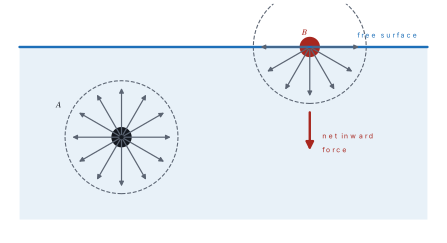
Theory. Molecules attract one another (cohesion) within a sphere of influence of radius about 10^{-9}\ \text{m}. A molecule deep inside is pulled equally in all directions, so the resultant on it is zero; one in the surface layer has liquid only below it and feels a net inward pull. Work must be done to bring a molecule up to the surface, so the liquid keeps its area as small as possible — which is why free drops are spherical.
Surface energy. A soap film on a frame of width l pulls its light sliding wire inwards with force F = 2Tl (the 2 because a film has two surfaces). Pulling the wire out a distance x does work
since 2lx is the increase in surface area, so T = W/\Delta A.
Surface energy is the work done in increasing the area by unity (J m⁻²); surface tension is force per unit length (N m⁻¹). As 1\ \text{J m}^{-2} = 1\ \text{N m}^{-1}, the two are numerically equal.
The excess pressure inside a curved surface is 2T/r for a drop or an air bubble in a liquid (one surface) and 4T/r for a soap bubble (two). Surface tension falls as temperature rises and is lowered by detergents.
Problem. Find the work done in blowing a soap bubble of radius 3\ \text{cm} and the excess pressure inside it, given T = 0.03\ \text{N m}^{-1}.
Solution. A soap bubble has two surfaces, so the area created is
Excess pressure = \dfrac{4T}{r} = \dfrac{4 \times 0.03}{0.03} = 4\ \text{Pa}.
3.3 Angle of contact, capillarity and its applications
The angle of contact is the angle between the tangent to the liquid surface at the point of contact and the solid surface, measured through the liquid.
Whether it is acute or obtuse depends on the competition between adhesion (liquid–solid attraction) and cohesion (liquid–liquid). The rise or fall of a liquid in a tube of fine bore is called capillarity.
| Water on glass | Mercury on glass | |
|---|---|---|
| Stronger force | adhesion | cohesion |
| Meniscus | concave | convex |
| Angle of contact | acute (about 8^{\circ}, taken as 0^{\circ}) | obtuse (about 140^{\circ}) |
| Behaviour | wets glass, rises | does not wet, is depressed |
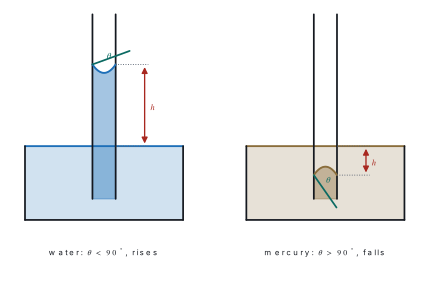
A tube of internal radius r stands in a liquid of density \rho, surface tension T and angle of contact \theta. The liquid touches it along a circle of length 2\pi r, and the vertical component of the tension per unit length is T\cos\theta, so the upward force is
This supports the weight of the raised column of height h, W = (\pi r^{2}h)\rho g. Equating F = W,
So h \propto 1/r — the narrower the tube, the higher the rise (Jurin's law). If \theta > 90^{\circ}, \cos\theta is negative and h is a depression, as with mercury.
Applications: oil rises up a lamp wick; sap reaches the leaves of a tree; ink soaks into blotting paper; and farmers plough their fields to break the soil capillaries, so water is not drawn up and lost by evaporation.
In h = 2T\cos\theta/r\rho g, r is the internal radius. For water on clean glass \cos\theta = 1, but for mercury \cos 140^{\circ} = -0.766: get that sign wrong and a depression becomes a rise.
Problem. Find the rise of water in a capillary tube of internal diameter 0.4\ \text{mm}. (T = 0.072\ \text{N m}^{-1}, \theta = 0^{\circ}, \rho = 1000\ \text{kg m}^{-3}, g = 9.8\ \text{m s}^{-2})
Solution. Here r = 0.2\ \text{mm} = 2\times10^{-4}\ \text{m} and \cos 0^{\circ} = 1, so
The water rises 7.35\ \text{cm}.
3.4 Fluid Dynamics: Newton's formula for viscosity in a liquid; Coefficient of viscosity
In streamline (laminar) flow a liquid moves in layers that slide over one another, each dragging on its neighbours; this internal friction is viscosity. If layers a distance dx apart differ in velocity by dv, then dv/dx is the velocity gradient, and Newton found the viscous force on a contact area A to be
the minus sign showing that it opposes the relative motion.
The coefficient of viscosity is the tangential viscous force per unit area per unit velocity gradient, \eta = F/(A\,dv/dx). Its SI unit is N s m⁻² (Pa s), its dimensions are [ML^{-1}T^{-1}], and 1\ \text{Pa s} = 10\ \text{poise}.
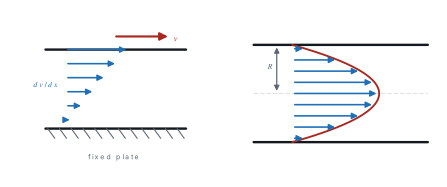
Viscosity is to fluids what friction is to solids, except that the force depends on speed. Heating makes a liquid less viscous (warm honey pours easily) but a gas more viscous.
Problem. A plate of area 0.1\ \text{m}^{2} is dragged at 0.5\ \text{m s}^{-1} over a 1\ \text{mm} layer of oil of viscosity 0.8\ \text{Pa s} on a fixed table. What force is needed?
Solution. The velocity falls uniformly to zero across the layer, so dv/dx = 0.5/10^{-3} = 500\ \text{s}^{-1} and
3.5 Poiseuille's formula and its application
For steady laminar flow through a horizontal capillary of radius r and length l under a pressure difference P, the volume flowing per second is
Let Q depend on the pressure gradient P/l, the radius r and \eta:
With [Q] = [L^{3}T^{-1}], [P/l] = [ML^{-2}T^{-2}], [r] = [L] and [\eta] = [ML^{-1}T^{-1}],
Comparing powers of M: a + c = 0; of T: -2a - c = -1; of L: -2a + b - c = 3. These give a = 1, c = -1, b = 4:
Q \propto r^{4}: halving the radius cuts the flow to one sixteenth, which is why a slight narrowing of an artery makes the heart work so much harder.
It is used to measure \eta, to study blood flow, and to fix the bore of hypodermic needles and drip sets.
Problem. Water (\eta = 1.0\times10^{-3}\ \text{Pa s}) flows through a horizontal tube of length 0.5\ \text{m} and radius 1\ \text{mm} under a pressure difference of 1000\ \text{Pa}. Find Q, and Q if r is halved.
Solution.
i.e. 0.785\ \text{cm}^{3}\text{s}^{-1}. Halving r divides Q by 16, giving 4.91\times10^{-8}\ \text{m}^{3}\text{s}^{-1}.
3.6 Stokes law and its applications
A small sphere of radius r moving with velocity v through a fluid of viscosity \eta meets a retarding force
This is Stokes' law, valid for slow, streamline motion; dimensional analysis of F \propto \eta^{a}r^{b}v^{c} gives a = b = c = 1.
A sphere of radius r and density \rho falling through a liquid of density \sigma feels its weight down, and upthrust and drag up. The drag grows with speed until the three balance and the sphere falls at a constant terminal velocity v_t:
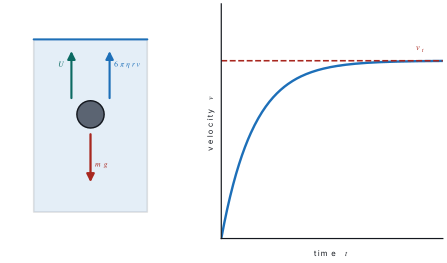
Applications: Millikan's oil-drop experiment finds the drop radius and hence the electronic charge; since v_t \propto r^{2} tiny droplets float as cloud while large drops fall fast; and \eta is found by timing a ball-bearing falling through the liquid.
Problem. A steel ball of radius 1\ \text{mm} and density 7800\ \text{kg m}^{-3} falls through oil of density 900\ \text{kg m}^{-3} and viscosity 1.0\ \text{Pa s}. Find v_t.
Solution.
i.e. about 1.5\ \text{cm s}^{-1}.
3.7 Equation of continuity and its applications
Take steady, incompressible flow through a tube whose cross-section changes from A_1 to A_2. In time \Delta t the liquid entering occupies a length v_1\Delta t, so the mass entering is \rho A_1v_1\Delta t and that leaving is \rho A_2v_2\Delta t. No liquid is created or lost, so
This is the equation of continuity — the conservation of mass. Since v \propto 1/A, a fluid speeds up where the pipe narrows: a thumb over a hosepipe makes water shoot further, and a river runs fast through a gorge but slow over a plain.
Problem. Water flows at 2\ \text{m s}^{-1} through a pipe of internal diameter 6\ \text{cm} that narrows to 3\ \text{cm}. Find the speed there and the volume flow rate.
Solution. Since A \propto d^{2},
3.8 Bernoulli's equation and its applications
For the steady streamline flow of an ideal (non-viscous, incompressible) fluid, the sum of pressure, kinetic and potential energy per unit volume is constant along a streamline:
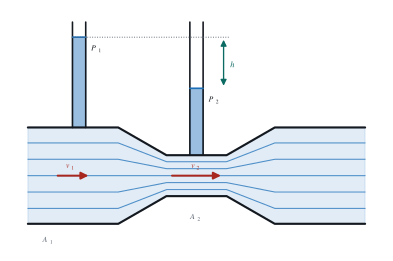
Take a tube of flow with sections A_1 (height h_1, pressure P_1, speed v_1) and A_2 (height h_2, pressure P_2, speed v_2). In time \Delta t a mass m = \rho V enters one end and an equal mass leaves the other, where V = A_1v_1\Delta t = A_2v_2\Delta t. The entry pressure does work P_1V and work P_2V is done against the exit pressure, so W = (P_1-P_2)V. By the work–energy theorem this is the gain in kinetic plus potential energy:
Putting m = \rho V and dividing by V,
Applications.
- Venturi meter. In a horizontal pipe h_1 = h_2, so P_1 - P_2 = \frac{1}{2}\rho(v_2^{2}-v_1^{2}); with A_1v_1 = A_2v_2 the measured pressure difference gives the rate of flow.
- Torricelli's theorem. For a hole a depth h below the free surface of an open tank the pressure is atmospheric at both points and the surface speed is negligible, so \frac{1}{2}\rho v^{2} = \rho gh, giving v = \sqrt{2gh} — the speed of free fall through the same height.
- Aerofoil lift. Air travels faster over the curved upper surface of a wing, so the pressure above is lower and there is a net upward force — the same effect lifts a tin roof off in a storm.
- Atomiser and Bunsen burner. Fast air across the top of a tube lowers the pressure there, and atmospheric pressure drives the liquid up.
It holds only for steady, streamline, non-viscous, incompressible flow and only along one streamline. Do not use it for turbulent flow, or for a real viscous liquid in a long pipe where energy is lost as heat.
Chapter summary
- P = h\rho g (gauge), P = P_0 + h\rho g (absolute); pressure depends on depth only, and Pascal's law transmits it undiminished.
- Upthrust U = V\rho g = weight of fluid displaced; a floating body has V_s/V = \rho_b/\rho_l.
- T = F/L (N m⁻¹) equals the surface energy W/\Delta A (J m⁻²). Excess pressure: 2T/r in a drop, 4T/r in a soap bubble.
- Capillary rise h = 2T\cos\theta/r\rho g, so h \propto 1/r.
- Viscosity F = \eta A\,dv/dx, \eta in Pa s, [ML^{-1}T^{-1}].
- Poiseuille Q = \pi P r^{4}/8\eta l — the fourth power of the radius.
- Stokes F = 6\pi\eta rv, giving v_t = 2r^{2}(\rho-\sigma)g/9\eta.
- Continuity A_1v_1 = A_2v_2 (mass) and Bernoulli P + \frac{1}{2}\rho v^{2} + \rho gh = \text{constant} (energy), giving v = \sqrt{2gh} for efflux.
Practice questions
Group A — Multiple choice (1 mark each)
- The SI unit of the coefficient of viscosity is [1]apoisebPa scN s⁻¹dm² s⁻¹
- A body floats in water with three-quarters of its volume submerged. Its relative density is [1]a0.25b0.50c0.75d1.33
- Water rises to a height h in a capillary tube of radius r. In a tube of radius r/2 it rises to [1]ah/2bhc2hd4h
- In Poiseuille's formula Q is proportional to [1]arbr^{2}cr^{3}dr^{4}
- Bernoulli's equation expresses the conservation of [1]amassbmomentumcenergydangular momentum
Answers to Group A
1. (b) — from \eta = F/(A\,dv/dx), the unit is N s m⁻² = Pa s.
2. (c) — the fraction submerged equals the ratio of densities.
3. (c) — h \propto 1/r.
4. (d) — Q = \pi Pr^{4}/8\eta l.
5. (c) — it is the work–energy theorem per unit volume of fluid.
Group B — Short answer (5 marks each)
- Define surface tension and surface energy and show that they are numerically equal. [5]
- A capillary tube of internal radius 0.5\ \text{mm} is dipped vertically in water of surface tension 0.072\ \text{N m}^{-1}. Calculate the rise. (\theta = 0^{\circ}, \rho = 1000\ \text{kg m}^{-3}) [5]
- State Stokes' law and derive the terminal velocity of a sphere in a viscous liquid. Hence find the terminal velocity of an air bubble of radius 1\ \text{mm} rising through a liquid of density 1200\ \text{kg m}^{-3} and viscosity 0.5\ \text{Pa s}. [5]
- Water flows at 3\ \text{m s}^{-1} along a horizontal pipe of cross-section 10\ \text{cm}^{2}, which narrows to 5\ \text{cm}^{2}. Find the speed there and the pressure difference between the two sections. [5]
Answers to Group B
1. Outline: T = F/L; surface energy = W/\Delta A. For a film on a frame of width l pulled out a distance x, W = 2Tl\,x = T(2lx) = T\Delta A, so 1\ \text{N m}^{-1} = 1\ \text{J m}^{-2}.
2. h = \dfrac{2T\cos\theta}{r\rho g} = \dfrac{2(0.072)}{(5\times10^{-4})(1000)(9.8)} = \dfrac{0.144}{4.9} = 0.0294\ \text{m} = 2.94\ \text{cm}.
3. For a rising bubble the upthrust exceeds the weight; taking the air density as negligible, v_t = \dfrac{2r^{2}\sigma g}{9\eta} = \dfrac{2(10^{-3})^{2}(1200)(9.8)}{9(0.5)} = 5.23\times10^{-3}\ \text{m s}^{-1}, about 5.2\ \text{mm s}^{-1} upwards.
4. v_2 = A_1v_1/A_2 = (10 \times 3)/5 = 6\ \text{m s}^{-1}; for a horizontal pipe P_1 - P_2 = \frac{1}{2}\rho(v_2^{2}-v_1^{2}) = \frac{1}{2}(1000)(36-9) = 1.35\times10^{4}\ \text{Pa}.
Group C — Long answer (8 marks each)
- (a) Define angle of contact and explain why water wets glass but mercury does not. [3](b) Derive an expression for the rise of a liquid in a capillary tube and calculate the rise of water in a tube of internal radius 0.1\ \text{mm}. (T = 0.072\ \text{N m}^{-1}, \theta = 0^{\circ}, \rho = 1000\ \text{kg m}^{-3}) [5]
- (a) State Bernoulli's principle and derive Bernoulli's equation for the streamline flow of an ideal liquid. [5](b) A tank on the ground holds water to a depth of 3\ \text{m}. A small hole is made in its side 1.2\ \text{m} below the surface. Find the speed of efflux and how far from the foot of the tank the jet strikes the ground. [3]
Answers to Group C
1.(b) h = \dfrac{2T\cos\theta}{r\rho g} = \dfrac{2(0.072)}{(10^{-4})(1000)(9.8)} = \dfrac{0.144}{0.98} = 0.147\ \text{m} = 14.7\ \text{cm}.
2.(b) v = \sqrt{2gh} = \sqrt{2(9.8)(1.2)} = 4.85\ \text{m s}^{-1}. The hole is 1.8\ \text{m} above the ground and the jet leaves horizontally, so t = \sqrt{2(1.8)/9.8} = 0.606\ \text{s} and x = vt = 2.94\ \text{m}.
Practise more: Physics question bank