Unit 17 · Electricity and Magnetism · 5 teaching hours · 18 min read
Magnetic properties of materials
What the syllabus asks for 4
- Magnetic field lines and magnetic flux
- Flux density in magnetic material; Relative permeability; Susceptibility
- Hysteresis
- Dia-, para- and ferro-magnetic materials
Unit 16 treated magnetic fields in empty space. Real coils, however, are wound on iron, and the iron changes everything: the same current produces a field a thousand times stronger, and the material remembers what you did to it. This unit introduces the two field vectors \vec{B} and \vec{H}, the numbers that link them (permeability and susceptibility), the loop that describes magnetic memory (hysteresis), and the three-way classification of all matter as diamagnetic, paramagnetic or ferromagnetic.
Three items dominate: the derivation \mu_r = 1 + \chi_m, a labelled hysteresis loop with retentivity and coercivity defined, and the soft-iron-versus-steel comparison table. Numericals are almost always "find H, then B, then M" for a solenoid or ring with a core. Keep B (tesla) and H (ampere per metre) strictly apart — mixing their units is the single commonest error in this unit.
17.1 Magnetic field lines and magnetic flux
A magnetic field line is a curve whose tangent at every point gives the direction of the magnetic flux density \vec{B} at that point. Because there are no magnetic monopoles, every field line closes on itself: outside a magnet it runs N to S, inside the magnet it continues S to N.
The magnetic flux through a surface of area A in a uniform field is
where \theta is the angle between \vec{B} and the normal to the surface. Flux is a scalar; its SI unit is the weber (Wb), and 1\ \text{Wb} = 1\ \text{T m}^{2}.
Rearranged, B = \Phi/A for a surface held perpendicular to the field, which is why B is called the magnetic flux density — flux per unit area. Since every line entering a closed surface must leave it,
This is Gauss's law for magnetism, and it holds inside matter as well as in vacuum. Its practical consequence is that flux is continuous: if a magnetic circuit narrows, the flux stays the same and B rises.
Magnetic materials are studied with a toroidal ring (a Rowland ring) because in a toroid the flux is trapped entirely inside the core, with no leakage and no end effects. The whole of the winding's magnetising action is then felt by the specimen.
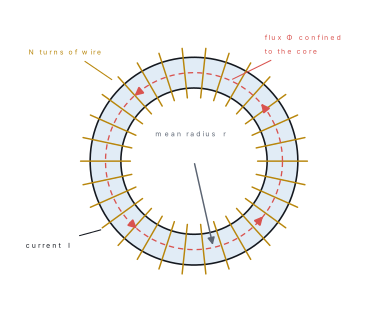
Problem. A closed iron ring of cross-sectional area 4\ \text{cm}^{2} and mean circumference 0.50\ \text{m} carries a flux of 6\times10^{-4}\ \text{Wb}. The relative permeability of the iron is 1200. Find (a) the flux density in the core and (b) the ampere-turns needed on the winding.
Solution.
(a) A = 4\times10^{-4}\ \text{m}^{2}, so
(b) Inside the core B = \mu_0\mu_r H, hence
For a ring, H = NI/l with l = 0.50\ \text{m}, so
17.2 Flux density in magnetic material; Relative permeability; Susceptibility
When a specimen is placed inside a current-carrying solenoid, two separate causes produce the field inside it:
- the free current in the winding, described by the magnetising field \vec{H}, and
- the atomic currents inside the specimen itself, described by the intensity of magnetisation \vec{M}.
The magnetising field H of a long solenoid or ring is the ampere-turns per metre of its winding, H = nI = NI/l. The intensity of magnetisation M is the net magnetic dipole moment per unit volume of the specimen, M = m/V. Both are measured in ampere per metre (A m⁻¹), and both are independent of the material's response.
The resultant flux density inside the specimen is the sum of the two contributions:
For a material that responds linearly, the magnetisation produced is proportional to the magnetising field. The constant of proportionality is the magnetic susceptibility:
Since M and H have the same unit, \chi_m is a pure number. Substituting M = \chi_m H,
The absolute permeability of the medium is defined by \mu = B/H, and the relative permeability by \mu_r = \mu/\mu_0. Comparing,
| Quantity | Symbol | Defining relation | SI unit |
|---|---|---|---|
| Magnetic flux | \Phi | BA\cos\theta | weber (Wb) |
| Flux density | B | \Phi/A | tesla (T) |
| Magnetising field | H | NI/l | A m⁻¹ |
| Magnetisation | M | m/V | A m⁻¹ |
| Susceptibility | \chi_m | M/H | none |
| Permeability | \mu | B/H | T m A⁻¹ (= H m⁻¹) |
| Relative permeability | \mu_r | \mu/\mu_0 | none |
Here \mu_0 = 4\pi\times10^{-7}\ \text{T m A}^{-1} is the permeability of free space; for vacuum \chi_m = 0 and \mu_r = 1 exactly.
H is fixed by the current you pass through the winding; B is what the material gives you back. Changing the core changes B but not H. Writing "H = 1.5\ \text{T}" or "B = 2000\ \text{A m}^{-1}" costs marks even if the arithmetic is right.
Problem. A solenoid 50\ \text{cm} long has 500 turns and carries 2.0\ \text{A}. An iron rod fills the solenoid, and the flux density measured inside is 1.6\ \text{T}. Calculate H, \mu, \mu_r, M and \chi_m.
Solution. Turns per metre: n = 500/0.50 = 1000\ \text{m}^{-1}.
From B = \mu_0(H+M),
As a check, \mu_r = 1 + \chi_m = 637, which agrees.
17.3 Hysteresis
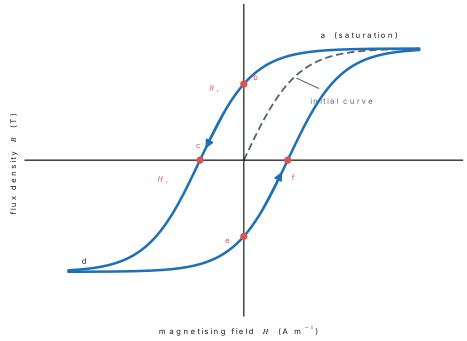
Take an unmagnetised ferromagnetic ring and raise H from zero. B climbs along the initial magnetisation curve Oa and then flattens: all the domains are aligned and the specimen has reached saturation. Now reduce H back to zero. B does not retrace the curve — it falls along ab and stops at a non-zero value B_r. The specimen has become a magnet on its own.
Hysteresis is the lagging of the flux density B behind the magnetising field H when a ferromagnetic specimen is taken through a cycle of magnetisation.
Retentivity (remanence) B_r is the flux density that remains in the specimen when the magnetising field is reduced to zero.
Coercivity H_c is the reverse magnetising field needed to reduce the retained flux density to zero.
Continuing to reverse H drives the specimen to saturation the other way, and bringing H forward again closes the curve. The closed figure abcdefa is the hysteresis loop.
Energy lost per cycle
Take a ring of mean length l, cross-section A and N turns. When the flux changes, a back e.m.f. e = N\,d\Phi/dt opposes the source, so in time dt the source does work
But H = NI/l, so NI = Hl and
Since Al is the volume V of the specimen, the work done per unit volume in one complete cycle is
The unit of this area is (\text{A m}^{-1})(\text{T}) = \text{J m}^{-3}. Because the loop is traversed once per cycle and the work is not recovered, it appears as heat. For a core of volume V driven at frequency f,
Soft and hard magnetic materials
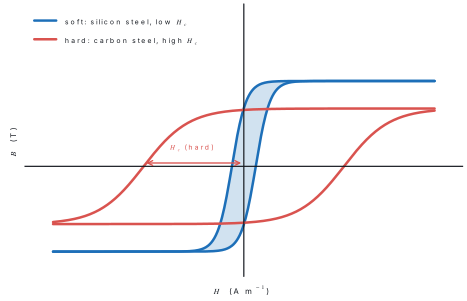
| Property | Soft magnetic material | Hard magnetic material |
|---|---|---|
| Loop shape | narrow, tall, small area | broad, large area |
| Retentivity B_r | high | high |
| Coercivity H_c | very low | very high |
| Susceptibility, \mu_r | very large | moderate |
| Energy loss per cycle | small | large |
| Magnetisation | easily magnetised and demagnetised | hard to demagnetise |
| Examples | soft iron, silicon steel, mu-metal, ferrites | carbon steel, cobalt steel, alnico, ferrite magnets |
| Used for | transformer and motor cores, electromagnets, relays | permanent magnets, loudspeakers, compass needles, magnetic latches |
Anything that is magnetised and demagnetised many times a second wants a small loop area, so use a soft material. Anything that must stay magnetised wants a large coercivity, so use a hard material.
Problem. The hysteresis loop of a transformer core material encloses an area equivalent to 250\ \text{J m}^{-3} per cycle. The core has volume 1200\ \text{cm}^{3} and the transformer runs at 50\ \text{Hz}. Find the energy lost per cycle and the hysteresis power loss.
Solution. V = 1200\ \text{cm}^{3} = 1200\times10^{-6} = 1.2\times10^{-3}\ \text{m}^{3}.
Energy per cycle:
Power lost (50 cycles each second):
Low-loss silicon steel is used precisely to keep this figure small.
17.4 Dia-, para- and ferro-magnetic materials
Every electron in an atom is both orbiting and spinning, and each motion is a tiny current loop with a magnetic moment. How those moments add up decides the class of the material.
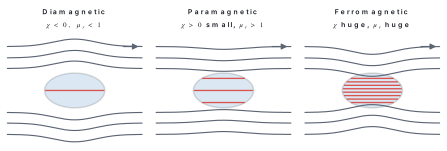
Diamagnetic materials. The atomic moments cancel exactly, so the atom has no permanent magnetic moment. An applied field changes the electron orbits slightly (Lenz's law at atomic scale) and induces a moment opposing the field. Hence M is antiparallel to H, \chi_m is small and negative (about -10^{-5}), and \mu_r is slightly less than 1. Field lines are pushed out of the specimen, and a rod suspended in a non-uniform field moves from strong to weak field and sets perpendicular to it. Examples: bismuth, copper, water, gold, mercury, nitrogen, sodium chloride. Superconductors are perfect diamagnets with \chi_m = -1.
Paramagnetic materials. The atoms do have permanent moments, but thermal agitation keeps them randomly oriented. An applied field aligns them slightly, so M is parallel to H with \chi_m small and positive (about 10^{-5} to 10^{-3}) and \mu_r slightly greater than 1. A rod moves from weak to strong field and sets parallel to it. Alignment is destroyed by heat, so susceptibility obeys Curie's law:
where C is the Curie constant. Examples: aluminium, platinum, manganese, chromium, oxygen, copper sulphate solution.
Ferromagnetic materials. Neighbouring atomic moments lock parallel to each other over regions called domains, each containing about 10^{17}–10^{21} atoms. In an unmagnetised sample the domains point in random directions and cancel. A field makes favourably oriented domains grow at the expense of the others and finally rotates them all into line — which is why M saturates. \chi_m is large and positive (10² to 10⁵), \mu_r runs into thousands, field lines crowd strongly into the specimen, and the material shows hysteresis. Examples: iron, cobalt, nickel, gadolinium and alloys such as alnico.
Above a critical temperature, the Curie temperature T_C, thermal energy destroys the domain alignment and a ferromagnet becomes an ordinary paramagnet obeying the Curie–Weiss law:
For iron T_C = 1043\ \text{K} (770\ ^{\circ}\text{C}), for cobalt 1394\ \text{K} and for nickel 631\ \text{K}.
| Property | Diamagnetic | Paramagnetic | Ferromagnetic |
|---|---|---|---|
| Atomic moment | zero | permanent, random | permanent, aligned in domains |
| \chi_m | small, negative (\approx -10^{-5}) | small, positive (10^{-5}–10^{-3}) | large, positive (10^{2}–10^{5}) |
| \mu_r | slightly < 1 | slightly > 1 | \gg 1 (10²–10⁵) |
| M vs H | linear, negative slope | linear, small positive slope | non-linear, saturates |
| Field lines | expelled | slightly concentrated | strongly concentrated |
| In non-uniform field | moves to weaker field | moves to stronger field | moves strongly to stronger field |
| Effect of temperature | almost none | \chi_m = C/T | ferromagnetic below T_C, paramagnetic above |
| Hysteresis | no | no | yes |
| Examples | Bi, Cu, Au, H₂O, N₂ | Al, Pt, Mn, O₂, CuSO₄ | Fe, Co, Ni, Gd, alnico |
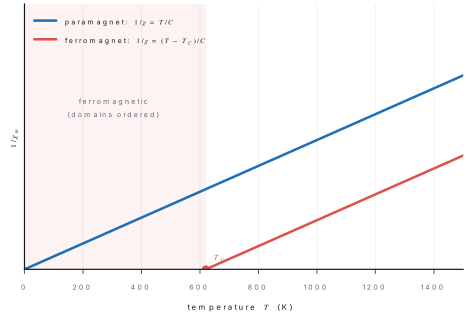
Problem. A paramagnetic salt has susceptibility 2.4\times10^{-4} at 300\ \text{K}. (a) Find its susceptibility at 200\ \text{K}. (b) At 200\ \text{K} the salt is placed in a magnetising field of 1.6\times10^{4}\ \text{A m}^{-1}. Find its magnetisation and the flux density inside it.
Solution.
(a) Curie's law gives \chi_m T = C, a constant, so \chi_1T_1 = \chi_2T_2:
(b) M = \chi_m H = 3.6\times10^{-4}\times 1.6\times10^{4} = 5.76\ \text{A m}^{-1}.
The magnetisation contributes only 0.04\% of the total — a paramagnet barely changes the field, unlike the iron of Worked example 17.2.
No. Permeability measures how easily a material carries flux when a field is applied. Soft iron has an enormous \mu_r but makes a hopeless permanent magnet, because its coercivity is tiny and it loses its magnetism as soon as the current is switched off.
Chapter summary
- Magnetic flux \Phi = BA\cos\theta (weber); B = \Phi/A is the flux density (tesla); \oint\vec{B}\cdot d\vec{A} = 0 since field lines are closed loops.
- The magnetising field is H = NI/l (A m⁻¹); magnetisation is M = m/V (A m⁻¹); inside matter B = \mu_0(H+M).
- \chi_m = M/H, \mu = B/H, \mu_r = \mu/\mu_0 and \mu_r = 1 + \chi_m. Both \chi_m and \mu_r are dimensionless.
- Hysteresis is the lag of B behind H. Retentivity B_r is the flux density left when H = 0; coercivity H_c is the reverse field that makes B = 0.
- Energy dissipated per unit volume per cycle equals the loop area, \oint H\,dB (J m⁻³); the hysteresis power loss is (area) \times V \times f.
- Soft materials (small H_c, narrow loop) are for transformer cores and electromagnets; hard materials (large H_c, broad loop) are for permanent magnets.
- Diamagnetics: \chi_m small negative, \mu_r < 1, repelled. Paramagnetics: \chi_m small positive, \mu_r > 1, \chi_m = C/T. Ferromagnetics: domains, \chi_m \gg 1, saturation and hysteresis, and \chi_m = C/(T - T_C) above the Curie temperature.
Practice questions
Group A — Multiple choice (1 mark each)
- The SI unit of magnetic susceptibility is [1]ateslabA m⁻¹cweberdit has no unit
- For a paramagnetic substance [1]a\chi_m < 0,\ \mu_r < 1b\chi_m > 0,\ \mu_r > 1c\chi_m \gg 1d\mu_r = 1
- The area of a B–H hysteresis loop represents [1]aretentivitybcoercivitycenergy lost per unit volume per cycledpermeability
- Soft iron rather than steel is used for a transformer core because it has [1]ahigh coercivityblow coercivity and small loop areaclow permeabilitydhigh density
- Above its Curie temperature, iron becomes [1]adiamagneticbparamagneticcnon-magneticdmore strongly ferromagnetic
Answers to Group A
1. (d) — \chi_m = M/H, and M and H share the unit A m⁻¹, so the ratio is a pure number.
2. (b) — the moments align weakly with the field, so M is positive and \mu_r = 1+\chi_m > 1.
3. (c) — the loop area is \oint H\,dB, whose unit is J m⁻³.
4. (b) — the core is remagnetised 100 times a second, so the loop area (energy wasted) must be small.
5. (b) — thermal agitation destroys domain alignment, leaving randomly oriented permanent moments.
Group B — Short answer (5 marks each)
- Define magnetic flux and magnetic flux density, and state their SI units. Distinguish clearly between \vec{B} and \vec{H}. [5]
- Define magnetic susceptibility and relative permeability, and derive the relation \mu_r = 1 + \chi_m. [5]
- A solenoid with 400 turns per metre carries a current of 3.0\ \text{A} and is filled with an iron core of relative permeability 800. Calculate H, B, M and \chi_m. [5]
- Explain, with reference to the hysteresis loop, why soft iron is used in electromagnets while steel is used for permanent magnets. [5]
- State Curie's law. A paramagnetic sample has \chi_m = 3.6\times10^{-4} at 200\ \text{K}. Find its susceptibility at 300\ \text{K}. [5]
Answers to Group B
3. H = nI = 400\times3.0 = 1.2\times10^{3}\ \text{A m}^{-1}. B = \mu_0\mu_rH = (4\pi\times10^{-7})(800)(1200) = 1.21\ \text{T}. \chi_m = \mu_r - 1 = 799. M = \chi_mH = 799\times1200 = 9.59\times10^{5}\ \text{A m}^{-1}.
4. Outline: an electromagnet must switch on and off, so it needs a small coercivity (demagnetises the instant the current stops) and a small loop area (little heat wasted per cycle) — soft iron. A permanent magnet must keep its magnetism against stray fields and knocks, so it needs a large coercivity and large retentivity — steel. Sketch the narrow and broad loops side by side.
5. Curie's law: for a paramagnetic material \chi_m = C/T, i.e. the susceptibility is inversely proportional to the absolute temperature. \chi_2 = \chi_1T_1/T_2 = 3.6\times10^{-4}\times200/300 = 2.4\times10^{-4}.
Group C — Long answer (8 marks each)
- (a) What is hysteresis? Draw a complete hysteresis loop for a ferromagnetic material and define retentivity and coercivity on it. [4](b) Show that the energy dissipated per unit volume per cycle equals the area of the loop. A core of volume 0.010\ \text{m}^{3} whose loop area is 300\ \text{J m}^{-3} is used at 50\ \text{Hz}; find the power lost as heat. [4]
- Compare diamagnetic, paramagnetic and ferromagnetic materials with respect to susceptibility, relative permeability, behaviour of field lines, behaviour in a non-uniform field and effect of temperature, giving two examples of each. Hence explain what happens to a ferromagnetic material as it is heated through its Curie temperature. [8]
Answers to Group C
1. (a) Hysteresis is the lagging of B behind H over a magnetising cycle; B_r (retentivity) is the intercept on the B-axis, H_c (coercivity) the intercept on the H-axis. See the labelled loop in §17.3.
(b) For a ring of volume V = Al and N turns, the source does work dW = eI\,dt = NI\,d\Phi = NI A\,dB = (Al)H\,dB, so W/V = \oint H\,dB = loop area. Numerically, energy per cycle = 300\times0.010 = 3.0\ \text{J}, and
2. Outline: reproduce the comparison table of §17.4 with two examples each (Bi and Cu; Al and Pt; Fe and Ni). For the Curie point: below T_C the exchange interaction holds neighbouring atomic moments parallel inside domains, giving huge \chi_m, saturation and hysteresis. As T rises, thermal energy disrupts this order; at T = T_C the domain structure collapses completely. Above T_C the atoms keep their individual moments but point randomly, so the material is paramagnetic with \chi_m = C/(T-T_C), a value smaller by several orders of magnitude. For iron T_C = 1043\ \text{K}; a red-hot iron nail is not attracted by a magnet.
Practise more: Physics question bank