Unit 4 · Heat and Thermodynamics · 6 teaching hours · 18 min read
First Law of Thermodynamics
What the syllabus asks for 6
- Thermodynamic systems
- Work done during volume change
- Heat and work; Internal energy and First law of thermodynamics
- Thermodynamic processes: Adiabatic, isochoric, isothermal and isobaric
- Heat capacities of an ideal gas at constant pressure and volume and relation between them
- Isothermal and Adiabatic processes for an ideal gas
Thermodynamics is the book-keeping of energy. A gas trapped in a cylinder can be heated, compressed, allowed to expand, or left alone — and in every case the energy that goes in must equal the energy that comes out plus whatever stays behind inside the gas. That single statement, written carefully, is the first law. This unit teaches you to write it correctly, to compute the work from a pressure–volume graph, and to apply it to the four processes that every NEB paper asks about.
Three things repeat every year: (i) state the first law with correct sign conventions, (ii) derive C_p - C_v = R, and (iii) derive PV^{\gamma} = constant and the work done in an isothermal or adiabatic change. Everything else is numerical substitution into those results.
4.1 Thermodynamic systems
A system is the definite quantity of matter we choose to study — usually a fixed mass of gas in a cylinder. Everything outside it that can exchange energy with it is the surroundings. The real or imagined surface separating the two is the boundary.
| Type of system | Exchanges matter? | Exchanges energy? | Example |
|---|---|---|---|
| Open | yes | yes | water boiling in an open pan |
| Closed | no | yes | gas sealed in a metal cylinder |
| Isolated | no | no | hot tea in a perfect thermos flask |

The condition of a system is fixed by its state variables P, V, T and the amount of gas n. For an ideal gas these are tied together by the equation of state
so only two of them can be chosen freely. That is why a state can be shown as a single point on a P–V graph, and a process as a curve. Such a graph is called an indicator diagram.
A system is in thermodynamic equilibrium when it is simultaneously in mechanical equilibrium (no unbalanced pressure), thermal equilibrium (one uniform temperature) and chemical equilibrium (no reaction in progress). Only then do P and T have single definite values, and only then can the process be drawn as a smooth curve. Such an idealised, infinitely slow process is called quasi-static.
A state function depends only on the present state, not on how the system got there — pressure, volume, temperature and internal energy are state functions. A path function depends on the route taken between two states — heat and work are path functions. This is why we write \Delta U but never "\Delta Q".
4.2 Work done during volume change
Consider a gas at pressure P inside a cylinder closed by a frictionless piston of area A. The gas pushes the piston with force F = PA. If the piston moves out through a small distance dx, so slowly that the pressure stays essentially constant during the move, the work done by the gas is
since A\,dx = dV is the increase in volume. For a finite change from V_1 to V_2 we add up all such slices:

So the work done by a gas equals the area under its P–V curve. Two consequences follow immediately:
- If the gas expands, dV > 0 and W is positive — the gas does work on the surroundings. If it is compressed, W is negative.
- Because different curves joining the same two points enclose different areas, the work depends on the path, not merely on the end states.
4.3 Heat and work; Internal energy and First law of thermodynamics
Heat Q is energy that crosses a boundary because of a temperature difference. Work W is energy that crosses because a force moves its point of application. Both are energy in transit; neither is stored in the gas.
What is stored is the internal energy U — the total kinetic energy of the random molecular motion plus the potential energy of intermolecular forces. For an ideal gas the intermolecular forces are zero, so
where f is the number of degrees of freedom. The important consequence is that for an ideal gas U depends only on temperature: no temperature change means no change in internal energy, whatever happens to P and V.
Energy supplied as heat must either raise the internal energy or leave again as work. That is the first law.
The heat supplied to a system is equal to the increase in its internal energy plus the external work done by the system:
It is the law of conservation of energy applied to a thermodynamic system, and it asserts that internal energy is a state function.
| Quantity | Positive when | Negative when |
|---|---|---|
| Q | heat is absorbed by the system | heat is rejected by the system |
| W | the gas expands (does work) | the gas is compressed |
| \Delta U | temperature rises | temperature falls |
NEB uses Q = \Delta U + W with W as work done by the gas. Some books write \Delta U = Q + W with W as work done on the gas. Both are correct physics, but mixing them changes the sign of your answer. Pick the NEB form, write it down first, and stick to it for the whole question.
Problem. A gas at a constant pressure of 2.0\times10^{5}\ \text{Pa} expands from 1.0\times10^{-3}\ \text{m}^{3} to 3.0\times10^{-3}\ \text{m}^{3} while absorbing 500\ \text{J} of heat. Find the work done by the gas and the change in its internal energy.
Solution. At constant pressure the area under the P–V line is a rectangle:
From the first law, \Delta U = Q - W = 500 - 400 = 100\ \text{J}.
The internal energy rises by 100\ \text{J}, so the gas also gets warmer.
4.4 Thermodynamic processes: Adiabatic, isochoric, isothermal and isobaric
Four special paths are worth memorising because in each one the first law collapses to a one-term equation.
| Process | Held constant | Condition | First law becomes | P–V curve |
|---|---|---|---|---|
| Isochoric | volume | dV = 0 | Q = \Delta U | vertical line |
| Isobaric | pressure | dP = 0 | Q = \Delta U + P\Delta V | horizontal line |
| Isothermal | temperature | \Delta U = 0 | Q = W | rectangular hyperbola |
| Adiabatic | no heat flow | Q = 0 | \Delta U = -W | steeper hyperbola-like curve |
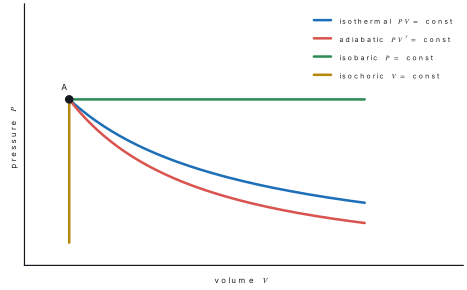
A fifth case matters for engines: in a cyclic process the gas returns to its starting state, so \Delta U = 0 and Q = W. The net work equals the area enclosed by the loop — positive if the loop is traced clockwise, negative if anticlockwise.
Two more named changes appear in NEB questions. A free expansion is the expansion of a gas into a vacuum inside an insulated vessel: no heat enters (Q=0) and there is nothing to push against (W=0), so \Delta U = 0 and the temperature of an ideal gas is unchanged. A throttling process is a similar irreversible expansion through a porous plug.
4.5 Heat capacities of an ideal gas at constant pressure and volume and relation between them
The molar heat capacity of a gas is the heat needed to raise the temperature of one mole by one kelvin. A gas has two of them, because the answer depends on whether you let it expand.
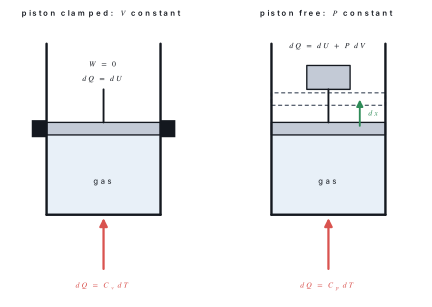
- C_v is measured with the piston clamped. No work is done, so all the heat raises the internal energy: dQ = dU = C_v\,dT for one mole.
- C_p is measured with the piston free to move. The gas must also push the atmosphere back, so more heat is needed for the same rise in temperature.
Hence C_p > C_v always. The exact difference is Mayer's relation.
Take one mole of an ideal gas and heat it through dT.
At constant volume. dV = 0, so dW = 0 and the first law gives
Because U depends only on T, this expression for dU is true for any process, not only the constant-volume one.
At constant pressure. Now dQ = C_p\,dT and the gas does work dW = P\,dV, so the first law reads
Eliminate P\,dV. For one mole, PV = RT. Differentiating at constant P,
Substituting,
In terms of specific heat capacities per kilogram, dividing by the molar mass M gives c_p - c_v = R/M.
The ratio \gamma = C_p/C_v is fixed by the number of degrees of freedom f, since C_v = \frac{f}{2}R:
| Gas | f | C_v (J mol⁻¹ K⁻¹) | C_p (J mol⁻¹ K⁻¹) | \gamma |
|---|---|---|---|---|
| Monatomic (He, Ar) | 3 | 12.47 | 20.79 | 1.67 |
| Diatomic (N₂, O₂, H₂) | 5 | 20.79 | 29.10 | 1.40 |
| Polyatomic (CO₂, NH₃) | 6 | 24.94 | 33.26 | 1.33 |
Problem. For nitrogen gas \gamma = 1.40 and the molar mass is 28\ \text{g mol}^{-1}. Calculate C_v, C_p and the two specific heat capacities per kilogram. Take R = 8.314\ \text{J mol}^{-1}\text{K}^{-1}.
Solution. From C_p - C_v = R and C_p = \gamma C_v,
Dividing by M = 0.028\ \text{kg mol}^{-1}:
Check: c_p - c_v = 297 = R/M = 8.314/0.028. Correct.
4.6 Isothermal and Adiabatic processes for an ideal gas
Isothermal process
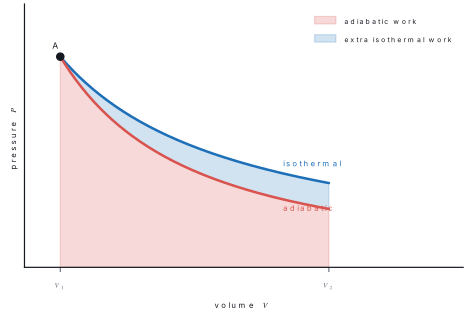
The gas is kept at constant temperature, so PV = constant (Boyle's law). In practice this needs thin, highly conducting walls and a very slow change, so that heat can flow in or out fast enough to hold T fixed. Since \Delta U = 0, all the heat absorbed reappears as work.
For n moles, P = nRT/V with T constant. Then
Since P_1V_1 = P_2V_2, this can also be written W = nRT\ln(P_1/P_2). Here Q = W and \Delta U = 0.
Adiabatic process
No heat enters or leaves: Q = 0. This needs thick insulating walls, or a change so fast that heat has no time to flow — the compression stroke of a diesel engine and the propagation of a sound wave are both effectively adiabatic. The first law gives \Delta U = -W: an expanding gas does work at the cost of its own internal energy, and therefore cools.
For one mole, dU = C_v\,dT and dW = P\,dV. With dQ = 0 the first law gives
From PV = RT, differentiating gives P\,dV + V\,dP = R\,dT, so dT = (P\,dV + V\,dP)/R. Substituting,
Multiply through by R and use R = C_p - C_v:
Divide by C_v PV and write \gamma = C_p/C_v:
Integrating, \ln P + \gamma \ln V = constant, that is
Using PV = nRT to eliminate P or V gives the two companion forms
Let PV^{\gamma} = K, so P = KV^{-\gamma}. Then
But K = P_1V_1^{\gamma} = P_2V_2^{\gamma}, so KV_2^{1-\gamma} = P_2V_2 and KV_1^{1-\gamma} = P_1V_1. Hence
Differentiating the two curves shows why the adiabatic is steeper. For the isothermal, P\,dV + V\,dP = 0 gives slope dP/dV = -P/V; for the adiabatic, dP/P = -\gamma\,dV/V gives slope -\gamma P/V. Since \gamma > 1, the adiabatic slope is \gamma times steeper at every point.
Problem. Two moles of an ideal gas at 300\ \text{K} expand isothermally to three times the original volume. Find the work done by the gas and the heat absorbed. (\ln 3 = 1.0986.)
Solution.
Because the temperature does not change, \Delta U = 0, so by the first law
Problem. One mole of air (\gamma = 1.40) at 27\ ^{\circ}\text{C} is compressed adiabatically to one-eighth of its volume. Find the final temperature and the work done on the gas. (8^{0.4} = 2.297.)
Solution. T_1 = 300\ \text{K} and V_1/V_2 = 8. Using TV^{\gamma-1} = constant,
That is 416\ ^{\circ}\text{C} — the reason diesel fuel ignites without a spark. The work done by the gas is
The negative sign means 8.09\ \text{kJ} of work is done on the gas; since Q = 0, all of it becomes internal energy, \Delta U = +8.09\ \text{kJ}.
Chapter summary
- A system exchanges matter and energy with its surroundings across a boundary; open, closed and isolated systems differ in what may cross it. P, V, T and U are state functions; Q and W are path functions.
- Work done by a gas is W = \int P\,dV, the area under the P–V curve; positive for expansion, negative for compression.
- First law: Q = \Delta U + W, with Q positive for heat absorbed and W positive for expansion. For an ideal gas U depends only on T.
- Isochoric: W=0, Q=\Delta U. Isobaric: W = P\Delta V. Isothermal: \Delta U = 0, Q = W. Adiabatic: Q = 0, \Delta U = -W. Cyclic: \Delta U = 0, Q = W = area of loop.
- Mayer's relation: C_p - C_v = R, so C_v = R/(\gamma-1) and C_p = \gamma R/(\gamma-1). Here \gamma = 1.67, 1.40 and 1.33 for mono-, di- and polyatomic gases.
- Isothermal: PV = constant and W = nRT\ln(V_2/V_1).
- Adiabatic: PV^{\gamma} = constant, TV^{\gamma-1} = constant, and W = (P_1V_1 - P_2V_2)/(\gamma-1) = nR(T_1-T_2)/(\gamma-1).
- At any common point the adiabatic curve is \gamma times steeper than the isothermal, so adiabatic expansion cools a gas.
Practice questions
Group A — Multiple choice (1 mark each)
- In an isothermal expansion of an ideal gas, the heat absorbed is [1]azerobequal to the work done by the gascequal to the rise in internal energydequal to C_v\Delta T
- For one mole of an ideal gas, C_p - C_v is equal to [1]aRb\gamma RcR/\gammadzero
- At the same point on an indicator diagram, the slope of the adiabatic curve compared with that of the isothermal is [1]aequalb\gamma times greater in magnitudec1/\gamma timesdzero
- In a complete cyclic process the change in internal energy of the gas is [1]aequal to Qbequal to Wczerodalways negative
- A gas expands freely into an evacuated insulated vessel. Its temperature [1]arisesbfallscstays the samedfirst rises, then falls
Answers to Group A
1. (b) — \Delta U = 0 at constant T, so the first law gives Q = W.
2. (a) — Mayer's relation, C_p - C_v = R for one mole.
3. (b) — slopes are -P/V and -\gamma P/V respectively.
4. (c) — U is a state function and the gas returns to its initial state.
5. (c) — Q = 0 and W = 0, so \Delta U = 0; for an ideal gas that means \Delta T = 0.
Group B — Short answer (5 marks each)
- Define internal energy. State the first law of thermodynamics, write it in differential form, and explain the sign convention used for Q and W. [5]
- Derive the relation C_p - C_v = R for one mole of an ideal gas, and explain physically why C_p must be greater than C_v. [5]
- A gas expands at a constant pressure of 1.5\times10^{5}\ \text{Pa} from 2.0\times10^{-3}\ \text{m}^{3} to 5.0\times10^{-3}\ \text{m}^{3}, absorbing 800\ \text{J} of heat. Calculate the work done and the change in internal energy. [5]
- One mole of oxygen at 27\ ^{\circ}\text{C} expands isothermally to four times its volume. Calculate the work done by the gas. (\ln 4 = 1.386) [5]
Answers to Group B
1. Internal energy is the total kinetic plus potential energy of the molecules of a system, measured in its own frame; it is a state function. First law: Q = \Delta U + W, i.e. dQ = dU + dW. Q is positive when heat is absorbed, W is positive when the gas expands, \Delta U is positive when the temperature rises.
2. See the derivation in §4.5. Physically, at constant volume all the heat goes into internal energy, whereas at constant pressure the gas must additionally do work P\,dV = R\,dT against the surroundings, so more heat is needed for the same dT.
3. W = P\Delta V = 1.5\times10^{5}\times(5.0-2.0)\times10^{-3} = 450\ \text{J}. Then \Delta U = Q - W = 800 - 450 = 350\ \text{J}.
4. W = nRT\ln(V_2/V_1) = 1\times8.314\times300\times1.386 = 3.46\times10^{3}\ \text{J}. Since \Delta U = 0, the gas also absorbs 3.46\ \text{kJ} of heat.
Group C — Long answer (8 marks each)
- (a) Show that for a quasi-static change the work done by a gas is W = \int P\,dV, and hence that it equals the area under the indicator diagram. [3](b) Derive the adiabatic relation PV^{\gamma} = constant for an ideal gas, and obtain an expression for the work done during an adiabatic expansion. [5]
- A cylinder contains 0.5\ \text{mol} of a diatomic ideal gas (\gamma = 1.40) at 300\ \text{K} and 1.0\times10^{5}\ \text{Pa}. The gas is (i) heated at constant volume to 450\ \text{K}, then (ii) expanded isothermally at 450\ \text{K} until its pressure returns to 1.0\times10^{5}\ \text{Pa}. Calculate the heat supplied, the work done and the change in internal energy for each stage. (\ln 1.5 = 0.4055) [8]
Answer to Group C question 2
Stage (i) — isochoric. C_v = R/(\gamma-1) = 8.314/0.40 = 20.79\ \text{J mol}^{-1}\text{K}^{-1}.
so Q_1 = \Delta U_1 = 1.56\times10^{3}\ \text{J}. The pressure rises to P = 1.0\times10^{5}\times(450/300) = 1.5\times10^{5}\ \text{Pa}.
Stage (ii) — isothermal. The pressure falls from 1.5\times10^{5} to 1.0\times10^{5}\ \text{Pa}, so V_2/V_1 = P_1/P_2 = 1.5.
\Delta U_2 = 0 and Q_2 = W_2 = 758\ \text{J}.
Totals. Q = 1559 + 758 = 2.32\times10^{3}\ \text{J}, W = 758\ \text{J}, \Delta U = 1559\ \text{J}, which satisfies Q = \Delta U + W.
Practise more: Physics question bank