Unit 6 · Waves and Optics · 2 teaching hours · 13 min read
Wave motion
What the syllabus asks for 3
- Progressive waves
- Mathematical description of a wave
- Stationary waves
Drop a stone in the Phewa lake and rings spread outwards, but a leaf floating on the surface only bobs up and down — it does not travel with the ring. That is the whole idea of a wave: the disturbance moves, carrying energy with it, while the matter stays put. This short unit sets up the language and the equation of a travelling wave, and then shows what happens when two such waves meet head-on. Everything in Units 7 to 9 is built on it.
Be able to write the wave equation y = a\sin(\omega t - kx) and read off a, f, \lambda and v from any given form of it; derive the stationary-wave equation y = 2a\cos kx\,\sin\omega t; and list the differences between progressive and stationary waves.
6.1 Progressive waves
A progressive wave is a disturbance that travels continuously through a medium in a definite direction, transferring energy and momentum from one point to the next, without any net transport of the medium itself.
A mechanical wave needs a material medium with two properties: elasticity, to provide a restoring force, and inertia, to make the displaced particle overshoot. Light and radio waves are electromagnetic and need no medium; they are not treated in this unit.
Waves are classified by the direction in which the particles vibrate.
| Transverse wave | Longitudinal wave | |
|---|---|---|
| Particle vibration | perpendicular to propagation | parallel to propagation |
| Form of the wave | crests and troughs | compressions and rarefactions |
| Travels through | solids and liquid surfaces | solids, liquids and gases |
| Can be polarised? | yes | no |
| Examples | wave on a string, ripple, light | sound in air, wave in a spring pushed lengthwise |
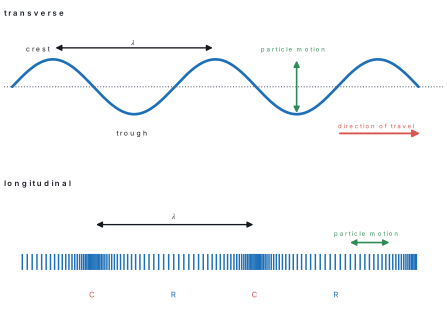
Five quantities describe any progressive wave:
- Amplitude a — the maximum displacement of a particle from its mean position.
- Wavelength \lambda — the distance between two successive particles in the same phase (crest to crest, or compression to compression).
- Period T — the time for one complete vibration of a particle.
- Frequency f = 1/T — vibrations per second, in hertz.
- Wave velocity v — the speed at which the disturbance advances.
In one period the wave advances exactly one wavelength, so
This wave equation holds for every wave, mechanical or electromagnetic. In a given medium v is fixed by the medium's elasticity and density, so changing the frequency of the source changes the wavelength, not the speed.
Two further facts are worth remembering: in a progressive wave every particle vibrates with the same amplitude and frequency, and each particle starts its vibration slightly later than the one before it — the phase lags steadily behind along the direction of travel.
6.2 Mathematical description of a wave
Let the particle at the origin perform SHM, y = a\sin\omega t. A wave moving in the +x direction with speed v reaches a particle at distance x after a delay t' = x/v, so that particle simply repeats what the origin did x/v seconds earlier:
Putting \omega = 2\pi/T and v = \lambda/T into the expression above,
Defining the angular frequency \omega = 2\pi/T and the propagation constant (or wave number) k = 2\pi/\lambda, this becomes
An equivalent form often quoted in NEB papers is
For a wave travelling in the -x direction, replace x by -x: y = a\sin(\omega t + kx).
The quantity (\omega t - kx) is the phase. Two particles separated by a path difference \Delta x differ in phase by
so a separation of one whole wavelength means a phase difference of 2\pi (the particles are in step), and a separation of \lambda/2 means \pi (exactly out of step).
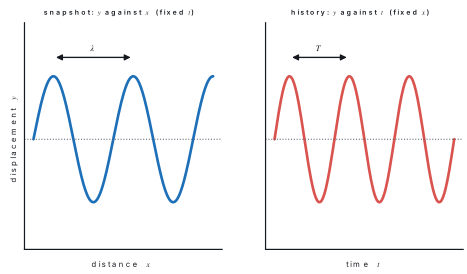
Differentiating y with respect to time at a fixed x gives the particle velocity:
The wave velocity v = f\lambda is a constant property of the medium. The particle velocity v_p = a\omega\cos(\omega t - kx) changes from instant to instant, is zero at the crests and troughs and greatest at the mean position. Differentiating y with respect to x instead gives the slope of the curve, and the two are linked by v_p = -v\,(\partial y/\partial x).
Problem. A progressive wave is given by y = 0.05\sin(100\pi t - 0.5\pi x), all quantities in SI units. Find the amplitude, frequency, wavelength, wave speed and maximum particle velocity.
Solution. Comparing with y = a\sin(\omega t - kx): a = 0.05\ \text{m}, \omega = 100\pi\ \text{rad s}^{-1}, k = 0.5\pi\ \text{rad m}^{-1}.
Check: f\lambda = 50 \times 4 = 200\ \text{m s}^{-1}. Finally
Problem. A sound wave of frequency 500\ \text{Hz} travels through air at 350\ \text{m s}^{-1}. Find its wavelength and the phase difference between two points 0.175\ \text{m} apart along the direction of travel.
Solution.
That is 90^{\circ} — the two points are a quarter of a wavelength apart, so one is at a crest when the other is at its mean position.
6.3 Stationary waves
When two progressive waves of the same amplitude, frequency and speed travel along the same line in opposite directions, they superpose to give a wave that does not travel at all. This is a stationary (or standing) wave. In practice the second wave is usually the reflection of the first from a fixed end — a plucked sarangi string, or the air column in a flute.
Let the incident wave travelling in the +x direction and the reflected wave travelling in the -x direction be
By the principle of superposition the resultant displacement is y = y_1 + y_2. Using \sin C + \sin D = 2\sin\frac{C+D}{2}\cos\frac{C-D}{2} with C = \omega t + kx and D = \omega t - kx,
This is not of the form f(vt - x): the x and t dependences have separated, so nothing travels. Each particle performs SHM of period T, but with an amplitude
that depends on where the particle is.
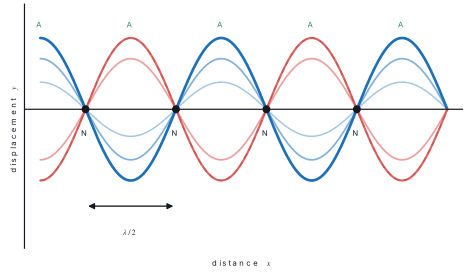
The amplitude A vanishes at some points and is maximum at others.
Nodes are points of permanently zero displacement, where \cos(2\pi x/\lambda) = 0:
Antinodes are points of maximum amplitude 2a, where \cos(2\pi x/\lambda) = \pm 1:
So successive nodes are \lambda/2 apart, successive antinodes are \lambda/2 apart, and a node and the next antinode are \lambda/4 apart. Measuring the distance between two nodes is therefore the standard laboratory way of finding a wavelength.
If the origin is chosen at a node instead of an antinode, the same superposition gives y = 2a\sin kx\,\cos\omega t. Only the labelling has changed: the nodes are then at x = 0, \lambda/2, \lambda,\ldots and the antinodes midway between them. The spacings \lambda/2 and \lambda/4 are the same either way.
| Progressive wave | Stationary wave | |
|---|---|---|
| Disturbance | advances through the medium | confined between the boundaries |
| Energy | transported along the wave | not transported; only exchanged locally |
| Amplitude | same for every particle | varies from 0 at nodes to 2a at antinodes |
| Phase | changes continuously with x | same for all particles between two nodes; reverses across a node |
| Nodes and antinodes | none | present, spaced \lambda/2 apart |
| Particle at rest | no particle is permanently at rest | particles at the nodes never move |
Problem. A stationary wave on a string is described by y = 4\sin(0.5\pi x)\cos(200\pi t), where y and x are in centimetres and t in seconds. Find (a) the amplitude of the two component waves, (b) the wavelength, (c) the frequency, (d) the wave speed, and (e) the distance between successive nodes.
Solution. Compare with y = 2a\sin kx\cos\omega t.
(a) 2a = 4\ \text{cm}, so each component wave has amplitude a = 2\ \text{cm}.
(b) k = 0.5\pi\ \text{cm}^{-1}, so \lambda = 2\pi/k = 2\pi/0.5\pi = 4\ \text{cm}.
(c) \omega = 200\pi\ \text{rad s}^{-1}, so f = \omega/2\pi = 100\ \text{Hz}.
(d) v = f\lambda = 100 \times 0.04 = 4\ \text{m s}^{-1}.
(e) Successive nodes are \lambda/2 = 2\ \text{cm} apart; here \sin(0.5\pi x)=0 gives x = 0, 2, 4, 6\ \text{cm}, confirming the spacing.
Chapter summary
- A progressive wave carries energy and momentum through a medium without carrying the medium. Transverse waves vibrate perpendicular to the direction of travel, longitudinal waves parallel to it.
- v = f\lambda = \lambda/T for every wave; in a given medium v is fixed, so raising f shortens \lambda.
- Wave equation: y = a\sin(\omega t - kx) = a\sin 2\pi(t/T - x/\lambda), with \omega = 2\pi/T, k = 2\pi/\lambda and v = \omega/k. Use +kx for a wave travelling in the -x direction.
- Phase difference and path difference are linked by \Delta\phi = (2\pi/\lambda)\Delta x.
- Particle velocity v_p = a\omega\cos(\omega t - kx), maximum a\omega; it is not the wave velocity.
- Two identical waves travelling in opposite directions superpose to give a stationary wave, y = 2a\cos kx\,\sin\omega t, whose amplitude 2a\cos(2\pi x/\lambda) depends on position.
- Nodes (zero amplitude) lie at x = \lambda/4, 3\lambda/4, \ldots and antinodes (amplitude 2a) at x = 0, \lambda/2, \lambda, \ldots. Successive nodes are \lambda/2 apart and a node is \lambda/4 from the nearest antinode.
Practice questions
Group A — Multiple choice (1 mark each)
- The distance between two consecutive nodes of a stationary wave is [1]a\lambdab\lambda/2c\lambda/4d2\lambda
- For the wave y = a\sin(\omega t - kx), the speed of the wave is [1]a\omega kb\omega/kck/\omegada\omega
- Two points in a progressive wave are \lambda/4 apart. Their phase difference is [1]a\pi/4b\pi/2c\pid2\pi
- Sound waves travelling through air are [1]atransverseblongitudinalcelectromagneticdalways stationary
- In a stationary wave, the net energy transported across a node is [1]amaximumbzerocequal to 2adproportional to f
Answers to Group A
1. (b) — nodes occur at x = \lambda/4, 3\lambda/4, \ldots, spaced \lambda/2 apart.
2. (b) — v = \omega/k = (2\pi/T)(\lambda/2\pi) = \lambda/T.
3. (b) — \Delta\phi = (2\pi/\lambda)(\lambda/4) = \pi/2.
4. (b) — air has no shear elasticity, so it can carry only longitudinal waves.
5. (b) — a node never moves, so no energy crosses it; energy is only exchanged between neighbouring nodes.
Group B — Short answer (5 marks each)
- What is a progressive wave? Derive the expression y = a\sin\dfrac{2\pi}{\lambda}(vt - x) for a wave travelling along the positive x direction. [5]
- Distinguish between progressive and stationary waves, giving any five points of difference. [5]
- A transverse wave is represented by y = 0.03\sin(40\pi t - 0.2\pi x) in SI units. Find its amplitude, frequency, wavelength, speed and maximum particle velocity. [5]
- A stationary wave is given by y = 5\sin(0.4\pi x)\cos(100\pi t), with y and x in centimetres. Find the wavelength, frequency, wave speed and the distance between a node and the next antinode. [5]
Answers to Group B
1. See §6.2: the particle at x repeats the motion of the origin after a delay x/v, so y = a\sin\omega(t - x/v); substituting \omega = 2\pi/T and v = \lambda/T gives the required form.
2. Any five rows of the comparison table in §6.3.
3. a = 0.03\ \text{m}; \omega = 40\pi, so f = 20\ \text{Hz}; k = 0.2\pi, so \lambda = 2\pi/0.2\pi = 10\ \text{m}; v = \omega/k = 40\pi/0.2\pi = 200\ \text{m s}^{-1} (check: f\lambda = 20\times10); (v_p)_{\max} = a\omega = 0.03\times40\pi = 3.77\ \text{m s}^{-1}.
4. k = 0.4\pi\ \text{cm}^{-1}, so \lambda = 2\pi/0.4\pi = 5\ \text{cm}; \omega = 100\pi, so f = 50\ \text{Hz}; v = f\lambda = 50 \times 0.05 = 2.5\ \text{m s}^{-1}; node to next antinode = \lambda/4 = 1.25\ \text{cm}.
Group C — Long answer (8 marks each)
- Explain how a stationary wave is formed. Derive its equation by superposing two identical progressive waves travelling in opposite directions, and hence obtain the positions of the nodes and antinodes. Show that successive nodes are half a wavelength apart. [8]
- A progressive wave of frequency 250\ \text{Hz} and amplitude 2\ \text{cm} travels along a stretched string at 400\ \text{m s}^{-1}.(a) Find its wavelength and period. [2](b) Find the phase difference and the time lag between two points 0.4\ \text{m} apart. [3](c) Write the equation of the wave, and find the maximum particle velocity. [3]
Answer to Group C question 2
(a) \lambda = v/f = 400/250 = 1.6\ \text{m} and T = 1/f = 4\times10^{-3}\ \text{s} = 4\ \text{ms}.
(b) \Delta\phi = (2\pi/\lambda)\Delta x = (2\pi/1.6)(0.4) = \pi/2\ \text{rad} = 90^{\circ}. The time lag is \Delta t = \Delta x/v = 0.4/400 = 1\times10^{-3}\ \text{s} = 1\ \text{ms}, which is indeed T/4.
(c) \omega = 2\pi f = 500\pi\ \text{rad s}^{-1} and k = 2\pi/\lambda = 2\pi/1.6 = 1.25\pi\ \text{rad m}^{-1}, so
(v_p)_{\max} = a\omega = 0.02 \times 500\pi = 10\pi = 31.4\ \text{m s}^{-1}.
Practise more: Physics question bank