Unit 14 · Electricity and Magnetism · 6 teaching hours · 22 min read
Electrical circuits
What the syllabus asks for 6
- Kirchhoff's law
- Wheatstone bridge circuit; Meter bridge
- Potentiometer: Comparison of e.m.f.; measurement of internal resistance of a cell
- Super conductors; Perfect conductors
- Conversion of galvanometer into voltmeter and ammeter; Ohmmeter
- Joule's law
Ohm's law alone cannot solve a circuit with two cells in different branches, or a bridge, or a network that is neither series nor parallel. This unit gives you the two rules that solve any network — Kirchhoff's laws — and then applies them to the three instruments the NEB paper asks about every year: the Wheatstone bridge, the metre bridge and the potentiometer. It ends with what current actually does in a resistor: it heats it, according to Joule's law.
Group B almost always carries one numerical from the metre bridge or the potentiometer, and one galvanometer-conversion sum. Group C likes "derive the balance condition of a Wheatstone bridge" and "describe how a potentiometer measures the internal resistance of a cell". Learn the four boxed formulas and you can walk through most of them.
14.1 Kirchhoff's law
A junction (or node) is a point where three or more conductors meet. A loop is any closed conducting path. Kirchhoff gave one rule for each.
First law (junction law). The algebraic sum of the currents meeting at a junction is zero:
Currents flowing into the junction are taken positive, those flowing out negative. This is a statement of conservation of charge — charge cannot pile up at a point.
Second law (loop law). Around any closed loop, the algebraic sum of the e.m.f.s equals the algebraic sum of the potential drops IR:
This is a statement of conservation of energy — a unit charge taken once round a loop returns to the same potential.
Sign rules that never fail. Choose a direction to walk round the loop, then:
| Element met while walking round | Term to write |
|---|---|
| Resistor traversed along the assumed current | -IR |
| Resistor traversed against the assumed current | +IR |
| Cell entered at - and left at + | +E |
| Cell entered at + and left at - | -E |
Set the algebraic sum to zero. If a current comes out negative, its true direction is opposite to the one you assumed — the magnitude is still right, so never go back and redraw.
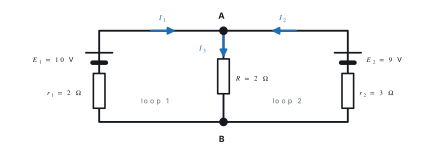
Problem. In the network above, E_1 = 10\ \text{V} with r_1 = 2\ \Omega, E_2 = 9\ \text{V} with r_2 = 3\ \Omega, and R = 2\ \Omega. Find the current in each branch.
Solution. Let I_1 and I_2 flow towards junction A through the two cells, and I_3 flow from A to B through R.
Junction law at A: I_3 = I_1 + I_2.
Loop 1 (left cell and R), walking with the currents:
Loop 2 (right cell and R):
From the first, I_2 = 5 - 2I_1. Substituting in the second, 2I_1 + 5(5 - 2I_1) = 9, so -8I_1 = -16 and
Check: the potential at A is I_3R = 6\ \text{V}; the left cell drops 10 - 6 = 4\ \text{V} across 2\ \Omega (giving 2 A) and the right cell drops 9 - 6 = 3\ \text{V} across 3\ \Omega (giving 1 A). Consistent.
Every loop equation must be written round a complete conducting path. A branch containing an ideal voltmeter or a galvanometer with no current carries I = 0, so its IR term vanishes — but the branch's e.m.f. and the potential difference across it do not vanish. This is exactly how a balanced bridge works.
14.2 Wheatstone bridge circuit; Meter bridge
Four resistors P, Q, R, S form a quadrilateral ABCD. A cell is across one diagonal AC and a galvanometer across the other, BD. The bridge is balanced when the galvanometer shows no deflection.
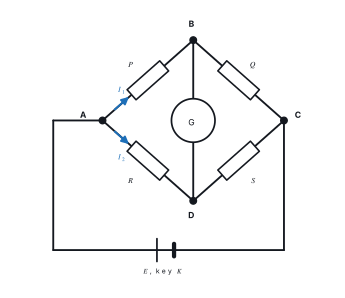
At balance no current flows through the galvanometer, so by the junction law the current I_1 in P also flows through Q, and the current I_2 in R also flows through S.
Since I_g = 0, points B and D are at the same potential. Hence
- along ABD: V_A - V_B = V_A - V_D, so I_1P = I_2R (1)
- along BCD: V_B - V_C = V_D - V_C, so I_1Q = I_2S (2)
Dividing (1) by (2):
If three resistances are known the fourth follows. Note that the condition does not involve E, r or the galvanometer resistance — this is why the bridge is a null method and is so accurate.
The metre bridge
The metre bridge is the Wheatstone bridge built from a single uniform wire. A manganin or constantan wire exactly 100\ \text{cm} long is stretched along a metre scale between copper strips. The unknown resistance X goes in the left gap and a resistance box R in the right gap. A jockey slides along the wire until the galvanometer reads zero at a balance length l from the left end.
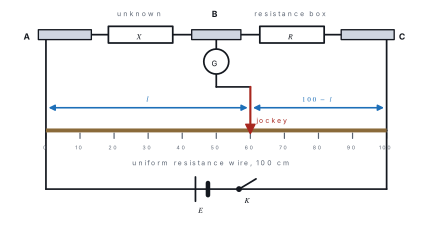
If the wire has resistance \sigma per centimetre, the two parts of the wire have resistances \sigma l and \sigma(100-l). Applying the balance condition,
The fractional error in X is smallest when l \approx 50\ \text{cm}, so choose R in the box to bring the null point between about 40 cm and 60 cm. Repeating the reading with X and R interchanged and averaging cancels the error caused by the end resistances of the copper strips.
Problem. In a metre bridge the unknown resistance X is in the left gap and R = 4\ \Omega in the right gap. The balance point is 60\ \text{cm} from the left end. Find X, and the new balance point when X and R are interchanged.
Solution.
On interchanging, R = 4\ \Omega is now on the left, so
The balance point simply moves to 100 - 60 = 40\ \text{cm}, as symmetry demands.
14.3 Potentiometer: Comparison of e.m.f.; measurement of internal resistance of a cell
A potentiometer is a long uniform wire (usually 4 m or 10 m, wound in 1 m strips) carrying a steady current from a driver cell of e.m.f. E_0. The potential falls uniformly along it, so the potential difference across a length l is V = kl, where the potential gradient
is constant as long as the driver current is steady.
At the balance point no current is drawn from the cell being tested. The cell therefore has no internal drop Ir, and the potentiometer measures the true e.m.f., not the terminal p.d. A voltmeter always draws some current, so it always reads slightly low. A potentiometer behaves like a voltmeter of infinite resistance.
Comparison of e.m.f. of two cells
Connect the two cells E_1 and E_2 through a two-way key so that either can be put in the galvanometer branch, with their positive terminals joined to the same end A as the driver cell. If they balance at lengths l_1 and l_2,
Internal resistance of a cell
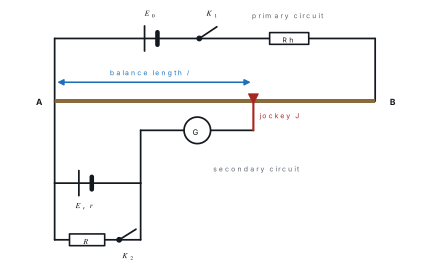
Step 1 — key K_2 open. No current is drawn from the test cell, so the potentiometer balances against its full e.m.f.:
Step 2 — key K_2 closed. The cell now drives a current through the known resistance R. At the new balance point the potentiometer matches the terminal p.d.:
Step 3 — divide.
If the driver cell's e.m.f. E_0 is less than the e.m.f. being measured, the potential drop over the whole wire is too small and the galvanometer deflects the same way everywhere — there is no null point. Always take E_0 > E, and check that the positive terminals of both cells are connected to the same end of the wire. One-sided deflection at both ends is the classic symptom of a reversed cell.
Problem. A cell balances at l_1 = 240\ \text{cm} on a potentiometer. When a resistance of 5\ \Omega is connected across its terminals the balance length falls to l_2 = 200\ \text{cm}. Find the internal resistance of the cell. If the potential gradient is 2.0\ \text{mV cm}^{-1}, find the e.m.f. as well.
Solution.
14.4 Super conductors; Perfect conductors
The resistivity of a normal metal falls as it is cooled, because the lattice ions vibrate less and scatter electrons less. But it never reaches zero: impurities and defects leave a residual resistivity even at 0\ \text{K}.
Certain materials behave completely differently. Below a sharp critical temperature T_c their resistivity drops abruptly to zero — not "very small", but zero, as far as any measurement can tell. Kamerlingh Onnes discovered this in mercury in 1911 at T_c = 4.2\ \text{K}.
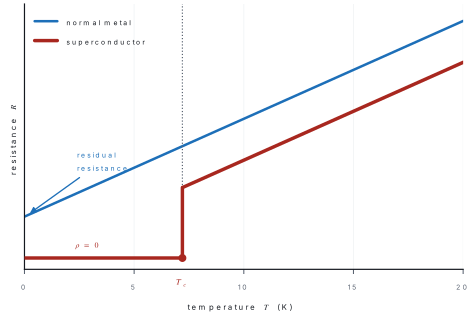
A superconductor is a material whose electrical resistivity becomes exactly zero below a critical temperature T_c, and which at the same time expels magnetic flux from its interior, so that B = 0 inside it (the Meissner effect).
Perfect conductor versus superconductor. A perfect conductor is an idealisation: a material with \rho = 0 but with no other special property. The distinction is not academic, and examiners like it:
| Perfect conductor (hypothetical) | Superconductor (real) | |
|---|---|---|
| Resistivity | zero | zero |
| Defined by | \rho = 0 only | \rho = 0 and B = 0 inside |
| Cooled in a magnetic field | traps the flux already inside it, because d\vec{B}/dt = 0 | expels the flux completely (Meissner effect) |
| Final state | depends on the history of cooling and magnetising | same state whatever the order — a true thermodynamic phase |
| Exists? | no | yes, below T_c |
A superconductor is destroyed by too large a magnetic field (the critical field B_c, which falls to zero at T_c) or by too large a current (the critical current). Both limits matter in real magnets.
High-temperature superconductors. In 1986–87 ceramic oxides such as YBa₂Cu₃O₇ were found to superconduct up to about 92 K — above the boiling point of liquid nitrogen (77 K), which is cheap. Uses: MRI and NMR magnets, particle-accelerator magnets, maglev trains, SQUID magnetometers, and loss-free power cables.
14.5 Conversion of galvanometer into voltmeter and ammeter; Ohmmeter
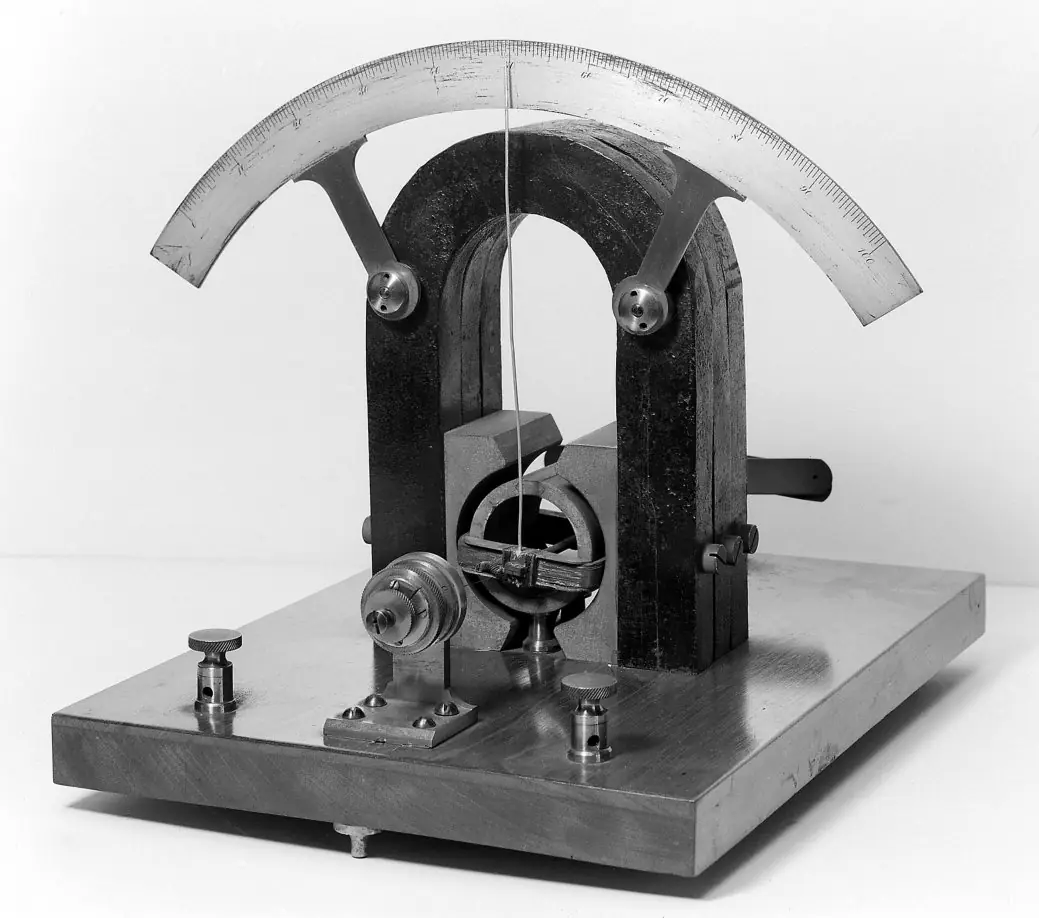
A moving-coil galvanometer has a resistance G and gives full-scale deflection for a small current I_g (typically a few milliamperes). It is the movement inside every analogue meter; only the resistor bolted to it changes.
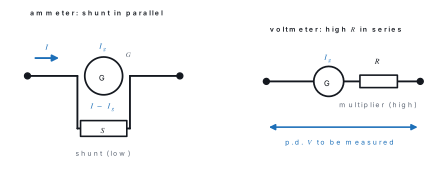
Ammeter. To read up to a current I, a low resistance S (the shunt) is joined in parallel with the galvanometer so that only I_g passes through the coil and (I - I_g) bypasses it. The p.d. across the parallel pair is the same:
The resistance of the finished ammeter is R_A = \dfrac{GS}{G+S}, which is very small — an ammeter must be connected in series and must not disturb the current. An ideal ammeter has zero resistance.
Voltmeter. To read up to a p.d. V, a high resistance R (the multiplier) is joined in series, chosen so that the current is exactly I_g when the p.d. is V:
The resistance of the finished voltmeter is G + R, which is very large — a voltmeter is connected in parallel and must draw as little current as possible. An ideal voltmeter has infinite resistance.
The ohmmeter
An ohmmeter is a galvanometer, a cell of e.m.f. E and an adjustable resistor R in series, with two test leads. First the leads are touched together (zero external resistance) and R is adjusted so that the deflection is exactly full scale:
With an unknown resistance X between the leads the current becomes
so each deflection corresponds to one value of X. Two features follow at once and are often asked:
- the scale is non-uniform (cramped at large X), because I is not proportional to X;
- the scale is reversed: zero ohms is at the full-scale end (right) and infinite ohms at the zero-current end (left).
Problem. A galvanometer of resistance G = 50\ \Omega gives full-scale deflection for I_g = 2\ \text{mA}. How would you convert it into (a) an ammeter reading 0–5\ \text{A}, and (b) a voltmeter reading 0–10\ \text{V}? Find the resistance of each finished instrument.
Solution.
(a) I = 5\ \text{A}, I_g = 2\times10^{-3}\ \text{A}:
A shunt of about 0.02\ \Omega is connected in parallel. Meter resistance
(b) V = 10\ \text{V}:
This is connected in series; the voltmeter's resistance is G + R = 5000\ \Omega, i.e. 500\ \Omega per volt.
14.6 Joule's law
When a current passes through a conductor, the ordered drift energy the electrons gain from the field is handed to the lattice in collisions, and the conductor warms up.
In time t a charge q = It moves through a potential difference V. The work done by the source on this charge is
None of it appears as kinetic energy, because the drift velocity stays constant; all of it appears as heat. Using V = IR,
and the rate of heating — the power dissipated — is P = H/t = I^2R = V^2/R.
The three statements usually quoted as Joule's laws are just the three proportionalities hidden in H = I^2Rt:
- H \propto I^{2} when R and t are constant;
- H \propto R when I and t are constant;
- H \propto t when I and R are constant.
If the heat is wanted in calories, divide by the mechanical equivalent of heat J = 4.2\ \text{J cal}^{-1}: H = I^2Rt/J calories.
For resistors in series the current I is common, so use H = I^2Rt and the largest resistance gets hottest. For resistors in parallel the voltage V is common, so use H = V^2t/R and the smallest resistance gets hottest. Picking the wrong form reverses the answer — this is a favourite Group A trap.
Where it is used. Heaters, immersion rods, electric irons and incandescent lamps use a high-resistivity alloy (nichrome, \rho \approx 1.1\times10^{-6}\ \Omega\,\text{m}) with a high melting point. A fuse does the opposite job: a short piece of low-melting tin–lead alloy that melts and breaks the circuit when I^2R heating becomes dangerous. Electrical energy is sold in kilowatt-hours: 1\ \text{kWh} = 1000 \times 3600 = 3.6\times10^{6}\ \text{J}.
Problem. An electric kettle is marked "1500 W, 230 V". It is used to heat 1.0\ \text{kg} of water from 20\,^{\circ}\text{C} to 100\,^{\circ}\text{C}. If 80 % of the electrical energy reaches the water, how long does it take? Take the specific heat capacity of water as 4200\ \text{J kg}^{-1}\text{K}^{-1}. Also find the resistance of the element.
Solution. Heat required by the water:
Useful power delivered = 0.80 \times 1500 = 1200\ \text{W}, so
Resistance of the element at its working temperature:
Chapter summary
- Kirchhoff's junction law \sum I = 0 expresses conservation of charge; the loop law \sum E = \sum IR expresses conservation of energy.
- A Wheatstone bridge is balanced when I_g = 0, and then P/Q = R/S. The condition is independent of the cell and of the galvanometer.
- Metre bridge: X = R\,l/(100-l), with l measured from the end next to X. Keep l near 50 cm and interchange X and R to cancel end errors.
- Potentiometer: V = kl with k = V_{AB}/L. Comparison of e.m.f. E_1/E_2 = l_1/l_2; internal resistance r = R(l_1-l_2)/l_2. At balance the cell supplies no current, so the true e.m.f. is measured.
- A superconductor has \rho = 0 below T_c and expels magnetic flux (Meissner effect); a merely perfect conductor would trap the flux instead.
- Galvanometer conversions: ammeter S = I_gG/(I-I_g) in parallel; voltmeter R = V/I_g - G in series. An ohmmeter has a reversed, non-uniform scale.
- Joule's law: H = I^2Rt = VIt = V^2t/R; power P = I^2R = V^2/R; 1\ \text{kWh} = 3.6\times10^{6}\ \text{J}.
Practice questions
Group A — Multiple choice (1 mark each)
- Kirchhoff's junction law is a consequence of the conservation of [1]aenergybchargecmomentumdmagnetic flux
- In a balanced Wheatstone bridge, the current through the galvanometer is [1]amaximumbzerochalf the main currentdequal to the main current
- A potentiometer measures the e.m.f. of a cell more accurately than a voltmeter because at balance it [1]ahas a very low resistancebdraws no current from the cellcuses a longer wiredis calibrated in volts
- To convert a galvanometer into an ammeter, we connect a [1]ahigh resistance in seriesbhigh resistance in parallelclow resistance in seriesdlow resistance in parallel
- Two resistors of 2\ \Omega and 4\ \Omega are joined in parallel across a battery. The ratio of the heat produced in them in a given time is [1]a1:2b2:1c1:4d4:1
- Below its critical temperature a superconductor [1]ahas infinite resistancebbecomes an insulatorcexpels magnetic flux from its interiordtraps all the flux inside it
Answers to Group A
1. (b) — charge cannot accumulate at a junction, so what flows in must flow out.
2. (b) — balance is defined by the null (zero) galvanometer deflection.
3. (b) — with no current drawn there is no internal drop Ir, so the reading is the true e.m.f.
4. (d) — the shunt S = I_gG/(I-I_g) is small and goes in parallel.
5. (b) — in parallel V is common, so H = V^2t/R \propto 1/R, giving H_2:H_4 = \frac14 : \frac12 inverted, i.e. 2:1.
6. (c) — the Meissner effect; that, plus \rho = 0, defines superconductivity.
Group B — Short answer (5 marks each)
- State Kirchhoff's laws and name the conservation principle behind each. Using them, obtain the balance condition of a Wheatstone bridge. [5]
- In a metre bridge the unknown resistance X is in the left gap and a 6\ \Omega resistance in the right gap. The balance point is 40\ \text{cm} from the left end. Find X and the new balance length if the two are interchanged. [5]
- A cell balances against 150\ \text{cm} of a potentiometer wire. When a 4\ \Omega resistor is connected across the cell, the balance length becomes 120\ \text{cm}. Calculate the internal resistance of the cell. [5]
- A galvanometer of resistance 100\ \Omega gives full-scale deflection for 1\ \text{mA}. Find the resistance needed to convert it into(a) an ammeter reading up to 1\ \text{A} and(b) a voltmeter reading up to 5\ \text{V}. [5]
- Distinguish between a perfect conductor and a superconductor. Why is a superconducting magnet cooled below T_c before the field is switched on? [5]
Answers to Group B
1. Junction law \sum I = 0 (conservation of charge); loop law \sum E = \sum IR (conservation of energy). At balance I_g = 0, so I_1 flows through P and Q and I_2 through R and S, and V_B = V_D. Then I_1P = I_2R and I_1Q = I_2S; dividing gives P/Q = R/S.
2. X = R\,l/(100-l) = 6 \times 40/60 = 4\ \Omega. Interchanged, the left gap holds 6\ \Omega, so 6/4 = l'/(100-l'), giving 600 - 6l' = 4l' and l' = 60\ \text{cm}.
3. r = R\left(\dfrac{l_1-l_2}{l_2}\right) = 4\left(\dfrac{150-120}{120}\right) = 4 \times 0.25 = 1\ \Omega.
4. (a) S = \dfrac{I_gG}{I-I_g} = \dfrac{(10^{-3})(100)}{1-0.001} = \dfrac{0.1}{0.999} = 0.100\ \Omega in parallel. (b) R = \dfrac{V}{I_g} - G = \dfrac{5}{10^{-3}} - 100 = 5000 - 100 = 4900\ \Omega in series.
5. A perfect conductor only has \rho = 0; a superconductor also has B = 0 inside it. If a perfect conductor were cooled in a field it would trap that flux, because d\vec{B}/dt = 0 inside a resistanceless material; a superconductor expels the flux (Meissner effect) whatever the order of cooling and magnetising. In practice the magnet is cooled first so that the whole winding is superconducting before any current — and hence any I^2R heating at a normal spot — can appear; a normal region would heat, spread, and "quench" the magnet.
Group C — Long answer (8 marks each)
- (a) Draw a labelled diagram of a potentiometer arranged to compare the e.m.f.s of two cells, and derive E_1/E_2 = l_1/l_2. [4](b) A Daniell cell of e.m.f. 1.08\ \text{V} balances at 216\ \text{cm}. A second cell balances at 300\ \text{cm} on the same wire. Find the e.m.f. of the second cell and the potential gradient of the wire. [4]
- (a) State and derive Joule's law of heating, and explain why the element of a heater glows red while its copper connecting leads stay cool. [4](b) An electric heater marked "1000 W, 220 V" is used for 5 hours a day for 30 days. Find its resistance, the current it draws, and the monthly cost of running it at NPR 10 per unit. [4]
Answers to Group C
1. (b) Since E \propto l for the same wire and driver current,
Potential gradient k = E_1/l_1 = 1.08/216 = 5.0\times10^{-3}\ \text{V cm}^{-1} = 0.50\ \text{V m}^{-1}.
2. (a) W = qV = VIt = I^2Rt, all of which appears as heat since the drift velocity is unchanged. In a series path the current is the same everywhere, so H \propto R: the nichrome element has a resistance of tens of ohms and a high melting point, while the thick copper leads have a resistance of a fraction of an ohm, so almost all the heat is produced in the element.
(b) R = V^2/P = 220^2/1000 = 48.4\ \Omega; I = P/V = 1000/220 = 4.55\ \text{A}. Energy = 1.0\ \text{kW} \times 5\ \text{h} \times 30 = 150\ \text{kWh}, so the cost is 150 \times 10 = NPR 1500 per month.
Practise more: Physics question bank