Unit 8 · Waves and Optics · 4 teaching hours · 15 min read
Wave in pipes and strings
What the syllabus asks for 6
- Stationary waves in closed and open pipes
- Harmonics and overtones in closed and open organ pipes
- End correction in pipes
- Velocity of transverse waves along a stretched string
- Vibration of string and overtones
- Laws of vibration of fixed string
A flute made from Kathmandu bamboo, a sarangi string, a bottle you blow across — all of them make a musical note the same way. A wave is trapped between two boundaries, reflects back and forth, and only those wavelengths that fit the boundaries survive. This unit works out exactly which wavelengths fit, for air columns and for stretched strings, and turns each answer into a frequency you can calculate.
Which whole number of quarter- or half-wavelengths fits between the two ends? Fix the node/antinode at each end from the physics, count the loops, read off \lambda, and use f = v/\lambda. Everything in this unit is that one step.
8.1 Stationary waves in closed and open pipes
When a progressive wave reaches the end of a pipe it is reflected. The reflected wave and the incident wave, of equal frequency and amplitude but opposite direction, superpose to give a stationary (standing) wave with fixed nodes (zero displacement) and antinodes (maximum displacement). Adjacent nodes are \lambda/2 apart; a node and the next antinode are \lambda/4 apart.
What decides where the nodes are is the boundary condition at each end:
| End of pipe | Can the air move? | Can the pressure change? | Displacement | Pressure |
|---|---|---|---|---|
| Closed (rigid) | no | yes | node | antinode |
| Open (to atmosphere) | yes | no | antinode | node |
At a closed end the rigid surface stops the air moving, so the displacement must be zero — a displacement node. At an open end the air is in contact with the atmosphere, whose pressure it cannot change, so the pressure variation is zero — a pressure node, which is the same place as a displacement antinode.
The two descriptions are always a quarter wavelength out of step. A closed end is a displacement node but a pressure antinode. If a question says "pressure antinode at the closed end" it is saying exactly the same thing as "displacement node". Decide which quantity you are drawing before you draw.
A closed pipe (closed organ pipe) is closed at one end and open at the other. An open pipe (open organ pipe) is open at both ends. A flute or bansuri behaves as an open pipe; a stopped organ pipe and a test-tube behave as closed pipes.
8.2 Harmonics and overtones in closed and open organ pipes
Closed organ pipe
The closed end must be a node and the open end an antinode, so the shortest column that fits is a quarter of a wavelength.
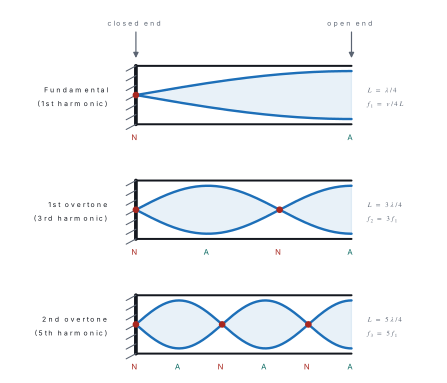
Reading the modes off the diagram, the possible lengths are L = \lambda/4,\ 3\lambda/4,\ 5\lambda/4,\dots, i.e.
and since f = v/\lambda,
So a closed pipe produces only the odd harmonics f_1 : 3f_1 : 5f_1 : \dots The even harmonics are missing.
Open organ pipe
Both ends are antinodes, so the shortest column is half a wavelength.
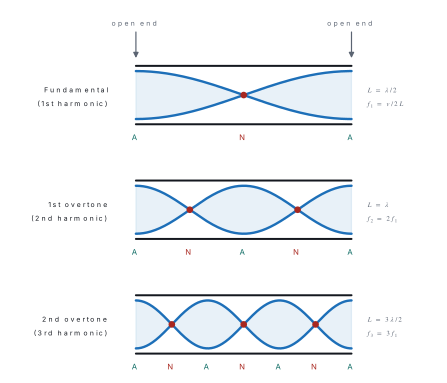
Here L = n\lambda_n/2, so \lambda_n = 2L/n and
| Closed pipe | Open pipe | |
|---|---|---|
| Fundamental | f_1 = v/4L | f_1 = v/2L |
| Harmonics present | odd only: 1, 3, 5, … | all: 1, 2, 3, … |
| 1st overtone | 3rd harmonic, 3f_1 | 2nd harmonic, 2f_1 |
| 2nd overtone | 5th harmonic, 5f_1 | 3rd harmonic, 3f_1 |
| Quality of note | poorer (few harmonics) | richer (many harmonics) |
| Same length L | note one octave lower | note one octave higher |
A harmonic is any whole-number multiple of the fundamental. An overtone is any tone actually produced above the fundamental, counted in order. So for a closed pipe the 1st overtone is the 3rd harmonic — the 2nd harmonic does not exist. Confusing the two words loses marks in almost every paper.
Problem. A closed organ pipe is 25 cm long. Taking the speed of sound as 340 m s⁻¹, find its fundamental frequency and the frequencies of its first two overtones. What would the fundamental be if the same pipe were open at both ends?
Solution. Closed pipe, L = 0.25\ \text{m}:
Only odd harmonics occur, so the first overtone is the 3rd harmonic and the second overtone is the 5th harmonic:
If the same pipe were open at both ends,
exactly twice as high — one octave above.
8.3 End correction in pipes
The air just outside an open end still takes part in the vibration, so the antinode does not sit exactly at the rim: it lies a small distance outside. That distance is the end correction e. Rayleigh showed that for a pipe of internal radius r,
The pipe therefore behaves as though it were longer than it measures:
(an open pipe has two open ends, so it gets two corrections). End correction matters most for short, wide pipes.
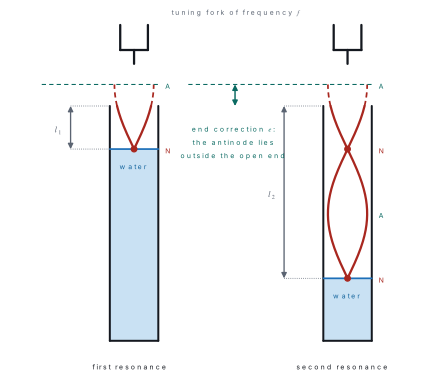
Lower the water level below a sounding tuning fork of frequency f and the air column resonates first at length l_1 and next at l_2. Including the correction,
Subtracting the first from the second removes e altogether:
Multiplying the first by 3 and subtracting the second instead gives e:
This is why the resonance tube is the standard school experiment for measuring the velocity of sound: the awkward unknown e cancels.
Problem. In a resonance-tube experiment a tuning fork of frequency 480 Hz gives resonance when the air column is 17.0 cm long and again when it is 53.0 cm long. Find the velocity of sound in air and the end correction.
Solution. l_1 = 0.170\ \text{m}, l_2 = 0.530\ \text{m}.
For the end correction,
Since e = 0.6r, the internal radius of the tube is r = 1.0/0.6 = 1.7\ \text{cm}.
8.4 Velocity of transverse waves along a stretched string
A stretched string carries transverse waves. Two quantities control their speed: the tension T that pulls a displaced element back, and the mass per unit length (linear density) \mu = m/L that resists the pull.
Let a pulse travel with speed v along a string of tension T and linear density \mu. View it from a frame moving with the pulse: the pulse stands still and the string streams backwards through it with speed v.
Take a short element at the crest of the pulse. It is very nearly an arc of a circle of radius R subtending a small angle \Delta\theta at the centre, so its length is R\Delta\theta and its mass is
The tension T pulls tangentially at each end of the arc. The tangential directions make angles \Delta\theta/2 with the horizontal, so the horizontal components cancel and the vertical components add, giving a resultant towards the centre of curvature:
In this frame the element moves along the arc with speed v, so F is the centripetal force:
Cancelling \Delta\theta,
Check the dimensions: [T]/[\mu] = (\text{M L T}^{-2})/(\text{M L}^{-1}) = \text{L}^2\text{T}^{-2}, whose square root is a velocity. If the wire has radius r and material density \rho then \mu = \pi r^{2}\rho, so a thicker or denser wire carries slower waves.
8.5 Vibration of string and overtones
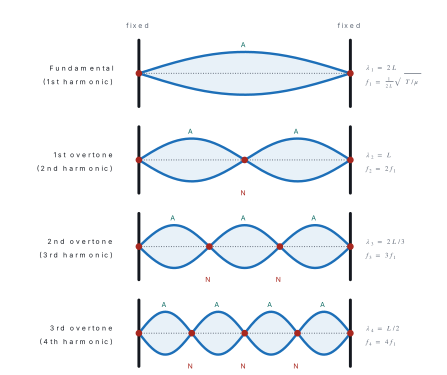
A sonometer wire is clamped at both ends, so both ends must be nodes. The string is therefore a whole number of half-wavelength loops long:
Combining with f = v/\lambda and v=\sqrt{T/\mu},
Unlike a closed pipe, a string gives every harmonic. That is why a plucked string sounds far richer than a stopped pipe of the same pitch.
Problem. A sonometer wire 50 cm long has a mass per unit length of 1.0 g m⁻¹ and is stretched by a tension of 160 N. Find the speed of transverse waves on it, its fundamental frequency, and the frequency of its second overtone.
Solution. \mu = 1.0\ \text{g m}^{-1} = 1.0\times10^{-3}\ \text{kg m}^{-1}, L = 0.50\ \text{m}, T = 160\ \text{N}.
A string gives all harmonics, so the second overtone is the 3rd harmonic:
8.6 Laws of vibration of fixed string
Writing f_1 = \dfrac{1}{2L}\sqrt{\dfrac{T}{\mu}} and holding two factors fixed at a time gives the three laws, all verifiable on a sonometer.
| Law | Statement | Form |
|---|---|---|
| Law of length | f \propto 1/L when T and \mu are constant | fL = constant |
| Law of tension | f \propto \sqrt{T} when L and \mu are constant | f/\sqrt{T} = constant |
| Law of mass | f \propto 1/\sqrt{\mu} when L and T are constant | f\sqrt{\mu} = constant |
Because \mu = \pi r^{2}\rho for a wire of radius r and density \rho, the third law is often split into a law of diameter (f\propto 1/D) and a law of density (f\propto 1/\sqrt{\rho}). Putting \mu = \pi D^{2}\rho/4 in the fundamental gives the compact working form
Almost every exam numerical on these laws is a ratio question. Write \dfrac{f_2}{f_1} = \dfrac{L_1}{L_2}\sqrt{\dfrac{T_2}{T_1}}\sqrt{\dfrac{\mu_1}{\mu_2}} and substitute only the quantities that changed. You never need v or \mu in absolute terms.
Problem. A sonometer wire sounds its fundamental at 256 Hz under a tension of 100 N. (a) To what value must the tension be raised to make it sound 320 Hz at the same length? (b) Instead, keeping the tension at 100 N, where should a bridge be placed on the 60 cm wire to obtain 320 Hz?
Solution.
(a) By the law of tension, f \propto \sqrt{T} at constant L and \mu:
(b) By the law of length, f \propto 1/L at constant T and \mu:
The bridge must be set 48 cm from the fixed end — that is, the vibrating length must be shortened by 12 cm.
Chapter summary
- A stationary wave forms when incident and reflected waves superpose. Closed end → displacement node; open end → displacement antinode. Adjacent nodes are \lambda/2 apart.
- Closed pipe: L=(2n-1)\lambda/4, so f_n = (2n-1)v/4L — odd harmonics only. The 1st overtone is the 3rd harmonic.
- Open pipe: L=n\lambda/2, so f_n = nv/2L — all harmonics. An open pipe sounds one octave above a closed pipe of the same length and gives a richer note.
- End correction e = 0.6r: closed pipe f_1 = v/4(L+e), open pipe f_1 = v/2(L+2e).
- Resonance tube: v = 2f(l_2-l_1) and e = (l_2-3l_1)/2.
- Transverse waves on a string: v = \sqrt{T/\mu}, derived from the centripetal force on a curved element.
- String fixed at both ends: f_n = \dfrac{n}{2L}\sqrt{\dfrac{T}{\mu}}, all harmonics present.
- Laws of a vibrating string: f\propto 1/L, f\propto\sqrt{T}, f\propto 1/\sqrt{\mu}.
Practice questions
Group A — Multiple choice (1 mark each)
- A closed organ pipe of length L produces harmonics of frequency [1]anv/2Lb(2n-1)v/4Lcnv/4Ld(2n-1)v/2L
- The first overtone of a closed pipe is its [1]a2nd harmonicb3rd harmonicc4th harmonicd5th harmonic
- If the tension in a stretched string is made four times, its fundamental frequency becomes [1]ahalfbtwicecfour timesdunchanged
- The end correction of a cylindrical pipe of internal radius r is about [1]a0.3rb0.6rcrd1.2r
- At the open end of an organ pipe there is always a [1]adisplacement nodebpressure antinodecdisplacement antinodedpoint of zero velocity
Answers to Group A
1. (b) — only odd multiples of v/4L fit a node-to-antinode column.
2. (b) — the 2nd harmonic is forbidden, so the first tone above the fundamental is 3f_1.
3. (b) — f\propto\sqrt{T} and \sqrt{4}=2.
4. (b) — Rayleigh's result, e = 0.6r.
5. (c) — the air is free to move there but cannot change the atmospheric pressure.
Group B — Short answer (5 marks each)
- Show that a closed organ pipe produces only odd harmonics while an open pipe of the same length produces all harmonics, and hence compare their fundamental frequencies. [5]
- What is meant by end correction? In a resonance-tube experiment, show that v = 2f(l_2-l_1) and e = (l_2-3l_1)/2. [5]
- State the three laws of vibration of a stretched string and write the single formula from which all three follow. [5]
- The third harmonic of a closed pipe has the same frequency as the first overtone of an open pipe 50 cm long. Find the length of the closed pipe. [5]
- A closed pipe 20 cm long has an internal radius of 2.0 cm. Taking v = 340\ \text{m s}^{-1}, find its fundamental frequency with and without the end correction. [5]
Answers to Group B
1. Closed: node at one end, antinode at the other, so L = (2n-1)\lambda/4 and f_n = (2n-1)v/4L — odd harmonics. Open: antinodes at both ends, so L = n\lambda/2 and f_n = nv/2L — all harmonics. For the same L, f_1(\text{open}) = 2f_1(\text{closed}).
4. The first overtone of an open pipe is its 2nd harmonic, f = 2\times\dfrac{v}{2L_o} = \dfrac{v}{L_o}. The third harmonic of a closed pipe is f = \dfrac{3v}{4L_c}. Equating the two,
5. Without correction, f_1 = v/4L = 340/(4\times0.20) = 425\ \text{Hz}. With correction, e = 0.6\times0.020 = 0.012\ \text{m}, so
The correction lowers the predicted note by 24 Hz — about a semitone, which is easily heard.
Group C — Long answer (8 marks each)
- (a) Derive the expression v = \sqrt{T/\mu} for the speed of a transverse wave on a stretched string. [4](b) Hence obtain the frequencies of the harmonics of a string fixed at both ends and state the laws of vibration of a fixed string. [4]
- A wire 1.0 m long has a mass per unit length of 5.0\times10^{-3}\ \text{kg m}^{-1} and is stretched by a tension of 200 N.(a) Find the speed of transverse waves and the fundamental frequency. [3](b) What tension would raise the fundamental to 150 Hz? [3](c) With the original tension restored, where must a bridge be placed to give a fundamental of 250 Hz? [2]
Answer to Group C question 2
(a) v = \sqrt{T/\mu} = \sqrt{200/(5.0\times10^{-3})} = \sqrt{4.0\times10^{4}} = 200\ \text{m s}^{-1}, and
(b) f\propto\sqrt{T}, so T' = T(f'/f_1)^{2} = 200\times(150/100)^{2} = 200\times2.25 = 450\ \text{N}.
(c) f\propto 1/L, so L' = L f_1/f' = 1.0\times(100/250) = 0.40\ \text{m}. The bridge must be placed 40 cm from one end.
Practise more: Physics question bank