Unit 20 · Modern Physics · 4 teaching hours · 15 min read
Electrons
What the syllabus asks for 3
- Millikan's oil drop experiment
- Motion of electron beam in electric and magnetic fields
- Thomson's experiment to determine specific charge of electrons
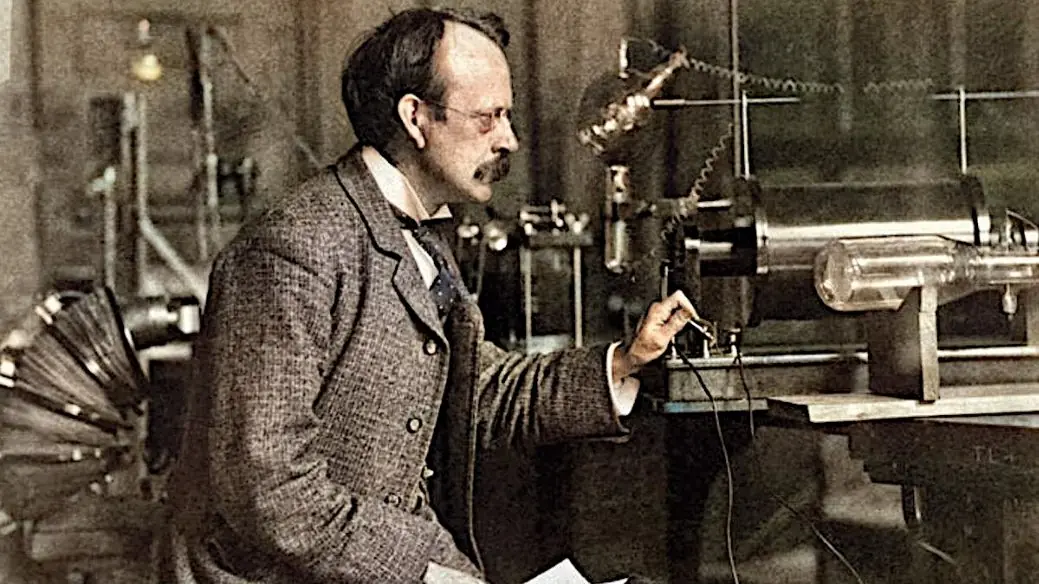
The electron was discovered twice over. In 1897 J. J. Thomson measured the ratio of its charge to its mass and showed that the same particle comes out of every cathode, whatever the gas or the metal. In 1909 R. A. Millikan measured the charge itself and found that it never comes in fractions. Put the two numbers together and the mass of the electron drops out. This unit is those two experiments, plus the piece of mechanics they both rest on: how a beam of electrons moves when an electric or a magnetic field pushes it sideways.
Two set-piece experiments — Millikan and Thomson — each a full Group C answer: labelled diagram, theory, working formula, result. Between them sits a small formula bank, v=\sqrt{2eV_a/m}, y = eEL^{2}/2mv^{2}, r = mv/eB and v = E/B, which carries almost every Group B numerical in this unit.
20.1 Millikan's oil drop experiment
Millikan's question was simple: is electric charge continuous, like the volume of water in a jug, or does it come in indivisible lumps? He answered it by weighing single charged oil drops against an electric field.
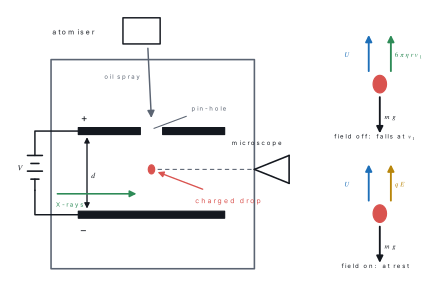
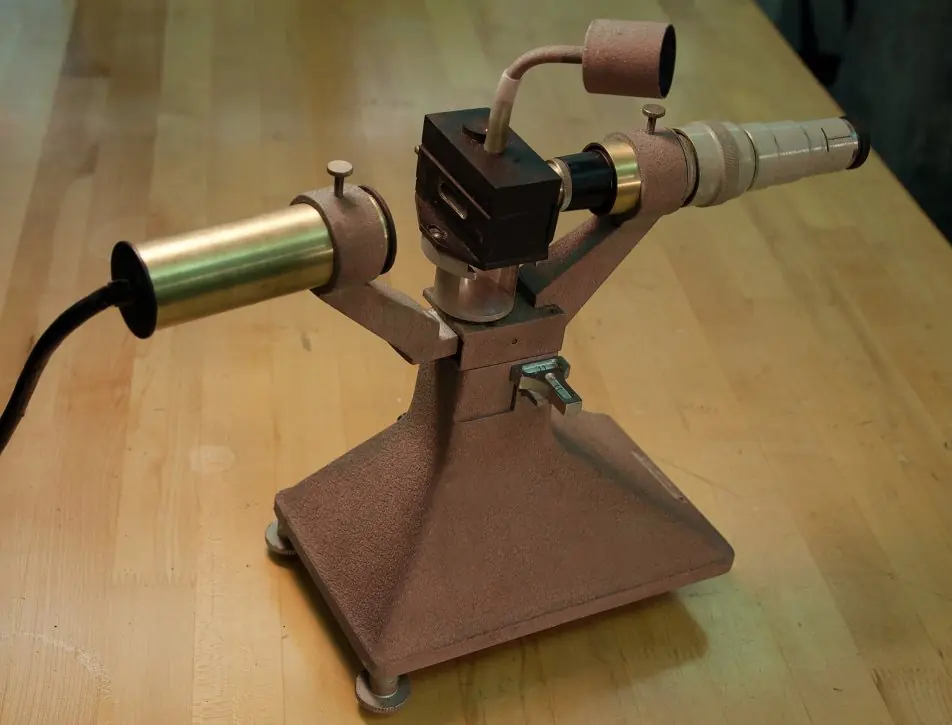
Fine drops of low-volatility oil are sprayed from an atomiser into the space between two horizontal metal plates a distance d apart. Friction in the nozzle leaves each drop with a small charge; a beam of X-rays can add or remove further electrons. A drop is watched through a travelling microscope against an illuminated scale.
Stage 1 — field off. The drop falls and quickly reaches a constant (terminal) velocity v_1, when weight is balanced by upthrust plus the viscous drag given by Stokes' law:
where \rho is the density of the oil, \sigma that of air and \eta the viscosity of air. Rearranging gives the radius of the drop:
Stage 2 — field on. The pd V is adjusted until the drop hangs stationary. Now the drag is zero, and the upward electric force balances the apparent weight:
Every quantity on the right is measurable, so q is measurable.
In practice a drop is rarely balanced exactly. Millikan more often let it rise with a steady velocity v_2 against the field. The drag then acts downwards and
Timing the same drop up and down many times, and using X-rays to change its charge in between, he could watch q jump in steps — and the steps were always the same size.
Millikan repeated this for thousands of drops. The charges were never random: every one was a whole-number multiple of the same small quantity.
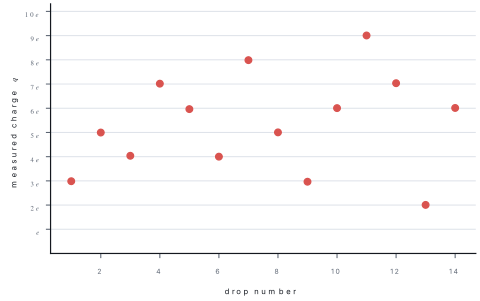
Electric charge is not continuous. It exists only in integral multiples of the elementary charge e = 1.6\times10^{-19}\ \text{C}. Millikan's experiment is the direct experimental proof, and it also gives the value of e.
The drop floats in air, so you must use the apparent weight \frac{4}{3}\pi r^{3}(\rho-\sigma)g, not \frac{4}{3}\pi r^{3}\rho g. Students also forget that the viscous force vanishes when the drop is stationary — Stokes' drag depends on speed, and the speed is zero.
Problem. In a Millikan apparatus the plates are 1.0\ \text{cm} apart. An oil drop of mass 4.9\times10^{-15}\ \text{kg} is held stationary when the pd across the plates is 1000\ \text{V}. Find the charge on the drop and the number of electrons it carries. (Neglect upthrust; g = 9.8\ \text{m s}^{-2}.)
Solution. The field between the plates is
For equilibrium, qE = mg, so
Number of electronic charges:
The drop carries 3 excess electrons.
20.2 Motion of electron beam in electric and magnetic fields
An electron released from rest at a cathode and accelerated through a pd V_a gains kinetic energy equal to the work done on it:
The speed depends on \sqrt{V_a}, not on V_a — doubling the accelerating voltage multiplies the speed by only \sqrt{2}.
Transverse electric field
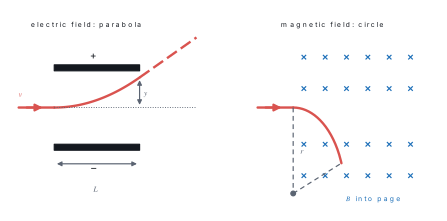
The beam now enters, at right angles, the field between two plates of length L and separation d held at pd V_d. Inside, E = V_d/d and the electron has a constant sideways acceleration a = eE/m, while its forward speed v is unchanged. This is exactly projectile motion: uniform velocity along the beam, uniform acceleration across it, so the path is a parabola.
At the far edge of the plates x = L, so the deflection there is
using v^{2} = 2eV_a/m. Notice that e and m have cancelled: the deflection of a cathode-ray spot depends only on the two voltages and the geometry. Beyond the plates there is no field, so the electron travels in a straight line along the tangent, making an angle \theta with the axis where \tan\theta = eEL/mv^{2} = 2y/L.
Transverse magnetic field
A magnetic field B perpendicular to the velocity exerts a force F = evB that is always perpendicular to the velocity. It therefore changes the direction but never the speed: the path is a circular arc of radius r given by
The period T is independent of the speed — the principle of the cyclotron.
Crossed fields — the velocity selector
Apply E and B at right angles to each other and to the beam, so that the electric force eE and the magnetic force evB act in opposite directions. Only electrons of one particular speed pass straight through:
Faster electrons are bent by the magnetic force, slower ones by the electric force. This "null method" is the heart of Thomson's experiment, and it is accurate because setting a deflection to zero is much easier than measuring it.
These three results are the working parts of every electron-beam instrument. The cathode-ray oscilloscope uses one pair of plates for the horizontal sweep and another for the vertical signal, so the spot traces the waveform directly. Television picture tubes and electron microscopes steer the beam magnetically, because a magnetic deflection needs no high voltage inside the tube. The mass spectrometer puts a velocity selector in front of a magnetic analyser, so that r = mv/qB then sorts ions purely by mass.
| Field | Force | Work done | Path | Speed |
|---|---|---|---|---|
| Electric E | eE, along the field line | non-zero | parabola | changes |
| Magnetic B | evB, perpendicular to v | zero | circle | constant |
Problem. An electron is accelerated through 2000\ \text{V} and then enters midway between two parallel plates 5.0\ \text{cm} long and 2.0\ \text{cm} apart, with 200\ \text{V} across them. Find (a) the speed of the electron, (b) its deflection as it leaves the plates. (e = 1.6\times10^{-19}\ \text{C}, m = 9.1\times10^{-31}\ \text{kg}.)
Solution.
(a) From eV_a = \frac{1}{2}mv^{2},
(b) Using the deflection formula,
so the beam is deflected about 3.1\ \text{mm} — comfortably less than the 1.0\ \text{cm} half-gap, so the electron does get out.
20.3 Thomson's experiment to determine specific charge of electrons
The specific charge of a particle is the ratio e/m — charge per unit mass. Thomson measured it for cathode rays and found a value about 1800 times larger than that for the lightest known ion, the hydrogen ion. Either the charge was enormous or the mass was tiny; the constancy of the result for every cathode material showed it was a new, very light particle common to all matter.
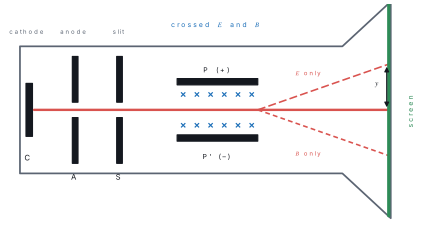
Method. The tube is evacuated. Electrons boiled off the cathode C are accelerated by the anode A, collimated by the slit S, and strike a fluorescent screen, where they make a bright spot. Between the plates P and P' both an electric field E (from the plate pd) and a magnetic field B (from coils outside the tube, perpendicular to E) can be applied.
Step 1 — find the speed. Switch on both fields and adjust B until the spot returns to its undeflected position. The two forces are then equal and opposite:
Step 2 — find the radius. Switch the electric field off, leaving B alone. The magnetic force now provides the centripetal force and the beam bends into a circle of radius r:
Combining the two,
The radius is obtained from the measured deflection y of the spot and the geometry of the tube; for a short field region of length L, r \approx L^{2}/2y.
Alternative route. If instead the electric deflection y is measured with the magnetic field off, then y = eEL^{2}/2mv^{2}, and substituting v = E/B from Step 1 gives e/m = 2yE/B^{2}L^{2}.
| Quantity | Modern accepted value |
|---|---|
| Specific charge of electron, e/m | 1.76\times10^{11}\ \text{C kg}^{-1} |
| Electronic charge, e (Millikan) | 1.60\times10^{-19}\ \text{C} |
| Mass of electron, m = e \div (e/m) | 9.11\times10^{-31}\ \text{kg} |
| e/m for the hydrogen ion | 9.58\times10^{7}\ \text{C kg}^{-1} |
The last two rows are the punchline: the electron's specific charge is 1837 times that of the hydrogen ion, so the electron is about 1837 times lighter than the lightest atom.
Problem. In a Thomson-type tube the deflecting plates are 1.0\ \text{cm} apart with 300\ \text{V} across them. A magnetic field of 1.0\times10^{-3}\ \text{T} leaves the beam undeflected. When the electric field is switched off the beam bends into a circle of radius 17.0\ \text{cm}. Find the speed of the electrons, their specific charge, and hence the electron mass.
Solution. The electric field is
From the null condition,
From the circular path,
Taking e = 1.6\times10^{-19}\ \text{C} from Millikan,
Millikan gives e; Thomson gives e/m. Neither gives m on its own. If a question asks for the mass of the electron, it is asking you to combine the two.
Chapter summary
- Millikan balanced the apparent weight of a charged oil drop against an electric force: q = mgd/V for a stationary drop, or q = 6\pi\eta r v_1 d/V with r = \sqrt{9\eta v_1/2(\rho-\sigma)g}.
- Every measured charge is an integral multiple of e = 1.60\times10^{-19}\ \text{C}: charge is quantised.
- An electron accelerated through V_a has speed v = \sqrt{2eV_a/m}.
- In a transverse electric field the path is a parabola with deflection y = eEL^{2}/2mv^{2} = V_dL^{2}/4V_ad at the edge of the plates.
- In a transverse magnetic field the path is a circle, r = mv/eB, period T = 2\pi m/eB; the magnetic force does no work, so the speed is unchanged.
- Crossed fields select one speed: v = E/B.
- Thomson's tube gives e/m = E/B^{2}r = 2yE/B^{2}L^{2}; the accepted value is 1.76\times10^{11}\ \text{C kg}^{-1}, which with Millikan's e gives m = 9.11\times10^{-31}\ \text{kg}.
Practice questions
Group A — Multiple choice (1 mark each)
- Millikan's oil-drop experiment established that [1]aelectrons have massbcharge is quantisedce/m is constantdoil is an insulator
- An electron accelerated from rest through a pd V acquires a speed proportional to [1]aVb\sqrt{V}cV^{2}d1/V
- A charged particle enters a uniform magnetic field at right angles to it. Its path is [1]aa straight lineba parabolaca circleda helix
- In crossed electric and magnetic fields, the particles that pass undeflected have speed [1]aEBbE/BcB/EdE^{2}/B
- The specific charge of an electron is about [1]a1.6\times10^{-19}\ \text{C kg}^{-1}b9.1\times10^{-31}\ \text{C kg}^{-1}c1.76\times10^{11}\ \text{C kg}^{-1}d9.58\times10^{7}\ \text{C kg}^{-1}
Answers to Group A
1. (b) — every drop charge came out as an integral multiple of e.
2. (b) — eV = \frac12 mv^2 gives v \propto \sqrt{V}.
3. (c) — the force evB stays perpendicular to v, so the speed is constant and the path closes into a circle.
4. (b) — setting eE = evB gives v = E/B.
5. (c) — 1.76\times10^{11}\ \text{C kg}^{-1}; (d) is the value for the hydrogen ion.
Group B — Short answer (5 marks each)
- Describe Millikan's oil-drop experiment with a labelled diagram and derive an expression for the charge on a stationary drop. [5]
- An oil drop of mass 1.96\times10^{-15}\ \text{kg} carrying two excess electrons is held stationary between horizontal plates 5.0\ \text{mm} apart. Find the pd applied across the plates. [5]
- Show that the path of an electron entering a uniform transverse electric field is a parabola, and obtain the deflection at the end of the plates. [5]
- An electron is accelerated through 500\ \text{V} and then enters a magnetic field of 2.0\times10^{-3}\ \text{T} at right angles. Find its speed and the radius of its circular path. [5]
- Distinguish between the effects of an electric field and a magnetic field on a moving electron. [5]
Answers to Group B
2. q = 2e = 3.2\times10^{-19}\ \text{C} and mg = 1.96\times10^{-15}\times9.8 = 1.92\times10^{-14}\ \text{N}. For equilibrium qV/d = mg, so V = mgd/q = (1.92\times10^{-14}\times5.0\times10^{-3})/(3.2\times10^{-19}) = 300\ \text{V}.
4. v = \sqrt{2eV_a/m} = \sqrt{2\times1.6\times10^{-19}\times500/9.1\times10^{-31}} = \sqrt{1.76\times10^{14}} = 1.33\times10^{7}\ \text{m s}^{-1}. Then r = mv/eB = (9.1\times10^{-31}\times1.33\times10^{7})/(1.6\times10^{-19}\times2.0\times10^{-3}) = 1.21\times10^{-23}/3.2\times10^{-22} = 3.8\times10^{-2}\ \text{m} = 3.8\ \text{cm}.
5. Outline: the electric force eE is along the field and does work, so the speed changes and the path is a parabola; the magnetic force evB is perpendicular to v, does no work, so the speed is constant and the path is a circular arc. A magnetic field acts only on a moving charge; an electric field acts on a charge at rest as well.
Group C — Long answer (8 marks each)
- (a) Draw a labelled diagram of Thomson's apparatus for measuring the specific charge of the electron. [3](b) Explain the crossed-field (null) method and derive e/m = E/B^{2}r. Show how the mass of the electron follows when Millikan's value of e is used. [5]
- An electron accelerated through 1000\ \text{V} enters midway between two plates 4.0\ \text{cm} long and 1.0\ \text{cm} apart, with a pd of 100\ \text{V} between them. Find(a) the speed of the electron,(b) its deflection on leaving the plates,(c) the angle its path then makes with the axis, and(d) the magnetic flux density that would bring the beam back to the axis. [8]
Answer to Group C question 2
(a) v = \sqrt{2eV_a/m} = \sqrt{2\times1.6\times10^{-19}\times1000/9.1\times10^{-31}} = \sqrt{3.52\times10^{14}} = 1.88\times10^{7}\ \text{m s}^{-1}.
(b) y = \dfrac{V_dL^{2}}{4V_ad} = \dfrac{100\times(4.0\times10^{-2})^{2}}{4\times1000\times1.0\times10^{-2}} = \dfrac{0.16}{40} = 4.0\times10^{-3}\ \text{m} = 4.0\ \text{mm}.
(c) \tan\theta = 2y/L = (2\times4.0\times10^{-3})/(4.0\times10^{-2}) = 0.20, so \theta = 11.3^{\circ}.
(d) For no deflection, eE = evB with E = V_d/d = 100/0.010 = 1.0\times10^{4}\ \text{V m}^{-1}: B = E/v = 1.0\times10^{4}/1.88\times10^{7} = 5.3\times10^{-4}\ \text{T}.
Practise more: Physics question bank