Unit 2 · Mechanics · 6 teaching hours · 15 min read
Periodic motion
What the syllabus asks for 5
- Equation of simple harmonic motion (SHM)
- Energy in SHM
- Application of SHM: vertical oscillation of mass suspended from coiled spring
- Angular SHM; simple pendulum
- Oscillatory motion: Damped oscillation, Forced oscillation and resonance
A motion that repeats itself in equal intervals of time is periodic. If, in addition, the body moves to and fro about a fixed point, the motion is oscillatory. The swinging of a temple bell, the trembling of the ground during an earthquake, the vibration of a sitar string and the current in a radio circuit are all oscillations, and all of them are built out of one simple pattern — simple harmonic motion. This unit sets up that pattern, its energy, two standard applications, and what happens when friction or an external driver is added.
A motion is simple harmonic if the acceleration is proportional to the displacement from the mean position and always directed towards it. Every result in this chapter follows from that one sentence, so learn it exactly.
2.1 Equation of simple harmonic motion (SHM)
Simple harmonic motion is the oscillation of a body in which the restoring force (and hence the acceleration) is directly proportional to the displacement from the mean position and is directed opposite to that displacement:
The constant \omega is the angular frequency (rad s⁻¹). The minus sign is the physics: it says the force always pushes the body back towards x = 0.
Write the acceleration as a = v\,dv/dx and separate the variables:
The body is momentarily at rest at the extreme position x = A (the amplitude), so C = \omega^{2}A^{2}/2 and
Writing v = dx/dt and separating again,
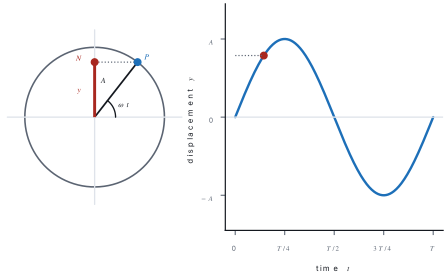
where the constant of integration \phi is the initial phase or epoch.
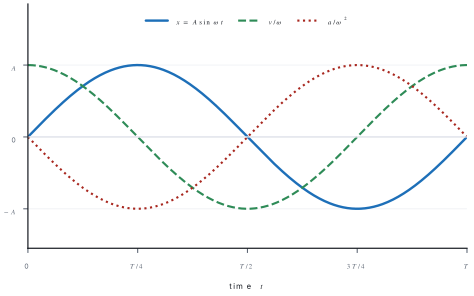
Differentiating the displacement gives the velocity and acceleration:
The period is the time for one complete oscillation and the frequency is its reciprocal:
| Position | Displacement | Speed | Acceleration |
|---|---|---|---|
| Mean position (x=0) | 0 | maximum, A\omega | 0 |
| Extreme position (x=\pm A) | \pm A | 0 | maximum, \omega^{2}A |
Problem. A particle executes SHM of amplitude 5\ \text{cm} and period 2\ \text{s}. Find (a) its maximum velocity, (b) its maximum acceleration, and (c) its velocity and acceleration when the displacement is 3\ \text{cm}.
Solution. \omega = 2\pi/T = 2\pi/2 = \pi = 3.14\ \text{rad s}^{-1} and A = 0.05\ \text{m}.
(a) v_{\max} = A\omega = 0.05 \times 3.14 = 0.157\ \text{m s}^{-1}.
(b) a_{\max} = A\omega^{2} = 0.05 \times (3.14)^{2} = 0.493\ \text{m s}^{-2}.
(c) v = \omega\sqrt{A^{2}-x^{2}} = 3.14\sqrt{0.05^{2}-0.03^{2}} = 3.14 \times 0.04 = 0.126\ \text{m s}^{-1}, and |a| = \omega^{2}x = 9.87 \times 0.03 = 0.296\ \text{m s}^{-2}, directed towards the mean position.
2.2 Energy in SHM
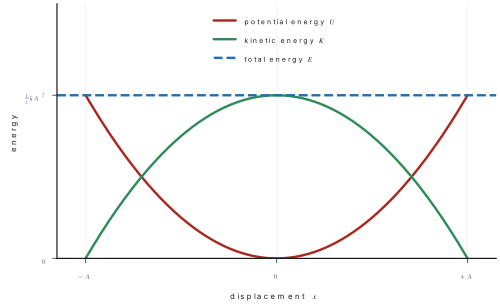
The restoring force is F = -kx with k = m\omega^{2}. The work done against it in moving from 0 to x is stored as potential energy:
The kinetic energy follows from v = \omega\sqrt{A^{2}-x^{2}}:
Adding them, the x^{2} terms cancel:
The total energy is constant, proportional to the square of the amplitude and to the square of the frequency. Doubling the amplitude quadruples the energy. Energy is continuously exchanged between K and U: all kinetic at the mean position, all potential at the extremes.
Averaged over a full cycle, \langle K\rangle = \langle U\rangle = \frac{1}{4}m\omega^{2}A^{2}, i.e. each is half the total.
Problem. A body of mass 0.5\ \text{kg} attached to a spring of force constant 200\ \text{N m}^{-1} oscillates with amplitude 0.10\ \text{m}. Find the period, the total energy, and the kinetic and potential energies when the displacement is 0.05\ \text{m}.
Solution. \omega = \sqrt{k/m} = \sqrt{200/0.5} = 20\ \text{rad s}^{-1}, so
At x = 0.05\ \text{m}: U = \frac{1}{2}(200)(0.05)^{2} = 0.25\ \text{J}, so K = E - U = 0.75\ \text{J}. The speed there is v = \sqrt{2K/m} = \sqrt{2(0.75)/0.5} = 1.73\ \text{m s}^{-1}.
2.3 Application of SHM: vertical oscillation of mass suspended from coiled spring
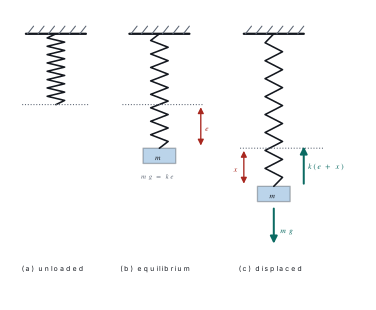
Hang a mass m from a light spiral spring of force constant k. The spring stretches by an amount e until the elastic force balances the weight:
This stretched position is the new mean position.
Pull the mass a further distance x down and release it. The spring now pulls up with force k(e+x) while the weight mg acts down, so the resultant (restoring) force is
The weight cancels exactly — it only shifts the mean position, it does not affect the motion about it. Hence ma = -kx, i.e.
which is SHM with \omega = \sqrt{k/m}, so
The second form is useful in the laboratory: measure the static extension e produced by the load and you can predict the period, or measure T and e and obtain g = 4\pi^{2}e/T^{2}.
Problem. A mass of 0.5\ \text{kg} hung from a light spiral spring stretches it by 10\ \text{cm}. Find the force constant of the spring and the period of vertical oscillation. Take g = 9.8\ \text{m s}^{-2}.
Solution.
The frequency is f = 1/T = 1.58\ \text{Hz}. Note that the answer needs only e and g — the mass cancels, because a heavier mass also stretches the spring more.
2.4 Angular SHM; simple pendulum
In angular SHM the body is displaced through an angle \theta and the restoring torque is proportional to that angle:
where c is the torsional constant and I the moment of inertia about the axis. A torsion pendulum and the coil of a moving-coil galvanometer behave this way.
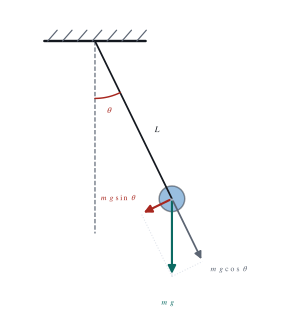
A simple pendulum is a point mass (bob) of mass m hung by a light inextensible string of length L from a rigid support. When the string makes an angle \theta with the vertical, the weight mg is resolved into mg\cos\theta along the string (balanced by the tension) and mg\sin\theta perpendicular to it. The second component is the restoring force:
For small angles, \sin\theta \approx \theta in radians, and the displacement along the arc is x = L\theta, so
This is SHM with \omega^{2} = g/L, hence
The four laws of the simple pendulum follow directly: T \propto \sqrt{L} (law of length); T \propto 1/\sqrt{g} (law of gravity); T is independent of the mass of the bob; and T is independent of the amplitude so long as it is small (law of isochronism). A seconds pendulum has T = 2\ \text{s}, so it takes one second for each swing.
T = 2\pi\sqrt{L/g} comes from replacing \sin\theta by \theta, which is accurate only for amplitudes of a few degrees (up to about 4^{\circ}). For larger swings the real period is longer, and the motion is periodic but no longer simple harmonic.
Problem. Find the length of a seconds pendulum at a place where g = 9.8\ \text{m s}^{-2}. If this pendulum clock is carried to a place where g = 9.78\ \text{m s}^{-2}, how much time will it lose in one day?
Solution. From T = 2\pi\sqrt{L/g},
At the new place the same pendulum has period
The clock still counts every swing as 2\ \text{s}. In one real day it makes 86400/2.002 = 43156 oscillations and therefore records only 43156 \times 2 = 86312\ \text{s}.
Time lost per day = 86400 - 86312 = 88\ \text{s}, i.e. about 1\ \text{minute}\ 28\ \text{s} slow.
2.5 Oscillatory motion: Damped oscillation, Forced oscillation and resonance
Real oscillators lose energy to friction and air resistance, so the amplitude falls with time. This is damped oscillation. For small speeds the resistive force is proportional to the velocity, F_d = -bv, and Newton's second law gives
whose light-damping solution is
The amplitude decays exponentially as A = A_0e^{-bt/2m}, and because E \propto A^{2} the energy decays twice as fast. Damping also makes the oscillation slightly slower (\omega' < \omega_0).
| Case | Condition | Behaviour | Example |
|---|---|---|---|
| Under-damped | b small | oscillates with decaying amplitude | pendulum in air |
| Critically damped | b^{2} = 4mk | returns to rest in the shortest time, no oscillation | dead-beat galvanometer |
| Over-damped | b large | returns to rest slowly, no oscillation | pendulum in thick oil |
If an external periodic force F_0\sin\omega_d t is applied, the oscillator settles into a forced oscillation at the driver's frequency \omega_d, not its own. The steady amplitude is
Resonance is the large increase in the amplitude of a forced oscillation that occurs when the frequency of the driving force becomes equal to the natural frequency of the oscillator (\omega_d = \omega_0). At resonance the driver feeds energy to the oscillator in step with its motion, and the amplitude is limited only by damping.
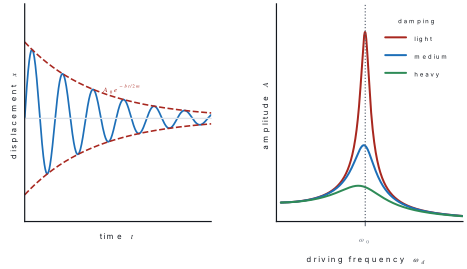
Resonance is useful and dangerous in equal measure: it lets a radio pick out one station, makes a sitar's sympathetic strings sing, and allows a small push at the right moment to swing a child high. But it also destroyed the Tacoma Narrows bridge, is why soldiers break step on a bridge, and is why buildings whose natural frequency matches the shaking of an earthquake — as some did in the Gorkha earthquake of 2015 — suffer the worst damage.
Problem. A damped oscillator has mass 0.2\ \text{kg} and damping constant b = 0.04\ \text{kg s}^{-1}. After what time does (a) the amplitude fall to 1/e of its initial value, and (b) the energy fall to 1/e of its initial value?
Solution. (a) A = A_0e^{-bt/2m}, so A = A_0/e when bt/2m = 1:
(b) E \propto A^{2}, so E = E_0e^{-bt/m}, and E = E_0/e when
The energy decays in half the time the amplitude does.
Chapter summary
- SHM: a = -\omega^{2}x, with x = A\sin(\omega t + \phi), v = A\omega\cos(\omega t+\phi) = \omega\sqrt{A^{2}-x^{2}} and T = 2\pi/\omega = 2\pi\sqrt{m/k}.
- Speed is maximum (A\omega) at the mean position; acceleration is maximum (\omega^{2}A) at the extremes. SHM is the projection of uniform circular motion on a diameter.
- U = \frac{1}{2}m\omega^{2}x^{2}, K = \frac{1}{2}m\omega^{2}(A^{2}-x^{2}), and the total E = \frac{1}{2}m\omega^{2}A^{2} = \frac{1}{2}kA^{2} is constant.
- Mass on a vertical spring: mg = ke and T = 2\pi\sqrt{m/k} = 2\pi\sqrt{e/g}; the weight only shifts the mean position.
- Angular SHM: \tau = -c\theta gives T = 2\pi\sqrt{I/c}. Simple pendulum: T = 2\pi\sqrt{L/g} for small amplitude, independent of the mass of the bob.
- Damped oscillation: A = A_0e^{-bt/2m}, \omega' = \sqrt{k/m - b^{2}/4m^{2}}; critical damping returns the system to rest fastest.
- A forced oscillator vibrates at the driver's frequency; at resonance (\omega_d = \omega_0) the amplitude is maximum and is limited only by damping.
Practice questions
Group A — Multiple choice (1 mark each)
- In simple harmonic motion the acceleration is [1]aconstantbproportional to displacement and in the same directioncproportional to displacement and oppositely directeddinversely proportional to displacement
- The total energy of a particle executing SHM is proportional to [1]aAbA^{2}c1/Ad\sqrt{A}
- The period of a simple pendulum does not depend on [1]aits lengthbthe acceleration due to gravitycthe mass of the bobdany of these
- A mass m hanging from a spring of force constant k oscillates with period [1]a2\pi\sqrt{k/m}b2\pi\sqrt{m/k}c2\pi\sqrt{mk}d\frac{1}{2\pi}\sqrt{m/k}
- At resonance the amplitude of a forced oscillation is [1]azerobminimumcmaximumdindependent of damping
Answers to Group A
1. (c) — this is the definition, a = -\omega^{2}x.
2. (b) — E = \frac{1}{2}m\omega^{2}A^{2}.
3. (c) — mass cancels between the restoring force and the inertia.
4. (b) — \omega = \sqrt{k/m}, so T = 2\pi/\omega = 2\pi\sqrt{m/k}.
5. (c) — the driving frequency matches the natural frequency, so energy is fed in step with the motion.
Group B — Short answer (5 marks each)
- Define simple harmonic motion. Show that the motion of a mass attached to a spring obeying Hooke's law is simple harmonic, and obtain its period. [5]
- Derive expressions for the kinetic and potential energies of a particle in SHM and show that the total energy is constant. [5]
- A particle of mass 0.2\ \text{kg} executes SHM of amplitude 0.10\ \text{m} with angular frequency 10\ \text{rad s}^{-1}. Find its total energy, and its kinetic and potential energies at a displacement of 0.05\ \text{m}. [5]
- A load of 0.5\ \text{kg} stretches a light spiral spring by 5\ \text{cm}. Find the force constant of the spring and the period of vertical oscillation of the load. (g = 9.8\ \text{m s}^{-2}) [5]
Answers to Group B
1. Outline: state the definition; for a spring F = -kx, so a = -(k/m)x = -\omega^{2}x with \omega = \sqrt{k/m}, which is SHM; hence T = 2\pi\sqrt{m/k}.
2. Outline: U = \int_0^x kx\,dx = \frac{1}{2}m\omega^{2}x^{2}; K = \frac{1}{2}mv^{2} = \frac{1}{2}m\omega^{2}(A^{2}-x^{2}); adding, E = \frac{1}{2}m\omega^{2}A^{2}, independent of x.
3. E = \frac{1}{2}m\omega^{2}A^{2} = \frac{1}{2}(0.2)(10)^{2}(0.10)^{2} = 0.1\ \text{J}. At x = 0.05\ \text{m}: U = \frac{1}{2}(0.2)(100)(0.05)^{2} = 0.025\ \text{J} and K = 0.1 - 0.025 = 0.075\ \text{J}.
4. k = mg/e = (0.5 \times 9.8)/0.05 = 98\ \text{N m}^{-1}; T = 2\pi\sqrt{e/g} = 2\pi\sqrt{0.05/9.8} = 0.449\ \text{s}.
Group C — Long answer (8 marks each)
- (a) Define simple harmonic motion and, starting from a = -\omega^{2}x, derive the expression x = A\sin(\omega t+\phi) and hence v = \omega\sqrt{A^{2}-x^{2}}. [5](b) Sketch how the kinetic and potential energies vary with displacement, and state where each is maximum. [3]
- (a) Derive an expression for the period of a simple pendulum, stating clearly the assumptions made. [5](b) A seconds pendulum is set up in Kathmandu, where g = 9.79\ \text{m s}^{-2}. Find its length. If it is then taken to a place where g = 9.81\ \text{m s}^{-2}, how much time will it gain in a day? [3]
Answer to Group C question 2(b)
L = \dfrac{gT^{2}}{4\pi^{2}} = \dfrac{9.79 \times 4}{4\pi^{2}} = 0.992\ \text{m}.
At the new place, T' = 2\pi\sqrt{0.992/9.81} = 1.998\ \text{s}.
In one real day the pendulum makes 86400/1.998 = 43244 oscillations, and the clock records 43244 \times 2 = 86488\ \text{s}.
Gain per day = 86488 - 86400 \approx 88\ \text{s}.
Practise more: Physics question bank