Unit 23 · Modern Physics · 8 teaching hours · 18 min read
Quantization of energy
What the syllabus asks for 7
- Bohr's theory of hydrogen atom
- Spectral series; Excitation and ionization potentials
- Energy level; Emission and absorption spectra
- De Broglie Theory; Duality
- Uncertainty principle
- X-rays: Nature and production; uses
- X-rays diffraction; Bragg's law
Rutherford's nuclear atom had a fatal flaw: an orbiting electron is an accelerating charge, so classical physics says it must radiate and spiral into the nucleus in about 10^{-8} s. Atoms do not do this, and the light they emit is not a continuous rainbow but a set of sharp lines. Bohr's answer was that energy inside an atom is quantized. This unit follows that idea from the hydrogen atom to X-rays and to the matter waves behind Bohr's rule.
The heaviest Modern Physics unit, and a reliable source of a Group C question. Master five things: derive r_n and E_n for hydrogen; use 1/\lambda = R(1/n_f^2 - 1/n_i^2); quote \lambda = h/p = 12.27/\sqrt{V} Å; draw the X-ray spectrum; apply 2d\sin\theta = n\lambda.
23.1 Bohr's theory of hydrogen atom
Bohr kept Rutherford's nucleus but added three postulates.
- Stationary orbits. An electron can revolve only in certain circular orbits in which it does not radiate energy. The centripetal force is supplied by the electrostatic attraction of the nucleus.
- Quantization of angular momentum. The allowed orbits are those for which the angular momentum is an integral multiple of h/2\pi:
- Frequency condition. Radiation is emitted or absorbed only when the electron jumps between two stationary orbits, and then
n is the principal quantum number.
For a hydrogen atom (nuclear charge +e), the Coulomb attraction provides the centripetal force:
From the second postulate, v = nh/(2\pi m r). Substituting into (i):
Putting in the constants, r_1 = 5.29\times10^{-11}\ \text{m} = 0.529 Å (the Bohr radius), and r_n \propto n^{2}.
Eliminating r instead gives the orbital speed
so v_1 = 2.19\times10^{6}\ \text{m s}^{-1}, about 1/137 of the speed of light.
Energy. From (i) the kinetic energy is K = \tfrac{1}{2}mv^{2} = e^{2}/(8\pi\varepsilon_0 r), and the electrostatic potential energy is U = -e^{2}/(4\pi\varepsilon_0 r). Hence
Substituting r_n:
Note U = -2K and E = -K: the energy is negative, so the electron is bound. E = 0 means a free, stationary electron.
It works for hydrogen and hydrogen-like ions (He⁺, Li²⁺, where E_n = -13.6\,Z^{2}/n^{2} eV and r_n = 0.529\,n^{2}/Z Å), but fails for any atom with two or more electrons. Do not apply it to helium or sodium.
23.2 Spectral series; Excitation and ionization potentials
Combining the frequency condition with E_n and \nu = c/\lambda:
where R = 1.097\times10^{7}\ \text{m}^{-1} is the Rydberg constant. All transitions ending on the same n_f form one spectral series.
| Series | n_f | n_i | Region | Longest \lambda | Series limit |
|---|---|---|---|---|---|
| Lyman | 1 | 2, 3, … | Ultraviolet | 121.6 nm | 91.2 nm |
| Balmer | 2 | 3, 4, … | Visible | 656.3 nm | 364.6 nm |
| Paschen | 3 | 4, 5, … | Infrared | 1875 nm | 820.4 nm |
| Brackett | 4 | 5, 6, … | Infrared | 4051 nm | 1458 nm |
| Pfund | 5 | 6, 7, … | Far infrared | 7460 nm | 2279 nm |
The series limit is the n_i \to \infty line, \lambda_{\min} = n_f^{2}/R.
Lyman, Balmer, Paschen, Brackett, Pfund — "Little Boys Play Better Football" — ending on n_f = 1,2,3,4,5.
Excitation potential. The p.d. through which an electron must be accelerated so that, on colliding with an atom, it can lift that atom from the ground state to the level n:
For hydrogen the first excitation potential is (-3.4) - (-13.6) = 10.2 V and the second is (-1.51)-(-13.6) = 12.09 V.
Ionization potential. The potential needed to take the electron from n=1 to n=\infty: for hydrogen V_{ion} = 13.6 V, so the ionization energy is 13.6 eV.
Problem. Find (a) the radius and energy of the n = 3 orbit of hydrogen, and (b) the wavelength of the photon emitted in the transition n = 3 \to 2.
Solution.
(a) r_3 = 0.529 \times 3^{2} = 4.76 Å = 4.76\times10^{-10} m; E_3 = -13.6/9 = -1.51 eV.
(b) \Delta E = E_3 - E_2 = -1.51 - (-3.40) = 1.89\ \text{eV}.
Using \lambda = hc/\Delta E with hc = 1240\ \text{eV nm},
This is the red H_\alpha line of the Balmer series.
23.3 Energy level; Emission and absorption spectra
Drawing the allowed energies as horizontal lines gives the energy-level diagram. Since E_n \propto -1/n^{2}, the levels crowd together as n grows and converge on the ionization limit E = 0. Above it lies a continuum: a free electron may have any energy.
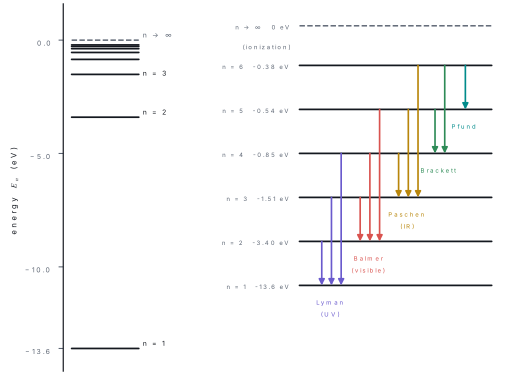
Emission spectrum. An atom excited by heat, discharge or collision is unstable and drops back within about 10^{-8} s, emitting a photon of energy E_i - E_f. The result is a bright-line spectrum: coloured lines on a dark background.
Absorption spectrum. White light passed through cool hydrogen gas loses exactly those photons that can lift atoms to a higher level, giving a dark-line spectrum at the same wavelengths as the emission lines.
| Feature | Emission spectrum | Absorption spectrum |
|---|---|---|
| Produced by | hot/excited gas | cool gas in front of a hot continuum source |
| Appearance | bright lines on dark ground | dark lines on bright ground |
| Transition | n_i \to n_f (downward) | n_f \to n_i (upward) |
| Lines observed | all series | mainly Lyman (from the ground state) |
The dark Fraunhofer lines in sunlight are an absorption spectrum produced by the Sun's cooler outer gases, and they are how we know what stars are made of.
Problem. A hydrogen atom in its ground state is bombarded by an electron accelerated through 12.5 V. To which level can the atom be excited, and what wavelengths can it then emit?
Solution. The electron brings 12.5 eV. Energies needed from n=1 are E_2 - E_1 = 10.2 eV, E_3 - E_1 = 12.09 eV, E_4 - E_1 = 12.75 eV. Since 12.09 < 12.5 < 12.75, the atom can reach n = 3 but not n = 4.
From n = 3 three transitions are possible:
3 \to 2: \Delta E = 1.89 eV, \lambda = 1240/1.89 = 656 nm (Balmer) 3 \to 1: \Delta E = 12.09 eV, \lambda = 1240/12.09 = 103 nm (Lyman) 2 \to 1: \Delta E = 10.2 eV, \lambda = 1240/10.2 = 122 nm (Lyman)
23.4 De Broglie Theory; Duality
Light behaves as a wave in diffraction and as photons in the photoelectric effect. In 1924 de Broglie proposed that this duality is universal: every moving particle has an associated wave of wavelength
For a photon, E = h\nu and E = pc give p = h/\lambda; de Broglie read this backwards for matter. For an electron accelerated from rest through a p.d. V, \tfrac12 mv^{2} = eV, so p = \sqrt{2meV} and
h = 6.63\times10^{-34} J s is minute. A 60 kg student running at 5\ \text{m s}^{-1} has \lambda = 2.2\times10^{-36} m — smaller than any possible obstacle, so no diffraction is observable. Wave behaviour appears only when \lambda is comparable to the aperture, i.e. for electrons and atoms.
The Davisson–Germer experiment (1927) confirmed this: electrons accelerated through 54 V and scattered from a nickel crystal gave a strong beam at 50^{\circ}, matching the predicted 12.27/\sqrt{54} = 1.67 Å.
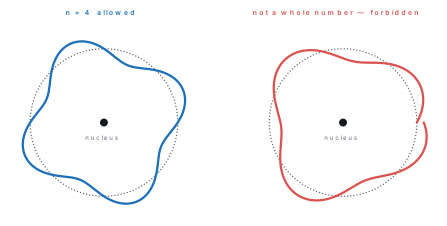
De Broglie's hypothesis also explains Bohr's second postulate: a stable orbit is a standing wave that joins on to itself round the circumference,
which is exactly the quantization rule Bohr had to assume.
Problem. Calculate the de Broglie wavelength of an electron accelerated through 100 V. Take h = 6.63\times10^{-34} J s, m = 9.1\times10^{-31} kg, e = 1.6\times10^{-19} C.
Solution.
Check with the shortcut: 12.27/\sqrt{100} = 1.227 Å. This is about the spacing of atoms in a crystal, which is why electron diffraction works.
23.5 Uncertainty principle
If an electron is a wave spread over a region, asking for its exact position is meaningless. Heisenberg made this quantitative in 1927.
It is impossible to measure simultaneously both the position and the momentum of a particle with unlimited accuracy. If \Delta x and \Delta p are the uncertainties in position and in the momentum component along the same direction, then
An equivalent statement for energy and time is \Delta E \cdot \Delta t \ge \dfrac{h}{4\pi}.
This is not a limitation of our instruments; it is a property of nature. Two standard consequences:
- Electrons cannot exist inside the nucleus. Confining an electron to \Delta x \approx 10^{-14} m needs \Delta p \ge h/(4\pi\Delta x), an energy of about 20 MeV, whereas beta particles carry only a few MeV. The electron is created at the moment of decay, not stored.
- Natural line width. A state living for \Delta t \approx 10^{-8} s has an energy blur \Delta E \ge h/4\pi\Delta t, so spectral "lines" are never infinitely sharp.
\Delta x and \Delta p are not mistakes in reading a scale: even with perfect apparatus the product cannot fall below h/4\pi. The principle links x with p_x only — \Delta x and \Delta p_y are unrestricted.
Problem. The position of an electron is measured to an accuracy of 10^{-10} m. Find the minimum uncertainty in its velocity.
Solution.
Denominator = 4 \times 3.1416 \times 9.1\times10^{-31} \times 10^{-10} = 1.144\times10^{-39}.
The uncertainty is about a quarter of the electron's own orbital speed in hydrogen — so the idea of a definite "orbit" is not really tenable.
23.6 X-rays: Nature and production; uses
X-rays were discovered by Röntgen in 1895. They are electromagnetic waves of wavelength roughly 0.01 Å to 100 Å (0.001–10 nm), produced when fast electrons are suddenly stopped by a heavy target — the reverse of the photoelectric effect.
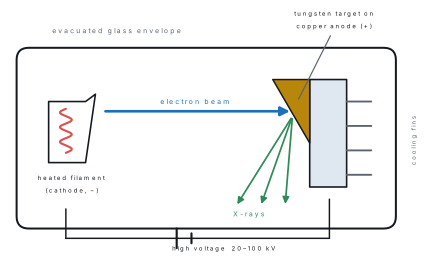
Two processes go on at the target, giving two parts to the spectrum.
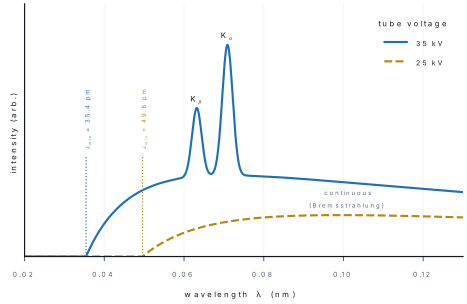
- Continuous (Bremsstrahlung) spectrum. An electron decelerating in the field of a target nucleus radiates, and may lose any fraction of its energy, so all wavelengths above a limit appear. The limit comes from an electron that gives up all its energy in one collision:
This Duane–Hunt limit depends only on the accelerating voltage, not on the target material.
- Characteristic spectrum. A fast electron knocks an electron out of the K shell of a target atom; an L-shell electron falling into the vacancy emits the sharp K_\alpha line, an M-shell electron the K_\beta line. These positions depend only on the target element (Moseley's law).
Properties. X-rays travel in straight lines at the speed of light, are undeflected by electric and magnetic fields, penetrate matter, ionize gases, affect photographic plates, cause fluorescence and are diffracted by crystals.
| Use | Basis |
|---|---|
| Medical radiography, CT scan | bone (high Z) absorbs more than soft tissue |
| Radiotherapy | hard X-rays destroy malignant cells |
| Airport and customs scanning | differential absorption reveals hidden metal |
| Detecting cracks in castings | voids transmit more |
| X-ray crystallography | \lambda comparable to atomic spacing |
Hard and soft X-rays. A high tube voltage gives short wavelength and high penetrating power ("hard" X-rays, used in radiotherapy); a low voltage gives "soft", less penetrating X-rays used for imaging soft tissue.
23.7 X-rays diffraction; Bragg's law
An optical grating has lines about 10^{-6} m apart — far too coarse to diffract X-rays of wavelength 10^{-10} m. Laue realised in 1912 that the atomic planes of a crystal, spaced about 10^{-10} m apart, form a natural three-dimensional grating.
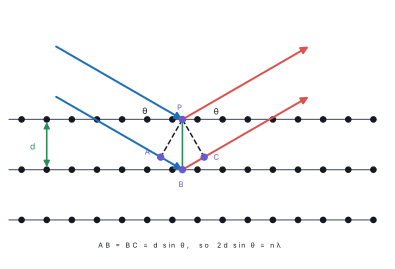
Take two atomic planes a distance d apart and a beam striking them at a glancing angle \theta. With B vertically below P, the lower ray travels the extra distance AB + BC, where PA and PC are wavefronts. From the right-angled triangles PAB and PCB,
Constructive interference (a bright spot) requires the path difference to be a whole number of wavelengths:
In optics the angle of incidence is measured from the normal; in Bragg's law \theta is the glancing angle, measured from the plane itself. Using the normal angle replaces \sin\theta by \cos\theta and is always wrong.
Since \sin\theta \le 1, Bragg reflection needs \lambda \le 2d. The law is used both ways: with \lambda known it measures d (X-ray crystallography, which gave us the structure of DNA); with d known it measures \lambda (the X-ray spectrometer).
Problem. A beam of X-rays of wavelength 1.54 Å gives a first-order Bragg reflection from a set of crystal planes at a glancing angle of 15.9^{\circ}. Find the spacing of the planes. What is the largest order that can be observed?
Solution. For n = 1,
Highest order: \sin\theta \le 1 needs n \le 2d/\lambda = 2(2.81)/1.54 = 3.65, so n = 3 is the highest order observable.
Chapter summary
- Bohr: mvr = nh/2\pi; r_n = \varepsilon_0h^{2}n^{2}/\pi me^{2} = 0.529\,n^{2} Å; v_n = c/137n; E_n = -13.6/n^{2} eV (multiply by Z^{2}, divide r_n by Z, for hydrogen-like ions).
- h\nu = E_i - E_f gives 1/\lambda = R(1/n_f^{2} - 1/n_i^{2}), R = 1.097\times10^{7} m⁻¹. Series: Lyman (UV, n_f=1), Balmer (visible), Paschen, Brackett, Pfund (IR).
- Hydrogen: first excitation potential 10.2 V, ionization potential 13.6 V. Emission gives bright lines, absorption dark lines at the same wavelengths.
- De Broglie: \lambda = h/p = 12.27/\sqrt{V} Å for an accelerated electron; 2\pi r = n\lambda reproduces Bohr's quantization.
- Uncertainty: \Delta x\,\Delta p \ge h/4\pi and \Delta E\,\Delta t \ge h/4\pi.
- X-ray tube: continuous spectrum with \lambda_{\min} = hc/eV (depends on V) plus characteristic K_\alpha, K_\beta lines (depend on the target).
- Bragg: 2d\sin\theta = n\lambda, \theta measured from the atomic plane.
Practice questions
Group A — Multiple choice (1 mark each)
- The radius of the n^{\text{th}} Bohr orbit of hydrogen is proportional to [1]anbn^{2}c1/nd1/n^{2}
- The Balmer series of hydrogen lies in the [1]aultravioletbvisiblecinfrareddX-ray region
- The minimum wavelength of the continuous X-ray spectrum depends on [1]athe target materialbthe filament currentcthe accelerating voltagedthe gas pressure in the tube
- The de Broglie wavelength of an electron accelerated through 400 V is about [1]a0.61 Åb1.23 Åc2.45 Åd12.27 Å
- In Bragg's law 2d\sin\theta = n\lambda, the angle \theta is measured between the incident ray and the [1]anormal to the crystal planebcrystal planecreflected raydsurface of the crystal only
Answers to Group A
1. (b) — r_n = (\varepsilon_0h^{2}/\pi me^{2})n^{2}.
2. (b) — transitions to n = 2 give 656–410 nm, which is visible light.
3. (c) — \lambda_{\min} = hc/eV contains only V; the characteristic lines depend on the target.
4. (a) — 12.27/\sqrt{400} = 12.27/20 = 0.61 Å.
5. (b) — \theta is the glancing angle, measured from the plane.
Group B — Short answer (5 marks each)
- State Bohr's postulates and hence derive an expression for the radius of the n^{\text{th}} orbit of a hydrogen atom. [5]
- Distinguish between emission and absorption spectra. Why do the dark lines of the solar absorption spectrum occur at exactly the wavelengths of the bright lines of a laboratory hydrogen lamp? [5]
- Calculate the wavelength of the first line and of the series limit of the Lyman series. Take R = 1.097\times10^{7}\ \text{m}^{-1}. [5]
- An X-ray tube operates at 40 kV. Find the minimum wavelength of the emitted X-rays. Explain why the spectrum also contains sharp lines whose wavelengths do not change when the voltage is raised. [5]
Answers to Group B
1. Postulates as in §23.1. Equating Coulomb and centripetal force, e^{2}/4\pi\varepsilon_0r^{2} = mv^{2}/r; putting v = nh/2\pi mr gives r_n = \varepsilon_0h^{2}n^{2}/\pi me^{2} = 0.529\,n^{2} Å.
2. See the comparison table in §23.3. The same pair of levels is involved in both cases — upward in absorption, downward in emission — and the energy gap E_i - E_f is a property of the atom, so \lambda = hc/\Delta E is identical.
3. First line, n_i = 2 \to n_f = 1: 1/\lambda = 1.097\times10^{7}(1 - 1/4) = 8.228\times10^{6}\ \text{m}^{-1}, so \lambda = 1.216\times10^{-7}\ \text{m} = 121.6 nm. Series limit, n_i = \infty: 1/\lambda = 1.097\times10^{7}(1), so \lambda = 9.12\times10^{-8}\ \text{m} = 91.2 nm. Both are ultraviolet.
4. \lambda_{\min} = hc/eV = (6.63\times10^{-34})(3\times10^{8}) / [(1.6\times10^{-19})(4\times10^{4})] = 3.11\times10^{-11} m = 0.311 Å. The sharp lines are the characteristic spectrum, whose photon energies are fixed by the target's own energy levels, not by the tube voltage.
Group C — Long answer (8 marks each)
- (a) Using Bohr's postulates, derive an expression for the total energy of the electron in the n^{\text{th}} orbit of a hydrogen atom, and show that it equals -13.6/n^{2} eV. [5](b) Draw an energy-level diagram and mark the Lyman, Balmer and Paschen series. Calculate the ionization potential and the first excitation potential of hydrogen. [3]
- (a) State de Broglie's hypothesis and show that it leads to Bohr's quantization of angular momentum. [4](b) A beam of electrons is accelerated through 10 kV and falls on a crystal whose planes are 2.0 Å apart. Find the de Broglie wavelength and the glancing angle for first-order Bragg reflection. [4]
Answer to Group C question 2(b)
\lambda = 12.27/\sqrt{10000} = 12.27/100 = 0.1227 Å = 1.227\times10^{-11} m.
For n = 1: \sin\theta = \dfrac{n\lambda}{2d} = \dfrac{1.227\times10^{-11}}{2 \times 2.0\times10^{-10}} = 0.03068, so \theta = 1.76^{\circ} — a very small glancing angle, because the electron wavelength is far shorter than the plane spacing.
Practise more: Physics question bank