Unit 13 · Waves and Optics · 3 teaching hours · 14 min read
Polarization
What the syllabus asks for 3
- Phenomenon of polarization
- Brewster's law; transverse nature of light
- Polaroid
Interference and diffraction prove that light is a wave, but they cannot say whether it is a longitudinal wave like sound or a transverse one. Polarization settles that question. Only a transverse wave can be filtered so that its vibrations survive in one direction and not another, and light can. This unit explains what polarized light is, how it is produced, and the two formulae the NEB asks for: Brewster's law and Malus's law.
Sound cannot be polarized; light can. That single experimental fact proves that light vibrations are perpendicular to the direction of travel — light is a transverse wave. In an electromagnetic wave it is the electric field vector that we mean by "the vibration".
13.1 Phenomenon of polarization
In a light wave from an ordinary source — a lamp, the Sun, a burning stick — the electric field vibrates in a direction at right angles to the direction of travel, but that direction changes randomly millions of times a second as one atom after another emits its short wave train. Such light is unpolarized.
Polarization is the process of confining the vibrations of the electric vector of a light wave to a single plane. Light in which the vibrations are confined to one plane is called plane polarized (or linearly polarized) light.
Two planes are named, and students regularly confuse them:
| Plane | Definition |
|---|---|
| Plane of vibration | the plane containing the direction of vibration and the direction of propagation |
| Plane of polarization | the plane through the direction of propagation and perpendicular to the plane of vibration |
The two planes are always at 90^\circ to each other. No vibration takes place in the plane of polarization.
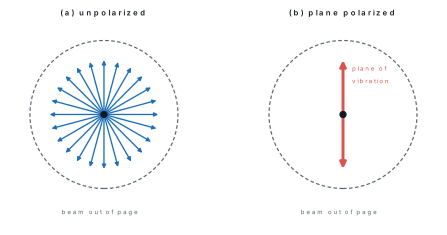
In diagrams drawn side-on, vibrations in the plane of the page are shown as short double-headed arrows (↕) and vibrations perpendicular to the page as dots (•). Unpolarized light is drawn with both, plane polarized light with only one of the two.
Ways of producing polarized light
| Method | How it works | Example |
|---|---|---|
| Reflection | at the polarizing angle the reflected light is fully plane polarized | glare from a wet road or from Phewa Lake |
| Refraction (pile of plates) | the transmitted beam becomes progressively polarized after many glass plates | pile-of-plates polarizer |
| Selective absorption (dichroism) | one component is absorbed, the other transmitted | Polaroid sheet |
| Double refraction | a calcite crystal splits the beam into two oppositely polarized rays | Nicol prism |
| Scattering | light scattered at 90^\circ from air molecules is plane polarized | the blue sky at right angles to the Sun |
Double refraction. When unpolarized light enters a calcite (Iceland spar) or quartz crystal it splits into two refracted rays: the ordinary ray, which obeys Snell's law, and the extraordinary ray, which does not. The two rays are plane polarized in mutually perpendicular planes. A Nicol prism is a calcite crystal cut and cemented with Canada balsam so that the ordinary ray is totally internally reflected away and only the plane polarized extraordinary ray emerges.
Partial polarization. In most of these processes the emerging light is a mixture. The degree of polarization is
where I_{\max} and I_{\min} are the largest and smallest intensities observed as an analyser is rotated through a full turn. P = 1 for fully plane polarized light and P = 0 for unpolarized light.
13.2 Brewster's law; transverse nature of light
When unpolarized light strikes a transparent surface, both the reflected and the refracted beams are partially polarized. In 1811 David Brewster found that at one particular angle of incidence the reflected beam is completely plane polarized, with its vibrations perpendicular to the plane of incidence. That angle is the polarizing angle or Brewster angle, \theta_p.
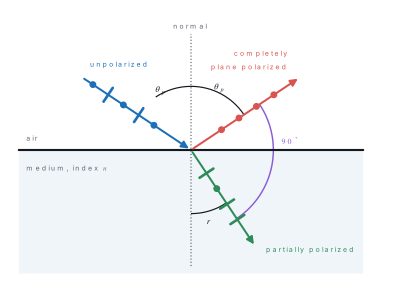
At the polarizing angle the reflected and refracted rays are found experimentally to be at right angles to each other. From the figure the three angles at O must add to a straight angle:
Apply Snell's law for light going from air into the medium:
This is Brewster's law: the tangent of the polarizing angle of a medium is equal to its refractive index.
The physical reason is neat. The refracted wave sets the electrons of the medium vibrating along its own electric vector, at right angles to the refracted ray. A vibrating charge radiates nothing along its own line of vibration. At the Brewster angle the reflected direction is exactly along that line for the component in the plane of incidence, so that component simply cannot be reflected. Only the component perpendicular to the plane of incidence survives — and the reflected light is fully plane polarized.
Because n varies slightly with wavelength (dispersion), \theta_p is not quite the same for every colour: for crown glass it is about 56.3^\circ for yellow light and a fraction of a degree larger for violet.
\theta_p = \tan^{-1}n applies when light goes from a rarer medium into a denser one, and the reflected beam is the polarized one. The critical angle C = \sin^{-1}(1/n) applies going the other way, from denser to rarer. For n = 1.5, \theta_p = 56.3^\circ but C = 41.8^\circ — different angles, different phenomena.
Transverse nature of light
Take two Polaroid sheets, P and A. Send light through P; the beam that emerges looks slightly dimmer but otherwise normal. Now rotate A about the beam as axis. The transmitted intensity rises and falls, and twice in every complete turn it drops to zero.
If light were a longitudinal wave, its vibrations would be along the direction of travel, and a rotation of A about that same axis could make no difference whatsoever — the wave has no "sideways" direction to be picky about. The fact that rotating A extinguishes the beam shows the vibrations must lie across the beam. Polarization is therefore the only optical phenomenon that establishes the transverse nature of light waves.
Problem. Find the polarizing angle for a glass of refractive index 1.5, and the corresponding angle of refraction. Verify that the reflected and refracted rays are perpendicular.
Solution. By Brewster's law,
Check with Snell's law: \dfrac{\sin 56.3^\circ}{\sin 33.7^\circ} = \dfrac{0.832}{0.555} = 1.50 — correct. The angle between the reflected ray and the refracted ray is 180^\circ - 56.3^\circ - 33.7^\circ = 90^\circ.
13.3 Polaroid
A Polaroid is a thin commercial sheet that transmits light vibrating in one direction only. Edwin Land made the first one in 1928 by embedding tiny aligned needle-shaped crystals of herapathite (quinine iodosulphate) in nitrocellulose — the J-type sheet. Modern H-Polaroid is made from a sheet of polyvinyl alcohol that is stretched so that its long molecules all lie parallel, then soaked in iodine. The iodine-doped chains conduct along their length, so they absorb the component of the electric field parallel to the chains and transmit the perpendicular component. The direction that is passed is called the transmission axis or pass axis.
When two Polaroids are used, the first is the polarizer and the second the analyser.
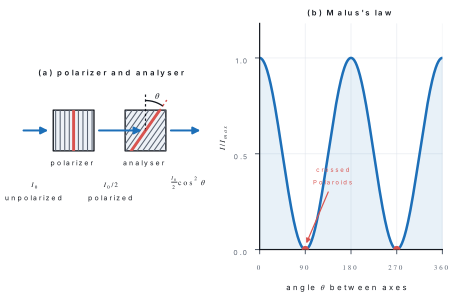
Let plane polarized light of amplitude A fall on an analyser whose transmission axis makes an angle \theta with the plane of vibration of the incoming light. Resolve A into two components:
- A\cos\theta along the transmission axis — this is transmitted;
- A\sin\theta perpendicular to it — this is absorbed.
Intensity is proportional to the square of the amplitude, so if I_0 is the intensity of the light reaching the analyser,
This is Malus's law. It gives I = I_0 for parallel axes (\theta = 0^\circ) and I = 0 for crossed axes (\theta = 90^\circ).
Malus's law applies to light that is already plane polarized. When unpolarized light of intensity I_0 falls on the first Polaroid, \theta takes every value at random and the average of \cos^2\theta is \frac{1}{2}, so the emergent intensity is I_0/2 whatever the orientation of the sheet. Only then does \cos^2\theta apply, at the second sheet.
Uses of Polaroids
- Sunglasses. Glare reflected from water or a wet road is largely horizontally polarized, so the lenses are cut with a vertical transmission axis and the glare is removed.
- Photography. A rotatable polarizing filter darkens a blue sky and kills reflections from glass and water.
- LCD screens in calculators, watches, laptops and mobile phones work by rotating polarized light between two crossed Polaroids.
- 3-D cinema, where the two eyes receive images polarized at right angles.
- Photoelastic stress analysis: a plastic model of a bridge or a machine part placed between crossed Polaroids shows coloured fringes wherever it is strained.
- Controlling light intensity smoothly in optical instruments and in laboratory work, using two Polaroids in series.
Problem. Unpolarized light of intensity I_0 falls on a polarizer. An analyser is placed behind it with its axis at 60^\circ to that of the polarizer. Find the intensity of the emergent light.
Solution. After the polarizer the light is plane polarized with intensity
By Malus's law, the analyser transmits
Problem. Three Polaroids are placed one behind the other. The first and the third are crossed. The middle one makes an angle of 30^\circ with the first. Unpolarized light of intensity I_0 enters. Find the intensity emerging from the third sheet.
Solution. After sheet 1: I_1 = I_0/2.
Sheet 2 is at 30^\circ to sheet 1:
Sheet 3 is at 90^\circ to sheet 1, hence at 90^\circ - 30^\circ = 60^\circ to sheet 2:
Note that with the middle sheet removed nothing at all would get through — adding a third Polaroid increases the transmitted light.
Problem. The polarizing angle of a certain transparent medium is 60^\circ. Find (a) its refractive index, (b) the speed of light in it, and (c) its critical angle. Take c = 3\times10^{8}\ \text{m s}^{-1}.
Solution.
(a) n = \tan 60^\circ = \sqrt{3} = 1.732.
(b) v = \dfrac{c}{n} = \dfrac{3\times10^{8}}{1.732} = 1.73\times10^{8}\ \text{m s}^{-1}.
(c) \sin C = \dfrac{1}{n} = \dfrac{1}{1.732} = 0.5774, so C = 35.3^\circ.
Chapter summary
- Unpolarized light vibrates in all directions perpendicular to the ray; plane polarized light vibrates in one plane only. The plane of polarization is perpendicular to the plane of vibration.
- Polarized light is produced by reflection, refraction through a pile of plates, selective absorption (Polaroid), double refraction (Nicol prism) and scattering.
- Degree of polarization P = (I_{\max}-I_{\min})/(I_{\max}+I_{\min}).
- Brewster's law: n = \tan\theta_p, with \theta_p + r = 90^\circ; the reflected and refracted rays are then perpendicular and the reflected beam is fully plane polarized.
- Brewster's angle (\tan^{-1}n, rarer to denser) is not the critical angle (\sin^{-1}(1/n), denser to rarer).
- Malus's law: I = I_0\cos^2\theta. Unpolarized light through the first Polaroid always gives I_0/2; crossed Polaroids give zero.
- Polarization occurs for transverse waves only, so it proves that light is a transverse wave. Sound, being longitudinal, cannot be polarized.
Practice questions
Group A — Multiple choice (1 mark each)
- Polarization of light establishes that light waves are [1]alongitudinalbtransversecstationarydmechanical
- Brewster's law is stated as [1]an = \sin\theta_pbn = \tan\theta_pcn = \cot\theta_pdn = \cos\theta_p
- At the polarizing angle, the angle between the reflected and the refracted ray is [1]a0^\circb45^\circc90^\circd180^\circ
- Unpolarized light of intensity I_0 passes through a single Polaroid. The emergent intensity is [1]aI_0bI_0/2cI_0/4dzero
- Two Polaroids are crossed. The intensity of the light coming out is [1]aI_0bI_0/2cI_0/4dzero
Answers to Group A
1. (b) — only a transverse wave has a vibration direction across the ray that can be selected.
2. (b) — n = \tan\theta_p.
3. (c) — that perpendicularity is what makes \theta_p + r = 90^\circ.
4. (b) — averaging \cos^2\theta over all directions gives \frac{1}{2}.
5. (d) — \theta = 90^\circ gives I = I_0\cos^2 90^\circ = 0.
Group B — Short answer (5 marks each)
- What is plane polarized light? How does it differ from unpolarized light? Explain how plane polarized light can be produced by reflection. [5]
- State and prove Brewster's law, and show that at the polarizing angle the reflected and refracted rays are perpendicular to each other. [5]
- State Malus's law and derive it. Unpolarized light of intensity I_0 passes through two Polaroids whose axes are at 30^\circ. Find the emergent intensity. [5]
- What is a Polaroid? Describe how it is made and state four of its uses. [5]
Answers to Group B
1. Outline: plane polarized = vibrations in one plane only; unpolarized = vibrations in all directions perpendicular to the ray. At the polarizing angle \theta_p = \tan^{-1}n the reflected beam contains only the component perpendicular to the plane of incidence, so it is fully plane polarized.
3. Derivation as in §13.3. Numerically, after the first Polaroid I_1 = I_0/2; after the second,
4. Outline: a sheet of stretched iodine-treated polyvinyl alcohol whose long aligned molecules absorb the electric vector parallel to them and transmit the perpendicular component. Uses: sunglasses, camera filters, LCD displays, 3-D glasses, photoelastic stress analysis, intensity control.
Group C — Long answer (8 marks each)
- (a) Explain the phenomenon of polarization by reflection and derive Brewster's law. [4](b) Explain how polarization proves the transverse nature of light. [2](c) The polarizing angle of a medium is 58^\circ. Calculate its refractive index and the speed of light in it. [2]
- (a) State and derive Malus's law. [4](b) Unpolarized light of intensity I_0 is passed through three Polaroids. The first and the third are crossed and the second makes an angle \theta with the first. Show that the emergent intensity is \frac{I_0}{8}\sin^{2}2\theta, and find the value of \theta for which it is maximum. [4]
Answers to Group C
1. (c) n = \tan 58^\circ = 1.60, and v = c/n = 3\times10^{8}/1.60 = 1.87\times10^{8}\ \text{m s}^{-1}.
2. (b) After the first Polaroid, I_1 = I_0/2. After the second, I_2 = \frac{I_0}{2}\cos^{2}\theta. The third is at (90^\circ - \theta) to the second, so
Using 2\sin\theta\cos\theta = \sin 2\theta,
This is maximum when \sin 2\theta = 1, i.e. \theta = 45^\circ, giving I_3 = I_0/8.
Practise more: Physics question bank