Unit 24 · Modern Physics · 6 teaching hours · 16 min read
Radioactivity and nuclear reaction
What the syllabus asks for 6
- Alpha-particles, Beta-particles, Gamma rays
- Laws of radioactive disintegration
- Half-life, mean-life and decay constant
- Geiger-Muller Tube
- Carbon dating
- Medical use of nuclear radiation and possible health hazard
Becquerel found in 1896 that uranium salts fogged a wrapped photographic plate in a locked drawer. No chemistry, no heating and no light could switch the effect on or off — it came from inside the nucleus. Radioactivity is the spontaneous breakup of an unstable nucleus, and because it is spontaneous and random it obeys a statistical law rather than a mechanical one. This unit sets out that law, the instrument that counts the decays, and the two places Nepali students meet radioactivity in ordinary life: dating old things and treating cancer.
The derivation of N = N_0e^{-\lambda t} from dN/dt = -\lambda N, the three relations T_{1/2} = 0.693/\lambda, \tau = 1/\lambda = 1.44\,T_{1/2} and A = \lambda N, the labelled GM tube, and a dating or activity numerical. Learn to spot "n half-lives" problems — they need no calculus at all.
24.1 Alpha-particles, Beta-particles, Gamma rays
A nucleus is held together by the short-range strong nuclear force against the electrostatic repulsion of its protons. Plotting the binding energy per nucleon against mass number shows where stability lies.
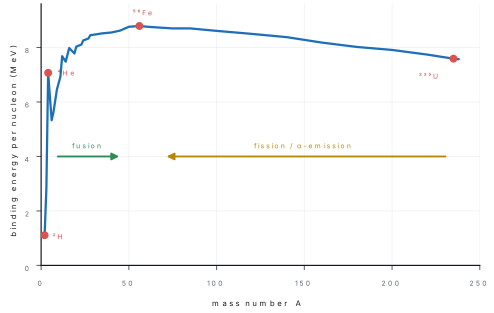
Nuclei with A > 209 have no stable form: emitting particles moves them towards the peak and releases energy. Three kinds of radiation come out.
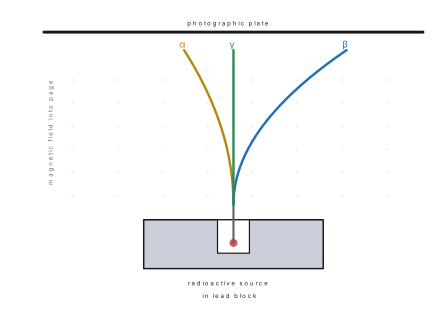
| Property | Alpha (\alpha) | Beta (\beta^-) | Gamma (\gamma) |
|---|---|---|---|
| Nature | helium nucleus, ⁴₂He | fast electron | electromagnetic photon |
| Charge | +2e | -e | 0 |
| Mass | 4u = 6.64\times10^{-27} kg | 9.1\times10^{-31} kg | 0 (rest mass) |
| Speed | \approx 0.05c | up to 0.99c | c |
| Ionizing power | very high (10⁴) | moderate (10²) | low (1) |
| Penetrating power | low (1) | moderate (100) | very high (10⁴) |
| Stopped by | a sheet of paper | 3 mm aluminium | several cm of lead |
| Deflection in field | small | large, opposite way | none |
| Effect on nucleus | A-4, Z-2 | A same, Z+1 | no change |
\alpha is the best ionizer and the worst penetrator; \gamma is the reverse. The reason is the same for both: an \alpha-particle is heavy and doubly charged, so it loses energy fast in a short distance.
The last row is the Soddy–Fajans displacement law:
²³⁸₉₂U → ²³⁴₉₀Th + ⁴₂He (alpha decay) ²³⁴₉₀Th → ²³⁴₉₁Pa + ⁰₋₁e + ν̄ (beta decay; inside the nucleus n → p + e⁻ + ν̄)
Gamma emission follows either of these: the daughter nucleus is left excited and drops to its ground state by emitting a photon, typically 0.1–3 MeV.
The nucleus contains no electrons (see the uncertainty-principle argument in Unit 23). The \beta-particle is created at the instant a neutron converts into a proton. An antineutrino is emitted with it, which is why \beta energies form a continuous spectrum while \alpha energies are sharp.
The energy released in a decay is the Q-value, Q = \Delta m \times 931.5 MeV, where \Delta m is the mass lost. A positive Q means the decay is energetically allowed.
Problem. Find the energy released when ²³⁸U decays by alpha emission. Atomic masses: ²³⁸U = 238.050788 u, ²³⁴Th = 234.043601 u, ⁴He = 4.002603 u.
Solution. Mass of products = 234.043601 + 4.002603 = 238.046204 u.
Almost all of this appears as kinetic energy of the light \alpha-particle, which is why \alpha-particles from a given nuclide all have the same energy.
24.2 Laws of radioactive disintegration
- Radioactivity is a spontaneous and random nuclear process. It is not affected by temperature, pressure, chemical combination or any other physical condition. Which particular nucleus decays next cannot be predicted.
- The rate of disintegration at any instant is directly proportional to the number of undecayed nuclei present at that instant.
Let N be the number of undecayed nuclei at time t. By the second law,
where \lambda is the decay constant, a property of the nuclide. The minus sign shows N decreases. Separating the variables,
and integrating from N = N_0 at t = 0 to N at time t:
The activity A is the number of disintegrations per second, A = -dN/dt = \lambda N. Multiplying the decay law by \lambda,
so activity — which is what a counter actually measures — falls off with the same exponential. The SI unit of activity is the becquerel (1 Bq = 1 disintegration per second); the older unit is the curie, 1\ \text{Ci} = 3.7\times10^{10} Bq.
\lambda is the probability per unit time that a given nucleus will decay. Its unit is s⁻¹. From N = N_0e^{-\lambda t}, putting t = 1/\lambda gives N = N_0/e, so \lambda is the reciprocal of the time in which the number of undecayed nuclei falls to 1/e (about 37%) of its initial value.
24.3 Half-life, mean-life and decay constant
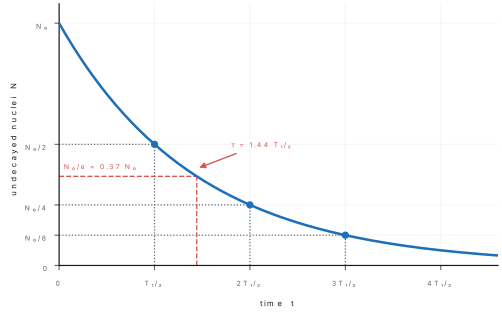
Half-life T_{1/2} is the time in which half the nuclei present decay. Putting N = N_0/2 at t = T_{1/2} in N = N_0e^{-\lambda t}:
Mean life \tau is the average lifetime of all the nuclei. The number decaying between t and t+dt is \lambda N\,dt, each having lived a time t, so
After n half-lives (n = t/T_{1/2}), the surviving fraction is
which handles most exam numericals without any logarithms.
| T_{1/2} | Nuclide | Typical use |
|---|---|---|
| 110 minutes | fluorine-18 | PET brain and cancer scans |
| 6.0 hours | technetium-99m | bone and kidney scans |
| 8.0 days | iodine-131 | thyroid diagnosis and therapy |
| 5.27 years | cobalt-60 | teletherapy, sterilizing equipment |
| 5730 years | carbon-14 | archaeological dating |
| 4.5\times10^{9} years | uranium-238 | dating rocks and the Earth |
Problem. The activity of a radioactive sample falls from 8000 counts per minute to 500 counts per minute in 24 hours. Find the half-life, the decay constant and the mean life.
Solution. \dfrac{A_0}{A} = \dfrac{8000}{500} = 16 = 2^{4}, so 4 half-lives have passed.
Problem. Calculate the activity of 1.0 g of radium-226, whose half-life is 1600 years. Take 1 year = 3.156\times10^{7} s and N_A = 6.022\times10^{23}\ \text{mol}^{-1}.
Solution. Number of nuclei in 1.0 g:
Decay constant:
This is almost exactly 3.7\times10^{10} Bq — and that is no accident: the curie was originally defined as the activity of one gram of radium.
A sample never disappears. After 2T_{1/2} one quarter remains, after 3T_{1/2} one eighth, and so on — the decay law is exponential, so the number never reaches zero. Also, T_{1/2} is fixed for a nuclide: it cannot be changed by heating, cooling or chemical reaction.
24.4 Geiger-Muller Tube
The GM tube converts a single ionizing particle into an electrical pulse big enough to count.
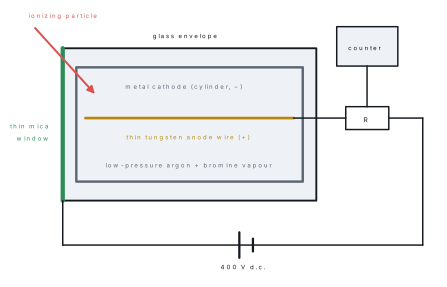
Construction. A cylindrical metal tube (the cathode) is sealed in glass with a fine tungsten wire along its axis (the anode). One end is closed by a thin mica window so that even \alpha-particles can get in. The tube is filled with argon at about 0.1 atmosphere together with a little bromine or ethyl alcohol vapour, which acts as a quenching agent. A p.d. of about 400 V is applied through a high resistance R.
Working. An ionizing particle entering the window produces a few ion pairs. The electric field near the thin wire is intense, so the freed electrons are accelerated hard enough to ionize further atoms. The result is an avalanche of about 10^{8} electrons reaching the anode within a microsecond. The current through R produces a voltage pulse, which is amplified and counted.
Quenching and dead time. The positive argon ions drift slowly to the cathode, where they would release fresh electrons and restart the discharge. The quenching vapour absorbs their energy and dissociates instead, stopping the pulse. During the roughly 200\ \mu\text{s} the ions take to clear — the dead time — the tube cannot register another particle, so true counts exceed recorded counts at high rates.
The plateau. Plotting count rate against tube voltage for a fixed source gives a flat plateau about 100 V wide. The tube is operated in the middle of the plateau, so that small supply fluctuations do not change the reading. Above the plateau a continuous discharge starts and destroys the tube.
It counts \alpha, \beta and \gamma particles, but the pulse size is the same whatever the particle's energy. So a GM tube measures how many, never how energetic — energy measurement needs a scintillation counter instead.
24.5 Carbon dating
Cosmic-ray neutrons striking nitrogen in the upper atmosphere make radioactive carbon-14:
¹⁴₇N + ¹₀n → ¹⁴₆C + ¹₁H
The ¹⁴C mixes into atmospheric CO₂, so every living plant and animal keeps a fixed ratio ¹⁴C : ¹²C of about 1.3\times10^{-12}, giving an activity of 15.3 disintegrations per minute per gram of carbon. At death, intake stops while the ¹⁴C keeps decaying back to nitrogen (T_{1/2} = 5730 years):
¹⁴₆C → ¹⁴₇N + ⁰₋₁e + ν̄
Measuring the present activity A therefore dates the specimen:
After about 10 half-lives the remaining activity is lost in the background, so the method is useful to roughly 50,000 years. It works only on once-living material — wood, charcoal, bone, cloth. Radiocarbon dating of charcoal and timber beneath the Maya Devi temple at Lumbini placed a wooden structure there in about the sixth century BCE.
Problem. A piece of wood from an old temple beam gives 9.2 disintegrations per minute per gram of carbon. Living wood gives 15.3 per minute per gram. Take T_{1/2}(^{14}\text{C}) = 5730 years. How old is the beam?
Solution.
The beam is about 4200 years old.
24.6 Medical use of nuclear radiation and possible health hazard
Diagnosis. A short-lived \gamma-emitting tracer is injected and a gamma camera images where it collects. Technetium-99m (T_{1/2} = 6 h) is used for bone, kidney and heart scans; iodine-131 concentrates in the thyroid; fluorine-18 is the tracer in PET scans. Short half-lives are chosen so that the activity dies away within a day.
Therapy. Cancer cells divide fast and are more easily killed by radiation than normal cells. A cobalt-60 teletherapy unit aims 1.17 and 1.33 MeV \gamma-rays at a tumour from several directions, so the tumour receives a large dose while surrounding tissue receives little. In brachytherapy a sealed iridium-192 seed is placed inside or beside the tumour. Iodine-131 is drunk as a solution to destroy an over-active thyroid.
Sterilization. Syringes, dressings and surgical gloves are sealed in plastic and sterilized by \gamma-rays, which kill bacteria without heating.
Health hazards. Radiation ionizes the molecules of living cells and can break DNA strands. The effects are of two kinds:
- Somatic — affecting the exposed person: radiation burns, hair loss, sterility, cataract, anaemia, leukaemia and other cancers.
- Genetic — mutations in reproductive cells that are passed to children.
| Quantity | Definition | SI unit |
|---|---|---|
| Absorbed dose D | energy absorbed per kg of tissue | gray (Gy), 1 Gy = 1 J kg⁻¹ |
| Equivalent dose H | H = D \times Q (quality factor: 1 for \beta,\gamma; 20 for \alpha) | sievert (Sv) |
| Activity A | disintegrations per second | becquerel (Bq) |
Natural background radiation in Nepal delivers roughly 2–3 mSv per year from cosmic rays, rocks and radon. Safety follows three simple rules: keep the time of exposure short, keep your distance (intensity falls as 1/r^{2}), and use shielding — lead aprons, thick concrete walls, remote handling tongs. Workers wear film badges or thermoluminescent dosimeters, and radioactive waste is sealed in lead-lined containers.
Chapter summary
- Binding energy per nucleon peaks near A \approx 56 at about 8.8 MeV; nuclei move towards the peak by fusing, splitting or emitting \alpha-particles.
- \alpha = ⁴₂He (A-4, Z-2); \beta^- = electron created when n → p (Z+1); \gamma = photon (no change). Ionizing power \alpha > \beta > \gamma; penetrating power is the reverse.
- Q = \Delta m \times 931.5 MeV is the energy released in a decay.
- Decay law: dN/dt = -\lambda N gives N = N_0e^{-\lambda t} and A = \lambda N = A_0e^{-\lambda t}. 1 Ci = 3.7\times10^{10} Bq.
- T_{1/2} = 0.693/\lambda; \tau = 1/\lambda = 1.44\,T_{1/2}; after n half-lives N/N_0 = (1/2)^n.
- A GM tube uses avalanche ionization in argon at 400 V, with a quenching vapour and a dead time of about 200\ \mus; it counts particles but not their energy.
- Carbon dating: t = (T_{1/2}/0.693)\ln(A_0/A) with A_0 = 15.3 min⁻¹ g⁻¹ and T_{1/2} = 5730 y; useful to about 50,000 years.
- Medical tracers are short-lived \gamma-emitters; therapy uses cobalt-60. Dose is measured in gray (absorbed) and sievert (equivalent).
Practice questions
Group A — Multiple choice (1 mark each)
- When a nucleus emits a \beta^- particle, its mass number and atomic number [1]aboth decreasebA unchanged, Z increases by 1cA decreases by 4, Z by 2dboth unchanged
- The decay constant of a nuclide of half-life 20 minutes is [1]a0.0347\ \text{min}^{-1}b0.693\ \text{min}^{-1}c20\ \text{min}^{-1}d28.8\ \text{min}^{-1}
- After 3 half-lives, the fraction of a radioactive sample left undecayed is [1]a1/3b1/6c1/8d1/9
- The gas commonly used in a Geiger–Müller tube is [1]ahydrogenbargoncoxygendnitrogen
- Carbon dating cannot be used to find the age of [1]aan old wooden beambcharcoal from a fireplaceca granite boulderda bone
Answers to Group A
1. (b) — a neutron becomes a proton, so Z rises by 1 and A is unchanged.
2. (a) — \lambda = 0.693/20 = 0.0347\ \text{min}^{-1}.
3. (c) — (1/2)^3 = 1/8.
4. (b) — argon, an inert gas, with a bromine or alcohol quenching vapour.
5. (c) — granite was never alive, so it never took up ¹⁴C.
Group B — Short answer (5 marks each)
- State the laws of radioactive disintegration and hence derive N = N_0e^{-\lambda t}. [5]
- Define half-life and mean life, and show that \tau = 1.44\,T_{1/2}. [5]
- Calculate the binding energy per nucleon of ⁴₂He. Take mass of ⁴He = 4.002603 u, of ¹H = 1.007825 u, of a neutron = 1.008665 u and 1\ \text{u} = 931.5\ \text{MeV}. [5]
- A radioactive sample has a half-life of 10 days. Find its decay constant in s⁻¹ and the fraction of the sample remaining after 30 days. [5]
Answers to Group B
2. Definitions as in §24.3. T_{1/2} = 0.693/\lambda and \tau = 1/\lambda, so \tau = T_{1/2}/0.693 = 1.44\,T_{1/2}.
3. ⁴He has 2 protons and 2 neutrons. Sum of separate masses = 2(1.007825) + 2(1.008665) = 2.015650 + 2.017330 = 4.032980 u. \Delta m = 4.032980 - 4.002603 = 0.030377 u. Binding energy = 0.030377 \times 931.5 = 28.30 MeV, so BE per nucleon = 28.30/4 = 7.07 MeV.
4. \lambda = 0.693/T_{1/2} = 0.693/10 = 0.0693\ \text{day}^{-1}. In SI, \lambda = 0.693/(10 \times 86400\ \text{s}) = 0.693/864000 = 8.02\times10^{-7}\ \text{s}^{-1}. After 30 days = 3 half-lives, N/N_0 = (1/2)^3 = 1/8 = 0.125, i.e. 12.5%.
Group C — Long answer (8 marks each)
- (a) Draw a labelled diagram of a Geiger–Müller tube and explain how it detects a single ionizing particle. [5](b) What is meant by quenching and dead time? Why is the tube operated on the plateau of its characteristic curve? [3]
- (a) Derive the relation between half-life and decay constant. [3](b) A radioactive source contains 1.0\times10^{20} nuclei of a nuclide whose half-life is 8 hours. Calculate the decay constant, the initial activity, and the activity after 24 hours. [5]
Answer to Group C question 2(b)
24 hours is exactly 3 half-lives, so N = N_0/8 = 1.25\times10^{19} and
(equivalently A = A_0/8).
Practise more: Physics question bank