Unit 11 · Waves and Optics · 2 teaching hours · 12 min read
Interference
What the syllabus asks for 2
- Phenomenon of Interference: Coherent sources
- Young's double slit experiment
Two torches pointed at the same wall never produce dark bands. Yet light from a single lamp, split into two and recombined, produces a ladder of bright and dark stripes. That is interference, and it was Thomas Young's demonstration of it in 1801 that finally proved light is a wave. This short unit sets out the conditions under which interference can be seen, and works through the one experiment the NEB asks about every year — Young's double slit.
A derivation of the fringe width \beta = \lambda D/d from the path difference, and numericals built on it. Get the path difference \Delta = yd/D right and every question in the unit follows from it.
11.1 Phenomenon of Interference: Coherent sources
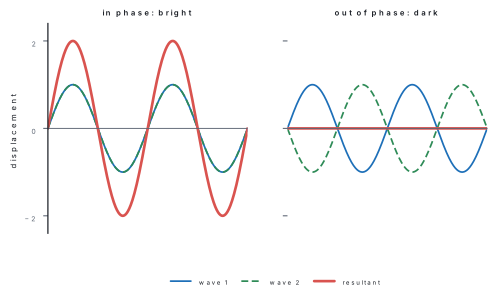
When two waves arrive at the same point, the principle of superposition says the resultant displacement is the vector sum of the individual displacements. For two waves of the same frequency and amplitudes a_1, a_2 arriving with a phase difference \phi, the resultant amplitude is
Since intensity is proportional to the square of the amplitude, I \propto A^2,
The last term is the interference term. It is positive where the waves arrive in step and negative where they arrive out of step.
Interference is the modification of intensity produced by the superposition of two or more light waves. Where the resultant intensity is a maximum the interference is constructive; where it is a minimum it is destructive.
A path difference \Delta corresponds to a phase difference
so the conditions can be written either way:
| Path difference \Delta | Phase difference \phi | Resultant | |
|---|---|---|---|
| Constructive (bright) | n\lambda | 2n\pi | A = a_1+a_2, I_{\max} = (\sqrt{I_1}+\sqrt{I_2})^2 |
| Destructive (dark) | (2n-1)\lambda/2 | (2n-1)\pi | A = |a_1-a_2|, I_{\min} = (\sqrt{I_1}-\sqrt{I_2})^2 |
with n = 0, 1, 2, \dots For two equal sources of intensity I_0 each, I_{\max} = 4I_0 and I_{\min} = 0, and the general result is
Coherent sources
The stripes only stay put if \phi at each point stays the same from one instant to the next.
Two sources are coherent if they emit light of the same frequency (and ideally the same amplitude) with a constant phase difference that does not change with time.
An ordinary lamp emits light in bursts lasting about 10^{-8}\ \text{s}, each burst starting with a random phase. Two separate lamps therefore have a phase difference that reshuffles about 10^{8} times a second — far faster than the eye or any detector can follow — so \cos\phi averages to zero and
The intensities simply add and no fringes are seen. The way round this is to derive both beams from a single source, so that whatever phase jump occurs happens in both beams together and cancels out of \phi. Two methods are used:
- Division of wavefront — two parts of the same wavefront are used: Young's double slit, Fresnel's biprism, Lloyd's mirror.
- Division of amplitude — one beam is partly reflected and partly transmitted: thin films, soap bubbles, the colours on a layer of oil on a Kathmandu street after rain, Newton's rings.
Lasers are naturally coherent over long distances, which is why a laser pointer makes the double-slit experiment easy to show in a school laboratory.
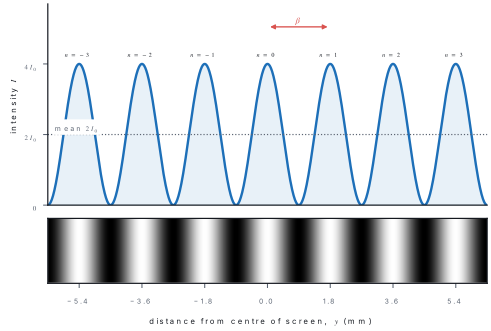
At a dark fringe the intensity is zero, but energy is not lost — it has been redistributed to the bright fringes, where the intensity is 4I_0 instead of the 2I_0 you would get without interference. Averaged over one fringe spacing, the mean of 4I_0\cos^2(\phi/2) is exactly 2I_0, so energy is conserved.
11.2 Young's double slit experiment
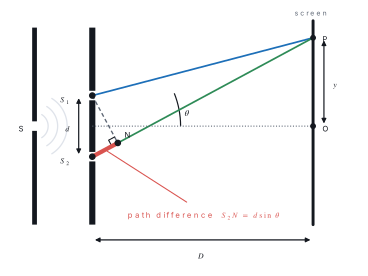
Light from a monochromatic source falls on a narrow slit S. The cylindrical wavefront spreading from S reaches two more narrow slits S_1 and S_2, placed symmetrically a small distance d apart. Because S_1 and S_2 are carved out of the same wavefront, they are coherent. They act as two line sources, and the overlapping light falls on a screen a distance D away.
Path difference
Take O as the foot of the perpendicular from the midpoint of S_1S_2 to the screen, and let P be a point at height y above O. From the right-angled triangles,
Subtracting,
In practice D is about a metre while y and d are under a millimetre, so both distances are very nearly D and S_2P + S_1P \approx 2D. Hence the path difference is
Positions of the fringes
Bright fringes need \Delta = n\lambda:
Dark fringes need \Delta = (2n-1)\lambda/2:
The fringe width \beta is the distance between two consecutive bright (or two consecutive dark) fringes:
The same subtraction on the dark-fringe formula gives the same answer, so bright and dark fringes are equally spaced and the pattern is a set of uniformly spaced, equally bright straight lines parallel to the slits. Rearranged, \lambda = \beta d/D — this is how Young measured the wavelength of light.
The intensity across the screen follows from \phi = 2\pi\Delta/\lambda:
What changes the fringes
| Change | Effect on \beta = \lambda D/d |
|---|---|
| Longer wavelength (red instead of blue) | \beta increases |
| Slits moved further apart (d up) | \beta decreases |
| Screen moved back (D up) | \beta increases |
| Whole apparatus in water, index n | \lambda \to \lambda/n, so \beta \to \beta/n |
| One slit covered | fringes vanish, uniform illumination |
| White light used | central fringe white, coloured fringes on either side, violet nearest the centre |
At O the path difference is zero for every wavelength, so all colours are bright there and the central fringe is white. Away from O, \beta \propto \lambda, so violet fringes crowd nearer the centre and red spread out further, giving a few coloured fringes before they overlap into white.
Problem. In a Young's double slit experiment the slits are 0.50\ \text{mm} apart and the screen is 1.5\ \text{m} away. Light of wavelength 600\ \text{nm} is used. Find (a) the fringe width, (b) the distance of the 3rd bright fringe from the centre, (c) the distance of the 3rd dark fringe from the centre.
Solution.
(a) \beta = \dfrac{\lambda D}{d} = \dfrac{600\times10^{-9} \times 1.5}{0.50\times10^{-3}} = 1.8\times10^{-3}\ \text{m} = 1.8\ \text{mm}.
(b) y_3 = 3\beta = 3 \times 1.8 = 5.4\ \text{mm}.
(c) The 3rd dark fringe has \Delta = (2\times3-1)\lambda/2 = 2.5\lambda, so y = 2.5\beta = 4.5\ \text{mm}.
Problem. In an interference experiment the distance between the 2nd and the 7th bright fringes on the same side of the centre is 9.0\ \text{mm}. The slit separation is 0.50\ \text{mm} and the screen is 1.5\ \text{m} away. Find the wavelength of the light used.
Solution. Between the 2nd and 7th bright fringes there are 7-2 = 5 fringe widths, so
This is orange-red light.
Problem. The apparatus of Example 11.1 is now completely immersed in water of refractive index 4/3. Find the new fringe width. What would the fringe width become if, in air, D were doubled and d halved?
Solution. Inside water the wavelength becomes \lambda_w = \lambda/n, so
With D \to 2D and d \to d/2 in air, \beta \to 4\beta = 7.2\ \text{mm}.
Problem. Two coherent sources have intensities in the ratio 4:1. Find (a) the ratio of their amplitudes, (b) the ratio I_{\max}:I_{\min}. (c) For two equal sources, what fraction of I_{\max} is the intensity at a point where the path difference is \lambda/3?
Solution.
(a) I \propto a^{2}, so a_1/a_2 = \sqrt{4/1} = 2.
(b) \dfrac{I_{\max}}{I_{\min}} = \dfrac{(a_1+a_2)^{2}}{(a_1-a_2)^{2}} = \dfrac{(2+1)^{2}}{(2-1)^{2}} = \dfrac{9}{1}.
(c) \phi = \dfrac{2\pi}{\lambda}\cdot\dfrac{\lambda}{3} = \dfrac{2\pi}{3}, so
Chapter summary
- Superposition gives I = I_1 + I_2 + 2\sqrt{I_1I_2}\cos\phi, with \phi = 2\pi\Delta/\lambda.
- Bright when \Delta = n\lambda; dark when \Delta = (2n-1)\lambda/2. For equal sources I = 4I_0\cos^2(\phi/2), with I_{\max} = 4I_0, I_{\min} = 0.
- I_{\max}:I_{\min} = (\sqrt{I_1}+\sqrt{I_2})^2 : (\sqrt{I_1}-\sqrt{I_2})^2.
- Coherent sources have the same frequency and a constant phase difference; they must be obtained from one source, by division of wavefront or of amplitude.
- In Young's experiment \Delta = yd/D, bright fringes at y_n = n\lambda D/d, dark at y_n = (2n-1)\lambda D/2d.
- Fringe width \beta = \lambda D/d; all fringes are equally spaced and equally bright. In a medium of index n, \beta shrinks to \beta/n.
- Energy is redistributed, not destroyed: the average intensity across the pattern is 2I_0, exactly what the two beams carry.
Practice questions
Group A — Multiple choice (1 mark each)
- Two sources are coherent if they have the same frequency and [1]aa constant phase differencebzero phase differencecthe same amplitude onlydthe same intensity only
- In Young's double slit experiment the fringe width is [1]a\lambda d/Db\lambda D/dcDd/\lambdad\lambda/Dd
- At a point where the path difference is \lambda/2, the intensity due to two equal coherent sources of intensity I_0 each is [1]a4I_0b2I_0cI_0dzero
- If the whole double-slit apparatus is immersed in water, the fringe width [1]aincreasesbdecreasescis unchangeddbecomes zero
- In white-light interference, the central fringe is [1]avioletbredcwhiteddark
Answers to Group A
1. (a) — the phase difference must be constant in time; it need not be zero.
2. (b) — \beta = \lambda D/d.
3. (d) — \Delta = \lambda/2 gives \phi = \pi and I = 4I_0\cos^2(\pi/2) = 0.
4. (b) — the wavelength shrinks to \lambda/n, so \beta shrinks to \beta/n.
5. (c) — zero path difference at the centre for every wavelength, so all colours are bright.
Group B — Short answer (5 marks each)
- What are coherent sources? Explain why two independent bulbs of the same colour cannot produce a steady interference pattern. [5]
- Derive an expression for the fringe width in Young's double slit experiment. [5]
- In a double slit experiment d = 0.28\ \text{mm}, D = 1.4\ \text{m} and \lambda = 600\ \text{nm}. Find the fringe width and the distance of the 4th dark fringe from the central bright fringe. [5]
- Show that interference of light does not violate the principle of conservation of energy. [5]
Answers to Group B
1. Outline: coherent = same frequency, constant phase difference. An ordinary source emits wave trains of about 10^{-8}\ \text{s} with random phase, so the phase difference between two independent lamps changes about 10^{8} times per second; \cos\phi averages to zero, giving I = I_1+I_2 and no fringes.
3. \beta = \dfrac{\lambda D}{d} = \dfrac{600\times10^{-9}\times1.4}{0.28\times10^{-3}} = 3.0\times10^{-3}\ \text{m} = 3.0\ \text{mm}. The 4th dark fringe is at y = \dfrac{(2\times4-1)\lambda D}{2d} = 3.5\beta = 10.5\ \text{mm}.
4. Outline: I = 4I_0\cos^2(\phi/2); the average of \cos^2 over a fringe is \frac{1}{2}, so the mean intensity is 2I_0 — exactly the sum of the two beams. The energy missing from the dark fringes reappears in the bright ones.
Group C — Long answer (8 marks each)
- (a) Describe Young's double slit experiment with a labelled diagram. [3](b) Derive expressions for the positions of the bright and dark fringes and hence for the fringe width. State two ways in which the fringe width can be increased. [5]
- In a Young's double slit experiment, light of wavelength 589\ \text{nm} falls on two slits 1.0\ \text{mm} apart and the fringes are observed on a screen 1.0\ \text{m} away. Find(a) the fringe width,(b) the distance between the 3rd bright fringe on one side and the 3rd dark fringe on the other side of the centre, and(c) the new fringe width if the source is changed to one of wavelength 442\ \text{nm}. [8]
Answer to Group C question 2
(a) \beta = \dfrac{\lambda D}{d} = \dfrac{589\times10^{-9}\times1.0}{1.0\times10^{-3}} = 5.89\times10^{-4}\ \text{m} = 0.589\ \text{mm}.
(b) 3rd bright fringe: y_1 = 3\beta = 1.767\ \text{mm} on one side. 3rd dark fringe: y_2 = 2.5\beta = 1.4725\ \text{mm} on the other side. Since they are on opposite sides, the separation is 1.767 + 1.4725 = 3.24\ \text{mm}.
(c) \beta' = \dfrac{442\times10^{-9}\times1.0}{1.0\times10^{-3}} = 0.442\ \text{mm} — blue light gives narrower fringes.
Practise more: Physics question bank