Unit 25 · Modern Physics · 6 teaching hours · 15 min read
Recent trends in physics
What the syllabus asks for 2
- Seismology: Surface waves (Rayleigh and Love waves); Internal waves (S and P-waves); Wave patterns of Gorkha Earthquake 2015
- Gravitational Wave; Nanotechnology; Higgs Boson
The last unit looks outward. Gravitational waves, nanotechnology and the Higgs boson are results of the past two decades; seismology is the physics of the ground under Nepal. The mathematics is light — what is examined is whether you can explain the physics clearly and quote the key numbers.
Descriptive answers with correct detail: the four wave types and their order of arrival, the facts of the Gorkha earthquake, what LIGO measured in 2015, what "nanoscale" means, and what the Higgs field does. Numbers earn marks: M_w 7.8, strain 10^{-21}, 1–100 nm, 125 GeV.
25.1 Seismology: Surface waves (Rayleigh and Love waves); Internal waves (S and P-waves); Wave patterns of Gorkha Earthquake 2015
Seismology is the study of elastic waves travelling through the Earth. Nepal sits where the Indian plate pushes north under Eurasia at about 20 mm per year along the Main Himalayan Thrust; strain stored on that locked fault for centuries is released in minutes as an earthquake. The point of rupture inside the Earth is the focus; the point on the surface above it is the epicentre.
Body waves: P and S
Waves travelling through the interior are body waves (internal waves).
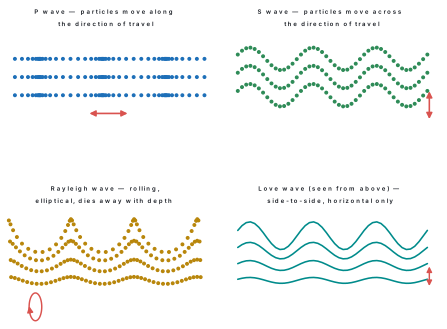
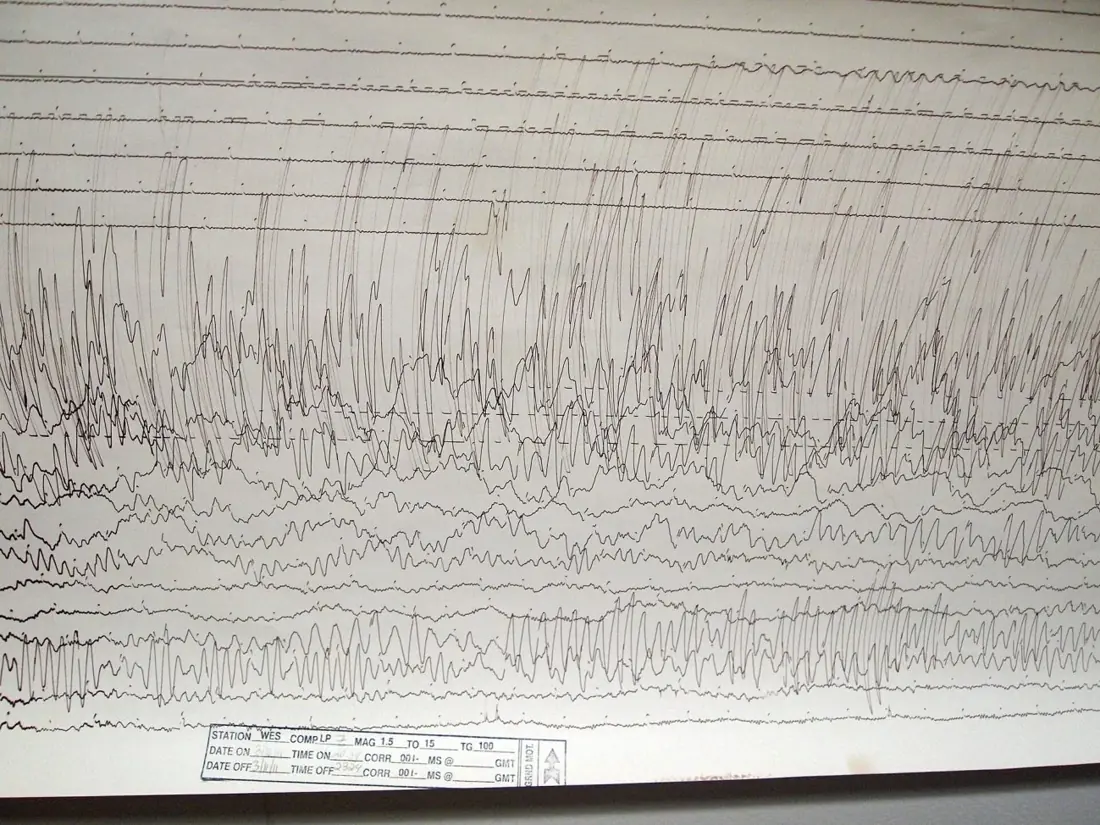
P-waves (primary, longitudinal). The ground is alternately compressed and stretched along the direction of travel, like sound in air. At about 6 km s⁻¹ in the crust they are the fastest waves and arrive first. A compression needs only a change of volume, so P-waves pass through solids and liquids alike.
S-waves (secondary, transverse). Particles move at right angles to the direction of travel, shearing the rock sideways, at about 3.5 km s⁻¹. A liquid has no rigidity, so S-waves cannot pass through liquids — the S-wave shadow zone beyond 103^{\circ} from an epicentre is the direct evidence that the outer core is molten.
Surface waves: Rayleigh and Love
Surface waves are guided along the boundary between ground and air. They are slower than body waves, so they arrive last, but they carry the largest amplitude and do most of the damage, and they die away exponentially with depth.
| Wave | Type | Particle motion | Typical speed | Note |
|---|---|---|---|---|
| P | body, longitudinal | along the ray | 6 km s⁻¹ | passes through liquids |
| S | body, transverse | perpendicular to the ray | 3.5 km s⁻¹ | blocked by liquids |
| Love | surface, transverse | horizontal, across the ray | 3 km s⁻¹ | needs a slow surface layer |
| Rayleigh | surface | retrograde vertical ellipse | 2.7 km s⁻¹ | "ground roll"; largest |
P before S before Love before Rayleigh — "Please Start Leaving Rightaway".
Because P and S travel at different speeds, the gap between their arrival times measures the distance to the epicentre:
Three stations give three circles on a map, and the epicentre is where they meet.
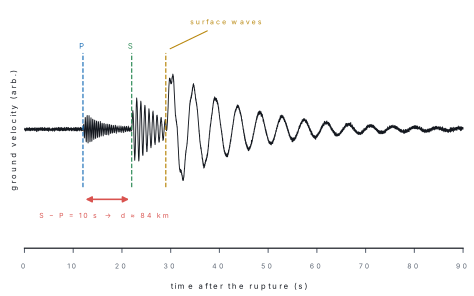
Problem. A Kathmandu station records the first P-wave at 11:56:22 and the first S-wave at 11:56:32. Taking v_P = 6.0\ \text{km s}^{-1} and v_S = 3.5\ \text{km s}^{-1}, find the distance to the epicentre.
Solution. \Delta t = 10\ \text{s}.
Barpak, the 2015 epicentre, is about 80 km from Kathmandu.
Wave patterns of the Gorkha Earthquake 2015
| Quantity | Value |
|---|---|
| Date and time | 25 April 2015, 11:56 NST (06:11 UTC) |
| Moment magnitude | M_w 7.8 (Nepal's National Seismological Centre: M_L 7.6) |
| Epicentre | Barpak, Gorkha district (28.2° N, 84.7° E), ~80 km WNW of Kathmandu |
| Focal depth | about 15 km — shallow |
| Fault | Main Himalayan Thrust, dipping a few degrees |
| Rupture | ~140 km eastwards at ~3.3 km s⁻¹, maximum slip ~6 m |
| Largest aftershock | M_w 7.3, 12 May 2015, near Dolakha |
| Casualties | about 8,970 killed, 22,300 injured |
Three features of the recorded waves explain the damage.
- Little high-frequency energy. The fault slipped smoothly rather than jerkily, so peak ground acceleration in Kathmandu was only about 0.16g — far less than expected for M_w 7.8. Many ordinary houses therefore survived.
- Strong long-period shaking. The soft lake sediments filling the Kathmandu valley resonated at a period of 4–5 s, amplifying the surface waves and keeping the ground moving for tens of seconds. Tall flexible buildings, whose natural period is near 4–5 s, were shaken hardest; short stiff ones were not.
- Eastward directivity. The rupture ran east, so the waves piled up in that direction. Sindhupalchok, east of the epicentre, lost the most lives.
Magnitude (M_w) is one number for the whole earthquake, fixed by the energy released at the source. Intensity (Modified Mercalli, I–XII) describes the shaking at one place and differs from village to village with distance and soil. One earthquake has one magnitude but many intensities; an increase of 1 in M_w means about 32 times more energy.
25.2 Gravitational Wave; Nanotechnology; Higgs Boson
Gravitational waves
Einstein's general theory of relativity (1915) describes gravity not as a force but as curvature of spacetime. When a massive body accelerates non-symmetrically, that curvature ripples outwards at the speed of light: these ripples are gravitational waves.
A passing wave stretches space in one direction while squeezing it in the perpendicular direction. The quantity measured is the strain
and even for the strongest sources reaching Earth h \approx 10^{-21} — which is why detection took a century.
LIGO. Each detector is a giant Michelson interferometer with two evacuated arms 4 km long at right angles. A laser beam is split between the arms, reflected and recombined; a passing wave lengthens one arm and shortens the other, shifting the interference fringes. Two detectors 3,000 km apart (Hanford and Livingston, USA) must see the same signal within milliseconds, which rules out local disturbances.
Problem. A wave of strain h = 1.0\times10^{-21} passes through a LIGO arm of length L = 4.0 km. Find the change in the arm's length and compare it with a proton radius, 0.84\times10^{-15} m.
Solution.
LIGO measures a length change about one two-hundredth of a proton radius — hence the multi-stage pendulums and ultra-high vacuum.
GW150914 — the first detection. On 14 September 2015 both LIGO detectors recorded a 0.2 s signal whose frequency swept up from 35 Hz to 250 Hz — a "chirp". Its source was two black holes of about 36 and 29 solar masses spiralling together 1.3 billion light-years away. They merged into one black hole of 62 solar masses, the missing 3 solar masses being radiated as gravitational waves; the peak strain was 1.0\times10^{-21}. The result was announced on 11 February 2016 and won the 2017 Nobel Prize in Physics for Weiss, Barish and Thorne.
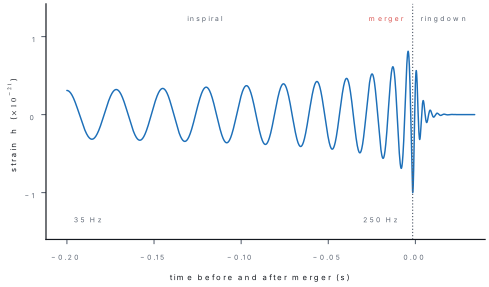
Gravitational-wave astronomy is now routine. GW170817 (2017), two merging neutron stars, was also seen by optical and gamma-ray telescopes — the start of "multi-messenger" astronomy. LIGO's fourth observing run ended in November 2025, and the catalogues now hold several hundred confirmed mergers.
They are ripples in spacetime itself, not oscillating electric and magnetic fields. Nothing can shield you from them, and they come only from accelerating mass distributions that are not spherically symmetric — a perfectly spherical collapsing star radiates none.
Nanotechnology
Nanotechnology is the design and use of structures with at least one dimension in the range 1 to 100 nanometres (1\ \text{nm} = 10^{-9} m), where the properties of matter differ from those of the bulk material.
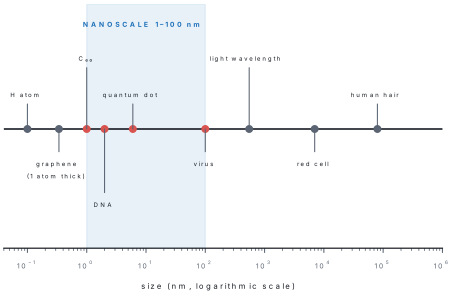
Why the nanoscale is different. Two effects take over.
- Surface dominates. For a cube of side L the surface-to-volume ratio is 6/L, so shrinking a 1 cm grain to a 10 nm grain multiplies it by a million and almost every atom sits on the surface. Nanoparticles are therefore superb catalysts and absorbers.
- Quantum confinement. In a particle only a few nanometres across the electron's de Broglie wave is squeezed and its energy levels spread apart (Unit 23), so the band gap — and hence the colour — depends on size. Semiconductor "quantum dots" of one material glow red at 6 nm and blue at 2 nm.
| Nanomaterial | Structure | Property and use |
|---|---|---|
| Fullerene C₆₀ (1985) | hollow ball of 60 carbon atoms, ~1 nm | drug carriers, lubricants |
| Carbon nanotube (1991) | rolled graphene cylinder, 1–2 nm | ~100× the tensile strength of steel |
| Graphene (2004) | one carbon layer, 0.34 nm thick | strongest known material; Nobel Prize 2010 |
| Quantum dot | semiconductor crystal 2–10 nm | size-tunable colour; QLED screens |
| TiO₂ / ZnO nanoparticle | oxide crystal ~30 nm | absorbs UV, looks clear — sunscreen |
Uses already in the field include targeted drug delivery, nanofiltration membranes that strip arsenic and iron from tube-well water, water-repellent coatings, chemical sensors and the transistors in every phone. The guiding idea goes back to Feynman's 1959 lecture There's Plenty of Room at the Bottom.
Higgs boson
The Standard Model lists the fundamental particles: six quarks, six leptons and the force-carrying bosons (photon, gluon, W, Z). Its equations, however, stay consistent only if all of them are massless, which they plainly are not.
The way out, proposed in 1964 by Peter Higgs and independently by Englert and Brout and by others, is the Higgs field, which fills all of space with a non-zero value. Particles moving through it are dragged, and that resistance is what we measure as mass: the top quark and the W and Z bosons couple strongly and are heavy, while the photon does not couple at all and stays massless.
The quantum of the Higgs field is the Higgs boson, and finding it was the last great test of the Standard Model.
| Fact | Value |
|---|---|
| Announced | 4 July 2012, CERN, by ATLAS and CMS |
| Machine | Large Hadron Collider — 27 km proton ring, 13 TeV |
| Mass | about 125 GeV/c^{2} (~133 proton masses) |
| Spin | 0 — the only known fundamental scalar |
| Lifetime | ~1.6\times10^{-22} s; seen only via its decay products |
| Nobel Prize | Physics 2013, Higgs and Englert |
Problem. The Higgs boson has a rest energy of 125 GeV. Find its mass in kg and in proton masses (1\ \text{eV} = 1.6\times10^{-19} J, m_p = 1.67\times10^{-27} kg).
Solution.
One Higgs boson weighs as much as 133 protons — about a caesium atom.
"The Higgs field gives mass to the elementary particles; the Higgs boson is a ripple in that field, and detecting it in 2012 confirmed the mechanism." It does not explain everyday mass — over 98% of an atom's mass is the binding energy of the quarks inside its nucleons.
Chapter summary
- Body waves: P (longitudinal, ~6 km s⁻¹, passes through liquids) and S (transverse, ~3.5 km s⁻¹, blocked by liquids). Surface waves: Love (horizontal transverse) and Rayleigh (rolling ellipse, largest amplitude). Arrival order P, S, Love, Rayleigh.
- Epicentral distance from the S–P interval: d = \Delta t\,v_Pv_S/(v_P - v_S); three stations fix the epicentre.
- Gorkha: 25 April 2015, M_w 7.8, focus ~15 km deep near Barpak, rupture ~140 km eastwards on the Main Himalayan Thrust; PGA in Kathmandu only ~0.16g but strong 4–5 s basin resonance; about 8,970 deaths.
- Gravitational waves are ripples of spacetime travelling at c, of strain h = \Delta L/L \approx 10^{-21}. LIGO's 4 km interferometers detected GW150914 on 14 September 2015 (36 + 29 → 62 solar masses, 3 radiated).
- Nanotechnology works between 1 and 100 nm, where surface-to-volume ratio (6/L) and quantum confinement change behaviour: fullerenes, nanotubes, graphene, quantum dots.
- The Higgs field gives elementary particles their mass; its quantum, the Higgs boson (\approx 125 GeV/c^2, spin 0), was found at the LHC on 4 July 2012.
Practice questions
Group A — Multiple choice (1 mark each)
- Which seismic wave cannot travel through a liquid? [1]aP-wavebS-wavecbothdneither
- The wave that usually does most damage to buildings is the [1]aP-wavebS-wavecRayleigh wavedsound wave
- The strain at LIGO from the first detected gravitational wave was about [1]a10^{-9}b10^{-15}c10^{-21}d10^{-31}
- A structure is said to be nanoscale if one of its dimensions lies between [1]a1 and 100 pmb1 and 100 nmc1 and 100 μmd1 and 100 mm
- The Higgs boson was discovered in 2012 at [1]aLIGObFermilabcCERNdthe ISS
Answers to Group A
1. (b) — a liquid has no rigidity, so it cannot carry a shear wave.
2. (c) — surface waves have the largest amplitude and longest period.
3. (c) — h \approx 1.0\times10^{-21} for GW150914.
4. (b) — 1 nm = 10^{-9} m.
5. (c) — by ATLAS and CMS on CERN's Large Hadron Collider.
Group B — Short answer (5 marks each)
- Distinguish between body waves and surface waves. Explain why P-waves arrive before S-waves, and why S-waves prove the outer core is liquid. [5]
- A station notes an S–P interval of 25 s. Taking v_P = 6.0\ \text{km s}^{-1} and v_S = 3.5\ \text{km s}^{-1}, find the distance to the epicentre, and explain why three stations are needed. [5]
- What is a gravitational wave? Describe how LIGO detects one, and state two results from the 2015 detection. [5]
- Define nanotechnology. Give two reasons why materials behave differently at the nanoscale, with an example of each. [5]
Answers to Group B
1. Body waves (P, S) travel through the interior; surface waves (Love, Rayleigh) run along the surface and decay with depth. P-waves are longitudinal and depend on the bulk modulus, which exceeds the shear modulus, so v_P > v_S and P arrives first. S-waves need rigidity, and they vanish beyond 103^{\circ} from the epicentre — the outer core must be liquid.
2. d = \Delta t\,\dfrac{v_Pv_S}{v_P - v_S} = 25 \times \dfrac{6.0 \times 3.5}{2.5} = 25 \times 8.4 = 210\ \text{km}. One station gives only a circle of possible epicentres; two circles meet at two points; a third picks out the correct one.
3. A ripple in the curvature of spacetime travelling at c, produced by accelerating masses. LIGO uses a Michelson interferometer with 4 km arms: the wave stretches one arm and squeezes the other, shifting the fringes. GW150914 showed (i) that black-hole binaries exist and merge, and (ii) that the waves travel at the speed of light, as relativity predicts.
4. Definition as in §25.2. (i) The surface-to-volume ratio 6/L becomes huge, so nanoparticles are highly reactive — platinum in catalytic converters. (ii) Quantum confinement spaces out the energy levels, so the band gap depends on size — quantum dots change colour with diameter.
Group C — Long answer (8 marks each)
- (a) Describe the four types of seismic wave, sketching the particle motion in each. [4](b) Give an account of the wave pattern of the Gorkha Earthquake of 2015, and explain why damage in Kathmandu fell mainly on tall buildings. [4]
- (a) What is the Higgs field, and what problem does it solve? [4](b) The Higgs boson's rest energy is 125 GeV. Find its mass in kg, and the minimum uncertainty in that energy if it lives only 1.6\times10^{-22} s (h = 6.63\times10^{-34} J s). [4]
Answer to Group C question 2(b)
E = 125\times10^{9}\times1.6\times10^{-19} = 2.0\times10^{-8} J, so m = E/c^{2} = 2.0\times10^{-8}/9.0\times10^{16} = 2.22\times10^{-25} kg. From \Delta E\,\Delta t \ge h/4\pi,
In electronvolts, \Delta E = 3.30\times10^{-13}/1.6\times10^{-19} \approx 2 MeV — the measured "width" of the Higgs peak. The shorter the lifetime, the broader the peak.
Practise more: Physics question bank