Unit 5 · Heat and Thermodynamics · 6 teaching hours · 18 min read
Second Law of Thermodynamics
What the syllabus asks for 6
- Thermodynamic systems and direction of thermodynamic processes
- Second law of thermodynamics
- Heat engines
- Internal combustion engines: Otto cycle, Diesel cycle, Carnot cycle
- Refrigerator
- Entropy and disorder (introduction only)
The first law says energy is conserved, but not which way things go. It would be perfectly happy if the water in a glass froze while the glass grew hot, or if a stone cooled slightly and leapt into the air. Nature refuses. The second law fixes the direction of every real process, and from it follow the limits on every engine and every refrigerator ever built.
The two statements of the second law (Kelvin–Planck and Clausius), the heat engine formula \eta = 1 - Q_2/Q_1, the Carnot cycle with its derivation of \eta = 1 - T_2/T_1, and the coefficient of performance of a refrigerator. Numerical questions almost always reduce to those four results.
5.1 Thermodynamic systems and direction of thermodynamic processes
Every process you have watched runs one way only. Heat flows from hot tea to the cold cup, never back. A gas released from a cylinder fills the room and never gathers itself up again. A dropped ball bounces lower each time, but a warm floor never cools slightly and launches a ball upwards. Each reverse process would conserve energy perfectly, so the first law does not forbid it. Something else does.
A reversible process is one that can be made to retrace its path exactly, so that both the system and its surroundings return to their initial states, leaving no trace anywhere. Any process that cannot is irreversible.
A process is reversible only if it is quasi-static (carried out infinitely slowly through a succession of equilibrium states) and free of all dissipative effects — friction, viscosity, electrical resistance, or heat flow across a finite temperature difference.
| Reversible (idealised) | Irreversible (real) |
|---|---|
| infinitely slow, always in equilibrium | finite rate, passes through non-equilibrium states |
| no friction, viscosity or turbulence | dissipative forces always present |
| Carnot cycle | free expansion; burning fuel; rubbing hands |
No real process is reversible. Reversibility is a limiting ideal, useful because it fixes the best performance any real machine could approach.
5.2 Second law of thermodynamics
There are two classical statements. They look quite different but each can be shown to imply the other.
It is impossible to construct a device that, operating in a cycle, produces no effect other than the extraction of heat from a single reservoir and the performance of an equivalent amount of work.
It is impossible for any self-acting device, operating in a cycle, to transfer heat from a colder body to a hotter body without any external work being done on it.
In plain terms: Kelvin–Planck forbids a 100 % efficient engine, Clausius forbids a refrigerator that needs no power supply. The two are equivalent. Suppose a device violated Clausius and moved Q_2 from sink to source for free. Couple it to an ordinary engine that takes Q_1 from the source and rejects exactly Q_2. The sink then gains and loses Q_2 each cycle, so it can be removed altogether, leaving an engine that draws Q_1 - Q_2 from one reservoir and converts it entirely into work — a violation of Kelvin–Planck.
In an isothermal expansion of an ideal gas, \Delta U = 0, so Q = W: all the heat does become work. The second law is not violated because the gas has been left in an expanded state — the conversion was not the sole effect, and the process cannot be repeated in a cycle. The word "cycle" in both statements is doing real work; never drop it.
5.3 Heat engines
A heat engine is a device that converts heat into mechanical work continuously, by taking a working substance repeatedly around a cycle: it absorbs heat Q_1 from a source (hot reservoir) at T_1, converts part of it into work W, and rejects the rest Q_2 to a sink (cold reservoir) at T_2.
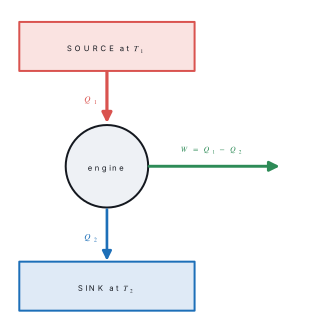
Because the working substance returns to its initial state every cycle, \Delta U = 0, and the first law gives
The thermal efficiency is the fraction of the heat paid for that comes out as useful work:
Efficiency equals 1 only if Q_2 = 0, exactly what Kelvin–Planck forbids. Every heat engine must have a sink, so \eta is always below 100 %.
Engines are classified by where the fuel burns: outside the working cylinder in an external combustion engine (steam turbine), inside it in an internal combustion engine (petrol, diesel), where the burning mixture is itself the working substance.
Problem. A heat engine absorbs 2000\ \text{J} of heat per cycle from a source at 500\ \text{K} and rejects 1400\ \text{J} to a sink at 300\ \text{K}. Find the work done per cycle and the efficiency. Is such an engine possible?
Solution. Per cycle, W = Q_1 - Q_2 = 2000 - 1400 = 600\ \text{J}, so
The best possible efficiency between these temperatures is that of a Carnot engine,
Since 30\ \% < 40\ \%, the engine does not violate the second law and is possible (though not reversible).
5.4 Internal combustion engines: Otto cycle, Diesel cycle, Carnot cycle
The Otto cycle — the ideal petrol engine
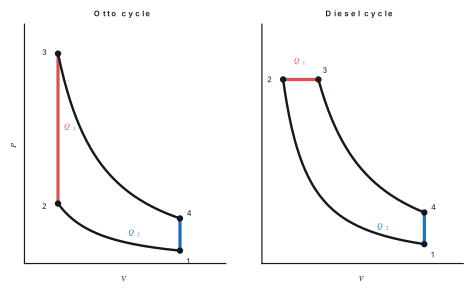
The four-stroke petrol engine is modelled by the Otto cycle — two adiabatics and two isochorics.
| Step | Process | What happens |
|---|---|---|
| 1 → 2 | adiabatic compression | piston compresses the fuel–air mixture; T rises |
| 2 → 3 | isochoric heat input Q_1 | spark plug fires; pressure jumps at constant volume |
| 3 → 4 | adiabatic expansion | the power stroke; the gas drives the piston out |
| 4 → 1 | isochoric heat rejection Q_2 | exhaust valve opens; pressure drops |
With the compression ratio r = V_1/V_2, and Q = nC_v\Delta T on both isochoric steps, the ideal efficiency is
It depends only on r and \gamma, not on how much fuel is burnt. Petrol engines are limited to r \approx 8–10: above that the mixture ignites on its own before the spark (knocking).
The Diesel cycle
A diesel engine compresses air alone, so there is no knocking limit and r can be 15–22. The compressed air becomes hot enough (Worked example 4.4) to ignite fuel sprayed in at the top of the stroke, so heat is added at roughly constant pressure:
where \rho = V_3/V_2 is the cut-off ratio. For the same r the diesel cycle is slightly less efficient than the Otto cycle, but because r can be made much larger the real diesel engine wins comfortably.
The Carnot cycle
Sadi Carnot asked the deepest question: what is the greatest efficiency any engine working between two given temperatures can have? His answer is an imaginary, perfectly reversible engine running the cycle below.
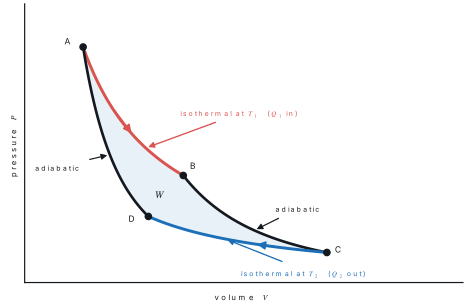
Take n moles of an ideal gas round the cycle.
A → B, isothermal expansion at T_1. \Delta U = 0, so the heat absorbed is
C → D, isothermal compression at T_2. Similarly the heat rejected is
The two adiabatics. Using TV^{\gamma-1} = constant on B → C and on D → A,
Dividing one by the other,
Result. The two logarithms are therefore equal and cancel:
Notice that the result contains no property of the working substance — air, steam or helium give the same answer — and that it reaches 1 only if T_2 = 0\ \text{K}, which is unattainable.
(a) No engine working between two given temperatures can be more efficient than a reversible engine working between the same two temperatures. (b) All reversible engines working between the same two temperatures have the same efficiency, whatever the working substance.
Problem. A Carnot engine operates between a source at 227\ ^{\circ}\text{C} and a sink at 27\ ^{\circ}\text{C}, absorbing 6000\ \text{J} per cycle. Find its efficiency, the work done and the heat rejected.
Solution. Convert to kelvin: T_1 = 227 + 273 = 500\ \text{K}, T_2 = 27 + 273 = 300\ \text{K}.
Check: Q_2/Q_1 = 3600/6000 = 0.60 = T_2/T_1. Consistent.
Problem. A petrol engine working on the Otto cycle has a compression ratio of 8. Taking \gamma = 1.40, find its ideal efficiency. What would it become if the compression ratio were raised to 10? (8^{0.4} = 2.297, 10^{0.4} = 2.512.)
Solution.
For r = 10,
Real petrol engines reach only 25–30\ \%, because of friction, heat loss and incomplete combustion.
5.5 Refrigerator
A refrigerator is a heat engine run backwards. A compressor supplies work W; the machine extracts heat Q_2 from the cold interior and dumps Q_1 = Q_2 + W into the kitchen through the coils at the back. The Clausius statement is exactly the assertion that W cannot be zero.
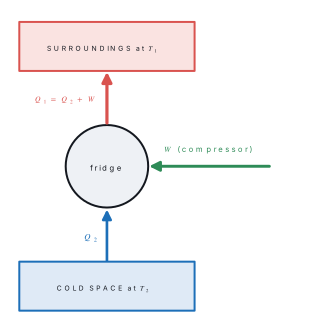
The useful output is the heat removed from the cold space and the cost is the work supplied, so the performance figure is
called the coefficient of performance (COP). It is not an efficiency, because it is usually greater than 1: a good refrigerator moves four or five joules of heat per joule of electrical work. For a reversible (Carnot) refrigerator Q_2/Q_1 = T_2/T_1, so
Comparing with the engine formula gives \beta = (1-\eta)/\eta. Note that \beta falls as the temperature difference grows: a deep freezer costs far more to run than a chiller.
In a domestic refrigerator the working substance is a volatile refrigerant. The compressor compresses its vapour, which condenses in the condenser coils at the back, giving out Q_1 to the kitchen; the liquid then passes through a throttle valve, where it expands and cools sharply, and evaporates in the evaporator coils inside the cabinet, absorbing Q_2 from the food. A heat pump is the same machine used for its hot end, with COP = Q_1/W.
Problem. A refrigerator maintains its freezer at -13\ ^{\circ}\text{C} in a kitchen at 27\ ^{\circ}\text{C}. Assuming ideal (reversible) operation, find its coefficient of performance, the work needed to remove 1300\ \text{J} of heat, and the heat delivered to the kitchen.
Solution. T_2 = -13 + 273 = 260\ \text{K}, T_1 = 27 + 273 = 300\ \text{K}.
So leaving the fridge door open warms the room by 200\ \text{J} for every 1300\ \text{J} moved, rather than cooling it.
5.6 Entropy and disorder (introduction only)
Clausius found a state function that turns the second law into an equation rather than a prohibition. For a reversible transfer of heat dQ at absolute temperature T, the change in entropy is
Its SI unit is J K⁻¹. Entropy is a state function: round any cycle it returns to its starting value. Check this on the Carnot cycle — the gas gains Q_1/T_1 and loses Q_2/T_2, and these are equal since Q_2/Q_1 = T_2/T_1.
For a change at constant temperature (melting, boiling) the integral is trivial:
In any process, the total entropy of the system together with its surroundings never decreases:
The equality holds only for a reversible process. Every real process increases the entropy of the universe.
Entropy measures disorder — more exactly, the number of microscopic arrangements of the molecules that look the same from outside. Ice has its molecules locked in a lattice (low entropy), water has them tumbling freely (higher), steam higher still. Heat flowing from hot to cold raises the total entropy, which is why it happens; the reverse would lower it, which is why it does not.
Problem. One kilogram of ice at 0\ ^{\circ}\text{C} melts completely into water at 0\ ^{\circ}\text{C}. Find the change in entropy of the ice. Take the latent heat of fusion as 3.34\times10^{5}\ \text{J kg}^{-1}.
Solution. Melting happens at a constant temperature of T = 0 + 273 = 273\ \text{K}, and the heat absorbed is
The entropy increases, as it must: liquid water is more disordered than ice.
Chapter summary
- Real processes run one way only. A reversible process is quasi-static and free of all dissipative effects; no real process is reversible.
- Kelvin–Planck: no cyclic device can convert heat from a single reservoir entirely into work. Clausius: no self-acting cyclic device can move heat from a colder to a hotter body. The two statements are equivalent.
- Heat engine: W = Q_1 - Q_2 and \eta = W/Q_1 = 1 - Q_2/Q_1. A sink is compulsory, so \eta < 1 always.
- Otto cycle (petrol): two adiabatics and two isochorics, \eta = 1 - r^{-(\gamma-1)}. Diesel cycle: heat added isobarically, allowing a much larger r.
- Carnot cycle: two isothermals and two adiabatics, all reversible, with \eta = 1 - T_2/T_1 — the maximum possible for the given temperatures, and independent of the working substance (Carnot's theorem).
- Refrigerator: Q_1 = Q_2 + W, \beta = Q_2/W = Q_2/(Q_1-Q_2), and for the ideal case \beta_{\max} = T_2/(T_1-T_2) = (1-\eta)/\eta.
- Entropy dS = dQ_{\text{rev}}/T is a state function measured in J K⁻¹, and for an isothermal change \Delta S = Q/T. The second law states \Delta S_{\text{universe}} \ge 0; entropy is a measure of disorder.
Practice questions
Group A — Multiple choice (1 mark each)
- The efficiency of a Carnot engine working between 27\ ^{\circ}\text{C} and 327\ ^{\circ}\text{C} is [1]a50 %b25 %c75 %d92 %
- The Clausius statement of the second law forbids [1]aan engine of 100 % efficiencyba self-acting device that moves heat from a cold body to a hot bodycthe conversion of work into heatdadiabatic expansion
- In the ideal Otto cycle, heat is supplied at constant [1]apressurebvolumectemperaturedentropy
- The maximum coefficient of performance of a refrigerator working between 250\ \text{K} and 300\ \text{K} is [1]a5b6c0.2d1.2
- In every real (irreversible) process, the entropy of the universe [1]adecreasesbremains constantcincreasesdbecomes zero
Answers to Group A
1. (a) — T_1 = 600\ \text{K}, T_2 = 300\ \text{K}, so \eta = 1 - 300/600 = 0.5.
2. (b) — the Clausius prohibition; (a) is the Kelvin–Planck one.
3. (b) — the spark fires while the piston is at the top, so the volume is fixed.
4. (a) — \beta_{\max} = T_2/(T_1-T_2) = 250/50 = 5.
5. (c) — \Delta S_{\text{universe}} > 0 for irreversible changes.
Group B — Short answer (5 marks each)
- State the Kelvin–Planck and Clausius statements of the second law, and show that a violation of one implies a violation of the other. [5]
- What is a heat engine? Draw its energy-flow diagram, derive \eta = 1 - Q_2/Q_1, and explain why \eta can never be 100 %. [5]
- A Carnot engine has an efficiency of 40\ \% when its sink is at 27\ ^{\circ}\text{C}. Find the temperature of the source. To what temperature must the source be raised to obtain an efficiency of 50\ \%, the sink being unchanged? [5]
- Define the coefficient of performance of a refrigerator. A refrigerator with a COP of 5 extracts 600\ \text{J} of heat per cycle from the cold chamber. Find the work done per cycle and the heat rejected to the surroundings. [5]
Answers to Group B
1. Statements and the equivalence argument as in §5.2.
2. \Delta U = 0 over a cycle gives W = Q_1 - Q_2, hence \eta = W/Q_1 = 1 - Q_2/Q_1. Here \eta = 1 needs Q_2 = 0, an engine with no sink, which Kelvin–Planck forbids.
3. \eta = 1 - T_2/T_1 gives 0.40 = 1 - 300/T_1, so T_1 = 300/0.60 = 500\ \text{K} (227\ ^{\circ}\text{C}). For \eta = 0.50, T_1 = 300/0.50 = 600\ \text{K} (327\ ^{\circ}\text{C}) — a rise of 100\ \text{K}.
4. COP is the ratio of the heat extracted from the cold body to the work supplied, \beta = Q_2/W. Here W = Q_2/\beta = 600/5 = 120\ \text{J} and Q_1 = Q_2 + W = 600 + 120 = 720\ \text{J}.
Group C — Long answer (8 marks each)
- Describe the Carnot cycle with the help of an indicator diagram, naming the four processes, and derive the expression \eta = 1 - T_2/T_1 for its efficiency. State Carnot's theorem. [8]
- A petrol engine working on the ideal Otto cycle has a compression ratio of 9 and uses a gas with \gamma = 1.40. (9^{0.4} = 2.408)(a) Calculate its ideal efficiency. [3](b) If it absorbs 2000\ \text{J} of heat per cycle, find the work output and the heat rejected. [3](c) A Carnot engine works between the same extreme temperatures, 1500\ \text{K} and 300\ \text{K}. Compare the two efficiencies and comment. [2]
Answer to Group C question 2
(a) \eta = 1 - 1/r^{\gamma-1} = 1 - 1/9^{0.4} = 1 - 1/2.408 = 1 - 0.415 = 0.585, that is 58.5\ \%.
(b) W = \eta Q_1 = 0.585 \times 2000 = 1.17\times10^{3}\ \text{J}, and Q_2 = Q_1 - W = 2000 - 1170 = 830\ \text{J}.
(c) \eta_{\text{Carnot}} = 1 - 300/1500 = 0.80 = 80\ \%. The Otto cycle falls well short because it absorbs and rejects heat over a range of temperatures rather than at the two extremes.
Practise more: Physics question bank